Lookbook
Your OOTD calendar.The world's lookbook.
A quiet place to play with clothes again. Anonymous by default.
The lookbook, revisited
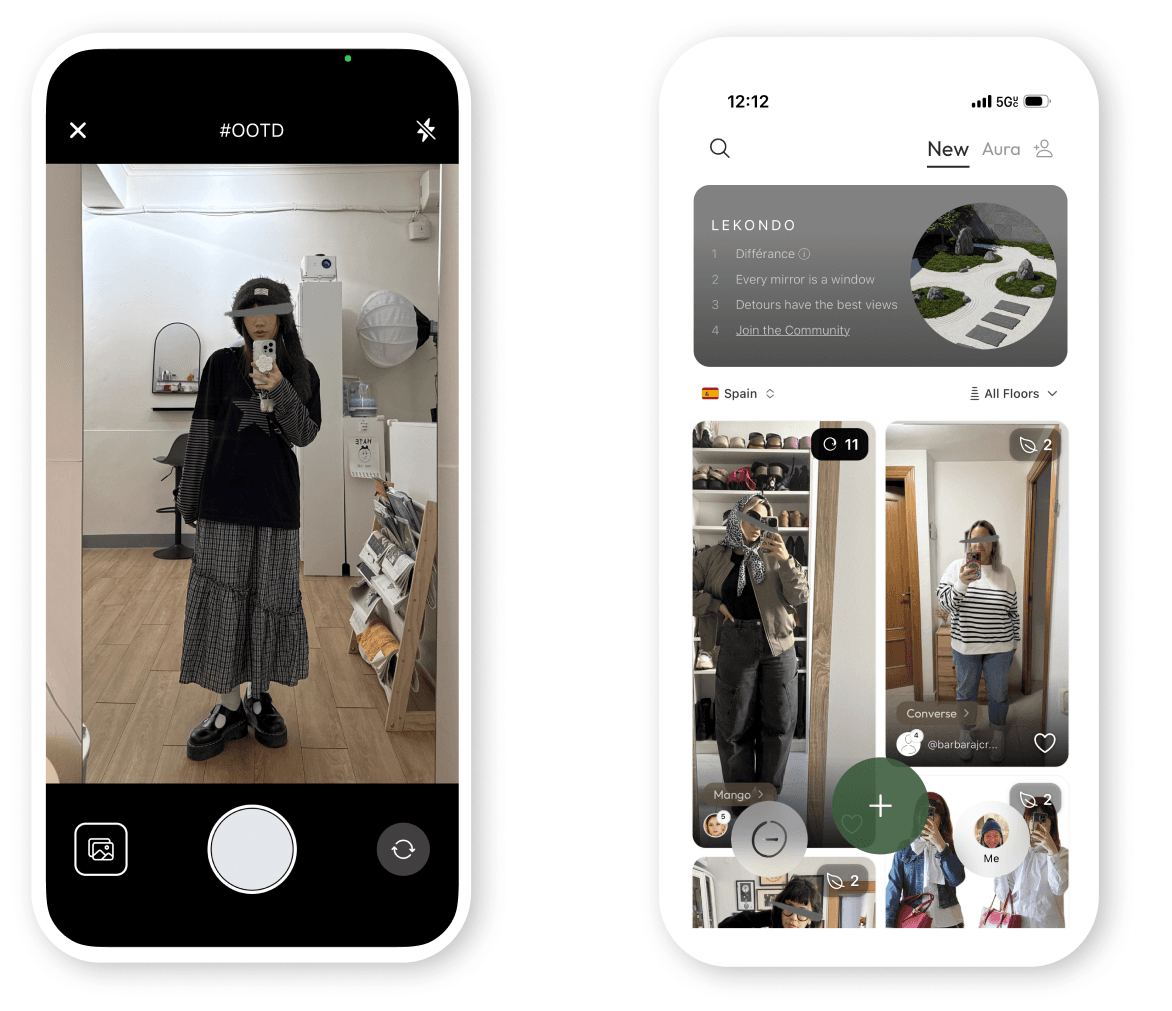
Posting an outfit used to be a smaller thing. You took a grainy bedroom photo, uploaded it to Lookbook.nu, and went on with your day. The username next to it meant nothing. There was no expectation that anyone you knew would see it.
Most people I know now spiral a little before they post. What if my ex sees this. What if no one likes it. What if it doesn't read the way I want it to. The spiral is baked into the algorithm. The fear is part of the medium.
Lekondo is what you get if you take that part out. Anonymity by default, so the photo can be the photo and the outfit can be the outfit. You document, the way you would in a journal. Except the journal is shared, and the strangers reading it are doing the same thing.
A third space for fashion, quieter than what we have now.
Your half
Your daily outfit calendar.
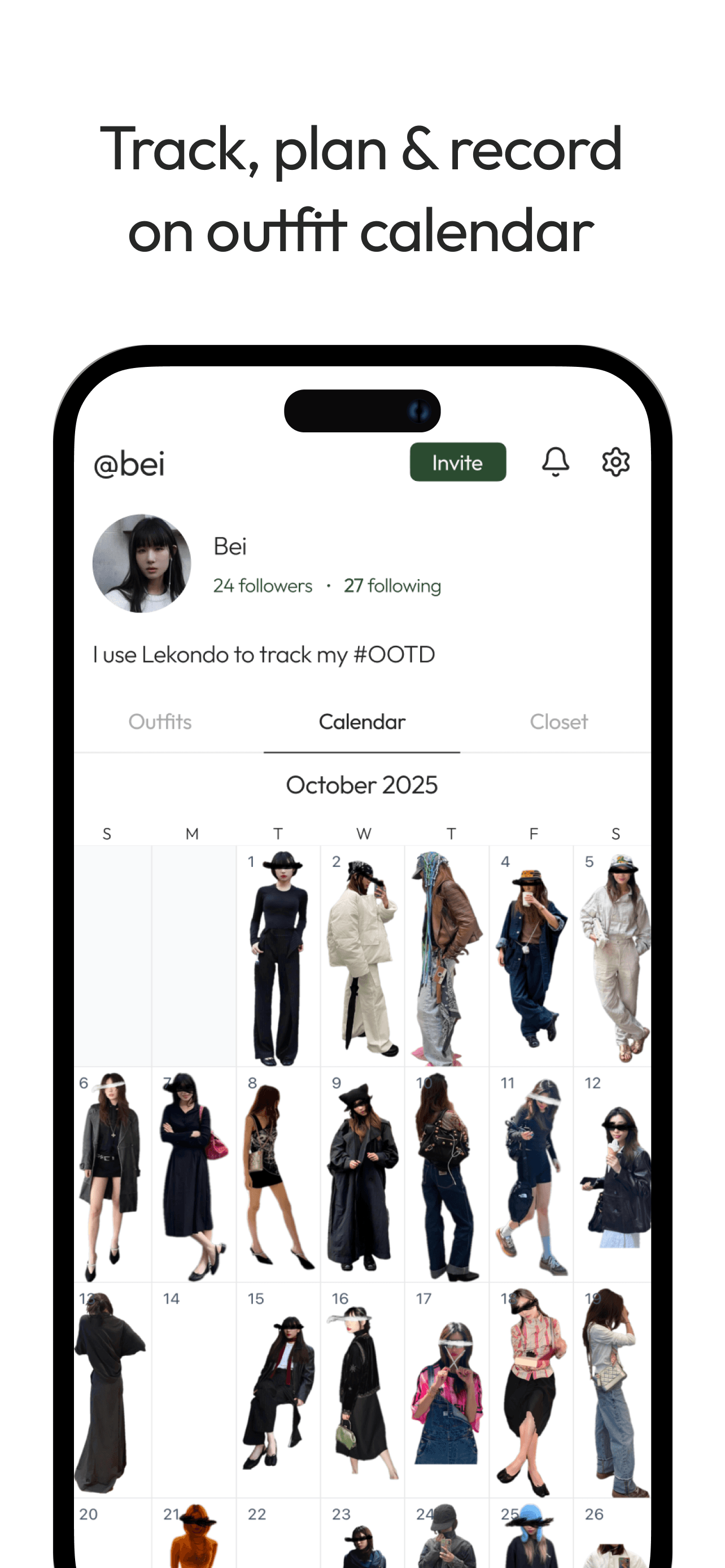
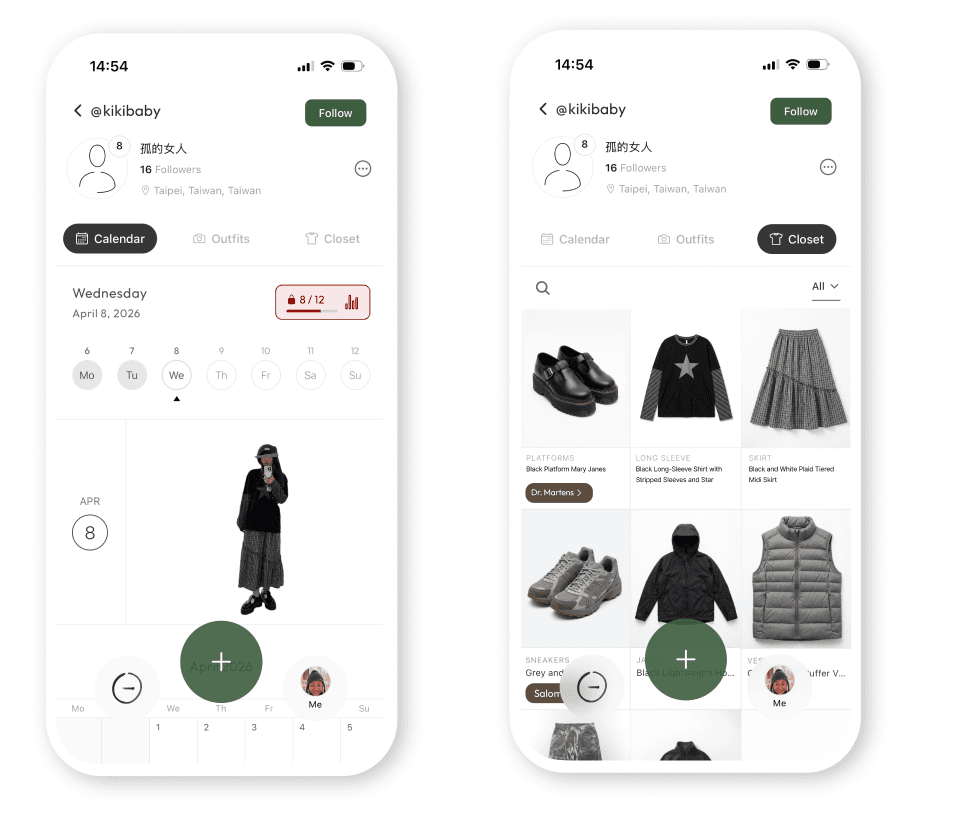
Each day in Lekondo is a tile in a grid. Snap a mirror selfie of what you wore. The calendar logs the day, and the model detects every item in the photo and adds them to your digital closet. One photo, one day recorded.
Look back at last October and remember what you wore. Search "the black blazer" and see every day it appeared. Plan tomorrow before bed, check the forecast, and wake up to a decision already made.
Everyone else's
The world's lookbook.
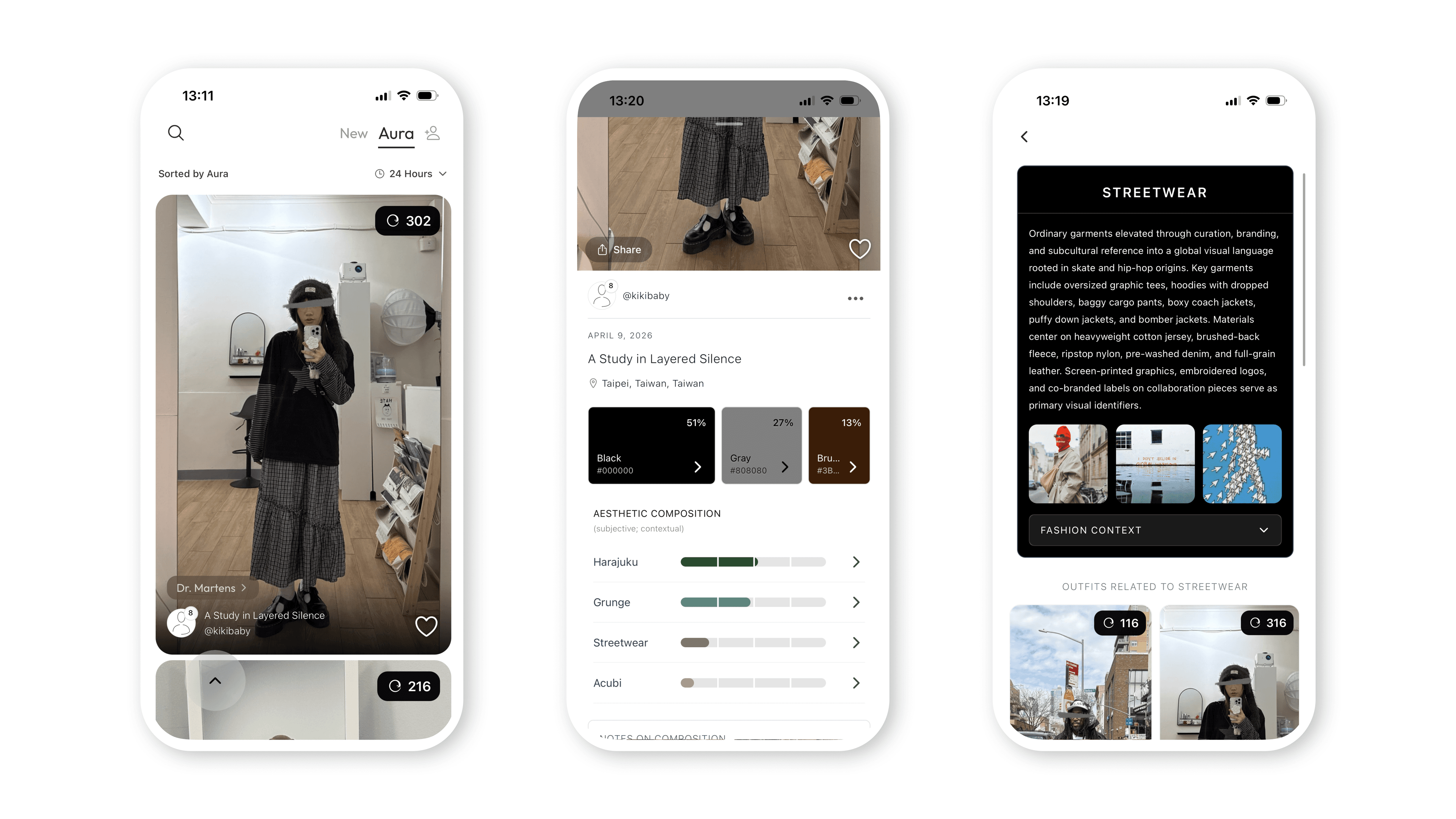
The other half is everyone else's. Hundreds of thousands of outfits posted by anonymous people, sorted by aura. The faces are blurred. The usernames mean nothing. The point is the outfit.
Every photo comes apart into its aesthetic composition. 47% Harajuku, 28% Grunge, 14% Streetwear. Click any color in any photo and follow that color through other people's wardrobes. Click an aesthetic and follow it through history.
The comparison
Lekondo vs Pinterest.
Outfit ideas usually start at Pinterest. It's the world's mood board: editorial shoots, product photos, runway stills, pinned onto boards of who you might become. Almost none of it is an outfit someone actually wore.
Lekondo is the other direction. Every photo in the lookbook is a real outfit on a real day: a mirror selfie, anonymous by default, broken down into its aesthetics, colors, and items. Ideas you can trust, because somebody wore them out the door.
Pin the fantasy on Pinterest. Come here to see how real people put it together, and to keep a record of how you did.
| Lekondo | ||
|---|---|---|
| The photos | Editorial shoots, product shots, AI renders | Mirror selfies of real outfits |
| Where they come from | Repinned from across the web | Snapped in the app, one day at a time |
| Identity | Public profiles | Anonymous by default |
| How you browse | Algorithmic recommendations | By aura, aesthetic, and color |
| What it's for | Saving ideas for later | Documenting your OOTD, browsing everyone else's |
| Price | Free, with ads | Free |
Essay
Anonymity, the OOTD, and the return of internet magic.
Documentation matters. We've always thought so. There is something reassuring about things-as-they-are, something that resists tampering. An OOTD is a kind of journaling. Every day, an entry.
Most of us learned to post outfits on Instagram, or somewhere like it. At first the posting was just documentation. Then it became a wait. The indexing of likes. The scrutiny of who watched. The refresh, the dissatisfaction with the arithmetic. Posting started to feel closer to marketing than documentation, and there was no obvious way out of the commodification of what we uploaded.
And it wasn't only us. The medium itself had moved. Posting drifted from documentation toward performance, from journaling toward marketing. The likes, the follower counts, the 'Suggested for you' page, the algorithmic feed itself, all of it engineered for attention. The medium isn't neutral. It hasn't been for a long time.
Lookbook.nu, in its heyday, was different. Outfits were documented for no one in particular. Usernames meant nothing. Grainy bedroom photos told you less than they concealed. Illegibility was a kind of freedom. Browsing was its own pleasure, the rare privilege of looking through images without the urgency to compare, to measure, to wait, to judge. Just fitchecks, endlessly.
What anonymity protects is the photo itself. The expressive power of the clothes, the colors, silhouettes, fabrics, moods, conformity, nonconformity, playfulness, comfort. The whole visual vocabulary, without a face attached. When the face is absent and the username means nothing, the outfit gets to be the subject. The photo can be looked at on its own.
We built Lekondo for that. A third space for fashion, tucked inside the internet. Anonymous by default. A place to play with clothes again.
Frequently asked questions
What is an OOTD calendar?
A daily record of what you wore. In Lekondo, each day is a tile in your calendar, built automatically from the mirror selfies you snap. You can look back at any day to see the outfit and the items in it.
What's a "lookbook"? Like Lookbook.nu?
Yes, that lineage. Lookbook.nu was a community where people uploaded outfit photos and discovered each other through aesthetics. We built Lekondo as a return to that idea, with anonymity by default and aura as the sort.
Do I have to share my calendar?
No. Your calendar is private by default. You decide which outfits become part of the public lookbook and which stay yours.
How is this different from Pinterest or Instagram?
Pinterest is mood boards from anywhere, mostly photos of clothes nobody you know is actually wearing. Instagram is the commerce feed. Lekondo is real outfits worn by anonymous people, sorted by aesthetic.
Is it free?
Yes. Free to use, unlimited items, unlimited calendar entries, full access to the lookbook.
Is Lekondo a good Pinterest alternative for outfit ideas?
Yes, if you want outfit ideas from real people. Pinterest shows you images of clothes; Lekondo shows you outfits as they were worn, sorted by aesthetic, every item identified. Many people use both: Pinterest to collect, Lekondo to see it worn.
What is a digital closet?
A phone-based catalog of every piece of clothing you own — so you can plan outfits, stop re-buying the same things, and actually wear what's in your wardrobe.
In one sentence
A digital closet (also called a virtual closet or digital wardrobe) is an app that stores photos of the clothes, shoes, and accessories you own. You can browse your wardrobe like a catalog, mix items into outfits, and track what you've worn — without opening your physical closet.
Why have a digital closet
Stop re-buying clothes you already own
Most people discover roughly a third of their wardrobe they'd forgotten about within the first week. The fastest way to cut clothing spend is to see what you already have.
Plan outfits the night before
Pull up tomorrow's calendar, drag tops onto bottoms, save the outfit. No more 7am closet panic.
See your cost-per-wear
Track which items earn their place. The $300 boots you wear weekly are cheaper than the $80 ones you wore twice.
Pack for trips without the closet
Build trip lookbooks from your phone — at the office, on the train, anywhere except standing in front of a suitcase.
How to start one
About five minutes to log your favorites. You don't have to do the whole closet at once.
Photograph or import
In most apps, you snap each item one by one against any background and they auto-remove it. Lekondo takes a shortcut: snap a single outfit photo and the model detects every item in it at once — no piece-by-piece shooting.
Tag once
Color, category, season, fabric. Most apps auto-detect these now. About five seconds per item.
Build outfits & log wears
Drag items together to save outfits. Tap an outfit on your calendar to log a wear. Patterns emerge after a few weeks.
How Lekondo is different
One outfit photo. The whole closet builds itself.
Every other closet app asks you to photograph each item individually. Top, then trousers, then shoes, then each piece of jewelry. Most people lose patience after twenty items and never finish — leaving most of their wardrobe permanently invisible to the app.
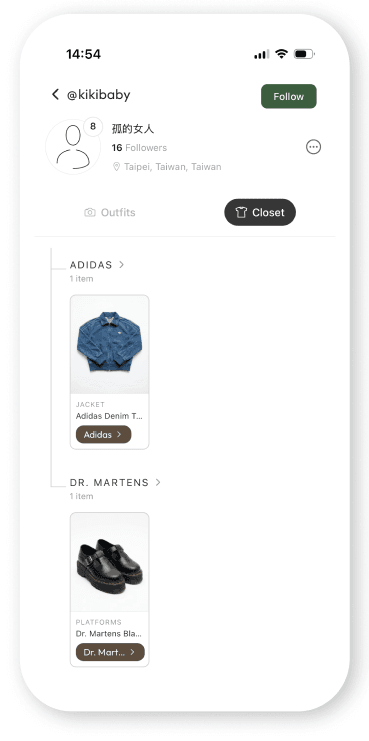
Lekondo takes a different path. Upload one outfit photo — a mirror selfie, an OOTD, a snap from the dressing room — and the model identifies each piece in it: top, bottom, shoes, bag, jewelry. One photo can populate five items at once, with images and tags.
This is the single reason most Lekondo users build a usable closet in under fifteen minutes instead of weeks. It's also why the comparison table below leads with how each app adds items — it's the part most reviews skip over.
The best digital closet apps in 2026, compared
We've used all of these. No single app wins on every axis — pick based on what you actually need.
| App | Best for | Free tier | Adding items | Social / lookbook | Platforms |
|---|---|---|---|---|---|
| Lekondo | Auto-building your closet from outfit photos + global community lookbook | Unlimited items | Snap one outfit → Lekondo detects each item | Yes | iOS, Android |
| Alta | AI-generated outfits + virtual try-on with avatars | Free | Receipts, brand search, single-item photos | Partial | iOS, Android |
| Whering | Closet basics, strong UK and EU community | Limited items | Single-item photos, receipts | Partial | iOS, Android |
| Acloset | AI outfit suggestions, weather-aware picks | Limited | Single-item photos | No | iOS, Android |
| Indyx | Capsule wardrobe + resale tracking | Limited | Single-item photos, receipts | No | iOS only |
| Stylebook | Power users who want detailed analytics | $4.99, no free tier | Single-item photos (manual) | No | iOS only |
| Cladwell | Capsule wardrobe coaching | Trial only | Curated brand catalog only | No | iOS, Android |
Frequently asked questions
Is there a free digital closet app?
Yes — Lekondo, Alta, and Whering all offer free tiers. Lekondo's is unlimited; Whering's caps the number of items; Stylebook is the notable outlier as paid-only ($4.99 one-time).
What's the difference between Lekondo and Alta?
Alta focuses on AI styling — it generates outfits for you and shows them on a personal avatar. Lekondo focuses on logging what you actually wear and exploring a global community lookbook of real outfits from real people. Both are free; many users use them side by side.
Do I have to photograph every item one by one?
In most apps, yes — you snap each piece individually or import from receipts. Lekondo is the exception: upload one outfit photo and the model detects each item in it and adds them to your closet at once. This is the single biggest reason people actually finish their digital closet in Lekondo versus stalling out at twenty items in other apps.
Can a digital closet really help me stop overspending?
It helps because you stop forgetting what you own. Most users find roughly a third of their wardrobe they hadn't worn in months within the first week of logging it. Seeing your closet outside your closet rewires the impulse to buy.
Is a digital closet the same as an OOTD calendar?
Related but not the same. A digital closet stores your items; an OOTD calendar logs which outfits you wore on which days. Most closet apps include a calendar — see our OOTD calendar guide for the details.
Can I share my digital closet with friends?
Depends on the app. Lekondo, Alta, and Whering have sharing features built in. Stylebook and Cladwell are private by design. If you want a community angle, choose an app built around sharing rather than retrofitting it.
Start your Calendar.Wander through everyone else's.
Free. One #OOTD to begin.