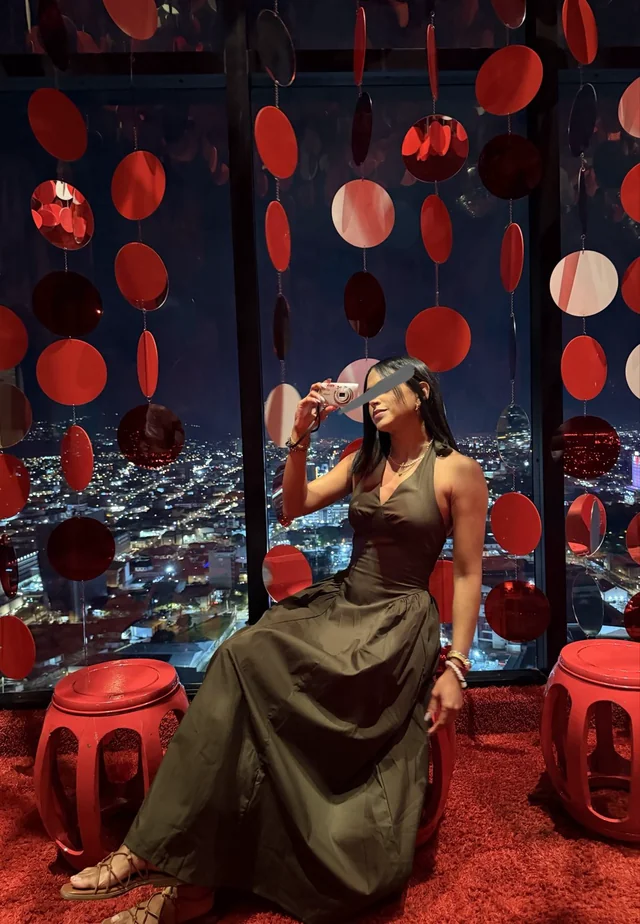
Sotto
Summary. Sotto is a dress regime in which garment value is encoded almost entirely in material quality, construction precision, and fit discipline rather than in visible branding, chromatic assertion, or silhouette novelty — producing a system where the most expensive clothing in a room is legible only to observers who possess the tactile literacy, brand knowledge, and proximity required to decode it. The aesthetic is governed by a concealment-of-investment logic: ultra-fine cashmere, high-super-number worsted wools, hand-finished construction details, and floating-canvas tailoring create garments whose cost-per-wear often exceeds that of conspicuous luxury by an order of magnitude, yet whose visual presentation registers to untrained eyes as merely "nice" or "plain." Sotto derives its name from the Italian musical directive "sotto voce" — under the voice — and its operative principle is that true material luxury, like a pianissimo passage in a concert hall, rewards attentive listening rather than demanding it. Unlike minimalism, which reduces form as an aesthetic end in itself, sotto reduces visual signaling as a class-strategic end: the garment communicates wealth, taste, and cultural capital precisely through its refusal to communicate loudly.
In Material Terms
Sotto's coherence depends on fiber-quality hierarchies invisible to casual observation. The system operates at the extremes of natural-fiber performance: cashmere from Inner Mongolian Capra hircus goats at fiber diameters below 15.5 microns (compared to the 19-micron commercial standard), worsted wool suiting at Super 150s to Super 180s counts (where the yarn's fineness produces a hand-feel luxury detectable only through touch), silk in weights and weave structures — habotai, charmeuse, crepe de chine — that layer against the body with thermal intimacy invisible beneath outer garments, and sea-island cotton at thread counts that approach silk-like hand. These materials share a common property: their quality is tactile and behavioral rather than visual. Two cashmere sweaters — one knitted from 14-micron, 2-ply Mongolian cashmere and the other from 19-micron, single-ply Chinese cashmere blended with synthetic — may appear identical at three meters, diverge radically at touch, and age into entirely different objects over five years of wear. This perceptual asymmetry — quality that is invisible at distance but unmistakable at contact — is sotto's foundational material logic.
At Category Level
Sotto occupies the space between minimalism's formal reduction and traditional luxury's conspicuous display. Where minimalism achieves visual quiet through design restraint (Jil Sander's architectural severity, COS's Scandinavian functionalism), sotto achieves it through material investment that operates beneath the visual register entirely — the quiet is not designed into the garment's form but purchased into its fiber. Where conspicuous luxury signals through logos, monograms, and brand-identifiable hardware (Gucci's interlocking Gs, Louis Vuitton's monogram canvas, Chanel's quilted-chain vocabulary), sotto signals through the absence of these markers, converting the empty signifier space into a display of restraint that is itself a higher-order luxury signal. This positions sotto not as anti-luxury but as meta-luxury: a system that presupposes the observer's knowledge of what luxury looks like in order to demonstrate its transcendence of that appearance.
Methodologically
This entry treats sotto as a class-encoding material system: garments are analyzed by how their fiber specifications, construction techniques, and maintenance demands create a regime of legibility stratified by proximity, expertise, and economic access — and by how that regime reproduces social distinction through the very mechanisms that appear to refuse it.
Word (Etymology)
"Sotto voce" (Italian: "under the voice") entered English circa 1737 from Italian musical and theatrical tradition as a performance directive indicating that a passage should be sung, spoken, or played in a markedly subdued tone — not absent but suppressed, audible only to those close enough or attentive enough to hear. The phrase compounds sotto ("under, below," from Latin subtus, a derivative of sub) and voce ("voice," from Latin vocem, accusative of vox). In Italian musical notation, sotto voce operates as an instruction for controlled restraint: the performer does not cease playing but calibrates output to the threshold of perception, creating intimacy through reduction rather than projection.
Fashion media adopted the phrase to describe a specific lineage of Italian luxury houses — Loro Piana, Brunello Cucinelli, Max Mara, Zegna — whose commercial identity was built on material excellence and construction integrity rather than logo visibility or trend participation. The term gained currency in Anglophone fashion discourse around 2022-2023, when "quiet luxury" became a media headline category driven by HBO's Succession (2018-2023, where costume designer Michelle Matland dressed the Roy family in Loro Piana, The Row, and unmarked cashmere to encode dynastic wealth through material understatement) and by broader post-pandemic recalibrations of conspicuous consumption. "Sotto" emerged as a more precise Italianate alternative to the vaguer, more commercially flattened "quiet luxury" — emphasizing the aesthetic's roots in Italian textile heritage rather than in Anglo-American trend-cycle naming.
The etymological migration is instructive. In music, sotto voce describes a technical execution requiring greater skill than full-volume projection: maintaining tonal quality, pitch accuracy, and expressive nuance at reduced dynamic levels demands more muscular control and breath management than fortissimo playing. Analogously, sotto dressing requires greater material knowledge, fit precision, and maintenance discipline than conspicuous luxury: it is easier to signal wealth through a logo-covered handbag than through a perfectly gauged cashmere knit whose quality declares itself only to the initiated hand. The term thus carries its musical logic into fashion: sotto is not the absence of luxury but luxury performed at the threshold of perception, where only the most literate audience can detect it.
Subculture
Sotto did not emerge from a subcultural movement in the conventional sense — no founding venue, no zine network, no scene crystallization event. Instead, it formed through the convergence of several distinct communities whose overlapping practices produced a shared evaluative regime despite the absence of explicit coordination or self-identification.
Italian industrial families and heritage clientele. The longest-standing sotto community consists of the families — textile-manufacturing dynasties in Biella, Prato, and Como; Milanese and Torinese professional-class households; Italian diplomatic and banking circles — who have patronized houses like Loro Piana, Cucinelli, and Kiton for decades, often across multiple generations. Within this community, sotto is not an adopted aesthetic but an inherited habitus in Bourdieu's sense: children learn to evaluate cashmere hand, recognize proper fit, and distinguish construction quality through familial socialization rather than media consumption. Expertise is transmitted through embodied experience — accompanying parents to the tailor, handling fabrics in family-owned mills, observing which garments endure across seasons — rather than through brand education or trend literacy. This community's evaluative authority derives from proximity to production: they know sotto materials because they make them, sell them, or have worn them since childhood.
Anglo-American finance and professional-class adopters. A second community formed through the professional dress requirements of high-finance, private-equity, and corporate-law environments where conspicuous luxury is coded as gauche but material quality is expected. In these contexts, a Loro Piana Storm System overcoat or a Cucinelli cashmere sport coat communicates economic position to colleagues who share the evaluative framework while registering as unremarkable to outsiders. Expertise in this community is acquired through peer observation, retail interaction (the Loro Piana boutique as education site), and targeted media consumption (menswear forums, Permanent Style, The Rake). Status accrues to those who can identify a floating-canvas blazer by its lapel roll, detect hand-sewn buttonholes by their slight irregularity, or assess cashmere quality by pinching the fabric between thumb and forefinger — knowledge markers that function as in-group credentials without requiring verbal declaration.
Post-Succession media-literate adopters. The 2023 "quiet luxury" media cycle produced a third community: consumers who encountered sotto through HBO's Succession, TikTok styling content, and fashion-media explainers, and who adopted the visual grammar (neutral palette, minimal branding, cashmere and wool investment) as a consciously chosen aesthetic project. This community's expertise is media-derived rather than experientially accumulated: participants learn the vocabulary (Super numbers, ply counts, hand-finished details) through content consumption rather than through tactile comparison or long-term garment ownership. The community's growth was commercially significant — Loro Piana's revenue increased substantially in 2023-2024, and The Row expanded retail presence — but it also introduced a tension between sotto as inherited material literacy and sotto as purchasable trend identity.
Expertise economy and gatekeeping dynamics. The hierarchy across these communities is structured by the depth and origin of material knowledge. At the apex, textile professionals, bespoke tailors, and multi-generational clients evaluate garments through production knowledge: fiber sourcing, yarn construction, weave specification, and finishing technique. Mid-tier authority belongs to experienced consumers who have developed comparative tactile literacy through years of ownership — they can distinguish 14-micron from 16-micron cashmere by hand, identify hand-rolled hems by visual inspection, and predict garment aging based on material composition. At the entry level, participants navigate brand recognition and price signaling — purchasing Loro Piana or Cucinelli as status objects without possessing the material literacy to evaluate whether the specific garment justifies its price relative to alternatives.
The gatekeeping dynamic is distinctive: unlike streetwear or goth, where gatekeeping operates through visible cultural markers (knowledge of specific releases, band identification, scene attendance), sotto gatekeeping operates through invisible ones. You cannot determine someone's sotto expertise by looking at them; you discover it through physical interaction with their clothing or through the specificity of their material conversation. This invisibility of expertise mirrors sotto's invisibility of quality — the hierarchy itself is encoded in the same register of concealment as the garments it evaluates.
History
Italian textile infrastructure (1800s-1960s). Sotto's material preconditions were established by the Italian textile industry's development as Europe's premier producer of luxury fibers and fabrics. The Biella district in Piemonte — encompassing the towns of Biella, Trivero, and Borgosesia, positioned along Alpine watercourses that provided both the clean water required for wool finishing and the humidity that prevented fiber breakage during processing — became the world's concentration point for fine-wool and cashmere manufacturing. The Loro Piana family entered wool trading in the early nineteenth century; by the time Pietro Loro Piana formally incorporated the business in 1924 in Quarona, the family had accumulated generations of fiber-sourcing expertise spanning Australian merino, Inner Mongolian cashmere, and Peruvian vicuna. Ermenegildo Zegna established his woolen mill in Trivero in 1910, vertically integrating from raw fiber to finished fabric in a model that subsequent Italian luxury houses would emulate. The Biella district's competitive advantage was not merely technical but epistemic: knowledge of fiber grading, yarn spinning tolerances, and finishing techniques was transmitted through apprenticeship networks embedded in local family and community structures, creating a geographic concentration of textile expertise that remains globally unmatched.
The Como district developed parallel expertise in silk production, weaving, and finishing — supplying haute couture houses across Europe with printed silks, jacquards, and crepes. Prato specialized in carded and recycled wool, though its sotto relevance is secondary. Together, these districts constituted the material infrastructure upon which sotto as a dress system became possible: without access to Italian-finished cashmere, high-super-count worsted, and precision-woven silk, the fiber-quality distinctions that define sotto would be commercially unavailable.
The founding houses and the philosophy of restraint (1920s-1980s). Loro Piana (1924, Quarona), Ermenegildo Zegna (1910, Trivero), Brunello Cucinelli (1978, Solomeo), and Max Mara (1951, Reggio Emilia) each built commercial identities around material investment rather than visual novelty. Loro Piana's business model was exemplary: the house controlled sourcing relationships for the world's finest cashmere (contracting directly with Inner Mongolian herding cooperatives), vicuna (managing conservation-linked harvesting in Peru), and Tasmanian merino (selecting fleeces at fiber diameters of 12-15 microns, compared to the 19-23-micron commodity standard). This sourcing control allowed Loro Piana to produce garments whose fiber quality was documentably superior to competitors — a factual claim rather than a marketing assertion, verifiable through laboratory measurement of fiber diameter, tensile strength, and uniformity.
Brunello Cucinelli established a different sotto paradigm: "humanistic capitalism" as articulated through his Solomeo-based operations, where cashmere production was integrated with village restoration, employee welfare, and philosophical discourse. Cucinelli's sotto was not merely material but ethical — the garment's quality was inseparable from the production conditions that created it, a proposition that anticipated twenty-first-century sustainability discourse by decades. Max Mara's contribution was the coat as sotto archetype: the 101801 Icon Coat (introduced 1981, double-faced cashmere, no lining, hand-finished edges) demonstrated that a single garment could encode the entire sotto logic — material luxury, construction precision, and design restraint concentrated in an object that communicates its quality only through handling.
Global luxury realignment and LVMH consolidation (2000s-2013). As luxury conglomerates — LVMH, Kering, Richemont — consolidated the global luxury market through acquisition, sotto houses occupied a strategic position: they represented the material-quality tier that conglomerate brands aspired to but structurally could not match, because conglomerate economics require scale efficiencies that degrade fiber sourcing and construction precision. LVMH's 2013 acquisition of an 80% stake in Loro Piana for approximately EUR 2 billion acknowledged this dynamic: Loro Piana's value lay precisely in its non-scalable sourcing relationships and production expertise. The acquisition raised sotto's central commercial tension: could material exclusivity survive corporate integration, or would conglomerate ownership inevitably push Loro Piana toward the logo-driven, growth-oriented model that its identity defined against?
The Succession moment and mass-market legibility (2022-2024). HBO's Succession (created by Jesse Armstrong, 2018-2023) performed an unprecedented act of sotto semiotics: it made stealth wealth visually legible to a mass television audience. Costume designer Michelle Matland dressed the Roy family — billionaires whose wealth was so established it required no announcement — in Loro Piana baseball caps, The Row overcoats, unmarked cashmere knitwear, and Zegna tailoring, creating a visual language where the absence of branding became the most legible brand signal of all. The show's cultural impact was taxonomic: it gave mainstream audiences a framework for reading sotto as a distinct luxury category, producing "quiet luxury" as a searchable term, a retail strategy, and a TikTok content genre. Fashion media amplified the taxonomy — Vogue, Business of Fashion, Business Insider, and The New York Times all published explainers positioning quiet luxury as 2023's defining trend.
The commercial consequences were immediate: Loro Piana's revenues surged, The Row expanded from cult-insider status to global luxury brand, and retailers from Nordstrom to Ssense reorganized their merchandising around neutral-palette, low-branding propositions. However, the trend cycle's compression also produced rapid backlash: by late 2024, fashion media was declaring quiet luxury "over," replaced by maximalist counter-trends. Italian sotto houses — which had practiced this mode for decades before it received a name — continued regardless. Loro Piana's CEO Damian Bertrand publicly disputed the "quiet" label: "If quiet means silent, I don't believe it's the right word for us. We are not silent — we simply don't need to shout."
Analytically, sotto's history reveals a persistent structural dynamic: the aesthetic exists in stable form within Italian production communities and professional-class dress cultures, is periodically "discovered" and named by Anglophone media, undergoes rapid trend-cycle amplification and compression, and then recedes from media visibility while continuing to operate within its foundational communities. The aesthetic is not cyclical — it does not come and go — but its visibility to mainstream fashion discourse is cyclical, producing the illusion of trend temporality over what is actually an enduring class-encoding practice.
Silhouette
Sotto silhouette is governed by a proportional-restraint logic whose operative principle is that the garment should appear to require no effort — that the body inhabits its clothing with such ease that the observer registers the person rather than the outfit. This "effortlessness" is, of course, entirely engineered: it requires precise fit, careful proportion, and pattern-construction techniques that accommodate the body's movement without clinging, pulling, or creating the visual noise of excess fabric.
Tailoring as invisible architecture. The sotto blazer or sport coat uses a soft-shoulder construction — typically Neapolitan-derived, with a spalla camicia (shirt shoulder) or lightly padded natural shoulder that follows the body's shoulder line rather than extending or squaring it. This construction requires more skilled pattern-making than structured shoulders because the fabric must drape correctly without the scaffolding of heavy padding or canvas to impose the shape. The lapel rolls naturally from the gorge to the button stance — a behavior produced by proper chest-canvas construction (horsehair interlining that shapes through steam and hand-manipulation rather than fusible adhesive) and accurate balance in the pattern. A properly balanced sotto jacket appears to hang from the shoulders without gripping the body anywhere, creating a visual impression of ease that is actually the result of multiple fitting adjustments at shoulder pitch, chest suppression, waist shaping, and skirt drape. This proportional discipline distinguishes sotto from both structured Italian tailoring (Brioni's architectural shoulders, Tom Ford's highly suppressed waist) and from deconstructed fashion tailoring (Comme des Garcons's deliberate distortion, Margiela's exposed construction): sotto sits in the narrow band where structure is present but invisible.
Knitwear as body geometry. The sotto cashmere or fine-gauge wool knit operates through dimensional control: gauge (stitches per inch), ply (number of yarn strands twisted together), and tension determine how the knit conforms to the body. A 12-gauge, 2-ply cashmere crew-neck in 14-micron fiber will drape close to the body without clinging, maintain its shape across a full day of wear, and recover its form overnight without stretching or bagging — behaviors produced by the interaction of fine fiber, tight gauge, and adequate ply. Coarser gauges (5-gauge, 7-gauge) in chunkier cashmere produce under sotto's proportional logic a relaxed, enveloping silhouette that should appear generous without reading as oversized: the shoulder seam sits at the natural shoulder or fractionally beyond, the body follows the torso's line without hugging, and the hem falls without rolling or distortion.
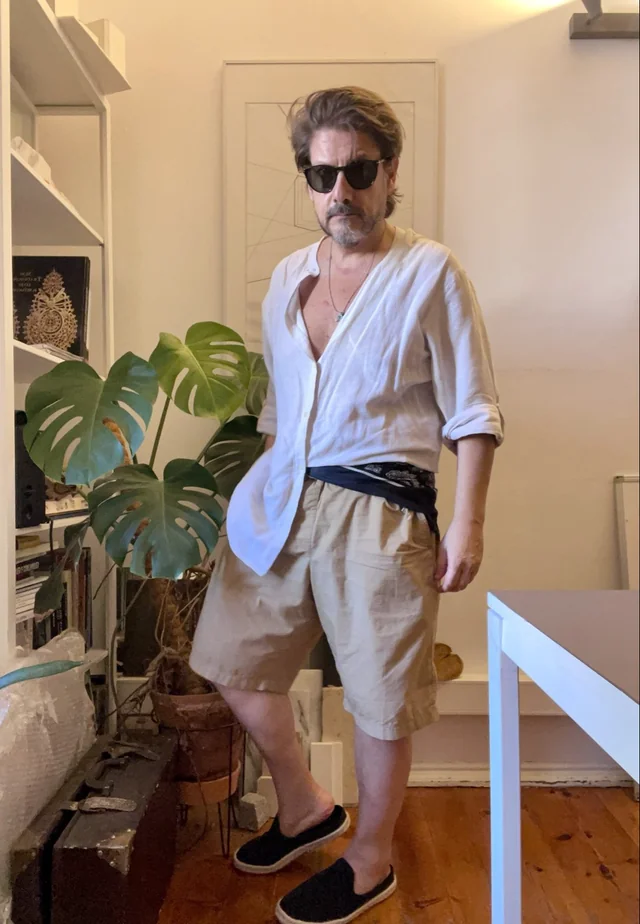
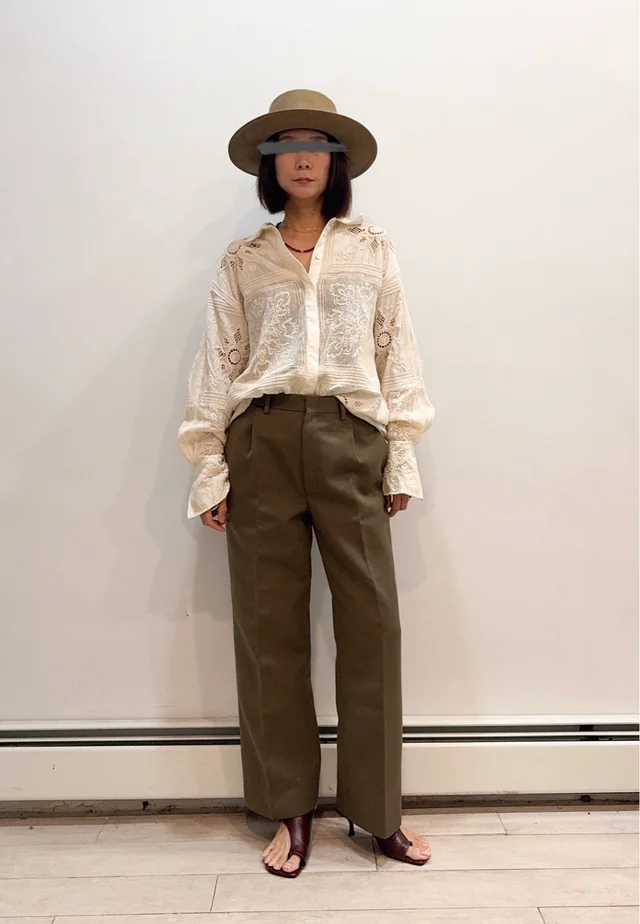
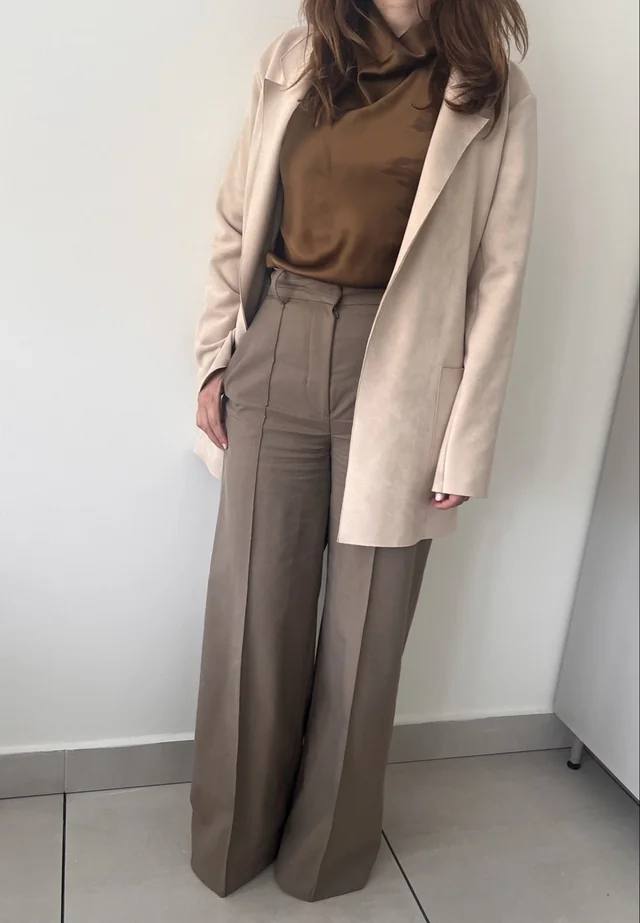
Trouser and bottom proportions. Sotto trousers — whether tailored wool, cotton chino, or jersey — favor clean, straight to gently tapered lines that avoid both the tight-to-body silhouettes of trend-forward fashion and the aggressively wide proportions of avant-garde tailoring. The standard sotto trouser sits at or near the natural waist, falls with a medium to full break at the shoe, and carries enough ease through the thigh and knee to permit seated comfort without producing knee-bags after prolonged sitting. This proportional moderation is the trouser equivalent of sotto's broader logic: the garment should not appear to be trying to achieve a silhouette. Single or double forward pleats are common, providing the ease that flat-front constructions cannot match at the natural waist.
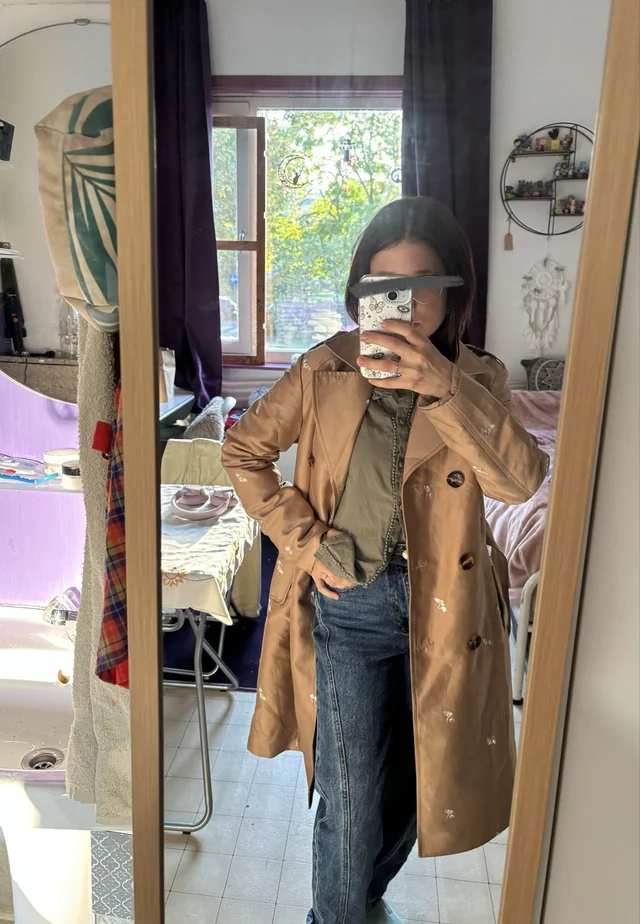
Outerwear proportions. The sotto overcoat — the aesthetic's most iconic single garment — uses length (typically at or below the knee), a single-breasted closure, and minimal detailing to create an unbroken vertical line of fabric. Max Mara's 101801, Loro Piana's various cashmere overcoat models, and The Row's architectural coats all deploy the same logic: the coat's visual impact derives entirely from the fabric's quality (weight, drape, surface texture, color depth) and the precision of its cut (clean shoulder, lapel proportioned to the body, pockets that lie flat, a hem that hangs evenly). Nothing competes with the material for the observer's attention. This silhouette discipline extends to outerwear layering: the sotto system requires that inner garments (knitwear, shirting) be dimensioned to layer beneath outer garments without producing bulk or pulling at closure points, demanding coordinated proportional planning across the wardrobe rather than the independent garment-by-garment sizing that most fashion categories assume.
Materials
Material selection is sotto's primary value-encoding mechanism and its most technically demanding dimension. The category's entire semiotic structure depends on fiber-quality distinctions that are invisible to visual inspection at social distance but unmistakable through touch, handling, and long-term observation of garment behavior.
Cashmere: fiber science and quality hierarchy. Cashmere is the sotto system's prestige fiber, and its quality hierarchy illustrates the aesthetic's concealment logic with precision. All commercial cashmere derives from the undercoat of the Capra hircus goat, but fiber diameter — measured in microns via optical or laser-based analysis per ASTM D1440 standards — creates quality strata with radically different performance profiles. Standard commercial cashmere operates at 15.5-19 microns in diameter and 34-36mm in fiber length. Premium sotto-grade cashmere targets fiber diameters below 15.5 microns — with ultra-premium lots (Loro Piana's "Baby Cashmere," harvested exclusively from kids under twelve months, or "The Gift of Kings" from merino-cashmere cross animals) reaching 13-14 microns — and fiber lengths exceeding 38mm.
The performance consequences of these specifications are measurable. Finer fibers produce softer hand-feel (the bending stiffness of a fiber decreases with the fourth power of its diameter, per beam-bending theory, so a 14-micron fiber is roughly 50% softer than a 16-micron fiber of the same type). Longer fibers produce more durable yarns (longer staple lengths require fewer fiber-ends per unit of yarn length, reducing the surface fuzz that initiates pilling). Higher ply counts (2-ply versus single-ply) increase dimensional stability, pill resistance, and drape. These relationships mean that a 2-ply, 14-micron, 40mm-staple cashmere sweater will be detectably softer, more dimensionally stable, and more pill-resistant than a single-ply, 18-micron, 34mm alternative — but the difference is perceptible only through touch and long-term wear observation, not through visual inspection. Two garments may look identical on a retail shelf while embodying a threefold price differential justified by fiber specifications.
Cashmere failure modes are sotto's most visible material vulnerability. Pilling — the formation of small fiber balls on the fabric surface through abrasion — occurs in all cashmere but varies dramatically by quality: lower-grade cashmere with shorter fibers and looser yarn construction pills aggressively within weeks of wear, while premium long-fiber, tightly spun cashmere develops minimal pilling that stabilizes after initial surface fibers are shed. Moth damage (larvae of Tineola bisselliella consume keratin-based animal fibers) represents a storage-dependent failure mode whose prevention — cedar storage, airtight containers, regular inspection, pheromone traps — constitutes an ongoing maintenance burden that functions as an invisible class marker. Only those with storage infrastructure (dedicated closet space, cedar-lined drawers, seasonal garment rotation protocols) can maintain cashmere wardrobes across years without loss.
Worsted wool suiting: the Super-number system. Sotto tailoring relies on worsted wool at the upper end of the Super-number classification, which measures the maximum fiber diameter in the lot: Super 100s denotes a maximum of 18.5 microns, Super 120s = 17.5 microns, Super 150s = 16.0 microns, Super 180s = 14.5 microns. Each increment in fineness produces measurably softer hand, finer drape, and more refined surface luster — but also increased fragility. Super 150s and above produce a hand-feel luxury that sotto enthusiasts describe as the fabric "disappearing" against the body: the cloth is so fine it conforms without stiffness, drapes without weight, and moves with the body rather than constraining it. However, this fineness comes with performance trade-offs that structure sotto's failure-mode architecture.
Super 150s-and-above wools are vulnerable to seat shine (compression and abrasion at the thigh and seat flatten the fiber's surface scales, creating reflective patches visible under direct light), knee and elbow bagging (fine fibers have lower elastic recovery under sustained deformation, meaning crossed legs or bent elbows stretch the fabric beyond its recovery capacity), and accelerated wear at friction points (fine fibers have lower abrasion resistance, measured by Martindale cycles, than coarser wools). A Super 180s suit may feel transcendently soft at purchase but develop visible shine and structural distortion within eighteen months of regular office wear — a degradation timeline that a Super 100s suit would resist for four to five years. This creates a sotto paradox: the finest materials produce the most ephemeral garments, making the ongoing cost of maintaining a sotto wardrobe significantly higher than its initial acquisition cost would suggest.
Silk: weight, weave, and concealment. Sotto deploys silk primarily as a layering and lining fabric rather than as a display textile, using its thermal regulation properties (silk absorbs up to 30% of its weight in moisture without feeling damp) and tactile luxury to create a concealed comfort layer. Habotai (a plain-weave silk, light and soft, used in linings and underlayers), charmeuse (a satin-weave silk with a lustrous face and matte back, used in blouses and scarves where controlled sheen is desired), and crepe de chine (a slightly textured plain-weave silk with a matte surface and fluid drape, used in shirts and unstructured garments) each serve distinct sotto functions. Silk's failure modes — snagging (fibers catch on rough surfaces and pull, creating visible distortion in the weave), water-spotting (silk fibers swell unevenly when wetted, creating permanent marks), UV degradation (sunlight weakens silk fibers and alters dye color), and perspiration damage (body chemistry can yellow and weaken silk at underarm contact points) — collectively demand care protocols that exceed those of any other common apparel fiber. Sotto silk garments require dry cleaning or hand-washing, careful drying, and rotation to distribute wear, creating maintenance overhead that is invisible to external observation but structurally significant to the wearer.
Sea-island cotton and fine shirting. Sotto shirting uses long-staple cottons — Sea Island (fiber lengths exceeding 50mm, grown in the Caribbean), Egyptian Giza 45 and Giza 87 (Nile Delta, 35-40mm), or Xinjiang long-staple — woven at thread counts of 100-200 per square inch in broadcloth, poplin, twill, or Oxford structures. At the upper end, these fabrics approach silk-like hand while retaining cotton's breathability and laundering tolerance. The quality hierarchy is detectable through visual transparency (finer yarns permit more light transmission, giving the fabric a subtle luminosity), surface smoothness (longer fibers produce yarns with fewer protruding fiber ends), and drape (higher thread counts produce more fluid behavior). Thomas Mason, Alumo, and David & John Anderson (Albini Group) supply the cloths from which sotto shirts are typically cut. Failure modes center on collar and cuff wear (abrasion at fold lines causes fiber breakdown, typically within 30-50 wearings at the fold point) and yellowing (oxidation of sizing and body-oil residue under heat, accelerated by incorrect ironing technique).
Leather: absence of display. Where most luxury categories use leather as a display material (visible hardware, embossed logos, distinctive finishes), sotto leather is maximally understated: vegetable-tanned calf in natural shades (tan, dark brown, black), minimal or absent hardware, unlined or leather-lined construction, and no visible branding. Sotto leather goods — Valextra's understated bags, Loro Piana's suede accessories, Bottega Veneta's intrecciato without visible logo — derive their value from leather quality (grain tightness, surface uniformity, tannage depth) and construction precision (hand-stitched edges, precisely fitted linings, invisible closure mechanisms). Suede — the napped underside of calfskin — is sotto's signature leather surface: tactile, matte, and visually quiet.
Color Palette
Sotto's chromatic system operates through deliberate suppression of visual noise, producing a palette that functions as absence rather than assertion. The colors selected are not arbitrary but are chosen for their capacity to recede from attention, directing the observer's perception — if it registers at all — toward fabric quality, surface texture, and fit rather than toward chromatic identity.
Neutrals as structural grammar. Camel (referencing raw cashmere's natural undyed shade, and by extension Loro Piana's iconic cashmere products), oatmeal, cream, stone, and sand constitute sotto's warm-neutral axis. Navy, charcoal, slate grey, and black constitute the cool-neutral axis. Chocolate brown and cognac provide depth accents. These colors share a specific optical property: they do not compete with the textile's surface texture for perceptual attention. A camel cashmere coat's visual impact derives entirely from the fabric's nap, drape, and light absorption — the color functions as a ground against which material quality becomes the figure. A bright red or cobalt blue garment, by contrast, creates a chromatic assertion that overrides textile perception, making the fabric's quality less perceptible.
Pattern as whisper. When pattern appears in sotto, it operates at a scale and contrast level that approaches invisibility at social distance. Micro-herringbone (a weave pattern with chevron repetitions at 1-2mm scale, legible only within arm's reach), tonal stripes (yarn-dyed stripes in values so close that the pattern reads as texture rather than pattern), windowpane checks in self-color (thread contrast limited to sheen variation rather than color variation), and houndstooth at miniature scale provide visual interest that rewards close inspection without creating distance-readable pattern identity. This approach to pattern mirrors sotto's broader logic: information is present but access to it is gated by proximity.
Seasonal chromatic modulation. Sotto's palette is not seasonless but modulates minimally: autumn-winter shifts toward deeper tones (chocolate, charcoal, navy, black) and heavier fabric weights; spring-summer shifts toward lighter values (cream, sand, light grey, powder blue) and lighter fabric weights. The shift is subtle enough that a sotto wardrobe maintains cross-seasonal coherence — garments from different seasons can be combined without chromatic conflict, a property that supports sotto's buy-less-replace-less economy.
Details
Details in sotto are best understood as concealed-quality interfaces — construction and finishing elements engineered to be legible only through close physical inspection, handling, or expert observation, and whose presence or absence encodes the garment's position within the sotto quality hierarchy.
Hand-finished buttonholes. The hand-stitched buttonhole — executed with a buttonhole stitch in silk thread, producing a slightly irregular edge and a visible "eye" (the teardrop-shaped opening at the buttonhole's end, formed by wrapping thread around a gimp cord) — is sotto's most iconic detail marker. Machine-made buttonholes are geometrically uniform, with a consistent stitch density and no eye formation; hand-made buttonholes exhibit the micro-irregularities of human execution that experienced observers can detect by sight and that novices discover by touch. A single Kiton jacket may contain twenty hand-stitched buttonholes, each requiring five to eight minutes of skilled labor — a cumulative investment of two to three hours of handwork invisible to anyone who does not know where and how to look. The functional difference is negligible (both types retain the button adequately); the quality signal is entirely communicative.
Pick-stitching (AMF stitching). A line of small, evenly spaced hand-stitches visible along the lapel edge, pocket flaps, and sometimes the collar of tailored garments. Named after the American Machine and Foundry Company, which developed a machine imitation of the technique, true hand pick-stitching is detectable by its slight irregularity and dimensional depth (the stitch catches the under-layer of fabric, creating a subtle ridge that machine stitching cannot replicate). Pick-stitching serves a dual function: it secures the lapel's folded edge with greater precision than machine topstitching, and it communicates bespoke or semi-bespoke construction to observers literate in tailoring detail. In sotto contexts, pick-stitching is typically executed in thread that matches the garment's fabric, rendering it nearly invisible — the antithesis of contrast-color pick-stitching deployed as visible decoration in some contemporary menswear.
Floating canvas and construction concealment. Full-canvas construction — where a layer of horsehair interlining (the "canvas," typically woven from a blend of horse mane hair and wool or cotton) is cut and shaped by hand to conform to the wearer's chest contour, then attached to the jacket's front panels with pad-stitching (rows of small diagonal hand-stitches that permanently mold the canvas into a three-dimensional chest shape) — is sotto tailoring's structural foundation. The canvas floats between the outer fabric and the inner lining, attached only at specific points, allowing it to move independently and drape naturally with the body rather than restricting movement as fused (glued) interlinings do. Half-canvas (canvas in the chest and lapel, fusible in the lower front) represents a mid-tier compromise. Full fusible (adhesive-bonded interlining throughout) represents the mass-market standard.
The quality hierarchy is detectable through the "pinch test" — grasping the jacket's front fabric between thumb and forefinger reveals whether the outer cloth, canvas, and lining move independently (full canvas) or are bonded together (fusible). This test, transmittable through brief instruction, constitutes one of sotto's most accessible expertise markers. The performance consequence is longitudinal: canvas-constructed jackets develop a personalized drape that improves with wear as the canvas molds to the wearer's body, while fusible jackets maintain their initial shape until the adhesive degrades (typically 3-7 years), at which point they develop bubbling and delamination that is irreparable.
Seam finishing as concealed quality. Hong Kong seams (raw edges bound with a narrow strip of lightweight silk or rayon, enclosing the cut edge entirely) are sotto's interior-finishing standard. Compared to serged or overlocked edges (the industrial standard, functional but visible as a machine-finished edge) or raw edges (found in budget construction), Hong Kong seams indicate additional labor investment per seam that is visible only when the garment's interior is examined — during try-on, at the tailor, or when hanging on a valet stand. The finishing serves a secondary functional purpose: bound edges resist fraying, extending the garment's interior longevity, but the primary function is communicative. In sotto logic, even the garment's hidden surfaces are finished to a standard that presupposes they will eventually be inspected by someone who understands what they are seeing.
Hidden plackets and minimal hardware. Sotto shirts use concealed button plackets (the button band is folded back on itself, hiding the buttons behind a clean fabric edge) rather than the visible button-stand that characterizes standard shirt construction. This creates an unbroken vertical line of fabric across the shirt front — visual quiet achieved through additional construction steps. Buttons themselves are typically mother-of-pearl (Australian Trochus shell or white-lip pearl oyster), cross-stitched by hand to the garment, and sewn with a shank (a thread stem between button and fabric that allows the buttonhole layer to sit smoothly without pulling). Horn buttons, smoked to achieve tonal range from golden to deep brown, replace plastic buttons on knitwear and outerwear. These button materials are not merely decorative preferences but functional choices: natural-material buttons withstand dry-cleaning solvents and pressing temperatures that crack or melt plastic alternatives, extending the garment's maintenance-compatible service life.
Accessories
Sotto accessories extend the concealment-of-quality logic from garments to carried objects, worn items, and grooming, creating a total-system coherence where no single element announces the wearer's investment.
Leather goods. Sotto handbags and leather accessories refuse the it-bag logic that drives most luxury-leather markets. Where Hermes Birkins, Chanel Classic Flaps, and Louis Vuitton Speedys are designed for instant brand recognition at distance, sotto leather goods — Valextra's Iside, Loro Piana's Extra Pocket, Bottega Veneta's intrecciato pieces under Daniel Lee's minimal branding, The Row's Margaux — derive their value from leather quality, construction precision, and proportional harmony rather than from distance-recognizable hardware or monogramming. The evaluation is necessarily proximate: only handling the bag (assessing leather weight, edge finishing, closure precision, lining quality) or recognizing the brand's signature form through prior knowledge enables quality assessment. This proximity-gating reproduces sotto's broader semiotics at the accessory level.
Footwear. Sotto footwear — plain-toe Oxfords, penny or horsebit loafers, Chelsea boots, minimal sneakers — uses construction quality and material selection to encode value invisibly. A John Lobb, Edward Green, or Crockett & Jones Goodyear-welted shoe in hand-burnished calfskin shares its visual profile with substantially cheaper alternatives at social distance; the distinction emerges through sole construction (leather versus rubber, Goodyear welt versus cemented), leather grade (hand-selected single-hide cutting versus composite panels), and finishing quality (hand-burnished patina versus machine-applied dye). Women's sotto footwear parallels this logic: The Row's minimal pumps and flats, Gianvito Rossi's clean silhouettes, and Loro Piana's Summer Walk loafers use premium materials and precise construction within visually restrained forms.
Watches and jewelry. Sotto timepieces reject the large-case, busy-dial conventions of most luxury-watch marketing in favor of understated proportions and clean dials: Patek Philippe's Calatrava, A. Lange & Sohne's Saxonia, Cartier's Tank in steel, or vintage Jaeger-LeCoultre Reversos communicate horological investment only to observers who can identify the brand or assess the case and dial quality. Jewelry is minimal and material-focused: small gold or platinum pieces (thin bracelets, stud earrings, plain wedding bands) without gemstone display, logo marking, or statement scale.
Eyewear and scarves. Sotto eyewear avoids logo temples and fashion-forward shapes in favor of classically proportioned frames in acetate or titanium — brands like Lindberg, Mykita, or Oliver Peoples (before its Luxottica-era logo expansion) represent the category's standards. Cashmere scarves — often the most accessible sotto entry point, at price levels ($200-$600) below the barrier of a full garment investment — use fiber quality and color restraint to function as sotto identifiers: a Loro Piana cashmere scarf in oatmeal draped over a navy overcoat is one of the aesthetic's most recognizable compositions.
Body Logic
Sotto conceptualizes the body as a presence to be harmonized with rather than a surface to be displayed, corrected, or spectacularized. The aesthetic's body logic operates through a principle of calibrated disappearance: the clothing should be perceptible as "right" — correctly proportioned, comfortable-looking, well-maintained — without being perceptible as "designed," "styled," or "fashionable." The dressed sotto body aims to read as a person in good clothes rather than as a person performing an outfit.
This body logic encodes class through mechanisms more subtle than conspicuous-luxury display. Fit that appears effortless but is actually precisely tailored (requiring access to skilled alteration or bespoke services), fabric that appears simple but is actually premium-grade (requiring economic access to luxury retail), and grooming that appears natural but is actually maintained (skin care, hair care, dental care — the body-maintenance infrastructure of economic privilege) collectively produce a presentation that reads as inherent quality rather than acquired display. In Bourdieu's terms, sotto converts economic capital into embodied cultural capital — the body appears to possess taste as a natural attribute rather than as a purchased competence. These class dynamics underpin sotto's most potent and most culturally significant operation.
Gender coding in sotto is attenuated but not absent. The aesthetic's restraint applies across gender presentations, and its core materials (cashmere, fine wool, silk) and proportional principles (ease, precision, material quality) translate without fundamental modification. However, sotto women's dress permits slightly more visible luxury than sotto men's dress — a silk blouse with a visible luster, a cashmere wrap with drape emphasis, a leather bag with discernible form — reflecting broader gendered conventions about decorative display. Sotto men's dress operates within narrower parameters: the navy blazer, the grey trouser, the cashmere crew-neck, the plain leather shoe — a vocabulary so restrained that quality differences are detectable only through material and construction assessment.
The sotto body is also a maintained body. The aesthetic assumes ongoing physical maintenance — fitness without bulk (suggesting leisure time for exercise), clear skin (suggesting access to dermatological care), well-kept hair (suggesting regular professional grooming), and healthy weight — that is itself class-structured. The "effortless" sotto body is the product of systematic effort whose infrastructure (gym memberships, skincare routines, regular medical care, dietary choice) presupposes economic stability. This embodied maintenance extends sotto's concealment logic from garments to the body itself: the effort that produces the appearance of effortlessness is rendered invisible at every level.
Garment Logic
Sotto garment construction operates through a concealment-of-skill principle: the garment's internal engineering should exceed its external appearance, such that the construction reveals itself only upon close inspection, handling, or longitudinal observation of how the garment ages and performs.
Tailored garments: canvas, lining, and seaming. A full-canvas sport coat or blazer — sotto's most construction-intensive garment type — integrates horsehair canvas (shaped through pad-stitching into a compound chest curve), lining (typically Bemberg cupro, chosen for its smooth hand, moisture absorption, and resistance to static), and shell fabric into a system where each component contributes to the garment's drape, comfort, and longevity. The canvas provides structure without rigidity; the lining allows the jacket to slide over underlayers without friction or static; the shell fabric provides the visual and tactile surface. Seam allowances are generous (10-12mm in bespoke, compared to 6-8mm in mass production), permitting future alteration — a construction choice that anticipates the garment's decades-long service life. Shoulder construction uses hand-set sleeves with a roped or natural sleeve head (depending on the intended formality and regional tailoring tradition), creating a shoulder line that follows the wearer's anatomy rather than imposing a geometric silhouette.
Knitwear: gauge, ply, and finishing. Sotto knitwear is typically fully fashioned — meaning individual garment panels are shaped on the knitting machine to their final dimensions, then linked (joined at the seams using a chain-stitch technique that maintains the knit's elasticity) rather than cut from knitted yardage and sewn. Fully fashioned construction is identifiable by "fashioning marks" — slight directional changes in the knit structure visible near seam lines and at decrease points — and produces garments that maintain their shape better than cut-and-sew alternatives because the knit's structural integrity is not interrupted by cutting. Finishing includes hand-linking at seams, hand-attached buttons, and careful blocking (wet- or steam-shaping the finished garment to precise dimensions) that determines the garment's initial fit and drape.
Outerwear: double-face and hand-finishing. Sotto's signature outerwear construction is the double-faced technique: two layers of fabric (typically cashmere) are woven simultaneously and bound together by interlocking fibers at the center plane, producing a reversible fabric with finished surfaces on both sides. This eliminates the need for a lining — the coat's interior is the fabric's reverse face — and allows hand-finished edges (raw edges are turned, pressed, and invisibly stitched by hand) that create a clean, self-contained garment. Max Mara's 101801 coat pioneered this approach as a commercial proposition; Loro Piana and The Row have developed their own double-face constructions. The technique requires higher-quality fabric (both faces must meet aesthetic standards), more skilled finishing (hand-stitching raw edges is labor-intensive), and careful pressing (both surfaces must maintain their finish through wear and cleaning).
Aftercare. Sotto garments demand maintenance protocols proportional to their material investment, and the care burden itself functions as a concealed class marker. Cashmere requires hand-washing or dry cleaning (machine agitation causes felting and dimensional distortion), storage in breathable garment bags with moth deterrent (cedar, lavender, or synthetic pheromone traps), and seasonal rotation (continuous wear accelerates pilling and fiber fatigue). Worsted wool tailoring requires professional pressing (home ironing risks shine marks on high-super-count fabrics), periodic dry cleaning (less frequently than commonly assumed — spot-cleaning and airing between wearings extends intervals), and seasonal storage with proper hanging (shaped wooden hangers for jackets, trouser hangers with non-compressive clamps for trousers). Silk garments require professional cleaning, cool-iron pressing with a pressing cloth, and protected storage away from direct light. Leather goods require conditioning (lanolin-based products for smooth leather, specialized nubuck/suede treatments for napped surfaces) and dust-bag storage. This cumulative maintenance infrastructure — the closet space, the garment bags, the specialist cleaning relationships, the seasonal rotation discipline — is invisible to external observers but represents an ongoing cost of participation that sotto's "effortlessness" rhetoric systematically conceals.
Failure modes and longevity. Sotto garments fail along material-specific trajectories that experienced owners anticipate and manage. Cashmere pills (mitigated by quality selection and periodic de-pilling with a cashmere comb), stretches (mitigated by blocking after washing), and attracts moths (mitigated by storage protocol). High-super-number wools shine at seat and elbow (mitigated by rotation and professional pressing, but ultimately irreversible), bag at knees (mitigated by hanging between wearings, but accelerated by the fineness that sotto prizes), and thin at friction points. Silk yellows at perspiration-contact zones and weakens under UV exposure. Canvas-constructed jackets can develop adhesive migration (where pad-stitching thread impressions become visible on the outer fabric surface after years of pressing — a failure mode called "striking through" that indicates the garment has reached the limit of its pressing tolerance). These failure modes collectively establish sotto's replacement economics: a high-quality sotto wardrobe is not a one-time investment but a rolling capital commitment, where individual garments cycle through acquisition, maintenance, degradation, and replacement at intervals determined by material quality, use intensity, and care competence.
Motifs / Themes
Sotto's thematic system is organized not around visual motifs (logos, patterns, graphic elements) but around conceptual motifs — recurring ideas that structure the aesthetic's meaning even when they manifest differently across garments and contexts.
The anti-motif: restraint as statement. Sotto's most powerful thematic gesture is the refusal of thematic gesture. Where most aesthetic systems build identity through addition — logos, patterns, color, hardware, cultural references — sotto builds identity through subtraction. The plain cashmere sweater, the unmarked leather bag, the unmonogrammed shirt: these are not absences of design but positive assertions of restraint whose legibility depends on the observer's awareness of what has been omitted. This requires sotto to exist in relation to the conspicuous-luxury system it defines against — without Gucci logos and Louis Vuitton monograms as the background norm, sotto's refusal would be invisible.
Material quality as moral claim. Sotto discourse frequently encodes material investment as ethical superiority: "buy less, buy better," "quality over quantity," "investment dressing." These formulations position sotto consumption as environmentally and economically responsible — fewer garments of higher quality, worn longer, replacing the volume-driven consumption of fast fashion. The claim has empirical support (a cashmere sweater worn for ten years has lower per-wear environmental impact than ten acrylic sweaters each worn for one year) but also conceals the absolute cost of sotto participation: "buy less, buy better" presupposes the capital to "buy better," naturalizing economic access as moral virtue.
Effortlessness as performance. The sotto concept of "sprezzatura" — Baldassare Castiglione's sixteenth-century term for studied carelessness — recurs as a thematic touchstone. The sotto wearer should appear not to have tried: the jacket is worn, not displayed; the cashmere is inhabited, not showcased; the watch tells time rather than announcing its manufacture. This effortlessness is, of course, the product of maximal effort — precise fit, careful maintenance, informed selection — making it a recursive performance: the effort to conceal effort, the care to appear uncaring, the investment to appear uninvested.
IYKYK (If You Know, You Know). Sotto's self-referential motto, circulated widely in post-Succession media discourse, encodes the aesthetic's fundamental semiotic mechanism: quality that is legible only to the initiated. The phrase simultaneously describes sotto's operation (concealed quality, proximity-gated legibility) and performs its exclusivity (by declaring a boundary between those who know and those who do not). The motto's ubiquity in sotto-adjacent social-media discourse has, paradoxically, expanded the "you who know" to include anyone who has encountered the phrase — a self-undermining dynamic that mirrors the broader tension between sotto as exclusive knowledge and sotto as commercial trend.
Cultural Touchstones
Television. Succession (HBO, 2018-2023) is sotto's most consequential cultural vehicle, translating Italian material-quality codes into a dramatic narrative about dynastic American wealth. Costume designer Michelle Matland's specific choices — Loro Piana baseball caps and cashmere knitwear for the Roy siblings, The Row and Loro Piana outerwear, Zegna tailoring for formal contexts — encoded a visual thesis: that the wealthiest people dress in the most unremarkable-looking clothing, and that the unremarkability is itself the most expensive thing about it. The show's cultural impact extended beyond fashion-media discourse into mainstream consciousness, creating a taxonomic shift in how television audiences read on-screen wealth.
Film and visual media. Italian cinema's representation of upper-class dress — Luchino Visconti's aristocratic interiors, Michelangelo Antonioni's Milan and Rome bourgeoisie in L'Avventura (1960) and La Notte (1961), Federico Fellini's Cinecotta-filtered high society — established the visual grammar of Italian sotto long before it received a name. More recently, Luca Guadagnino's I Am Love (2009, Tilda Swinton wearing Jil Sander and Fendi in a Milanese industrial-dynasty setting) and A Bigger Splash (2015) deployed sotto costuming to encode old-European wealth within cinematic narrative.
Fashion media and critical discourse. Business of Fashion's analysis of the "quiet luxury" category, Vogue's 2023 trend coverage, and Simon Crompton's Permanent Style blog (providing granular analysis of under-the-radar tailoring and material quality since 2007) constitute sotto's primary media infrastructure. Italian-language coverage in Vogue Italia, Corriere della Sera's lifestyle sections, and Milano Finanza's luxury-market reporting provides the Italian perspective that Anglophone trend-naming often elides: these sources frame sotto not as a discovered trend but as an ongoing Italian commercial and cultural practice.
Retail environments as cultural space. Sotto's retail touchstones — the Loro Piana boutique on Via Montenapoleone, Cucinelli's Solomeo village (where the brand's headquarters, production facilities, and a restored medieval hamlet create a physical environment encoding the humanistic-capitalism philosophy), The Row's minimalist retail interiors — function as cultural sites where the aesthetic's values are spatially performed. These environments use material quality (stone, wood, cashmere displayed on open shelves), spatial generosity (low product density, high staff-to-customer ratios), and sensory reduction (muted lighting, no music, no visual clutter) to create retail experiences that mirror the garments' own logic of restraint and tactile quality.
See Also
- Minimalism: Shared formal reduction; sotto adds material-quality encoding as class strategy where minimalism pursues reduction as aesthetic end
- Old Money: Overlapping class-signaling functions; old money encompasses broader lifestyle markers (manners, education, accent, social network) where sotto focuses specifically on dress
- Sartorial: Shared tailoring investment; sartorial foregrounds visible construction mastery (pick-stitching, pattern-matching, working buttonholes) where sotto conceals it
- Normcore: Shared anti-logo impulse; normcore achieves unremarkableness through ordinary garments where sotto achieves it through extraordinary ones
- Genteel: Shared restraint and manners-as-signal; genteel operates through behavioral codes where sotto operates through material ones
- Parisian: Shared elevated-neutral palette; Parisian foregrounds insouciance and cultural reference where sotto foregrounds fiber quality
Brands and Designers
Italian Heritage Houses:
- Loro Piana (1924, Quarona, Piemonte; LVMH since 2013): the sotto system's exemplary house — controls sourcing for the world's finest cashmere (Inner Mongolian partnerships), vicuna (Peruvian conservation harvesting), and ultra-fine Tasmanian merino; Storm System weather-resistant cashmere, Summer Walk loafers, and the Loro Piana baseball cap as post-Succession cultural icon
- Brunello Cucinelli (1978, Solomeo, Umbria): "humanistic capitalism" positioning, village-based production, cashmere as ethical-luxury proposition, IPO 2012 while maintaining founder control and artisan-wage commitments
- Ermenegildo Zegna (1910, Trivero, Piemonte): vertically integrated from raw fiber to finished garment, Trofeo and 13 MILMIL 13 luxury suiting fabrics, Oasi Cashmere line, acquisition strategy expanding into lifestyle (Thom Browne, Tom Ford under Zegna Group)
- Max Mara (1951, Reggio Emilia): the 101801 Icon Coat as sotto archetype (double-faced cashmere, hand-finished, introduced 1981), Sportmax and Weekend Max Mara as diffusion tiers, family-owned independence
- Kiton (1968, Arzano, Naples): ultra-premium Neapolitan tailoring, 25 hours of handwork per jacket, Super 180s and above suiting, production limited to approximately 20,000 garments annually
- Valextra (1937, Milan): sotto leather goods — minimal branding, signature "Costa" raised-seam edge finishing, handmade in Milan, Pergamena leather treatment creating luminous surface without visible hardware
Contemporary Practitioners:
- The Row (2006, New York; Mary-Kate and Ashley Olsen): the primary American sotto house — architectural minimalism in premium materials, Margaux bag, minimal retail environments, pricing at Italian-heritage levels ($3,000+ for outerwear, $1,500+ for knitwear)
- Khaite (2016, New York; Catherine Holstein): sotto-adjacent American luxury with slightly more visible design identity — cashmere knitwear, leather goods, and ready-to-wear positioned between The Row's austerity and conventional luxury
- Toteme (2014, Stockholm; Elin Kling and Karl Lindman): Scandinavian sotto incorporating Swedish design restraint with Italian-sourced materials, monogram scarf as the brand's sole visible identifier
- Jil Sander (1968, Hamburg; currently under creative direction of Lucie and Luke Meier): architectural minimalism with sotto-adjacent material investment, historically the bridge between German design rigor and Italian manufacturing quality
- Auralee (2015, Tokyo; Ryota Iwai): Japanese sotto — ultra-premium fiber sourcing (cashmere, alpaca, super-fine wools) in minimally designed garments, representing the intersection of Japanese textile perfectionism and sotto material logic
- Zegna (as consumer brand, distinct from fabric-mill heritage): the Artistic Director era under Alessandro Sartori repositioning the house toward sotto-inflected contemporary luxury
Accessible Tier:
- COS (2007, London; H&M Group): Scandinavian-minimalist gateway to sotto proportions and neutral palettes at high-street pricing, using competent but non-premium materials
- Uniqlo (various cashmere and premium-line offerings): accessible cashmere, merino, and fine-cotton basics that reproduce sotto's visual grammar at mass-market pricing, though fiber quality operates at the commercial floor rather than the sotto standard
- Massimo Dutti (Inditex Group): Mediterranean-inflected smart-casual positioning using sotto-adjacent proportions and color palettes with commercial-grade materials
- J.Crew (Ludlow suiting, cashmere programs): American-market sotto gateway, historically significant for democratizing Italian-fabric tailoring at mid-range pricing
Bespoke and Made-to-Measure:
- Neapolitan tailoring houses (Cesare Attolini, Isaia, Stile Latino, Rubinacci): soft-shoulder, unstructured tailoring tradition that provides sotto's construction vocabulary — spalla camicia, minimal padding, hand-finished details as standard rather than premium feature
- Savile Row under sotto logic (Anderson & Sheppard's drape-cut tradition, specifically): soft British tailoring that parallels Neapolitan approaches, preferred by sotto adherents who favor English cloth and construction
- Italian shirt-makers (Finamore, Luigi Borrelli, Barba Napoli): hand-cut, hand-finished shirting using Thomas Mason and Albini cloths, producing sotto's concealed-quality shirting standard
Citations
[1] "Sotto voce." Merriam-Webster Dictionary. https://www.merriam-webster.com/dictionary/sotto%20voce [2] "Sotto voce." Online Etymology Dictionary. https://www.etymonline.com/word/sotto%20voce [3] Bourdieu, Pierre. Distinction: A Social Critique of the Judgement of Taste. Translated by Richard Nice, Harvard University Press, 1984. [4] Castiglione, Baldassare. The Book of the Courtier (1528). Translated by George Bull, Penguin Classics, 2003. [5] Veblen, Thorstein. The Theory of the Leisure Class. Macmillan, 1899. [6] Simmel, Georg. "Fashion" (1904). In Simmel on Culture: Selected Writings, edited by David Frisby and Mike Featherstone, SAGE, 1997. [7] "Quiet Luxury Explained: What It Is and Which Brands Will Benefit." Business Insider, April 2023. [8] "If You Pay Attention to One Trend This Season, Make It Quiet Luxury." Vogue, 2023. [9] "Loro Piana, storia del brand made in Italy centenario." Vogue Italia, 2024. https://www.vogue.it/article/loro-piana-libro-anniversario-100-anni-foto [10] "Loro Piana." LVMH. https://www.lvmh.com/les-maisons/mode-maroquinerie/loro-piana/ [11] Friedman, Vanessa. "The Quiet Luxury Backlash Has Begun." The New York Times, 2024. [12] Amed, Imran, et al. "The State of Fashion 2024." McKinsey & Company and The Business of Fashion, 2024. [13] McDowell, Colin. The Anatomy of Fashion: Why We Dress the Way We Do. Phaidon, 2013. [14] Entwistle, Joanne. The Fashioned Body: Fashion, Dress and Social Theory. 2nd ed., Polity, 2015. [15] Kawamura, Yuniya. Fashion-ology: An Introduction to Fashion Studies. 2nd ed., Bloomsbury Academic, 2018. [16] Breward, Christopher. Fashion. Oxford University Press, 2003. [17] Wilson, Elizabeth. Adorned in Dreams: Fashion and Modernity. Revised ed., Rutgers University Press, 2003. [18] Crane, Diana. Fashion and Its Social Agendas: Class, Gender, and Identity in Clothing. University of Chicago Press, 2000. [19] Lipovetsky, Gilles. The Empire of Fashion: Dressing Modern Democracy. Princeton University Press, 1994. [20] Barthes, Roland. The Fashion System. Translated by Matthew Ward and Richard Howard, University of California Press, 1983. [21] Hollander, Anne. Seeing Through Clothes. University of California Press, 1993. [22] Frankel, Susannah. Visionaries: Interviews with Fashion Designers. V&A Publications, 2001. [23] McRobbie, Angela. British Fashion Design: Rag Trade or Image Industry? Routledge, 1998. [24] Potvin, John, editor. The Places and Spaces of Fashion, 1800-2007. Routledge, 2009. [25] Schneier, Matthew. "What Happened to Quiet Luxury?" The Cut, New York Magazine, 2024. [26] Crompton, Simon. The Anatomy of Style. Permanent Style, 2018. [27] Cabrera, Roberto, and Patricia Flaherty Meyers. Classic Tailoring Techniques: A Construction Guide for Men's Wear. Fairchild Books, 2015. [28] Piombino-Mascali, Dario, et al. "Fiber Diameter Measurement in Cashmere and Fine Animal Fibers." Textile Research Journal, vol. 82, no. 11, 2012, pp. 1153-1159. [29] Iñiguez, L.C., et al. "Cashmere Production, Quality, and Processing in Mongolia." In Proceedings of the International Symposium on Fibre-Producing Animals, 2005. [30] UNDP Mongolia. "Sustainable Cashmere Project." United Nations Development Programme, 2019. https://www.undp.org/mongolia/projects/sustainable-cashmere [31] Schneider, Jane. "In and Out of Polyester: Desire, Disdain, and Global Fibre Competitions." Anthropology Today, vol. 10, no. 4, 1994, pp. 2-10. [32] Hebdige, Dick. Subculture: The Meaning of Style. Routledge, 1979. [33] Steele, Valerie. Fashion, Italian Style. Yale University Press, 2003. [34] White, Nicola. Reconstructing Italian Fashion: America and the Development of the Italian Fashion Industry. Berg, 2000. [35] Fletcher, Kate. Sustainable Fashion and Textiles: Design Journeys. 2nd ed., Earthscan, 2013. [36] Thornton, Sarah. Club Cultures: Music, Media and Subcultural Capital. Polity, 1995. [37] Hines, Tony, and Margaret Bruce, editors. Fashion Marketing: Contemporary Issues. 2nd ed., Butterworth-Heinemann, 2007.