Shangri La
Summary. Shangri-La is a dress regime in which garments are governed by a mythicized elevation logic — Himalayan and Central/South Asian textile traditions (pashmina fiber science, Tibetan wool weaving, silk-and-metallic-thread embroidery, natural indigo and madder dyeing, handloom production) are drawn from their originating craft and geographic contexts and recomposed as a portable imaginary of altitude, spiritual refinement, and temporal withdrawal. The system operates through a paradox of geographical displacement: material techniques developed over centuries by Kashmiri, Tibetan, Nepali, Bhutanese, and broader South and Central Asian textile communities for specific climatic, ceremonial, and economic conditions are reorganized — through imaginative literary fantasy, luxury-hospitality branding, and global fashion curation — into an aesthetic that signifies retreat from modernity itself. Unlike monastic dress, which derives its formal logic from religious rules specifying garment number, fiber type, and ornament suppression, Shangri-La derives its logic from a Western literary invention — James Hilton's 1933 fictional utopia — that evokes spiritual purity and temporal suspension through an imaginative Himalayan landscape, and then interprets the textile traditions of Himalayan peoples through that literary lens. The aesthetic is coherent only when its construction substrate (handloom weaving, natural dyeing, artisanal embroidery) is preserved alongside its atmospheric intent (calm, elevation, refuge); when the substrate is stripped away and replaced by machine-printed approximations on synthetic base cloths, the category collapses into themed costume.
In Material Terms
Shangri-La's coherence depends on the fiber science and craft systems of the greater Himalayan textile belt. Pashmina — the ultrafine undercoat fiber of the Changthangi goat (Capra hircus laniger), harvested by hand-combing at altitudes above 4,000 meters in Ladakh and western Tibet, with fiber diameters of 12–16 microns (compared to fine Merino wool at 17–22 microns) — provides the category's signature thermal-luxury substrate: a fiber whose extreme fineness produces a hand simultaneously warmer and lighter than any equivalent-weight wool, with a characteristic fluid drape that distinguishes genuine pashmina from the coarser cashmere (18–22 micron) commercially substituted for it. Tibetan highland wool, spun from Changra and Byansi sheep breeds at elevations where cold stress produces dense, lanolin-rich fleeces, provides the denser weaving substrate for Tibetan carpets, blanket wraps, and the chuba (traditional Tibetan wrap robe). Silk — particularly the wild tussah silks of Assam and the cultivated mulberry silks of Varanasi, Kanchipuram, and the Kashmir Valley — provides the ceremonial and embroidery base, while metallic threads (zari, traditionally gold or silver wire wound around a silk-thread core, now frequently replaced by copper-core or polyester-metallic substitutes) supply the luminous accent that distinguishes Shangri-La's textile language from monastic austerity. Natural dyes — indigo from Indigofera tinctoria fermentation, madder (Rubia cordifolia) root extraction, turmeric (Curcuma longa) rhizome, lac insect resin (Kerria lacca), walnut hull, and pomegranate rind — produce the muted, warm-shifted palette that the aesthetic demands, and their aging behavior (gradual fading, tonal warming, UV-driven shift) creates the temporal patina that Shangri-La garments acquire through wear. When these material systems are intact — genuine pashmina fiber, handloom construction, natural-dye chemistry — garments carry empirically verifiable craft content; when they are substituted by machine-woven acrylic or digitally printed polyester, the material claim dissolves and only the atmospheric citation remains.
At Category Level
Shangri-La occupies a distinctive position between heritage-craft preservation and imaginative literary fantasy, sharing material territory with several adjacent aesthetics while maintaining a distinct atmospheric logic. It overlaps with monastic dress in its volumetric silhouette and chromatic restraint but diverges in its embrace of ornamental embroidery, metallic accent, and polychromatic natural-dye palettes that monastic austerity explicitly suppresses. It shares with wabi-sabi an interest in natural-fiber aging and artisanal imperfection but derives from South and Central Asian textile traditions rather than Japanese Buddhist craft philosophy. It intersects with bohemian fashion in its adoption of non-Western textile motifs, wrap construction, and handcraft signaling, but where boho flattens diverse textile traditions into an undifferentiated "global" aesthetic, Shangri-La (at its most rigorous) retains geographic and technique specificity — distinguishing Kashmiri sozni embroidery from Bhutanese kushuthara weaving, or Ladakhi pashmina from Nepali dhaka cloth. Against quiet luxury, which achieves restraint through understatement of Western tailoring, Shangri-La achieves restraint through the atmospheric recontextualization of non-Western handcraft — a fundamentally different operation with its own distinct character.
Methodologically
This entry treats Shangri-La as a cross-cultural heritage-textile aesthetic system: garments and textile techniques are analyzed by how they travel from Himalayan and South/Central Asian production contexts into Western and global fashion consumption, and by how that journey transforms function, attribution, economic value, and cultural meaning at each stage. The emphasis is on fiber science, dye chemistry, handloom mechanics, embroidery construction, and the economics of craft production — not on mood-board aesthetics alone.
Word (Etymology)
"Shangri-La" was coined by James Hilton in his 1933 novel Lost Horizon as the name of a fictional Tibetan lamasery hidden in the Kunlun Mountains, where inhabitants live in perfect harmony, aging ceases, and Western modernity's violence is held at bay. The word has no Tibetan, Sanskrit, or any other Asian-language etymological root — it is a purely English literary invention, though its phonetic construction borrows from the Tibetan place-name suffix "-la" (ལ, meaning "mountain pass") to produce an aural impression of Himalayan geography. Hilton, who never visited Tibet, composed the name to sound plausibly Tibetan to English-speaking audiences, creating a linguistic container for Western fantasy that borrowed the sound of an actual geographic referent while inventing its content wholesale.
Frank Capra's 1937 film adaptation of Lost Horizon amplified "Shangri-La" from literary neologism to cultural shorthand, establishing its visual grammar — snow-capped peaks, serene interiors, flowing robes, golden light — in mass Western consciousness. By the 1940s, the term had become a general-purpose English metaphor for any idealized, remote, peaceful place: Franklin D. Roosevelt named the presidential retreat in Maryland "Shangri-La" (later renamed Camp David by Eisenhower); luxury hotel chains, restaurants, and real-estate developments adopted it globally. This rapid genericization is etymologically significant because it detached the word from its specific literary origin and attached it to a floating signifier of aspirational escape — a process that fashion later replicated by detaching the word from any specific textile tradition and attaching it to a generalized "elevated Eastern" aesthetic mood.
In fashion discourse, "Shangri-La" functions as a classificatory device that performs several operations simultaneously: it groups diverse Asian textile traditions under a single Western imaginative framework, it elevates the garments' atmospheric associations (serenity, spirituality, timelessness) while often backgrounding their production realities (labor-intensive handcraft, dedicated artisan communities, complex supply chains), and it has become so culturally ubiquitous that its invented origins are easily forgotten. "Shangri-La" is ultimately a Western literary invention rather than a description of Asian reality, and the aesthetic that bears its name carries that imaginative origin at the structural level.
Subculture
Shangri-La fashion did not emerge from a bounded subculture with fixed membership, initiation rituals, or scene-specific venues. It formed through the convergence of several distinct communities whose overlap produced a recognizable but unstable evaluative regime — one in which the criteria for authenticity, quality, and legitimate participation are continuously contested across communities with fundamentally different relationships to the textile traditions involved.
South and Central Asian textile artisan communities. The originating producers — Kashmiri pashmina weavers operating on handlooms in Srinagar's Old City, Tibetan carpet weavers in Lhasa and exile communities in Dharamsala and Kathmandu, Bhutanese kushuthara weavers using backstrap looms, Nepali dhaka weavers in Palpa and Terhathum, block-printers in Rajasthan's Bagru and Sanganer, ikat weavers in Gujarat's Patan district — possess the deepest expertise in the material systems that Shangri-La fashion draws upon. Within these communities, authority is measured through demonstrated craft mastery: the ability to spin pashmina fiber to consistent fineness without mechanical drafting, the capacity to maintain a natural-indigo fermentation vat's biological health across seasons, the skill to execute sozni embroidery's chain-stitch density at 400–600 stitches per square inch over months of continuous work. Status accrues through apprenticeship lineage, production quality, and peer recognition within guild structures (karkhana workshop systems in Kashmir, family-transmission systems in Bhutan and Nepal). These communities evaluate textiles through process knowledge — fiber grade, spin quality, weave density, dye source, embroidery technique — rather than through brand, trend, or atmospheric association. Their relationship to Shangri-La as a fashion category is complicated: the term imposes a Western literary fantasy upon textile traditions that predate it by centuries and whose practitioners may never have encountered Hilton's novel.
Luxury-hospitality and wellness-retreat consumers. The Shangri-La Hotel chain (founded 1971 by Robert Kuok, headquartered in Hong Kong) and its competitors (Aman Resorts, COMO Hotels, Six Senses, Anantara) industrialized the Shangri-La imaginary as an experiential product: curated seclusion, premium natural materials, "Eastern" spiritual atmospherics, and gift-shop textile purchases that serve as material souvenirs of the retreat experience. Within this community, textiles are evaluated as luxury accessories — thread count, brand provenance, packaging presentation — rather than through craft-process knowledge. A pashmina shawl purchased at an Aman resort gift shop circulates as a status object whose value derives from the retail environment (price point, exclusivity, travel-narrative attachment) rather than from the fiber's micron count or the weaving community's labor conditions. This consumer community constitutes the largest market for Shangri-La-adjacent textiles globally, and its evaluative criteria — atmospheric coherence, luxury signaling, lifestyle integration — dominate commercial definitions of the aesthetic.
Western yoga, meditation, and spiritual-seeking communities. The counterculture trail from Kathmandu to Goa (1960s–1970s), the subsequent mainstreaming of yoga and meditation practice in Western wellness culture (1990s–present), and the ongoing popularization of "Eastern spirituality" through retreat centers, teacher-training programs, and lifestyle media produced a consumer community that adopts South Asian textiles as material correlates of spiritual practice. Mala beads, meditation shawls, "yoga wraps" in Nepali pashmina, and block-printed cotton clothing from Indian workshops circulate within this community as both functional objects and identity markers. Expertise is organized around spiritual-practice legitimacy rather than textile knowledge: status accrues to long-term practitioners, teacher-lineage holders, and retreat organizers rather than to those who can distinguish handloom from power-loom construction or natural from synthetic indigo. The community's relationship to the aesthetic is genuine but epistemologically distinct from artisan communities' material knowledge.
Slow-fashion and ethical-consumption advocates. A growing constituency evaluates Shangri-La textiles through sustainability and fair-trade frameworks: supply-chain transparency, artisan compensation, environmental impact of dye chemistry, and the survival economics of traditional craft communities. Organizations such as Aid to Artisans, Nest (the nonprofit standards organization), and the Craft Revival Trust document artisan conditions and certify ethical production, providing an evaluative infrastructure that mediates between Western consumer demand and South Asian production realities. Within this community, expertise centers on sourcing knowledge — which cooperatives pay living wages, which certifications are meaningful, which "handmade" claims are verifiable — rather than on either craft technique or atmospheric styling.
Sociologically, Shangri-La is structured by a four-tier expertise gradient: artisan producers command material authority through craft mastery; slow-fashion advocates command ethical authority through supply-chain knowledge; spiritual-practice communities command experiential authority through embodied practice; luxury consumers command market authority through purchasing power. These tiers interact uneasily: artisan expertise is frequently invisible to luxury consumers, ethical concerns may conflict with market incentives, and spiritual-practice claims can become culturally disconnected when divorced from the traditions they reference. The resulting gatekeeping operates not through exclusion from a scene but through competing definitions of what constitutes legitimate engagement with the aesthetic's material and cultural substrate.
History
The material history of Shangri-La fashion begins not in Western literary fantasy but in the millennia-old textile traditions of the Himalayan and Central/South Asian region — traditions whose craft systems, trade networks, and cultural meanings predate Hilton's novel by centuries and whose subsequent incorporation into Western fashion operates through a series of adoptions, translations, and recontextualizations.
Ancient and medieval textile substrate (3rd millennium BCE–15th century CE). The Indus Valley civilization (c. 2600–1900 BCE) provides the earliest evidence of South Asian cotton cultivation, spinning, and weaving — the Mohenjo-daro priest-king figurine depicts a draped garment whose patterning suggests block-printing or resist-dyeing techniques. By the Maurya period (322–185 BCE), Indian cotton textiles were traded across the ancient world, with Kautilya's Arthashastra documenting textile production as state-regulated industry. Kashmir's pashmina-weaving tradition consolidated during the Mughal period (16th–19th centuries), when emperors Akbar, Jahangir, and Shah Jahan elevated the Kashmiri shawl from regional craft to imperial luxury: the kani shawl, woven on a specialized loom using pre-arranged colored bobbins (tujis) to produce intricate tapestry-woven patterns without supplementary weft, required 18–36 months of continuous work by a master weaver and represented the highest technical achievement in South Asian textile production. Tibetan textile traditions developed in parallel: highland wool weaving for the chuba (wrap robe worn by both sexes), carpet weaving using Tibetan knot construction (a single-warp knot distinct from both Turkish/Ghiordes and Persian/Senneh knots), and silk brocade weaving influenced by Chinese and Central Asian trade-route exchange. Bhutanese textile traditions — particularly the kushuthara (brocade-supplementary-weft cloth woven exclusively by women on backstrap looms) and the mathra (silk raw-weave) — developed sophisticated pattern vocabularies encoding social status, regional identity, and ceremonial function. These textile systems were not decorative arts layered onto clothing but integrated technologies in which fiber processing, dyeing, weaving, and embroidery constituted interconnected knowledge systems transmitted through apprenticeship, family lineage, and guild organization.
European trade and shawl mania (1765–1870). The East India Company's entry into Kashmir following Mughal decline introduced Kashmiri shawls to European markets, where they became the most coveted luxury textile of the late eighteenth and nineteenth centuries. Napoleon's gift of Kashmiri shawls to Empress Josephine (c. 1798–1802) triggered a fashion that consumed European elite dress for nearly a century: the Kashmiri shawl became so central to bourgeois femininity that its absence signaled reduced social standing. European demand transformed Kashmiri production: the Dogra rulers who governed Kashmir from 1846 imposed heavy taxation on shawl weavers (shawl tax), claiming up to 75% of production value while weavers worked under demanding conditions. The scale of demand also drove industrial imitation: Paisley, Scotland (from which the "paisley" pattern takes its English name — an adoption of the Kashmiri boteh motif, itself derived from the Zoroastrian cypress-and-flower symbol) became the center of machine-woven shawl production, using Jacquard looms to replicate at industrial scale patterns that Kashmiri weavers produced through months of manual tapestry weaving. The Paisley imitation performed a double translation: it adopted the pattern vocabulary while bypassing the labor that gave those patterns their material integrity. This era's dynamic — Western demand transforming Asian textile production while Western industry simultaneously replicates and competes with it — established the structural template that Shangri-La fashion would inherit.
Literary invention and cinematic amplification (1933–1950s). Hilton's Lost Horizon (1933) crystallized a diffuse Western imaginative vision into a named fantasy with specific visual coordinates: a hidden Himalayan valley, ageless inhabitants, monastic architecture, flowing robes, golden light, and absolute separation from modern Western life. The novel appeared at a moment of acute Western anxiety — Depression economics, rising fascism, imminent war — and its escapist appeal was enormous: "Shangri-La" entered common English usage within a decade. Capra's 1937 film adaptation established the fantasy's visual grammar through production design: flowing white garments, terraced gardens, ornate interiors combining Tibetan, Chinese, and invented "Oriental" motifs. This cinematic template — serene, luminous, ethnically ambiguous, architecturally hybrid — became the foundational mood-board for what would eventually become Shangri-La fashion, though its relationship to actual Himalayan dress was nearly nonexistent. The film costumed its inhabitants in vaguely Hellenistic draped garments rather than in anything resembling Tibetan chubas, Kashmiri phirans, or Nepali daura suruwals, revealing that the Shangri-La imaginary was never about Asian clothing per se but about a Western literary fantasy set against an Asian backdrop.
Counterculture trail and hippie adoption (1960s–1970s). The overland trail from Istanbul through Iran, Afghanistan, Pakistan, and India to Kathmandu — traveled by tens of thousands of Western youth between 1965 and 1979 — produced the first large-scale Western encounter with Himalayan textiles as wearable fashion objects rather than museum artifacts or historical trade goods. Kathmandu's Freak Street (Jhochhen Tole) and India's Goa became nodes where Western travelers purchased block-printed cotton, Nepali wool wraps, Tibetan jewelry, and Kashmiri embroidered garments, incorporating them into the eclectic, anti-bourgeois dress vocabularies of the counterculture. This adoption was affectionate but epistemologically shallow: travelers valued the garments' atmospheric associations (spirituality, simplicity, rejection of Western materialism) and their affordability (artisan wages in South Asia were orders of magnitude below Western manufacturing costs) without acquiring the craft knowledge to evaluate fiber quality, dye authenticity, or construction technique. The Beatles' 1968 visit to Maharishi Mahesh Yogi's ashram in Rishikesh, India — photographed extensively in kurtas, malas, and Nehru-collar jackets — amplified the countercultural embrace of South Asian dress into mass-media visibility. The long-term effect was the establishment of "Indian/Himalayan textiles as alternative-lifestyle signifier" as a durable fashion trope that subsequent decades would refine, commercialize, and institutionalize.
Luxury hospitality industrialization (1971–2000s). Robert Kuok's founding of the Shangri-La Hotels and Resorts chain in 1971 (first property: Singapore) initiated the industrialization of the Shangri-La imaginary as a hospitality product. The chain — which grew to over 100 properties across Asia, Europe, and the Middle East — formalized the aesthetic's commercial template: serene interiors, East Asian decorative motifs, premium natural materials, and a service philosophy branded as "Asian hospitality" that translated cultural practices of welcome and care into a standardized luxury hospitality experience. Competing chains (Aman Resorts, founded 1988 by Adrian Zecha; COMO Hotels; Six Senses) extended the template toward higher exclusivity, with Aman properties in Bhutan (Amankora), India (Aman-i-Khas), and Nepal establishing the Himalayan region itself as a premium hospitality destination. These properties function as aesthetic laboratories: their interior design, staff uniforms, gift-shop merchandise, and experiential programming produce a curated Shangri-La environment that guests then reproduce in their personal dress and home aesthetics. The hotel gift shop — stocking pashmina shawls, block-printed scarves, embroidered cushion covers, and artisan jewelry — became the primary retail channel through which luxury consumers encounter Himalayan textiles, a distribution model that prices textiles at luxury margins while the artisans who produce them receive fractions of that price.
Wellness-culture convergence and quiet-luxury absorption (2010s–present). The global mainstreaming of yoga, meditation, and mindfulness practice — from niche countercultural interest to a $100+ billion wellness industry — produced a consumer audience primed for Shangri-La's atmospheric promises. Athleisure brands incorporated "Eastern-inspired" capsule collections (soft drape, wrap construction, mala-bead accessories); luxury brands staged Himalayan-themed editorial shoots and runway presentations (Chanel's 2012 Paris-Bombay Metiers d'Art collection, Dior's 2023 cruise show in Mumbai); and social-media curation (#himalayanstyle, #pashmina, #handwoven) transmitted the aesthetic's visual grammar globally. Simultaneously, the "quiet luxury" movement's emphasis on understated material quality — cashmere over logomania, natural fiber over synthetic performance — absorbed Shangri-La elements into a broader luxury-minimalist vocabulary: the pashmina wrap as quiet-luxury accessory, the handloom tunic as artisan-credentialed simplicity, the natural-dye palette as chromatic restraint. This absorption represents the aesthetic's current commercial form: Himalayan-derived textile traditions filtered through wellness aspiration and luxury-minimalist styling to produce garments that signify spiritual refinement, material quality, and cultural sophistication within Western fashion systems — while the labor conditions, economic realities, and cultural complexity of the originating production communities are only beginning to receive wider attention from the consuming audience.
Analytically, the history of Shangri-La fashion is a sequence of translations — Mughal imperial luxury adopted through European trade, literary fantasy inspired by Western longing, artisan production discovered through counterculture tourism, craft technique incorporated by luxury hospitality, atmospheric mood embraced by wellness commerce — in which the visual and tactile grammar of Himalayan textile traditions is preserved while its production context, labor economics, and cultural specificity are progressively attenuated. Each stage of translation makes the aesthetic more commercially portable and more culturally distant from the communities whose knowledge sustains it.
Silhouette
Shangri-La silhouette is governed by wrap-and-drape geometry derived from South and Central Asian garment construction — systems in which the body is clothed through wrapping, folding, tying, and layering uncut or minimally cut fabric lengths rather than through the shaped-panel cutting and darting of Western tailoring. The characteristic volumetric, flowing, gender-attenuated profile is not a stylistic preference imposed by fashion but a structural consequence of these construction methods: when the primary garment-forming operation is wrapping rather than cutting, the fabric's drape behavior — determined by fiber type, weave structure, and weight — becomes the silhouette's primary shaping force.
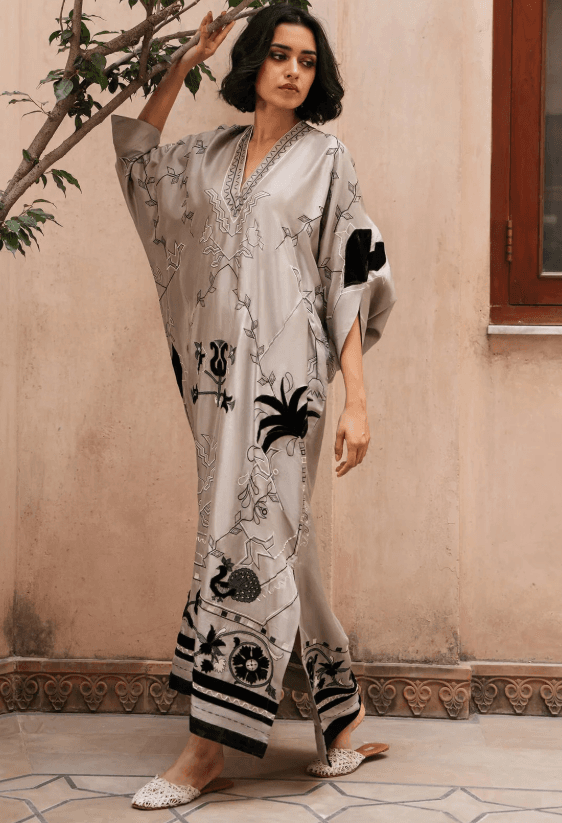
The wrap robe and chuba geometry. The Tibetan chuba (Tibetan: ཕྱུ་པ, phyu-ba) is a wrap-front robe secured at the waist by a sash, worn by both sexes across the Himalayan plateau with variations in length, fabric, and closure detail corresponding to region, class, and gender. The garment is cut from rectangular panels — typically four body panels and two sleeve panels — with no darts, princess seams, or curved pattern pieces: the body's shape is determined by the wrap angle (how far the front panels cross), the sash tension (which gathers excess fabric into a bloused pouch above the waist, historically used as storage space for tools, food, and personal items), and the fabric weight (heavier Tibetan wool produces a more structured wrap; lighter cotton or silk produces a more fluid one). This construction produces a characteristic silhouette: broad through the torso due to wrapping overlap and blousing, tapering below the waist where the sash cinches, and extending to ankle length in formal versions or knee length for labor. The bloused section above the waist — the ampa (pocket-like space) — is both functional (carrying capacity equivalent to a small pack) and visually distinctive, creating a volumetric mass at the torso that contrasts with Western garments' body-following logic. Contemporary Shangri-La fashion adapts this geometry: wrap coats with interior ties that create the chuba's cross-front closure, belted tunics that reproduce the sash-and-blouse effect, and asymmetric front panels that echo the wrap's diagonal closure line.
The shawl and draped outer layer. The Kashmiri/Himalayan shawl — whether the fine pashmina doshala (a rectangular shawl approximately 100 × 200 cm, doubled and draped over the shoulders) or the heavier Tibetan wool blanket wrap — functions as a garment whose silhouette is entirely user-determined: the same rectangular textile can be wrapped as a shoulder cape, folded as a stole, draped as a head covering, belted as a poncho, or pleated as a lap blanket. This geometric versatility — one uncut rectangle producing multiple silhouettes through different folding and draping operations — represents a fundamentally different garment logic from Western outerwear, where each silhouette (coat, cape, poncho, scarf) requires a differently cut garment. The shawl's silhouette is therefore processual rather than fixed: it changes throughout the day as the wearer adjusts the drape, and it acquires its specific form through embodied skill rather than through the garment's engineering. In Shangri-La fashion, this drape versatility is both preserved and constrained: designers produce shawl-derived garments (poncho-cut coats, blanket wraps with armhole slits, cape-collar jackets) that fix one drape configuration into a permanent construction, sacrificing the original rectangle's versatility for Western consumers' expectation of garments with predetermined silhouettes.
Layering logic and altitude dressing. The Himalayan climate — extreme diurnal temperature variation (20–30°C swings between midday sun and nighttime frost at altitude), high UV intensity, low humidity, and sudden wind — produces a layering logic distinct from both Western outdoor systems and Japanese seasonal-wardrobe systems. The Himalayan stack typically consists of a cotton or silk base layer (cholo or kurta in Nepali and Indian traditions), a wool or silk mid-layer wrap (chuba, bakhu, phiran), and an outer layer of heavier wool, yak-hair felt, or sheepskin for extreme cold. Each layer is independently adjustable — the chuba can be worn with one arm free in mild conditions, pulled up to expose the calves for movement, or wrapped tightly with sash and over-cape for severe cold. This modular, user-adjusted layering produces the visual density characteristic of Shangri-La dress: multiple overlapping fabric edges, visible layer transitions, and a overall silhouette whose bulk reflects functional thermal management rather than stylistic exaggeration.
Proportional logic. Shangri-La proportions favor length over breadth at the extremities (elongated tunics, ankle-length wraps, floor-length coats) but accept significant breadth through the torso (wrap overlap, sash blousing, shawl volume). The overall effect is columnar-to-pyramidal: narrow at the shoulders and hem, expanding through the wrapped mid-body. This proportion communicates both enclosure (the body is swathed, protected, withdrawn) and material abundance (visible fabric volume signals quality and sufficiency). The silhouette's gender attenuation derives from the wrap system itself: the same rectangular garment constructions accommodate different body geometries through adjustment rather than through gendered patterning, producing a visual vocabulary in which draped volume reads before sexual contour.
Materials
Material selection is Shangri-La's primary authentication mechanism — the domain where the aesthetic's claims about craft heritage, natural process, and cultural depth are most empirically testable. The category's credibility depends on fiber systems, dye chemistries, and construction techniques whose provenance and quality can be verified through physical examination, and the gap between genuine artisan textiles and their industrial imitations defines the central quality hierarchy.
Pashmina fiber. Pashmina (pashm, from Persian پشم meaning "wool") is the fine undercoat fiber of the Changthangi goat, indigenous to the Changthang plateau of Ladakh and western Tibet at altitudes of 4,000–5,500 meters. The extreme cold of this habitat (-40°C winter temperatures) drives the production of exceptionally fine undercoat fiber: 12–16 microns in diameter, compared to 17–22 microns for standard fine cashmere and 24–40 microns for typical sheep's wool. This fineness produces the fiber's defining properties — extreme softness, high warmth-to-weight ratio (the fine fibers trap proportionally more insulative dead air per unit weight than coarser fibers), and a characteristic fluid drape that distinguishes genuine pashmina textiles from coarser cashmere substitutes. The fiber is harvested by hand-combing during the spring molting season (April–June), yielding approximately 80–170 grams of raw fiber per goat per year — a yield so small that a single pashmina shawl requires the fiber harvest of three to four goats. After harvest, the fiber undergoes manual sorting (separating fine undercoat from coarser guard hairs), washing, and hand-spinning on a yindar (spinning wheel) or takli (drop spindle) — processes that preserve the fiber's length and softness but produce yarn at rates of 6–8 grams per hour, meaning a single shawl's yarn requires approximately 200 hours of spinning labor alone. The resulting yarn is woven on handlooms — typically the Kashmiri khaddi loom — into the three traditional pashmina textile categories: the ring shawl (so fine it can be drawn through a finger ring, woven from the finest-grade fiber at a density of 100+ threads per inch), the standard doshala shawl (heavier, warmer, typically 60–80 threads per inch), and woven yardage for garment construction.
Pashmina's failure modes are specific and instructive. Pilling occurs at friction points within 20–50 wears, as the short fiber staple (50–90 mm) is more vulnerable to surface disruption than longer-staple wools. Moth damage is acute: keratin-feeding larvae (Tineola bisselliella) preferentially attack pashmina due to its high protein accessibility, and a single season of unprotected storage can produce irreversible damage. Fiber thinning under sustained friction (at shawl fold lines, elbow points, shoulder-drape zones) eventually produces transparency and then hole formation — typically after 300–500 wears without repair. The most common fraud in the pashmina market involves substitution: blending pashmina with cheaper cashmere, sheep's wool, or viscose rayon while labeling the product "100% pashmina." Laboratory testing (fiber-diameter measurement via optical microscopy or OFDA/Laserscan analysis) can detect these substitutions, but consumers purchasing at retail — particularly in tourism-adjacent markets — lack access to such testing. The Kashmir Chamber of Commerce and Industry's GI (Geographical Indication) certification for Kashmiri pashmina, granted in 2008, provides a verification framework, but enforcement remains incomplete and counterfeit GI labels circulate.
Tibetan and Himalayan wool. Highland sheep and yak (Bos grunniens) produce wool fibers adapted to extreme cold: Tibetan sheep wool ranges from 25–40 microns (coarser than Merino but exceptionally durable), while yak down fiber (the soft undercoat, distinct from the coarse outer hair) ranges from 16–20 microns — comparable to fine cashmere. Yak fiber provides exceptional warmth at low weight but is produced in limited quantities (approximately 500 grams of down fiber per adult yak per year) and requires careful dehairing to separate the fine down from coarser guard hairs. Tibetan wool is traditionally spun into high-twist yarn that produces a dense, weather-resistant fabric when woven — the high lanolin content of unwashed Tibetan wool provides natural water resistance that degrades when the wool is commercially scoured, which is why traditional Tibetan textiles often retain more lanolin than Western-processed equivalents. Yak-hair felt (nambu in Tibetan), produced by wet-felting yak outer hair, provides the densest insulative textile in the Himalayan repertoire: waterproof, windproof, and sufficiently rigid to serve as structural material for tent panels and floor mats as well as garment construction. In Shangri-La fashion, Tibetan wool appears in blanket wraps, carpet-weight jackets, and heavy outerwear, while yak down is increasingly marketed as a luxury alternative to cashmere — a positioning that reflects both genuine fiber quality and the commercial appeal of exotic-origin narratives.
Silk systems. Multiple silk traditions feed Shangri-La textiles. Wild tussah silk (Antheraea mylitta and A. assamensis), produced by moths feeding on oak, sal, and arjun leaves in Assam, Bihar, and Jharkhand, generates a coarser, more textured yarn than cultivated mulberry silk, with a natural warm-gold to brown color that resists bleaching. Muga silk (A. assamensis), indigenous to Assam, produces a naturally golden fiber with exceptional durability and luster that intensifies with washing — the only silk that improves in appearance with age rather than degrading. Eri silk (Samia ricini), also Assamese, is produced from cocoons from which the moth is allowed to emerge alive (making it acceptable to ahimsa/non-violence traditions), producing a cotton-like silk fiber that is spun rather than reeled, with a matte, textured hand. Cultivated mulberry silk (Bombyx mori) from Varanasi, Kanchipuram, and Kashmir provides the fine, lustrous base for brocade weaving and embroidery. These silk types are not interchangeable — each produces a distinct hand, drape, and surface quality — and the ability to identify them by touch and visual examination constitutes one of the Shangri-La expertise economy's key knowledge markers.
Natural dye chemistry. The Shangri-La palette is historically dye-determined: colors were constrained by locally available dye sources and their chemical interactions with available mordants (metallic salts that fix dye molecules to fiber). Indigo (Indigofera tinctoria) provides the blue range through a vat-dyeing process in which the insoluble indigo molecule is reduced to soluble leuco-indigo in an alkaline fermentation vat, the textile is dipped and oxidized (the leuco-indigo converting back to insoluble indigo within the fiber matrix), and multiple dippings build color intensity from pale sky blue to near-black. The depth and complexity of natural-indigo color — multiple tones emerging from layer-by-layer oxidation — differs perceptibly from synthetic indigo's flatter, more uniform saturation. Madder root (Rubia cordifolia in South Asian tradition, R. tinctorum in the Middle East) provides the red-to-terracotta range through alizarin and purpurin pigments fixed with alum or iron mordants — alum-mordanted madder producing clear red-orange, iron-mordanted madder producing deep burgundy-to-brown. Turmeric (Curcuma longa) provides brilliant yellow that is notoriously fugitive (fading rapidly under UV and washing), which is why turmeric-dyed textiles were historically reserved for ceremonial rather than everyday use. Lac (Kerria lacca insect resin) provides a crimson-to-purple range with superior lightfastness to most plant dyes. Walnut hull provides brown-to-black. Pomegranate rind provides golden yellow with excellent wash and lightfastness. These dyes interact with fiber type: the same indigo produces different tones on cotton (clean blue) versus silk (blue-grey) versus wool (greenish blue), because the dye molecule's interaction with cellulose, fibroin, and keratin protein substrates differs at the molecular level. This dye-fiber interaction chemistry is the deepest layer of the Shangri-La material expertise economy — knowledge held primarily by practicing dyers in South Asian artisan communities and accessible to Western consumers only through extensive study or direct apprenticeship.
Metallic thread and zari construction. Traditional zari (metallic embroidery thread) consists of a flattened gold or silver wire spiral-wound around a silk-thread core, producing a flexible metallic yarn that can be woven, embroidered, or couched onto fabric surfaces. The metal content gave traditional zari its characteristic weight, warmth of color, and resistance to tarnishing (gold zari) or its cool brilliance and gradual oxidation patina (silver zari). Contemporary substitutions have progressively reduced metal content: copper-core zari (coated with gold or silver) replaced solid precious-metal wire by the mid-twentieth century; polyester-metallic zari (metallized plastic film wound around a synthetic core) replaced copper-core by the 1980s in mass-market production. Each substitution reduces weight, durability, color warmth, and aging character while increasing affordability: genuine gold zari develops a deeper, warmer patina over decades; polyester-metallic zari either remains unchanged or degrades through delamination and fiber brittleness. The ability to distinguish these zari grades by weight, flexibility, tarnish behavior, and burn test (real zari produces a metallic residue; synthetic zari melts) constitutes a key authentication skill.
Handloom versus power-loom production. The distinction between handloom and power-loom production is structurally central to Shangri-La authenticity claims. Handloom weaving — on the Kashmiri khaddi loom, the Bhutanese backstrap loom, the Nepali frame loom, or the Indian fly-shuttle handloom — produces textiles with characteristic irregularities: slight variations in weft tension, selvedge width, and pattern registration that result from the human weaver's physical rhythm. These irregularities are empirically detectable (selvedge analysis, weft-tension measurement, pattern-repeat examination) and constitute the material evidence of hand production that the aesthetic values. Power-loom production eliminates these irregularities, producing textiles with uniform tension, perfect pattern registration, and consistent selvedge — characteristics that are commercially desirable in most textile markets but that contradict Shangri-La's craft-authenticity claims. The economic implication is severe: a handloom pashmina shawl requiring 180–250 hours of weaving labor cannot compete on price with a power-loom cashmere-blend shawl produced in 2–4 hours, and the resulting price pressure has driven many traditional handloom weavers out of production. India's 2003 Handloom Reservation Act attempted to protect handloom artisans by reserving certain textile categories for hand production, but enforcement has been inconsistent and power-loom producers routinely market their products with "handloom" labeling.
Color Palette
The palette is dye-determined rather than trend-selected: Shangri-La color is historically constrained by the chromatic range of locally available natural dye sources and their interactions with available fiber substrates and mordant chemistries. This constraint produces a palette that is inherently warm-shifted, muted, and variable — characteristics that synthetic dyes can approximate visually but not replicate in aging behavior, tonal depth, or batch-to-batch variation.
Indigo range. From near-black (15+ dippings in a well-maintained fermentation vat) through deep navy, medium blue, and pale sky blue (1–3 dippings), with the specific blue tone varying by fiber substrate (cooler on cotton, warmer on silk, greener on wool). Indigo is the only traditional source of deep blue in the Himalayan dye palette, and its presence signals specific craft knowledge — maintaining a fermentation-based indigo vat is a microbiological skill requiring daily monitoring and adjustment.
Madder and lac range. Terracotta, rust, warm brick, deep burgundy, and crimson — the warm-red territory that, together with indigo, defines the chromatic poles of the Shangri-La palette. Madder fades toward warm coral over time; lac maintains its depth longer but eventually shifts toward mauve-brown under UV exposure.
Turmeric and pomegranate range. Brilliant saffron-yellow (turmeric, ceremonially significant but fugitive), warm gold (pomegranate rind, excellent lightfastness), muted amber (turmeric over-dyed with iron mordant). These yellows age quickly under light exposure, producing garments whose color at purchase differs notably from their color after a season of wear.
Earth and tannin range. Walnut brown, iron-black, tea-stain amber, bark grey — the neutral zone produced by tannin-rich dye sources and iron mordanting. These colors provide the palette's grounding tones, aging toward warmer, lighter versions of themselves through UV exposure and washing.
Undyed fiber spectrum. Raw pashmina (warm ivory to pale grey depending on goat color), unbleached cotton (cream to ecru), undyed silk (warm gold for tussah, cream for Bombyx, deep gold for muga), undyed yak down (dark brown to charcoal), and raw wool (cream through grey-brown depending on breed). These are not "neutrals" chosen from a design palette but fiber-determined outcomes of material constraint — the colors that fibers produce when processing is withheld.
Metallic accents. Gold zari (warm, deepening to antique amber with age), silver zari (cool, developing grey-to-black tarnish patina), and copper-tone zari (developing verdigris green). Metallics are deployed as accent, not as dominant color — appearing in embroidery borders, brocade highlights, and woven selvedge details rather than as overall fabric color.
The palette's aging behavior distinguishes it from synthetically dyed alternatives: natural-dye garments shift chromatically over their lifespan, with each dye source producing a characteristic fade trajectory. An indigo-dyed cotton tunic purchased at deep navy will develop differential fade at contact points (elbows, waist-sash zone, shoulder-shawl area), recording the wearer's body geometry in its color change. A madder-dyed silk scarf will warm toward coral as UV exposure depletes the shorter-wavelength components of the alizarin pigment. This chromatic dynamism — garments whose color is in process rather than fixed — is the palette's most distinctive property and its most vulnerable authentication point: synthetic dyes designed for colorfastness produce colors that remain static, which is commercially desirable but aesthetically contrary to the Shangri-La logic of temporal transformation.
Details
Details in Shangri-La function as both structural interfaces and craft-authentication markers — each element serves a practical garment-construction purpose while simultaneously encoding the provenance, skill level, and cultural context of its production.
Embroidery systems. Kashmiri sozni embroidery (also known as needlework or suzani-dozi) is executed in fine chain stitch using a hooked needle (aar) that produces a continuous chain of interlocking loops on the fabric surface. The technique permits extraordinary density — fine sozni work achieves 400–600 stitches per square inch, with individual stitch length of 1–2 mm — and the resulting embroidery is effectively a second fabric layer built upon the woven base, adding warmth, weight, and visual complexity. Sozni patterns derive from a vocabulary of naturalistic floral motifs — the chinar (plane tree leaf), lotus, iris, almond blossom, and paisley (boteh) — rendered in multicolored silk thread against the pashmina ground. A fully embroidered jamawar shawl may require 18–36 months of continuous stitching by a single artisan or team, and the embroidery labor typically exceeds the weaving labor in both time and cost. Phulkari embroidery (Punjab, western Himalayan foothills) uses darning stitch worked from the reverse side of the fabric, producing a satin-like embroidered surface on the face — the stitch density is lower than sozni but the surface coverage is greater, creating garments whose embroidery constitutes the primary visual surface rather than an applied decoration. Bhutanese embroidery uses couching and cross-stitch techniques on heavy cotton or silk grounds, with motifs encoding religious and social symbolism (the eight auspicious symbols, the dragon, the lotus). Each embroidery system is identifiable by stitch type, thread material, motif vocabulary, and ground fabric — expertise that constitutes one of the Shangri-La connoisseur's primary authentication tools.
Closure and fastening systems. Shangri-La garments favor wrap-and-tie closures — fabric sashes, woven belts, textile knot closures — over metal hardware. The Tibetan chuba is secured by a woven wool or silk sash (kera) wound multiple times around the waist and tied in a flat knot at the front or side. The Kashmiri phiran (a loose, knee-length tunic worn over trousers) is pull-on with no closure, relying on volume and fabric weight to maintain its drape. The Nepali dhoti and Indian sari are wrapped garments whose "closure" is entirely a function of folding technique and tuck placement — no fastening hardware at all. These closure systems produce uninterrupted fabric surfaces (no button lines, no zipper tracks, no snap bands) that preserve the textile's visual continuity, and they permit ongoing fit adjustment throughout the day (retightening a sash, retucking a drape fold) that hardware closures do not accommodate. In contemporary Shangri-La fashion, designers translate these systems into hidden interior ties, self-fabric belt closures, magnetic snap plackets concealed within fabric folds, and fabric-loop-and-toggle systems derived from Tibetan and Central Asian garment construction.
Selvedge and edge treatment. Handloom textiles produce self-finished selvedges — the weft thread loops back at the fabric edge, creating a closed border that requires no additional hemming or edge finishing. These selvedges are narrower, more irregular, and visually distinct from power-loom selvedges (which are typically wider, more uniform, and may include manufacturer identification text woven into the edge). In garments constructed from handloom fabric, the selvedge may be deliberately incorporated into the garment's visible edge — used as a hem, a cuff, or a neckline finish — both as a construction economy (eliminating hemming labor) and as a craft-authentication marker (the visible selvedge proves handloom origin). Embroidered borders — hashia work in Kashmiri shawls, pallu borders in saris — provide decorative edge finishing that simultaneously reinforces the fabric edge against fraying and identifies the textile's regional origin through pattern vocabulary.
Tassel, fringe, and knotted-edge systems. Warp-end fringing — the unwoven warp threads left as decorative fringe at the textile's ends — is a characteristic detail of Himalayan shawls, scarves, and wraps. The fringe serves a structural function (preventing weft threads from unraveling at the textile's termination) and a decorative function (adding movement, visual weight, and textural complexity to the textile's edge). Fringe may be left as simple warp ends, twisted into grouped tassels, knotted into macrame patterns, or interwoven with metallic or contrasting-color threads. Fringe condition is also an aging indicator: new fringe hangs straight and uniform; worn fringe shows differential fiber loss, tangles, and breakage that record the textile's use history.
Accessories
Accessories in Shangri-La extend the textile-craft logic from garments to body-adjacent objects, forming an integrated system in which every carried or worn element participates in the aesthetic's craft-authentication and atmospheric-signaling economies.
Shawls and wraps as primary accessories. The pashmina shawl is Shangri-La's defining accessory — a portable textile object that functions simultaneously as weather protection, social signifier, craft demonstration, and atmospheric anchor. Shawl quality is evaluated through fiber fineness (ring-test passability for the finest grades), weave density, embroidery technique and coverage, and dye integrity. The shawl's versatility — head covering, shoulder wrap, blanket, waist sash, bag wrapper — makes it the aesthetic's most functionally adaptable element, and its visible deployment signals the wearer's comfort with wrap-and-drape garment logic.
Jewelry and talismanic objects. Tibetan dzi beads (etched agate beads with "eye" patterns, believed to hold protective power), coral and turquoise combinations (the chromatic signature of Himalayan jewelry from Ladakh through Tibet to Bhutan), and silver (luk or gau boxes, prayer-wheel pendants, dorje-and-bell motifs) constitute the traditional Shangri-La jewelry vocabulary. These objects carry religious and cultural significance in their originating contexts — dzi beads are valued at thousands of dollars in Tibetan markets based on age, pattern, and provenance — and their adoption as fashion accessories in Western Shangri-La styling reflects the same cross-cultural borrowing dynamic seen in textile adoption. Contemporary interpretations include seed-bead mala (prayer-bead) necklaces, hammered-metal cuff bracelets, carved-stone pendants, and brass-and-copper mixed-metal rings — simplified citations of the Himalayan jewelry vocabulary that retain atmospheric effect while reducing cultural and economic complexity.
Footwear. Traditional Himalayan footwear — the Tibetan som-ba (wool or yak-hair boot with leather sole), the Nepali docha (padded cotton boot), and various regional leather sandals — informed Shangri-La footwear logic: soft-soled, minimal-construction, natural-material shoes that prioritize ground contact and thermal protection over structural support or aesthetic shaping. Contemporary translations include suede or leather moccasin-style shoes, shearling-lined boots, leather sandals with wide straps, and minimalist trainers in natural-tone suede or nubuck. The aesthetic excludes high heels, pointed toes, synthetic uppers, and logo-heavy athletic shoes — anything that signals urban formality, synthetic performance, or brand-driven consumption.
Bags and carrying objects. Woven textile bags (Nepali jhola shoulder bags, Tibetan wool satchels, Indian block-printed cotton totes), leather cross-body bags with minimal hardware, and straw or rattan baskets constitute the Shangri-La carrying vocabulary. The shared properties are natural material, minimal closure hardware, and a proportional relationship to the body that suggests walking-pace travel rather than commuter efficiency or nightlife display.
Body Logic
Shangri-La conceptualizes the body as a thermal-regulation platform moving through altitude-variable conditions and as a frame for textile display — the body serves the cloth rather than the cloth sculpting the body. Wrap-and-drape construction treats the body as an armature whose specific geometry is accommodated through adjustment (retying a sash, redraping a shawl, retucking a fold) rather than through pre-cut fitting, producing a relationship between body and garment that is dynamic and user-mediated rather than fixed by pattern engineering.
Gender coding is comparatively attenuated by the wrap system's structural logic: the same rectangular shawl, the same wrap-front robe, the same sash-closure system accommodates different body geometries through drape adjustment rather than through gendered cutting. Traditional Himalayan dress includes gender-specific garments (the Bhutanese gho for men versus kira for women; the Nepali daura suruwal for men versus gunyu choli for women), but the aesthetic's migration into Western fashion has tended to flatten these distinctions into a unisex wrap-and-layer vocabulary — a simplification that makes the aesthetic more commercially accessible while erasing the gender-coding systems embedded in the originating traditions.
Class encoding operates at multiple levels. Genuine pashmina textiles are expensive — a fine ring-shawl can exceed $2,000 at ethical retail, and fully embroidered jamawar shawls can reach $10,000–$50,000 — encoding the wearer's economic capacity within an aesthetic that rhetorically values simplicity and spiritual refinement. The paradox mirrors that of monastic fashion: materially restrained dress that signals wealth through quality rather than ornament. Additionally, the leisure time and cultural capital required to develop textile-authentication expertise (fiber identification, dye-source recognition, embroidery-technique literacy) presupposes educational access and travel experience that are themselves class-structured resources.
The body in Shangri-La dressing reads as "enveloped" before it reads as gendered, as "culturally situated" before it reads as fashionable. This atmospheric body logic — the dressed figure as a locus of warmth, craft, and cultural reference rather than of sexual display or athletic performance — is the aesthetic's primary somatic signature.
Garment Logic
Shangri-La garment construction integrates the wrap-and-drape principles outlined in the silhouette section with specific technical systems for joining, reinforcing, and finishing textiles that are structurally distinct from Western tailoring conventions.
Wrap construction and minimal cutting. The foundational Shangri-La garment is constructed from rectangular or minimally shaped panels — the chuba, the phiran, the shawl, the sari — using straight seams, right-angle sleeve insertion, and fabric-width-determined proportions rather than body-traced pattern pieces. This construction minimizes cutting waste (a critical consideration when the base textile — handwoven pashmina, handloom silk, hand-dyed cotton — represents hundreds of hours of prior labor), permits flat folding for storage and transport, and produces garments whose silhouette is determined primarily by fabric behavior and user draping rather than by construction engineering. Seams are typically flat-felled (the seam allowance folded twice and stitched flat, producing a strong, clean interior finish visible from neither side) or French-seamed (the raw edge enclosed within a double-stitched seam), both techniques that protect raw edges without the bulk of overlocking or serging.
Embroidery as structural reinforcement. In densely embroidered garments (fully covered jamawar shawls, phulkari suits), the embroidery layer functions as structural reinforcement: the dense network of stitches binds the ground fabric's fibers together, increasing resistance to tearing, reducing flexibility at embroidered zones, and adding weight that improves drape. This structural effect is both functional (the embroidered textile is more durable than the ground fabric alone) and aesthetic (the embroidery zone's increased stiffness creates a contrast between rigid embroidered panels and fluid unembroidered zones that produces visual rhythm across the garment surface).
Lining and interlining systems. Traditional Himalayan garments use sheep- or yak-skin lining for extreme-cold conditions (the chuba may be lined with sheepskin for winter wear), cotton or silk lining for moderate conditions, and no lining for warm-weather versions. Contemporary Shangri-La fashion translates this into silk crepe de chine linings (providing smooth interior hand against skin), quilted cotton or wool interlinings (providing thermal structure without visible quilting on the exterior), and detachable liner systems (snap-in wool layers that convert a single garment between seasonal weights). The lining's quality — fiber composition, seam finishing, attachment method — is a key evaluation point for construction quality: cheap linings (polyester, loosely attached, poorly finished at hem and cuff) undermine even high-quality outer textiles.
Aftercare and maintenance. Shangri-La garments require care protocols calibrated to their specific material systems, and failure to follow these protocols produces the most common quality-degradation pathways. Pashmina requires hand washing in cold water with neutral-pH soap (never alkaline detergent, which degrades keratin protein and causes felting), flat drying (never hanging, which stretches the fine fiber under wet-weight stress), and storage with moth deterrent (cedar, lavender, or sealed containers). Silk requires similar cold hand washing, avoidance of chlorine bleach (which dissolves fibroin protein), and protection from UV exposure during storage (silk's peptide bonds are UV-vulnerable, producing yellowing and embrittlement). Natural-dyed textiles require cold washing (heat accelerates dye release from fiber), avoidance of alkaline detergents (which shift dye-mordant equilibria, causing color change), and separation from undyed textiles during washing (released dye molecules will migrate to adjacent fibers). Embroidered garments require flat or rolled storage (never folded along embroidery lines, which cracks the stitch structure and creates permanent creases in the metallic thread). These maintenance requirements are not arbitrary impositions but consequences of the material systems' chemistry and physics: each care instruction addresses a specific degradation mechanism that, if unmanaged, will destroy the garment's functional and aesthetic integrity.
Failure modes. The most common failure modes in Shangri-La garments are moth damage to protein fibers (pashmina, wool, silk — all keratin or fibroin substrates vulnerable to Tineola bisselliella larvae), natural-dye fading under UV exposure (particularly turmeric yellows and indigo blues, though madder reds and lac crimsons show superior lightfastness), embroidery thread breakage at fold-stress points (metallic zari is particularly vulnerable because the metal component resists the bending that the textile component accommodates), and fiber thinning at friction zones (shawl drape points, chuba sash-friction area, elbow and knee flex points). The catastrophic failure mode unique to pashmina is felting: if washed in hot water or agitated mechanically (machine washing), pashmina's fine fiber scales interlock irreversibly, producing a dense, stiff mat that bears no resemblance to the original textile and cannot be restored. This failure is instant, total, and irreversible — the single most important care instruction for pashmina owners, and the knowledge test that separates informed from uninformed consumers.
Motifs / Themes
The motif vocabulary of Shangri-La operates on two registers: the specific iconographic traditions of Himalayan and South/Central Asian textile arts, and the broader atmospheric themes that Western fashion draws from those traditions.
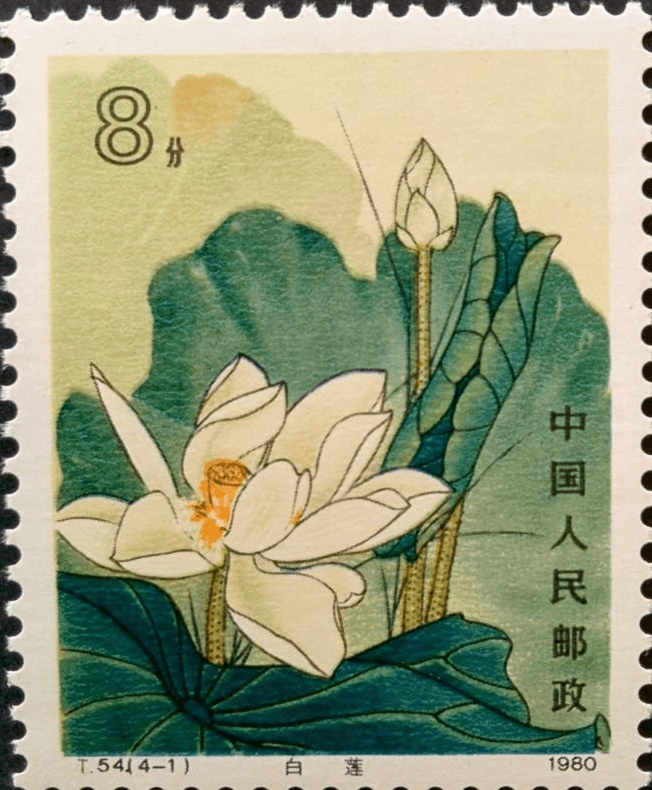
Textile-specific motifs. The boteh (paisley) — an abstract floral-foliar form whose origins are traced to Zoroastrian, Mughal, and Kashmiri artistic traditions — is the Shangri-La aesthetic's most globally recognized pattern element, though its ubiquity has also made it the most degraded through industrial reproduction. The chinar leaf (Kashmiri plane tree), the lotus flower (pan-Buddhist), the cloud band (Tibetan and Central Asian), the dragon and phoenix (Bhutanese), the mandala (geometric-cosmic diagram), and the endless knot (one of the eight auspicious Buddhist symbols) constitute the core motif vocabulary. Each motif carries specific cultural meaning in its originating context: the endless knot signifies the interdependence of all phenomena; the lotus signifies purity emerging from suffering; the dragon (in Bhutanese context) signifies protective power. In Western Shangri-La fashion, these motifs are typically deployed for visual effect — pattern, color, rhythm — rather than for their symbolic content, producing a decorative surface that references cultural depth without communicating it.
Atmospheric themes. Elevation (literal altitude as metaphor for spiritual elevation), refuge (withdrawal from modern life as aesthetic program), temporal suspension (the Shangri-La fantasy of time slowed or stopped, materialized through "timeless" garment construction), and handcraft sincerity (the visible evidence of human labor as antidote to industrial anonymity) constitute the aesthetic's thematic architecture. These themes originate more from the Western reception of these textile traditions than from the traditions themselves — the Kashmiri weaver is focused on producing a shawl of exceptional quality; the Tibetan dyer is processing fiber with deep expertise. The interplay between the production reality and the atmospheric themes layered upon it is one of Shangri-La's most fascinating interpretive dimensions.
Cultural Touchstones
The cultural reference system operates across literary, cinematic, editorial, hospitality, and social-media contexts.
Literature and intellectual history. James Hilton's Lost Horizon (1933) provides the foundational fantasy — the hidden valley, the ageless inhabitants, the spiritual clarity — that all subsequent Shangri-La cultural production references. Edward Said's Orientalism (1978) is a foundational text for understanding how Western cultural production has historically framed representations of "the East." Peter Bishop's The Myth of Shangri-La: Tibet, Travel Writing and the Western Creation of Sacred Landscape (1989) examines the Western literary construction of Tibet and the Shangri-La imaginary. Donald Lopez's Prisoners of Shangri-La: Tibetan Buddhism and the West (1998) extends this analysis to the Western reception of Tibetan Buddhism, exploring how Western fascination has shaped the global image of Tibet.
Film and visual culture. Frank Capra's Lost Horizon (1937) established the cinematic visual grammar: terraced gardens, flowing robes, golden interior light, snow-peak backdrop. Martin Scorsese's Kundun (1997) and Jean-Jacques Annaud's Seven Years in Tibet (1997) reproduced Himalayan visual culture for Western audiences with greater ethnographic attention but continued to frame Tibet through Western protagonist perspectives. Wes Anderson's The Darjeeling Limited (2007) satirized and reinforced the Western-spiritual-tourist-in-South-Asia trope simultaneously, with its production design creating an aestheticized India that the film's narrative partially critiques. Luxury-travel editorial photography in Conde Nast Traveller, Travel + Leisure, and Kinfolk transmits the Shangri-La visual template — mountain light, handwoven textiles, meditation spaces, curated simplicity — through lifestyle-media channels that frame consumption as cultural experience.
Hospitality and retail environments. The Shangri-La Hotels chain, Aman Resorts properties in Bhutan and India, COMO Hotels' Himalayan properties, and the growing network of luxury wellness retreats in Rishikesh, Dharamsala, and the Kathmandu Valley function as immersive aesthetic environments where Shangri-La dress, interior design, and experiential programming converge. These environments are the aesthetic's primary commercial interface: they produce the atmospheric context within which textiles, garments, and accessories acquire their aspirational meaning.
Social media and platform curation. Instagram accounts curating Himalayan travel, artisan textiles, and wellness-retreat aesthetics (#pashmina, #handwoven, #himalayanstyle, #slowfashion) transmit the Shangri-La visual grammar globally while compressing it into platform-optimized image formats that favor atmospheric mood over material specificity. TikTok's aesthetic taxonomy includes Shangri-La-adjacent categories ("mountain aesthetic," "retreat dressing," "ethereal minimalism") that further flatten the aesthetic's cultural and material complexity into trend-cycle content.
See Also
- Monastic: Shared volumetric silhouette and chromatic restraint; monastic derives from Western/Buddhist religious rules while Shangri-La derives from South/Central Asian textile traditions and Western literary imagination
- Wabi-sabi: Shared interest in natural-fiber aging and artisanal imperfection; wabi-sabi derives from Japanese Buddhist philosophy and craft traditions rather than Himalayan textile systems
- Bohemian: Overlapping adoption of non-Western textile motifs and handcraft signaling; boho flattens diverse traditions into undifferentiated "global" aesthetic while Shangri-La (at best) retains geographic specificity
- Quiet luxury: Shared emphasis on material quality over brand visibility; quiet luxury achieves restraint through Western tailoring understatement while Shangri-La achieves it through non-Western handcraft recontextualization
- Cottagecore: Shared pastoral-retreat thematics; cottagecore references Western rural domesticity while Shangri-La references Himalayan altitude and Asian spirituality
- Pilgrimcore: Overlapping journey-and-simplicity themes; pilgrimcore is movement-oriented while Shangri-La is destination-oriented
- Hygge: Shared emphasis on warmth, enclosure, and domestic comfort; hygge derives from Scandinavian cultural practices rather than Asian textile traditions
Brands and Designers
Heritage Himalayan and South Asian Craft:
- Pashmina artisan cooperatives of Srinagar, Kashmir (GI-certified Kashmiri pashmina, traditional kani and sozni shawl production)
- Tibetan carpet-weaving cooperatives in Dharamsala, Kathmandu, and Lhasa (Tibetan-knot construction, highland wool, natural dyes)
- Bhutanese Royal Textile Academy (preservation and teaching of kushuthara, mathra, and traditional Bhutanese weaving techniques)
- Fabindia (1960, New Delhi): India's largest private platform for handloom and hand-crafted products, connecting over 55,000 artisans to retail markets
- Good Earth (1996, New Delhi): Indian luxury lifestyle brand integrating traditional textile techniques with contemporary design
- Raw Mango (2013, Varanasi): Sanjay Garg's revival of handloom sari weaving using traditional techniques and natural fibers
Luxury Integration / Western Designers Drawing on South Asian Textile Traditions:
- Loro Piana (1924, Quarona, Italy): cashmere and pashmina fiber sourcing from Changthang plateau, highest-grade fiber processing and garment construction
- Brunello Cucinelli (1978, Solomeo, Italy): cashmere-forward quiet luxury with craft-village production model, pashmina-adjacent positioning
- The Row (2006, New York): luxury cashmere and fine-wool garments in monastic-to-Shangri-La silhouettes, exemplifying the quiet-luxury absorption of Himalayan fiber traditions
- Lemaire (2014, Paris): wrap construction, natural-fiber drape, and volume-forward silhouettes with South Asian structural echoes
- Dries Van Noten (1986, Antwerp): sustained engagement with South Asian textile traditions, Indian embroidery, and natural-dye palettes across decades of collections
Artisan-Forward / Ethical Production:
- Maiyet (2011, New York): luxury accessories and garments produced in partnership with artisan communities in India, Indonesia, and Kenya
- Anavila (2011, Mumbai): Anavila Misra's handloom linen saris reviving traditional weaving communities with contemporary design
- 11.11/eleven eleven (2013, New Delhi): hand-spun, handwoven, naturally dyed clothing produced entirely through artisan communities
- Injiri (2009, Ahmedabad): Chinar Farooqui's handloom and hand-block-printed textiles preserving Gujarati and Rajasthani craft techniques
- Péro (2009, New Delhi): Aneeth Arora's craft-intensive garments integrating hand-embroidery, handloom weaving, and mixed-textile construction
Hospitality-Adjacent / Lifestyle Positioning:
- Shangri-La Hotels and Resorts (1971, Hong Kong): the aesthetic's namesake hospitality brand, whose retail and gift-shop operations constitute a significant distribution channel for Himalayan textiles
- Aman Resorts brand partnerships and retail (curated artisan textiles as experiential souvenirs at Himalayan properties)
- Toast (1997, Wales): British lifestyle brand whose linen, wool, and natural-dye palette and editorial positioning align with Shangri-La atmospheric logic
- Eileen Fisher (1984, New York): natural-fiber system dressing with sustainability commitment, overlap in silhouette and palette logic
Wellness-Adjacent / Yoga-Retreat Positioning:
- prAna (1992, Carlsbad, California): yoga and outdoor lifestyle clothing with South Asian naming and occasional textile reference
- Spiritual Gangster (2007, Los Angeles): yoga-lifestyle brand using Sanskrit and Buddhist motifs as decorative elements
- Free People (1984, Philadelphia): bohemian-adjacent brand incorporating Himalayan textile citations (block prints, embroidery, wrap construction) into mass-market fashion
Citations
[1] Hilton, James. Lost Horizon. Macmillan, 1933. [2] Said, Edward W. Orientalism. Vintage Books, 1978. [3] Bishop, Peter. The Myth of Shangri-La: Tibet, Travel Writing and the Western Creation of Sacred Landscape. Athlone Press, 1989. [4] Lopez Jr., Donald S. Prisoners of Shangri-La: Tibetan Buddhism and the West. University of Chicago Press, 1998. [5] Rizvi, Janet. Pashmina: The Kashmir Shawl and Beyond. Marg Publications, 2009. [6] Ames, Frank. The Kashmir Shawl and Its Indo-French Influence. Antique Collectors' Club, 1997. [7] Irwin, John, and Katharine B. Brett. Origins of Chintz: With a Catalogue of Indo-European Cotton-Paintings in the Victoria and Albert Museum. HMSO, 1970. [8] Bhushan, Jamila Brij. The Costumes and Textiles of India. Taraporevala's Treasure House of Books, 1958. [9] Crill, Rosemary. Indian Ikat Textiles. V&A Publishing, 1998. [10] Gillow, John, and Nicholas Barnard. Indian Textiles. Thames and Hudson, 2008. [11] Myers, Diana K. From the Land of the Thunder Dragon: Textile Arts of Bhutan. Peabody Essex Museum, 1994. [12] Bartholomew, Mark. Thunder Dragon Textiles from Bhutan. Serindia Publications, 2008. [13] Harris, Jennifer, editor. Textiles, 5,000 Years: An International History and Illustrated Survey. Harry N. Abrams, 1993. [14] Balfour-Paul, Jenny. Indigo: Egyptian Mummies to Blue Jeans. British Museum Press, 2011. [15] Cardon, Dominique. Natural Dyes: Sources, Tradition, Technology and Science. Archetype Publications, 2007. [16] Dean, Jenny. Wild Colour: How to Grow, Prepare and Use Natural Plant Dyes. Mitchell Beazley, 2010. [17] Entwistle, Joanne. The Fashioned Body: Fashion, Dress and Social Theory. 2nd ed., Polity, 2015. [18] Kawamura, Yuniya. Fashion-ology: An Introduction to Fashion Studies. 2nd ed., Bloomsbury Academic, 2018. [19] Breward, Christopher. Fashion. Oxford University Press, 2003. [20] Wilson, Elizabeth. Adorned in Dreams: Fashion and Modernity. Revised ed., Rutgers University Press, 2003. [21] Crane, Diana. Fashion and Its Social Agendas: Class, Gender, and Identity in Clothing. University of Chicago Press, 2000. [22] Tarlo, Emma. Clothing Matters: Dress and Identity in India. University of Chicago Press, 1996. [23] Bayly, C.A. "The Origins of Swadeshi (Home Industry): Cloth and Indian Society, 1700–1930." In The Social Life of Things: Commodities in Cultural Perspective, edited by Arjun Appadurai, Cambridge University Press, 1986. [24] Maskiell, Michelle. "Consuming Kashmir: Shawls and Empires, 1500–2000." Journal of World History, vol. 13, no. 1, 2002, pp. 27–65. [25] Lipovetsky, Gilles. The Empire of Fashion: Dressing Modern Democracy. Princeton University Press, 1994. [26] Bourdieu, Pierre. Distinction: A Social Critique of the Judgement of Taste. Translated by Richard Nice, Harvard University Press, 1984. [27] Appadurai, Arjun. The Social Life of Things: Commodities in Cultural Perspective. Cambridge University Press, 1986. [28] Veblen, Thorstein. The Theory of the Leisure Class. Macmillan, 1899. [29] Barthes, Roland. The Fashion System. Translated by Matthew Ward and Richard Howard, University of California Press, 1983. [30] Simmel, Georg. "Fashion" (1904). In Simmel on Culture: Selected Writings, edited by David Frisby and Mike Featherstone, SAGE, 1997. [31] Fletcher, Kate. Sustainable Fashion and Textiles: Design Journeys. 2nd ed., Earthscan, 2013. [32] Scrase, Timothy J. "Precarious Production: Globalisation and Artisan Labour in the Third World." Third World Quarterly, vol. 24, no. 3, 2003, pp. 449–461. [33] Yanagi, Sōetsu. The Unknown Craftsman: A Japanese Insight into Beauty. Adapted by Bernard Leach. Kodansha International, 1972. [34] Capra, Frank, director. Lost Horizon. Columbia Pictures, 1937. [35] Rizvi, Janet. Trans-Himalayan Caravans: Merchant Princes and Peasant Traders in Ladakh. Oxford University Press, 1999. [36] McHugh, Ernestine. "Encountering the Dharma: Meditation and Transformation in Western Buddhism." In Westward Dharma, edited by Charles S. Prebish and Martin Baumann, University of California Press, 2002.