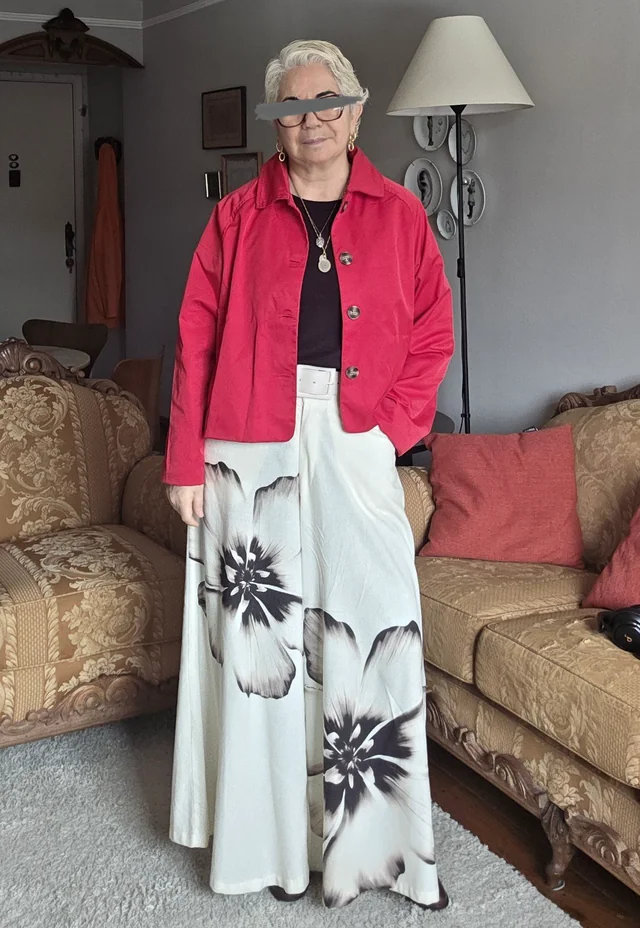
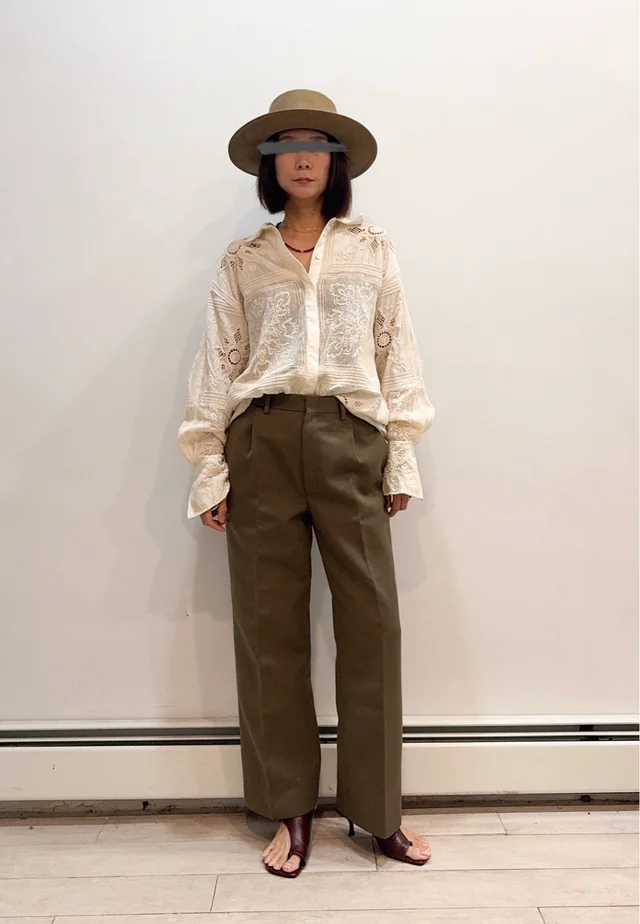
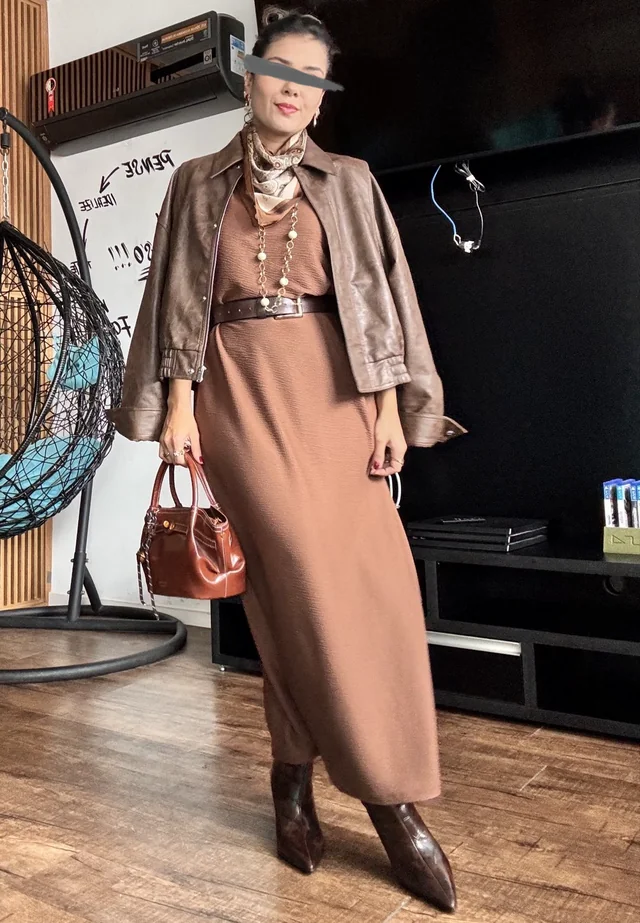
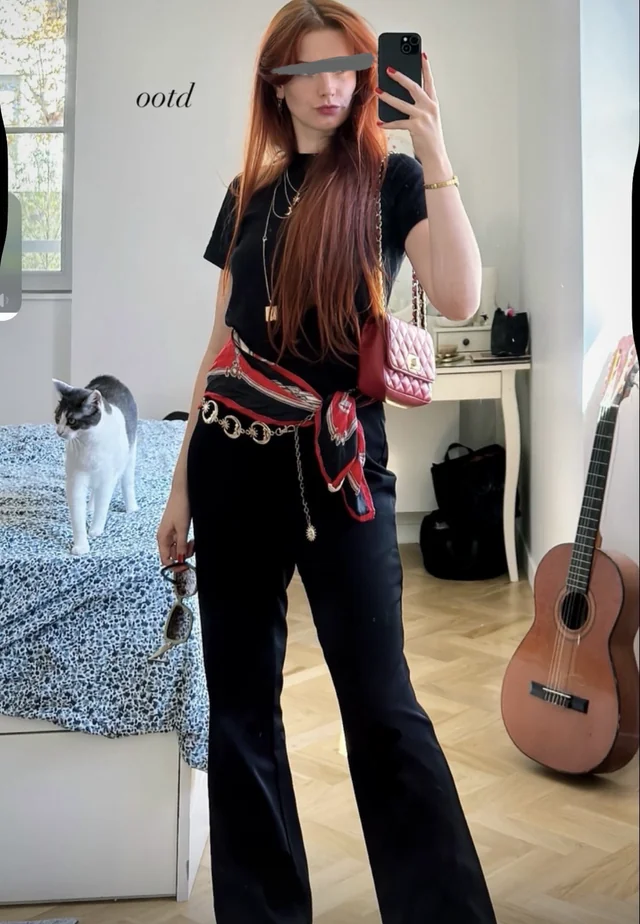
Parisian
Summary. Parisian chic is a dress regime in which garments engineered for bourgeois urban life in Paris — tailored wool blazers, gabardine trench coats, Breton-stripe marinières, silk blouses, ballet flats, and structured leather accessories — are organized into a wardrobe system governed by a restraint-as-distinction logic: quality of fiber and construction replaces visible branding, controlled underpinning replaces overt structure, and calibrated imperfection (a cuff pushed back, a collar left open, a hem deliberately unhemmed) replaces the finished precision of other tailoring traditions. The aesthetic is not defined by specific garments but by a regulatory grammar that determines how garments are selected, combined, worn, and — critically — how their apparent effortlessness is produced through deliberate engineering of fit, proportion, and surface texture. Unlike sartorial dress, which foregrounds visible construction mastery, or minimalism, which foregrounds reduction to essentials, Parisian chic foregrounds the concealment of the system that produces its effects — the labor of appearing unlabored, the discipline of appearing undisciplined, the expense of appearing indifferent to expense.
In Material Terms
Parisian chic's coherence depends on a narrow band of natural-fiber textiles whose hand feel, drape behavior, and aging characteristics produce the specific visual and tactile signatures the aesthetic demands. French wool suiting — typically sourced from Biella-district mills (Vitale Barberis Canonico, Reda, Loro Piana's wool division) or from heritage Anglo-French merchants like Dormeuil (founded 1842, Paris, with Yorkshire mill operations) and Holland & Sherry — occupies a weight range of 240–300 g/m², lighter than British worsted suiting (typically 310–370 g/m²) and softer than Milanese tailoring cloths, producing a blazer that drapes closer to the body with less rigid structure. This weight choice is not incidental but constitutive: it enables the slightly collapsed shoulder, the soft roll of an unstructured lapel, and the controlled ease through the torso that distinguish the Parisian blazer from its English (structured, armored) and Italian (deconstructed, louche) counterparts. Cotton for the Breton marinière is a tightly knit interlock or jersey, typically 20-gauge, in a combed long-staple cotton that resists pilling and maintains dimensional stability through repeated laundering — a construction standard established by Saint James (founded 1889, Saint-James, Normandy) and Armor-Lux (1938, Quimper, Brittany) that mass-market imitations consistently fail to replicate in gauge consistency and yarn quality. Silk crêpe de chine (14–16 momme) and silk charmeuse (19–22 momme) provide the blouse fabrics whose fluid drape and light-catching surface produce the characteristic Parisian interplay between structured lower body (wool trouser, denim) and fluid upper body (silk, fine knit). Gabardine — a tightly woven twill (typically 63-degree twill angle) in worsted wool or cotton — provides trench-coat water resistance through weave density rather than coating or membrane, a construction principle established by Thomas Burberry's 1879 patent but refined in French production through lighter-weight executions (280–320 g/m² versus Burberry's heavier 350 g/m² heritage cloths) that permit year-round urban wear. When any of these material specifications is compromised — polyester substituted for silk, acrylic blended into the marinière knit, bonded interfacing replacing canvas in the blazer chest — the aesthetic collapses from system into costume, because the hand feel, drape, and aging behavior that produce Parisian chic's visual signatures depend on fiber properties that synthetic substitutes cannot replicate.
At Category Level
Parisian chic occupies a contested position between several adjacent dress regimes. It shares restraint and quality-over-quantity logic with quiet luxury but differs in its tolerance for visible imperfection and its rejection of head-to-toe seamlessness; quiet luxury aims to eliminate all friction from the dressed surface, while Parisian chic deliberately introduces controlled friction (a slightly oversized blazer, an untucked hem, undone hair) as proof of nonchalance. It shares tailoring vocabulary with sartorial dress but operates at lower structure — Parisian blazers are typically half-canvassed or unstructured where sartorial blazers are full-canvassed, and Parisian trouser creases are optional where sartorial creases are mandatory. It shares cultural geography with Continental European style but distinguishes itself through a specifically French institutional infrastructure — the Chambre Syndicale de la Haute Couture, the Fédération de la Haute Couture et de la Mode, and the editorial apparatus of French Vogue, Madame Figaro, and L'Officiel — that produces and certifies its legitimacy. The category's most significant boundary is internal: between Parisian chic as a locally practiced urban dress code (class-structured, neighborhood-specific, professionally calibrated) and "French girl style" as a globally exported content category (simplified, aspirational, commercially instrumentalized). These are not the same phenomenon, and conflating them is the most common analytical error in the discourse.
Methodologically
This entry treats Parisian chic as a restraint-engineering regime: garments are analyzed by how their material composition, pattern construction, and styling protocols produce the appearance of effortlessness through deliberate technical means, and by how this production system is embedded in French class structures, institutional fashion governance, and global mythmaking economies that determine who can access, perform, and profit from the aesthetic.
Word (Etymology)
"Parisian" derives from the Latin Parisii, the Gallic tribe that inhabited the Île de la Cité, through Old French parisien, designating belonging to or origin in Paris. As a fashion modifier, "Parisian" performs classificatory work that exceeds geographic reference. It functions as a quality claim — asserting that the garments or style in question embody a set of values (restraint, quality, nonchalance, sensuality-through-understatement) that are attributed to Parisian culture as essential properties rather than contingent historical products. This essentializing move is the term's most consequential semantic operation: it naturalizes a learned, class-specific, institutionally maintained dress code as an innate cultural disposition, converting what is in practice a set of acquisition, maintenance, and styling skills into an identity category ("French women just know how to dress").
The adjacent term "chic" — borrowed into English from French in the 1850s, itself likely derived from German Schick ("skill, fitness, elegance") — amplifies this naturalization. In French usage, chic implies an elegance that appears uncontrived; in English adoption, it further implies that this uncontrived elegance is specifically French. The compound "Parisian chic" thus double-encodes the myth: the style is effortless (chic) and the effortlessness is geographically innate (Parisian). Roland Barthes's analysis of fashion's semiotic operations — the conversion of designed objects into "natural" signs — applies with particular precision here: "Parisian chic" is a constructed category that presents itself as a found condition.
In French fashion discourse, the concept circulates through adjacent terms: allure (bearing, manner, the way a body carries clothing), je ne sais quoi (the deliberately unnamed quality that resists codification), élégance décontractée (relaxed elegance), and the negative construction ne pas en faire trop (not doing too much). Each term reinforces the aesthetic's core rhetorical strategy: defining itself through what it refuses (excess, effort, visibility of system) rather than through what it asserts, making the style paradoxically difficult to specify precisely because its specification would violate its own principle of apparent unselfconsciousness.
Subculture
Parisian chic did not emerge from a single scene or youth-culture formation but coalesced through the overlap and mutual reinforcement of several distinct social fields, each contributing evaluative criteria, transmission mechanisms, and gatekeeping structures that collectively produce the aesthetic's institutional thickness.
Haute couture and its diffusion networks. The Chambre Syndicale de la Haute Couture Parisienne (established 1868, reorganized under the Fédération de la Haute Couture et de la Mode) institutionalized Paris as fashion's regulatory center by establishing legally enforceable criteria for the designation "haute couture" — garments must be custom-fitted, hand-sewn by a specified number of ateliers employing a minimum number of artisans, and presented in biannual collections of a minimum number of looks. This institutional framework produced a top-down diffusion pipeline: couture innovations were translated into prêt-à-porter (ready-to-wear) by the same houses, then into mass-market approximations by department stores and eventually fast-fashion chains. The aesthetic sensibility that couture transmitted — emphasis on fabric quality, construction precision, and restrained silhouette — filtered through each diffusion stage in attenuated form, providing the aspirational reference structure against which everyday Parisian dressing was evaluated. The bourgeoise parisienne who purchased a Chanel tweed jacket at retail, who had it copied by a neighborhood couturière, or who approximated its logic through careful selection at Galeries Lafayette, occupied different positions in this diffusion chain but participated in the same evaluative system.
Left Bank intellectual-artistic circles. The existentialist milieu of postwar Saint-Germain-des-Prés (Sartre, de Beauvoir, Juliette Gréco, Boris Vian) contributed an anti-bourgeois variant: black turtlenecks, slim trousers, flat shoes, minimal adornment, cigarettes as accessories. This intellectual-bohemian register rejected couture's expense while sharing its emphasis on restraint, producing a dress code readable as both class refusal and class display — the studied simplicity of someone who has read enough to know that appearances are constructed and therefore chooses to construct an appearance of not caring about construction. This tradition persists in the contemporary Parisian wardrobe through the prevalence of black, the tolerance for worn textures, and the valorization of books, cigarettes, and café tables as environmental accessories.
Cinema and editorial image-making. French New Wave cinema (Godard, Truffaut, Chabrol, Varda) created the visual archive that global audiences would subsequently decode as "Parisian style": Jean Seberg's pixie cut and striped marinière in Breathless (1960), Anna Karina's dark bangs and simple shifts in Vivre sa vie (1962), Catherine Deneuve's structured coats and restrained palette in Belle de Jour (1967). These cinematic images were not documentaries of existing dress practice — they were styled, directed, and edited — but they acquired documentary authority through their apparent naturalism, the New Wave's location shooting and improvisational aesthetic lending its subjects a "real life" quality that studio productions could not match. Fashion-magazine editorial at Vogue Paris (founded 1920, particularly under the editorships of Edmonde Charles-Roux, Francine Crescent, and Carine Roitfeld) continued this image-production labor, curating and recirculating the visual conventions that constituted "Parisian" as a legible category.
Digital-platform globalization (2005–present). Fashion blogs (Garance Doré, The Sartorialist's Paris coverage, Jeanne Damas's early blog), Instagram accounts, and TikTok content creators translated locally practiced Parisian dress into a globally accessible template by isolating its most reproducible visual elements — the blazer-and-jeans combination, the red lip, the tousled hair, the basket bag — and recirculating them as actionable style instructions. This translation necessarily simplified: the class-specific knowledge, neighborhood-inflected variation, and maintenance economies that sustained Parisian chic as a local practice were stripped away in favor of purchasable signifiers. The result was a content category — "French girl style" — that bore the same relationship to practiced Parisian dressing that a phrase book bears to fluency: functionally communicative but structurally impoverished.
Sociologically, Parisian chic is structured by layered expertise economies that operate simultaneously. At the apex, couture clients, fashion editors, and long-established bourgeois families command authority through inherited knowledge, institutional access, and financial capacity to maintain garments at the quality level the aesthetic demands. Mid-tier authority belongs to the educated professional class — the cadre or bourgeoise who has learned the system's rules through observation, experimentation, and the transmission of implicit knowledge within social networks. At the entry level, global consumers navigate brand recognition and content-creator instruction. These tiers are not sealed — mobility is possible through demonstrated competence — but the hierarchy structures how legitimacy claims are adjudicated. The critical gatekeeping mechanism is not wealth alone but the capacity to deploy restraint convincingly: a new entrant who overdresses (too much jewelry, too-perfect hair, too-visible branding) signals outsider status more clearly than one who underdresses, because the system's evaluative logic penalizes excess more severely than deficit.
History
The institutional and material history of Parisian chic begins not with any single designer but with the establishment of Paris as fashion's regulatory and mythological capital — a process driven by state policy, industrial infrastructure, guild governance, and cultural exportation across five centuries.
Ancien régime and mercantile foundation (17th–18th centuries). Louis XIV's finance minister Jean-Baptiste Colbert established France's textile industries as instruments of state economic policy, founding the Manufacture royale de draps (royal cloth manufacture) and imposing tariff protections that made French silk (Lyon), lace (Alençon, Chantilly), and embroidered textiles the dominant luxury goods in European trade. The guild system regulated artisan production — tailors (tailleurs), dressmakers (couturières), and mercers (marchands de modes) operated under legally defined jurisdictions — creating an institutional framework in which garment quality was enforced through collective governance rather than individual brand reputation. Rose Bertin, marchande de modes to Marie Antoinette from the 1770s, established the prototype of the fashion authority — the individual whose taste, access, and promotional skill created market demand for specific styles — that would later evolve into the couturier model. By the late eighteenth century, Paris had accumulated the institutional, artisanal, and commercial infrastructure that would sustain its fashion authority through revolution, industrialization, and world wars.
Haute couture codification (1858–1945). Charles Frederick Worth, an English-born draper working in Paris, established the first couture house (1858, Rue de la Paix) on principles that defined the industry for a century: the designer as creative authority rather than artisan-for-hire; seasonal collections presented on live mannequins; proprietary designs sold to individual clients and licensed for reproduction. The Chambre Syndicale de la Couture Parisienne (1868) institutionalized these principles through membership criteria and collective scheduling of presentations. Paul Poiret (1903–1929) liberated women from corsetry and introduced orientalist draped silhouettes. Coco Chanel (house founded 1910) established the foundational grammar of modern Parisian chic: jersey fabrics elevated from underwear to outerwear, tweed jackets with braid trim and chain-weighted hems, costume jewelry worn with couture, the little black dress (1926, Vogue's "Ford" — a garment so universal and essential it was compared to the automobile), perfume as extension of the fashion brand (No. 5, 1921). Chanel's genius was not merely sartorial but systemic: she constructed a complete aesthetic regime in which simplicity, quality materials, and the rejection of ornamental excess became legible as sophistication rather than deprivation. Elsa Schiaparelli provided Chanel's dialectical counterpoint through surrealist collaboration (Dalí, Cocteau), inventive color (shocking pink), and conceptual garments (the lobster dress, the shoe hat), establishing the tension between classical restraint and artistic provocation that French fashion continues to negotiate.
Postwar reconstruction and global mythology (1947–1969). Christian Dior's "New Look" (Spring 1947, officially named the "Corolle" line) — nipped waist, padded hips, full skirt consuming 20+ yards of fabric, structured shoulders — re-established Paris as fashion capital after the deprivations of occupation and reconstruction. The New Look was simultaneously a construction achievement (requiring elaborate internal architecture: boned bodices, padded hip panniers, layered petticoats) and a political statement (France reasserting luxury-industry dominance through conspicuous fabric consumption). Dior's successors — Yves Saint Laurent (named Dior's creative director at age 21 in 1957, founded own house 1961), Hubert de Givenchy (1952), Cristóbal Balenciaga (Spanish-born, operating from Paris 1937–1968), Pierre Cardin (1950), André Courrèges (1961) — extended Parisian couture's range while maintaining its institutional center. Saint Laurent's contributions were paradigmatic for Parisian chic's contemporary form: Le Smoking tuxedo suit for women (1966), which translated masculine tailoring authority into female dress without camp or apology; the safari jacket (1968); the sheer blouse; the trench coat as evening wear — each innovation expanding the Parisian woman's access to garments previously restricted by gender convention, creating the cross-category freedom (masculine structure + feminine body + sexual charge + intellectual austerity) that defines the aesthetic's modern syntax.
Style icons and image consolidation (1950s–1990s). Brigitte Bardot's gingham, ballet flats, and disheveled hair (1950s–1960s); Françoise Hardy's mod minimalism and geometric cuts (1960s); Jane Birkin's basket bag, unbuttoned shirt, and Left Bank ease (1970s); Charlotte Rampling's androgynous severity; Inès de la Fressange's classic-bourgeoise uniform (appointed Chanel muse 1983, authored Parisian Chic: A Style Guide, 2010); Charlotte Gainsbourg's inherited intellectual-bohemian minimalism (1990s–present) — each figure contributed visual data to the accumulating archive that global audiences decoded as "Parisian style." Crucially, these icons were not representative of average Parisian dress but were curated exceptions whose images, circulated through magazines, cinema, and later digital platforms, became the referents against which the myth was constructed.
Digital translation and content-category formation (2000s–present). Garance Doré's street-style photography and blog (launched 2006) documented Parisian women with an intimacy that read as documentary truth while applying editorial selection and compositional staging. Jeanne Damas (blogger, later founder of Rouje, 2016) became the digital-native Parisian icon — red lip, vintage dresses, Parisian apartment as backdrop — whose visual output codified "French girl style" as a reproducible content template. Sézane (founded 2013 by Morgane Sézalory) and Rouje built commercial brands on this template, offering garments pre-formatted to satisfy the global market's demand for accessible Parisian signifiers. Jacquemus (founded 2009 by Simon Porte Jacquemus, Marseille origin, Paris-based) introduced a sun-drenched, sensual, provincially-rooted French aesthetic that both extended and disrupted the Parisian-centric mythology by demonstrating that "French style" need not mean Parisian restraint. The 2020s saw pandemic-driven acceleration of "elevated basics" discourse, which converged with Parisian chic's existing wardrobe grammar, and a growing critical counter-discourse interrogating the aesthetic's historical and socioeconomic limitations.
Analytically, Parisian chic's history is a sequence of institutional constructions — state mercantile policy, guild regulation, couture certification, editorial image-making, digital content production — in which the same visual grammar (restraint, quality, controlled imperfection) is preserved while its social function, audience, and commercial infrastructure are repeatedly renegotiated. The visual continuity masks institutional discontinuity: the couture client of 1960 and the Instagram consumer of 2024 recognize similar garments as "Parisian" but inhabit entirely different evaluative regimes.
Silhouette
Parisian silhouette is governed by restraint geometry — a pattern-engineering logic that produces the appearance of ease through deliberate manipulation of fit, proportion, and structural suppression. The characteristic forms — slightly oversized blazer, straight or gently tapered trouser, fluid blouse, column skirt, unstructured coat — are not arbitrary preferences but the products of specific construction decisions whose technical rationale is obscured by the aesthetic's rhetoric of effortlessness.
The blazer and its shoulder engineering. The Parisian blazer diverges from both English and Italian tailoring traditions at the shoulder. An English blazer (Savile Row school) constructs a clean, extended shoulder through layered wadding, canvas, and precise sleeve-head roll, creating a geometric line that visually broadens the frame. An Italian blazer (Neapolitan school) minimizes shoulder structure, often using a "spalla camicia" (shirt shoulder) with gathered sleeve-head that produces a soft, rounded junction. The Parisian blazer occupies a specific middle position: it typically uses a light shoulder pad (3–5mm polyester or cotton wadding, versus 8–12mm in English tailoring) positioned slightly forward of the natural shoulder point, with the shoulder seam dropped 5–10mm past the bone. This produces a shoulder line that is neither rigidly structured nor softly collapsed but gently defined — wide enough to create a frame for the torso without the armored quality of English tailoring. The chest piece is typically half-canvas (fused below the chest, canvas above) or, in less expensive constructions, fully fused with a soft hand — a compromise that reduces cost and weight while sacrificing the long-term shape retention that full canvas provides. Dart suppression is deliberately incomplete: where sartorial tailoring darts the blazer precisely to the body's contours, the Parisian blazer retains 1–2 cm of ease through the waist, creating a controlled looseness that permits the garment to shift slightly on the body in movement — the engineering basis of the "thrown-on" appearance.
Trouser proportion and the high waist. The Parisian trouser — whether wool, cotton chino, or denim — typically sits at the natural waist (navel level) or slightly below, with a rise of 27–31 cm depending on body length. This high-rise construction serves three functional purposes: it elongates the visual leg line (the eye reads "leg" from waistband to shoe, and a higher waistband increases this apparent length), it provides a clean tuck line for blouses and knits (the waistband anchors the tucked garment, preventing the blousing and bunching that low-rise waists produce), and it eliminates the gap-and-slide exposure problem of low-rise constructions when bending, sitting, or moving through urban space. The leg is straight or very gently tapered, breaking at the shoe with minimal or no fabric pooling — a proportion that reads as intentional without the aggressive taper of Italian slim-cut trousers or the generous volume of wide-leg fashion silhouettes.
The marinière and its visual geometry. The Breton stripe marinière operates as a horizontal-line generator that structures the torso plane. Traditional marinière construction uses a 20–21-gauge interlock knit in a specific stripe ratio: 12–14 white or ecru yarns to 6–7 navy yarns, producing a stripe width of approximately 10mm navy on 20mm white. This ratio is not arbitrary — it produces a visual rhythm that reads as orderly without regimentation, the asymmetry of narrow-on-wide creating more visual interest than equal-width stripes while maintaining the garment's clean, structured character. The neckline is a shallow boat neck (bateau) that exposes the collarbone without revealing décolletage — a precise calibration of the reveal-conceal ratio that is characteristic of Parisian chic's management of sexual signaling.
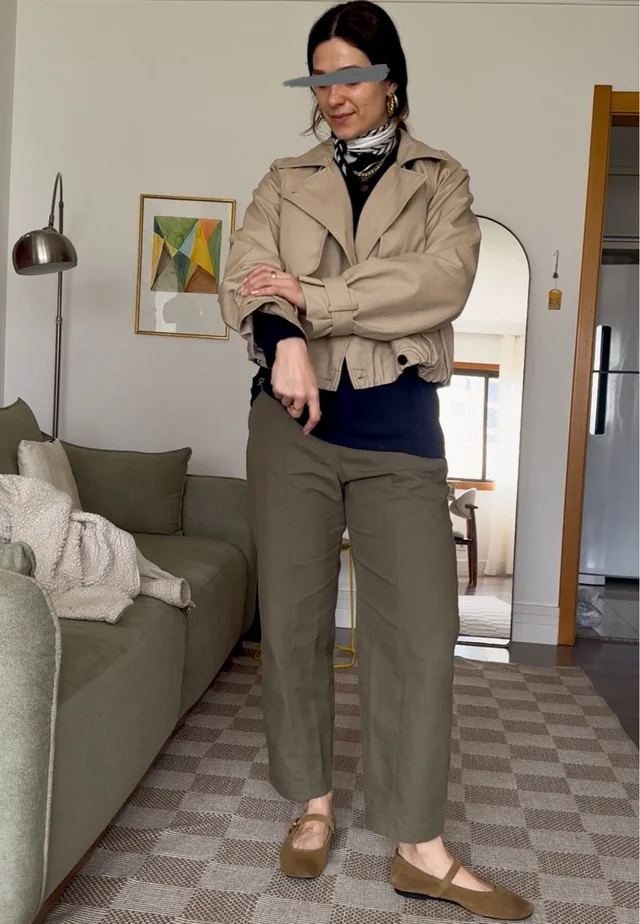
Layering logic and the "third piece." Parisian silhouette is organized around a three-element system: a base (skin-adjacent garment — blouse, t-shirt, knit), a frame (structured garment — blazer, jacket, coat), and a "third piece" (scarf, bag, shoe, or single jewelry item) that provides focal point and visual completion without ornamental accumulation. The layering is not thermal but semiotic — each layer adds visual information (texture contrast, proportion shift, color accent) rather than insulation. The trench coat, worn open and belted loosely (never buckled), provides a final exterior layer whose movement and drape in urban walking produces the characteristic Parisian silhouette in motion: a controlled billow around the legs, a lapel that shifts with stride, a belt that swings slightly — all effects that depend on gabardine's body and weight, and that polyester-blend trench imitations cannot reproduce because lighter fabric lacks the inertial mass that produces proper drape behavior.
As a result, Parisian silhouette communicates composure through accommodation: the body appears dressed by someone who understands proportion, fabric, and fit but who has not permitted that understanding to produce visible effort. The relaxation is engineered, not accidental — and the gap between the appearance of ease and the construction that produces it is the aesthetic's central formal achievement.
Materials
Material selection is Parisian chic's primary quality discriminator and the domain where the aesthetic's construction logic is most empirically verifiable. The category's credibility depends on a narrow range of natural fibers whose performance properties — drape, hand feel, aging behavior, laundering response — produce specific visual and tactile results that synthetic substitutes approximate visually but fail to replicate materially.
Wool suiting and blazer cloth. French-market blazer fabrics are predominantly worsted or semi-worsted wools from Italian (Biella-district) mills, sourced through Paris-based cloth merchants. The target specification is a Super 100s–130s wool (fiber diameter 18.5–15.5 microns), woven in a plain or twill weave at 240–300 g/m². At this weight and fineness, the cloth drapes close to the body without collapsing (lighter cloths lose shape; heavier cloths resist draping), takes a soft press without holding a rigid crease, and recovers from wrinkling within hours of hanging — properties that are essential because the Parisian blazer is worn without the structural canvas that sustains shape in English tailoring, meaning the cloth itself must provide sufficient body. Dormeuil's "Amadeus" and "Iconik" ranges, Holland & Sherry's "Sherry Stretch" and "City of London," and Vitale Barberis Canonico's "Perennial" line are frequently specified in Parisian prêt-à-porter production. Failure modes include shine development at seat and elbow from friction-induced fiber flattening (visible after 80–120 wears without rotation), moth damage in storage (keratin-fiber vulnerability), and progressive shape loss at shoulder and elbow when half-canvas or fused construction cannot maintain form against the body's heat and moisture — a failure that accelerates in lighter-weight cloths and is the primary reason Parisian blazers require more frequent replacement than heavier English counterparts.
Silk blouse fabrics. Silk crêpe de chine (12–16 momme) and silk charmeuse (16–22 momme) are the principal blouse textiles. Momme weight (a unit measuring the weight of a standard-dimension bolt of silk; one momme equals approximately 4.34 g/m²) determines opacity, drape weight, and durability: below 12mm, crêpe de chine becomes translucent and fragile; above 16mm, it loses the fluid movement that distinguishes silk blouses from cotton or polyester alternatives. Charmeuse's satin-face weave produces a light-reflecting surface that reads as richness without ornament — the fabric's luster performs the work that jewelry or embellishment would perform in other aesthetic systems. The critical failure mode of silk in urban wear is water spotting: water droplets (rain, perspiration, spilled beverages) cause localized fiber swelling that disrupts the weave's light-reflection pattern, creating visible marks that cannot be removed without full laundering or dry cleaning. This vulnerability is the material basis of the Parisian woman's noted caution around rain — not mere fastidiousness but rational garment preservation — and the reason the silk scarf (Hermès carré, 90cm × 90cm, in 28-momme twill) functions simultaneously as accessory and blouse-protection device when draped over the shoulders in light precipitation. Polyester charmeuse approximates silk's visual luster but fails its hand-feel test (polyester is warmer against skin, lacks silk's temperature-adaptive coolness) and its drape test (polyester falls in stiffer, more uniform folds rather than the irregular, responsive draping of natural silk).
Breton marinière cotton. The authentic marinière knit uses a combed, long-staple cotton (30–40mm fiber length, typically Egyptian or Supima grade) in a 20-gauge interlock construction. Long-staple cotton produces a smoother yarn with fewer protruding fiber ends, resulting in a surface that resists pilling — the formation of small surface balls through fiber entanglement — which is the primary failure mode in marinière-type garments. Interlock knit (a double-faced jersey where face and back are identical) provides dimensional stability that single-jersey knits cannot match: interlock resists curling at edges, maintains stripe alignment through washing, and provides a denser hand feel that reads as "quality" against the skin. Saint James's "Guildo" and "Minquiers" marinières and Armor-Lux's "Breton Striped" range represent the category benchmark. Mass-market marinière imitations typically use ring-spun or open-end cotton in a finer gauge single jersey, producing garments that stretch and deform after 10–15 wash cycles, develop pilling within the first season, and lose stripe definition through differential shrinkage between colored and white yarns.
Gabardine for trench coats. The trench coat's weather performance derives entirely from gabardine's weave construction. A true gabardine is a twill weave with a high warp-to-weft density ratio (typically 2:1 or higher), producing a fabric whose surface presents tightly packed diagonal ridges that shed water through capillary deflection — water droplets bead on the surface and roll off before penetrating between fibers, much as rain runs off a thatched roof. This water resistance is structural, not chemical: it does not require DWR coating and does not degrade with washing, though it diminishes if the weave loosens through wear or if the fabric is stored under compression that flattens the twill ridges. Cotton gabardine (the traditional Burberry/Aquascutum specification) is the heritage standard; worsted wool gabardine (lighter, warmer, with better wrinkle recovery) is increasingly common in French production. The critical distinction is between gabardine's woven water resistance and the polyester-with-DWR construction used in mass-market trench imitations — the former is permanent and maintenance-free; the latter degrades through laundering and UV exposure, requiring reapplication every 15–25 washes.
Denim in the Parisian system. Denim occupies a specific position in the Parisian wardrobe: it provides the "casual anchor" against which structured upper-body garments read as intentionally relaxed rather than formally dressed. The Parisian denim specification is a mid-weight (11–13 oz), relatively clean rinse or vintage-wash selvedge or quality shuttle-less denim, in a straight or slightly tapered cut. A.P.C.'s "New Standard" and "Petit Standard" (Breton-Japanese selvedge, 12.5 oz, Kaihara-woven) established the template for contemporary Parisian denim: dark indigo, minimal distressing, clean finishing without contrast stitching, and a gradual fade pattern that develops over months of wear to produce the appearance of garments "lived in" rather than purchased in a distressed state. The fade development itself is a form of Parisian chic's time-investment logic: the jeans must be worn consistently and washed infrequently (A.P.C. famously recommends 6 months before first wash) to develop the personalized wear patterns that signal authentic use rather than manufactured aging.
Hair and cosmetic material systems. Parisian beauty operates as a materials regime no less specific than its textile counterpart. The "French pharmacy" skincare system — built on thermal water-based products (La Roche-Posay, Avène, Vichy), micellar water (Bioderma Sensibio H2O, the cult product), retinol-based treatments, and sunscreen as daily non-negotiable — represents an investment-forward approach where skincare expenditure substitutes for makeup application. The material logic is preventative: maintaining skin quality through active ingredients (hyaluronic acid, niacinamide, retinoids, vitamin C serums) reduces the need for cosmetic coverage, permitting the "bare face" effect that is actually a product of sustained chemical maintenance. Hair products follow the same logic: French women's reportedly effortless hair depends on texturizing sprays (salt-based or dry-texture formulations), diffused rather than blow-dried curl patterns, and strategic cut architecture (the "French bob," typically chin-length with face-framing layers and minimal layering at the back, or the "Parisian shag" with curtain bangs) that produces volume and movement without heat-styling labor. The French pharmacie itself — Citypharma on Rue du Four, Pharmacie Monge, the online extension through Parapharmacie — functions as an institutional retail space where the material science of the beauty regime is accessible at regulated prices, producing a class-leveling effect within the skincare domain that has no equivalent in the fashion domain.
Color Palette
The palette operates on a principle of chromatic restraint that reduces the color-combination problem space to a narrow range where almost any combination produces visual coherence — a systems-engineering approach to getting dressed that minimizes error probability while maximizing perceived sophistication.
The foundational palette — navy, black, white, cream, grey (from pale silver to charcoal), and camel — constitutes the load-bearing color infrastructure. These colors dominate because they satisfy overlapping requirements: they are mutually intercombinable (any two-color pairing from this set produces a harmonious outfit), they read as intentional across all seasonal and lighting contexts, they resist trend-cycle dating (a navy blazer from 2008 reads identically to one from 2024), and they accommodate the texture variations (matte wool, glossy silk, soft knit, rigid denim) that provide visual interest within the Parisian system. Navy is the true center of the palette — more versatile than black (which can read as severe or subcultural), richer than grey, and more universally flattering across skin tones. The Parisian preference for navy over black is not arbitrary but functional: navy's warm undertone softens facial shadowing and complements the gold-toned jewelry (small hoops, thin chains, signet rings) that the aesthetic favors.
Accent colors are deployed as strategic interruptions of the neutral base: red (Parisian red, a warm, blue-based true red distinct from orange-reds or cool berry-reds — the exact shade calibrated to skin tone, typically applied as lipstick rather than as garment color, though red is permissible in knits, scarves, and occasionally skirts), burgundy (fall-winter accent), forest green (muted, never bright), and écru (year-round neutral that softens white's starkness in winter light). Color-blocking and pattern-mixing are largely absent from the core Parisian palette; when pattern appears, it is through the marinière stripe, a modest floral on a silk blouse, or the geometric print of an Hermès carré — never through competing patterns on different garments in the same outfit.
Seasonal modulation is subtle rather than dramatic: summer shifts from navy-and-white to navy-and-cream-and-tan, introducing lighter-weight visible textures (linen, open-weave cotton) that read as "summer" through materiality rather than through color change. Winter deepens the palette toward charcoal, black, dark navy, and burgundy, but the structure remains unchanged. This seasonal stability is itself a class signal — it implies a wardrobe of sufficient quality and range that seasonal participation requires styling adjustment rather than new acquisition.
Details
Details in Parisian chic are best understood as calibrated signaling interfaces — elements whose deployment communicates the wearer's relationship to the aesthetic's rule system through the precision with which they are applied and the restraint with which they are limited.
The cuff roll and sleeve management. A blazer sleeve pushed back to mid-forearm, a shirt cuff rolled twice to rest just below the elbow, a marinière sleeve scrunched to three-quarter length — these sleeve-management operations are the aesthetic's most accessible styling gestures. They serve a dual function: practically, they expose the wrist and lower forearm, reducing thermal encumbrance in indoor or mild-weather contexts; semiotically, they signal casualness within formality, the wearer demonstrating that the garment is a tool to be adjusted rather than a uniform to be preserved. The specific technique matters: a blazer sleeve should be gently pushed (not folded) to produce an irregular compression with visible interior lining at the cuff edge; a shirt cuff should be folded exactly twice (three or more folds signals workwear or manual-labor coding); a marinière sleeve should be scrunched rather than folded, producing an asymmetric compression. These instructions sound absurdly precise — and their precision is exactly the point: the "effortless" roll is in fact a codified gesture with specific acceptable parameters.
Jewelry as punctuation, not accumulation. The Parisian jewelry rule is subtraction: one or two pieces maximum, selected for proportion and permanence rather than for trend. Small gold hoop earrings (14–16mm diameter, in 18k yellow gold or high-quality gold-plated brass), a thin gold chain (16–18 inches), a watch (historically a Cartier Tank, more recently a vintage-market find or minimal-design piece), or a signet ring constitute the acceptable range. The functional logic is anti-ornamental: jewelry should appear as though it has been worn continuously for years rather than selected for the occasion, implying that the wearer's relationship to adornment is one of permanent, unconscious habit rather than deliberate daily curation. Hermès bangles (the "Clic Clac" or enamel bracelet) and the Chanel camellia brooch are exceptions that prove the rule — they are acceptable because their design is restrained enough to read as permanent fixtures rather than statement pieces, and because their brand legibility is accessible only to initiates (no external logos, recognition dependent on design literacy).
The red lip as material system. Red lipstick is Parisian chic's single most economical signaling device — a small cosmetic investment that transforms a neutral outfit into a coded statement. The material specification is precise: a satin or matte-satin finish (never glossy, which reads as pop-culture Americana; never fully matte, which reads as editorial or subcultural), in a warm blue-red or neutral-red shade (never orange-red, which reads as Italian or Latin American; never cool berry-red, which reads as English). Application must appear unhurried but not precise — a slightly blurred lip line (achieved through finger-blotting after application) is preferred over a hard-edged, liner-defined outline. This controlled imprecision is the cosmetic equivalent of the pushed-back blazer sleeve: it signals mastery through the willingness to deviate from perfection.
Hair as anti-styling system. Parisian hair is defined by what it refuses: it refuses blowout smoothness (American coding), it refuses voluminous curls (Southern European or Latin coding), it refuses architectural structure (editorial or avant-garde coding), and it refuses overt color processing (visible roots, balayage contrast bands, unnatural tones). What it accepts is air-dried texture, slight asymmetry, face-framing movement, and a color within two shades of the natural base. This refusal system is itself a maintenance regime: the "undone" appearance depends on strategic cutting (internal layers that produce movement without visible graduation), appropriate product application (texturizing spray or lightweight mousse worked through damp hair and air-dried), and regular trimming (every 6–8 weeks to maintain the shape architecture that produces seemingly shapeless results).
Buttons, closures, and the open collar. The unbuttoned shirt collar — one or two buttons left open on a cotton or silk blouse, exposing the collarbone and upper sternum — is the aesthetic's most coded detail. It manages the reveal-conceal ratio that governs Parisian sexual signaling: enough exposure to register as sensual, not enough to register as provocative. The specific button count matters: one button open reads as relaxed; two reads as confident and slightly alluring; three reads as deliberate and is reserved for contexts (evening, editorial) where overt sensuality is appropriate. A blazer worn with all buttons closed reads as corporate; with one button fastened (the middle button on a three-button, the single button on a one-button) it reads as Parisian; with all buttons open it reads as casual-editorial. These closure-state conventions are not written rules but embodied knowledge transmitted through observation within the social field.
Accessories
Accessory systems in Parisian chic extend the same restraint-as-distinction logic as garments, forming an integrated urban-mobility kit that prioritizes durability, proportion, and material quality over ornamental variety.
Footwear as foundation. Ballet flats (Repetto "Cendrillon," the category-defining example, using lambskin or goatskin upper on a thin leather sole with cotton-canvas lining) provide the aesthetic's signature foot silhouette: low, unadorned, proportionally small against the leg line, permitting rapid walking on Parisian sidewalks and Métro stairs. The material failure mode is sole wear-through — Repetto's leather soles are 3–4mm thick and wear through at the ball of the foot within 3–6 months of regular Parisian walking (estimated 8,000–12,000 steps/day on stone and concrete surfaces), requiring resoling at a cordonnier (cobbler) for EUR 25–40 per service. This maintenance cycle is built into the economic logic of the aesthetic: ballet flats are not disposable but they are not permanent; they require periodic professional maintenance that assumes access to a local cobbler and willingness to invest in repair rather than replacement. Loafers (J.M. Weston's "180" moccasin, a Goodyear-welted loafer in box calf that requires a 50–100-hour break-in period during which the rigid sole conforms to the foot) provide the alternative flat-shoe option, with significantly greater durability (5+ years with resoling) but higher initial cost (EUR 500+) and a masculine-coded silhouette that sits within the androgynous range of the aesthetic. Ankle boots (low-heeled, 4–6cm, in black or dark brown leather, either Chelsea construction or side-zip) serve as the cold-weather foundation. High heels are permitted but constrained: block heels (5–7cm) rather than stilettos, in proportions that permit walking rather than requiring vehicular transport — a functional test that reflects Parisian chic's pedestrian-urban orientation.
Bags as investment architecture. The structured leather bag is the aesthetic's highest-investment accessory category and its most visible brand-signaling device. The hierarchy runs from Hermès (Birkin, Kelly — objects operating as financial instruments as much as accessories, with secondary-market values exceeding primary retail by 50–200%), through Chanel (Classic Flap, 2.55 — quilted lambskin or caviar calfskin, chain-interlaced-leather strap), to heritage houses with lower secondary-market premium (Celine "Classic," Saint Laurent "Sac de Jour," Dior "Lady Dior"), to contemporary-design-led options (A.P.C. "Half-Moon," Polène, Le Tanneur) and the straw market basket (panier, associated with Jane Birkin's Parisian summer iconography and available from any Parisian marchande for EUR 10–30). The material specification across all tiers is full-grain leather (not corrected grain, not bonded leather, not PU), and the quality hierarchy is legible through: edge-finishing method (hand-painted and burnished > folded and glued > raw-cut), hardware weight (solid brass or palladium > plated zinc alloy), lining material (leather or twill cotton > polyester), and stitching regularity (saddle-stitched by hand > machine-stitched). The "investment bag" logic is Parisian chic's most explicit articulation of its economic substrate: it acknowledges that the aesthetic requires capital outlay while framing that outlay as rational (cost-per-wear over decades of use) rather than as luxury consumption.
Scarves as multifunctional interface. The Hermès carré (90cm silk twill, 28 momme, hand-rolled edges, screen-printed in up to 40 colors per design) is the category's apex scarf object, functioning simultaneously as neck adornment, hair accessory, bag decoration, blouse protection (against rain, as noted above), and portable art object. The cashmere scarf (light-gauge, 200–300g, in solid neutral or muted tartan) provides cold-weather neck and chest insulation in a format that replaces the more voluminous woolen scarves of northern European traditions. The scarf is the aesthetic's most versatile detail — its deployment (knotted at the throat, draped over shoulders, tied to a bag handle, wound into hair) provides daily variation within the system's narrow garment range.
Body Logic
Parisian chic conceptualizes the body as a display surface that should be revealed selectively and framed proportionally rather than either concealed (as in modest-dress systems) or maximally displayed (as in body-con or beachwear-derived aesthetics). The body is managed through a reveal-conceal ratio that typically exposes one zone — collarbones, forearms, ankles, or the line of the waist — while covering the rest, producing a sexuality that operates through suggestion rather than exposition.
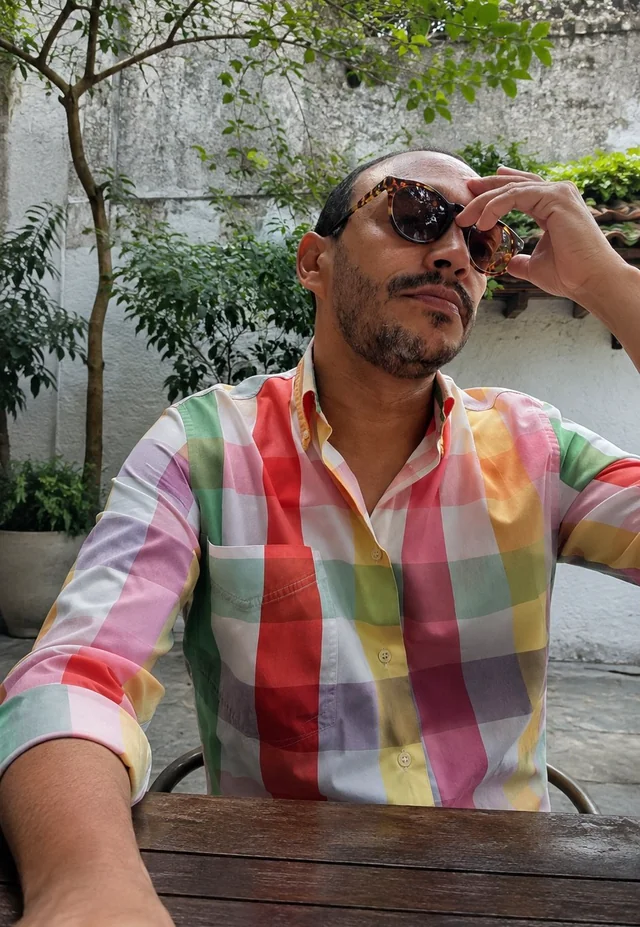
Gender coding is historically heteronormative but structurally flexible. The aesthetic developed around the female body as primary site — Chanel, Dior, Saint Laurent, and subsequent designers all addressed women as their principal audience — and its vocabulary (the blazer, the silk blouse, the ballet flat, the red lip) encodes a specifically feminine subject position. However, Saint Laurent's Le Smoking established a formal precedent for masculine-coded garments on female bodies, and the contemporary Parisian wardrobe includes significant borrowing from masculine dress (oversized blazers, straight trousers, loafers, men's-department shirting) that produces an androgynous zone the aesthetic actively cultivates. Male Parisian chic — less codified, less globally exported — operates through similar principles (navy blazer, quality knitwear, well-fitting trousers, leather shoes, restraint in accessories) but with even less tolerance for visible effort; the Parisian man's style ideal is a composure so complete that it appears to have been achieved without thought, which in practice requires the same construction literacy and maintenance investment as its female counterpart.
The body's age is uniquely valued in Parisian chic relative to other contemporary fashion systems. Where many global fashion cultures optimize for youth, Parisian chic explicitly valorizes aging — the "Frenchwoman" archetype is mature (40s–60s), not young (20s), and the aesthetic's emphasis on quality materials, precise fit, and minimal makeup presumes a body that has developed sufficient self-knowledge to dress without experimentation. This age-positive orientation has material consequences: it favors garments that accommodate rather than restrict (soft-structured blazers over tight bodices), colors that complement changing skin tones (navy and cream over pure black and white), and beauty regimes that maintain skin health (retinoids, sunscreen, moisturizer) over cosmetic coverage designed for youthful performance.
The concealed labor that sustains the Parisian body — tailoring appointments, regular laundering and pressing, cobbler visits, skincare routines, hair maintenance, and the replacement cycles for items that degrade through use — constitutes an invisible infrastructure of time and money. Bourdieu's concept of embodied cultural capital is directly applicable and was developed precisely through the study of French class structures: the "natural" elegance of the bourgeoise parisienne is the product of socialization — childhood exposure to quality garments, learned evaluation of fabric and fit, absorbed knowledge of which colors, proportions, and gestures are "correct" — that is experienced subjectively as taste but functions structurally as class reproduction.
Garment Logic
Parisian garment logic begins with interchangeability engineering: garments are designed, selected, and maintained to combine across contexts (work, weekend, evening, travel) without friction, producing a wardrobe whose total combinatorial output vastly exceeds its piece count. The technical infrastructure supporting this interchangeability includes standardized color range (ensuring cross-garment color compatibility), consistent proportion grammar (ensuring that any top combines with any bottom without visual conflict), and quality maintenance protocols that keep garments within their performance specifications across multi-year service lives.
Blazer construction and maintenance. The Parisian blazer's half-canvas or fused construction produces a garment that is lighter and less structured than full-canvas sartorial alternatives but more vulnerable to shape degradation over time. Fused interlinings (thermoplastic adhesive bonding a non-woven interfacing to the shell fabric) are susceptible to delamination — separation of the interfacing from the shell through heat, moisture, and dry-cleaning solvent exposure — producing visible bubbling on the chest and lapel that is irreversible and constitutes garment failure. Half-canvas construction (canvas chest piece in the upper chest and lapel, fused interfacing below) provides a compromise: the canvas drapes naturally and will not bubble, but the fused lower section remains vulnerable. Maintenance requires rotation (no more than two consecutive days of wear before resting to allow wool fibers to recover from body-heat-induced deformation), hanging on contoured wooden hangers (wire hangers distort shoulder shape within weeks), light brushing after each wear (to remove surface particulate that would abrade fiber), and steam pressing (never direct-iron contact on wool, which produces irreversible shine through fiber crushing). Dry cleaning should be minimized (the perchloroethylene solvent strips natural lanolin from wool, accelerating fiber degradation) in favor of spot cleaning and steaming.
Silk blouse care and failure modes. Silk is chemically weakened by both alkaline detergents and chlorine-containing water, requiring pH-neutral silk-specific cleaners or hand-washing in distilled or filtered water. Machine washing, even on delicate cycles, subjects silk to agitation forces that break down the fibroin protein structure, producing irreversible roughening of the fabric surface (the transition from lustrous smoothness to a matte, pilled texture). Perspiration stains are silk's second-major failure mode: the salts and proteins in sweat react with silk dyes, causing permanent discoloration in underarm and neckline areas that is resistant to conventional cleaning. Garment shields (thin absorbent pads worn inside the garment at the underarm) are a maintenance technology that experienced silk-blouse wearers deploy to prevent this damage. Proper silk storage requires acid-free tissue paper interleaving (to prevent color transfer between stored garments) and cedar or lavender sachets (to deter silk moths, whose larvae consume silk protein fibers).
Denim aging protocol. The Parisian denim regimen — purchase raw or dark-wash, wear frequently, wash infrequently (every 2–4 weeks for dark-wash; every 4–6 months for raw), cold water, inside-out, hang dry, no tumble-drying — is a material-science protocol whose objective is to manage indigo loss and cellulose degradation rates to produce a specific aging trajectory. Frequent washing accelerates indigo loss (producing pale, undifferentiated fading) and cellulose chain scission (producing premature fabric thinning), while extended unwashed wear allows crease-pattern formation (the mechanical basis of whisker and honeycomb fades) and controlled surface-indigo loss at high-abrasion points. The investment calculation is temporal: 6–12 months of consistent wear transforms a generic dark-denim trouser into a personalized garment whose fade pattern is as unique as a fingerprint.
Trench coat seasonality and storage. Cotton gabardine trench coats require hanging storage on broad-shouldered wooden hangers to maintain shoulder shape, and must be fully dried before storage to prevent mildew in the tightly woven fabric. The belt should be tied (never buckled) in storage to prevent metal-mark transfer to the cotton. Wool gabardine variants require the same care as blazers: rotation, brushing, minimal dry cleaning. The trench coat's seasonal range is determined by its material: cotton gabardine is optimal for 10–20C temperatures; below 10C it requires layering beneath that can distort the silhouette; above 20C it becomes thermally oppressive. This temperature range maps precisely onto Parisian spring (March–May) and autumn (September–November), making the trench a biannual garment rather than a year-round staple — a seasonality that the aesthetic acknowledges through storage-and-retrieval rituals.
Replacement economics and cost-per-wear analysis. The Parisian wardrobe's economic logic favors high initial investment amortized over long service life, producing low cost-per-wear. A well-maintained navy blazer (EUR 400–800 initial cost, 5–8 years of regular use = EUR 80–160 per year) achieves a cost-per-wear of EUR 0.50–1.00 per wearing if worn 2–3 times per week. A silk blouse (EUR 150–350, 3–5 years with proper care, worn weekly = EUR 30–70 per year) achieves a comparable rate. Ballet flats, due to their rapid sole degradation, are the system's highest-cost-per-wear item (EUR 200 purchase + EUR 70/year in resoling, 2-year maximum body life = EUR 135/year), which explains the economic logic of investing in resoleable loafers or boots for daily wear and reserving ballet flats for lower-mileage occasions. This cost analysis reveals Parisian chic's class infrastructure in material terms: the "simple" wardrobe requires not only the capital for initial purchase but the ongoing maintenance investment (cobbler, dry cleaner, cedar hangers, silk detergent, garment bags) that sustains garment quality across multi-year service lives.
Motifs / Themes
Dominant themes include effortlessness as engineered performance, restraint as taste signal, repetition as confidence marker, quality-over-quantity as economic and moral logic, and the city of Paris itself as environmental stage for the aesthetic's deployment. The Parisian wardrobe presents the wearer as someone whose relationship to clothing is resolved — choices have been made, a system has been established, and daily dressing is an act of execution rather than exploration.
The "capsule wardrobe" concept, though not exclusively Parisian in origin, finds its most culturally resonant expression in Parisian chic's wardrobe grammar. The idea that 15–20 high-quality garments in a coordinated palette can produce a year's worth of outfits without repetition fatigue is both a practical strategy and a mythological claim: it implies that the wearer has achieved a level of self-knowledge and material discernment that renders constant acquisition unnecessary. This claim is complicated by the reality that most participants in the aesthetic own significantly more than 20 garments and engage in regular seasonal acquisition — the "capsule" ideal functions as regulatory aspiration rather than descriptive reality.
The "Parisienne" as identity figure — Inès de la Fressange, Jeanne Damas, Caroline de Maigret, Garance Doré, and their predecessors — operates as a brand-like construct: a composite image assembled from photography, editorial text, social media, and commercial endorsement that presents a specific set of garments, grooming practices, and lifestyle markers as an integrated identity available for adoption. The commercial productivity of this figure is enormous: books (Parisian Chic, How to Be Parisian Wherever You Are, Love Style Life), brands (Rouje, Sézane, Musier Paris), and content platforms have generated significant revenue by offering global consumers instructions for becoming "Parisian."
Cultural Touchstones
Cinema. Jean Seberg in Breathless (1960, Jean-Luc Godard): pixie haircut, Breton-stripe marinière, cropped trousers, New York Herald Tribune — the single most influential Parisian-chic image in cinema, establishing the template of casual-intellectual street style that subsequent iterations would refine but never fully replace. Anna Karina in Vivre sa vie (1962, Godard) and Bande à part (1964): dark bob, simple shift dresses, kohl-lined eyes — the existentialist-feminine complement to Seberg's gamine. Catherine Deneuve in Belle de Jour (1967, Luis Buñuel): Yves Saint Laurent-dressed bourgeoise whose structured coats, low heels, and restrained palette established the "composed Parisienne" archetype. Audrey Tautou in Amélie (2001, Jean-Pierre Jeunet): bob, red lip, green color palette — a whimsical-romantic Parisian variant that became the 2000s gateway to the aesthetic for global audiences. Léa Seydoux's Bond films (2015, 2021) and art-house work: contemporary Parisian chic translated through minimal-makeup, tousled-hair, restrained-palette red-carpet presentations that refuse Hollywood maximalism.
Music and celebrity. Françoise Hardy (1960s–1970s): long hair, simple shifts, geometric patterns — yé-yé pop's visual contribution to the Parisian archive. Jane Birkin (1970s–1990s): the basket bag, the unbuttoned men's shirt, the faded jeans, the fringe — a bohemian-Parisian template whose influence on the aesthetic is second only to Chanel's. Serge Gainsbourg (1960s–1990s): rumpled suit, open collar, cigarette, three-day stubble — the male Parisian chic archetype whose deliberate dishevelment was indistinguishable from genuine indifference. Charlotte Gainsbourg (1990s–present): inherited the parent-figures' combined aesthetic — intellectual, minimal, gender-fluid, anti-glamorous — and translated it into the contemporary era. Timothée Chalamet: French-American fluidity that updates Parisian menswear codes through youth-culture inflection while maintaining the category's emphasis on proportion and restraint.
Publishing and editorial. Carine Roitfeld's editorship of Vogue Paris (2001–2011): repositioned the magazine toward a sexually charged, fashion-forward Parisian aesthetic that influenced global editorial standards. How to Be Parisian Wherever You Are (Anne Berest, Audrey Diwan, Caroline de Maigret, Sophie Mas, 2014): the book that most explicitly codified (and satirized) the "Parisienne" as exportable lifestyle product. Garance Doré's blog and Love Style Life (2015): street-style photography that documented the aesthetic with apparent naturalism while applying curatorial selection.
Fashion moments. Coco Chanel's little black dress (1926, Vogue's "Chanel's Ford"): the foundational garment-concept of democratic Parisian chic. Yves Saint Laurent's Le Smoking (Autumn 1966): the tuxedo suit for women that formalized Parisian chic's borrowing from masculine tailoring. Hermès Birkin bag origin (1984, Jane Birkin's encounter with Jean-Louis Dumas on an Air France flight): the anecdotal origin of the aesthetic's apex accessory, linking Parisian chic to artisanal French leather craftsmanship.
See Also
- Quiet luxury: Shares restraint and quality signaling but aims for seamless invisibility where Parisian chic tolerates controlled imperfection
- Sartorial: Shares tailoring vocabulary but operates at higher structural formality and visible construction pride
- Minimalism: Shares reduction logic but applies it programmatically across all categories rather than selectively
- Gamine: Historical overlap through Seberg, Bardot, Hepburn — the playful-youthful variant of Parisian restraint
- Old money / stealth wealth: Adjacent class coding, overlapping material standards, but Anglo-American cultural orientation versus French
- Continental European style: Broader geographic category within which Parisian chic is the most codified and globally exported variant
- Bohemian: Parisian-bohemian overlap through Left Bank intellectual tradition (Birkin, Gainsbourg, Saint-Germain)
- Capsule wardrobe philosophy: Shared quality-over-quantity framework, with Parisian chic providing the most culturally specific implementation
Brands and Designers
Heritage Maisons (Haute Couture / Prêt-à-Porter):
- Chanel (founded 1910, Paris): tweed jacket, little black dress, 2.55 bag, No. 5 — foundational grammar of modern Parisian chic
- Dior (1946, Paris): New Look reconstruction of Parisian fashion authority, Lady Dior bag, Bar jacket
- Yves Saint Laurent / Saint Laurent (1961, Paris): Le Smoking, Rive Gauche prêt-à-porter, the safari jacket — expanded the Parisian woman's garment vocabulary
- Hermès (1837, Paris): Birkin, Kelly, carré silk scarf, saddle-stitched leather goods — the apex of Parisian artisanal luxury
- Celine (1945, Paris; under Phoebe Philo 2008–2018, reimagined Parisian minimalism for the 2010s; Hedi Slimane 2018–present)
- Givenchy (1952, Paris): Audrey Hepburn collaboration, refined Parisian elegance
- Balenciaga (1937, Paris, Spanish origin): Cristóbal's sculptural couture; Demna Gvasalia's contemporary deconstruction
Contemporary French Houses:
- Isabel Marant (1994, Paris): bohemian-Parisian hybrid, the wedge sneaker, relaxed tailoring with Left Bank inflection
- Jacquemus (2009, Paris/Marseille): sun-drenched southern-French alternative to Parisian restraint, Le Chiquito micro-bag
- Lemaire (1992, Paris; Christophe Lemaire and Sarah-Linh Tran): quiet, material-focused Parisian minimalism
- AMI Paris (2011, Alexandre Mattiussi): accessible Parisian menswear and unisex wardrobe staples
- Officine Générale (2012, Pierre Mahéo): fabric-first Parisian wardrobe essentials, Italian-milled materials in French-proportioned silhouettes
- Maison Kitsuné (2002, Paris/Tokyo): Franco-Japanese lifestyle brand bridging Parisian chic and Japanese quality culture
Heritage Specialty (Non-Couture):
- Saint James (1889, Normandy): marinière production since French naval supply contracts, the benchmark Breton stripe
- Armor-Lux (1938, Quimper, Brittany): marinière and Breton-knit specialist, organic cotton transition
- Repetto (1947, Paris): ballet-flat production originating in dance-shoe manufacture, the "Cendrillon" as category-defining flat
- J.M. Weston (1891, Limoges): Goodyear-welted French shoemaking, the "180" loafer requiring 150-step hand construction
- Paraboot (1908, Izeaux): Norwegian-welted shoes, the "Michael" as Parisian casual-footwear standard
- K.Jacques (1933, Saint-Tropez): handmade leather sandals — the Parisian summer-footwear benchmark
- Longchamp (1948, Paris): the "Le Pliage" nylon-and-leather folding bag as the most ubiquitous Parisian everyday bag
- Goyard (1853, Paris): hand-painted canvas trunks and bags, old-money Parisian signaling pre-dating the Hermès Birkin mythology
Bridge / Accessible French:
- Sézane (2013, Morgane Sézalory): digital-native Parisian wardrobe at accessible pricing, monthly capsule drops
- Rouje (2016, Jeanne Damas): Instagram-Parisienne aesthetic translated into commercial brand, vintage-inspired silhouettes
- A.P.C. (1987, Jean Touitou): denim-anchored Parisian minimalism, "New Standard" as the benchmark Parisian jean
- Ba&sh (2003, Paris): bohemian-bourgeois wardrobe for the Parisian professional
- Sandro (1984, Paris) and Maje (1998, Paris): SMCP-group brands offering trend-responsive Parisian wardrobe at mid-market pricing
- The Kooples (2008, Paris): rock-inflected Parisian couple-dressing aesthetic
- Petit Bateau (1893, Troyes): cotton undergarments and marinières originally for children, adopted as adult basics in Parisian wardrobes
- Musier Paris (2018): Instagram-era Parisian basics with vintage reference
French Pharmacy / Beauty:
- Bioderma (Sensibio H2O micellar water — the cult Parisian cleansing product)
- La Roche-Posay, Avène, Vichy (thermal-water-based skincare constituting the "French pharmacy" material regime)
- Embryolisse (Lait-Crème Concentré — backstage staple at Paris Fashion Week, dual-function moisturizer-primer)
- Caudalie (Bordeaux-based vinotherapy skincare, "French natural" positioning)
Citations
[1] Bourdieu, Pierre. Distinction: A Social Critique of the Judgement of Taste. Translated by Richard Nice, Harvard University Press, 1984. [Originally published 1979; foundational analysis of French class and taste.] [2] Barthes, Roland. The Fashion System. Translated by Matthew Ward and Richard Howard, University of California Press, 1983. [3] Barthes, Roland. Mythologies. Translated by Annette Lavers, Hill and Wang, 1972. [Semiotic analysis of French cultural constructs, directly applicable to the "Parisian chic" myth.] [4] Lipovetsky, Gilles. The Empire of Fashion: Dressing Modern Democracy. Princeton University Press, 1994. [5] Steele, Valerie. Paris Fashion: A Cultural History. Revised ed., Berg, 1998. [The standard English-language history of Parisian fashion as institutional system.] [6] Steele, Valerie. Women of Fashion: Twentieth-Century Designers. Rizzoli, 1991. [7] DeJean, Joan. The Essence of Style: How the French Invented High Fashion, Fine Food, Chic Cafés, Style, Sophistication, and Glamour. Free Press, 2005. [Traces the mercantile and state-policy origins of French luxury.] [8] Troy, Nancy J. Couture Culture: A Study in Modern Art and Fashion. MIT Press, 2003. [9] Grumbach, Didier. Histoires de la mode. Éditions du Regard, 2008. [Institutional history of French fashion from the Chambre Syndicale perspective.] [10] de la Fressange, Inès, with Sophie Gachet. Parisian Chic: A Style Guide. Flammarion, 2011. [11] Berest, Anne, Audrey Diwan, Caroline de Maigret, and Sophie Mas. How to Be Parisian Wherever You Are: Love, Style, and Bad Habits. Doubleday, 2014. [12] Doré, Garance. Love Style Life. Spiegel & Grau, 2015. [13] Entwistle, Joanne. The Fashioned Body: Fashion, Dress and Social Theory. 2nd ed., Polity, 2015. [14] Kawamura, Yuniya. Fashion-ology: An Introduction to Fashion Studies. 2nd ed., Bloomsbury Academic, 2018. [15] Crane, Diana. Fashion and Its Social Agendas: Class, Gender, and Identity in Clothing. University of Chicago Press, 2000. [16] Wilson, Elizabeth. Adorned in Dreams: Fashion and Modernity. Revised ed., Rutgers University Press, 2003. [17] Breward, Christopher. Fashion. Oxford University Press, 2003. [18] Hollander, Anne. Seeing Through Clothes. University of California Press, 1993. [19] Hollander, Anne. Sex and Suits: The Evolution of Modern Dress. Kodansha International, 1994. [20] Rocamora, Agnès. Fashioning the City: Paris, Fashion and the Media. I.B. Tauris, 2009. [Media construction of Paris as fashion capital.] [21] Rocamora, Agnès. "Fields of Fashion: Critical Insights into Bourdieu's Sociology of Culture." Journal of Consumer Culture, vol. 2, no. 3, 2002, pp. 341–362. [22] Charles-Roux, Edmonde. Chanel and Her World. Vendome Press, 2005. [23] Garelick, Rhonda K. Mademoiselle: Coco Chanel and the Pulse of History. Random House, 2014. [24] Rawsthorn, Alice. Yves Saint Laurent: A Biography. Nan A. Talese, 1996. [25] Müller, Florence. Dior: The New Look Revolution. Rizzoli, 2019. [26] Hebdige, Dick. Subculture: The Meaning of Style. Routledge, 1979. [27] Simmel, Georg. "Fashion" (1904). In Simmel on Culture: Selected Writings, edited by David Frisby and Mike Featherstone, SAGE, 1997. [28] Veblen, Thorstein. The Theory of the Leisure Class. Macmillan, 1899. [Conspicuous consumption and leisure as class signaling — applicable to the "effortlessness" construction.] [29] Hatch, Kathryn L. Textile Science. West Publishing, 1993. [30] Kadolph, Sara J., and Sara B. Marcketti. Textiles. 12th ed., Pearson, 2016. [31] Tortora, Phyllis G., and Sara B. Marcketti. Survey of Historic Costume. 6th ed., Fairchild Books, 2015. [32] Rivoli, Pietra. The Travels of a T-Shirt in the Global Economy. 2nd ed., Wiley, 2014. [33] Green, Nancy L. Ready-to-Wear and Ready-to-Work: A Century of Industry and Immigrants in Paris and New York. Duke University Press, 1997. [Immigrant labor in the Parisian garment industry, the Sentier district.] [34] Dormeuil. "Heritage." https://www.dormeuil.com/en/heritage/ [35] Saint James. "L'Histoire." https://www.saint-james.com/en/history [36] Chambre Syndicale de la Haute Couture. "Members and Criteria." https://ffrp.net/en/the-federation/the-chambre-syndicale-de-la-haute-couture/ [37] Hermès. "Savoir-Faire." https://www.hermes.com/us/en/story/savoir-faire/