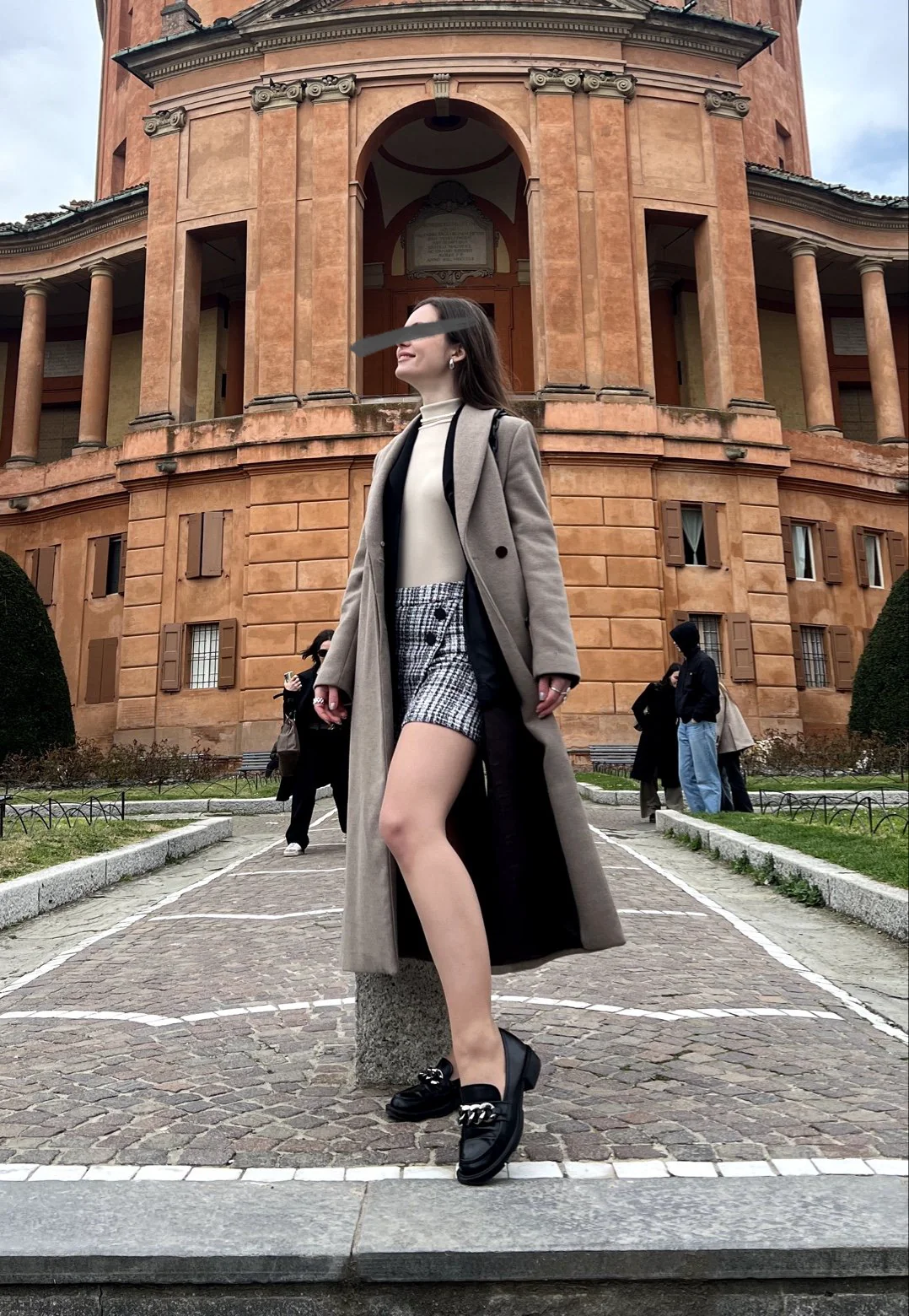
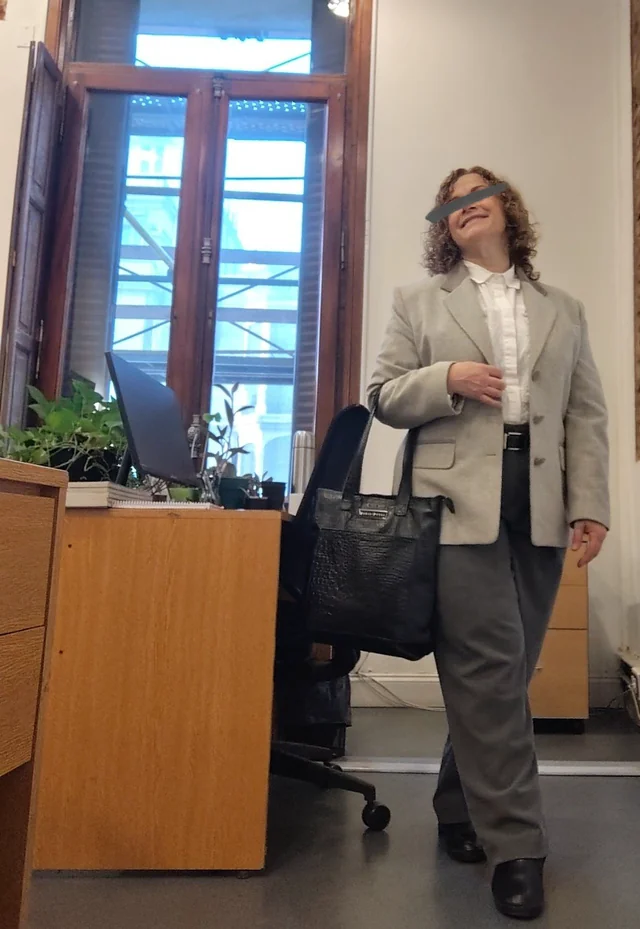
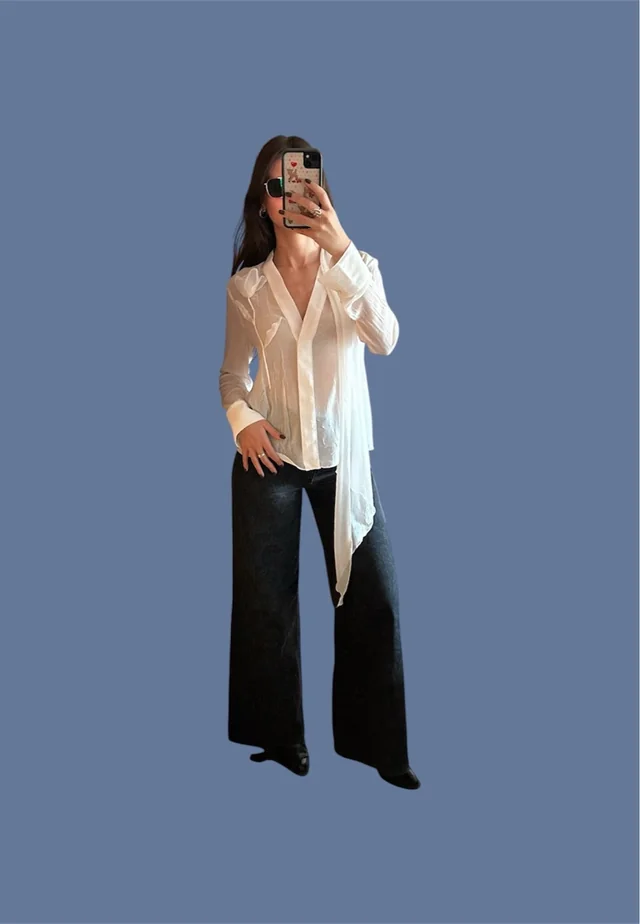
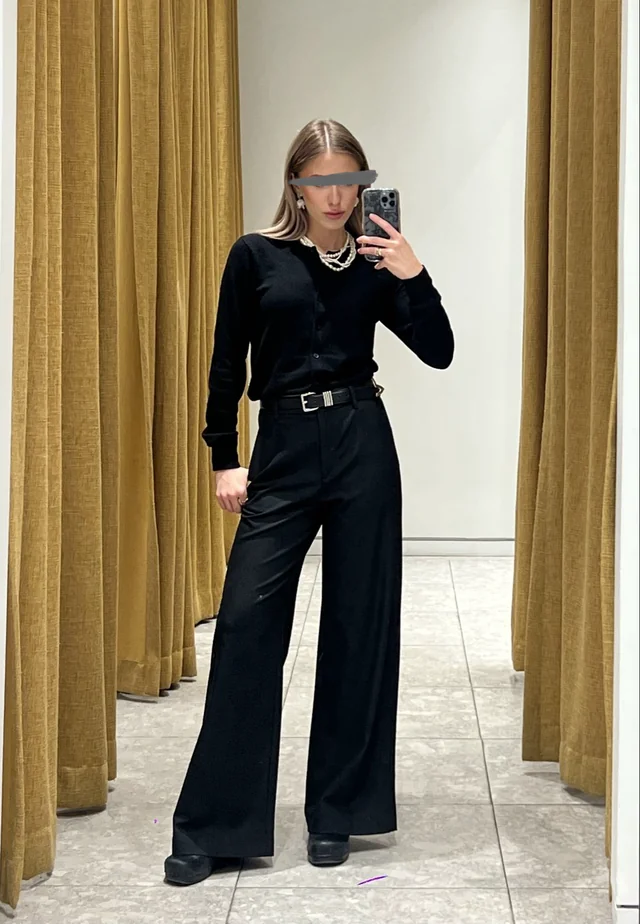
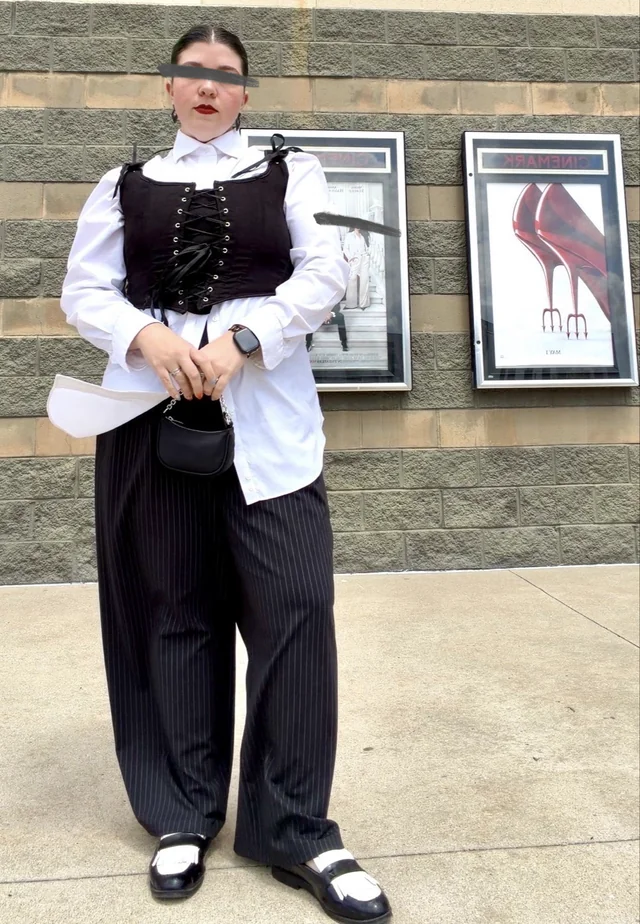
Officesiren
Summary. Office siren is a dress system in which corporate tailoring — garments originally engineered for institutional legibility, hierarchical signaling, and eight-hour seated-and-standing workplace endurance — is restyled through deliberate sensuality to produce a dual-coded body presentation that reads simultaneously as professionally competent and sexually self-possessed. The aesthetic is governed by a tension-management logic: stretch-suiting fabrics, pencil-skirt architectures, pointed-heel geometries, and sheer hosiery systems developed for workplace performance are recontextualized as instruments of curated desirability, so that each garment operates at the boundary between dress-code compliance and provocative display. Unlike adjacent categories such as corpcore (which reproduces corporate dress neutrally) or power dressing (which stages authority without erotic charge), office siren retains the workplace as its referent while deliberately overloading it with sexual legibility — the trace of the boardroom persists even when the outfit is assembled for the algorithm rather than the office.
In Material Terms
Office siren's coherence depends on stretch-suiting fabric science: wool-elastane and polyester-elastane blends engineered to maintain shape recovery under eight-hour seated compression, resist shine at friction points (inner thigh, seat, elbow), and hold a pressed crease through a full workday. Each component — jacket, skirt, shirt, hosiery, heel — is designed not as an isolated garment but as an interdependent system within a body-contouring stack where fit precision, fabric recovery rate, and silhouette discipline must remain coordinated across the ensemble. When this system functions correctly, it produces a line that follows the body's contours without pooling, wrinkling, or pulling at stress points — the tailored surface appearing effortless because the engineering is invisible. When the system is reduced to visual quotation — suiting silhouettes in non-recovery fabrics, pencil skirts without proper lining-to-shell engineering, hosiery in wrong denier for the garment weight — the category collapses into costume.
At Category Level
Office siren occupies a contested boundary between professional dress code and aestheticized self-presentation. High-specification implementations are evaluated through fit-engineering criteria: jacket suppression at the waist, skirt kick-pleat depth and lining behavior, heel pitch angle and foot-bed geometry, hosiery denier-to-opacity calibration, and shirt collar integrity under sustained wear. Lower-tier iterations reproduce the visual grammar — fitted blazer, tight skirt, glasses, sheer tights, pointed pump — while stripping away the construction substrate that originally justified those forms: fused interlinings that bubble after dry cleaning, unlined skirts that ride and twist, fast-fashion hosiery that ladders on first wear. This stratification is not merely commercial but epistemological: it separates participants who evaluate garments through tailoring literacy and fabric behavior from those who evaluate through trend recognition and TikTok reference matching.
Methodologically
This entry treats office siren as a gendered-signaling system embedded in workplace power structures: garments are analyzed by how they translate between institutional dress environments and platform-mediated aesthetic performance, by how stretch-suiting and hosiery science determine wearability and failure, and by how the political economy of women's corporate presentation shapes who can produce, access, and safely perform this aesthetic across classed and institutionally differentiated contexts.
Word (Etymology)
The compound "office siren" fuses two semantic fields whose collision produces the aesthetic's defining tension. "Office" — from Latin officium ("duty," "service"), through medieval administrative usage designating a place of institutional work — carries connotations of bureaucratic order, hierarchical compliance, and behavioral regulation. "Siren" — from Greek Seiren, the mythological creatures whose song lured sailors to destruction — carries connotations of dangerous beauty, irresistible allure, and feminine power exercised through sensory enchantment rather than institutional authority. The compound yokes duty to danger, compliance to seduction, producing a name that encodes the aesthetic's central contradiction: the office demands one behavior, the siren promises another, and the dressed body performs both simultaneously.
The term crystallized on TikTok in late 2022, gaining viral velocity through 2023. Unlike "gorpcore" (coined by a journalist with satirical intent) or "cottagecore" (emerging organically from Tumblr mood-board culture), "office siren" was born natively within TikTok's short-form styling content, where creators assembled reference boards combining 1990s runway imagery, early-2000s film stills, and contemporary try-on hauls. The "-core" suffix was notably absent — the term resists the taxonomic suffix that platform culture typically appends to aesthetic categories, suggesting that its coinage registered more as character archetype ("be an office siren") than as codified regime. Adjacent labels circulate — "corpcore," "CEO aesthetic," "corporate baddie," "9-to-5 siren" — but none achieved the specific tension between professionalism and seduction that "office siren" captures.
Culturally, the label performs classificatory work beyond its lexical content. It distinguishes sensuality-inflected corporate dress from power dressing (which stages authority without erotic charge), from corpcore (which reproduces corporate dress codes with deadpan neutrality), from coquette (which stages femininity through girlishness rather than professional authority), and from the broader "clean girl" aesthetic (which prioritizes minimalist polish without corporate specificity). In Korean and Japanese fashion discourse, overlapping concepts circulated earlier through "office lady" (OL) fashion in magazines such as CanCam, JJ, and Oggi, where fitted professional dress with deliberate feminine styling had been normalized as a category since the 1990s — without requiring the provocative mythological framing that the English coinage supplies.
Subculture
Office siren crystallized not from a physical scene — no club, no venue, no geographic locale — but from a platform-native reference loop in which TikTok creators, Pinterest mood boards, runway imagery, and early-2000s media screenshots converged into a recognizable styling code between late 2022 and mid-2023. The community formed around repeated item clusters: slim rectangular glasses (frequently tagged as "Bayonetta glasses" after the video-game character Cereza), fitted blazers with visible waist suppression, pencil skirts, sheer hosiery, and pointed-toe pumps. Recognition and participation were signaled through styling videos that demonstrated the transformation from "normal" to "office siren" — a before-and-after format that foregrounded the aesthetic's performative dimension: you do not passively wear office siren, you become it through deliberate assembly.
The subcultural formation is platform-native but not purely fictional. It repackages existing corporate dress codes into a deliberate aesthetic script by drawing from two distinct expertise communities. The first is the professional-dressing community — women who navigate actual corporate dress codes and possess embodied knowledge of what fabrics survive a ten-hour day, which heel heights remain walkable through a transit commute, and how hosiery interacts with specific skirt linings. The second is the styling-content community — creators who curate the aesthetic through visual reference, try-on content, and brand recommendations, evaluating garments through photographic legibility rather than workplace performance. These communities overlap but diverge on evaluative criteria: the professional community tests garments through sustained wear; the content community tests garments through camera-flattering fit and visual impact in 15-second video.
A structural tension runs through office siren's subcultural positioning. The aesthetic romanticizes the corporate workplace — staging it as a site of power, desirability, and cinematic self-possession — at a moment when many of its practitioners work remotely, work freelance, or have never occupied the institutional environments the aesthetic references. This produces an interesting reversal: whereas power dressing in the 1980s was developed by women who needed institutional armor for hostile workplaces, office siren in the 2020s is often performed by women who curate the corporate workplace as fantasy rather than navigate it as reality. The office becomes stage set rather than workplace, and the siren operates without the institutional audience the costume was designed to address.
Sociologically, office siren is structured by layered authority economies that invert traditional fashion expertise. Legacy authority — fashion editors, luxury brand houses, tailoring professionals — holds less influence than platform-native creators who demonstrate the aesthetic through accessible styling content. Mid-tier authority belongs to micro-influencers who translate runway references into achievable outfits at commercial price points. At the entry level, participants navigate the aesthetic through "starter pack" item lists circulated on TikTok and Pinterest. These tiers interact through continuous negotiation: entry-level participants push the aesthetic toward fast-fashion accessibility, while higher-tier participants attempt to gate-keep through construction literacy, vintage sourcing, and historical-reference depth.
History
The material prehistory of office siren begins not in internet culture but in the industrialization of women's professional dress, the engineering of stretch-suiting fabrics, and the cinematic construction of the "sexy office worker" archetype across a century of media representation.
Women's entry into corporate dress (1920s-1960s). The expanding presence of women in white-collar clerical and secretarial work during and after World War I created the first mass demand for women's workwear that was neither domestic nor industrial. Chanel's 1920s jersey suits established the principle that women's professional dress could be simultaneously streamlined, comfortable, and deliberately feminine. The 1950s "office girl" — immortalized in films like How to Marry a Millionaire (1953, with Marilyn Monroe) and the later The Best of Everything (1959) — codified the pencil skirt, fitted blouse, and pointed heel as a professional feminine uniform. NASA's "human computers" — women like Katherine Johnson, Dorothy Vaughan, and Mary Jackson (documented in Margot Lee Shetterly's Hidden Figures, 2016) — performed advanced mathematics in pencil skirts and structured blouses, embedding technical competence within a visual grammar that office siren would later aestheticize.
Power dressing and the shoulder-pad revolution (1975-1992). John T. Molloy's The Woman's Dress for Success Book (1977) systematized the theory that women's professional advancement required masculine-coded dress: boxy jackets, padded shoulders, dark suiting, minimal ornamentation. The book's prescriptions — no bright colors, no visible sexuality, no "distracting" femininity — reflected real institutional hostility toward women's bodily presence in corporate hierarchies. Donna Karan's "Seven Easy Pieces" collection (1985) offered a counter-proposition: a modular wardrobe system (bodysuit, wrap skirt, tailored jacket, gold hardware belt, sheer hosiery, coat, evening piece) that reconciled femininity with professionalism through engineering rather than erasure. The bodysuit — stretch fabric tucked into skirts and trousers to maintain a smooth line — was a construction innovation that solved the persistent tucking problem: it stayed in place because it was a leotard, not a shirt. Karan's system anticipated office siren's body-contouring logic by decades.
Shoulder-pad engineering in this period reached technical sophistication: foam, polyester wadding, and cotton-canvas laminate pads ranging from 0.5 to 3 inches of projection were calibrated to specific jacket structures (set-in sleeve, raglan, extended shoulder) to create the broad-shouldered silhouette that encoded institutional authority. The padded jacket's visual logic — making the female torso appear wider, squarer, more architecturally imposing — was explicitly borrowed from men's tailoring, where shoulder construction had served the same authority-signaling function since the nineteenth century. This engineering would be selectively retained and modified in office siren, where narrower, more body-conscious shoulder construction replaces the geometric authority of the power suit with a fitted precision that follows the body rather than armoring it.
The 1990s runway foundation (1993-2001). Three runway moments established the visual vocabulary that office siren would later mine. Tom Ford's Gucci Fall/Winter 1995 introduced sleek, louche suiting — low-rise trousers, unbuttoned satin shirts, velvet blazers — that coded corporate tailoring as sexually charged nightwear. The collection's genius was tonal: Ford did not add sexual elements to suits but revealed that suits had always contained sexual potential, requiring only a shift in fit, fabric, and styling to make it legible. Prada Spring/Summer 1996 established "geek-chic intellectualism" — narrow rectangular glasses, unadorned knit sets, austere color palettes — that would supply office siren's optical signature. Calvin Klein Fall/Winter 2001, under the creative direction of the house, pushed austere sensual tailoring: minimal, body-close suiting in restrained palettes where the eroticism resided in the precision of the fit rather than in exposed skin.
Cinematic codification (1999-2006). Film and television crystallized the office-siren archetype into durable cultural shorthand. The Thomas Crown Affair (1999) presented Rene Russo as Catherine Banning in an investigator's wardrobe of fitted blazers, pencil skirts, and confident heels that staged professional authority as seduction. Secretary (2002, Steven Shainberg) made the connection between corporate dress and erotic submission explicit, with Maggie Gyllenhaal's wardrobe performing the aesthetic's central tension in its most literal form. The Devil Wears Prada (2006, David Frankel) provided office siren's definitive visual archive: Emily Blunt's Emily Charlton as aspirational corporate glamour, Meryl Streep's Miranda Priestly as power-dressing apotheosis, and Anne Hathaway's Andrea Sachs transformation from outsider to insider as a dress-code conversion narrative. Joan Holloway (Christina Hendricks) in Mad Men (2007-2015) retrospectively supplied a 1960s origin archetype — the office body as spectacle within institutional space — though the show's period setting complicated its direct adoption.
The TikTok revival and viral crystallization (2022-2024). The specific term "office siren" emerged on TikTok in late 2022, catalyzed by several convergent factors: Miu Miu's Fall/Winter 2023 collection (featuring cardigans, hosiery-as-outerwear, and bookish styling that reactivated geek-chic codes), the broader post-pandemic return-to-office discourse (which raised questions about what professional dress meant after two years of remote work), and a cyclical resurgence of late-1990s/early-2000s styling. The aesthetic peaked in mainstream visibility between mid-2023 and early 2024, sustained by TikTok (#officesiren accumulating hundreds of millions of views), Instagram curation, and fast-fashion retailers rapidly producing tagged product. Sandy Liang's Fall/Winter 2024 collection — integrating ballet flats, librarian styling, and fitted tailoring — demonstrated the aesthetic's runway absorption. By late 2024, fashion media had begun declaring office siren "over" or "evolved," following the platform-accelerated trend cycle that compresses aesthetic lifespans from decades to months.
Analytically, office siren's history is a sequence of gendered-dress translations — from institutional necessity to runway aestheticization, from cinematic archetype to platform virality — in which the same material substrate (fitted suiting, pencil silhouettes, pointed heels, optical accessories) is preserved while its social function, audience, and evaluative framework are repeatedly renegotiated. Each translation alters who performs the look, under what conditions, and what it communicates — which is why a 1980s Donna Karan bodysuit and a 2023 TikTok try-on haul can share visual grammar while operating under entirely different social logics.
Silhouette
Office siren silhouette is governed by body-contouring precision and line discipline rather than by volume, drape, or architectural distortion. The characteristic fitted, shoulder-to-hem-controlled profile is not an arbitrary aesthetic preference but an engineering consequence: the aesthetic requires garments that follow the body's contours closely enough to be legible as sensual while remaining structured enough to read as professional — a narrow corridor between too-tight (coded as inappropriate) and too-loose (coded as merely corporate).
The jacket operates as the silhouette's structural anchor. Waist suppression — achieved through darting, princess seaming, or shaped side panels — creates an hourglass proportion that distinguishes office siren from the boxy authority of power-dressing blazers. Shoulder construction is typically natural or lightly structured (thin shoulder pads, 0.25-0.5 inches of lift, rather than the 1-3 inches of 1980s power dressing), maintaining the body's actual shoulder line rather than architecturally expanding it. Jacket length falls at or just below the hip, creating a clean break line with the skirt that maintains waist definition rather than obscuring it. Single-button or two-button closures are preferred over three-button for their higher stance point, which creates a longer visible V of shirt or skin below the collar — a deliberately calculated exposure geometry.
The pencil skirt is the silhouette's definitive garment. Its engineering is deceptively specific: a straight, body-skimming cut from waist to knee (typically 23-25 inches in length) requires precise darting at the waist to accommodate the hip-to-waist ratio without excess fabric, a back vent or kick pleat (typically 6-8 inches) to permit stride without splitting the center-back seam, and a lining-to-shell relationship that prevents the outer fabric from clinging to the body or riding up during seated-to-standing transitions. The pencil skirt's hemline — at or just below the knee — is the silhouette's critical tension point: higher reads as provocative (shifting toward nightwear coding), lower reads as conservative (shifting toward corporate neutrality), and the aesthetic's sweet spot occupies a precisely calibrated zone that varies by context and body proportion.
Trouser alternatives (slim-cut, often low-rise or mid-rise, with a tapered or straight leg) maintain the same body-contouring logic. The trouser break — where the hem meets the shoe — is a readable detail: a clean break (hem resting on the shoe with minimal fabric pooling) signals tailoring literacy; excessive break or cropped-too-short proportions disrupt the clean vertical line the aesthetic demands.
Shirts are fitted, often with minimal ease through the torso, and collared (point collar or spread collar rather than band collar, because the collar frames the face and creates formality). The number of buttons left unfastened — typically one or two below the collar — constitutes another calculated exposure geometry: enough to suggest but not enough to declare. Shrunken cardigans and fitted knit tops serve as shirt alternatives, providing the same body-close line with a softer material register.
Materials
Material selection is office siren's primary functionality test. The category's credibility depends on textiles engineered to survive the specific performance conditions of professional wear — eight hours of seated compression, standing meetings, transit commuting, temperature fluctuations between air-conditioned interiors and outdoor heat — while maintaining the precise fit that the aesthetic requires.
Stretch-suiting fabrics. The core textile system consists of wool-elastane and polyester-elastane blends that combine the drape, breathability, and crease-recovery of traditional suiting with the stretch and body-recovery properties that fitted silhouettes demand. Wool-elastane blends (typically 95-98% wool, 2-5% elastane or Lycra) represent the premium tier: wool's natural fiber properties — moisture absorption (up to 30% of its weight without feeling damp), temperature regulation through crimped-fiber air trapping, natural odor resistance through lanolin residue, and resilient crease recovery from the fiber's molecular spring structure — combine with elastane's stretch and recovery to produce suiting that moves with the body and returns to its pressed shape after deformation. The critical performance metric is recovery rate: how quickly and completely the fabric returns to its original dimensions after being stretched. Premium wool-elastane blends recover 95-97% within one hour of deformation; lower-quality blends may recover only 85-90%, producing gradual "bagging out" at the knees, seat, and elbows that destroys the clean line office siren requires.
Polyester-elastane blends dominate the accessible price tier. Polyester's advantages — lower cost, wrinkle resistance, color fastness, and machine washability — make it the default fabric for fast-fashion and mid-market suiting. Its disadvantages are significant for sustained wear: polyester does not breathe (it transports moisture poorly, trapping perspiration against the skin), generates static charge (causing fabric to cling to hosiery and undergarments), develops shine at friction points (the "polyester seat shine" that appears at thighs, elbows, and seat through abrasion-induced fiber flattening), and pills under sustained friction. The shine problem is particularly destructive to office siren's visual coherence: polished fabric that has developed matte-to-shiny variation reads as cheap and worn, undermining the precision the aesthetic demands.
Shirting fabrics. Cotton poplin (a plain-weave, tightly woven cotton with a slight sheen from the weave structure) is the prestige shirting fabric: it holds collar structure, takes pressing well, and breathes effectively. Thread count and ply affect behavior: two-ply poplin (80s-120s thread count) offers superior hand, wrinkle resistance, and durability compared to single-ply. Cotton-polyester blends reduce ironing requirements but sacrifice breathability and develop pilling. Stretch-cotton blends (cotton with 2-3% elastane) provide the body-close fit that office siren shirts require without the riding, pulling, and gap-between-buttons problem that afflicts non-stretch cotton in fitted cuts — button gaping at the bust line being the most visible fit failure in women's fitted shirting.
Hosiery materials. Hosiery is office siren's signature textile and its most technically specialized material system. The denier system — measuring the linear mass density of the fiber (grams per 9,000 meters of yarn) — determines opacity, durability, and visual weight: 5-10 denier produces "barely there" sheerness (extremely fragile, single-wear lifespan typical); 15-20 denier produces the semi-sheer standard for professional hosiery (skin visible through a tonal veil); 30-40 denier produces a more opaque coverage; 60+ denier enters the territory of tights rather than stockings. Office siren typically operates in the 15-30 denier range, where the leg is visible but veiled — an opacity that encodes the aesthetic's characteristic tension between display and concealment.
Fiber composition determines performance. Traditional nylon (polyamide) hosiery provides sheerness and elasticity but is vulnerable to snagging and run propagation — a single snag can produce a visible "ladder" that renders the garment unwearable. Microfiber nylon (finer fiber diameter, typically 0.5-1.0 denier per filament versus standard nylon's 1.5-3.0 denier) produces a softer hand, more even opacity, and marginally better snag resistance. Elastane or Lycra content (typically 10-20% of the blend) provides compression and recovery. Control-top engineering — graduated compression panels from waistband to upper thigh — uses higher-denier, tighter-gauge knit to provide abdominal smoothing and prevent the hosiery from sliding; the engineering is essentially a compression-garment integrated into the stocking's upper section. Reinforced toe and heel zones use higher-denier yarn or doubled knit to resist the abrasion forces concentrated at these contact points.
Hosiery failure is office siren's most frequent and most visible material crisis. A run in sheer hosiery is not merely a cosmetic defect but a systemic failure: the knit structure propagates the damage because each loop is dependent on its neighbors, so a single broken filament cascades into a visible ladder that can extend the full length of the leg within minutes. This fragility means that office siren practitioners who wear sheer hosiery daily may go through multiple pairs per week — a recurring cost that fast-fashion pricing obscures but that aggregates into a significant material expense over time.
Heel materials and construction. Pointed-toe pumps — the aesthetic's signature footwear — combine upper materials (leather, patent leather, or synthetic) with heel engineering that determines wearability. Heel pitch angle (the angle between the foot bed and the ground plane) increases with heel height: a 2-inch heel produces approximately 15 degrees of pitch, a 3-inch heel approximately 25 degrees, and a 4-inch heel approximately 35 degrees. As pitch increases, body weight transfers progressively from the heel to the metatarsal heads (the ball of the foot), creating compression forces that can produce metatarsalgia (forefoot pain), Morton's neuroma (nerve compression between metatarsal heads), and hammertoe deformity over sustained use. The pointed-toe box exacerbates these forces by compressing the forefoot laterally, forcing the toes into adduction.
Premium heel construction mitigates these biomechanical stresses through cushioned insoles (memory foam or gel padding at the metatarsal zone), arch-support inserts (maintaining the longitudinal arch that collapses under sustained heel wearing), and steel or composite shanks (rigid supports between the heel and the ball that distribute weight more evenly along the foot). Mass-market pumps frequently lack these engineering elements, producing a shoe that looks identical on camera but fails under sustained walking — the distinction between a four-hour event shoe and an eight-hour work shoe being invisible in photographs but immediately legible on the body.
Color Palette
The palette operates on a corporate-neutral foundation with strategic single-accent punctuation. Black, navy, charcoal, dark grey, and cream form the base system — colors inherited from men's professional suiting traditions that encode institutional seriousness and minimize visual distraction. White shirting provides high-contrast framing against dark suiting, creating the sharp tonal boundaries that the aesthetic requires.
The accent system is deliberately restrained: typically one saturated element — a red lip, burgundy pointed pump, deep red nail polish, or a single piece of statement jewelry — introduces chromatic tension without overwhelming the corporate base. This single-accent logic distinguishes office siren from maximalist aesthetics (which layer multiple color signals) and from pure corporate neutrality (which suppresses accent entirely). The red lip, in particular, functions as the aesthetic's most widely cited accent: it references Hollywood-era corporate femininity (the "boardroom red" convention), introduces sensual coding within an otherwise neutral palette, and provides a focal point that draws attention to the face.
Seasonal variation is minimal. Unlike aesthetics that shift palette with season (gorpcore's earth-tone-to-retro seasonal rotation, coquette's pastel-to-berry shifts), office siren maintains chromatic consistency year-round — mirroring the institutional dress codes it references, where wardrobe stability signals professional reliability rather than fashion responsiveness.
Details
Details in office siren are best understood as precision-calibrated tension instruments — elements that modulate the boundary between professional compliance and sensual suggestion, and whose calibration determines whether the ensemble reads as "corporate with edge" or "costume."
Optical accessories. Slim rectangular glasses — frequently cited as "Bayonetta glasses" after the stylized spectacles worn by the video-game character Bayonetta (Cereza) in PlatinumGames' franchise — function as the aesthetic's most immediately identifiable detail. The frame shape (narrow, horizontally elongated, with minimal vertical depth) references 1990s and early-2000s eyewear trends (Prada's 1996 collection being the most cited runway precedent). Functionally or non-prescriptively worn, the glasses perform a dual coding: intellectualism (the "smart" association of corrective eyewear) combined with the "sexy librarian" archetype that eroticizes studious presentation. Frame material (thin metal or acetate) and lens treatment (clear, lightly tinted, or blue-light-filter yellow) are further readable details.
Shirt and collar details. Collar stay quality, collar spread angle, and the precision of button placement are details that communicate construction literacy. The collar's ability to maintain its shape through a full day of wear — resisting the wilting and curling that afflicts cheap cotton-polyester blends — is the shirt's primary performance indicator. French cuffs, when present, add a formality register that tips the ensemble toward traditional power dressing; barrel cuffs (button closures) maintain the more contemporary, slightly relaxed register that office siren typically occupies.
Waist treatment. Cinching at the waist — through a belt (thin, structured, often patent or smooth leather), the jacket's own suppression, or a tucked-in shirt emphasizing the natural waistline — is the detail that converts corporate suiting into office siren. Without waist definition, the same garments read as corpcore; with it, they read as deliberately body-conscious. Belt hardware (buckle size, finish, closure type) carries additional information: a minimal, polished-metal buckle maintains professional restraint; oversized or decorative hardware shifts toward fashion-statement territory.
Grooming as detail system. Grooming in office siren functions as an extension of garment detailing rather than as a separate domain. Hair is typically polished — blown out, straightened, or styled in a controlled manner (low bun, sleek ponytail, or carefully undone waves) — rather than visibly effortful or elaborately structured. Makeup follows a "one-focal-element" logic: either a defined lip (matte red or deep berry) with restrained eye makeup, or a smoky/lined eye with nude lip. The base is matte, skin-smoothing, office-lighting-optimized. Nails are manicured in neutral or dark shades. Each grooming choice is a detail decision that contributes to or undermines the ensemble's coherence.
Accessories
Accessories complete the corporate-seduction equation through a logic of restrained multiplicity — each piece reinforcing the professional-sensual dual coding without tipping the ensemble into either pure corporate or pure nightwear territory.
Footwear. Pointed-toe pumps are the canonical choice: kitten heels (1.5-2 inches) for wearability-forward styling, mid-height stilettos (2.5-3.5 inches) for the aesthetic's standard register, and high stilettos (4+ inches) for editorial or evening iterations. The pointed toe is structurally essential — round-toe or block-heel alternatives shift the ensemble toward comfort-coded or retro-coded territory that disrupts office siren's specific sharpness. Slingback pumps provide a variation that introduces a strap detail across the heel, referencing mid-century professional femininity. Mule silhouettes occasionally appear but sacrifice the visual completion of a fully enclosed foot.
Bags. Top-handle bags and structured satchels — referencing institutional document-carrying function — dominate. The bag must read as purposeful rather than decorative: medium-to-large scale, rigid or semi-rigid structure, in leather or leather-effect material. Mini bags, crossbody bags, and clutches shift the coding away from professional function toward social/evening use.
Jewelry. Minimal: delicate chain necklaces, small stud or hoop earrings, thin bangles or a quality watch. The restraint is deliberate — office siren's jewelry logic mirrors corporate dress-code conventions that permit jewelry as long as it does not "distract." This restraint becomes its own signal: the absence of maximalist jewelry communicates disciplined self-editing that the subcultural community reads as sophistication.
Body Logic
Office siren conceptualizes the body as a dual-signal surface: simultaneously an institutional competence display and a curated desirability object. Tailoring creates structure through shoulder alignment, waist definition, and controlled hem length — the body presented as professionally organized, linear, and precise. Styling choices (fit tightness, exposure geometry, hosiery sheerness, heel height) introduce the counter-signal: the body is not merely organized for institutional legibility but deliberately arranged for aesthetic and erotic impact. This dual coding is the aesthetic's structural foundation: remove either signal and the category dissolves into adjacent but different aesthetic territories.
The body is presented as lean, upright, and elongated. The pointed heel, sheer hosiery, and pencil-skirt hemline collaborate to create a continuous vertical line from ankle to waist, optically lengthening the lower body. The fitted jacket continues this vertical discipline through the torso. The overall silhouette effect is one of controlled narrowness — the body held within the garment's line rather than moving freely within volume.
Gender coding is maximally feminine but specifically professional-feminine rather than decorative-feminine. Office siren avoids the softening gestures (bows, lace, pastel, floral print) that code femininity as gentle or girlish. Its femininity is sharp, structured, and institutional — the femininity of the negotiating table rather than the garden party. This positions the aesthetic in deliberate contrast to coquette (which stages feminine softness) and cottagecore (which stages feminine domesticity).
Because the look is frequently performed outside strict corporate contexts — in content creation, social events, or everyday styling — it functions as institutional role-play with real dress-code references rather than direct workplace uniform. This displacement creates a productive ambiguity: the aesthetic borrows the institutional authority of corporate dress without accepting its constraints, staging professional femininity as chosen performance rather than imposed compliance. However, this displacement also means that office siren's body logic is insulated from the actual physical demands of workplace wear — the commuter's foot pain, the conference-room chair's fabric friction, the mid-afternoon hosiery failure — that would provide a functional reality-check on its styling claims.
Class encoding operates through the familiar mechanism of invisible quality hierarchies. Premium stretch-wool suiting, real leather pumps, quality hosiery, and tailored fit require either significant expenditure or exceptional thrift-sourcing skill. The aesthetic's "effortless" appearance requires material investment or labor investment that is unequally distributed. Fast-fashion office siren achieves visual proximity at dramatically lower cost, but the material gap — pilling synthetics, shine-prone polyester, disposable hosiery — becomes legible under sustained wear in ways that platform photography conceals.
Garment Logic
Office siren garment construction begins with stretch-suiting engineering and works outward to individual component specifications. The system's architecture — jacket as structural anchor, skirt or trouser as lower-body shaper, shirt as interior contrast layer, hosiery as skin-management textile, heel as posture modifier — is not a free styling combination but an interdependent system where each component's construction quality and material behavior affects every other component's performance.
Jacket construction. Office siren jackets require a specific construction compromise between the full-canvas rigidity of traditional bespoke tailoring and the flexibility that fitted, body-close wear demands. Half-canvas construction (canvas chest piece extending to the waist with fused interlinings below) provides the best balance: sufficient structure to maintain shoulder shape and lapel roll while permitting the waist suppression and body movement that the aesthetic requires. Fully fused construction (adhesive-bonded interlining throughout, no floating canvas) is cheaper and lighter but degrades under dry cleaning: the adhesive can bubble and separate from the shell fabric, producing visible surface distortion that is irreversible. This fusing failure is the jacket's most common catastrophic failure mode and the reason experienced practitioners evaluate jackets by interlining method rather than by visual fit alone.
Pencil-skirt construction. The pencil skirt's engineering is deceptively demanding. The waistband must sit at the natural waist (or at a specified rise point) without rolling, riding, or gapping — requiring either precise sizing or the inclusion of interior grip tape (silicone-dotted elastic sewn to the waistband's inner face that grips a tucked-in shirt or bare skin). Waist darts (typically two per side, each removing 0.5-1.0 inch of fabric width) shape the flat fabric panel into the three-dimensional curve from waist to hip. The center-back seam carries a vent or kick pleat — a controlled opening at the hemline that permits stride length without pulling the seam under tension. Vent depth (6-8 inches is standard) and vent engineering (faced, lined, or raw-edge) determine both functionality and finish quality.
The lining-to-shell interaction is the pencil skirt's most underappreciated engineering element. A properly cut lining (typically acetate or polyester, cut with slightly less ease than the shell so that it creates a smooth under-layer rather than bunching) serves multiple functions: it prevents the shell fabric from clinging to hosiery or skin (eliminating static-related ride-up), provides a low-friction interior surface that permits ease of movement, and protects the shell fabric from body-oil transfer and perspiration damage. An unlined pencil skirt — common in fast-fashion production — clings to hosiery, rides up when walking, twists around the body when seated, and transfers body moisture directly to the shell fabric, accelerating deterioration. Lining quality is thus the construction detail that most dramatically separates wearable office siren from visual-only office siren.
Hosiery engineering. Sheer hosiery at 15-20 denier is knitted on circular or flat-knitting machines using nylon and elastane yarns in gauges ranging from 15 to 400 needles per inch (higher gauge producing finer, more even fabric). Control-top construction integrates a graduated-compression panel — typically knitted at a tighter gauge with heavier-denier yarn — from the waistband to the upper thigh, providing abdominal smoothing and preventing the hosiery from sliding. Gusset construction (a diamond-shaped reinforcement panel at the crotch) distributes stress at this high-tension junction. Reinforced toes and heels use doubled or tripled yarn to resist the concentrated abrasion forces at these contact points.
The primary failure mode — run propagation — occurs when a single filament breaks and the knit structure unravels along the course (horizontal row) or wale (vertical column), producing a visible ladder. Higher-denier hosiery resists this failure longer because thicker filaments require more force to break, but even premium 20-denier hosiery remains vulnerable to sharp contact (rough fingernails during donning, desk-edge snags, chair-arm catches). Run-resistant hosiery uses modified knit structures (lock-stitch or micro-mesh constructions) that contain damage to the break point rather than propagating it, but these constructions sacrifice some of the sheer, even appearance that the aesthetic demands.
Aftercare and failure modes. Stretch-suiting requires careful laundering: machine-washing wool-elastane blends on hot cycles or with harsh detergents causes felting (fiber-scale interlocking that shrinks and stiffens the fabric), destroying both fit and drape. Dry cleaning preserves shape but, over repeated cycles, strips natural wool oils and can damage elastane fibers, reducing stretch recovery. The optimal maintenance for premium office siren suiting is spot-cleaning, steaming, and brushing between wears, with dry cleaning reserved for quarterly deep cleans. Hosiery requires hand-washing or machine-washing in a mesh bag on cold delicate cycle; dryer heat degrades elastane, reducing compression and recovery. Leather-soled pumps require periodic resoling and heel-tip replacement (rubber or metal heel tips wear through within 2-4 months of regular walking on pavement) and benefit from shoe trees between wears to maintain shape.
The most significant long-term failure mode across the system is elastane degradation. Elastane (Lycra, spandex) fibers lose recovery capacity through heat exposure, chlorine contact, body-oil accumulation, and simple age — a phenomenon called "relaxation." Garments that initially provided body-contouring recovery gradually lose their ability to snap back, producing the progressive loosening and "bagging" that converts fitted suiting into shapeless approximation. This degradation is invisible until it manifests as fit failure, typically after 12-24 months of regular wear, and is irreversible. Experienced practitioners therefore evaluate office siren garments not only by current fit but by predicted elastane service life — a longitudinal assessment that separates material-literate participants from visual consumers.
Motifs / Themes
The secretary as siren — the administrative worker whose institutional subordination is overwritten by sexual self-possession — recurs as the aesthetic's foundational narrative. This archetype draws from a century of cultural production: from the "office girl" pin-ups of the 1940s through Secretary (2002) through TikTok transformation videos. The tension between institutional submission and personal power — following the rules while rewriting what they communicate — is the motif's engine.
Geek-chic intellectualism operates as a secondary motif. The glasses, the buttoned-up shirt, the structured bag suggest a woman who reads, who works, who possesses institutional competence — the "smart is sexy" proposition that the aesthetic stages through optical and sartorial cues rather than through direct statement.
The office as stage set — not as workplace but as cinematic environment — pervades the aesthetic's referential system. Fluorescent lighting, glass-walled conference rooms, elevator banks, revolving doors: these architectural elements appear repeatedly in office siren content as backdrop rather than workplace, aestheticized institutional space drained of labor content and refilled with styling narrative.
Cultural Touchstones
Catherine Banning (Rene Russo) in The Thomas Crown Affair (1999): the investigator's wardrobe as professional seduction. Emily Charlton (Emily Blunt) and Miranda Priestly (Meryl Streep) in The Devil Wears Prada (2006): the fashion workplace as ultimate office-siren stage. Lee Holloway (Maggie Gyllenhaal) in Secretary (2002): the secretary archetype made explicit. Joan Holloway (Christina Hendricks) in Mad Men (2007-2015): the 1960s office body as spectacle. Alex Cabot (Stephanie March) in Law & Order: SVU: the legal professional as composed authority. Bayonetta (Cereza) in Bayonetta (PlatinumGames, 2009): the source of the slim-rectangular-glasses motif. Donna Karan's "Seven Easy Pieces" (1985) as the wardrobe-system precedent. Tom Ford's Gucci Fall/Winter 1995 as the runway foundation. Miu Miu Fall/Winter 2023 as the contemporary catalyst.
See Also
- Power dressing: Direct historical antecedent; stages authority without erotic charge, broader-shouldered silhouette, 1980s institutional armor
- Corpcore / corporate core: Adjacent category; reproduces corporate dress neutrally without office siren's deliberate sensual overload
- Coquette: Contrasting femininity register; stages girlish softness where office siren stages professional sharpness
- Clean girl: Overlapping minimalist polish but without corporate specificity or sensual tension
- Sexy librarian: Adjacent archetype; shares the intellectualism-meets-sensuality tension but without office-specific institutional framing
- Geek chic: Overlapping glasses-and-intellectual-styling reference, Prada 1996 as shared source
- Dark academia: Adjacent intellectualism aesthetic, shared optical accessories but different institutional reference (university versus office)
Brands and Designers
Heritage Suiting / Tailoring Houses:
- Theory (founded 1997, New York): stretch-suiting innovation, "good wool" marketing, the accessible-luxury office wardrobe
- Hugo Boss (1924, Metzingen, Germany): structured suiting with body-conscious women's lines, accessible premium tier
- Max Mara (1951, Reggio Emilia): investment suiting and coats, Italian construction quality at accessible-luxury pricing
- Reiss (1971, London): sharp tailoring at mid-tier pricing, strong pencil-skirt and blazer offering
- Donna Karan / DKNY (1984/1989, New York): historical foundation of the modern professional-feminine wardrobe, "Seven Easy Pieces" as conceptual origin
Contemporary / Designer:
- Miu Miu (1993, Italy; Miuccia Prada): F/W 2023 collection as office siren's contemporary catalyst, geek-chic intellectualism, hosiery-as-outerwear
- Sandy Liang (2014, New York): F/W 2024 librarian styling, ballet-flat integration, contemporary office siren at designer tier
- Khaite (2016, New York): elevated basics with body-conscious tailoring, stretch knits and suiting
- Coperni (2013, Paris): tech-inflected minimalism with office-adjacent styling
- The Frankie Shop (2014, New York): oversized-to-fitted suiting range, TikTok-viral blazers
Accessible / Fast-Fashion Gateway:
- Zara (1975, A Coruna, Spain): rapid trend translation, office-siren-tagged collections within weeks of TikTok virality
- Mango (1984, Barcelona): mid-market suiting with above-average construction for the price tier
- NA-KD (2015, Gothenburg, Sweden): influencer-driven fast fashion, early office siren adoption
- H&M (1947, Stockholm): mass-market entry point, lowest-tier construction
- ASOS (2000, London): marketplace aggregation of office siren items across multiple brands and price tiers
Hosiery Specialists:
- Wolford (1950, Bregenz, Austria): premium hosiery engineering, Neon and Individual ranges as office siren standards, Austrian manufacturing
- Falke (1895, Schmallenberg, Germany): German-engineered hosiery and legwear, durable construction
- Calzedonia (1986, Verona, Italy): accessible European hosiery at mid-tier pricing
- Heist (2015, London): direct-to-consumer premium hosiery with contemporary sizing approach
Footwear:
- Manolo Blahnik (1970, London): pointed-toe pumps as aspirational standard, BB pump as category-defining silhouette
- Jimmy Choo (1996, London): stiletto engineering, red-carpet-to-office crossover
- Stuart Weitzman (1986, New York): comfort-engineered heels, walkable stilettos
- Sam Edelman (2004, New York): accessible pointed-toe pumps, entry-level office siren footwear
Eyewear:
- Gentle Monster (2011, Seoul): fashion-forward slim frames, office siren optical accessory
- Le Specs (1979, Sydney): accessible rectangular and slim-frame eyewear
- Miu Miu Eyewear: direct runway-to-retail optical accessories
Citations
[1] Molloy, John T. The Woman's Dress for Success Book. Follett Publishing, 1977. [2] Entwistle, Joanne. The Fashioned Body: Fashion, Dress and Social Theory. 2nd ed., Polity, 2015. [3] Kawamura, Yuniya. Fashion-ology: An Introduction to Fashion Studies. 2nd ed., Bloomsbury Academic, 2018. [4] Breward, Christopher. Fashion. Oxford University Press, 2003. [5] Wilson, Elizabeth. Adorned in Dreams: Fashion and Modernity. Revised ed., Rutgers University Press, 2003. [6] Crane, Diana. Fashion and Its Social Agendas: Class, Gender, and Identity in Clothing. University of Chicago Press, 2000. [7] Lipovetsky, Gilles. The Empire of Fashion: Dressing Modern Democracy. Princeton University Press, 1994. [8] Hollander, Anne. Seeing Through Clothes. University of California Press, 1993. [9] Barthes, Roland. The Fashion System. Translated by Matthew Ward and Richard Howard, University of California Press, 1983. [10] Hebdige, Dick. Subculture: The Meaning of Style. Routledge, 1979. [11] Vogue. "Office Siren Girlhood Trend Patriarchy." https://www.vogue.com/article/office-siren-girlhood-trend-patriarchy [12] WWD. "Office Siren Fashion Trend Photos." https://wwd.com/fashion-news/fashion-trends/gallery/office-siren-fashion-trend-photos-1236709354/ [13] Highsnobiety. "Office Siren Dress Codes." https://www.highsnobiety.com/p/office-siren-dress-codes/ [14] Vogue HK. "Tom Ford Gucci." https://www.voguehk.com/en/article/fashion/tom-ford-gucci/ [15] Vogue. "Miu Miu Fall 2023 Ready-to-Wear." https://www.vogue.com/fashion-shows/fall-2023-ready-to-wear/miu-miu [16] Shetterly, Margot Lee. Hidden Figures: The American Dream and the Untold Story of the Black Women Mathematicians Who Helped Win the Space Race. William Morrow, 2016. [17] Karan, Donna. "Seven Easy Pieces." Donna Karan New York, Fall 1985. [18] Steele, Valerie. Women of Fashion: Twentieth-Century Designers. Rizzoli, 1991. [19] Arnold, Rebecca. Fashion, Desire and Anxiety: Image and Morality in the Twentieth Century. I.B. Tauris, 2001. [20] Church Gibson, Pamela. Fashion and Celebrity Culture. Berg, 2012. [21] McRobbie, Angela. "Post-Feminism and Popular Culture." Feminist Media Studies, vol. 4, no. 3, 2004, pp. 255-264. [22] Gill, Rosalind. "Postfeminist Media Culture: Elements of a Sensibility." European Journal of Cultural Studies, vol. 10, no. 2, 2007, pp. 147-166. [23] Wolf, Naomi. The Beauty Myth: How Images of Beauty Are Used Against Women. William Morrow, 1991. [24] Simmel, Georg. "Fashion" (1904). In Simmel on Culture: Selected Writings, edited by David Frisby and Mike Featherstone, SAGE, 1997. [25] Bourdieu, Pierre. Distinction: A Social Critique of the Judgement of Taste. Translated by Richard Nice, Harvard University Press, 1984. [26] Butler, Judith. Gender Trouble: Feminism and the Subversion of Identity. Routledge, 1990. [27] Mulvey, Laura. "Visual Pleasure and Narrative Cinema." Screen, vol. 16, no. 3, 1975, pp. 6-18. [28] Thornton, Sarah. Club Cultures: Music, Media and Subcultural Capital. Polity, 1995. [29] Fletcher, Kate. Sustainable Fashion and Textiles: Design Journeys. 2nd ed., Earthscan, 2013. [30] Tortora, Phyllis G., and Sara B. Marcketti. Survey of Historic Costume. 6th ed., Fairchild Books, 2015. [31] Watkins, Susan M. Clothing: The Portable Environment. 2nd ed., Iowa State University Press, 1995. [32] Kadolph, Sara J. Textiles. 11th ed., Pearson, 2010. [33] Holt, Nathalia. Rise of the Rocket Girls: The Women Who Propelled Us, from Missiles to the Moon to Mars. Little, Brown, 2016. [34] Workman, Jane E., and Beth W. Freeburg. Dress and Society. Fairchild Books, 2009. [35] Vinken, Barbara. Fashion Zeitgeist: Trends and Cycles in the Fashion System. Translated by Mark Hewson, Berg, 2005.