Mori Kei
Summary. Mori kei (森系, "forest style") is a layering-accumulation dress regime in which multiple garments composed of minimally processed natural fibers — cotton gauze, linen, cotton voile, wool knit, raw silk — are worn simultaneously in stacks of four to seven layers, generating an enveloping, volume-forward silhouette through fabric weight and gravitational drape rather than through tailoring, darting, or structural interfacing. The system is governed by a soft-architecture logic: thermal regulation, moisture management, and silhouette formation are achieved through inter-layer air gaps, fiber-specific breathability differentials, and the graduated accumulation of hemlines at varying lengths — each layer contributing its weight, texture, and edge visibility to a composite dressed form that reads as hand-assembled, temporally layered, and deliberately un-engineered. Unlike adjacent natural-fiber aesthetics that foreground material austerity (monastic) or temporal degradation (wabi-sabi), mori kei foregrounds material accumulation — the pastoral body is constructed not through a single definitive garment but through the sedimentation of many lightweight garments whose combined effect produces shelter, textural density, and the visual impression of having been dressed across time rather than at a single moment.
In Material Terms
Mori kei's coherence depends on the interaction behavior of cellulosic and protein natural fibers within a multi-layer stack. Cotton gauze (open-weave, 40–80 g/m², thread count 20–30 per cm) provides breathability and skin-contact softness at the base layer but saturates rapidly under perspiration, losing insulative capacity within 20–30 minutes of sustained moisture exposure. Linen (flax fiber, 100–180 g/m²) provides superior moisture wicking and cooling through its crystalline cellulose structure but introduces stiffness and angular crease behavior that disrupts the soft drape mori kei requires — placing linen at mid-layers, where inter-garment friction softens its hand over a wearing session, resolves this tension. Cotton voile (semi-sheer, 60–100 g/m², combed yarns) provides visual layering depth without significant weight addition, functioning as a translucency layer through which underlying garments' textures and colors are partially visible. Wool knit (lightweight jersey or loose-gauge hand knit, 150–250 g/m²) provides thermal regulation through the hygroscopic properties of keratin fiber — absorbing up to 30% of its weight in moisture vapor before feeling damp — and creates the textural contrast against smoother woven layers that gives mori kei its characteristic surface complexity. Raw silk (tussah or habotai, unpolished, 50–80 g/m²) provides luminous matte sheen and fluid drape at scarf, collar, and cuff details. When these fibers are stacked correctly — smooth cellulosic base, textured mid-layers, softer knit and woven outers — the system creates a microclimate that passively regulates temperature across a 10–15°C ambient range through trapped air-gap insulation and differential moisture transport between layers. When the stack is assembled incorrectly — wool against skin causing itch, cotton gauze as outermost layer saturating in rain, linen at base layer creating stiffness against the body — the system fails both functionally and aesthetically.
At Category Level
Mori kei occupies a position between Japanese street-fashion subcultural specificity and the broader Western pastoral-dress tradition that later produced cottagecore. It shares with Lolita fashion a Japanese-origin rule-based community structure, codified garment typologies, and platform-mediated identity performance, but diverges fundamentally in construction logic: where Lolita uses petticoats, boning, and precise silhouette engineering to impose geometric form, mori kei uses fabric weight and gravity to generate organic form. It shares with cottagecore a pastoral visual vocabulary — floral prints, lace, earth tones, rustic accessories — but predates it by a decade (2006–2007 versus 2018–2019) and operates through a different material logic: mori kei's defining mechanism is layering-system accumulation, where cottagecore's is single-garment pastoral citation. It shares with natural kei (nachuraru kei, ナチュラル系) a preference for natural fibers and earth tones but distinguishes itself through volume: mori kei produces a visibly layered, enveloped silhouette where natural kei typically produces a cleaner, single-layer naturalistic profile. This categorical positioning means that mori kei's authenticity is judged not merely by individual garment selection but by the systemic coherence of the layered ensemble — how layers interact, how hemlines graduate, how textures accumulate — which is why single-piece "mori-style" dresses sold by fast-fashion retailers fail the category's evaluative criteria despite matching its visual vocabulary item by item.
Methodologically
This entry treats mori kei as a layering-system aesthetic: garments are analyzed through their fiber science, inter-layer interaction mechanics, silhouette-generation physics, handcraft construction techniques, and the platform-mediated community structures through which the aesthetic was codified, transmitted, simplified, and commercially adopted across Japanese and Western cultural contexts.
Word (Etymology)
Japanese: mori (森, forest) + kei (系, system/style/type). The compound mori-kei (森系) follows the productive Japanese suffix pattern in which -kei designates a codified style category within street-fashion taxonomy — the same morphological logic that generates gyaru-kei, nachuraru-kei, onii-kei, and dozens of other subcultural identifiers. The term entered circulation through the mixi social-networking platform in 2006–2007, coined or popularized by the user known as Choco (ちょこ), who established the "mori girl" (森ガール, mori gaaru) community as a group centered on a specific set of dress practices and lifestyle associations. The earliest formulation was mori gaaru rather than mori kei — "forest girl" rather than "forest style" — reflecting the community's initially gendered self-identification, with kei gaining currency as the aesthetic expanded beyond its original female-identified community and required a gender-neutral categorical term.
The word mori itself carries layered connotations in Japanese that its English translation "forest" only partially captures. Mori (森) uses three instances of the character for tree (木) stacked together, graphically encoding density and depth — a forest as an accumulation of individual units rather than a single mass, which resonates structurally with the aesthetic's layering logic. In Japanese cultural geography, mori evokes the satoyama (里山) landscape — the intermediate zone between village settlement and deep mountain wilderness — rather than primeval old-growth forest. This association positions mori kei's pastoral fantasy not in true wilderness but in the cultivated-rural margin, the forest edge where human habitation meets managed woodland. The distinction matters: mori kei is not a survivalist aesthetic (that would be gorpcore's territory) but a domestic-pastoral aesthetic — the forest as garden, refuge, and storybook setting rather than as challenge or exposure.
In Western reception, "mori girl" was the dominant English-language search term from 2009 through 2015, transmitted through Tumblr, LiveJournal, and early fashion blogs that translated Japanese community posts. The term's gendered specificity became contested as male-presenting and non-binary participants entered the community, leading to the gradual adoption of "mori kei" or simply "mori" in English-language discourse. In Chinese fashion contexts, the related term senxi (森系, using the same characters but Mandarin pronunciation) emerged independently in the early 2010s through Taobao retail ecosystems, producing a parallel but culturally distinct interpretation of the aesthetic with its own community norms, brand ecology, and silhouette conventions.
Subculture
Mori kei emerged as an internet-native Japanese microculture structured by explicit rule systems, platform-specific community norms, and a retail ecosystem that translated subcultural identity into consumer practice. Its community history demonstrates how platform affordances shape aesthetic codification, how rule systems mediate entry and gatekeeping, and how cross-platform migration transforms a subcultural practice into a global visual category.
The mixi community and the 65 rules (2006–2010). The foundational mori kei community formed on mixi (mikushii, ミクシィ), Japan's dominant social-networking platform before Facebook and Twitter's penetration of the Japanese market. Mixi's community (komyuniti) feature — moderated group spaces organized around shared interests — provided the organizational infrastructure for subcultural crystallization. The user Choco established the "mori girl" community in 2006 or early 2007, and the community produced the document that became the aesthetic's most referenced codification: the "65 rules of mori girl" (森ガールの65のルール). These rules specified identifying characteristics across dress, behavior, lifestyle, and sensibility — including preferences for hand-knit items, vintage lace, natural fabrics, round-toed shoes, loose-fitting layers, handmade accessories, storybook references, forest walks, herbal tea, handwritten letters, and a general orientation toward quietness, craft, and domestic creativity. The rules functioned not as rigid gatekeeping criteria but as a community self-portrait — a collective articulation of shared sensibility that participants could adopt selectively while maintaining coherent group identity. The 65-rule format reflected mixi's text-based community culture, in which aesthetic identity was articulated discursively (through written description) rather than purely visually (through image feeds), producing a more linguistically elaborate self-definition than later platform ecosystems would support.
Harajuku retail crystallization (2008–2012). As the mixi community grew, Harajuku's retail ecosystem translated the online aesthetic into physical commercial space. Shops including Grimoire (グリモワール, established 2009 in Shibuya/Harajuku, specializing in vintage and antique-influenced pieces), Wonder Rocket (ワンダーロケット, a Harajuku fixture stocking eclectic vintage and mori-adjacent brands), and the broader Laforet Harajuku department store complex carried merchandise that matched mori kei's visual codes. Mainstream Japanese brands responded with dedicated lines: SM2 (Samansa Mos2, サマンサ モスモス) became the commercially dominant mori-kei-adjacent brand, producing layerable cotton and linen pieces in the aesthetic's earth-tone palette at accessible price points; niko and... (niko ando, ニコアンド) offered lifestyle-integrated mori-adjacent clothing and home goods; studio CLIP provided similar natural-fiber layering basics. Magazine coverage in KERA, Fudge, Spoon, mina, and CUTiE documented the street-fashion expression, producing editorial imagery that circulated beyond Japan's borders through scan-sharing on LiveJournal and early Tumblr. The retail phase formalized the aesthetic's silhouette and material codes while also narrowing them: the community's original 65-rule breadth — encompassing lifestyle, personality, and sensibility alongside dress — was compressed into purchasable garment categories and styling formulas.
Tumblr transmission and Western adoption (2011–2015). Mori kei's migration to Western audiences occurred primarily through Tumblr's reblog ecosystem, which favored visual circulation over contextual transmission. Japanese street-fashion photography, editorial scans, and outfit snapshots were reblogged across the platform's fashion-aesthetic network, introducing the visual grammar to English-speaking audiences who had no access to the mixi community's discursive context. This transmission was characteristically lossy: the 65 rules' lifestyle dimensions (handwritten letters, forest walks, herbal tea, storybook reading) were attenuated, and the aesthetic was received primarily as a visual styling formula — lace, layers, earth tones, vintage, craft. English-language mori kei blogs (fuckyeahmorikei.tumblr.com, maboroshi-no-mori.tumblr.com, and others) consolidated reference imagery and introduced the aesthetic to audiences unfamiliar with Japanese street-fashion context. LiveJournal's "egl" (Elegant Gothic Lolita) and "daily_lolita" communities, already populated by Western participants in Japanese street fashion, served as secondary transmission channels, with users discovering mori kei through its adjacency to Lolita fashion.
Post-peak persistence and cottagecore divergence (2015–present). Mori kei's visibility in Japan declined from approximately 2013–2015, following the broader dissolution of codified street-fashion "tribes" (zoku, 族) that characterized Harajuku's late 2000s through the normalization of fast-fashion individualism and the shift from tribal dressing to personal-brand curation on Instagram. In Western contexts, the aesthetic persisted through niche Tumblr and Pinterest communities but was substantially absorbed into the cottagecore movement that crystallized on TikTok and Instagram in 2018–2020. Cottagecore adopted mori kei's pastoral visual vocabulary — natural fibers, earth tones, floral prints, handcraft references, forest imagery — while stripping the Japanese subcultural specificity, the rule-based community structure, and the multi-layer silhouette logic that had defined mori kei's formal coherence. The relationship between the two aesthetics is not one of direct lineage (cottagecore's immediate sources are English Romanticism, Prairie Revival, and Instagram lifestyle curation) but of visual convergence on a shared pastoral imaginary through different cultural pathways.
Sociologically, mori kei's expertise economy operated through a three-tier hierarchy. At the top, Japanese community members who participated in the original mixi community, shopped Harajuku's mori-kei retail ecosystem, and could articulate the aesthetic's rule system and lifestyle dimensions held maximum authority. Mid-tier authority belonged to Western bloggers and curators who translated Japanese source material, documented outfit construction, and maintained community knowledge through English-language platforms. At the entry level, participants navigated visual pattern-matching — assembling outfits that "looked mori" through image reference without accessing the discursive framework that structured the aesthetic's original community. This hierarchy has substantially flattened as the original mixi community closed, Harajuku retail shifted, and the aesthetic's knowledge base became distributed across archived blog posts, Pinterest boards, and nostalgic retrospectives rather than maintained through active community practice.
History
The material and cultural history of mori kei begins in the specific conditions of mid-2000s Japanese internet culture and arrives at its present status as a nostalgic-archival aesthetic through a sequence of platform migrations, commercial translations, and cross-cultural transmissions.
Japanese internet-culture preconditions (2000–2006). Mori kei's emergence required specific platform-sociological conditions that mixi provided. Japanese internet culture in the mid-2000s supported a highly developed ecosystem of fashion-specific subcultural communities (komyuniti) organized around shared aesthetic codes — a phenomenon without precise Western equivalent, because Western social-media platforms had not yet developed the group-organizing affordances that mixi offered. The broader context of Japanese street fashion's "tribal" period (late 1990s through early 2010s), in which Harajuku functioned as a physical site for the display and documentation of codified subcultural styles (gyaru, Lolita, visual kei, decora, etc.), provided the cultural infrastructure within which a new "tribe" could form around specific dress practices. Mixi's community system allowed Choco and other early participants to articulate mori kei's identifying characteristics in text — a critical affordance, because the aesthetic's definition depended on lifestyle and sensibility markers (quietness, craftiness, love of nature, preference for handmade over manufactured) that could not be communicated through outfit images alone.
Codification and peak period (2007–2012). Between 2007 and 2012, mori kei underwent rapid codification across community discourse, retail adaptation, and media representation. The 65-rule document crystallized the aesthetic's self-definition. Harajuku retail (SM2, niko and..., studio CLIP, Grimoire, Wonder Rocket) provided material infrastructure. Magazine coverage (FRUiTS, KERA, Spoon, mina) documented the aesthetic's street expression and editorial potential. FRUiTS magazine founder Shoichi Aoki's ongoing street-photography project captured mori-kei practitioners in Harajuku alongside the decade's other street-fashion tribes, documenting the aesthetic's material specifics — layered cotton and linen dresses, crochet cardigans, vintage lace aprons, round-toed leather boots, wicker baskets, floral headbands — as they appeared in practice rather than in editorial styling. The 2011 Tohoku earthquake and tsunami (3/11) produced a cultural moment in which mori kei's gentle naturalism, its orientation toward simplicity and domestic craft, resonated with broader Japanese desires for retreat from the traumatic disruption of urban modernity — though this resonance should not be overstated, as the aesthetic's peak commercial period preceded the disaster.
Cross-cultural transmission (2012–2016). Tumblr's image-reblog ecosystem facilitated mori kei's transmission to Western audiences between 2012 and 2016. This transmission was structurally selective: the visual grammar (layered silhouettes, earth tones, natural textures, floral prints, craft accessories) circulated efficiently through the image-reblog mechanism, while the discursive content (rule systems, lifestyle associations, community norms, Japanese cultural context) was transmitted only through the smaller subset of dedicated English-language mori kei blogs that undertook translation work. The result was a progressively simplified Western mori kei that retained the visual surface while losing the subcultural depth — a pattern that characterizes most cross-platform aesthetic transmissions. Pinterest further accelerated this simplification by reorganizing mori kei content from community-contextualized posts into decontextualized mood boards, where the aesthetic became a visual palette rather than a practice.
Cottagecore absorption and archival status (2018–present). The emergence of cottagecore as a mass-market pastoral aesthetic on TikTok and Instagram between 2018 and 2020 substantially absorbed mori kei's Western audience and visual territory. Cottagecore's rapid growth — accelerated by COVID-19 lockdowns, which amplified pastoral escapism — produced a pastoral dress category that was more broadly accessible (no Japanese subcultural knowledge required), more platform-native (optimized for TikTok's short-form video format), and more commercially supported (Reformation, Doen, House of Sunny, and fast-fashion adaptations). Mori kei's remaining Western community increasingly self-defines through differentiation from cottagecore — emphasizing layering complexity, Japanese reference, and the 65-rule framework as distinguishing features — positioning itself as the "original" pastoral aesthetic against cottagecore's popularization. In China, senxi (森系) continues as a commercially active category on Taobao and Xiaohongshu (Little Red Book), producing a parallel development that is more distant from the Japanese original than it is from cottagecore's pastoral-commercial logic. In Japan itself, mori kei persists as a nostalgic reference rather than an active street-fashion practice, with SM2 and niko and... continuing to produce mori-adjacent clothing without explicit subcultural positioning.
Silhouette
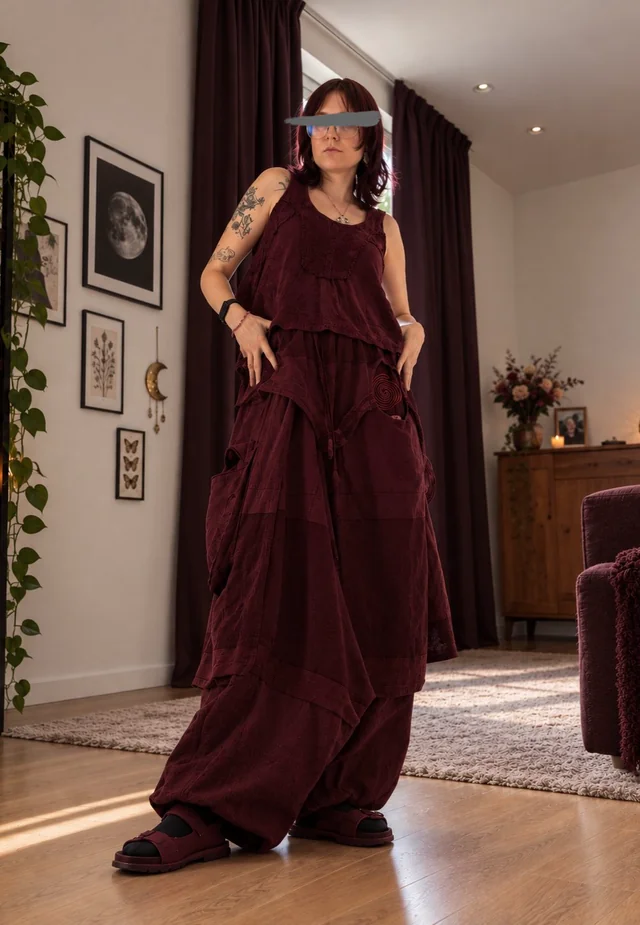
Mori kei silhouette is generated through the physics of multi-layer accumulation rather than through tailoring engineering. The characteristic enveloping, volume-forward, asymmetric-hemline profile is not designed as a single silhouette but emerges from the additive interaction of four to seven simultaneous garment layers, each contributing its own weight, length, texture, and drape behavior to a composite form whose specific geometry varies with every wearing.
Volume through accumulation. The fundamental silhouette principle is additive volume: each layer adds fabric mass that hangs from the shoulders and upper torso, and the cumulative weight of four to seven layers generates a soft, downward-pulling volume that envelops the body from shoulders to below the knee. Unlike tailored volume (achieved through darting, gathering, and structural underlayers that impose controlled shape), mori kei volume is gravitational — fabric falls where weight directs it, and the silhouette's specific form is determined by the aggregate drape behavior of whatever layers are combined on a given day. This produces silhouettes that are inherently variable: the same wearer with the same garments can produce subtly different profiles depending on layering order, because moving a heavier knit cardigan from the second to the fourth position in the stack changes how the lighter layers beneath it drape. The variability is not a defect but an aesthetic feature — it produces the "assembled over time" quality that distinguishes mori kei from single-garment dress systems.
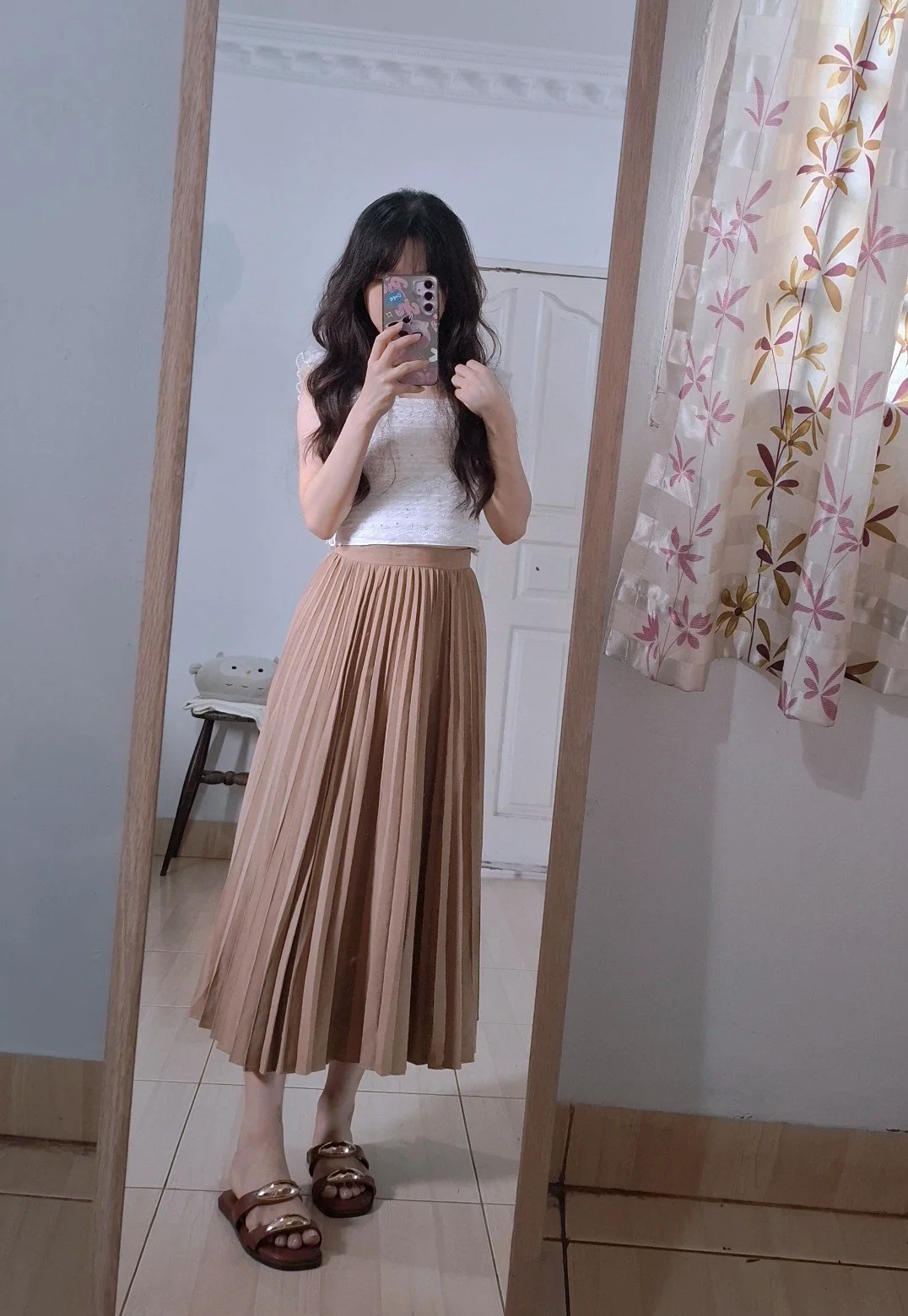
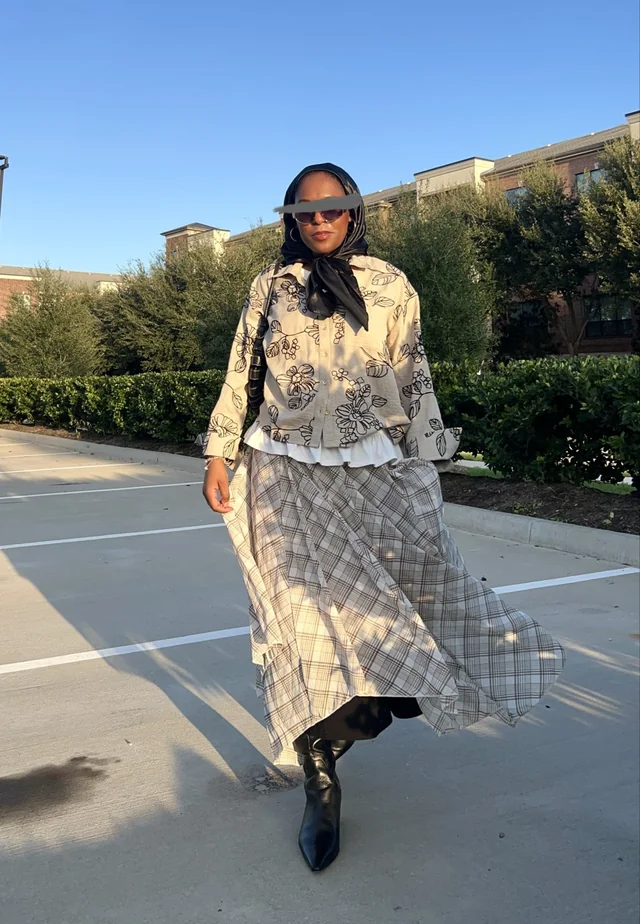
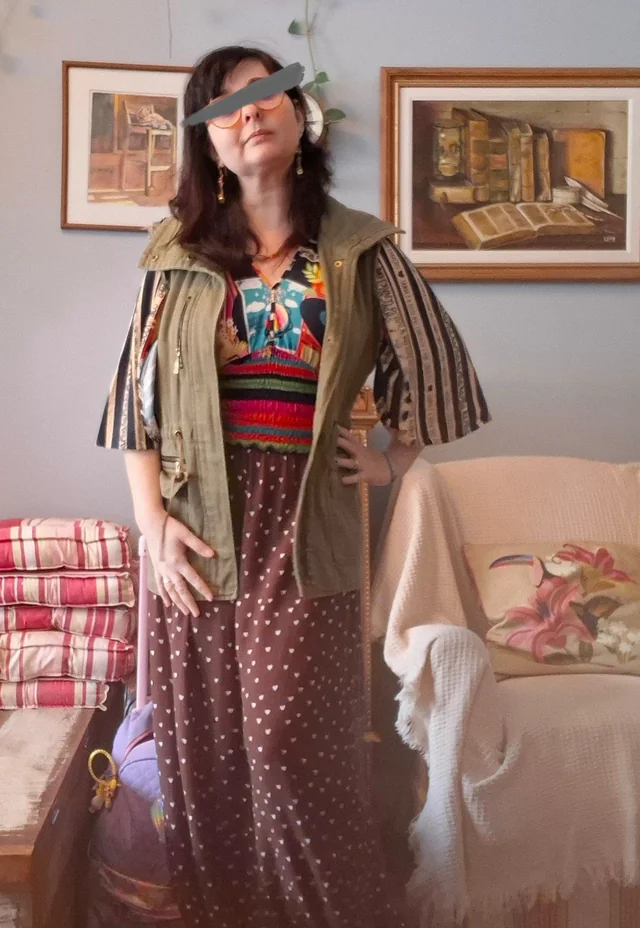
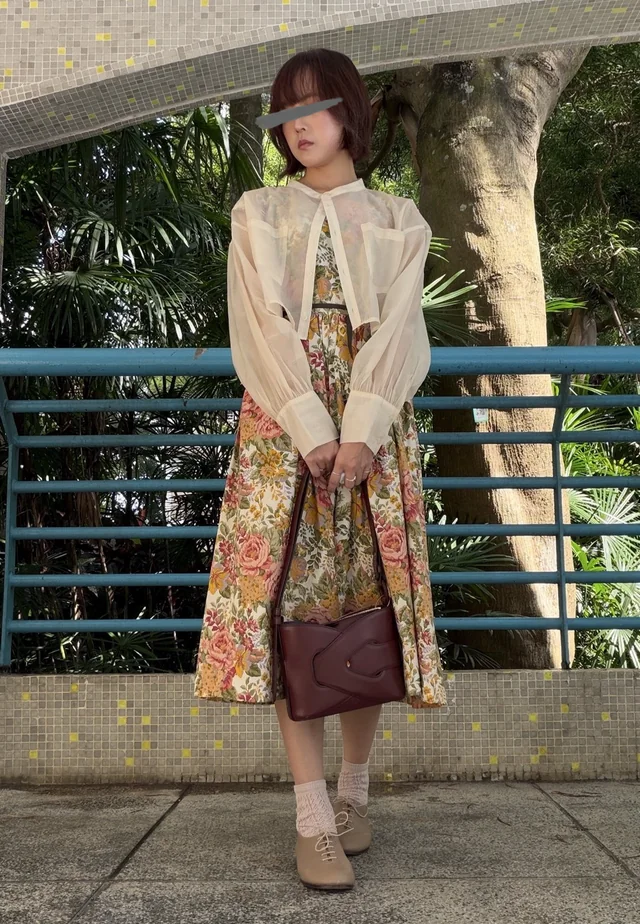
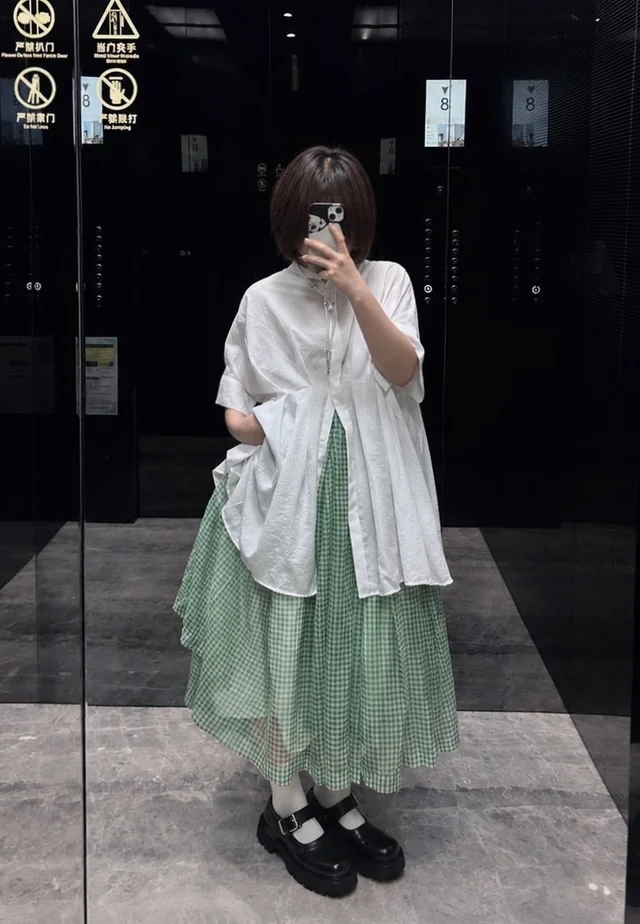
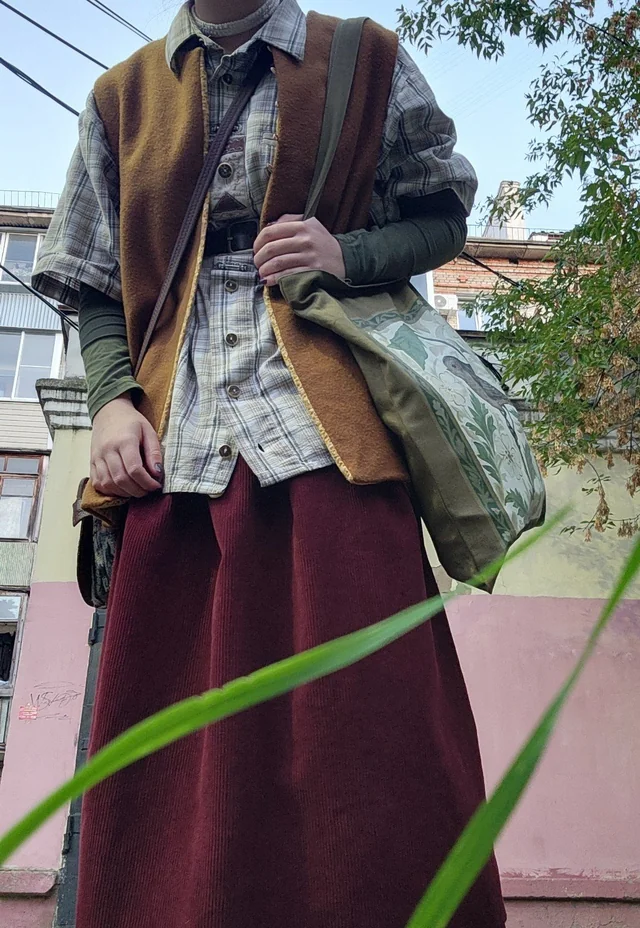
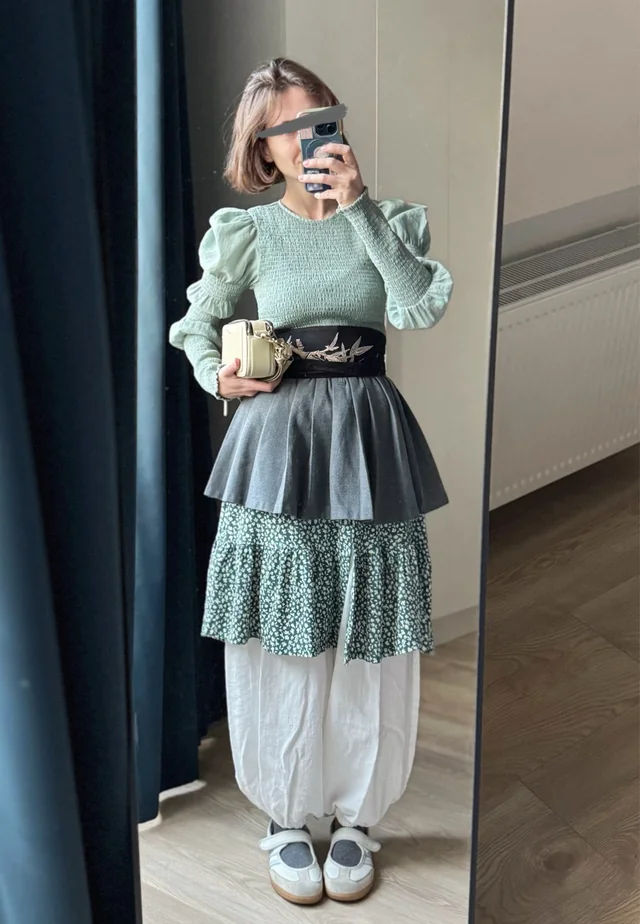
Graduated hemline architecture. The silhouette's most distinctive formal feature is the visible graduation of hemlines at different lengths, with inner layers extending below outer layers (or vice versa) to produce a stratified edge along the body's lower profile. A typical mori kei ensemble might show a cotton gauze underdress at calf length, a linen tunic at knee length, a knit cardigan at hip length, and a cropped lace bolero at waist length — each hemline visible as a distinct textile edge, creating a visual stratigraphy of texture, color, and weight from bottom to top. This hemline graduation is the formal element that most clearly distinguishes mori kei from other natural-fiber layering practices: workwear layering conceals inner layers, monastic layering uses uniform hemlines, and gorpcore layering optimizes for functional independence between layers. Mori kei deliberately exposes the fact of layering — making visible the accumulation process itself — as the aesthetic's primary compositional strategy.
Shoulder-to-hem flow without body mapping. The silhouette avoids waist definition, bust contouring, and hip shaping. Garments are either cut without darts (rectangular or A-line panels) or use minimal gathering at the yoke or empire line to distribute fullness evenly around the torso. The result is a continuous fabric flow from shoulder to hem, with the body's anatomical landmarks (waist, bust, hip) registered only through the fabric's passive response to body geometry rather than through active pattern shaping. Dropped shoulder lines — where the shoulder seam falls 5–15 cm below the anatomical shoulder point — further soften the silhouette's upper boundary, eliminating the angular shoulder definition that structured garments produce. Raglan and kimono sleeve constructions achieve similar softening through continuous fabric panels that eliminate the shoulder-seam junction entirely.
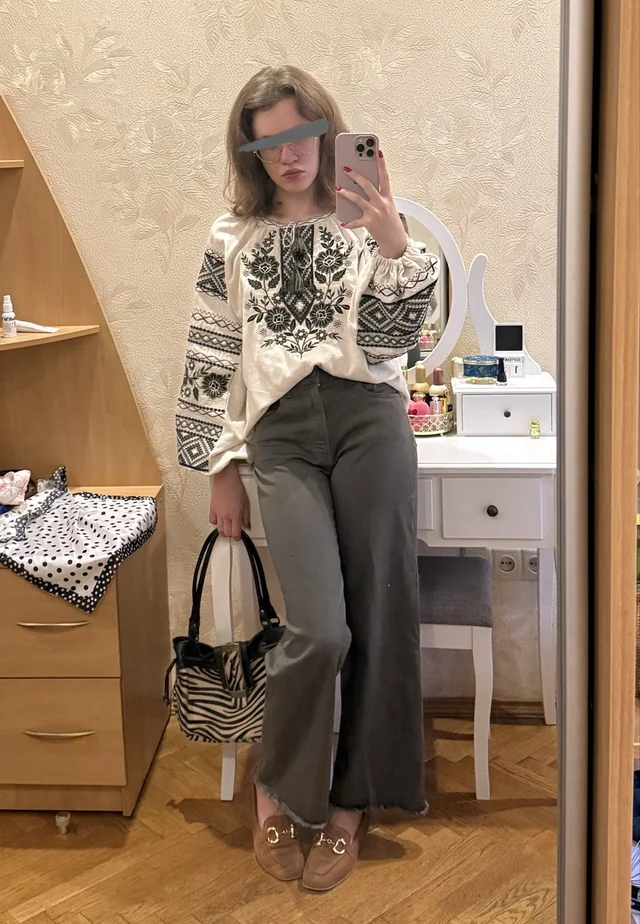
Proportion and length conventions. Mori kei proportions tend toward below-the-knee to ankle-length hemlines on primary garments, with layered cardigans and outer garments varying from hip to knee length. The overall profile is long and column-like when seen from a distance, softening into visible textural complexity at closer range. Trouser-based mori kei — less common but present in the aesthetic's range — uses wide-leg, ankle-length or cropped pants in soft cotton or linen, layered under tunics or long cardigans that partially obscure the trouser silhouette. The aesthetic avoids miniskirts, body-conscious proportions, structured tailoring, and any silhouette that reveals or emphasizes the body's shape through tight fit or strategic exposure.
Materials
Material selection in mori kei is organized by layering-system interaction: each fiber is evaluated not as an independent textile but as a component within a multi-layer stack, where its breathability, weight, texture, drape, and aging behavior affect — and are affected by — adjacent layers.
Cotton gauze. The foundational base-layer textile. Cotton gauze is a plain-weave fabric of extremely low density (40–80 g/m², 20–30 threads per cm in both warp and weft), producing an open, breathable fabric with a soft, slightly nubby hand. Its open weave creates excellent air permeability — critical for a base layer in a four-to-seven-layer stack, where the innermost garment must manage moisture transport to prevent the clammy microclimate that non-breathable bases produce. Cotton gauze's primary performance limitation is moisture saturation: cotton's amorphous cellulose structure absorbs water readily (up to 25% of fiber weight in liquid form, higher in vapor), and the gauze's low thread count means less total fiber mass is available to distribute absorbed moisture, resulting in localized damp patches within 20–30 minutes of sustained perspiration. In multi-layer mori kei, this is mitigated by the linen or cotton voile layers above, which wick moisture away from the gauze through capillary transfer between the layers' contacting surfaces. Cotton gauze ages through progressive softening (fiber surface abrasion reduces stiffness) and eventual thinning (fiber mass loss at friction points), producing a base layer that becomes more comfortable over time but structurally weaker. The characteristic aging signature of much-used cotton gauze — increasing translucency as the weave opens further through repeated washing — is valued in mori kei as evidence of sustained wear.
Linen. Mid-layer fiber providing structural counterpoint to cotton's softness. Linen's crystalline cellulose structure (flax fiber has approximately 70% crystallinity versus cotton's 60%) produces a stiffer, more angular drape with pronounced crease behavior that creates visual texture within the layering stack. In mori kei's mid-layer position, linen provides three functions: cooling through superior moisture wicking (linen absorbs and releases moisture faster than cotton, creating a cooling micro-evaporation cycle), textural contrast against softer cotton layers, and structural scaffolding that prevents the stack from collapsing into a formless mass. Linen's weight range in mori kei applications spans 100–180 g/m², with lighter weights (100–130 g/m²) used for summer tunics and heavier weights (150–180 g/m²) for transitional-season outer layers. The critical performance challenge is wrinkling: linen's low resilience means it creases aggressively and does not recover, producing a crumpled appearance after hours of seated wear that can read as either "authentically natural" (within mori kei's evaluative framework) or "unkempt" (outside it). This wrinkle behavior is exacerbated in layered systems where inter-garment friction increases crease formation at contact zones. Linen's aging trajectory in mori kei differs from single-garment use: when layered consistently, the inner face of a linen tunic (contacting the gauze base layer) pills and softens faster than its outer face (contacting the cardigan or outer layer), producing asymmetric aging that experienced practitioners can read as evidence of layered use.
Cotton voile. The transparency layer. Cotton voile is a semi-sheer plain-weave fabric (60–100 g/m²) woven from high-twist, combed cotton yarns that produce a smooth, crisp hand with moderate translucency. In mori kei layering, voile functions as a visual-depth device: positioned between opaque layers, a voile garment creates a zone of partial visibility through which underlying textures, colors, and patterns are diffusely perceived, producing the layered-depth quality the aesthetic prizes. Voile's high-twist yarns give it better shape retention than gauze at comparable weights, allowing it to maintain its own drape rather than collapsing against the layer beneath. Its performance limitation is wind permeability — voile provides minimal wind resistance, making it ineffective as an outer layer in cool or breezy conditions — and its semi-sheer quality requires careful color coordination, as dark undergarments visible through light voile disrupt the palette's tonal coherence.
Wool knit. Thermal regulation and textural contrast. Mori kei's wool-knit components range from lightweight jersey (150–200 g/m²) to loose-gauge hand knit (200–350 g/m², varying dramatically with gauge and yarn weight). Wool's hygroscopic properties — keratin fiber absorbs moisture vapor through an exothermic process that actually generates heat, unlike cellulosic fibers' endothermic absorption — make it the layering system's primary thermal regulator: a wool cardigan or vest absorbs excess body moisture in warm conditions and releases stored heat in cool conditions, buffering temperature fluctuations across the stack. Loose-gauge hand knit produces the most distinctively "mori" texture — visible stitch structure, yarn irregularity, the slight dimensional distortion of hand-tensioned knitting — and its open structure contributes to the stack's overall breathability while adding significant textural presence. Wool's failure mode in layered use is pilling: fiber-to-fiber abrasion between the wool layer and adjacent layers (particularly cotton or linen, whose stiffer fibers act as abrasive agents) produces surface pills within 30–50 wears at high-friction zones (underarm, inner elbow, where the cardigan overlaps the tunic beneath). Pilling is accelerated in mori kei's multi-layer context because the wool garment experiences friction on both faces simultaneously — from the layer beneath and the layer above — which is not the case in single-layer wear. Management requires periodic de-pilling with a fabric comb or razor tool and acceptance that some degree of surface texture change is inherent to the aesthetic's material logic.
Raw silk. Accent and detail fiber. Tussah silk (wild silk from non-mulberry-fed silkworms, producing irregular, matte-finish fiber) and unpolished habotai provide mori kei's luminous accent — a subtle sheen and fluid drape used in scarves, collar details, ribbon ties, and lining visible at cuff and hem. Raw silk's color (natural warm tan to golden-cream, depending on species and processing) contributes to the earth-tone palette without requiring dyeing. Its failure modes include UV degradation (the protein fiber weakens and yellows under sustained sun exposure), friction fragility (silk fibers are relatively weak when wet and shear easily under lateral abrasion), and perspiration staining (amino acid compounds in sweat chemically degrade silk protein, producing localized discoloration and fiber weakening). These vulnerabilities make silk appropriate for low-friction, low-exposure positions in the layering stack — the scarf, the trim, the visible lining — rather than for structural garments.
Unbleached and undyed cotton. Mori kei's fabric palette frequently relies on cotton that has been washed and pre-shrunk but not bleached or dyed, retaining natural ecru-to-cream coloration from residual cotton waxes and seed-coat pigments. This unbleached state is not merely a visual preference but a material condition: unbleached cotton retains approximately 2–5% of its weight in natural waxes, oils, and pectins that give the fiber a slightly waxy hand and a warmer color than bleached cotton. These residual compounds are progressively removed through washing (hot water and alkaline detergents strip them faster than cold water and mild soap), meaning that unbleached cotton garments shift gradually from warm ecru toward cooler white over their use-life — a slow color transformation that mori kei's temporal sensibility can accommodate but that surprises wearers expecting color stability.
Inter-layer friction and aging. The distinctive material condition of mori kei — four to seven garments worn simultaneously, with each interior layer experiencing friction on both faces — produces aging patterns unlike single-garment wear. Interior layers (the gauze base, the voile underlayer) pill and thin faster than exterior layers because they are abraded on both sides by adjacent garments. Seam ridges on one layer can create localized abrasion lines on the layer beneath, producing wear marks that follow the inner garment's seam map rather than the outer garment's stress points. Dye transfer between layers, particularly from darker linen or cotton to lighter gauze, can occur through friction and moisture, creating ghost-print discolorations. These inter-layer aging phenomena are specific to layering-system aesthetics and are not addressed by standard single-garment care advice.
Color Palette
The palette is fiber-determined rather than trend-selected. Mori kei's characteristic browns, ecrus, creams, dusty greens, and muted roses emerge primarily from unprocessed or minimally processed natural fibers and from the limited dye palette achievable through plant-based and low-impact dye processes.
Fiber-source colors. Unbleached cotton ranges from warm cream to ecru depending on variety and ginning residue. Unbleached linen ranges from silver-grey (fresh retting) to warm gold (sun-exposed). Undyed wool ranges from cream (Merino) through warm grey-brown (Shetland, Corriedale) to charcoal (natural dark breeds). Raw silk ranges from warm tan to golden-cream. These fiber-source colors — amber, cream, ecru, warm grey, silver — constitute the palette's neutral foundation and explain why mori kei's "signature colors" are not arbitrary selections but material consequences of the aesthetic's fiber preferences.
Plant-dye and low-impact color. Kakishibu (柿渋, persimmon tannin) produces warm amber through rich chestnut-brown tones depending on UV exposure duration, and is historically associated with Japanese rural textile traditions. Indigo in very light applications (single or double dipping, producing pale sky-blue rather than deep indigo) appears at the lighter end of the mori kei palette. Tea dyeing (using tannins from black tea, green tea, or hojicha roasted tea) produces warm yellow-brown that ages toward grey-brown. Walnut hull produces muted brown. Madder root at low concentrations produces the dusty rose and muted coral that provide the palette's only warm-tone accent. Onion-skin dyeing produces soft golden-yellow. These processes produce colors that are inherently muted, variable (no two dye baths produce identical results), and subject to fading through washing and UV exposure — which means mori kei garments' colors are understood as transitional states rather than fixed properties.
Earth-tone palette zones. The palette operates across four tonal zones: (1) creams and ecrus (unbleached cotton and silk, pale linen), functioning as the system's lightest values; (2) mid-browns and warm greys (kakishibu, walnut, tea-dyed cotton, undyed medium-toned wool), functioning as the palette's center of gravity; (3) greens and blue-greens (very light indigo, plant-dyed green from overdyeing yellow with indigo, forest-moss references), appearing sparingly as accent; (4) dusty roses, muted corals, and faded reds (light madder, cochineal at low concentration), providing the warmest accent tones. Black, bright white, and saturated colors are essentially absent — their visual sharpness disrupts the tonal continuity that makes mori kei's multi-layer system read as harmonious rather than chaotic.
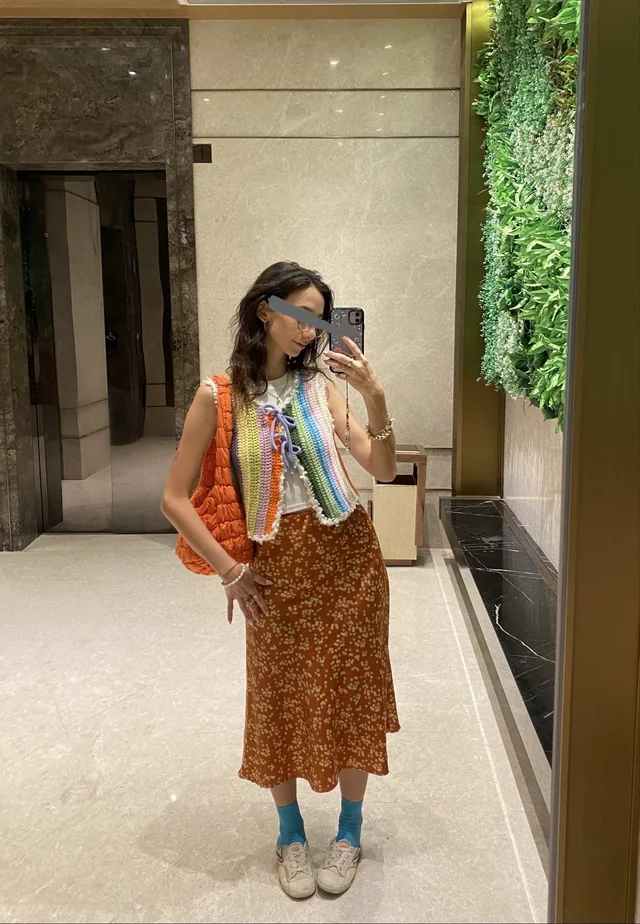
Small-scale prints and woven patterns. Floral prints — small-scale ditsy florals, vintage botanical patterns, William Morris-derivative vegetable-dyed prints — appear on cotton voile and lightweight cotton layers. Pin-stripes, gingham, and micro-check wovens provide tonal-range pattern without disrupting the palette's restraint. Pattern scale is consistently small: large graphic prints, bold stripes, and high-contrast patterns belong to other aesthetics. The prints serve to differentiate layers visually without introducing chromatic contrast — the eye distinguishes the floral voile from the plain cotton gauze beneath and the knit cardigan above through pattern rather than through color.
Details
Details in mori kei are best analyzed as handcraft-construction interfaces — elements whose visual character derives directly from the manual techniques and material constraints of their production.
Crochet lace. Cotton crochet lace appears at collar edges, cuff trims, yoke panels, and as full garments (cardigans, boleros, shawls). The technique uses a single hooked needle to interloop cotton thread (typically mercerized crochet cotton in weights #10–#30, producing thread diameters from 0.75mm to 1.5mm) into an open fabric of interlocking chain-and-cluster stitches. Gauge — the number of stitches per centimeter — determines the lace's scale, drape, and visual density: a loose gauge (#10 thread, 2–3 stitches per cm) produces a bold, open lace suitable for cardigans, while a tight gauge (#30 thread, 5–7 stitches per cm) produces fine, dense lace suitable for edgings and trim. Crochet lace in mori kei is typically ecru or cream (undyed or tea-dyed thread), reinforcing the palette's fiber-source color logic. The critical material distinction is between cotton crochet lace (cellulosic, matte, slightly stiff when new, softening with washing) and synthetic crochet-style lace (polyester or nylon, shiny, permanently stiff, non-absorptive) — a distinction invisible in photographs but immediately legible through touch, and which separates authentic mori kei material practice from fast-fashion approximation.
Cotton broderie anglaise. Broderie anglaise (eyelet embroidery) appears on blouse collars, dress hems, apron edges, and petticoat trims. The technique involves punching or cutting small holes in cotton fabric and finishing each hole with dense satin-stitch embroidery (whipping) that simultaneously decorates and reinforces the eyelet opening. Authentic broderie anglaise is produced on schiffli embroidery machines (originally developed in St. Gallen, Switzerland, in the 1860s) that punch and embroider simultaneously, producing eyelets whose edges are fully encased in thread with no raw fabric visible. Cheaper machine imitations punch holes with laser cutting and leave edges partially raw, producing eyelets that fray and distort after repeated washing — a failure mode that experienced mori kei practitioners can diagnose as construction quality rather than as material deficiency. Broderie anglaise's visual effect is controlled opacity: the eyelet openings provide transparency windows through which underlying layers are visible, reinforcing the layering-depth quality that voile accomplishes at full-garment scale.
Pintucks and smocking. Pintucks — narrow stitched folds (typically 2–3mm wide) running parallel across fabric surfaces — appear at bodices, yokes, and cuff details, creating textural ridges that catch light differently from the flat fabric between them. The technique reduces the effective fabric width by the total fold depth (a garment with twenty 3mm pintucks loses 120mm of width, requiring pattern adjustment), meaning pintucked garments use significantly more fabric than plain equivalents — a material-intensity marker that reads as handcraft investment. Smocking — gathering fabric into regular folds that are secured with decorative stitching — concentrates fullness at specific garment zones (typically the bodice or cuff), creating elastic, expandable sections that accommodate body movement without zippers or buttons. The gathering ratio (the relationship between the original fabric width and the smocked width) ranges from 2:1 to 3:1 in mori kei applications, meaning a 30cm smocked yoke requires 60–90cm of fabric — another material-intensity marker.
Gathering and ruffle construction. Gathering ratios in mori kei skirts and dress hems typically range from 1.5:1 to 2.5:1 (one and a half to two and a half times the finished measurement in fabric), producing soft, irregular folds rather than the crisp, even pleats of tailored construction. Ruffles — strips of fabric gathered along one edge and attached to a garment's hem, cuff, or collar — add both volume and visible construction complexity. The gathered edge of a ruffle creates a distinctive ripple pattern whose regularity varies with gathering method: machine-gathered ruffles produce even distributions, while hand-gathered ruffles produce irregular concentrations of fullness that read as artisanal.
Wooden and shell buttons. Closures in mori kei use natural-material buttons — corozo nut (tagua palm seed, producing dense, ivory-like buttons that darken with handling), shell (mother-of-pearl, trochus, or abalone, producing iridescent, slightly irregular surfaces), wood (olive wood, coconut shell, or carved domestic hardwoods), and horn — rather than plastic or metal. Each material ages distinctively: corozo develops a warm patina from skin oils; shell acquires surface scratching; wood may split or crack if repeatedly wetted without oiling. The buttons' individual irregularity — no two shell buttons are chromatically identical, no two wooden buttons share exact grain — reinforces the aesthetic's anti-industrial orientation.
Lace applique and fabric-layered trim. Strips of vintage or reproduction lace stitched along hemlines, plackets, and yoke seams create visible construction interfaces where one material meets another. These trims function as inter-layer mediators: a strip of cotton lace stitched to the hem of a linen tunic creates a visual transition zone between the tunic's opaque body and the gauze underdress visible below. The technique's material requirement is fiber compatibility — cotton lace on cotton or linen base fabrics, avoiding synthetic lace whose shrinkage rate, dye absorption, and aging behavior differ from cellulosic fabrics.
Accessories
Accessories in mori kei extend the handcraft-and-natural-material logic from garments to carried and worn objects, forming an integrated pastoral-craft vocabulary.
Footwear defaults to round-toed, low-heeled, leather or canvas constructions: round-toed leather ankle boots (the most canonical mori kei shoe, typically in brown or tan vegetable-tanned leather with minimal hardware), Mary Jane shoes (single-strap, low heel, round toe, in leather or canvas), lace-up canvas shoes, moccasin-construction flats, and occasionally wooden-soled clogs or Swedish-style leather clogs. The round toe is aesthetically critical — pointed toes signal urban sophistication, squared toes signal modernist design, and both breach the aesthetic's pastoral softness. Soles are leather, crepe, or natural rubber rather than synthetic foam. Footwear in mori kei carries the heaviest patina-development expectation: vegetable-tanned leather darkens, scratches, and molds to the foot's shape through extended wear, and this personalization is valued as evidence of sustained use.
Bags are soft, unstructured, and suggestive of gathering or domestic activity: wicker baskets (woven willow, rattan, or bamboo, with leather-strap handles or cotton-lined interiors), leather satchels in vegetable-tanned brown or tan leather, canvas tote bags, and drawstring fabric pouches. The wicker basket — impractical for urban use by most functional metrics (no zipper, no internal pockets, vulnerable to rain) — functions as a primary semiotic marker: it cites the foraging, berry-picking, flower-gathering pastoral activity that mori kei's forest fantasy imagines.
Headwear includes wide-brimmed straw hats (woven rice straw or raffia, unlined, unstructured), cotton or linen berets, crocheted berets and hats, and fabric headbands or hair scarves in the aesthetic's earth-tone palette. Knitted or crocheted leg warmers, arm warmers, and fingerless gloves extend the handcraft vocabulary to the extremities while adding additional layering elements to the silhouette.
Jewelry is minimal and material-specific: wooden beads, ceramic pendants, hand-stamped metal discs on cotton or leather cord, braided cotton bracelets, and occasional vintage brooches (enamel, filigree, or pressed-glass in floral or botanical motifs). Precious metals and gemstones are essentially absent — their luxury connotation contradicts the aesthetic's pastoral-humble positioning.
Body Logic
Mori kei constructs the body as a pastoral-domestic figure: gendered feminine in its original Japanese formulation but oriented toward softness, domesticity, and interiority rather than toward display, sexuality, or physical performance. The multi-layer silhouette envelops the body in textile volume that obscures anatomical contour while producing a specific body-type reading that is neither gender-neutral (as in monastic) nor gender-performing (as in Lolita) but gender-softened — femininity expressed through textile care, handcraft skill, and domestic-pastoral association rather than through body shape, skin exposure, or decorative excess.
The layered silhouette accommodates body diversity more readily than fitted fashion categories because its form is determined by fabric behavior rather than by body-garment fit precision. Within limits, the same garment stack reads as "mori kei" on different body sizes because the aesthetic's evaluative criteria center on layering coherence, textile quality, and tonal coordination rather than on body proportion or silhouette control. However, this accommodation has practical limits: the four-to-seven-layer system adds significant visual volume, and on shorter bodies, the effect can read as overwhelmed rather than enveloped — producing a "wearing the clothes rather than the clothes wearing you" perception that the aesthetic's critics frequently cite.
Age presentation in mori kei negotiates a tension between childlike reference and adult practice. The aesthetic's visual vocabulary — storybook illustration, forest fairy imagery, round-toed shoes, oversized cardigans, gathered skirts — cites childhood dress codes (the pinafore, the smocked bodice, the mary jane shoe) while being practiced by adult women (the original mixi community was predominantly women in their twenties and thirties). This "adult playing child" reading is central to both the aesthetic's appeal (it offers regression from urban-professional identity toward a more gentle, imaginative self-presentation) and its critique (it performs a voluntary infantilization that can read as retreat from adult agency). The tension is not resolved within the aesthetic but is managed through material sophistication: the quality of fiber, construction, and layering complexity signals adult craft knowledge and spending capacity even as the visual vocabulary signals youthful innocence.
Gender coding is structurally feminine in the original Japanese formulation — "mori girl" was the community's self-designation, and the 65 rules describe a feminine-gendered lifestyle and sensibility. Male participation in mori kei existed but was marginal in the original community and is more visible in contemporary Western contexts, where the aesthetic's gender-softening properties attract masculine-presenting and non-binary participants. The layering system's loose, body-obscuring construction makes it structurally available across gender presentations, even if its cultural coding remains primarily feminine.
Garment Logic
Construction in mori kei operates through soft engineering: garments are built to drape, layer, and accumulate rather than to fit, shape, or contour. The construction logic prioritizes inter-garment compatibility (how pieces work together in a stack) over individual garment precision (how a single piece fits a body).
Pattern logic. Mori kei garments use minimally darted or undarted patterns: A-line dresses with princess seams providing gentle shaping without waist suppression; boxy tunics cut from rectangular panels with minimal shaping; raglan-sleeve cardigans whose continuous front-to-sleeve panels eliminate the structured shoulder seam; gathered-yoke dresses where a flat, fitted yoke distributes fullness into the skirt through gathering rather than through darting. This pattern logic means mori kei garments are relatively simple to produce — they require less cutting precision, fewer pattern pieces, and less fitting iteration than tailored garments — which enables the handmade and small-production construction the aesthetic values. A beginning sewist can construct a functional mori kei dress from four to six pattern pieces; an equivalent fitted dress might require twelve to sixteen.
Seam and finish construction. French seams (the seam allowance enclosed within a second seam, producing a self-finished interior) appear frequently in cotton and linen mori kei garments, providing a clean interior finish that prevents fraying without the bulk of serged edges. Flat-felled seams (the seam allowance folded and topstitched flat) provide strength and a visible construction line at side seams and yoke seams. Raw-edge finishing — cutting and leaving the edge without hemming — appears at hem edges and cuff edges on woven fabrics whose weave density resists progressive unraveling (dense linen, canvas, flannel). This raw-edge treatment produces a hem that frays incrementally with washing, shortening slightly over time and developing a soft, feathered border — a detail that reads as authentically handmade within mori kei's evaluative framework.
Layering compatibility. Garments designed for mori kei layering include specific features that facilitate stacking: slightly wider necklines (to prevent bunching when multiple collars overlap), graduated sleeve lengths (so that each layer's cuff emerges from the layer above), and absence of bulky closures at the center front (which would create uncomfortable hardware stacking when multiple buttoned layers overlap). Cardigans are cut with extra ease through the chest and arms to accommodate the layers beneath. Underdresses are cut close to the body (relative to mori kei's overall looseness) to serve as a smooth base that subsequent layers drape over without bunching.
Aftercare protocols. Multi-layer garments composed of different natural fibers require care calibrated to the most vulnerable fiber in each garment. Cotton-and-linen garments tolerate cool machine wash (30°C) with mild detergent and line drying; hot water and tumble drying accelerate fiber degradation and dimensional change. Wool-knit layers require hand washing or delicate machine cycle in cold water with wool-specific detergent (which maintains lanolin and does not strip the fiber's surface scales), flat drying to prevent gravitational stretch distortion, and periodic moth-protection measures (cedar blocks, sealed storage) during seasonal off-rotation. Silk trim and accessories require hand washing in cold water with pH-neutral detergent, rolled in a towel to remove excess moisture, and flat drying out of direct sunlight. Crochet and broderie anglaise elements require careful washing to prevent the open-work structures from snagging, stretching, or distorting — a flat wash bag in a gentle machine cycle mitigates but does not eliminate this risk. The aftercare burden of a full mori kei wardrobe — in which a single outfit combines garments requiring three or four different care protocols — is a significant maintenance demand that is rarely acknowledged in the aesthetic's pastoral-ease presentation.
Failure modes. Multi-layer systems fail in ways that single-garment wear does not produce. Inter-garment friction accelerates pilling on interior-layer surfaces, particularly where wool contacts cotton or linen. Dye transfer between layers — a cream cotton gauze acquiring a faint brown shadow from a kakishibu-dyed linen over it — creates discolorations that no single-garment care protocol anticipates. Seam ridges on one layer abrade the adjacent layer's surface, creating ghost-impression wear lines. Weight accumulation in wet conditions — all four to seven layers absorbing rain simultaneously — can exceed the structural capacity of lightweight shoulder seams, causing stretch distortion or seam failure at the stack's uppermost garment (which bears the full weight of all saturated layers). The most common failure mode, however, is aesthetic rather than structural: as individual layers age at different rates (wool pills before linen softens, cotton thins before silk degrades), the ensemble's tonal and textural coherence shifts, requiring the wearer to retire or replace individual layers to maintain the stack's overall harmony — a form of maintenance that is wardrobe-systemic rather than garment-specific.
Motifs / Themes
Forest pastoralism as governing metaphor: the aesthetic positions the wearer within an imagined satoyama landscape of managed woodland, domestic gardens, cottage interiors, and seasonal botanical change. The forest is not wilderness but refuge — a cultivated alternative to the urban environments that mori kei's original community inhabited (Tokyo, specifically) and from which the aesthetic provides imaginary departure.
Handcraft as identity marker: crochet, knitting, embroidery, sewing, and other textile handcrafts appear both as garment-construction techniques and as lifestyle signifiers. The 65 rules include preferences for handmade items, suggesting that the wearer is not merely wearing handcraft but practicing it — the dressed body presents itself as a craftsperson's body rather than a consumer's body.
Storybook and fairy-tale reference: visual citation of European fairy-tale illustration (Arthur Rackham, Cicely Mary Barker, Beatrix Potter), Japanese children's-book illustration, and Studio Ghibli's pastoral settings positions the aesthetic within an explicitly fictional landscape. The mori kei wearer dresses for a world that does not exist — the enchanted forest, the cottage garden, the village market of storybook illustration — and this fictional address is part of the aesthetic's emotional operation: it provides imaginative rather than practical refuge.
Domesticity and interiority: tea, baking, flower arranging, letter writing, journal keeping, and other domestic-intimate activities recur as thematic reference points, distinguishing mori kei's pastoral from the agricultural pastoral of cottagecore (which emphasizes farming, preserving, and outdoor labor) and from the survival pastoral of gorpcore (which emphasizes wilderness exposure and equipment performance).
Anti-urbanism as sensibility rather than politics: mori kei's forest reference encodes a soft refusal of urban Japan's high-pressure work culture, dense housing, competitive social environments, and hypercommercial fashion systems. This refusal operates through aesthetic withdrawal (dressing as if one inhabited the forest) rather than through political action (organizing against the conditions one is withdrawing from), which is both the aesthetic's emotional appeal and the limit of its political effectiveness.
Cultural Touchstones
Studio Ghibli films constitute the aesthetic's primary cinematic reference system. My Neighbor Totoro (1988) provides the foundational visual template: rural Japanese landscape, children in simple cotton and linen dress, forest as living presence rather than scenic backdrop. Kiki's Delivery Service (1989) offers the figure of the independent girl in domestic-craft settings, wearing simple dresses and operating within a European-inflected small-town pastoral. Whisper of the Heart (1995) positions the creative, bookish young woman in an atmospheric urban-pastoral environment. The Secret World of Arrietty (2010) — released at mori kei's commercial peak — provides scaled-down domestic-pastoral imagery in which natural materials (leaves, twigs, fabric scraps) become architectural and sartorial elements.
Little Forest (Ritoru Foresuto, リトルフォレスト, 2014–2015) — Junichi Mori's two-part Japanese film based on Daisuke Igarashi's manga — functions as an accidental mori manifesto: a young woman's return to rural Tohoku for seasonal cooking, gardening, and self-sufficient domestic life, shot with meticulous attention to landscape, food preparation, and the rhythms of rural seasonality. The film's visual vocabulary — hand-dyed textiles, well-worn cotton and linen garments, wood-fired cooking, forest foraging — so precisely overlaps mori kei's thematic range that it circulated as reference material within the community despite being produced outside the street-fashion context.
Anne of Green Gables (Lucy Maud Montgomery, 1908), both the novel and its various adaptations (the 1979 Japanese anime adaptation Akage no An being particularly significant for the Japanese mori kei community), provides a literary-pastoral figure — the imaginative girl in rural domesticity, dressed in simple, handmade garments — that anticipates mori kei's character type by a century.
The broader zakka (雑貨) culture — Japanese aesthetic appreciation for everyday objects, domestic goods, stationery, and small crafts, sustained through magazines like Zakka Book and retail spaces like Tokyu Hands — provides mori kei's lifestyle-object context: the ceramic teacup, the linen handkerchief, the wooden hairpin, the hand-bound notebook are all zakka objects that complete the mori kei sensibility beyond dress.
See Also
- Cottagecore: Western pastoral overlap; mori kei predates it by a decade; cottagecore lacks the multi-layer silhouette logic and Japanese subcultural context
- Natural kei (nachuraru kei): Adjacent Japanese earth-tone naturalism; shares fiber preferences but typically produces cleaner single-layer silhouettes rather than mori kei's layered accumulation
- Dolly kei: Adjacent Japanese street fashion (peaked simultaneously with mori kei in Harajuku); shares vintage and fairy-tale reference but emphasizes richer colors, heavier textures, and European antique-market sourcing
- Fairy kei: Japanese street fashion sharing handcraft and fantasy reference; lighter palette (pastels versus earth tones) and 1980s pop-culture orientation versus mori kei's pastoral-historical orientation
- Lolita (classic and natural substyles): Shared Japanese street-fashion institutional context; Lolita's structured petticoat silhouette and precise garment engineering contrast with mori kei's gravitational drape and soft construction
- Dark academia: Western overlap in bookish-pastoral sensibility and natural-fiber preference; more structured, institutional-reference-heavy, and masculinity-inclusive
- Goblincore: Overlapping nature-and-craft aesthetic; goblincore foregrounds mess, decay, and non-pretty natural elements where mori kei foregrounds softness and beauty
- Wabi-sabi: Shared Japanese cultural origin and natural-fiber emphasis; wabi-sabi centers material degradation as aesthetic content where mori kei centers material accumulation
- Monastic: Shared natural-fiber volume and anti-display orientation; monastic uses volume for ascetic withdrawal where mori kei uses volume for pastoral shelter
Brands and Designers
Japanese Origin Brands:
- SM2 / Samansa Mos2 (サマンサ モスモス, founded 2000s, Japan, Can Group): commercially dominant mori-kei-adjacent brand; cotton and linen layering pieces in earth-tone palette at accessible price points; responsible for standardizing the aesthetic's retail form
- niko and... (ニコアンド, founded 2007, Japan, Adastria Group): lifestyle-integrated mori-adjacent clothing, home goods, and cafe culture; broader natural-lifestyle positioning than pure mori kei
- studio CLIP (スタディオクリップ, Japan, Adastria Group): natural-fiber layering basics and lifestyle goods in the mori kei earth-tone range
- SM2 keittio (SM2 sub-line, slightly more casual/kitchen-domestic positioning)
- Te chichi (テチチ, Japan, Can Group): vintage-inspired natural-fiber blouses, skirts, and dresses in the mori kei silhouette range
- MUJI (無印良品, founded 1980): unintentional mori baseline; unbleached cotton and linen basics in neutral tones that serve as mori kei's most accessible layering foundation
Vintage and Curated Retail:
- Grimoire (グリモワール, established 2009, Shibuya/Harajuku): vintage and antique-influenced pieces; historically significant as a physical retail node for the mori kei and dolly kei communities
- Wonder Rocket (ワンダーロケット, Harajuku): eclectic vintage and independent-brand retail; served as a mori-kei-adjacent discovery space
- Closet Child (クローゼットチャイルド, Tokyo): secondhand Japanese street-fashion retailer carrying archived mori kei pieces
Natural-Fiber Specialists:
- nest Robe (ネストローブ, founded 2008, Japan): linen-focused natural-fiber brand producing garments whose drape, color, and construction logic align closely with mori kei's material requirements
- ICHI (イチ, Japan): natural-fiber garments with linen emphasis and muted earth-tone palette; artisanal-adjacent positioning
- Lisette (リゼッタ, Japan): linen and cotton garments with French-pastoral-influenced design; shared mori kei silhouette logic
- Jurgen Lehl / Babaghuri (founded 1971/2003, Tokyo): plant-dyed natural fibers, artisanal construction, explicit anti-fashion positioning; luxury-tier mori kei material practice
Western Interpretations:
- Toast (founded 1997, UK): linen and cotton layering pieces in muted palette; British pastoral-domestic positioning that overlaps with mori kei's visual grammar
- Ewa i Walla (founded 1986, Sweden): layered linen, cotton, and silk garments with vintage-inspired construction, pintucks, and gathering; European interpretation of accumulation-layering logic
- Nadir Positano (Italy): linen-focused layering with botanical prints and handcraft details
- Magnolia Pearl (USA): heavily layered, distressed, and patched natural-fiber garments; more maximal and Western-bohemian than Japanese mori kei but sharing the accumulation-layering principle
Handcraft/Independent:
- Independent Taobao sellers (post-2015 Chinese senxi): parallel mori kei retail ecosystem producing cotton and linen layering garments for the Chinese market through Taobao and Tmall platforms
- Etsy handcraft sellers specializing in crochet, hand-knit, and linen garments in mori kei idiom
- Japanese independent makers selling through Creema and minne platforms (Japan's equivalent of Etsy), producing small-run crochet, hand-dyed, and hand-sewn mori kei pieces
Citations
[1] Kawamura, Yuniya. Fashioning Japanese Subcultures. Berg, 2012. [2] Kawamura, Yuniya. Fashioning Japanese Subcultures: Decentralization and Diversification as Neotribes. 2nd ed., Bloomsbury Visual Arts, 2024. [3] Aoki, Shoichi. FRUiTS. Phaidon Press, 2001. [4] Aoki, Shoichi. Fresh Fruits. Phaidon Press, 2005. [5] Godoy, Tiffany, and Ivan Vartanian. Style Deficit Disorder: Harajuku Street Fashion — Tokyo. Chronicle Books, 2007. [6] Marx, W. David. Ametora: How Japan Saved American Style. Basic Books, 2015. [7] Yagi, Yoko. "Mori Girl and Harajuku Fashion Tribes." Fashion Studies, vol. 1, no. 1, 2013. [8] "Girls of the Forest." Trends in Japan, Web Japan. https://web-japan.org/trends/09_fashion/fas100204.html [9] Heisei Archive (平成アーカイブ). "森ガール (Mori Girl)." https://heisei-archive.com/morigirl/ [10] Kadolph, Sara J., and Sara B. Marcketti. Textiles. 12th ed., Pearson, 2016. [11] Hatch, Kathryn L. Textile Science. West Publishing, 1993. [12] Morton, W. E., and J. W. S. Hearle. Physical Properties of Textile Fibres. 4th ed., Woodhead Publishing, 2008. [13] Gohl, E. P. G., and L. D. Vilensky. Textile Science: An Explanation of Fibre Properties. 2nd ed., Longman Cheshire, 1983. [14] Tortora, Phyllis G., and Robert S. Merkel. Fairchild's Dictionary of Textiles. 7th ed., Fairchild Books, 1996. [15] Watkins, Susan M. Clothing: The Portable Environment. 2nd ed., Iowa State University Press, 1995. [16] Fourt, Lyman, and Norman R.S. Hollies. Clothing: Comfort and Function. Marcel Dekker, 1970. [17] Renbourn, E.T., and W.H. Rees. Materials and Clothing in Health and Disease. H.K. Lewis, 1972. [18] Yanagi, Sōetsu. The Unknown Craftsman: A Japanese Insight into Beauty. Adapted by Bernard Leach, Kodansha International, 1972. [19] Dalby, Liza. Kimono: Fashioning Culture. Yale University Press, 1993. [20] Monden, Masafumi. Japanese Fashion Cultures: Dress and Adornment in Contemporary Japan. Bloomsbury Academic, 2015. [21] Kawamura, Yuniya. Fashion-ology: An Introduction to Fashion Studies. 2nd ed., Bloomsbury Academic, 2018. [22] Entwistle, Joanne. The Fashioned Body: Fashion, Dress and Social Theory. 2nd ed., Polity, 2015. [23] Wilson, Elizabeth. Adorned in Dreams: Fashion and Modernity. Revised ed., Rutgers University Press, 2003. [24] Crane, Diana. Fashion and Its Social Agendas: Class, Gender, and Identity in Clothing. University of Chicago Press, 2000. [25] Simmel, Georg. "Fashion" (1904). In Simmel on Culture: Selected Writings, edited by David Frisby and Mike Featherstone, SAGE, 1997. [26] Bourdieu, Pierre. Distinction: A Social Critique of the Judgement of Taste. Translated by Richard Nice, Harvard University Press, 1984. [27] Hebdige, Dick. Subculture: The Meaning of Style. Routledge, 1979. [28] Barthes, Roland. The Fashion System. Translated by Matthew Ward and Richard Howard, University of California Press, 1983. [29] Hollander, Anne. Seeing Through Clothes. University of California Press, 1993. [30] Fletcher, Kate. Sustainable Fashion and Textiles: Design Journeys. 2nd ed., Earthscan, 2013. [31] Fletcher, Kate. Craft of Use: Post-Growth Fashion. Routledge, 2016. [32] Lipovetsky, Gilles. The Empire of Fashion: Dressing Modern Democracy. Princeton University Press, 1994. [33] Niinimaki, Kirsi, editor. Sustainable Fashion in a Circular Economy. Aalto ARTS Books, 2018. [34] Braddock Clarke, Sarah E., and Marie O'Mahony. Techno Textiles 2: Revolutionary Fabrics for Fashion and Design. Thames and Hudson, 2005. [35] Gwilt, Alison. A Practical Guide to Sustainable Fashion. Bloomsbury Academic, 2014. [36] Veblen, Thorstein. The Theory of the Leisure Class. Macmillan, 1899.