Monastic
Summary. Monastic is a dress regime in which garments are governed by the structural logic of religious asceticism — rectangular flat-pattern construction, undyed or minimally processed natural fibers, enveloping volume achieved through fabric weight and drape rather than tailoring, and deliberate suppression of ornament, color variation, and body-contouring fit. The system descends from actual monastic dress codes (Benedictine, Cistercian, Franciscan, Buddhist vinaya, Sufi) that specified garment number, fiber type, color restriction, and maintenance protocol as expressions of spiritual discipline. In its contemporary fashion application, monastic operates as an anti-display regime: garments communicate withdrawal from trend cycles, body-surveillance dressing, and decorative competition by substituting material gravity — the weight, hand, and aging behavior of cloth itself — for the semiotic complexity that governs most fashion systems.
In Material Terms
Monastic coherence depends on the drape-and-weight behavior of natural fibers processed with minimal intervention. Wool — particularly lightweight weaves such as challis (plain-weave, 100–150 g/m²), tropical wool (high-twist yarns producing dry hand and fluid drape at 180–220 g/m²), and wool crepe (twisted-yarn weave creating matte, dimensionally stable fabric) — provides the controlled fall that defines monastic silhouettes: heavy enough to resist wind and movement distortion, light enough to follow the body's geometry without clinging. Linen, the monastic fiber of longest historical standing, produces a stiffer drape than wool — fabric that breaks into angular folds rather than flowing curves — and develops its characteristic softness only after extensive washing, creating garments whose hand improves with age rather than degrading. Cotton in monastic applications requires heavier weaves (canvas, twill, dense poplin at 180+ g/m²) to generate sufficient drape mass; lighter cottons lack the gravitational authority the silhouette demands. When these fibers are left undyed, they produce a specific and variable color range: raw wool from white to grey-brown depending on breed (Merino trending ivory, Shetland trending grey-brown, Churro trending amber); unbleached linen from silver-grey when new to yellow-gold after repeated washing and sun exposure; unbleached cotton from cream-white to warm ecru depending on variety and processing residue. These are not fashion colors chosen from a palette but fiber-determined outcomes of material constraint.
At Category Level
Monastic occupies a structural position between minimalism and avant-garde deconstruction, sharing minimalism's chromatic restraint and ornament refusal but diverging in its relationship to the body: where minimalism often produces clean, body-aware silhouettes (Jil Sander, Celine under Phoebe Philo), monastic envelops the body in excess fabric volume, treating the dressed form as an architectural mass rather than an articulated figure. It shares with wabi-sabi an interest in material imperfection and temporal texture (wear marks, softening, natural aging) but applies these to specifically Western and pan-religious garment typologies — the tunic, the cowl, the robe — rather than to the Japanese craft and repair traditions wabi-sabi foregrounds. Against normcore's anti-fashion through ordinariness, monastic proposes anti-fashion through gravity: garments that are too deliberate, too materially serious, and too historically freighted to read as casual default.
Methodologically
This entry treats monastic as a material-ascetic dress system: garments are analyzed through their fiber science, flat-pattern construction, drape mechanics, failure behavior under repetitive wear, maintenance protocols, and the religious textile traditions from which they descend — not through trend positioning or mood-board aesthetics alone. The emphasis is on what the garments are made of, how they are constructed, how they behave on the body across time, and what cultural work the rhetoric of "simplicity" performs across class positions.
Word (Etymology)
From Latin monasticus, from Greek monastikos ("solitary"), from monazein ("to live alone"), from monos ("alone, single"). The word entered English in the fifteenth century to describe the life, rules, and material culture of those living under religious vows in communal seclusion. In fashion usage, "monastic" begins appearing in design criticism during the 1980s — applied to Yohji Yamamoto's voluminous, dark, gender-obscuring garments presented in Paris from 1981 onward — as a descriptor for dress that borrows the formal vocabulary of religious garments (volume, drape, cowl, tunic, robe) without adopting their theological content.
The term's fashion application performs a characteristic transfer: it retains the ascetic connotation (withdrawal, discipline, refusal of vanity) while detaching it from the vowed poverty, obedience, and communal labor that gave monastic dress its original social meaning. This detachment is not neutral. When a Benedictine monk wears undyed wool, the garment materializes a rule of poverty specified in Chapter 55 of the Regula Benedicti: "Let clothing be given to the brothers according to local conditions and climate, for in cold regions more will be needed... Let the monks not worry about the color or texture of these things, but let them be such as can be found in the province where they live or can be purchased most cheaply." When a consumer purchases a $1,200 undyed cashmere tunic from The Row, the visual grammar is preserved while its material logic is inverted. The etymological history thus encodes the aesthetic's central tension: monastic dress as genuine material constraint versus monastic dress as performed simplicity within conditions of abundance.
Japanese fashion discourse uses the loanword monastikku (モナスティック) to describe this register, while also deploying sōryo-fū (僧侶風, "monk-style") for more explicitly religious-reference styling. Korean fashion media uses sudobok (수도복, "monastic dress") as a style descriptor, reflecting the aesthetic's global circulation through design media and e-commerce platforms.
Subculture
Monastic fashion did not emerge from a single subcultural scene but from the convergence of several communities whose evaluative regimes share an orientation toward material restraint, garment longevity, and anti-display dressing.
Avant-garde fashion adopters. The primary constituency since the 1980s has been consumers who follow the deconstructivist and anti-fashion lineages of Japanese and Belgian design — Yohji Yamamoto, Rei Kawakubo, Martin Margiela, Ann Demeulemeester — and who evaluate garments through construction analysis, fabric handle, and intellectual positioning rather than trend currency. Within this community, expertise is demonstrated through fiber identification by touch, recognition of construction techniques (flat-felled seams, raw edges, selvedge incorporation), and familiarity with designers' historical collections. Retail environments such as Dover Street Market, SSENSE, and specialized boutiques (Hostem in London, The Darkside Initiative in Hong Kong) function as community nodes where knowledge is transmitted through in-store handling, staff expertise, and curated adjacency.
Quiet-luxury minimalists. Overlapping but distinct from the avant-garde constituency, this group — aligned with The Row, Lemaire, Jil Sander, and Eileen Fisher — evaluates garments primarily through fabric quality, fit precision, and social discretion. The monastic elements they adopt (neutral palette, volume, reduced detail) serve a class-signaling function: communicating wealth through material quality rather than brand visibility. Their expertise economy centers on fiber knowledge (distinguishing cashmere grades, identifying wool weave types) and brand-specific fit systems, transmitted through fashion editorial, Instagram curation, and resale-market literacy.
Sustainability and slow-fashion practitioners. Consumers committed to reduced consumption, natural fibers, and garment longevity often arrive at monastic aesthetics through elimination: when you reduce a wardrobe to a small number of durable, natural-fiber garments in a restricted palette, you produce something that looks structurally monastic regardless of aesthetic intent. Within this community, expertise centers on fiber sourcing (provenance, animal welfare, organic certification), care technique (hand washing, air drying, mending), and garment longevity metrics. Brands such as Eileen Fisher (with its Renew take-back program), Evan Kinori, and Jan-Jan Van Essche serve this constituency.
Contemplative and spiritual communities. A smaller but culturally significant constituency includes practitioners of contemplative traditions — Zen Buddhism, Christian monasticism, yoga, and meditation — who adopt monastic dress elements as material extensions of spiritual practice. Within these communities, garment evaluation operates through different criteria entirely: appropriateness to practice (does the garment permit seated meditation, manual labor, prostration?), material honesty (natural fibers as expressions of non-artifice), and aesthetic restraint as a discipline rather than a preference.
The resulting expertise hierarchy is organized primarily around material literacy. At the top, participants evaluate fiber composition, weave structure, drape behavior, and garment aging with the specificity of textile professionals. Mid-tier participants navigate brand ecosystems and designer lineages with confidence. Entry-level participants select through visual pattern-matching — "looks monastic" — without evaluating the material substrate that produces the look. The tension between material knowledge and visual citation defines the subculture's internal gatekeeping.
History
The material history of monastic dress begins not in fashion studios but in religious rule-making, where garment specification served theological and institutional functions.
Religious textile codification (4th–13th century). The earliest systematic dress codes in Western monasticism appear in the Regula Benedicti (Rule of Saint Benedict, c. 530 CE), Chapter 55, which specifies that monks receive a tunic (tunica), cowl (cuculla), scapular for work, stockings, and shoes — with the abbot adjusting garment weight and number to local climate. The Rule explicitly forbids concern with color and quality: garments should be locally sourced and inexpensive, their function being to clothe the body adequately while preventing attachment to material goods. The Cistercian reform (founded 1098) intensified this logic by specifying undyed wool — producing the "white monks" whose habits were the natural cream-grey of unprocessed fleece — in deliberate contrast to the Benedictines' black-dyed habits, making fiber processing itself a theological statement. The Franciscan Rule (1223) went further, requiring garments of the lowest quality available ("de vilibus vestibus"), equating textile poverty with spiritual authenticity. In Buddhist monasticism, the vinaya rules governing the kāṣāya (monastic robe) specify three garments, each constructed from rectangular panels sewn together in a pattern representing rice paddies — the robe's geometry is doctrinally prescribed, and its color (saffron, maroon, or grey depending on tradition and region) derived from plant-dye processes available to mendicant communities. The construction principle across these traditions is consistent: rectangular flat patterning that avoids shaped cutting, producing garments from geometric panels that minimize waste and require minimal tailoring skill.
Medieval-to-modern textile continuity (13th–19th century). Monastic garments maintained remarkable formal stability across centuries because their design served institutional rather than fashionable logic — changes in secular silhouette (the fitted Gothic cotehardie, the Renaissance doublet, the Baroque court coat) did not penetrate enclosure walls. This stability makes monastic dress the longest-running continuously produced garment typology in Western textile history. The tunic-and-cowl system remained essentially unchanged from the sixth century to the twentieth: a T-shaped body cut from a single width of cloth, folded at the shoulder, with rectangular sleeves inserted at right angles. Variations occurred in proportion (wider sleeves for choir wear, narrower for labor), weight (heavier wool for northern European houses, lighter for Mediterranean), and outer layers (the Franciscan mantle, the Dominican cappa, the Benedictine cuculla), but the underlying flat-pattern logic persisted. This persistence was not merely conservative tradition but structural efficiency: rectangular construction required no fitting, no individual measurement, no skilled tailoring — any member of the community could cut and sew replacement garments from standard cloth widths.
Modernist and avant-garde adoption (1970s–1990s). Fashion's engagement with monastic form began seriously with Japanese designers' entry into Paris in the early 1980s. Issey Miyake's experiments with single-piece garment construction and pleated polyester systems drew on both Western drape and Japanese kimono geometry (itself a rectangular flat-pattern system). Yohji Yamamoto's 1981 Paris debut presented oversized, predominantly black garments that critics described as "monastic" — voluminous silhouettes that concealed the body's contours, suppressed gender signaling, and prioritized fabric behavior over body display. Rei Kawakubo's Comme des Garcons collections of the same period pushed further, using deliberate irregularity, asymmetric cutting, and anti-beauty construction to challenge Western fashion's body-revealing logic. Martin Margiela (Maison Martin Margiela, founded 1988) added monastic overtones through his all-white studio environment, anonymous design practice, and garments that foregrounded construction process — exposed linings, visible tacking stitches, recycled materials — as aesthetic content. These designers did not reproduce monastic garments but translated monastic principles (volume, austerity, anonymity, material primacy) into contemporary design vocabulary.
Luxury-market assimilation (2000s–present). The Row, founded by Ashley and Mary-Kate Olsen in 2006, codified monastic minimalism for the luxury market: cashmere and wool garments in neutral tones, enveloping silhouettes, invisible construction, and price points ($1,000–$5,000+) that encoded simplicity as extreme expense. Lemaire (Christophe Lemaire, later creative director of Uniqlo U) produced a more accessible version: Japanese-influenced volume in natural fibers with industrial-grade construction quality at mid-luxury pricing. Eileen Fisher built an entire brand on monastic-adjacent dressing — oversized linen and wool in earth tones, emphasizing sustainability and "system" dressing (interchangeable pieces within a restricted palette). Rick Owens's draping, while more aggressively sculptural, shares monastic DNA in its use of single-fiber jersey, elongated silhouettes, and tonal palette restriction. Post-pandemic (2020 onward), monastic codes entered wider circulation as "quiet luxury," "stealth wealth," and "old money" aesthetics drove interest in understated, texture-driven dressing — though this popularization often reduced monastic to a visual shorthand stripped of its material and philosophical substrate.
Analytically, the history of monastic fashion is a series of extractions: formal elements (volume, drape, restricted palette, rectangular construction) are removed from the religious-institutional context that gave them meaning and transplanted into secular fashion systems where they acquire new social functions — signaling intellectual seriousness, class position, sustainability commitment, or anti-fashion credibility — while the theological content (poverty, obedience, withdrawal from vanity) is invoked rhetorically but not practiced materially.
Silhouette
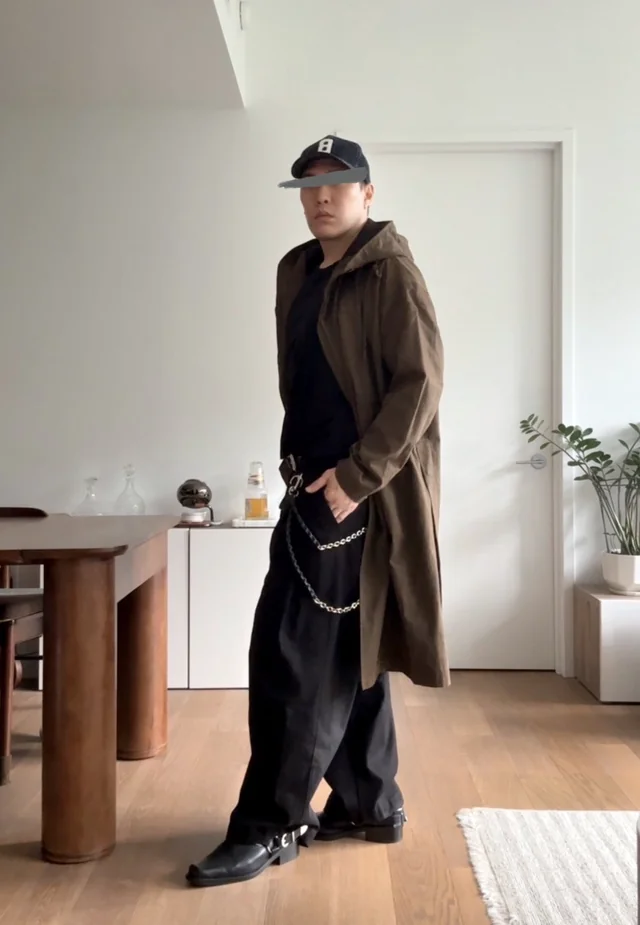
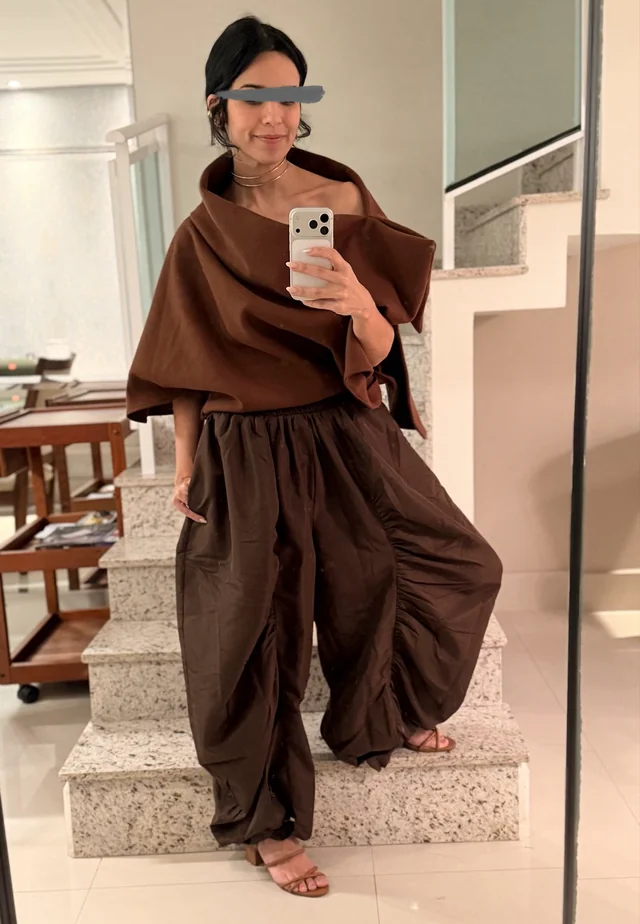
The monastic silhouette is governed by volume geometry and drape mechanics rather than by body-contouring tailoring or compression engineering. The characteristic forms — the tunic, the robe, the cowl, the wide-leg trouser — descend from rectangular flat-pattern construction that produces garment shapes as consequences of fabric weight, width, and drape stiffness interacting with gravity and the body's architecture.
The tunic and T-shape. The foundational monastic garment is the tunic: a T-shaped construction formed by folding fabric at the shoulder line, cutting a head opening, and inserting rectangular sleeves at right angles to the body panel. This construction eliminates darts, curved seams, princess lines, and all body-shaping devices — the resulting silhouette is determined entirely by the fabric's drape character, the garment's width relative to the body, and the length from shoulder to hem. In lightweight wool challis or crepe (100–180 g/m²), the T-shape produces soft, columnar volume that follows the body's vertical axis while obscuring its lateral dimensions — the fabric falls from the shoulder and flows over the torso without revealing waist, bust, or hip contour. In heavier wool (300+ g/m²) or canvas, the same pattern produces a stiffer, more architectural shape — the fabric stands slightly away from the body, creating an air gap that both insulates and abstracts the figure into a geometric mass. In linen, the T-shape produces angular, broken folds that re-form with each movement, creating a silhouette that is never fully resolved — permanently in process, never "smooth."
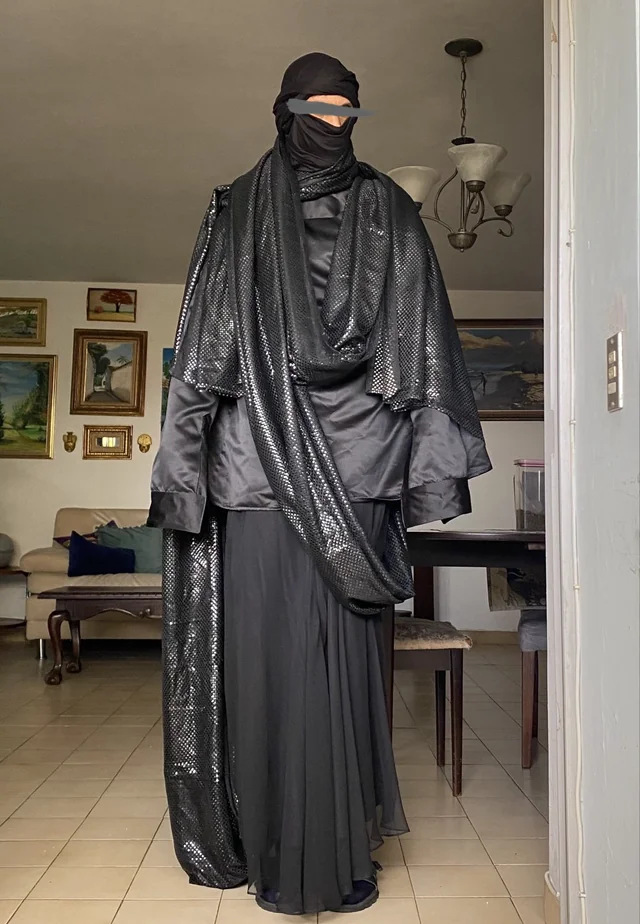
The robe and full-length envelope. Floor-length garments — the robe, the coat-dress, the full-length cardigan — extend the T-shape's vertical logic to the maximum, creating a continuous fabric column from shoulder to floor. The effect is architectural: the body becomes a structural armature supporting a textile surface, rather than a figure displayed through clothing. This is the silhouette's most direct inheritance from religious dress, where floor-length garments served simultaneously as modesty requirement, climate protection, and visual subordination of the individual body to the uniform of the order. In contemporary application (The Row, Lemaire, Yohji Yamamoto), the full-length envelope produces visual gravity — the garment dominates visual field proportion, making the dressed figure appear monumental without revealing anatomical detail.
The cowl and volume at the neckline. Cowl necklines and oversized hoods produce draped volume around the face and neck, framing the head within a soft textile architecture that references both the monastic hood (cuculla) and the contemplative tradition's emphasis on interiority over display. The cowl's drape behavior depends critically on fabric weight and bias orientation: a cowl cut on the bias of a lightweight wool crepe produces flowing, asymmetric folds that shift with movement; a cowl cut on grain in a heavier fabric produces more structured, symmetrical volume. The cowl functions as both functional element (warmth, wind protection) and semiotic marker (withdrawal, contemplation, anonymity).
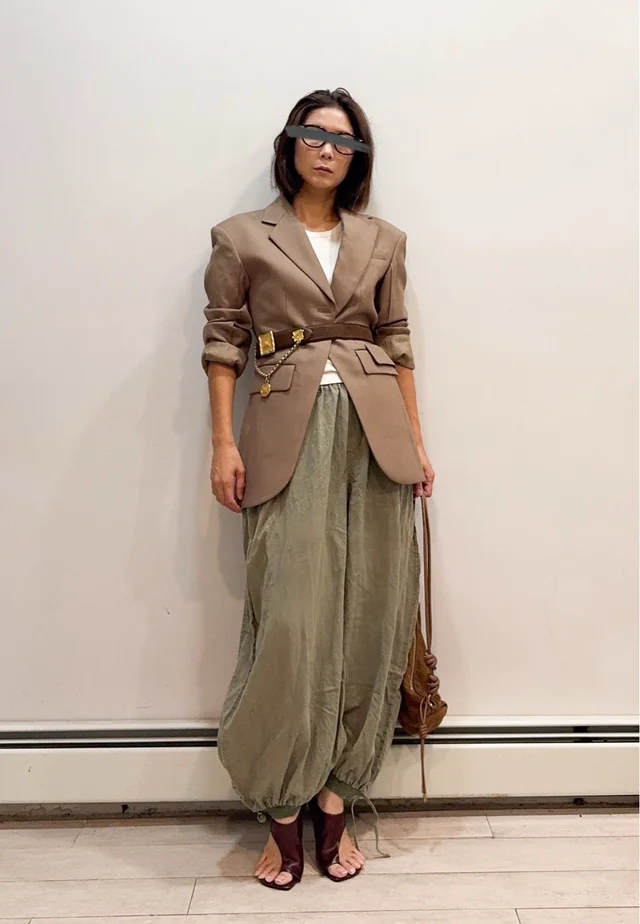
Proportional logic. Monastic silhouette achieves its visual weight through width-to-height ratio: garments are characteristically longer and wider than the body requires, with excess fabric creating volume that registers as intentional rather than ill-fitting. This proportional logic inverts fashion's standard body-optimization approach — instead of using garment dimensions to define and enhance body proportions (lengthening legs, narrowing waist, broadening shoulders), monastic proportion uses garment dimensions to subsume the body within a textile form whose proportions serve aesthetic and philosophical rather than anatomical goals.
Materials
Material selection in monastic fashion is governed by a principle of fiber honesty: fabrics are chosen for their intrinsic drape, aging behavior, and maintenance character rather than for trend currency, technical performance, or surface novelty. The category's material hierarchy is organized by how fibers behave under long-term repetitive wear — a critical criterion given that monastic dress, both historical and contemporary, assumes garment rotation systems far smaller than standard fashion wardrobes.
Wool. The primary fiber of Western monastic dress and the substrate that best produces the silhouette's characteristic drape. Lightweight wool weaves (challis, 100–150 g/m²; tropical suiting, 180–220 g/m²; crepe, 150–200 g/m²) provide fluid fall with enough body to resist wind distortion — the fabric moves with the wearer but returns to its resting drape when motion stops. Wool's natural resilience (the fiber can be bent 20,000 times before breaking, compared to cotton's 3,000) means wool garments recover from compression wrinkles and maintain their silhouette through extended daily wear. Under a regime of 300+ wears per year without rotation — approximating historical monastic use — wool's primary failure mode is surface pilling, which begins at abrasion contact points (under-arm, inner elbow, where the garment contacts seating or work surfaces) within 50–100 wears. Pilling is a function of fiber length and twist: longer-staple, higher-twist worsted yarns pill less than shorter-staple woolen-spun yarns, but the latter produce the softer, hazier surface preferred in monastic aesthetics. The resolution is management rather than prevention: pilling is removed by fabric comb or shaver, and the garment continues. Wool's second failure mode is moth damage, which targets keratin-based fibers specifically and requires either chemical treatment (mothproofing finishes, cedar oil) or physical exclusion (sealed storage). Wool's third long-term behavior is felting under friction and moisture — the fiber's surface scales interlock progressively, shrinking and densifying the fabric. This is a failure in dimensional stability but can be a positive transformation in hand and warmth, which is why historical monastic garments tolerated and sometimes encouraged controlled felting. Undyed wool's color depends on breed and processing: Merino produces near-white to cream; Shetland breeds range from warm grey to brown; Churro and Navajo-Churro produce warm amber-to-brown tones; Jacob sheep produce piebald patterns in brown and cream. Cistercian "white" habits were in practice cream-grey, the natural color of minimally processed European sheep's wool.
Linen. The monastic fiber of longest continuous use, predating wool in many Near Eastern and Mediterranean religious traditions. Linen's drape character is fundamentally different from wool's: its low elasticity and high bending stiffness produce angular, sharp-creased folds rather than flowing curves, giving linen garments a sculptural, architectonic quality. Linen wrinkles aggressively — a physical consequence of its low resilience (the fiber does not spring back from deformation) — and this wrinkling has become a positive aesthetic marker in monastic fashion, signaling material authenticity and refusal of the "pressed perfection" that formal and corporate dress demands. Under repetitive wear, linen softens progressively: the fiber's surface smooths through abrasion, and the fabric's bending resistance decreases with each wash cycle, producing garments that become more comfortable and more beautiful with age — the opposite of synthetic textiles' degradation trajectory. Linen's failure modes under monastic-intensity wear include localized thinning at fold lines and stress points (elbows, knees, seat), eventual hole formation at these thin spots (typically after 500+ wears), and color shift in undyed fabric from silver-grey when new to warm gold-yellow after extensive washing and sun bleaching — a transformation that takes 2–3 years of regular use to fully develop. Linen is stronger wet than dry (a rare fiber property), making it exceptionally durable under repeated laundering — historical monastic communities routinely used linen garments for decades.
Cotton. Cotton's role in monastic fashion is structurally secondary to wool and linen because its drape behavior requires specific construction to achieve monastic weight: cotton's lower density and moderate stiffness mean that lightweight cottons (voile, lawn, poplin under 150 g/m²) lack the gravitational authority the silhouette demands. Monastic cotton applications use heavier constructions — canvas (300+ g/m²), dense twill (250+ g/m²), or heavy jersey (280+ g/m²) — that generate sufficient mass for controlled drape. Cotton's failure trajectory under high-frequency wear is thinning: the fiber loses mass progressively through abrasion and laundering, producing garments that become softer but structurally weaker over time. Cotton pills less aggressively than wool but compensates by developing permanent stretch deformation at stress points — knees, elbows, seat — because the fiber lacks wool's elastic recovery. Undyed cotton ranges from warm cream (if only scoured, retaining natural waxes and pigmentation) to near-white (if bleached but not dyed), with an intermediate "greige" (grey-beige, from partially processed raw cotton) that appears frequently in monastic-adjacent garments.
Silk. A secondary monastic fiber, used primarily in Japanese and East Asian monastic traditions where sericulture was historically available. Silk habotai and crepe de chine produce the most directly monastic drape behavior: fluid, body-following fall with luminous matte surface. In contemporary monastic fashion, silk appears in linings, under-layers, and lightweight garments where wool or linen would be too heavy. Silk's failure modes include UV degradation (the fiber weakens and yellows under sun exposure), perspiration damage (body acids degrade silk protein), and seam slippage in loosely woven constructions. Raw silk (tussah or shantung) aligns better with monastic aesthetics than processed silk, producing an irregular, matte surface with natural color variation (warm tan to golden brown) that reads as materially honest rather than luxurious.
Fiber-processing as aesthetic decision. The material logic of monastic fashion treats fiber processing as a continuum of intervention, from raw (unwashed, undyed, unfinished) to minimal (washed but undyed, or piece-dyed in a single earth tone) to processed (dyed, finished, potentially blended). Each step away from the raw state introduces aesthetic choice and removes material contingency — and the monastic aesthetic ideologically favors the contingent, where color and texture are consequences of material rather than decisions imposed upon it. This preference has practical implications: undyed and minimally processed fabrics are often less colorfast, less uniform, and more variable batch-to-batch than fully processed textiles, which means monastic garments require a tolerance for imperfection that contradicts luxury fashion's quality-control expectations.
Color Palette
Monastic color is determined by fiber rather than chosen from a design palette. This principle — color as material consequence rather than aesthetic decision — distinguishes monastic from minimalism, where neutral palettes are deliberate design choices applied to diverse textiles. The core monastic palette consists of the colors that natural fibers produce when processing is withheld or minimized.
Undyed fiber spectrum. Raw wool ranges from near-white (fine Merino, Rambouillet) through cream (Corriedale, medium-wool crossbreeds) to grey-brown (Shetland, Icelandic), warm brown (Jacob, Churro), and near-black (Karakul, Black Welsh Mountain). Unbleached linen ranges from silver-grey when freshly retted to warm gold after repeated washing and sun exposure. Unbleached cotton ranges from cream-white to warm ecru depending on variety and ginning residue. Raw silk ranges from warm tan (tussah) to cream-gold (Bombyx, partially degummed). These are not interchangeable "neutrals" — each fiber produces a specific color with specific undertone behavior that affects how garments combine within a wardrobe system.
Earth-dye range. When monastic garments are dyed, the historical palette draws from locally available dye sources: walnut hull (warm brown to near-black), iron-mordanted tannins (grey-black), madder (terracotta to rust), indigo (the only historical source of deep blue, used in Japanese monastic traditions and, sparingly, in European work dress), weld (muted yellow-green), and oak gall (grey-brown). These produce colors that are muted, variable, and prone to shift with washing and light exposure — behaviors that monastic aesthetics valorize as evidence of material process rather than resisting as quality defects.
Contemporary palette conventions. In secular monastic fashion, the palette standardizes around five zones: black (the default, descending from Yamamoto and Kawakubo's 1980s presentations), charcoal-to-grey (the zone between black and undyed), cream-to-ecru (representing undyed fiber without literally using it), earth brown (warm mid-tones referencing Franciscan and Carmelite habits), and stone-to-sand (pale warm neutrals referencing plaster, parchment, and unfinished building materials). Navy occasionally appears through the Japanese indigo tradition. Absent from the palette are bright or saturated colors, pastels, and all colors that require complex synthetic dye chemistry — their presence signals departure from monastic logic into adjacent but distinct aesthetic territory.
Details
Details in monastic fashion operate as interface-reduction systems — each detail decision removes visual complexity, closure hardware, or decorative content to produce garments whose surfaces are governed by textile behavior alone.
Closure minimization. Monastic garments favor pull-on construction (no closures), wrap-and-tie systems (fabric self-fastening, referencing both Japanese obi logic and Franciscan rope cinctures), and concealed closures (hidden snap plackets, interior button systems, invisible zippers recessed within seam wells). When visible closures appear, they are typically oversized, simplified, and made from garment-compatible materials — fabric-covered buttons, horn toggles, leather frogs — rather than metal hardware. The goal is an unbroken fabric surface: the garment's exterior reads as continuous textile rather than as a constructed object punctuated by fastening mechanisms.
Hem and edge treatment. Raw edges, rolled hems, and minimal finishing characterize monastic detail. Raw-cut edges — where the fabric is cut and left unfinished, relying on the textile's inherent resistance to raveling — serve both aesthetic and philosophical functions: they expose the material's structure (warp and weft visible at the garment's boundary), they reduce construction labor, and they produce edges that evolve over time through controlled fraying. This technique works only with fabrics that resist progressive unraveling — felted wool, boiled wool, and tightly woven linen tolerate raw edges; loosely woven or knitted fabrics do not. Rolled hems (the edge rolled once or twice and secured with small, invisible stitches) produce a minimal, organic finishing that follows the fabric's natural curl tendency rather than imposing rigid geometry.
Seam exposure. Visible seams — topstitched, flat-felled, or deliberately placed on the garment's exterior — function as construction-transparency markers. The Margiela tradition of exposed tacking stitches (white basting threads left visible as deliberate detail) has been widely adopted in monastic fashion as a signal of process consciousness: the garment reveals its making rather than concealing it. This reverses conventional construction logic, which treats the seam as infrastructure to be hidden, and reframes it as content to be displayed — a translation of the monastic principle that labor should be visible rather than mystified.
Layering architecture. Monastic detail extends to how garments relate to each other in layered systems. The typical monastic outfit operates as a stack of rectangles: a base layer (fitted or semi-fitted T-shape), a mid layer (wider T-shape or tunic), and an outer layer (robe, coat, or poncho-like wrapper). Each layer's proportions are calibrated so that the undermost is longest or most visible at specific edges — a hem extending below a coat, a collar emerging above a tunic — creating visual depth through overlapping geometric forms rather than through color contrast or pattern mixing.
Accessories
Accessories in monastic fashion are governed by the same reduction logic that governs garments: minimal number, natural materials, functional justification, and absence of decorative excess.
Footwear defaults to flat or near-flat constructions in natural materials: leather sandals (the most direct monastic reference, descending from the caligae and sandalia specified in medieval rules), unlined leather boots (minimal construction, often resoleable), canvas slip-ons, or, in the Japanese tradition, wooden geta or straw waraji. Contemporary translations include Birkenstock's cork-and-leather sandals, Marsell's deconstructed leather forms, and simple leather slides by The Row or Lemaire. Heels, platforms, and engineered sneakers signal departure from monastic logic — their construction complexity and performance rhetoric belong to different dress systems.
Bags are soft, unstructured, and minimal: drawstring pouches, simple tote bags in canvas or leather, satchels with strap-and-buckle closures. Hardware is matte or absent. The monastic bag carries what is needed and communicates nothing else — it is container, not statement. Backpacks in waxed canvas or leather, referencing utilitarian carrying, are accepted where structured handbags are not.
Jewelry is either absent or ritualistic: a simple band ring, a pendant on cord rather than chain, prayer beads (mala, rosary, tasbih) worn as wrist wraps or carried. The decorative function of jewelry is replaced by its contemplative or symbolic function — objects worn for meaning rather than display.
Headwear, when present, takes the form of hoods integrated into garments, simple beanies in natural fiber, or wrapped scarves and shawls that frame the face in the manner of a cowl. Structured hats — fedoras, caps, visors — belong to other aesthetic systems.
Body Logic
Monastic fashion's relationship to the body is one of deliberate de-emphasis: the garment system constructs a dressed figure in which anatomical detail — musculature, body contour, gender-specific proportion — is subordinated to textile form. This is not concealment for concealment's sake but a specific proposition about how bodies should appear in social space: as bearers of material rather than as objects of visual assessment.
The enveloping silhouette redistributes visual attention from the body's anatomical specifics to the garment's material behavior — how the fabric falls, folds, shifts with movement, catches light, and accumulates the marks of wear. In this framework, the body functions as an armature that activates the textile's drape potential, but the aesthetic content resides in the textile's behavior rather than in the body's shape. This produces a mode of looking that is materially attentive rather than anatomically evaluative — a distinction with significant gender-political implications, as it disrupts the visual regimes (male gaze, body surveillance, size evaluation) that body-contouring fashion both produces and requires.
Gender coding is structurally suppressed: the same T-shaped tunic, wide-leg trouser, or robe silhouette can be worn across genders without modification, because the garment's proportions are determined by fabric behavior rather than by anatomical accommodation. This is not androgyny as a style choice but androgyny as a construction consequence — when garments are not shaped to bodies, they do not encode gender through shaping. In practice, residual gender signaling persists through fabric weight selection, garment length conventions, and the cultural reading of bodies within garments, but the garment system itself provides less gendered information than most fashion categories.
In embodied terms, monastic dress changes how the wearer experiences movement: the weight and volume of oversized natural-fiber garments produce physical awareness of fabric — its swing, its thermal mass, its friction against skin — that lighter, closer-fitting garments suppress. This material awareness parallels the contemplative traditions' emphasis on embodied attention (mindfulness of the body's sensory experience) and may explain monastic fashion's persistent appeal to meditation and yoga practitioners, whose practices train precisely this quality of somatic attention.
Garment Logic
Construction in monastic fashion operates through flat-pattern geometry rather than through the body-mapping dart-and-ease systems of conventional tailoring. The core construction method — rectangular panels joined at perpendicular seams — is both the aesthetic's historical inheritance from religious garment-making and its ongoing structural principle.
Flat-pattern construction. The T-shaped tunic is assembled from rectangular panels: a body panel (folded at the shoulder or seamed at the shoulder line), side panels (if additional width is needed), and rectangular sleeves inserted at right angles. No darts shape the bust, waist, or hip; no ease curves accommodate the body's three-dimensional form. Volume is generated through excess width — the garment is simply wider than the body it covers — and the relationship between body and garment is mediated entirely by fabric drape rather than by pattern engineering. This method requires far less cutting skill than tailored construction but demands superior fabric selection: the garment's success depends entirely on how the chosen textile behaves when draped over a body, because no construction intervention can correct for poor drape. This is why monastic garments in cheap polyester or stiff fast-fashion cotton fail — the construction method amplifies fabric quality rather than compensating for it.
Seam reduction. Where tailored garments may use 20–30 pattern pieces to map the body's contours, monastic construction typically uses 3–7 pieces to create equivalent coverage. Fewer seams means fewer interruptions in the fabric's drape behavior, fewer potential failure points, and a garment that reads as a continuous textile surface rather than as an assembled object. The trade-off is fit specificity: monastic garments fit a range of body sizes acceptably rather than fitting any single body precisely, which is structurally appropriate for communal dress (where garments may be shared or reassigned) but requires recalibration for contemporary fashion, where individual fit expectations are higher.
Aftercare as practice. In historical monastic contexts, garment maintenance was integrated into the community's labor structure: laundering was assigned as a form of manual work with spiritual value (laborare est orare — to work is to pray). Washing was typically performed by hand in cold or lukewarm water, using lye soap or wood-ash solution, with garments laid flat to dry and pressed (if at all) with heated stones or simple irons. This maintenance regime — cold wash, gentle handling, flat drying, minimal pressing — is, by coincidence of physics, exactly the aftercare protocol that maximizes natural-fiber garment longevity. Contemporary monastic garment care follows the same logic through different means: cold machine wash or hand wash in pH-neutral detergent, reshaping and flat drying to prevent deformation, steam pressing rather than dry-iron pressing (steam relaxes fibers without crushing them), and spot cleaning to reduce wash frequency. The discipline of careful maintenance — treating garment care as attentive practice rather than as chore — is itself a monastic behavior, whether or not the practitioner identifies it as such.
Mending and repair. Monastic dress traditions assumed that garments would be repaired rather than replaced: the Benedictine Rule specifies that old garments should be returned to the wardrobe for redistribution or rags for cleaning, and Franciscan poverty explicitly forbade acquiring new garments while old ones remained serviceable. Repair in monastic garments is typically visible rather than invisible — darning that shows, patches that contrast, seams that are resewn with visible thread — because the repair's visibility serves as evidence of the garment's continued use-value and the wearer's commitment to material stewardship rather than to appearance maintenance. Contemporary visible-mending practice (influenced by Japanese sashiko and boro traditions) has converged with monastic garment logic, producing a shared aesthetic in which repair is content rather than defect.
Failure modes and longevity. Under monastic-intensity wear (300+ wears per year, minimal rotation, repeated laundering), each fiber system fails distinctively. Wool pills first at friction zones (50–100 wears), then thins at stress points (200–400 wears), then develops holes at the thinnest areas (500+ wears); throughout this process, the fabric's drape character shifts from structured to soft as the fiber felts subtly and the surface nap compresses. Linen softens progressively (improving hand and drape through the first 100 washes), then thins at fold lines (200–400 wears), then fails by splitting along the weakened fold (500+ wears); this failure is sudden — linen does not warn through gradual thinning the way cotton does. Cotton thins gradually and uniformly, developing transparency at stress points before eventual hole formation; cotton's failure trajectory is the most predictable but also the most inevitable, because the fiber lacks the resilience mechanisms (wool's elasticity, linen's crystalline structure) that delay degradation. In all cases, monastic garments' single-item-repeated-daily wear pattern accelerates failure compared to rotation systems that distribute wear across multiple garments — which is why monastic dress historically specified minimum garment quantities (the Benedictine Rule's two tunics and two cowls) and why contemporary monastic-influenced wardrobes typically include 2–3 versions of core garments in rotation.
Motifs / Themes
Renunciation as form. Material honesty as ethical position. The body as armature rather than display surface. Cloth as subject rather than medium. Aging as transformation rather than degradation. Simplicity as discipline rather than default. Labor — of making, of maintaining, of mending — as practice with intrinsic value. Withdrawal from the competitive display economy of fashion not through absence of dress but through dress that refuses competition's terms: no novelty, no trend, no decoration, no body optimization, only textile, construction, and time.
The monastic theme system centers on temporal values: garments that improve with age, wardrobes that stabilize rather than churn, maintenance practices that deepen attention rather than consuming time. These values align monastic fashion with broader slow-culture movements (slow food, slow design, slow media) while maintaining a specifically textile-material focus that distinguishes it from lifestyle branding.
Cultural Touchstones
The Regula Benedicti (c. 530 CE), Chapter 55, as foundational Western dress code: the first systematic specification of garment number, fiber, and maintenance as spiritual discipline. Cistercian undyed-wool habits as the origin point of fiber-color-as-theology. Franciscan poverty dress as radical textile asceticism. Buddhist kāṣāya robes as doctrinally prescribed rectangular construction. Sufi khirqah (patched wool cloaks) as visible-repair-as-spiritual-practice.
Yohji Yamamoto's 1981 Paris debut — black, voluminous, gender-obscuring garments that introduced monastic visual grammar to contemporary fashion. Rei Kawakubo's 1982–83 "Destroy" collection at Comme des Garcons — garments with holes, raw edges, and asymmetric construction that critics called "post-nuclear" but that operated within monastic logic of anti-beauty and material primacy. Martin Margiela's white-coated studio and anonymous design practice as monastic institutional form translated into fashion. Rick Owens's draped jersey and earth-toned silhouettes as post-industrial monasticism.
Tilda Swinton's public presentation — minimal makeup, androgynous silhouette, natural-fiber garments in muted tones — as the monastic aesthetic's most visible celebrity embodiment. Jedi robes in the Star Wars franchise as monastic dress translated into science-fiction visual language. The Bene Gesserit costuming in Dune (Denis Villeneuve, 2021) — draped, hooded, volumetric garments in muted earth tones — as cinematic monastic. Terrence Malick's film aesthetics (natural light, contemplative pacing, rural settings) as visual-atmospheric context for monastic dress. Andrei Tarkovsky's Andrei Rublev (1966) as the most sustained cinematic treatment of actual monastic dress in medieval context.
See Also
- Minimalism: Shared chromatic restraint and ornament refusal; monastic diverges through volume, drape emphasis, and anti-body-contouring construction
- Wabi-sabi: Overlapping interest in material imperfection, aging, and temporal texture; wabi-sabi centers Japanese craft traditions where monastic centers religious-institutional dress
- Normcore: Shared anti-spectacle; normcore achieves anti-display through ordinariness, monastic through gravity and material weight
- Brutalism: Architectural crossover in raw-material honesty, exposed construction, and refusal of decorative finish
- Quiet luxury: Converging through shared restraint and expense-through-simplicity logic; monastic provides the historical-ascetic reference that quiet luxury cites
- Androgyny: Shared suppression of gender-coded silhouette through construction rather than through styling
- Japandi: Overlapping in natural-material palette and spatial restraint; Japandi applies these to domestic interiors, monastic to dress
Brands and Designers
Foundational / Category-Defining:
- Yohji Yamamoto (founded 1972, Tokyo/Paris): definitive monastic silhouette in contemporary fashion; oversized, black, gender-obscuring garments in wool and linen; anti-fashion positioning through volume, drape, and deliberate imperfection
- Comme des Garcons / Rei Kawakubo (founded 1969, Tokyo/Paris): radical deconstruction of Western garment logic; asymmetric construction, raw edges, anti-beauty as aesthetic principle; monastic through refusal rather than through reference
- Martin Margiela / Maison Margiela (founded 1988, Paris): anonymous design practice, white-coated atelier, exposed construction, recycled materials; institutional monasticism translated into fashion practice
- Rick Owens (founded 1994, Paris/Los Angeles): draped jersey, elongated silhouettes, earth-to-black palette, brutalist-monastic hybridization; single-fiber construction emphasis
Luxury / Premium Secular Monastic:
- The Row (founded 2006, New York): codified monastic minimalism for the luxury market; cashmere and wool in neutral tones, enveloping proportion, invisible construction at extreme price points ($1,000–$5,000+)
- Lemaire / Christophe Lemaire (founded 2015 as current entity, Paris): Japanese-influenced volume in natural fibers, mid-luxury pricing, system-dressing emphasis; former Uniqlo U creative director bridging monastic accessibility and premium quality
- Jil Sander (founded 1968, Hamburg/Milan): precision minimalism in luxury materials; monastic through geometric reduction and material purity rather than through volume or drape
- Peter Do (founded 2018, New York): architectural volume, natural-fiber emphasis, and Asian diaspora perspective on monastic restraint
- Jan-Jan Van Essche (founded 2010, Antwerp): artisanal rectangular construction, hand-woven and naturally dyed textiles, explicit engagement with non-Western drape traditions
Accessible / Sustainability-Positioned:
- Eileen Fisher (founded 1984, New York): system dressing in natural fibers (linen, wool, organic cotton, silk), earth-tone palette, oversized proportion; Renew take-back and resale program; most commercially accessible monastic brand
- COS (H&M Group, founded 2007, London): Scandinavian-minimalist interpretation of monastic volume at high-street price points; quality variable but silhouette consistent
- Evan Kinori (founded 2012, San Francisco): small-production natural-fiber garments with visible hand-construction; explicit slow-fashion positioning
- Toogood (founded 2013, London): sculptural volume in natural fibers; "The" garment naming system (The Sculptor, The Metalworker) referencing labor and craft identity
Japanese Monastic Lineage:
- Issey Miyake (founded 1970, Tokyo): single-piece garment construction, pleated polyester systems (Pleats Please, 1993), rectangular geometry as design principle; bridging monastic simplicity and material innovation
- Yohji Yamamoto Pour Homme and Y's: menswear and diffusion lines extending Yamamoto's monastic vocabulary at varied price points
- Jurgen Lehl / Babaghuri (founded 1971/2003, Tokyo): natural-fiber garments with artisanal construction, plant-dyed textiles, and explicit anti-fashion positioning within Japanese retail culture
Citations
[1] Fry, Timothy, editor. The Rule of St. Benedict in English. Liturgical Press, 1982. [2] France, James. The Cistercians in Medieval Art. Sutton Publishing, 1998. [3] Robson, Michael. The Franciscans in the Middle Ages. Boydell Press, 2006. [4] Heirman, Ann, and Stephan Peter Bumbacher, editors. The Spread of Buddhism. Brill, 2007. [5] Wijayaratna, Mohan. Buddhist Monastic Life: According to the Texts of the Theravada Tradition. Cambridge University Press, 1990. [6] Burns, E. Jane. Sea of Silk: A Textile Geography of Women's Work in Medieval French Literature. University of Pennsylvania Press, 2009. [7] Crowfoot, Elisabeth, Frances Pritchard, and Kay Staniland. Textiles and Clothing, c. 1150–c. 1450. Museum of London / Boydell Press, 2001. [8] Hatch, Kathryn L. Textile Science. West Publishing, 1993. [9] Kadolph, Sara J., and Sara B. Marcketti. Textiles. 12th ed., Pearson, 2016. [10] Morton, W. E., and J. W. S. Hearle. Physical Properties of Textile Fibres. 4th ed., Woodhead Publishing, 2008. [11] Gohl, E. P. G., and L. D. Vilensky. Textile Science: An Explanation of Fibre Properties. 2nd ed., Longman Cheshire, 1983. [12] Tortora, Phyllis G., and Robert S. Merkel. Fairchild's Dictionary of Textiles. 7th ed., Fairchild Books, 1996. [13] English, Bonnie. Japanese Fashion Designers: The Work and Influence of Issey Miyake, Yohji Yamamoto and Rei Kawakubo. Berg, 2011. [14] Grand, France. Comme des Garcons. Thames & Hudson, 1998. [15] Sudjic, Deyan. Rei Kawakubo and Comme des Garcons. Rizzoli, 1990. [16] Koda, Harold, and Andrew Bolton. Rei Kawakubo/Comme des Garcons: Art of the In-Between. Metropolitan Museum of Art, 2017. [17] Washida, Kiyokazu. Yohji Yamamoto: My Dear Bomb. Ludion, 2010. [18] Gill, Alison. "Deconstruction Fashion: The Making of Unfinished, Decomposing and Re-assembled Clothes." Fashion Theory, vol. 2, no. 1, 1998, pp. 25–49. [19] Evans, Caroline. Fashion at the Edge: Spectacle, Modernity, and Deathliness. Yale University Press, 2003. [20] Hollander, Anne. Seeing Through Clothes. University of California Press, 1993. [21] Entwistle, Joanne. The Fashioned Body: Fashion, Dress and Social Theory. 2nd ed., Polity, 2015. [22] Wilson, Elizabeth. Adorned in Dreams: Fashion and Modernity. Revised ed., Rutgers University Press, 2003. [23] Crane, Diana. Fashion and Its Social Agendas: Class, Gender, and Identity in Clothing. University of Chicago Press, 2000. [24] Simmel, Georg. "Fashion" (1904). In Simmel on Culture: Selected Writings, edited by David Frisby and Mike Featherstone, SAGE, 1997. [25] Bourdieu, Pierre. Distinction: A Social Critique of the Judgement of Taste. Translated by Richard Nice, Harvard University Press, 1984. [26] Veblen, Thorstein. The Theory of the Leisure Class. Macmillan, 1899. [27] Fletcher, Kate. Sustainable Fashion and Textiles: Design Journeys. 2nd ed., Earthscan, 2013. [28] Fletcher, Kate. Craft of Use: Post-Growth Fashion. Routledge, 2016. [29] Gwilt, Alison. A Practical Guide to Sustainable Fashion. Bloomsbury Academic, 2014. [30] Rissanen, Timo, and Holly McQuillan. Zero Waste Fashion Design. Bloomsbury Academic, 2016. [31] Watkins, Susan M. Clothing: The Portable Environment. 2nd ed., Iowa State University Press, 1995. [32] Kawamura, Yuniya. Fashion-ology: An Introduction to Fashion Studies. 2nd ed., Bloomsbury Academic, 2018. [33] Barthes, Roland. The Fashion System. Translated by Matthew Ward and Richard Howard, University of California Press, 1983. [34] Dalby, Liza. Kimono: Fashioning Culture. Yale University Press, 1993. [35] McNamara, Jo Ann Kay. Sisters in Arms: Catholic Nuns through Two Millennia. Harvard University Press, 1996.