Klubnacht
Summary. Klubnacht is an endurance-dress system: a regime of material selection, garment construction, and body management optimized for sustained dancing in the specific environmental conditions of techno club culture — 25–35°C ambient temperature, 70–95% relative humidity, sound-pressure levels of 100–130 dB, near-total darkness punctuated by minimal strobe and fog-machine haze, concrete or industrial flooring, dense crowd compression, and session durations of 12–72+ hours. The aesthetic appears minimal — black palette, functional hardware, body-conscious or deliberately concealing fit — but this apparent simplicity conceals a material-performance logic as demanding as any outdoor technical system: garments must regulate body temperature during sustained aerobic exertion (dancing at 120–140 BPM for hours generates metabolic heat loads comparable to moderate-intensity exercise), resist degradation from perspiration saturation, survive compression and friction in packed dancefloors, and maintain structural integrity across multi-day wear without laundering between sessions. The visual austerity is not absence of design but optimization under constraint — every material choice, closure system, and coverage decision is a solution to the problem of dressing a body that will function as a dance machine for durations that exceed most garments' design parameters.
In Material Terms
Klubnacht's coherence depends on how a narrow material palette — leather, latex, mesh, technical jersey, coated synthetics, and heavyweight cotton — performs under the extreme microclimate of the club interior. Chrome-tanned leather absorbs perspiration into its fiber matrix (up to 25–30% of its weight in moisture), developing salt-crystallization and bacterial colonization that produce the characteristic smell of heavily worn club leather if not treated; natural latex sheeting (0.25–0.60 mm gauge) provides the aesthetic's most dramatic surface but requires silicone dressing agents for both visual sheen and functional skin-slide, degrades through oxidation if stored improperly, and fails through tear-propagation if punctured (latex has zero tear-resistance once a crack initiates); polyester mesh offers the highest breathability-to-coverage ratio but provides no thermal insulation and collects body odor in its fiber matrix; and heavyweight cotton (the "just a black t-shirt" baseline) absorbs sweat readily but dries slowly, becoming cold and heavy as core temperature drops during rest periods. Each material represents a different trade-off between thermal regulation, tactile sensation, durability, maintenance burden, and subcultural legibility — and the expertise of the experienced Klubnacht practitioner lies in reading these trade-offs against the specific conditions of a particular venue and session duration.
At Category Level
Klubnacht occupies a structurally paradoxical position: it is an aesthetic that defines itself through anti-spectacle (no phones, no photos, dark rooms, minimal visual display) yet has become one of the most visually codified subcultural dress systems of the twenty-first century. The paradox is productive: because the look cannot be documented from inside the spaces it inhabits (Berghain's phone-sticker policy, KitKat's no-camera norm), its transmission depends on embodied knowledge rather than image circulation — you learn what to wear by being in the rooms, not by scrolling feeds. This anti-documentation stance places Klubnacht in direct opposition to platform-mediated aesthetics (streetwear's Instagram-optimized styling, Harajuku's photography-dependent display), making it the rare contemporary subculture where material knowledge and bodily co-presence remain the primary authentication vectors. When the look is extracted into fashion-media imagery ("Berlin club style" editorials, Instagram #berghain outfit posts), it is already operating outside the conditions that give it meaning — a contextual dependency that makes Klubnacht uniquely resistant to the image-first appropriation that has absorbed most subcultural aesthetics into commercial fashion.
Methodologically
This entry treats Klubnacht as a performance-environment interface system: garments are analyzed by how they regulate temperature, manage moisture, resist degradation, and communicate subcultural membership under the specific physical conditions of techno-club interiors during marathon-duration sessions. The analytical framework is closer to sports-science ergonomics or occupational-exposure analysis than to conventional fashion criticism — because the conditions these garments must survive are closer to industrial than to social environments.
Word (Etymology)
German: Klubnacht, literally "club night." The term's fashion usage crystallized in Berlin's techno community during the 2000s, specifically around Berghain's establishment of the weekend-spanning session format: doors opening Saturday night (typically 23:00–midnight) and closing Monday morning, with continuous operation through Sunday. Klubnacht designates not merely an evening's outing but a durational commitment — "going to Klubnacht" implies a session of indeterminate length during which the participant surrenders to the music's temporal logic rather than imposing a schedule from outside. The dress code is inseparable from this temporal structure: you dress for Klubnacht knowing the garments may be worn continuously for 12–36+ hours across multiple temperature cycles, emotional states, and levels of physical exertion [1][2][3].
In English-language fashion discourse, "Klubnacht" (or "club night" without the German specificity) has expanded beyond Berlin to index the dress codes of any techno venue operating under comparable conditions — Fabric and Corsica Studios in London, Bassiani in Tbilisi, De School in Amsterdam, Umami in San Francisco, Bossa Nova Civic Club and Aurora Halal's Sustain Release in New York — but the Berlin referent remains primary, and the aesthetic's material logic was shaped by the specific physical conditions of Berlin's industrial-conversion club spaces [2][4].
Subculture
Klubnacht's subcultural structure is organized around a gatekeeping-by-legibility system in which the door — the physical threshold between public street and club interior — functions as an aesthetic checkpoint that evaluates not what you're wearing but how you're wearing it, filtering for embodied scene knowledge rather than brand or cost.
The door as authentication system. The Berghain door — operated since the club's 2004 opening by Sven Marquardt (former East German punk photographer turned bouncer, whose own facial tattoos and piercings constitute a walking credential of subcultural commitment) and a rotating team of selectors — is the most discussed and least understood gatekeeping mechanism in contemporary nightlife. The door evaluates a complex of signals: clothing (dark, functional, non-tourist), attitude (relaxed, non-performative, not trying too hard), group composition (small groups or solo entry preferred over large packs), sobriety level (sufficient to be coherent, not so sober as to suggest tourist curiosity), and what regulars describe as an ineffable quality of "belonging" that experienced selectors read from posture, eye contact, and micro-behavioral cues accumulated over years of observation. The rejection phrase — Heute leider nicht ("unfortunately not today") — is delivered without explanation, creating an information vacuum that generates the mythology: you cannot study for the door because the door doesn't publish its criteria [1][2][5].
The door's effect on dress is structural rather than prescriptive: there is no published dress code, but there is a legibility threshold below which you are identified as outside the community. The threshold excludes: visible designer logos (which signal fashion consumption rather than scene participation), bright colors (which read as attention-seeking in a context that values anonymity), athletic-brand sportswear (which signals fitness culture rather than club culture), excessive grooming (which suggests preparation for documentation rather than for dancing), and anything that reads as "costume" (Halloween-level fetishwear on someone whose body language suggests they are wearing a costume rather than living in the garments). The threshold includes: worn-in black garments (not new, not distressed-for-fashion — actually broken in through repeated wear), functional boots or black sneakers (not pristine, not destroyed — used), minimal accessories (functional rather than decorative), and a general register of "dressed for the room, not for the camera" [1][2][5].
Expertise economy. Klubnacht expertise is measured by: (1) venue knowledge — understanding which rooms within a club have different temperature profiles (main floors near speakers run hotter; chill-out spaces and outdoor areas run cooler) and dressing for thermal transitions; (2) material literacy — knowing which fabrics survive 12+ hours of dance conditions and which fail (cotton t-shirts soaked through by hour 4, synthetic jersey still functional at hour 12); (3) layering strategy — bringing a secondary layer (bomber jacket, hoodie) for transition between hot dancefloor and cold smoking area or outdoor terrace; (4) session logistics — secure storage for essentials (phone, ID, cash/card, earplugs, water bottle) that won't be lost during physical movement, typically solved through belt bags, internal pockets, or crossbody micro-bags; (5) recovery dress — garments for the transit home post-session (clean socks, a fresh t-shirt in a locker or bag) when primary garments are sweat-saturated and potentially odor-compromised [2][6].
Transmission. Because the no-photo norm prevents visual documentation of the look in situ, Klubnacht's dress knowledge is transmitted through: embodied co-presence (learning by being in the rooms), pre-party social gatherings (seeing what regular attendees wear before entering the venue), retail environments (shops like Darklands in Berlin, Regulation in London, and online retailers like Maxfields that cater to the aesthetic), fashion-adjacent media (editorial features in 032c, Ssense, Highsnobiety, and fashion publications that document the look outside the club through street photography of post-session exits), and word-of-mouth (advice from experienced friends on what to wear and what to avoid). This transmission infrastructure privileges proximity and personal connection over platform accessibility, maintaining the look's resistance to algorithmic diffusion [2][7].
History
Pre-history: Industrial music and fetish-club crossover (1980s). Klubnacht's material vocabulary predates Berlin techno. Industrial music culture (Throbbing Gristle, SPK, Einstürzende Neubauten) established the association between electronic music, dark environments, and body-covering dress that prioritized material intensity (leather, rubber, PVC, metal hardware) over color or pattern. London's fetish-club scene (Torture Garden, founded 1990, but preceded by SM parties in the 1980s) contributed latex, harness, and body-exposure conventions that would be absorbed into techno-club dress. The material crossover is direct: Klubnacht's leather-and-harness vocabulary arrived through people who attended both fetish events and early techno parties, carrying garments and conventions between contexts [4][8][9].
Berlin post-reunification (1989–1995). The fall of the Berlin Wall (November 9, 1989) unlocked the material infrastructure that would define techno's spatial character: abandoned industrial buildings, disused power stations, empty department stores, and derelict Cold War border-zone spaces in East Berlin became available for occupation at negligible cost. These spaces — unheated, unfinished, with concrete floors, exposed infrastructure, and improvised electrical systems — imposed their material conditions on the bodies that danced in them. Dress adapted: heavy boots protected feet on rough floors; layered clothing managed temperature swings between frigid entry corridors and body-heat-heated dancefloors; dark colors were practical in spaces with minimal or zero conventional lighting [1][2][3].
UFO Club (1988, Köpenicker Straße, Kreuzberg) hosted some of the first Berlin acid house and techno parties in a West Berlin basement. Tresor (opened March 1991 in the vault of the former Wertheim department store on Leipziger Straße) hardwired Berlin's techno identity: the subterranean vault's metal grating, low ceilings, and industrial ambience established the template of the techno club as repurposed industrial infrastructure. E-Werk (a converted electrical substation, opened 1993) scaled the format upward. The club aesthetic of this period was raw and pragmatic: former East German industrial clothing, surplus military garments, secondhand leather, and early rave-culture elements (neon accessories, whistles) coexisted before the look consolidated [1][3][10].
Consolidation: Berghain and the marathon format (2004–2015). Berghain (opened 2004 in a former power station on Wriezener Bahnhof, Friedrichshain) consolidated Klubnacht's aesthetic through its specific operational characteristics: (1) marathon-duration sessions (Saturday night to Monday morning, continuously); (2) strict no-photo policy (phones physically covered with stickers at entry); (3) darkroom and fetish-space integration (normalizing body exposure, harness-wear, and fetish materials in the dancefloor context); (4) the Marquardt door (establishing aesthetic legibility as an entry condition); and (5) world-class sound-system engineering (Funktion-One system, custom-tuned for the space, operating at 110–130 dB SPL) that made the sonic experience physically immersive — bass frequencies felt in the sternum and gut as much as heard through the ears [1][2][5].
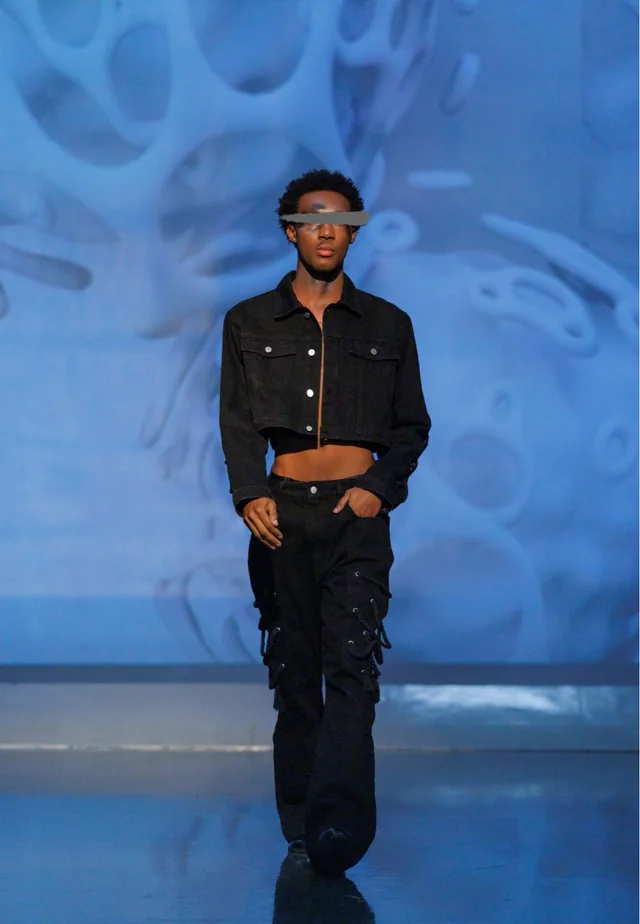
The aesthetic consolidated during this period into its recognizable form: predominantly black; body-conscious or strategically concealing; leather, mesh, technical fabrics, and heavyweight cotton; minimal hardware (D-rings, functional zippers, harness buckles); heavy boots or black sneakers; and a grooming register that signals "present in the room" rather than "presenting for observation." The consolidation was not designed but emergent — it arose from the collective response to the physical conditions and social norms of the spaces [2][6].
Globalization and fashion absorption (2015–present). Berlin techno's global cultural ascendancy — driven by tourism, DJ circuit internationalization, and media coverage — exported the Klubnacht look to techno scenes worldwide. Rick Owens (based in Paris, showing since 2002, increasingly associated with techno culture through his personal attendance at Berghain and his runway's sonic-aesthetic alignment) became the look's most visible luxury citation, his elongated black silhouettes, platform sneakers (Geobaskets), and draped constructions providing a designer-tier version of the Klubnacht body. 032c magazine (Berlin, founded 2000) provided editorial infrastructure connecting Berlin's club culture to the fashion industry. Demna Gvasalia's Vetements (2014) and subsequent Balenciaga tenure drew on Berlin-club aesthetics for several collections [2][7][11].
The fashion-absorption dynamic creates the standard tension: when the look is reproduced for Instagram consumption, fashion editorial, or festival costuming, it is separated from the environmental conditions and social norms that give it functional meaning. A Rick Owens leather jacket worn to Berghain on a 16-hour session is a performance garment operating under demanding conditions; the same jacket worn to a fashion dinner is a citation without context. Klubnacht's no-photo norm makes this contextual dependency harder to bridge than in photographically documented subcultures [2][7].
Silhouette
Klubnacht silhouettes solve a specific engineering problem: how to enable sustained high-intensity dance movement (120–140 BPM for 4–12+ hours) in hot, humid, densely packed environments while communicating subcultural membership and maintaining the wearer's desired level of body exposure or concealment.
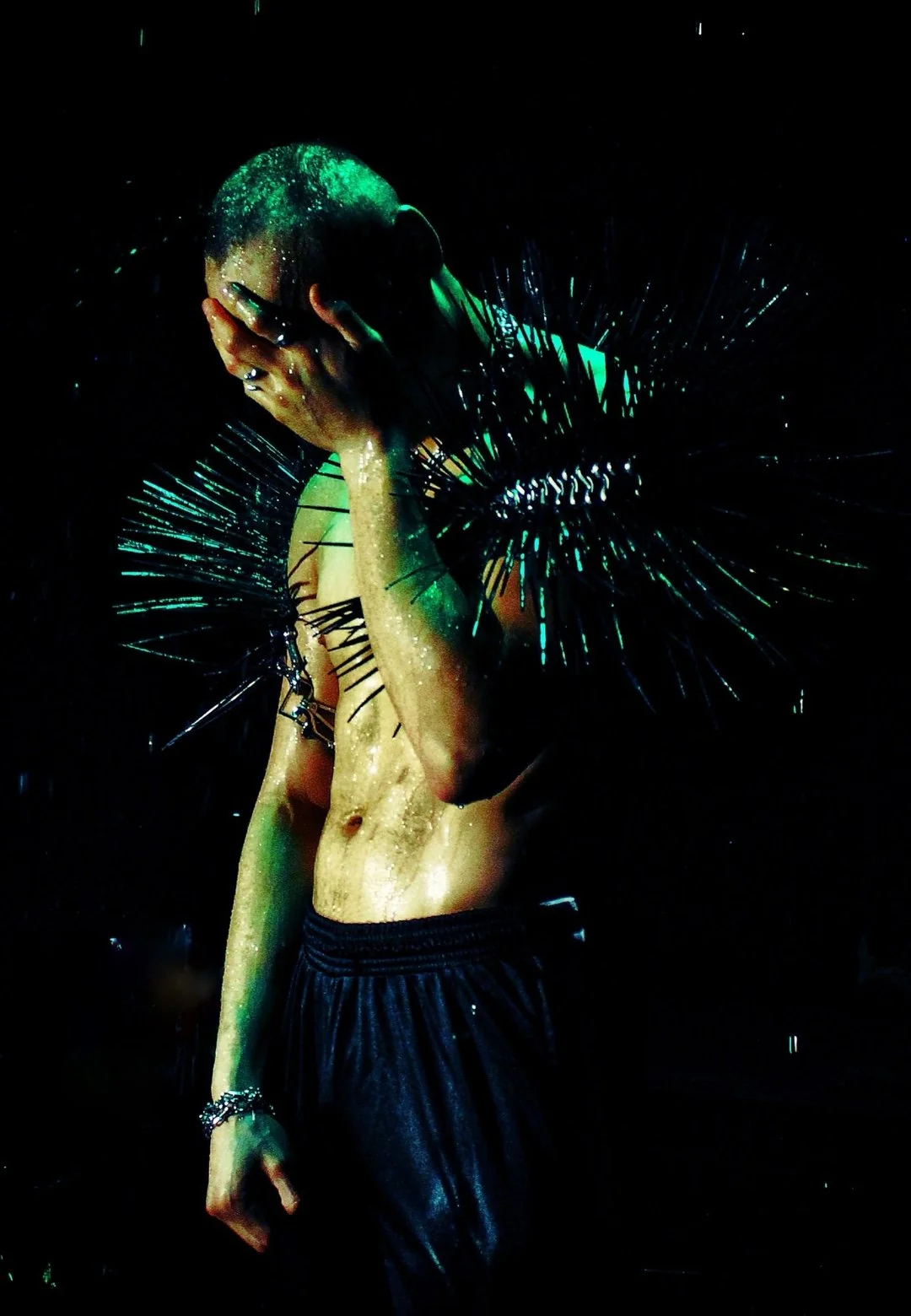
The endurance torso. Upper-body garments fall into three categories by thermal-regulation strategy: (1) Minimal coverage — mesh tops, cut-off tanks, bare chest (in venues where this is normative, particularly Berghain's main floor and Panorama Bar) provide maximum heat dissipation but zero insulation for transition zones. Mesh fabric (typically polyester knit with open cells, 50–100 g/m²) provides coverage without meaningful thermal insulation — air passes freely through the open structure, making mesh functionally equivalent to bare skin for temperature regulation while providing a garment surface for aesthetic treatment (black mesh as visual texture, printed or patterned mesh for visual interest). (2) Base-layer performance — fitted black t-shirts or long-sleeve tops in technical jersey (polyester or nylon-elastane blends, 150–200 g/m²) provide moisture management through capillary wicking while maintaining a slim silhouette that minimizes fabric mass in dense crowds. (3) Statement coverage — leather or coated-fabric jackets, harness systems, and structured tops that prioritize aesthetic impact at the cost of thermal regulation, worn during entry/transition periods and potentially removed during peak dancing [2][6].
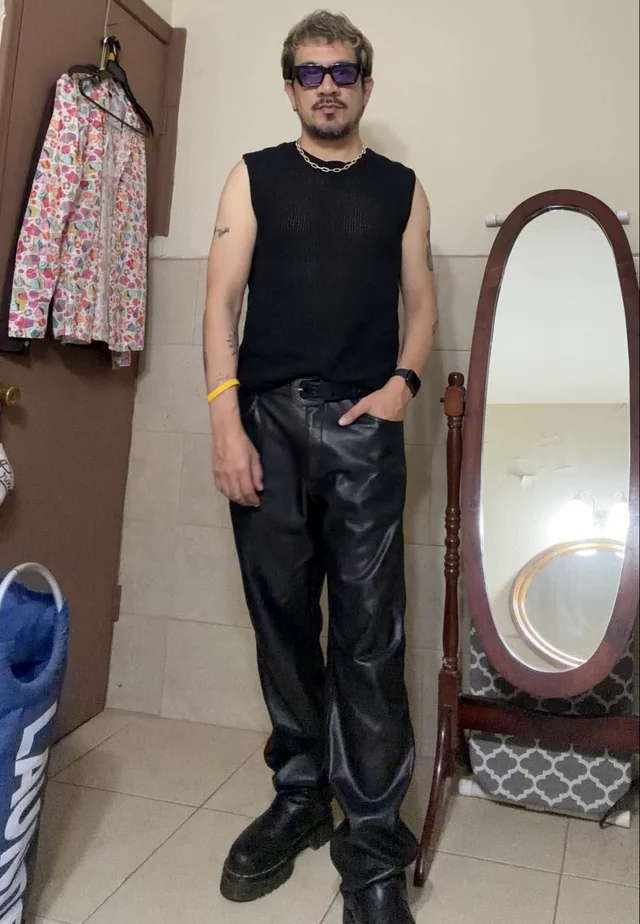
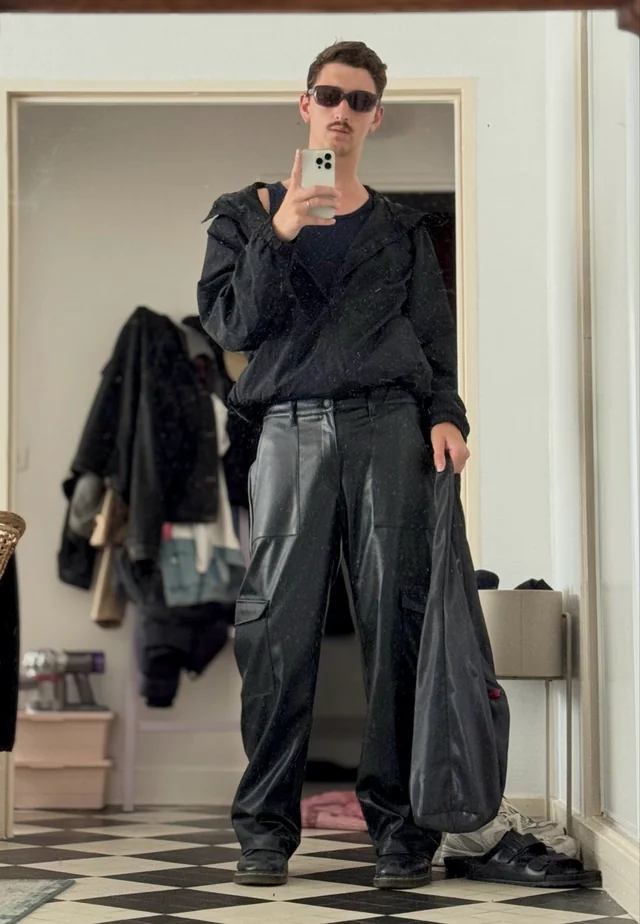
The functional lower body. Trousers must accommodate deep knee bend, hip flexion, lateral movement, and extended standing without seam restriction or crotch failure. Construction requirements: high-rise or mid-rise waistband with secure closure (the waistband must not migrate during movement — button-fly or secure zip with internal button); articulated or stretch-panel crotch gusset (providing range of motion without excess fabric); and thigh panels with sufficient ease for unrestricted leg movement. Common implementations: straight-leg or slightly tapered cotton-blend trousers (Carhartt WIP, Dickies, military surplus), cargo or carpenter pants with functional pocket systems (providing secure storage for essentials), and stretch-panel leather or coated trousers for higher-investment looks. Skirts and dresses appear primarily in KitKat and fetish-adjacent contexts, where body exposure is normative; tube skirts and column dresses in stretch jersey allow movement while maintaining silhouette [2][6][12].
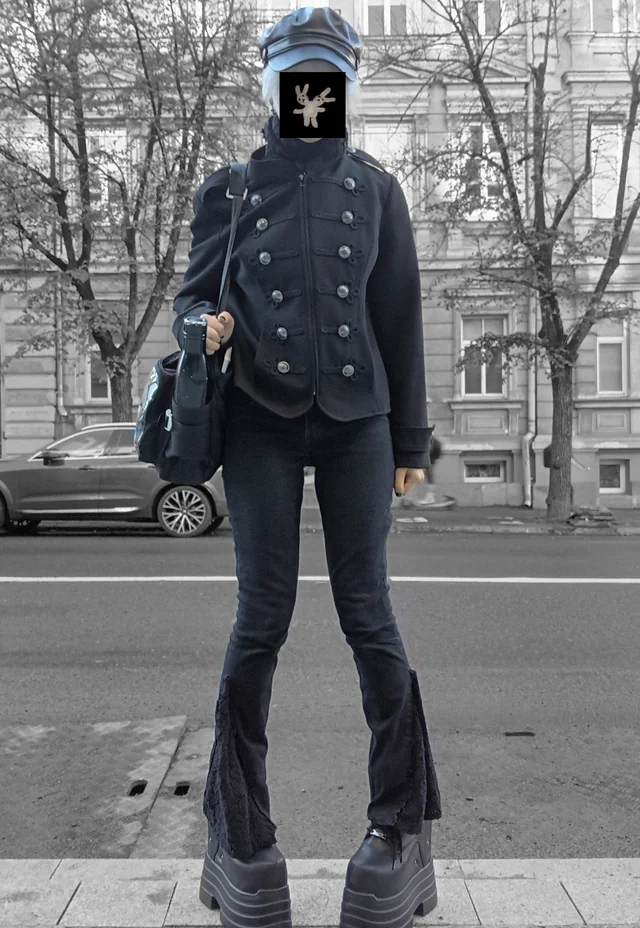
The transition layer. The bomber jacket (MA-1 derived, in nylon or cotton-blend shell) and the hoodie function as Klubnacht's transition-management system: worn during the commute to the venue, during smoking-area or outdoor-terrace breaks, and during the post-session transit home, these garments manage the 20–30°C temperature differential between peak-dancefloor heat and outdoor Berlin temperatures (which range from -5°C to 15°C during the club's October-to-April peak season). The bomber is preferred for its secure zip closure (buttons can snag in crowds), compact packing (it can be tied around the waist or stuffed into a bag during dancefloor hours), and matte-black availability. The hoodie provides the additional function of social withdrawal — the hood up signals disengagement from conversation, a legitimate social cue in Klubnacht's etiquette [6][12].
Materials
Klubnacht's material palette must satisfy a demanding performance specification: survival under sustained exposure to 25–35°C ambient temperature, 70–95% relative humidity (from hundreds of dancing bodies in enclosed industrial spaces with minimal HVAC), perspiration saturation (a dancer at 130 BPM can produce 0.5–1.5 liters of sweat per hour), mechanical stress from dance movement, compression from crowd density, and — critically — the ability to function across the full duration of a marathon session (12–36+ hours) without laundering or replacement.
Chrome-tanned leather. Leather is Klubnacht's prestige material — the material that communicates deepest scene investment. Chrome-tanned bovine leather (the standard for fashion-weight leather, using chromium salts to stabilize the collagen matrix) offers: high tensile strength (15–25 N/mm²), moderate breathability (leather is not airtight — its fiber structure permits limited vapor transmission, approximately 0.5–2.0 mg/cm²/h, depending on thickness and finish), progressive conformity to the wearer's body geometry through repeated wear (the collagen fibers gradually realign to match stress patterns, producing the "broken-in" fit that signals authentic use), and a patina development that accumulates subcultural credibility over years [13][14].
Performance under club conditions: Leather absorbs perspiration into its collagen matrix — up to 25–30% of its dry weight in moisture — becoming heavier, more pliable, and warmer as it saturates. The absorbed perspiration contains sodium chloride (salt), urea, lactic acid, and proteins that, if not removed, crystallize within the fiber structure as the leather dries, producing stiffening, white salt deposits on the surface (visible on dark leather as pale blooming), and providing a substrate for bacterial colonization that generates the characteristic "worn club leather" odor. Proper post-session maintenance requires: wiping the interior surface with a damp cloth to remove surface salt; hanging in open air (not sealed storage) to allow evaporation; periodic conditioning with leather-specific emollients (lanolin-based or synthetic conditioners that replace the fatliquor oils lost through sweat exposure and prevent the collagen from drying brittle). Without this maintenance, leather garments in heavy Klubnacht rotation develop irreversible stiffening, cracking, and odor within 6–12 months [13][14].
Failure modes of club leather: (1) Surface-finish degradation — the pigmented or aniline finish on leather's grain surface is abraded by crowd friction, strap contact, and handling, producing worn-through areas that expose the lighter-colored underlying collagen (this wear pattern is not a defect in Klubnacht culture — it is patina, and it authenticates use). (2) Seam stress — leather stitching holes do not close (unlike textile fabrics, where fibers shift to accommodate thread); if a seam fails, the stitch holes remain as a line of permanent perforations. (3) Hardware corrosion — zippers, snaps, and D-rings in contact with perspiration-saturated leather undergo accelerated oxidation; chrome-plated and stainless-steel hardware resist this better than brass or nickel-plated steel. (4) Odor accumulation — bacterial and fungal colonization of the moisture-saturated leather interior is the primary end-of-life driver for heavily used club leather garments; professional leather cleaning can partially remediate, but deeply embedded biological contamination is irreversible [13][14].
Natural latex. Latex sheeting — produced from vulcanized natural rubber (Hevea brasiliensis latex, processed into thin sheets through dipping or calendering, typically 0.25–0.60 mm gauge for garment use) — provides the Klubnacht aesthetic's most visually dramatic material: high-gloss, skin-tight, liquid-looking surfaces that reflect minimal club lighting with maximal optical impact. Latex garments require a dressing agent (silicone-based spray or liquid, applied to the exterior surface) that serves triple function: visual sheen (transforming the matte-finish raw latex into the characteristic mirror-gloss), skin-slide (reducing friction between latex and skin, making donning and doffing possible — without dressing agent, latex adheres to skin through suction and friction and is nearly impossible to remove), and surface protection (reducing the rate of oxidation that causes latex to cloud and degrade) [15][16].
Performance under club conditions: Latex is effectively airtight — it permits zero vapor transmission, meaning all perspiration produced beneath a latex garment is trapped against the skin surface, creating a microclimate of 100% humidity at skin temperature. This produces: rapid skin hydration (the stratum corneum absorbs water, becoming softer and more sensitive), thermal stress (the body cannot cool through evaporative perspiration from latex-covered areas, concentrating heat dissipation in exposed skin zones), and a tactile-sensory intensification that is part of latex's subcultural appeal. For these reasons, latex is typically worn for limited durations (2–6 hours) within longer sessions, not as a full-session garment [15][16].
Failure modes of latex: (1) Tear-propagation — natural rubber has near-zero tear-resistance once a crack initiates; a pinpoint puncture or nick from a fingernail or piece of hardware propagates into a full tear under tension. Repair is possible (liquid latex applied as adhesive patch) but visible. (2) Oxidation — exposure to UV light, ozone (produced by electrical equipment and atmospheric conditions), and copper-containing materials accelerates latex degradation, producing surface cloudiness, stiffening, and eventual brittleness. Storage must be in: dark, cool, dry conditions; away from copper, brass, or bronze contact; ideally powdered with unscented talc or silicone-dressed to prevent surface adhesion. (3) Color migration — colored latex (dyed with pigments during production) can transfer pigment to skin and adjacent garments; light-colored latex can absorb dark dyes from other materials. (4) Allergic response — Type I (immediate) latex allergy (IgE-mediated, affecting approximately 1–3% of the general population, higher in healthcare workers with occupational exposure) can produce contact urticaria, angioedema, or anaphylaxis. Synthetic alternatives (PVC-based, silicone-based) are available for latex-allergic practitioners but lack the material properties (stretch, skin-conformity, sheen after dressing) that define natural latex's subcultural appeal [15][16].
Mesh and technical jersey. Polyester mesh (open-cell warp-knit, 50–100 g/m², typically in 100% polyester or polyester-elastane blends) provides Klubnacht's highest breathability-to-coverage ratio: the open cell structure permits free air circulation while maintaining a garment layer that aesthetically reads as "clothed." Mesh absorbs minimal moisture (polyester's moisture regain is 0.4%, compared to cotton's 8.5%), dries rapidly, and resists microbial colonization better than natural fibers — making it functionally optimal for extended dance sessions. The trade-off: mesh provides no insulation (problematic in transition zones), no UV protection (irrelevant in club environments), and accumulates body odor through adsorption of volatile organic compounds onto the fiber surface despite its low moisture absorption (polyester's oleophilic surface traps sebum-derived odor compounds that resist laundering) [17][18].
Technical jersey (polyester-elastane or nylon-elastane blends, 150–250 g/m², typically with moisture-management construction — either hydrophilic-treated inner surface or engineered knit structures that create capillary-driven moisture transport) provides the performance-optimized base layer. Stretch recovery of 90–95% after 50% extension means garments maintain their fit after hours of dance movement. Quick-dry properties (30–60 minutes to dry from saturation, compared to 2–4 hours for cotton) mean that technical jersey re-equilibrates during rest periods rather than remaining cold and heavy [17][18].
Heavyweight cotton. The "just a black t-shirt" baseline — 180–220 g/m² cotton jersey, plain, black, no branding — constitutes Klubnacht's most common garment. Cotton's advantages: familiar comfort, universal availability, low cost (enabling a rotation of cheap black tees that are worn and discarded without emotional investment), and a democratic legibility (cotton communicates "I am here for the music, not for fashion display"). Cotton's disadvantages under club conditions: high moisture absorption (up to 27× its weight in water at saturation), slow drying (creating the cold, heavy, sweat-soaked t-shirt that is Klubnacht's most common material-failure experience), progressive odor retention (cotton's cellulose fiber structure harbors bacteria-producing volatile organic compounds), and structural degradation through repeated high-temperature laundering required to manage bacteria and odor [17][18].
Coated and synthetic alternatives. PU-coated fabrics (polyurethane coated onto a textile substrate, providing a leather-like appearance at lower cost and weight), waxed cotton (cotton canvas treated with paraffin or synthetic wax for water resistance and matte-sheen appearance), and nylon-ripstop (lightweight, tear-resistant nylon used for bomber jackets and technical outerwear) provide supplementary material options that bridge aesthetic and functional requirements at varied price points [12][14].
Color Palette
Black is not a color choice in Klubnacht but a functional and semiotic default:
Functional rationale: Black absorbs the minimal lighting in club environments, rendering the wearer's body as a dark form moving in darkness — reducing individual visual prominence and promoting the collective-body experience that techno culture values over individual display. Black also conceals perspiration staining (dark sweat marks are invisible on black fabric, whereas they are immediately visible on grey or colored garments), hides scuffing and wear damage, and maximizes the visual impact of minimal hardware (a silver D-ring or buckle flashes more dramatically against black than against any other background).
Semiotic rationale: The all-black palette communicates the aesthetic's foundational values — anonymity (individual distinction dissolved into collective darkness), seriousness (rejection of the festive polychrome of rave culture, festival culture, and mainstream nightlife), functionality (nothing decorative, nothing attention-seeking), and subcultural legibility (black as the uniform color of post-industrial, post-punk, and fetish-derived cultures). Charcoal grey, very dark navy, and desaturated earth tones appear at the margin but are exceptions, not alternatives.
Accent through material and hardware: Chromatic variation in Klubnacht comes not from color but from material reflectivity: matte-black cotton absorbs all light; satin-finish leather reflects directionally; latex reflects omnidirectionally; mesh creates a visual texture between fabric and skin. Metal hardware — stainless steel, chrome, gunmetal, matte black — provides the palette's only non-black elements, operating as functional punctuation rather than decorative accent.
Details
Details in Klubnacht function as environmental-survival interfaces rather than decorative elements:
Hardware systems. D-rings, carabiner clips, and buckles derive from both military/workwear heritage and fetish-culture adoption. In Klubnacht context, they serve: (1) attachment points for removable elements (crossbody bags clipped to D-rings, water bottles carabinered to belt loops); (2) adjustment mechanisms (harness straps, belt buckles, strap-and-buckle closures on boots); (3) subcultural signaling (visible hardware indexes the fetish-heritage layer of techno culture). Hardware material specification matters: stainless steel or chrome-plated hardware resists the corrosive effects of sweat exposure; brass and nickel-plated steel corrode more rapidly, developing discoloration and surface degradation within 3–6 months of heavy use [2][6][12].
Harness systems. The body harness — originally a fetish garment (chest harness, waist harness, full-body harness) derived from BDSM restraint equipment — has been absorbed into Klubnacht's mainstream vocabulary, where it functions as an over-garment detail rather than a functional restraint. Construction varies: premium harness brands (Zana Bayne, Fleet Ilya, Regulation London) use full-grain leather cut into straps, with adjustable buckle closures and riveted or stitched hardware attachment points; mid-range harnesses use bonded or reconstituted leather; and budget options use polyester webbing with plastic hardware. The material distinction is immediately legible in the club environment: full-grain leather develops patina and conforms to the body; bonded leather peels and cracks; polyester webbing pills and loses edge definition. Harness wearing in Klubnacht does not require or imply active fetish participation — it has crossed from fetish-specific to aesthetically general, though its heritage remains legible to informed observers [2][8][9].
Closure systems. Zippers are preferred over buttons in Klubnacht garments for functional reasons: zipper closures resist the pulling forces generated by crowd compression and dance movement, whereas buttons can gap or pop; zippers can be operated one-handed (useful when the other hand holds a drink or grips a railing); and metal zippers contribute to the hardware aesthetic. YKK brand zippers (specified on premium garments) are the quality standard; generic unbranded zippers in lower-cost garments are more prone to teeth separation and slider failure — a failure mode with immediate consequences in a club environment (a jacket that can't be re-zipped after removal is a jacket that must be carried or abandoned) [6][12].
Ear protection as required accessory. Sound-pressure levels in Klubnacht venues regularly exceed 100 dB SPL (Berghain's Funktion-One system is estimated at 110–130 dB SPL in the main room), well above the 85 dB threshold at which OSHA mandates hearing protection for workers with 8-hour exposure. Custom-molded ear attenuators (medical-grade silicone impressions of the ear canal, fitted with acoustic filters providing 15–25 dB attenuation with flat frequency response — retaining music fidelity while reducing volume) are the expert-tier solution, costing €100–250 from audiologist providers. Universal-fit musician's earplugs (silicone or foam with acoustic-filter inserts, 15–20 dB attenuation, €15–40) provide the accessible-tier solution. Foam earplugs (single-use, 25–33 dB attenuation, muffle high frequencies more than low) are the budget option. Ear protection is a detail that separates experienced practitioners from newcomers — regulars protect their hearing; first-timers don't think about it until the ringing starts [2][19].
Accessories
Footwear as foundation. Boot selection is Klubnacht's most consequential material decision: feet must survive 12–36+ hours of standing and dancing on concrete or industrial flooring.
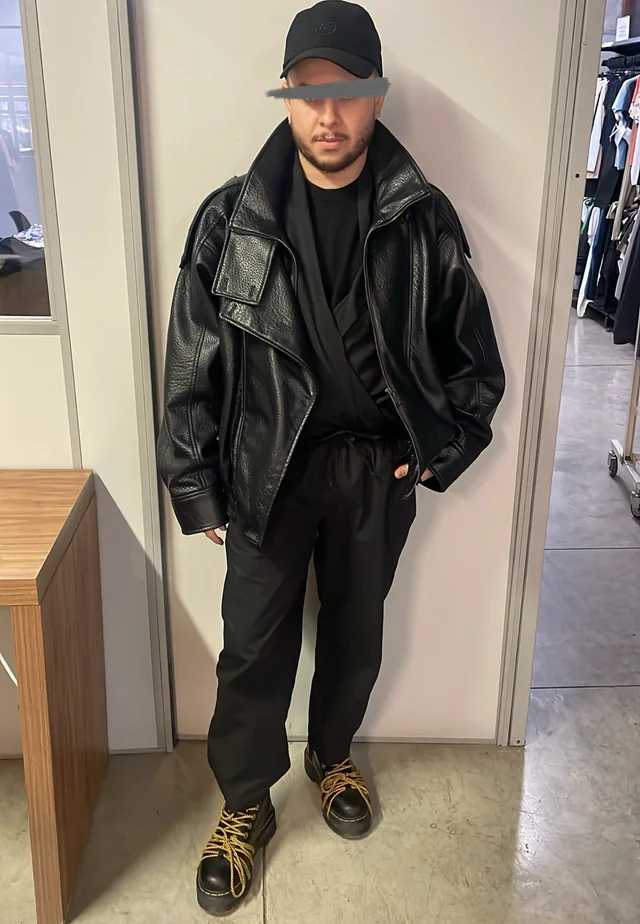
Heavy boots (Dr. Martens 1460 or 1490, Grinders, military surplus, Guidi, Rick Owens Creepers) provide: ankle support (preventing lateral-roll injury on uneven surfaces), sole cushioning (a thick rubber or rubber-and-EVA sole absorbs impact that concrete flooring does not), toe protection (crowds inevitably step on feet; a reinforced or hard-leather toe box prevents injury), and subcultural signaling (boot-wearing indexes the post-punk/industrial/fetish heritage layer of Klubnacht culture). The trade-off: boots are heavy (500–800 g per boot), hot (leather or heavy textile uppers restrict airflow to feet that are already heat-stressed from dancing), and slow to dry after perspiration saturation. Break-in period is essential: new leather boots (particularly Dr. Martens, whose SoftWair or classic sole units are notoriously stiff until broken in over 20–40 hours of wear) cause blisters and foot pain that can end a session prematurely [2][6][20].
Black sneakers (Nike Air Force 1 in triple black, Adidas Samba in all-black, Rick Owens DRKSHDW Ramones, Converse Chuck Taylor in black) provide the lightweight alternative: reduced weight, better ventilation (especially canvas-upper models), and cushioning designed for movement. The trade-off: less ankle support, less toe protection, and a slightly less scene-committed appearance (boots signal deeper investment; sneakers signal versatility) [2][6].
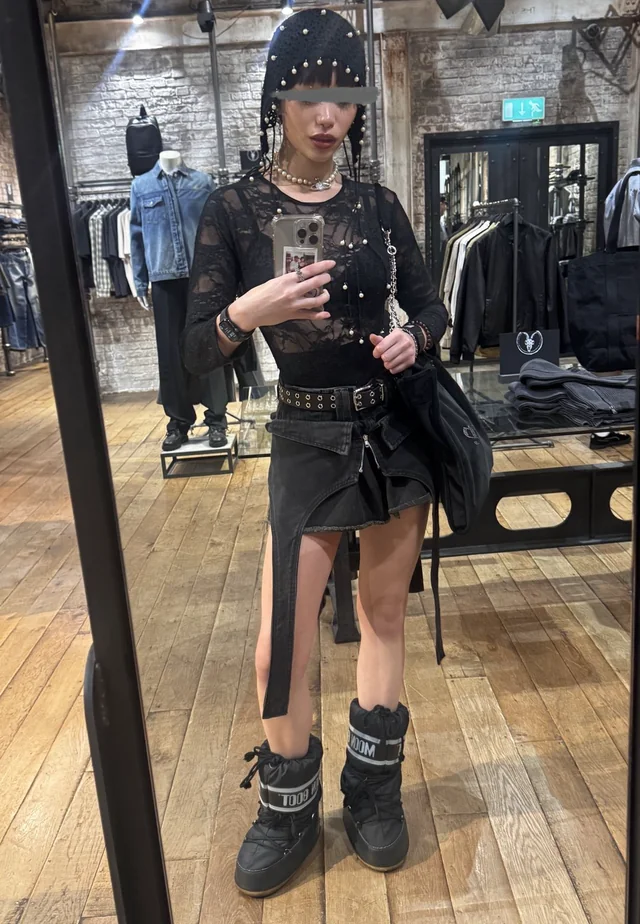
Belt bags and crossbody micro-bags. The essential carry solution: phone, ID, cash/card, keys, earplugs, and small personal items must be secured in a hands-free system that survives dancefloor conditions. Belt bags (fanny packs, bum bags) worn across the chest or at the hip, and micro crossbody bags (1–3 liter capacity), provide secure zip-closure storage that remains body-attached during movement. Material requirements: water-resistant shell (nylon or coated fabric — contents must survive contact with perspiration and spilled drinks), secure closure (YKK zipper preferred, magnetic-snap closures risk opening under movement), and an adjustable strap that distributes weight without creating friction points during extended wear [2][6].
Minimal jewelry. Simple rings (stainless steel or sterling silver — not costume jewelry, which corrodes under sweat exposure), single-stud or small-hoop earrings, and chain necklaces worn tight to the neck (loose pendants catch on crowd-members' clothing and hardware). The minimal-jewelry protocol serves both aesthetic and practical functions: fewer projecting elements mean fewer snag-points in dense crowds [6].
Body Logic
Klubnacht treats the body as a thermoregulatory machine under sustained load: garments are selected and configured to manage the body's heat production during continuous aerobic dance at 120–140 BPM, an intensity that generates metabolic heat loads of 300–600 watts — comparable to moderate-to-vigorous exercise, sustained for durations (4–12+ hours) that exceed most athletic contexts.
Thermal management as primary design criterion. The body dissipates excess heat through four mechanisms: radiation (infrared emission from skin surface — minimal in a hot room surrounded by other hot bodies), conduction (contact heat transfer to cooler surfaces — negligible on a packed dancefloor), convection (air movement over skin — limited in still, dense club environments), and evaporation (perspiration evaporating from skin — the dominant cooling mechanism, but severely impaired at 70–95% relative humidity). Clothing directly modulates the effectiveness of evaporative cooling: mesh and bare skin maximize it; cotton absorbs perspiration and impedes it; latex and leather eliminate it entirely from covered areas. The material choice for each body zone is thus a thermal-management decision: covering the torso in mesh preserves evaporative cooling; covering it in latex concentrates heat dissipation to exposed extremities (arms, head, hands) [17][21].
Gender and body exposure. Klubnacht's body logic is negotiated differently across venue contexts. Berghain's main floor (with its darkroom-adjacent layout and fetish-heritage norms) permits and normalizes high levels of male body exposure — shirtless, harness-only, minimal-coverage configurations — that would be inappropriate in more mainstream club contexts. KitKat Club (Berlin, opened 1994) extends this to near-full nudity as normative. Panorama Bar (Berghain's upper floor, with a lighter, more house-music-oriented atmosphere) maintains moderate coverage norms. The body-exposure gradient maps onto the venue's proximity to fetish culture: closer to fetish heritage = more exposure normative. For women and femme-presenting people, the exposure politics are more complex: club environments that normalize male shirtlessness may not extend equivalent normalization to female toplessness, producing gendered asymmetries in body-logic that the community negotiates continuously through consent culture and explicit venue policies [2][5][9].
Anonymity as embodied practice. Dark clothing in dark rooms produces a specific body experience: individual visual identity dissolves into collective movement. The body is experienced kinesthetically (through movement, rhythm, and tactile contact with adjacent dancers) rather than visually. This dissolution of visual identity is not incidental to the aesthetic but central to it — Klubnacht's material choices (black, non-reflective, non-distinctive) are engineered to facilitate the loss of individual prominence that techno culture frames as liberation. The dressed body in Klubnacht aspires to be felt rather than seen [2][4][22].
Garment Logic
Construction requirements. Klubnacht garments must satisfy a performance specification rarely demanded of non-athletic fashion: (1) Seam durability — all structural seams must survive the stress of sustained dance movement; flatlock or flat-felled seams are preferred at skin-contact points to prevent chafing during extended wear; overlocked seams must be reinforced at stress points (underarm, crotch, shoulder). (2) Closure security — zipper, button, and snap closures must resist the pulling and compression forces of a packed dancefloor; closures that open under stress create wardrobe-malfunction risk in environments where re-dressing mid-set is impractical. (3) Hardware attachment — D-rings, buckles, and decorative hardware must be riveted or securely stitched (not glued) to substrates; adhesive-attached hardware separates under sweat exposure and mechanical stress. (4) Colorfastness — black dyes must resist perspiration-induced bleeding; garments that transfer dye to skin or adjacent items during heavy sweating are functionally defective for Klubnacht use [6][12][14].
Aftercare protocols. Klubnacht garments require post-session maintenance specific to the environmental conditions they've endured:
- Cotton garments: Machine-wash cold immediately post-session (do not let perspiration-saturated cotton sit in a bag or hamper — bacterial colonization accelerates within hours, producing odor that is difficult to remove). Add white vinegar (100 ml) to the rinse cycle to neutralize pH and kill residual bacteria. Line-dry (tumble-drying accelerates cotton degradation but is acceptable for cheap rotation tees intended for short lifespans).
- Leather garments: Wipe interior surfaces with a damp cloth to remove surface salt immediately post-session. Hang in open air (not in closet — ventilation is essential for evaporation). Apply leather conditioner (lanolin-based or synthetic) every 3–5 sessions to replace fatliquor lost through perspiration exposure. Professional leather cleaning every 6–12 months for garments in heavy rotation.
- Latex garments: Wash both surfaces with warm water and mild soap immediately after removal (perspiration left on latex accelerates degradation). Dry completely. Apply silicone dressing to exterior surface for storage. Store flat or hanging, away from light and heat, separated from other latex pieces with talc or silicone to prevent surface adhesion. Never fold latex — fold lines become permanent creases that weaken the material.
- Technical jersey/mesh: Machine-wash cold. Avoid fabric softener (which coats the fiber surface and reduces wicking performance). Line-dry or low-heat tumble-dry.
- Boots: Remove insoles and air-dry separately after sessions involving heavy perspiration. Apply boot-specific deodorizer. Condition leather uppers periodically. Replace insoles when cushioning compresses (every 6–12 months of regular use) [6][13][15][17].
Failure modes and garment lifespan. (1) Cotton t-shirt lifespan: 10–30 sessions before fabric thinning at stress points (collar, underarm), persistent odor despite laundering, and color fading from repeated washing render the garment end-of-life. Cost-per-session at €10–20 per shirt: €0.30–2.00 — Klubnacht's most economical garment category, treated as semi-disposable rotation stock. (2) Leather jacket lifespan: 5–15 years with proper maintenance (conditioning, professional cleaning); 1–3 years without (stiffening, cracking, irreversible odor). The most expensive garment in the system (€200–2,000+ depending on brand and quality), justified by multi-year amortization. (3) Latex garment lifespan: 2–5 years with scrupulous care; months without (oxidation, tackiness, tear-propagation). Latex is Klubnacht's highest-maintenance, shortest-lifespan material relative to its cost (€50–500+ per piece). (4) Boot lifespan: 3–10 years for quality leather boots (Dr. Martens, Guidi) with periodic resoling; boot sole failure (delamination, tread wear-through) is the primary end-of-life indicator, and is accelerated by the abrasive concrete flooring of industrial club spaces [6][13][15].
Motifs / Themes
- Anonymity as liberation: The dissolution of individual visual identity in dark rooms, dark clothing, and collective movement is Klubnacht's foundational ideology — freedom from the surveilling gaze of documented social life.
- Function as aesthetic: The material logic that produces the look is not decoration but environmental optimization — clothing that survives the room is clothing that looks correct for the room.
- The marathon as spiritual practice: Session durations of 12–72+ hours frame dancing as endurance ritual rather than recreational activity — closer to pilgrimage than to partying, with garment selection as preparation for ordeal.
- No-photo as resistance: In a culture organized around content production, the refusal to document is a political act — and it shapes dress by removing the camera as intended audience, forcing garments to address the body and the room rather than the lens.
- Berlin as mythological origin: The city's post-reunification spatial conditions (industrial ruins, cheap rent, cultural vacuum) created the material infrastructure for a culture that is now deterritorialized but remains Berlin-referent.
- Sound as material environment: Techno at 110–130 dB SPL is not background but physical medium — bass frequencies vibrate the sternum, the gut, the floor beneath the feet — and dressing for Klubnacht includes dressing for this physical immersion (ear protection, garments that don't muffle kinesthetic sensation).
Cultural Touchstones
Berlin Calling (2008). Hannes Stöhr's film starring Paul Kalkbrenner as DJ "Ickarus" — a thinly fictionalized representation of the Berlin techno DJ's working life — provides the most widely circulated visual reference for Klubnacht's mise-en-scène. The film's club sequences were shot in actual Berlin venues with real crowd, capturing the aesthetic in its native context [23].
Berghain's Funktion-One system. The club's custom-designed, room-tuned sound system (designed by Tony Andrews' Funktion-One company) represents the apex of techno sound-system engineering. Its relevance to dress: the system's bass reproduction (capable of sustained output at 25–40 Hz at SPLs that produce physical vibration) creates the bodily-immersive sound environment that Klubnacht's dress logic evolved to inhabit [1][2].
Sven Marquardt. The Berghain door selector whose visual presentation (extensive facial tattoos, industrial piercings, shaved head, dark clothing) embodies the aesthetic at its most committed. Marquardt's photography career (documenting East Berlin punk scenes in the 1980s) connects Klubnacht to its subcultural pre-history [5].
032c magazine (Berlin, 2000–present). Joerg Koch's magazine provides the editorial infrastructure connecting Berlin's techno culture to the fashion industry, documenting the aesthetic with the seriousness that its practitioners believe it warrants [7].
Tresor Records / Club. Tresor's founding (1991) in the vault of the former Wertheim department store established the template: industrial-conversion space, extreme sound-system investment, and a community organized around music rather than social performance [1][3][10].
See Also
- Goth: Shared dark palette and post-punk heritage, distinct in temporal structure and musical context
- Industrial: Musical and material crossover, particularly in leather, hardware, and body-coverage conventions
- Rave: Shared electronic-music origin but divergent aesthetic trajectory (rave toward polychrome, Klubnacht toward achromatic)
- Techwear: Shared functionality-first logic and technical-material vocabulary, distinct in color palette and social context
- Fetish/Kink culture: Direct material-vocabulary source (harness, latex, leather), with ongoing credit and appropriation dynamics
- Athleisure: Shared endurance-body logic and performance-material requirements, entirely distinct in visual register and social context
Brands and Designers
Designer-tier (luxury alignment):
- Rick Owens (Paris/Venice) — The most visible luxury-fashion citation of Klubnacht aesthetics; elongated black silhouettes, platform sneakers (Geobaskets, DRKSHDW Ramones), draped leather and stretch jersey
- Boris Bidjan Saberi (Barcelona) — Material-intensive dark-aesthetic design; hand-dyed leather, resin-coated fabrics, object-garment hybrids
- Julius (Tokyo, Tatsuro Horikawa) — Architectural dark-fashion with draping and asymmetry; post-apocalyptic severity aligned with Klubnacht's visual register
- Ann Demeulemeester (Antwerp, founding; now under Ludovic de Saint Sernin) — Poetic-dark aesthetic with leather, lace, and feather; original Antwerp Six member
- Gareth Pugh (London) — Inflatable silhouettes, PVC, and architectural darkwear; spectacular-end of Klubnacht's design spectrum
- Helmut Lang (Vienna/New York; archival influence) — Minimalist severity, rubber-strap detailing, and techno-adjacent aesthetic from the 1990s
- POST ARCHIVE FACTION (PAF) (Seoul, Dongjoon Lim) — Technical construction with experimental dark-aesthetic design
- Darklands (Berlin, retail) — Berghain-adjacent multi-brand retail stocking Rick Owens, BBS, Julius, and independent Berlin-based dark-fashion designers
Accessible-tier (subcultural staples):
- Dr. Martens (Wollaston, England) — 1460 and 1490 boots as default Klubnacht footwear; SoftWair sole for cushioning, classic sole for subcultural credibility
- Guidi (Pescia, Italy) — Handmade leather boots and accessories; vegetable-tanned and horse leather; the quality-investment boot choice
- Carhartt WIP (Europe) — Black cargo pants, work trousers, and bombers; functional workwear adapted for club context
- COS (H&M group) — Affordable minimal black basics (t-shirts, trousers) for rotation stock
- Uniqlo (black basics line) — Ultra-accessible entry-level black t-shirts and trousers
Fetish-heritage/specialty:
- Regulation (London) — Leather, latex, and harness retailer serving both fetish and club-fashion markets
- Zana Bayne (New York) — Leather harness design; fashion-tier quality with fetish-heritage form
- Fleet Ilya (London) — Leather harness and accessory design; Berghain-approved aesthetic
- Blackstyle (Berlin) — Latex specialist; custom and ready-to-wear latex garments for club use
- Expectations (Berlin) — Latex and fetishwear retailer; Klubnacht-adjacent
Citations
[1] Denk, Felix, and Sven von Thülen. Der Klang der Familie: Berlin, Techno und die Wende. Suhrkamp, 2012. English translation: Der Klang der Familie: Berlin, Techno and the Fall of the Wall, 2014. Primary oral history of Berlin's techno scene 1989–1994. [2] Cagney, Liam. Berghain Nights. Reaktion Books, 2025. On Berghain's cultural formation, operational structure, and aesthetic codification. [3] Rapp, Tobias. Lost and Sound: Berlin, Techno und der Easyjetset. Suhrkamp, 2009. On techno tourism, club economics, and the globalization of Berlin's nightlife. [4] Reynolds, Simon. Energy Flash: A Journey Through Rave Music and Dance Culture. Soft Skull Press, 2012 (revised edition). Comprehensive history of rave and electronic dance music culture. [5] Marquardt, Sven, with Judka Strittmatter. Die Nacht ist Leben: Autobiographie. Ullstein, 2014. Berghain door selector's autobiography; firsthand account of the door's aesthetic logic. [6] Nye, Sean. "Minimal Understandings: The Berlin Debate on Techno and Minimalism." Journal of Popular Music Studies, vol. 25, no. 2, 2013, pp. 154–184. On techno's minimalist-aesthetic ideology. [7] 032c magazine, various issues, 2000–present. Berlin-based magazine connecting techno culture and fashion. [8] Rubin, Gayle. "The Leather Menace: Comments on Politics and S/M." In Coming to Power: Writings and Graphics on Lesbian S/M, edited by SAMOIS, Alyson Publications, 1981. Foundational text on leather/fetish community politics. [9] Steele, Valerie. Fetish: Fashion, Sex and Power. Oxford University Press, 1996. On the crossover between fetish materials and mainstream fashion. [10] Bader, Ingo, and Albert Scharenberg. "The Sound of Berlin: Subculture and the Global Music Industry." International Journal of Urban and Regional Research, vol. 34, no. 1, 2010, pp. 76–91. [11] Blanks, Tim. "Rick Owens and the Church of Darkness." The Business of Fashion, 2019. On Owens' relationship to club culture and dark-fashion aesthetics. [12] Ingham, Rosemary, and Liz Covey. The Costume Designer's Handbook. 2nd ed., Heinemann, 1992. On garment construction for performance conditions. [13] Sharphouse, J.H. Leather Technician's Handbook. Leather Producers' Association, 1995. Standard technical reference for leather properties, processing, and behavior under wear conditions. [14] Covington, Anthony D. Tanning Chemistry: The Science of Leather. RSC Publishing, 2009. On chrome-tanning chemistry, leather performance, and environmental impacts. [15] Loadman, John. Tears of the Tree: The Story of Rubber. Oxford University Press, 2005. On natural rubber chemistry, processing, and material properties. [16] Morton, Maurice. Rubber Technology. 3rd ed., Van Nostrand Reinhold, 1987. Technical reference for vulcanized rubber properties including tear-propagation, oxidation, and degradation. [17] Kadolph, Sara J. Textiles. 11th ed., Pearson, 2011. Standard textile-science reference for fiber properties, moisture management, and fabric performance. [18] Bartels, Volkmar T. "Physiological Comfort of Sportswear." Textiles in Sport, Woodhead Publishing, 2005, pp. 177–203. On thermoregulation, moisture management, and textile performance under athletic conditions. [19] OSHA. "Occupational Noise Exposure." Standard 1910.95. Hearing-protection thresholds and requirements. [20] Riello, Giorgio, and Peter McNeil, eds. Shoes: A History from Sandals to Sneakers. Berg Publishers, 2006. On boot construction and material performance. [21] Havenith, George. "Heat Balance When Wearing Protective Clothing." Annals of Occupational Hygiene, vol. 43, no. 5, 1999, pp. 289–296. On thermoregulation under clothing constraints. [22] Thornton, Sarah. Club Cultures: Music, Media and Subcultural Capital. Polity, 1995. Foundational sociology of club-culture capital and gatekeeping. [23] Stöhr, Hannes, dir. Berlin Calling. 2008. Feature film documenting Berlin DJ culture. [24] Paternotte, David, and Roman Kuhar, eds. Anti-Gender Campaigns in Europe. Rowman & Littlefield, 2017. See also: journalistic investigations of racial bias in Berlin nightclub door policies, Exberliner and Vice Germany, various articles 2015–2022. [25] UNIDO. Future Trends in the World Leather and Leather Products Industry and Trade. United Nations Industrial Development Organization, 2010. On the environmental footprint of leather production. [26] Hebdige, Dick. Subculture: The Meaning of Style. Routledge, 1979. [27] Foucault, Michel. "Of Other Spaces." Diacritics, vol. 16, no. 1, 1986, pp. 22–27. On heterotopia — spaces that operate outside normal social rules — directly applicable to the techno club. [28] Attali, Jacques. Noise: The Political Economy of Music. University of Minnesota Press, 1985. On sound as social force and music's relationship to power. [29] Entwistle, Joanne. The Fashioned Body: Fashion, Dress and Social Theory. 2nd ed., Polity, 2015. [30] Breward, Christopher. Fashion. Oxford University Press, 2003. [31] Simmel, Georg. "Fashion" (1904). In Simmel on Culture: Selected Writings, edited by David Frisby and Mike Featherstone, SAGE, 1997. [32] Benjamin, Walter. The Arcades Project. Harvard University Press, 1999. [33] Kawamura, Yuniya. Fashion-ology: An Introduction to Fashion Studies. 2nd ed., Bloomsbury Academic, 2018. [34] McRobbie, Angela. "Fashion as a Culture Industry." Fashion Cultures Revisited, Routledge, 2013. [35] Muggleton, David. Inside Subculture: The Postmodern Meaning of Style. Berg, 2000.