Lekondo's
Ontology of Fashion Aesthetics

36 aesthetics

Clothing is expression without explanation. It influences how you’re seen and how you see yourself. Patterns of taste, mood, discipline, excess, and restraint repeat across time and culture. This is our guide to making that language visible.

Back to Ontology
Hygge 1
Hygge 2
Hygge 3

Hygge

Summary. Hygge is a dress system in which garments engineered for thermal comfort in cold-climate interiors and transitional outdoor environments — heavyweight knitwear, fleece-lined layers, soft-hand natural fibers, and enveloping cocoon silhouettes — are organized around a Scandinavian-derived comfort logic that treats the dressed body as a microclimate-management system optimized for warmth retention, tactile pleasure, and sensory withdrawal from external environmental stress. The aesthetic is governed by a CLO-value accumulation principle: garments are evaluated not through fashion-proportion criteria but through their capacity to trap insulative dead air against the body, manage moisture vapor transmission without clammy condensation, and deliver a haptic experience (softness, weight, warmth) that functions as a physiological comfort signal. Unlike adjacent cold-weather dress systems — gorpcore (which engineers for active outdoor performance under variable weather exposure), workwear (which engineers for durability under occupational stress), or monastic (which uses natural fibers for ascetic withdrawal) — hygge engineers for domestic thermal refuge: the body dressed for the sofa, the fireside, the candlelit kitchen, and the walk home through winter darkness.

In Material Terms

Hygge's coherence depends on the thermal-insulation and moisture-management properties of animal-protein and cellulosic fibers within layered knitwear systems. A Merino wool base layer (fiber diameter 17–22 microns, moisture absorption capacity up to 30% of fiber weight before feeling damp) creates a buffered microclimate against the skin; a mid-weight Shetland wool sweater (25–30 micron fiber, air-trapping crimp structure providing approximately 0.25 CLO per layer) adds bulk insulation through the low-conductivity dead-air pockets held within its yarn construction; a chunky Icelandic Lopi outer layer (tog-spun from mixed fleece lengths, loft providing 0.4–0.6 CLO) seals the system with a wind-resistant, naturally water-repellent surface. When this fiber hierarchy functions correctly — fine next to skin, medium for thermal mass, coarse for environmental protection — the stack maintains comfortable body temperature across an indoor-to-outdoor range of 10–22°C without synthetic insulation. When the hierarchy is collapsed into a single acrylic-blend "chunky knit" purchased for visual citation, the system fails both thermally and materially: acrylic absorbs less than 1.5% of its weight in moisture, creates static buildup against skin, and pills irreversibly within 20–30 wears, producing a garment that mimics hygge's visual grammar while inverting its material logic.

At Category Level

Hygge occupies a contested boundary between Scandinavian domestic-comfort practice and global lifestyle merchandising. High-fidelity implementations are evaluated through knitwear-construction criteria: fiber origin and breed specificity (Merino versus Shetland versus Icelandic), yarn construction (worsted-spun versus woolen-spun, plied versus singles), gauge and stitch density (stitches per inch determining fabric weight, drape, and insulation), and finishing treatment (blocking, fulling, lanolin retention). Lower-tier implementations reproduce the visual grammar — oversized silhouettes, neutral palettes, cable-stitch surface texture — while substituting acrylic blends, machine-knit shortcuts, and synthetic fleece that serve no thermal function beyond the central-heated interior they were designed for. This stratification is not merely commercial but epistemological: it separates participants who evaluate garments through fiber science and knitting literacy from those who evaluate through mood-board recognition and seasonal retail cycling.

Methodologically

This entry treats hygge as a thermal-comfort engineering system embedded within a culturally specific philosophy of domestic well-being: garments are analyzed by how their fiber science, construction logic, and layering behavior produce measurable thermal performance, and by how that performance is translated, commodified, and politically instrumentalized as Scandinavian lifestyle export across different market contexts.

Word (Etymology)

The term hygge (IPA: /ˈhyɡə/) traces to sixteenth-century Norwegian hugga (to comfort, to console), derived from Old Norse hugr (soul, mind, thought, mood) — the same Proto-Germanic root (*hugiz) that yields English "hug." The word entered written Danish in the late eighteenth century as a descriptor for a particular quality of domestic atmosphere: warmth, intimacy, security, the absence of anxiety. For nearly two centuries, hygge remained an unmarked Danish cultural concept — a word everyone used and no one needed to define, operating as what Raymond Williams would call a "structure of feeling" rather than a taxonomic category.

The critical etymological distinction is between hygge as Danish habitual practice and hygge as exported lifestyle brand. Within Denmark, the word is a verb as much as a noun — at hygge sig (to hygge oneself) describes an active creation of comfort conditions, not a purchasable product state. This verbal dimension — hygge as something you do through social arrangement, lighting adjustment, food preparation, and bodily comfort rather than something you buy — was systematically stripped during the term's 2016 global export, when publishers, retailers, and lifestyle platforms repackaged the concept as a commodity aesthetic: candles, knitwear, throw blankets, and other purchasable objects that promised to deliver hygge through transaction rather than through practice.

Related Nordic cognates illuminate what makes hygge culturally specific: Swedish mys (coziness, snuggling), Norwegian kos (cozy togetherness), Dutch gezelligheid (convivial sociability), and German Gemütlichkeit (comfortable conviviality) all express overlapping concepts of warm domestic togetherness. But Denmark alone positioned its variant as an export-ready cultural brand — a marketing achievement that reflects Denmark's particular investment in national identity through lifestyle narrative (the "World's Happiest Country" discourse, Copenhagen's design-capital positioning, the New Nordic culinary movement) as much as any inherent superiority of the concept itself. Collins Dictionary shortlisted "hygge" for Word of the Year 2016 (ranking second to "Brexit"), indexing the speed at which a centuries-old domestic practice became an international consumer keyword.

Subculture

Hygge originated not as a fashion subculture but as habitual Danish social practice embedded within specific climatic, architectural, and welfare-state conditions. Copenhagen receives approximately seven hours of daylight in December; Danish winters are cold, dark, and prolonged; residential architecture privileges insulated interiors with large windows, wood-burning stoves, and purpose-designed lighting. Within these conditions, hygge developed as a survival-comfort practice: gathering indoors, maintaining warmth through layered clothing and shared body heat, creating psychological refuge against physical cold and seasonal darkness. The practice was communal and egalitarian — hygge required neither wealth nor aesthetic sophistication but conviviality, warmth, and the deliberate cultivation of present-moment comfort.

Knitting communities and fiber-knowledge networks. The Scandinavian and broader Nordic knitwear tradition sustains the most technically specific expertise economy within hygge's material culture. Hand-knitting communities — organized through knitting guilds (strikkeklubber), local yarn shops (LYS), Ravelry (the dominant online knitting platform, 9+ million registered users), and regional wool festivals (Lopi Week in Iceland, Shetland Wool Week, Copenhagen Knit Fest) — transmit fiber knowledge through pattern publication, workshop instruction, and communal knitting practice. Within these communities, expertise is evaluated through demonstrated skill: the ability to read a cable chart, execute a provisional cast-on, steek a colorwork yoke (cutting a knitted tube to create an opening — a technique psychologically terrifying to beginners and technically routine for experienced knitters), and judge yarn quality by touch and twist. This expertise hierarchy separates participants who can evaluate a sweater through construction literacy (gauge, yarn weight, stitch definition, finishing quality, fiber content) from those who evaluate through brand recognition and visual pattern-matching.

Global lifestyle adoption (2015–2017). The international hygge moment was concentrated between 2015 and 2017, driven by overlapping media, publishing, and retail forces. Approximately twenty hygge-themed books were published in English between 2015 and 2017 — Meik Wiking's The Little Book of Hygge (New York Times bestseller), Signe Johansen's How to Hygge, Louisa Thomsen Brits's The Book of Hygge — transforming a lived practice into a publishable formula. Pinterest reported a 285% increase in hygge-related searches. Instagram accumulated millions of #hygge posts documenting candlelit interiors, chunky knitwear, steaming mugs, and neutral-palette domesticity. Retailers including Bloomingdale's, IKEA, and West Elm launched hygge-branded product lines. The timing was not accidental: the 2016 Brexit referendum and Trump election created political turbulence against which hygge offered escapist comfort. As Signe Johansen observed: "People are feeling very nervous about the future, and feel a deep primal need to start looking after themselves."

Scandinavian design tradition as institutional substrate. Hygge's fashion expression draws on a century of Scandinavian functionalist design philosophy. Post-WWII Nordic modernism — Alvar Aalto in Finland, Arne Jacobsen in Denmark, Bruno Mathsson in Sweden — established a design vocabulary that prioritized accessible beauty, material honesty, and democratic access to good living. The Danish social-democratic welfare state provided the institutional foundation: high taxes funding a generous safety net, legally protected work-life balance, and income equality reducing the status anxiety that drives conspicuous consumption. Hygge's egalitarianism — modest gatherings, homemade food, rejection of ostentation — reflects broader Danish values encoded in Janteloven (the Law of Jante): do not think you are better than others. This infrastructure is essential context for understanding what hygge-as-fashion lost in translation: the aesthetic was exported without the welfare state, the work-life balance, or the egalitarian social norms that made the practice possible in the first place.

Sociologically, hygge's expertise economy operates through a three-tier hierarchy. At the top, Scandinavian knitters, fiber artists, and design practitioners who participate in the material tradition command authority through demonstrated making skill and cultural embeddedness. Mid-tier authority belongs to content creators, lifestyle curators, and design journalists who translate Scandinavian material knowledge into global lifestyle narrative. At the entry level, participants navigate the aesthetic through retail acquisition and mood-board replication. The hierarchy shapes how authenticity is adjudicated: a hand-knit Icelandic lopapeysa communicates different cultural authority than a machine-knit acrylic facsimile from a fast-fashion chain, even when the visual silhouette is similar.

History

Hygge's material history begins in Nordic fiber traditions shaped by climate, geography, and the specific thermal-performance requirements of life in northern latitudes.

Nordic wool traditions and breed-specific fiber engineering (pre-industrial–1900s). Scandinavian and North Atlantic wool traditions developed in response to extreme cold, sustained moisture exposure, and limited access to imported textiles. Icelandic sheep — descended from Norse settlers' livestock and isolated on the island since the tenth century — developed a dual-coated fleece uniquely suited to harsh climates: a long, coarse outer coat (tog) providing water resistance and wind protection, and a fine, soft inner coat (þel) providing insulation. Traditional Icelandic yarn (lopi) is spun from both coats together in a minimally processed tog-spun construction that retains the fleece's natural lanolin (approximately 10–25% of raw fleece weight), creating a yarn with inherent water-repellency and loft that synthetic construction cannot replicate. Shetland sheep, similarly isolated on the Scottish archipelago, developed fine, crimped wool (25–30 micron fiber diameter) in a natural color range spanning moorit (warm brown), shaela (dark grey), and fawn — the breed provides the raw material for Fair Isle colorwork, one of knitwear's most technically demanding pattern traditions. Norwegian lusekofta (lice jacket, named for the small repeated motif resembling lice) and selburose (Selbu rose, a eight-petaled rose motif originating from Selbu municipality) established the graphic vocabulary of Scandinavian colorwork knitting.

Industrial knitting and the welfare-state design framework (1900s–1960s). Industrial knitting technology — the circular knitting machine, the flat-bed knitting machine, and later fully-fashioned knitting (shaping garments on the machine rather than cutting from knitted fabric) — transformed knitwear from household necessity to mass-market commodity. In Scandinavia, this industrialization was shaped by the social-democratic design framework: knitting mills (Dale of Norway, founded 1879; Sandnes Garn, 1888) produced quality wool garments at accessible price points, extending the democratic-design principle from furniture and housewares to clothing. The lopapeysa (Icelandic yoke sweater) — actually a mid-twentieth-century innovation combining Icelandic yarn with circular-yoke construction techniques likely inspired by South American and Greenlandic patterns — became Iceland's most recognizable garment export and a template for the chunky, patterned knitwear that would later define hygge's visual code.

Kinfolk, Scandi-style export, and aesthetic codification (2007–2015). The visual codification of hygge-as-fashion preceded the word's international breakthrough. Kinfolk magazine (founded Portland 2011, later headquartered in Copenhagen) created the photographic grammar — minimalist interiors, natural materials, muted palette, slow-living ethos — that made Scandinavian domestic aesthetics globally legible. H&M's premium sub-brands — COS (2007), & Other Stories (2013), Arket (2017) — translated "Scandi style" into mid-range retail, making the aesthetic purchasable at scale. Interior-design blogs and early Instagram accounts popularized the white-walled, plant-filled, knit-throw-draped domestic aesthetic that would become hygge's visual signature. Helen Russell's The Year of Living Danishly (2015) introduced Anglo-American audiences to Danish lifestyle concepts, including hygge, as aspirational cultural import. By the time the hygge publishing boom arrived in 2016, the visual infrastructure for reception was already built.

The hygge moment and post-peak diffusion (2016–present). The 2016–2017 hygge publishing boom, Pinterest surge, and retail commercialization constituted the aesthetic's peak international visibility. The New York Times, The New Yorker, BBC, and major lifestyle outlets produced extensive hygge coverage. The concept's commodification was swift and thorough: hygge-branded candles, blankets, socks, and knitwear appeared across the retail landscape, often produced from synthetic fibers and sold at price points that contradicted the egalitarian, non-materialist values hygge claimed to represent. COVID-19 lockdowns (2020–2021) revived interest through "cottagecore" and "cabincore" — hygge's conceptual descendants, optimized for pandemic-era domestic confinement and social-media documentation. The broader Scandinavian lifestyle-export pipeline continued with lagom (Swedish "just the right amount," 2017–2018) and friluftsliv (Norwegian "open-air living," 2020–2021), each following hygge's trajectory from untranslatable cultural concept to lifestyle-merchandising keyword.

Analytically, hygge's history is less a linear timeline than a sequence of translations between registers — domestic practice, national identity, design philosophy, publishing commodity, retail category, platform aesthetic — in which each translation preserves some visual grammar while altering function, audience, and the relationship between material practice and commercial image.

Silhouette

Hygge silhouette is governed by thermal-comfort geometry and domestic-mobility accommodation rather than by fashion-proportion or body-sculpting intent. The characteristic oversized, enveloping, deliberately soft-edged profile is not an arbitrary aesthetic preference but an engineering consequence: effective warmth retention requires trapped air volume between garment layers and between the garment and the body, and this volume demands generous ease throughout the pattern.

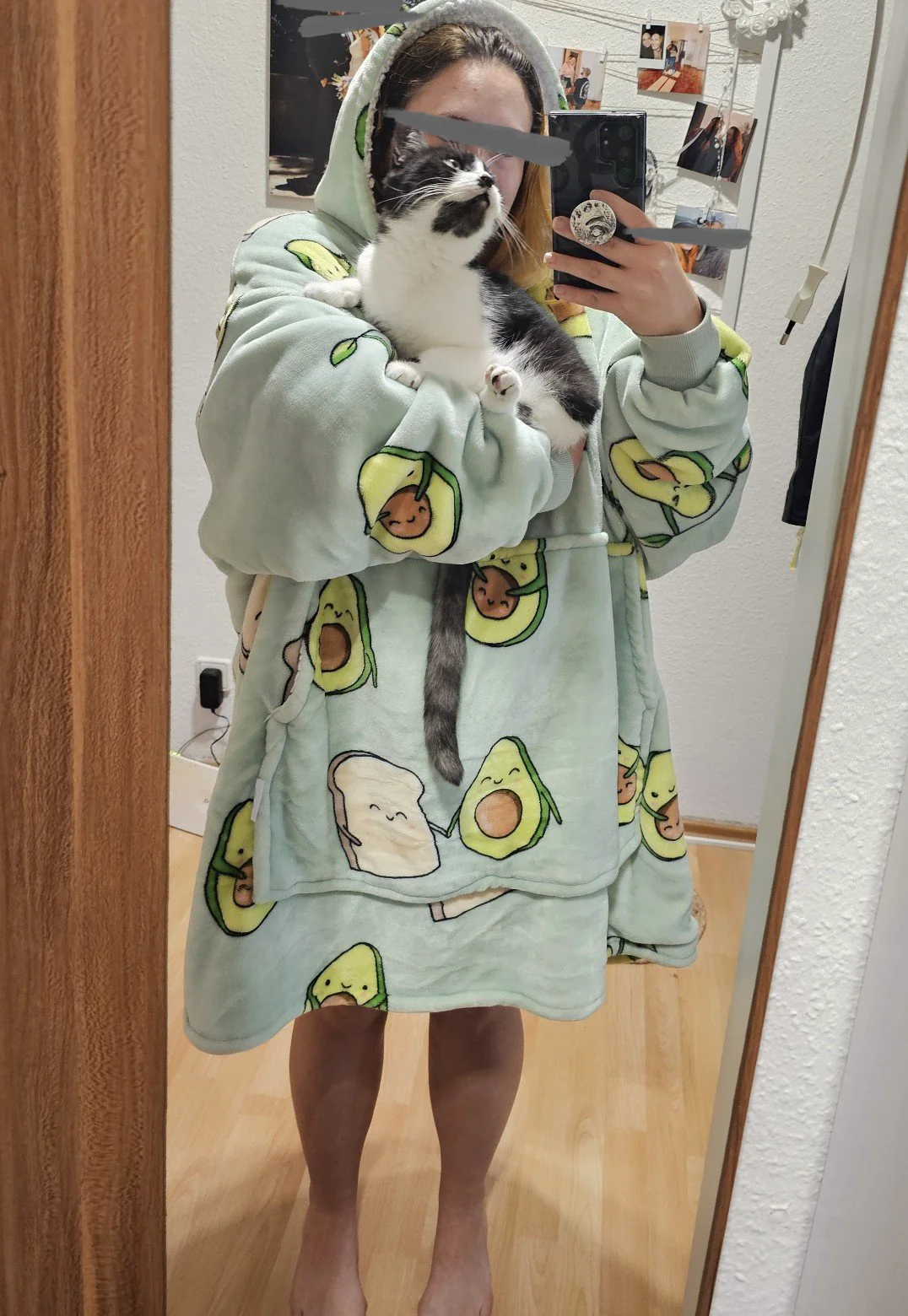
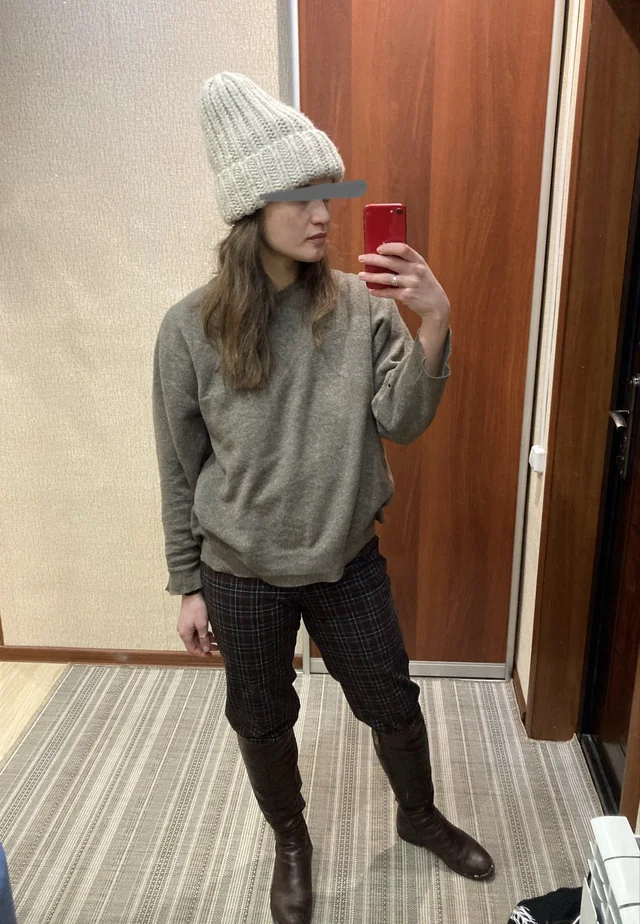
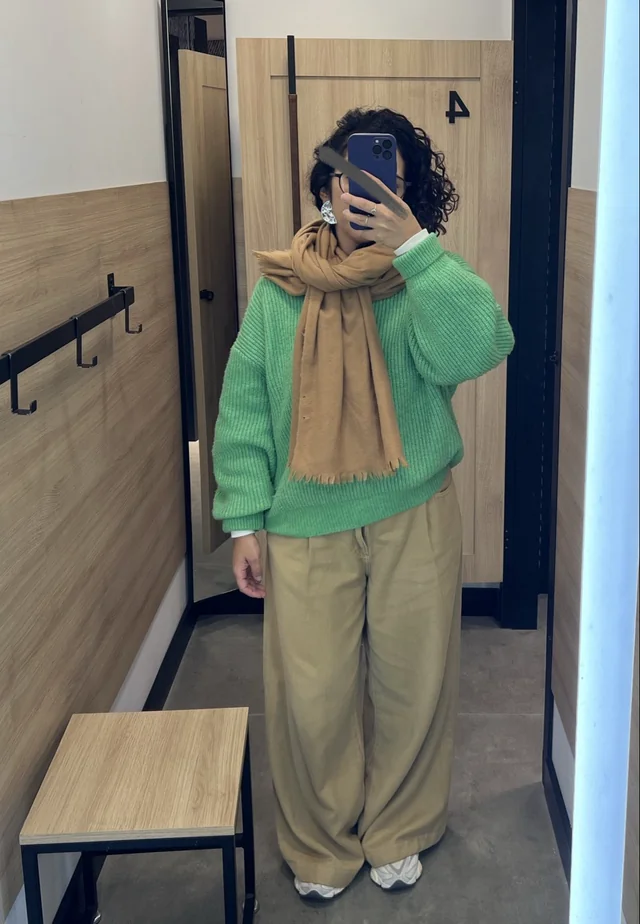
Oversized knit and cocoon forms. The definitive hygge garment — the oversized sweater — drops the shoulder line 5–15 cm past the anatomical shoulder point, extends the body length past the hip to upper-thigh, and provides 15–25 cm of positive ease through the chest and torso. This excess fabric is not waste; it creates the insulative air volume that drives the garment's thermal performance. A closely fitted sweater compresses the knit fabric against the body, reducing its effective loft and therefore its CLO value; an oversized sweater maintains full yarn loft across the entire interior surface, maximizing the dead-air insulation that wool fiber's natural crimp structure creates. Cocoon coats and wrap cardigans extend this logic to outer layers: curved, seamless front panels that wrap without button or zipper closure create a continuous fabric envelope around the torso, eliminating the cold-bridge gaps that conventional button-front closures produce at the center-front seam.

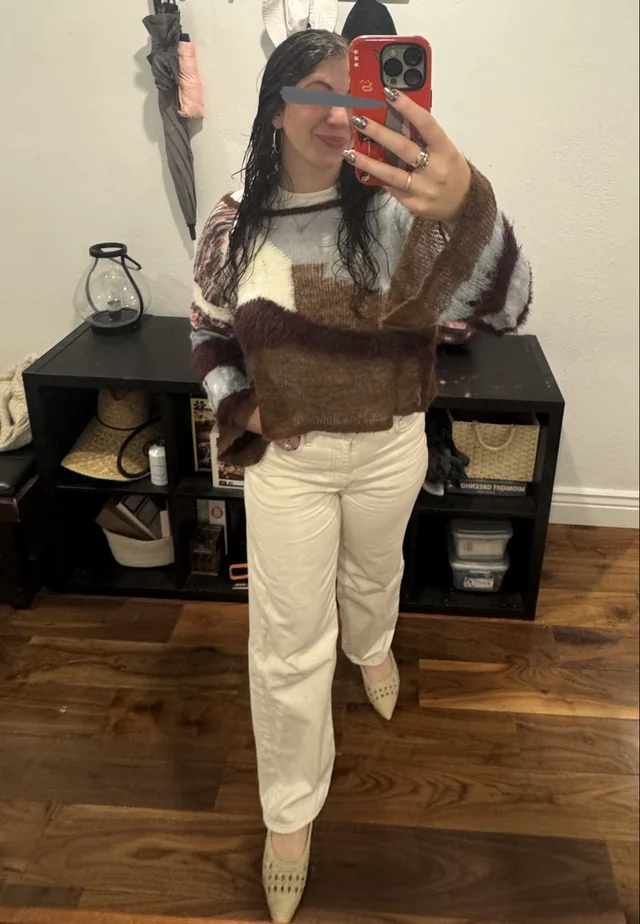
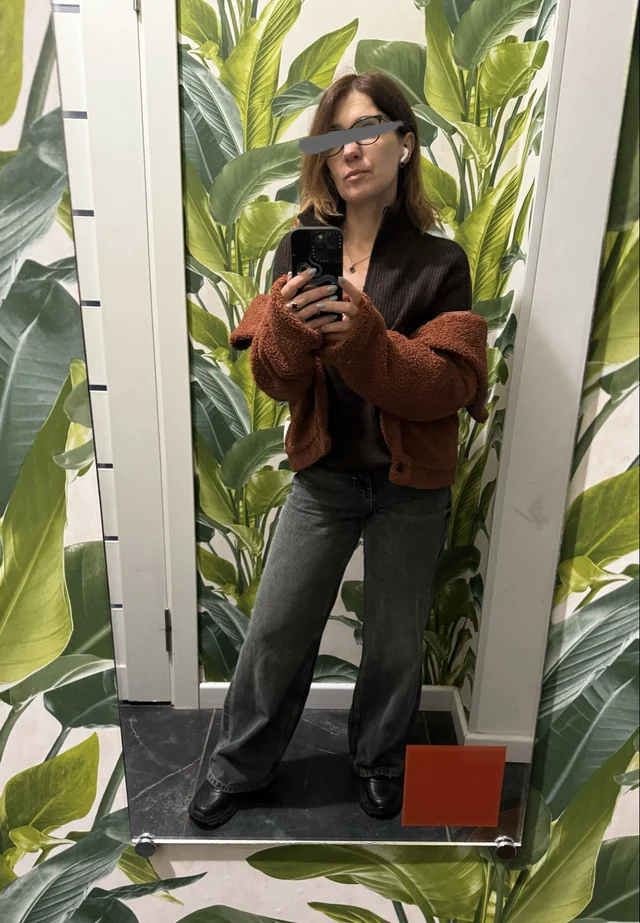
Layered proportional logic. Hygge layering follows a graduated-volume principle: the innermost layer (a fine-gauge base) sits closest to the body; the mid layer (a medium-weight sweater or cardigan) adds moderate ease; the outer layer (a chunky knit, fleece, or cocoon coat) provides maximum volume. This graduation ensures that no inner layer is compressed by an outer layer's tightness — a common fit failure in non-technical layering where a slim outer jacket compresses a thick inner sweater, destroying its insulation. The visible result is a silhouette that appears to grow outward from the body in soft concentric shells, with each layer's hem, cuff, and collar edge partially visible — a visual stratigraphy of texture and weight that signals warmth-seeking rather than body-display.

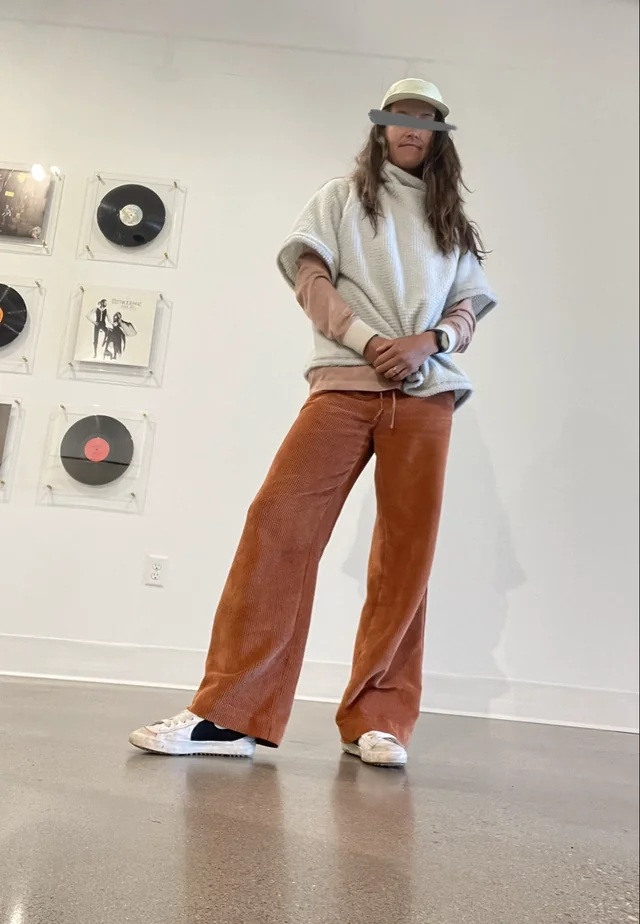
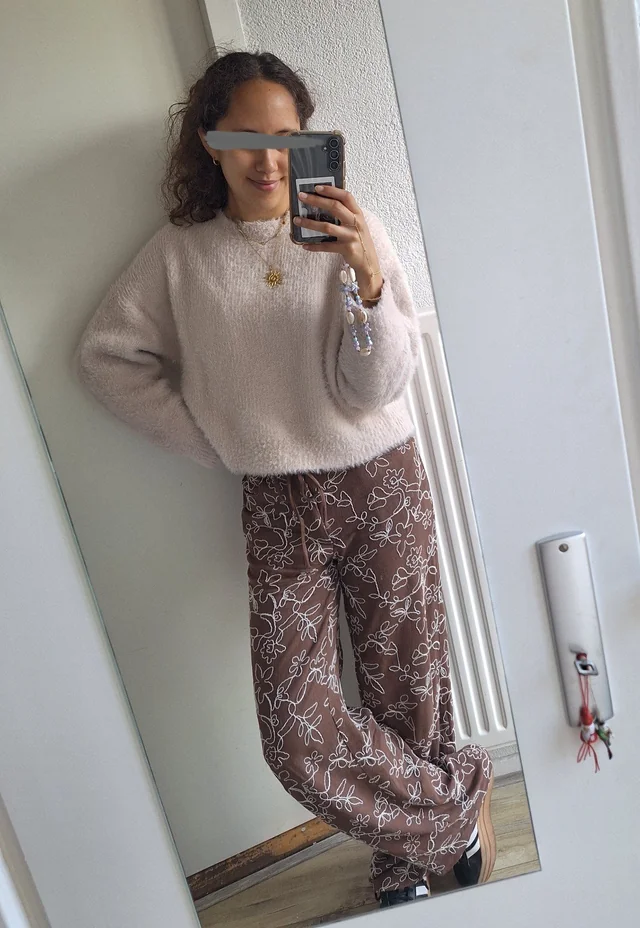
Lower-body proportions. Trousers in hygge systems are wide-leg or relaxed-straight in soft, draping fabrics — often heavyweight cotton, wool flannel, or ponte knit — that maintain the loose, low-friction comfort logic of the upper body. Elasticized or drawstring waists replace structured waistbands, eliminating pressure points during extended seated or reclined wear (the sofa, the reading chair, the floor cushion). Chunky socks — worn visibly above flat shoes or as indoor-only footwear — extend the knitwear logic to the extremities, adding a visual anchor that connects the outfit's textural language from collar to ankle. The overall proportional effect is column-like when standing and nest-like when seated: the silhouette is optimized not for upright, forward-moving public display but for settled, enclosed domestic rest.

Materials

Material selection is hygge's primary truth-test and the domain where the aesthetic's comfort-engineering claims are most empirically verifiable. Hygge textiles are evaluated through thermal insulation metrics (CLO value), moisture-vapor management, hand feel (softness, weight, warmth), and aging behavior across extended domestic use.

Wool fiber science and breed hierarchy. Wool is hygge's definitive fiber, and the category's internal quality hierarchy maps directly onto sheep-breed fiber characteristics. Merino wool (fiber diameter 17–22 microns, staple length 65–100mm) produces next-to-skin-comfortable yarns with high crimp frequency (approximately 100 crimps per inch at the finest grades), creating dense air-trapping microstructures within the fiber itself. Merino's moisture-absorption capacity — up to 30% of fiber weight in water vapor before the fiber feels damp — makes it the optimal base layer for thermal-comfort systems, buffering the body's moisture output without the clammy contact that cotton or synthetic base layers produce. Shetland wool (25–30 micron, variable staple length) provides the mid-weight warmth and color range for traditional colorwork knitting — Fair Isle, Norwegian-pattern, and similar stranded techniques where two or more colors are carried per row, creating a double-thickness fabric with superior insulation. Icelandic Lopi wool (mixed tog-and-þel fiber, effectively 27–31 micron average but with a bimodal distribution of coarse outer and fine inner fibers) produces the distinctively lofty, lightweight, and wind-resistant yarn used in lopapeysa sweaters — its tog-spun construction, which preserves the natural fiber arrangement rather than carding and combing it into uniformity, creates a yarn with more trapped air per unit weight than conventionally processed wool.

Yarn construction and gauge. The thermal performance of a knitted garment depends not only on fiber type but on how the fiber is processed into yarn and how the yarn is constructed into fabric. Worsted-spun yarn (fibers combed parallel, twisted tightly) produces a smooth, dense, relatively cool yarn suited to tailored knitwear. Woolen-spun yarn (fibers carded into a random arrangement, loosely twisted) produces a lofty, air-trapping, warm yarn suited to hygge's insulative requirements. The distinction is measurable: a woolen-spun yarn of equivalent fiber and weight will trap approximately 15–25% more dead air than a worsted-spun equivalent, directly increasing CLO value. Gauge — measured in stitches per inch (SPI) or stitches per 10 cm — determines fabric density and therefore the balance between insulation and weight. Chunky-gauge knitwear (2.5–3.5 SPI) produces the thick, visually textured fabric associated with hygge's aesthetic signature but creates relatively open fabric with limited wind resistance; fine-gauge knitwear (6–8 SPI) produces denser, more wind-resistant fabric with less visual "chunkiness." The optimal hygge-knit sits between these extremes: worsted-weight to bulky-weight yarn (approximately 4–5 SPI) knit at moderate gauge to produce fabric with both visual texture and functional insulation.

Fleece and sherpa construction. Polyester fleece entered the hygge material vocabulary through Patagonia's development of Synchilla (polyester-pile fabric, 1985) and the subsequent proliferation of fleece in cold-weather casual wear. Fleece provides warmth through mechanical loft — raised polyester fibers trapping dead air — but at significant environmental and material cost. Fleece garments shed microplastic fibers during every wash cycle: a single fleece jacket releases an estimated 1,174 milligrams of microfibers per wash, contributing to aquatic microplastic pollution. Fleece pills progressively under abrasion, with pill resistance directly correlating to fiber quality and knit density — premium Polartec resists pilling significantly longer than unbranded polyester fleece. Sherpa fleece (a deep-pile variant mimicking sheepskin's visual texture) provides the "cozy" visual signifier that hygge's retail expression demands but represents the aesthetic's material logic at its most compromised: synthetic fiber mimicking natural fiber's appearance while delivering none of its moisture-management, temperature-regulation, or biodegradability properties.

Thermal comfort data. CLO value — the standard measure of thermal insulation in clothing (1 CLO approximately equals the insulation needed to maintain comfort at 21°C in still air with light activity) — provides empirical grounding for hygge's warmth claims. A fine-gauge Merino base layer provides approximately 0.15–0.20 CLO; a mid-weight wool sweater 0.25–0.40 CLO; a chunky wool cardigan 0.35–0.50 CLO; a wool or fleece blanket wrap 0.50–0.80 CLO. A complete hygge layering stack (base layer + sweater + cardigan or blanket) can accumulate 0.75–1.50 CLO — sufficient for comfort in indoor environments at 16–20°C, which corresponds to Scandinavian indoor heating norms that are notably lower than North American standards (typical Danish home heating targets 20°C versus 22–24°C in North American homes). Moisture vapor transmission rate (MVTR) — measuring how quickly water vapor passes through a fabric — is equally critical: wool's MVTR exceeds cotton's by approximately 30% at equivalent fabric weights, explaining why a wool sweater feels comfortable during hours of sedentary indoor wear while a cotton sweatshirt of equal weight produces clammy condensation as metabolic moisture accumulates.

Cashmere and luxury-tier fibers. Cashmere (fiber from the undercoat of cashmere goats, 14–18 micron diameter) represents hygge's aspirational fiber ceiling — softer than Merino, lighter than Shetland, and priced at 3–10x the cost of equivalent-weight sheep's wool. The quality hierarchy within cashmere is steep: Inner Mongolian cashmere (longer staple, finer fiber) outperforms lower-grade cashmere in softness, pill resistance, and longevity. Cashmere's critical failure mode is pilling — the fiber's short staple length and softness make it vulnerable to surface-fiber migration under friction, and lower-grade cashmere pills noticeably within 10–15 wears. Alpaca fiber (23–28 micron, hollow fiber structure providing superior warmth-to-weight ratio) and yak fiber (18–20 micron, comparable to cashmere in softness but more durable) appear in premium hygge knitwear as alternatives with distinct performance profiles. The fiber hierarchy — Merino as democratic standard, Shetland as heritage signifier, cashmere as luxury aspiration, alpaca and yak as specialist alternatives — maps directly onto the category's market stratification.

Color Palette

The palette is fiber-determined and light-responsive rather than trend-selected. Hygge's characteristic creams, oatmeals, warm greys, and muted earth tones emerge from the intersection of natural-fiber coloration and the specific lighting conditions under which the aesthetic is meant to be experienced: candlelight, firelight, and the low-angle winter sun of northern latitudes.

Fiber-source neutrals. Undyed wool ranges from cream (fine Merino) through warm ecru (Shetland white) to silver-grey and warm brown (Shetland natural colors: moorit, shaela, musket, fawn). Unbleached cotton ranges from warm cream to pale ecru. Undyed linen ranges from silver-grey to warm gold. These fiber-source colors — cream, oatmeal, beige, taupe, warm grey, natural brown — constitute the palette's neutral foundation and explain why hygge's "signature colors" are material consequences of its fiber preferences rather than arbitrary trend selections.

Earth tones and muted accents. Camel, stone, sand, clay, and bark-brown tones extend the neutral range. Muted accents — fog blue, dusty rose, sage green, glacier mint, deep forest green, burgundy, and rust — appear sparingly, never saturating the composition. These accent tones are characteristically desaturated: hygge blue is not cobalt but fog; hygge green is not emerald but moss; hygge red is not scarlet but wine. The desaturation serves a lighting function — deeply saturated colors compete with warm-toned lighting (candlelight has a color temperature of approximately 1,800–2,000K, heavily amber-biased), while desaturated tones harmonize with it, appearing warmer and softer under the low-temperature light sources hygge's interior staging requires.

The monochromatic principle. Hygge outfits tend toward tonal coordination within a narrow value range rather than chromatic contrast: cream-on-oatmeal-on-taupe, or grey-on-grey-on-charcoal. This monochromatic logic serves the layering system by allowing individual layers' textural differences (cable-stitch versus stockinette versus ribbing, knit versus woven versus fleece) to register as the primary visual variation rather than being overwhelmed by color contrast. The palette photographs as Instagram-ready minimalism — which is simultaneously an authentic consequence of its fiber logic and a commercially convenient feature that eased the aesthetic's platform circulation.

Details

Details in hygge are best understood as knitwear-construction interfaces — structural features whose visual character derives directly from the engineering of knitted fabric.

Cable stitches and textured knitting. Cable patterns — formed by crossing groups of stitches over each other on a held cable needle, reversing their position and creating a raised, rope-like surface — are hygge's most recognizable construction detail. A basic six-stitch cable produces a raised twist approximately 1.5 cm wide; compound cables (cables crossing over cables, branching into multiple paths) can produce surface patterns of considerable geometric complexity. Cables are not decoration; they are structural engineering. Each cable crossing creates a localized fabric thickening (the crossed stitches pile three layers deep rather than the usual one) that increases the fabric's thermal mass and wind resistance at the cable's location. A heavily cabled sweater can provide 15–25% more insulation than a plain-stockinette sweater of equal yarn weight and gauge because the cable crossings create dense, air-trapping ridges across the fabric surface. Aran knitting (from the Aran Islands, western Ireland — though the "ancient" origin mythology is largely a mid-twentieth-century marketing invention) codified cable combinations into garment-scale compositions where distinct cable patterns occupy different garment zones (a central panel, shoulder panels, sleeve panels), each contributing to the overall fabric architecture.

Ribbing and cuff construction. Ribbed knitting (alternating columns of knit and purl stitches) produces an elastic fabric that contracts horizontally when at rest and stretches to accommodate the body during wearing. Ribbed cuffs, hems, and collars serve as closure interfaces: they seal the garment's openings against the body, reducing convective heat loss through air gaps at wrists, waist, and neck. A 2×2 rib (two knit, two purl) provides more elasticity than a 1×1 rib but creates a thicker, more visually prominent edge. The shawl collar — a wide, folded collar that lies flat across the upper chest and wraps around the neck — provides wind protection for the neck zone (where heat loss is significant due to high blood flow through the carotid arteries) while creating the soft, wrapped appearance that defines hygge's upper-body aesthetic.

Hand-knit versus machine-knit legibility. Hygge's expertise economy evaluates garments partly through their construction provenance. Hand-knit markers include slight tension variation between rows (producing subtle textural irregularity), yarn joins visible as small tails woven into the fabric interior, and individually shaped garment pieces (sleeves narrowing through decrease stitches rather than being cut from flat-knit fabric). Machine-knit markers include perfectly uniform tension, industrially clean selvedge edges, and cut-and-sew construction (garment pieces cut from machine-knit fabric yardage, with raw edges serged — the method used in most commercial knitwear). Fully-fashioned knitting — where garments are shaped on the knitting machine through increase and decrease operations, producing visible "fashioning marks" (small diagonal stitch distortions near shaped edges) — represents a middle ground: industrial production with construction quality closer to hand knitting. These markers encode quality in a hierarchy where hand-knit signals maximum craft investment, fully-fashioned signals quality manufacturing, and cut-and-sew signals mass production.

Natural closures and minimal hardware. Buttons in hygge knitwear are wooden (olive, walnut, coconut shell), horn, corozo nut, or leather-covered — materials whose warmth and surface irregularity contrast with the cold uniformity of plastic and metal. Leather closures (toggle-and-loop, button-loop) appear on heavier outerwear and cardigans. Zippers are rare in core hygge garments (their metal or plastic teeth create cold-contact points against the body and disrupt the soft, continuous fabric surface); when present, they are concealed behind a button or knit placket. The minimal-hardware principle serves both tactile comfort (no cold metal against warm skin) and visual continuity (the garment reads as an uninterrupted field of textile rather than as a chassis of functional components).

Accessories

Accessories in hygge extend the knitwear-and-natural-fiber logic from garments to the extremities and carried objects, forming an integrated comfort vocabulary.

Socks and indoor footwear. Thick hand-knit wool socks are hygge's most intimate accessory — worn visibly as indoor footwear, protruding above boots in outdoor contexts, and functioning as the garment closest to the category's literal Danish origin (the feet-up, fire-warmed domestic scene). Sock knitting represents a distinct expertise within the knitwear community: turning a heel (creating the three-dimensional shape that accommodates the ankle-to-foot angle) requires short-row shaping or gusset construction that beginning knitters often find technically challenging. Yarn selection for socks prioritizes durability alongside softness: reinforcement blends (typically 75% Merino / 25% nylon) resist the abrasion that pure wool cannot sustain at the heel and toe. Wool slippers (felted or knitted), sheepskin-lined moccasins, and shearling slide sandals extend indoor footwear into the hygge accessory range. Outdoor footwear defaults to flat, practical forms: leather boots with minimal heel, white sneakers (VEJA as the sustainability-signaling choice), and rubber-soled ankle boots for winter conditions.

Scarves, wraps, and blanket accessories. Oversized scarves and wraps — in chunky-gauge wool, cashmere, or alpaca — function as transitional insulation layers that can be added or removed without changing the garment stack. The blanket scarf (a scarf large enough to function as a lap blanket when seated) collapses the boundary between garment and furnishing, performing the domestic-public crossover that defines hygge's spatial logic. Throw blankets carried to outdoor cafes, wrapped around shoulders during evening gatherings, or draped over reading chairs extend the textile-comfort vocabulary into the environment, staging the domestic within public space.

Minimal jewelry and warm-toned metals. Jewelry in hygge is delicate, warm-toned (gold over silver, though both appear), and texturally quiet: thin chains, small pendants, simple stud earrings, understated rings. Metals are matte or brushed rather than high-polish. Ceramic, wooden, and woven-fiber jewelry appears in craft-adjacent interpretations. The principle is tactile non-interference: nothing should snag the knitwear, create cold-contact points against warm skin, or visually compete with the garments' textile surface.


Body Logic

Hygge styling frames the body as resting, thermal, and domestically social rather than as performing, displayed, or occupationally active. Fit choices prioritize thermal comfort, pressure reduction, and seated-body accommodation: oversized knits eliminate restrictive contact, soft waist construction avoids belt-line pressure during extended sitting and reclining, and layering systems manage the 10–22°C ambient range of heated indoor-to-cold outdoor transitions. The body is enveloped rather than revealed, warmed rather than shaped, settled rather than in motion.

Gender coding in hygge is comparatively attenuated but not absent. The oversized-knitwear silhouette and neutral-palette softness are not strongly gendered in construction — the same sweater pattern, in different sizes, can dress any body. However, hygge's lifestyle coding (domesticity, interiority, care, nurturing warmth) draws on historically feminine-gendered associations, and its commercial presentation frequently features feminine-presenting bodies in domestic settings. Male hygge participation centers on the same garments but is framed through slightly different cultural narratives — "dad sweater," "cabin weekender" — that maintain masculine identity markers within the comfort vocabulary.

The aesthetic's "effortless" image requires significant curation and resources: quality knitwear (a hand-knit Icelandic sweater retails at $200–500), stable housing with controllable heating and lighting, and the leisure time for the domestic-comfort rituals (cooking, reading, candle-lighting, gathering) that hygge stages. This creates a persistent class tension: hygge markets itself as democratic comfort — anyone can light a candle — while its material expression circulates through premium retail channels and presupposes housing stability that is neither universal nor inexpensive.


Garment Logic

Construction in hygge centers on knitwear engineering and soft-structure garment architecture, where garments are built to insulate, drape, and age through fiber behavior rather than to fit precisely or hold structural form.

Knitting construction systems. The dominant construction methods in hygge knitwear are: (1) seamless circular knitting (garments knit as continuous tubes, with sleeves joined to the body at the yoke — the technique used for traditional Icelandic, Norwegian, and Faroese sweaters), which eliminates seam bulk and cold-bridging at side seams; (2) flat-knit seamed construction (garment pieces knit as flat panels and sewn together), which allows greater pattern flexibility but introduces seams that must be properly mattress-stitched or grafted to avoid ridge bulk; and (3) top-down construction (garments begun at the neck and knit downward, allowing the knitter to try on the garment in progress and adjust length), which has become dominant in contemporary hand-knitting pattern design through the influence of designers like Elizabeth Zimmermann, whose Knitting Without Tears (1971) revolutionized hand-knitting pedagogy by emphasizing technique understanding over pattern-following.

Fiber-specific aftercare protocols. Wool knitwear requires washing in cool water (under 30°C) with a pH-neutral, lanolin-preserving wool wash — standard detergents strip lanolin and open the fiber's surface scales, accelerating felting. Hand washing is optimal; machine washing on a wool cycle (low agitation, low spin) is acceptable for robust constructions. Drying must be flat to prevent gravitational stretch distortion — hanging a wet wool sweater on a hanger produces irreversible shoulder distortion within a single drying cycle. Cashmere requires the same protocol with additional gentleness: shorter soak times, no wringing, and storage folded (never hung, as the fine fibers stretch under their own weight). Cedar blocks, lavender sachets, or sealed storage containers protect against moth damage — the larvae of Tineola bisselliella (common clothes moth) consume keratin protein, making all animal fibers vulnerable. Moth damage is hygge knitwear's most catastrophic failure mode: a single undetected infestation can destroy an entire stored wardrobe within a season.

Failure modes and degradation analysis. Pilling — the migration of short fiber ends to the fabric surface, where they tangle into small balls — is wool knitwear's primary aesthetic degradation mode. Pilling rate correlates inversely with staple length and ply twist: longer fibers (Merino, Shetland) and firmly plied yarns pill less than shorter fibers (cashmere, lambswool) and loosely plied singles. A low-quality cashmere sweater may show visible pilling after 5–10 wears; a quality Shetland sweater may remain pill-free for 50+ wears. Felting — the irreversible matting of wool fibers through the combination of heat, moisture, and agitation (the three conditions that cause keratin scales to interlock) — is the catastrophic wash-care failure: a machine-washed, hot-dried wool sweater shrinks 30–50% and loses all fabric hand, becoming a stiff, dense, usable-only-as-a-pot-holder textile. Fiber degradation through UV exposure (wool fades and weakens under sustained sunlight), stretch distortion through improper storage (hanging rather than folding), and moth damage through unprotected storage constitute the additional failure modes that experienced knitwear owners anticipate and manage.

Maintenance economics. The total cost of ownership for quality wool knitwear includes not only purchase price but ongoing maintenance: wool wash ($8–15 per bottle, lasting approximately 20–30 washes), cedar moth deterrents ($15–30 per season), flat-drying rack or blocking mats ($20–40), periodic professional cleaning for heavily soiled or felting-risk garments ($15–30 per item), and the time investment of hand washing, flat drying, and proper folded storage. A quality Merino or Shetland sweater maintained with this protocol can last 10–20+ years, making the per-wear cost economically favorable despite a high purchase price — but the protocol itself requires knowledge, equipment, and domestic infrastructure (drying space, storage space, consistent routine) that constitute an invisible care burden rarely acknowledged in hygge's "simple pleasures" rhetoric.

Motifs / Themes

Candlelight as governing image: Denmark consumes more candles per capita than any other European nation, and the candle functions as hygge's central environmental prop — its warm-toned, low-intensity light (1,800–2,000K color temperature) creates the specific atmospheric quality that hygge's garments are designed to harmonize with. The dressed body, in knitwear calibrated to earth-tone and cream palettes, is optimized for perception under this amber light.

Knit texture as surface motif: cables, ribs, Fair Isle patterns, bobbles, seed stitch, and moss stitch produce surface complexity that is visible as compositional content — the sweater's texture is its decoration, requiring no additional embellishment. This conflation of structure and ornament aligns with Scandinavian functionalist design principles, in which beauty emerges from honest material behavior rather than from applied decoration.

Domesticity and gathering: warm beverages, baked goods, shared meals, reading, firelight, blankets, and the physical proximity of small-group togetherness recur as thematic reference points, positioning the dressed body within a social context of intimate conviviality rather than public display.

Slowness and seasonality: hygge's temporal logic opposes fast-fashion's trend-cycle acceleration. Garments are framed as multi-season investments; seasonal rotation (heavier layers in winter, lighter layers in autumn and spring) replaces seasonal replacement. The wool sweater that ages through 10+ years of winter wear embodies a temporal value — patience, continuity, material knowledge accumulated through use — that contradicts disposable fashion's temporal logic.


Cultural Touchstones

Television: The Killing (Forbrydelsen, 2007–2012) — Sarah Lund's Faroese patterned sweater (designed by the Faroese company Gudrun & Gudrun) became the most iconic hygge garment in global media, demonstrating how a functional Nordic knitwear tradition could migrate into international fashion consciousness through narrative television. The sweater was not styled as fashion but as character dress — Lund's practical, emotionally understated wardrobe communicated Scandinavian values of functionality and anti-glamour that resonated with viewers well beyond Denmark.

Literature: The hygge publishing boom (2015–2017): Meik Wiking's The Little Book of Hygge: Danish Secrets to Happy Living (2016), Signe Johansen's How to Hygge: The Secrets of Nordic Living (2016), Louisa Thomsen Brits's The Book of Hygge (2016), Helen Russell's The Year of Living Danishly (2015). These books performed the critical translation that converted hygge from cultural practice to consumer concept — defining, packaging, and making purchasable a way of life that had previously required no explanation within its native context.

Design: Danish modernism — Arne Jacobsen (Egg Chair, Swan Chair), Kaare Klint (Safari Chair), Børge Mogensen (Spanish Chair), Hans Wegner (Wishbone Chair) — established the furniture vocabulary of the domestic interior within which hygge garments are experienced. Contemporary Danish homeware brands — HAY, Menu, Ferm Living — extend this vocabulary. IKEA functions as mass-market Scandinavian-design democratization, though its disposability model sits in tension with hygge's durability values.

Magazines: Kinfolk (2011–present) created the visual codifier that merged hygge with "slow living" minimalism through aspirational domestic photography, neutral palettes, and artisanal-craft emphasis — the magazine that taught non-Scandinavians how hygge was supposed to look.

Knitting culture: Elizabeth Zimmermann's Knitting Without Tears (1971) revolutionized hand-knitting pedagogy; Ravelry (launched 2007) built the digital infrastructure for global knitwear community exchange; Laine magazine (Finland, 2016) established the editorial standard for contemporary Nordic knitwear publishing, bridging craft instruction with lifestyle photography.


See Also

  • Scandinavian minimalism: visual overlap but distinct emphasis; minimalism foregrounds austerity and reduction, hygge adds warmth and textural accumulation
  • Cottagecore: descendant trend (2018–2021); shares pastoral domesticity but emerged through different cultural pipelines and lacks hygge's Scandinavian institutional substrate
  • Normcore: shared emphasis on comfortable, unremarkable clothing; hygge adds domestic-thermal coziness and knitwear specificity
  • Lagom: Swedish "just right" philosophy; moderation-focused cousin emphasizing balance rather than hygge's comfort-maximalism
  • Wabi-sabi: shared valuation of natural materials and aging; wabi-sabi centers material degradation where hygge centers material warmth
  • Mori kei: overlapping natural-fiber preference and domestic-pastoral orientation; mori kei uses layering for volume, hygge uses layering for warmth
  • Monastic: shared natural-fiber, anti-display orientation; monastic uses simplicity for spiritual withdrawal, hygge uses warmth for social gathering

Brands and Designers

Scandinavian Heritage / Fiber-Specialist:

  • Dale of Norway (founded 1879, Dale, Norway): Norwegian wool knitwear specialist; machine-knit using 100% Norwegian wool, known for traditional lusekofte and Olympic team sweaters
  • Sandnes Garn (1888, Sandnes, Norway): Norwegian yarn producer supplying hand-knitters; Peer Gynt and Smart yarn lines are domestic staples
  • Gudrun & Gudrun (2002, Faroe Islands): hand-knit Faroese wool knitwear; designed Sarah Lund's sweater from The Killing; natural-dye and traditional construction emphasis
  • Istex (Icelandic Textile Company): producer of Lopi yarn (Alafosslopi, Lettlopi, Plotulopi) from Icelandic sheep fleece; foundation of the lopapeysa tradition
  • Acne Studios (1996, Stockholm): Scandinavian design positioned between fashion and functionality; mohair and wool knitwear at luxury-tier pricing

Scandinavian Contemporary / Mid-Range:

  • COS (H&M Group, 2007): Scandinavian minimalist aesthetic with knitwear emphasis; mid-range pricing, global distribution
  • Arket (H&M Group, 2017): "modern-day market" positioning with Nordic material values; natural fibers, transparency rhetoric
  • Filippa K (1993, Stockholm): Swedish quality basics; hygge-adjacent minimalism with sustainability commitment
  • & Other Stories (H&M Group, 2013): Scandinavian-aesthetic accessible fashion; Stockholm design atelier emphasis
  • Ganni (2000, Copenhagen): Danish contemporary brand; Copenhagen-coded accessible entry point with stronger fashion-forward edge

Natural-Fiber Knitwear Specialists:

  • Jamieson's of Shetland (1893, Sandness, Shetland): Shetland wool yarn producer and knitwear manufacturer; Fair Isle tradition keeper
  • Brooklyn Tweed (2010, Portland, Oregon): American yarn company sourcing domestically raised wool; pattern-design emphasis bridging craft and lifestyle
  • Woolovers (UK): affordable natural-fiber knitwear (wool, cashmere, cotton) in hygge-compatible styles
  • Johnstons of Elgin (1797, Elgin, Scotland): cashmere and fine-wool producer; luxury-tier knitwear and accessories

Lifestyle / Mass-Market Gateway:

  • MUJI (1980, Tokyo): unintentional hygge baseline; unbleached cotton, wool, and linen basics in muted palette
  • Eileen Fisher (1984, New York): natural-fiber, neutral-palette basics positioned as hygge-aligned through material values and sustainability rhetoric
  • IKEA (1943, Sweden): mass-market Scandinavian-design democratization; textiles (blankets, cushions, rugs) extend hygge into furnishing
  • Everlane (2010, San Francisco): transparency-positioned basics with cashmere and wool knitwear lines

Citations

[1] Wiking, Meik. The Little Book of Hygge: Danish Secrets to Happy Living. William Morrow, 2017. [2] Johansen, Signe. How to Hygge: The Secrets of Nordic Living. Bluebird, 2016. [3] Brits, Louisa Thomsen. The Book of Hygge: The Danish Art of Living Well. Plume, 2017. [4] Russell, Helen. The Year of Living Danishly. Icon Books, 2015. [5] Linnet, Jeppe Trolle. "Money Can't Buy Me Hygge: Danish Middle-Class Consumption, Egalitarianism and the Sanctity of Inner Space." Social Analysis, vol. 55, no. 2, 2011, pp. 21–44. [6] Bille, Mikkel. "Lighting Up Cosy Atmospheres in Denmark." Emotion, Space and Society, vol. 15, 2015, pp. 56–63. [7] Denmark.dk. "Danish Hygge." https://denmark.dk/people-and-culture/hygge [8] Williams, Alex. "The Kinfolk Life: A Slow, Quiet Rebellion." The New York Times, October 7, 2016. [9] TIME. "Hygge: The Nordic Trend That Could Help You Survive 2016." December 5, 2016. https://time.com/4579894/hygge-denmark-nordic-trend-survive-2016/ [10] Hatch, Kathryn L. Textile Science. West Publishing, 1993. [11] Kadolph, Sara J., and Sara B. Marcketti. Textiles. 12th ed., Pearson, 2016. [12] Morton, W. E., and J. W. S. Hearle. Physical Properties of Textile Fibres. 4th ed., Woodhead Publishing, 2008. [13] Watkins, Susan M. Clothing: The Portable Environment. 2nd ed., Iowa State University Press, 1995. [14] Fourt, Lyman, and Norman R.S. Hollies. Clothing: Comfort and Function. Marcel Dekker, 1970. [15] Renbourn, E.T., and W.H. Rees. Materials and Clothing in Health and Disease. H.K. Lewis, 1972. [16] Gonzalez, Richard R., et al. "Biophysics of Heat Transfer and Clothing Insulation." Comprehensive Physiology, 2011. [17] Zimmermann, Elizabeth. Knitting Without Tears. Charles Scribner's Sons, 1971. [18] McGregor, B. A. "Properties, Processing and Performance of Rare and Natural Fibres." RIRDC Publication, no. 09/005, 2009. [19] Ryder, Michael L. Sheep and Man. Duckworth, 1983. [20] Fourné, Franz. Synthetic Fibers. Hanser Publishers, 1999. [21] Browne, Mark A., et al. "Accumulation of Microplastic on Shorelines Worldwide: Sources and Sinks." Environmental Science and Technology, vol. 45, no. 21, 2011, pp. 9175–9179. [22] Fletcher, Kate. Sustainable Fashion and Textiles: Design Journeys. 2nd ed., Earthscan, 2013. [23] Fletcher, Kate. Craft of Use: Post-Growth Fashion. Routledge, 2016. [24] Entwistle, Joanne. The Fashioned Body: Fashion, Dress and Social Theory. 2nd ed., Polity, 2015. [25] Kawamura, Yuniya. Fashion-ology: An Introduction to Fashion Studies. 2nd ed., Bloomsbury Academic, 2018. [26] Breward, Christopher. Fashion. Oxford University Press, 2003. [27] Wilson, Elizabeth. Adorned in Dreams: Fashion and Modernity. Revised ed., Rutgers University Press, 2003. [28] Crane, Diana. Fashion and Its Social Agendas: Class, Gender, and Identity in Clothing. University of Chicago Press, 2000. [29] Bourdieu, Pierre. Distinction: A Social Critique of the Judgement of Taste. Translated by Richard Nice, Harvard University Press, 1984. [30] Simmel, Georg. "Fashion" (1904). In Simmel on Culture: Selected Writings, edited by David Frisby and Mike Featherstone, SAGE, 1997. [31] Lipovetsky, Gilles. The Empire of Fashion: Dressing Modern Democracy. Princeton University Press, 1994. [32] Hebdige, Dick. Subculture: The Meaning of Style. Routledge, 1979. [33] Barthes, Roland. The Fashion System. Translated by Matthew Ward and Richard Howard, University of California Press, 1983. [34] Veblen, Thorstein. The Theory of the Leisure Class. Macmillan, 1899. [35] Gwilt, Alison. A Practical Guide to Sustainable Fashion. Bloomsbury Academic, 2014. [36] Tortora, Phyllis G., and Sara B. Marcketti. Survey of Historic Costume. 6th ed., Fairchild Books, 2015.