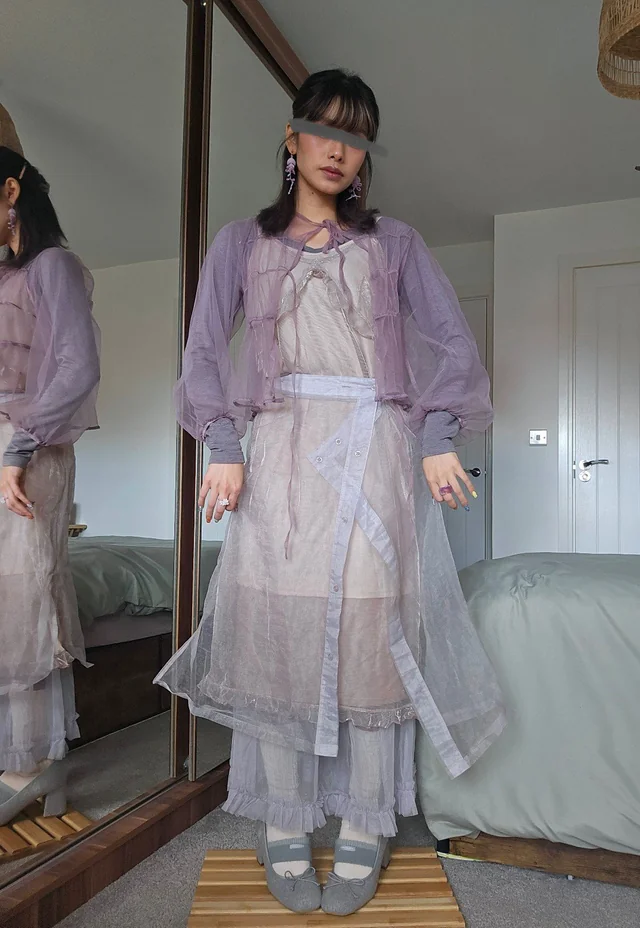
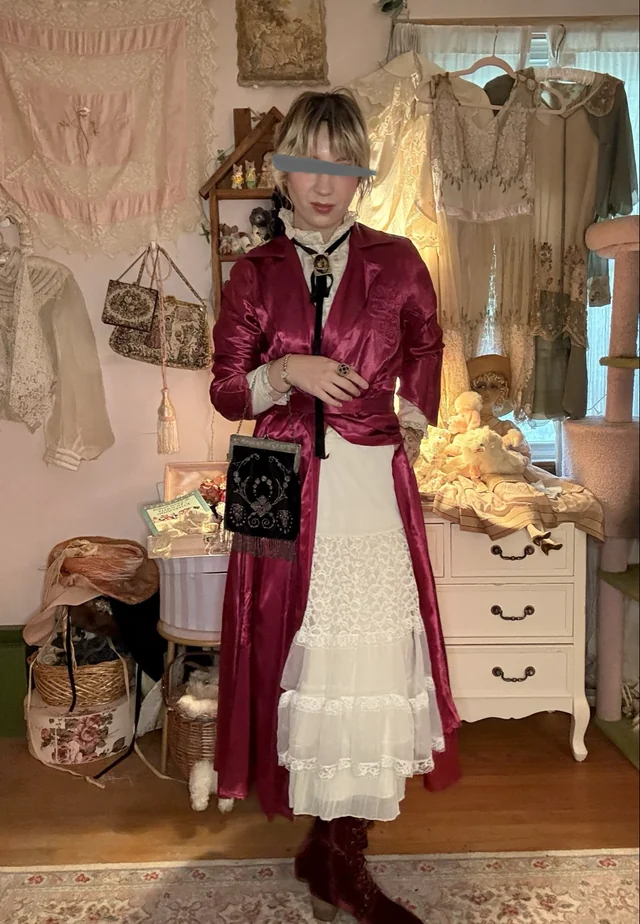
Harajuku
Summary. Harajuku names not a single aesthetic but a textile ecology: an interdependent system of substyles — Gothic Lolita, Sweet Lolita, Classical Lolita, Decora, Fairy Kei, Gyaru, Visual Kei — each governed by distinct material logics, construction grammars, and authentication regimes, unified only by their historical concentration around the Harajuku district of Shibuya ward, Tokyo, and their shared refusal of Japanese sartorial conformity (kuuki wo yomu — "reading the air"). What appears to outside observers as anarchic self-expression operates internally as tightly codified systems where petticoat circumference, lace origin, accessory density, and platform height function as legible taxonomic markers separating substyle from substyle, expert from novice, authentic from counterfeit. The ecology emerged through specific material conditions — postwar American cultural influence, Takeshita-dōri's retail density, Yoyogi Park's performance space, and the photographic documentation economy from street-snap magazines to Instagram — and its contemporary dispersal into platform-mediated global communities has not dissolved these codes but rather shifted the institutions that police them.
In Material Terms
Harajuku's diversity demands substrate-specific analysis rather than a unified material framework. Lolita's construction logic centers on cotton broadcloth printing, lace-quality hierarchy (chemical → raschel → Cluny → torchon), petticoat engineering (tulle and organza volume management), and shirring-elastic fit systems — a precision-femininity regime where fabric weight, weave, and print registration are authentication markers equivalent to techwear's membrane specifications. Decora inverts conventional material hierarchies entirely: cheap plastic (acrylic clips, polystyrene jewelry) is the correct substrate, valued for chromatic intensity and disposability rather than longevity, with accessory density of 50–100+ individual pieces creating 2–4 kg of additional body weight. Gyaru's material investment is directed at the body rather than the garment: circle contact lenses (polymacon hydrogel, 14.0–14.5 mm diameter), false eyelashes (synthetic PBT fiber, stacked 2–3 pairs per application), hair extensions (kanekalon synthetic or human hair), and DHA-based self-tanners constitute the primary material system, while garments themselves cycle through fast-fashion obsolescence at 4–8 week intervals. Visual Kei prioritizes stage-durable synthetics — PU leather that accepts extreme silhouettes but degrades through hydrolysis within 2–5 years, coated fabrics, and metallic-finish textiles — engineering spectacle at performance distance. Each substyle's material logic produces distinct failure modes, maintenance burdens, and aging trajectories that this entry documents with the same empirical specificity applied to membrane delamination in techwear or indigo loss in workwear.
At Category Level
Harajuku occupies a structurally unique position as a geographically anchored ecology that has survived deterritorialization. Unlike most fashion subcultures — which either remain local or dissolve upon global diffusion — Harajuku's substyles have maintained construction codes, authentication standards, and expertise hierarchies through successive platform migrations (street → magazine → forum → social media), producing communities where a Lolita practitioner in São Paulo is evaluated against the same coordinate rules as one in Tokyo. This persistence depends on the substyles' extraordinary codification: where grunge's authentication resists formalization (you can't write rules for "not trying") and streetwear's authentication concentrates in brand provenance (label forensics, drop-date knowledge), Harajuku's authentication — particularly in Lolita — is explicitly articulated in community-maintained rule documents, coordinate-review threads, and "ita" (痛, painful/ugly) critique galleries that catalog violations with taxonomic precision. The ecology is simultaneously one of fashion's most rule-bound systems and, in international reception, one of its most frequently generalized — often perceived as a single spectacle category rather than the internally differentiated system of boundaries, competitive dynamics, and construction knowledge that defines participation.
Methodologically
This entry treats Harajuku as a multi-substrate construction system: each substyle is analyzed through its material requirements, structural engineering, failure modes, maintenance burden, and authentication infrastructure. The analytical task is not to catalogue visual impressions but to document the textile science, construction logic, and institutional economics that make each substyle materially reproducible — or resistant to reproduction. Where techwear's rigor lives in membrane engineering and gorpcore's in insulation science, Harajuku's rigor lives in the precision engineering of constructed femininity, the material culture of additive decoration, and the economics of transnational subcultural transmission.
Word (Etymology)
原宿 (Harajuku): literally "meadow lodging," a place name predating the fashion district by centuries, referring to a rest station on the Kamakura road. The area's fashion identity crystallized only in the postwar period, as American military presence near Washington Heights (the occupied housing complex adjacent to Yoyogi Park, returned to Japan in 1964) introduced Western consumer goods. The name's global fashion meaning — indexing youth self-expression through spectacular dress — dates to the late 1970s when An-An and Non-no magazines began documenting Harajuku gatherings, and achieved international currency through Shoichi Aoki's FRUiTS magazine (1997–2017) [1][2].
The semantic drift is significant: within Japan, "Harajuku-kei" (Harajuku-style) carries connotations of youthful eccentricity that mainstream culture views with amused tolerance; outside Japan, "Harajuku" has become a metonym for Japanese creative freedom writ large, condensing dozens of mutually exclusive substyles into a single simplified category [3].
Subculture
Harajuku's subcultural architecture is not a unified tribe but a competitive ecology of practice communities, each maintaining distinct material standards, knowledge hierarchies, and authentication protocols. The major substyles function as parallel systems with occasional overlap but rigid internal boundaries:
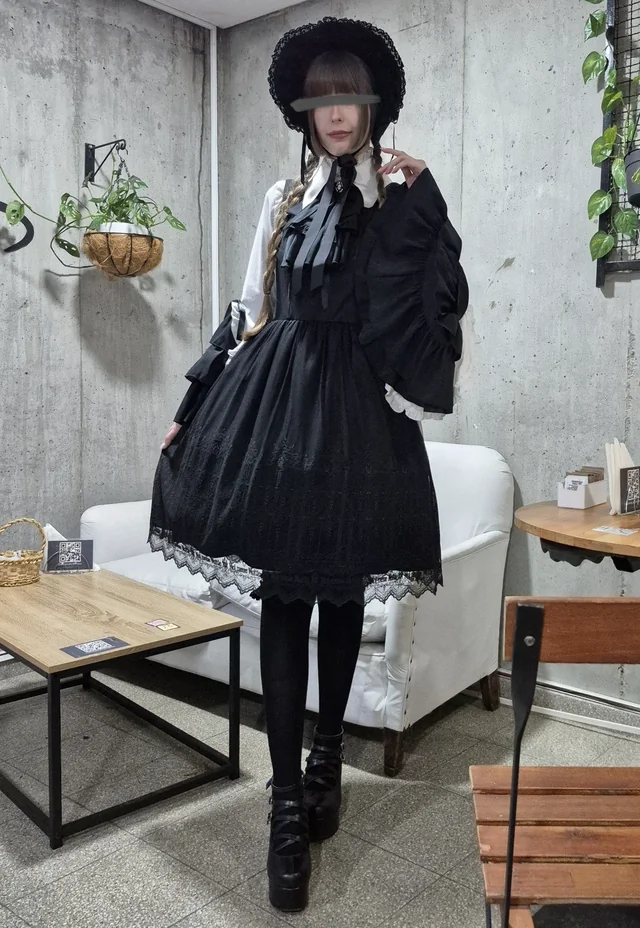
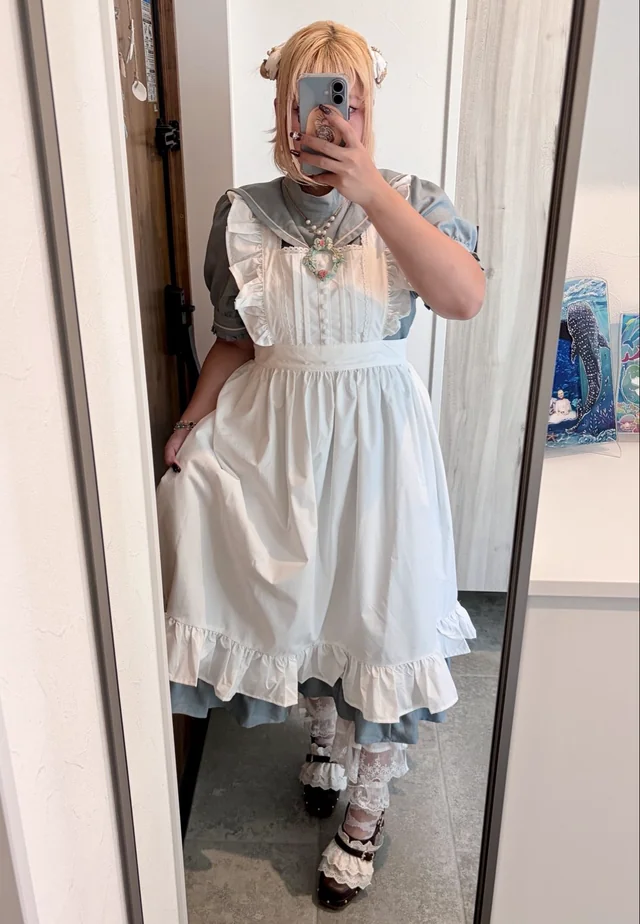
Gothic Lolita / Sweet Lolita / Classical Lolita — The Lolita substyles constitute the most codified construction system in the Harajuku ecology. Participation requires mastery of what the community terms "the rules" (ruuru): skirt length must fall at or below the knee; the silhouette must achieve a bell shape through proper petticoat support; headwear is required (bonnet, headdress, or bow); visible brand logos are vulgar; coordinates must achieve thematic and chromatic coherence. The gatekeeping infrastructure is elaborate: online communities like EGL (Elegant Gothic Lolita) LiveJournal (2001–2012, peak membership ~15,000), Lolita Fashion community on Reddit, and the Closet of Frills Discord server maintain FAQ documents, coordinate-review threads, and "ita" (痛, literally "painful") critique galleries where rule violations are catalogued and analyzed [4][5]. Expertise is measured by: (1) knowledge of brand archives and print histories, (2) ability to construct coordinates that reference without copying, (3) understanding of lace quality hierarchies, (4) petticoat engineering competence.
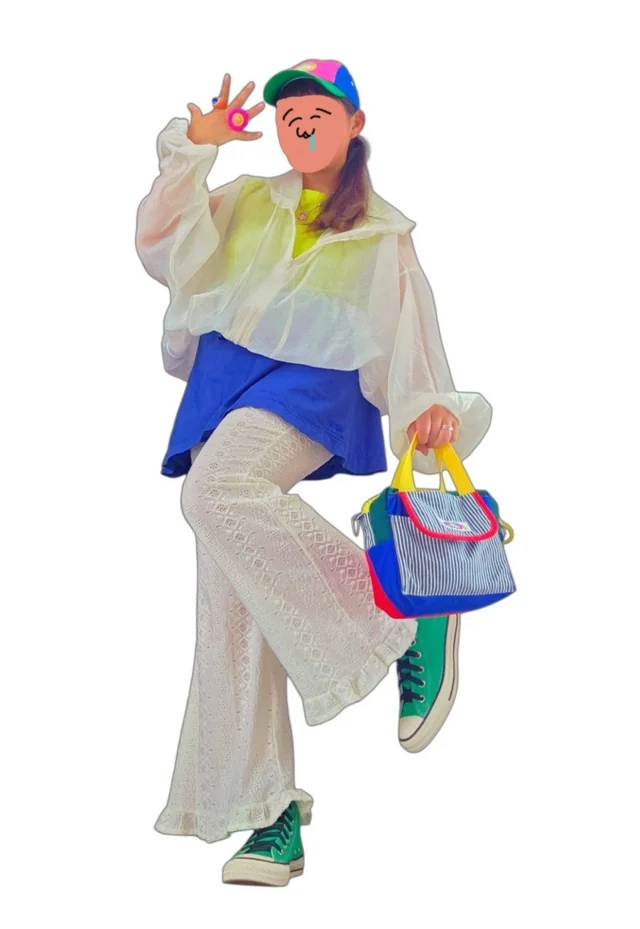
Decora — Decora (from "decoration") operates on additive material logic: the fundamental unit of aesthetic production is the accessory layer, and status derives from density, color coordination within excess, and the curation of character goods (Sanrio, Tamagotchi, 1990s toy iconography). Sebastian Masuda's 6%DOKIDOKI shop (opened 1995 in Harajuku) established the retail infrastructure and chromatic vocabulary. Expertise is measured not by construction skill but by curatorial stamina: maintaining 50–100+ hair clips, multiple necklace layers, stacked bracelets, and coordinated bags requires sourcing networks (Nakano Broadway, online auctions, character-goods specialty stores) and physical endurance — a full Decora coordinate can add 2–3 kg of accessory weight [6].
Fairy Kei — A nostalgia-driven substyle sourcing primarily from 1980s American and Japanese pop culture (My Little Pony, Care Bears, Popples, vintage Sanrio). The material logic centers on pastel palette discipline and vintage authentication: genuine 1980s sweatshirts and T-shirts command higher status than reproductions. Expertise lies in vintage sourcing, fabric-condition assessment, and the ability to integrate authentic vintage with contemporary Japanese pieces [7].
Gyaru — Gyaru (ギャル, from English "gal") inverts Japanese beauty norms through deliberate artifice: tanned skin (self-tanner or salon), lightened or colored hair, dramatic eye makeup (circle lenses expanding iris diameter 14.0–14.5 mm, false lashes stacked 2–3 pairs, lower lash line drawn or applied). The material system prioritizes visible brand consumption and body modification over construction quality. Sub-branches — Ganguro (extreme tan, white lip/eye concealer), Hime Gyaru (princess styling, Liz Lisa as canonical brand), Onee Gyaru (mature sophistication) — maintain distinct material standards. The gyaru-sa (circle/group) structure provided transmission and policing: groups like egg magazine's featured circles set standards that filtered through parapara dance gatherings and purikura photo-booth culture [8][9].
Visual Kei — Visual Kei (ヴィジュアル系) is a music-fashion symbiosis where the band's visual presentation is structurally equal to its sonic output. Emerged through X Japan (formed 1982), codified by Malice Mizer's Gothic-Baroque costuming (Mana's Moi-même-Moitié brand, founded 1999). Material requirements include stage-durable construction, dramatic volume (teased hair requiring industrial-strength hairspray, wig infrastructure), and androgynous presentation that deliberately destabilizes gender legibility. Expertise is measured by knowledge of band lineage, ability to identify visual references across eras, and costume-construction skill for live attendance [10][11].
Transmission infrastructure has shifted across three eras: (1) Street-and-magazine era (1980s–2005): knowledge transmitted through physical co-presence at Harajuku gatherings, street-snap magazines (FRUiTS, KERA, Gothic & Lolita Bible, egg, Ageha), and brand shop staff; (2) Forum era (2003–2015): EGL LiveJournal, daily_lolita, Gyaru Secrets, Tanuki BBS — text-heavy platforms enabling detailed construction discussion, coordinate critique, and brand-knowledge accumulation; (3) Platform era (2015–present): Instagram, TikTok, YouTube tutorials — image-first platforms that accelerate visual diffusion but compress the construction knowledge that street-snap and forum eras transmitted. Each shift alters what counts as expertise: magazine-era expertise was being photographed; forum-era expertise was articulate knowledge; platform-era expertise is algorithmic visibility [2][12][13].
History
1945–1960s: Occupation and importation. The American military presence established the material preconditions: Western clothing, music, and consumer culture entered Japan through GI surplus, base exchanges (PX stores), and cultural osmosis. The area around Yoyogi Park — specifically Washington Heights, a sprawling American housing complex — became a zone of cultural contact. After the complex's return to Japan for the 1964 Olympics, the adjacent Harajuku streets retained their Western-inflected commercial character [14].
1970s: Retail crystallization. Takeshita-dōri developed as a youth retail corridor. Takenoko-zoku ("bamboo-shoot tribe," named after the Takenoko boutique) performed choreographed dances in Yoyogi Park wearing handmade colorful costumes — the first instance of Harajuku as spectacle-space. The Hokōsha Tengoku (pedestrian paradise, 1977–1998) closing Omotesandō to vehicle traffic on Sundays created the physical infrastructure for public self-display [14][15].
1980s: Substyle differentiation. Visual Kei emerged through X Japan (1982) and the Nagoya kei scene. DC Brand boom (Designer's & Character's) brought avant-garde Japanese design to Harajuku retail. Early Gothic Lolita elements appeared in Mana's stage costuming. The bubble economy (1986–1991) funded elaborate youth consumption [10][16].
1990s: Documentary golden age. FRUiTS magazine launched (1997), Shoichi Aoki's street-snap photography creating an archival record of unprecedented specificity — each photograph documented not just the outfit but the wearer's name, age, occupation, and brand/source breakdown, establishing a material-traceability standard. KERA magazine (1998) served Gothic Lolita and punk substyles. egg magazine (1995) codified Gyaru culture. Gothic Lolita crystallized as a fully codified system through Mana's Moi-même-Moitié (1999) and the Gothic & Lolita Bible magazine (2001) [1][2][17].
2000–2010: International spectacle. Harajuku achieved global visibility through multiple vectors: Gwen Stefani's "Harajuku Girls" (2004) — four Japanese-American backup dancers styled in Harajuku-inspired fashion — sparked controversy and broader cross-cultural reception debates [3][18]. The Lolita Bible reached international distribution. Online communities (EGL LiveJournal, 2001) enabled non-Japanese participation, creating a transnational community that by 2005 included active chapters in the US, UK, Germany, France, Mexico, and Brazil [4].
2010s–present: Platform dispersal and physical decline. The Harajuku street-gathering tradition diminished: Hokōsha Tengoku had already ended in 1998; FRUiTS ceased publication in 2017 (Aoki cited insufficient interesting subjects); foot traffic on Takeshita-dōri shifted from subcultural practitioners to tourists and fast-fashion consumers. Substyle communities migrated to Instagram, TikTok, and Discord, where algorithmic curation replaced editorial curation. COVID-19 further dispersed physical communities. Yet the construction codes persist: Lolita brands continue to produce new collections, secondhand markets thrive, and online communities maintain authentication standards — the ecology has deterritorialized but not dissolved [2][12][19].
Silhouette
Harajuku silhouettes are not stylistic preferences but structural engineering problems, each substyle solving distinct relationships between body, fabric, and social legibility:
Lolita: The Engineered Bell. The defining Lolita silhouette — fitted bodice transitioning to a voluminous bell-shaped skirt at natural or empire waist — is an active construction achievement, not a passive drape. The bell requires: (1) a petticoat (pettikōto) of sufficient volume, typically 2–4 layers of polyester tulle or organza, with circumference ranging from 3 meters (daily wear) to 6+ meters (OTT/over-the-top coordinates); (2) a skirt cut with sufficient ease to accommodate petticoat expansion without pulling at the waistband — typically full-circle or gathered-rectangle construction with 2.5–3× fabric width relative to waist measurement; (3) a bodice employing darts, princess seams, or shirring (elastic-gathered panels, typically 5–8 rows of shirring elastic in back-shirred JSKs) to achieve a fitted torso without the structural commitment of boning. The bell's proportions are precisely calibrated: skirt should end at or below the knee (above-knee is a rule violation), and the widest point of the bell should fall at approximately mid-thigh, creating the "cupcake" proportion that distinguishes Lolita from Victorian revival [4][5][20].
Decora: Volumetric Accumulation. Decora silhouette is built through additive layering rather than pattern cutting. The base layer (T-shirt, sweatshirt, or tutu skirt) provides a substrate onto which accessories are stacked. The resulting silhouette is approximately spherical in the upper body — head and torso expanding outward through hair-clip density (50–100 clips creating a textured halo), stacked necklaces, layered bracelets, and pinned badges — tapering to relatively slim legs in knee socks or leg warmers with platform sneakers. The silhouette's geometry is governed by accessory mass distribution: too much weight on one side creates asymmetry that reads as incomplete rather than deliberate [6][21].
Fairy Kei: Soft Volume. The silhouette employs oversized tops (vintage sweatshirts 2–3 sizes above body size) paired with either tutu skirts (shorter, puffier than Lolita petticoats) or gathered mini-skirts over opaque tights. Platform sneakers (Buffalo, Demonia, vintage) raise the wearer 5–10 cm. The geometry is intentionally infantile: the oversized-top-to-slim-leg ratio mimics children's proportions, a deliberate regression aesthetic that Kinsella connects to Japan's broader kawaii culture as refusal of adult social obligation [7][22].
Gyaru: Elongation and Exposure. Gyaru silhouette engineering prioritizes vertical exaggeration: platform boots (10–15 cm soles in Ganguro/Manba variants), teased and volumized hair adding 10–20 cm of height, and mini-skirts or short-shorts that maximize visible leg. The proportion is inverted relative to Lolita — minimal fabric coverage, maximal body-modification investment (tanning, makeup, hair). Hime Gyaru modifies this with A-line skirts and princess-seam dresses (Liz Lisa's signature construction), but retains the elongation principle through high heels and voluminous hair [8][9][23].
Visual Kei: Theatrical Exaggeration. Visual Kei silhouette borrows from multiple historical vocabularies — Baroque court dress, Victorian mourning wear, punk leather, and glam rock — unified by scale amplification. Hair volume (achieved through backcombing, wig layering, and industrial-hold styling products) can add 30+ cm to total height. Shoulder width may be extended through structured epaulettes or layered accessories. Platform boots provide 10–20 cm elevation. The silhouette is designed for stage legibility: proportions must read from 10–50 meters in live venues, requiring exaggeration that appears grotesque at conversational distance [10][11].
Materials
Material analysis in Harajuku requires substyle-specific treatment, as the ecology's diversity means no single material logic applies across the system:
Lolita textiles: Structured femininity. The dominant substrate is cotton broadcloth (also called poplin), a plain-weave fabric in 100–130 g/m² weight range, chosen for its ability to hold printed patterns with sharp definition while accepting the structural demands of gathered construction. Original-print fabric (orijinaru purinto) — proprietary patterns designed by brands and printed on cotton broadcloth or cotton-polyester blends — constitutes the primary status marker. Baby, The Stars Shine Bright and Angelic Pretty commission print runs of specific colorways, each print produced in limited quantities across 3–6 colorways (e.g., Angelic Pretty's "Dreamy Baby Room" in pink, lavender, mint, black, red). Print quality is assessed by: color saturation, pattern registration accuracy, repeat size, and hand feel after washing [4][5][20].
Cotton sateen appears in more formal Lolita pieces, its weave structure (4:1 satin weave in cotton yarns) producing a subtle sheen appropriate to Classical Lolita's restrained aesthetic. Chiffon (polyester, 30–60 g/m²) is used for overlay layers and sleeve construction. Velveteen (cotton pile weave, distinct from silk velvet) appears in autumn/winter collections, its nap adding tactile depth but requiring careful maintenance to prevent crushing.
Lace hierarchy is a critical authentication marker. Lolita communities distinguish: (1) chemical lace (machine-embroidered on dissolvable substrate) — the lowest tier, identified by stiff hand and uniform pattern, used on budget pieces and Chinese replicas; (2) raschel lace (warp-knitted, common in mid-range Lolita) — softer drape, moderate pattern complexity; (3) Cluny lace (bobbin-lace style, machine-produced but mimicking handcraft patterning) — higher status, used on premium brand pieces; (4) torchon lace (geometric bobbin-lace pattern) — valued for its historical specificity. The ability to identify lace type by touch and visual inspection is a core Lolita expertise marker. Cheap lace is the most-cited flaw in "ita" (poorly executed) coordinates [4][5].
Petticoat engineering relies on polyester tulle (stiff, open-weave net, 15–30 g/m²) or polyester organza (crisp plain-weave, 40–60 g/m²), selected for resilience under sustained compression (sitting, transport). Tulle provides more volume per layer but creates a rougher silhouette edge; organza creates a smoother bell but requires more layers for equivalent volume. Premium petticoats combine both: organza for the outer tier, tulle for inner volume layers. Wire-hoop petticoats (borrowed from historical costuming) appear in OTT coordinates but are considered excessive for daily wear [20].
Decora materials: Plastics and quantity. Decora's material logic inverts conventional quality hierarchies: cheap plastic is not a compromise but the correct substrate. Hair clips (acrylic, polystyrene), plastic jewelry (beaded bracelets, character pendants), and synthetic-fiber accessories are valued for their chromatic intensity and disposability — Decora coordinates are reconfigured constantly, requiring low per-unit cost. The base-layer textiles (cotton jersey T-shirts, polyester-blend sweatshirts) are deliberately unremarkable; they serve as substrate for accessory attachment, not as aesthetic objects in themselves [6][21].
Material performance under Decora use conditions: Plastic accessories undergo UV-induced brittleness over 6–12 months of daily wear (polystyrene stress-cracking, acrylic yellowing). Hair clips lose spring tension through repeated use, requiring regular replacement. The material system is designed for throughput rather than longevity — consistent with Decora's emphasis on constant reconfiguration.
Fairy Kei materials: Vintage synthetics. Authentic Fairy Kei privileges 1980s-era textiles: acrylic knits (vintage sweatshirts), cotton-polyester blends (vintage T-shirts with screen-printed character graphics), and nylon taffeta (tutu skirts). The material authentication challenge is distinguishing genuine 1980s production from contemporary reproduction: vintage acrylic has a distinct pilling pattern (tight, uniform micro-pills from decades of wear) distinct from new acrylic's looser pilling; vintage screen prints exhibit micro-cracking in the ink layer that reproduction prints lack; vintage cotton-poly blends have a softened hand from repeated washing that new fabric cannot replicate [7].
Gyaru materials: Fast-fashion and modification substrates. Gyaru's material investment hierarchy inverts Lolita's: the highest-value materials are applied to the body (hair extensions — synthetic kanekalon fiber at ¥3,000–8,000 per pack, human hair at ¥15,000–50,000+; circle contact lenses — polymacon or methafilcon A hydrogel, 14.0–14.5 mm diameter; false eyelashes — synthetic PBT fiber, 2–3 pairs stacked and trimmed per application; self-tanning products — DHA-based bronzers) rather than to garments, which are often fast-fashion pieces from Shibuya 109 brands with planned obsolescence cycles of 4–8 weeks. Hime Gyaru represents an exception: Liz Lisa and similar brands use polyester jacquard, lace overlays, and structured A-line construction at a higher quality tier [8][9][23].
Visual Kei materials: Stage-durable synthetics. PU (polyurethane) leather dominates over genuine leather for practical reasons: lower cost enables the large yardage needed for layered costumes, lighter weight reduces performer fatigue, and PU accepts the extreme silhouettes (asymmetric cuts, draped panels, lace-up detailing) that stage presentation demands. However, PU leather's durability is limited: the polyurethane coating degrades through hydrolysis over 2–5 years (accelerated by sweat exposure during performances), producing surface cracking and flaking. Genuine chrome-tanned leather appears on premium accessories (boots, belts, cuffs) where durability justifies the cost. Coated fabrics, metallic-finish synthetics, and lace (often polyester rather than cotton for durability) complete the material palette [10][11].
Color Palette
Color in Harajuku is not decorative but taxonomic — chromatic choice is the primary external marker of substyle allegiance:
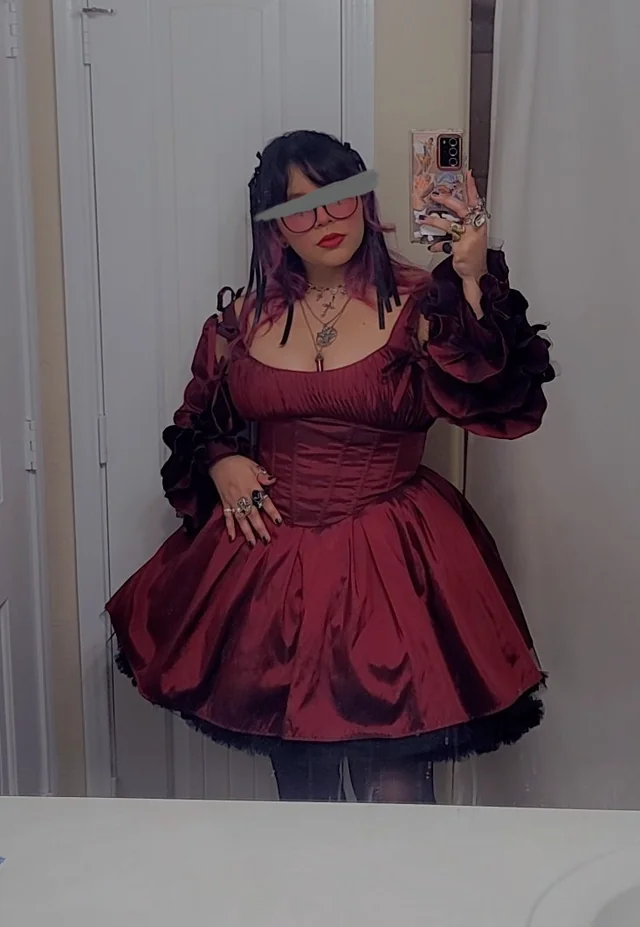
Gothic Lolita: Black with white lace accents; occasionally deep burgundy, navy, or forest green. The black must be optically dense (cotton or velveteen, not sheer or faded). Black-and-white Gothic coordinates require chromatic discipline: no warm tones, no pastels, no bright accents.
Sweet Lolita: Pink (the dominant hue, ranging from bubblegum to dusty rose), lavender, mint, powder blue, cream. White functions as a neutral. Sweet Lolita's chromatic regime is arguably the most restrictive: off-palette colors break coordinate coherence more visibly than in other substyles.
Classical Lolita: Muted tones — burgundy, forest green, old gold, ivory, chocolate brown, dusty rose. The palette references pre-Raphaelite and Edwardian source material. Saturated brights are excluded.
Decora: Maximum chromatic saturation. Rainbow coordination (achieving all spectrum colors simultaneously) or focused color-blocking (all-pink, all-blue coordinates) constitute the two primary strategies. Neon tones — highlighter yellow, electric pink, acid green — are preferred over pastel or muted variants.
Fairy Kei: Pastels exclusively — lavender, baby pink, powder blue, mint, cream, white. The palette's specificity distinguishes Fairy Kei from Sweet Lolita: Fairy Kei's pastels are lighter and more washed-out, evoking 1980s plastic toy coloring rather than confectionery.
Gyaru: Highly variable by sub-branch. Ganguro/Manba: white and metallics against tanned skin. Hime Gyaru: pink and white. Onee Gyaru: neutrals and earth tones. The common thread is high contrast against modified skin tone.
Visual Kei: Black and white as base, with red, purple, or metallic accents. Monochrome dominance ensures the face (the primary site of Visual Kei investment) remains the focal point.
Details
Details in Harajuku function as interface elements in a legibility system: each substyle's detail vocabulary communicates membership, expertise, and authenticity to other practitioners. The analytical task is not cataloguing ornaments but understanding how specific details function within their substyle's authentication infrastructure.
Lolita detail systems. (1) Closure engineering: Back-shirring (5–8 rows of shirring elastic concealed under a decorative panel) provides fit adjustment in JSKs (Jumperskirts — pinafore-style dresses) and OPs (One Pieces — sleeved dresses), enabling a single size to fit a range of measurements. This is a functional solution to Lolita brands' limited size runs (most pieces produced in one or two sizes) and the secondary-market economy where precise fit matching is impractical. Side-invisible-zippers are standard; front closures are decorative (non-functional buttons over a hidden zip or hooks). (2) Lace application: Lace placement follows rules: hem lace should be wider than bodice lace; lace should match in type and color within a coordinate; lace should be flat-applied (sewn at both edges) or gathered-applied (creating ruffled effect) consistently. Mixing application methods within a single garment reads as construction incompetence. (3) Bow hierarchy: Waist bows, headbows, and shoe bows must coordinate in ribbon width, material, and color. Oversized waist bows (15–25 cm width) are signature to brands like Angelic Pretty; more restrained bows signal Classical Lolita alignment. (4) Print coordination: In print-centric coordinates (dominant in Sweet Lolita), accessories must color-match to specific tones within the print — not the dominant color but the accent colors, demonstrating close reading of the print's palette [4][5][20].
Decora detail logic. Detail in Decora is governed by density and distribution rather than individual object quality. The standard coordinate includes: 50–100+ hair clips (arranged to create color gradients, patterns, or uniform density), 5–15 necklaces and pendants (layered by length to create cascade effect), 10–30 bracelets per arm (mixed materials: plastic beaded, fabric friendship-bracelet, rubber character-branded), pins and badges on bags and clothing (5–20 pieces). The curatorial challenge is maintaining visual coherence within extreme accumulation: expert Decora practitioners achieve controlled chaos through systematic color restriction (limiting the palette to 3–4 dominant hues despite 100+ individual accessories) or motif repetition (all-star theme, all-heart theme). The worst Decora mistake is randomness without system [6][21].
Gyaru detail systems. The highest-resolution details are applied to the face: circle lens diameter selection (14.0 mm for subtle enlargement, 14.5 mm for dramatic doll-eye effect), false-lash customization (cutting full strips to fit eye shape, stacking upper and lower lashes, applying lower lash segments individually with tweezers), eye-makeup geometry (drawing a larger eye shape below the natural lash line with brown or black pencil, then applying concealer to blend the false outline). This constitutes precision body-modification work requiring 45–90 minutes per application and a skill set transmitted through magazine tutorials (egg, Ageha, Popteen), video tutorials, and in-person gyaru-sa mentorship. The garment-level details — branded accessories, logo display, specific bag models — operate at a lower resolution than facial details [8][9].
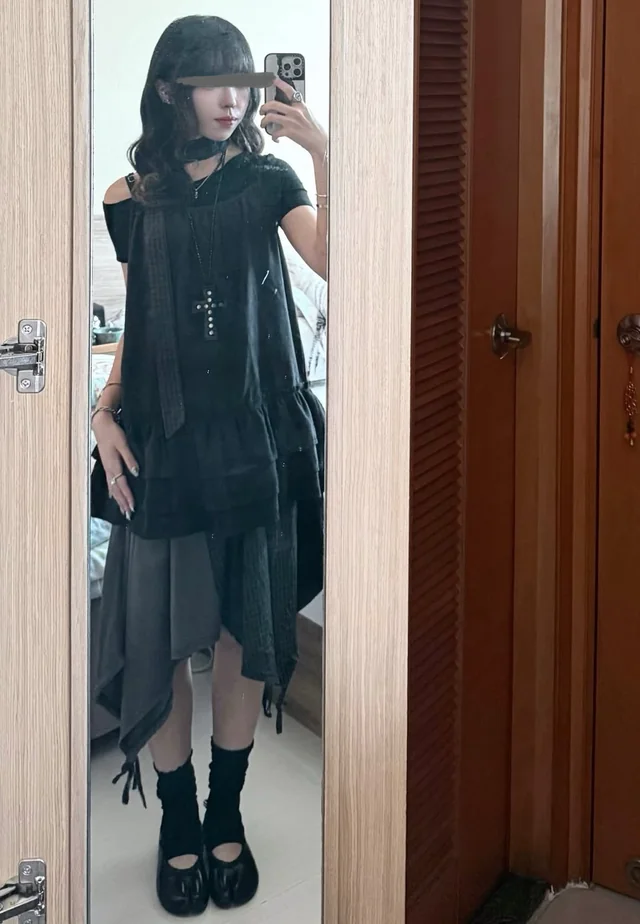
Visual Kei detail systems. Detail serves stage legibility: hardware (chains, buckles, safety pins, crosses) must be scaled to read from concert-venue distances. Asymmetry is structural — one sleeve long, one short; one leg covered, one exposed; makeup intensified on one side — creating visual interest at both intimate and performance distances. Lace-up closures (corset-style bodice lacing, boot lacing, sleeve lacing) provide adjustment for different performers' bodies while functioning as visual rhythm elements. The detail system is designed to be photographically dramatic: Visual Kei's material culture includes professional photoshoots (buromaido bromide photos sold at venues) where every detail must resolve at high magnification [10][11].
Accessories
Accessories in Harajuku are not supplementary but structurally constitutive — in several substyles, accessories ARE the aesthetic:
Lolita accessories as coordinate completion. A Lolita coordinate is considered incomplete without: headwear (bonnet, headdress, or headbow — the specific type signals formality level), legwear (OTK — over-the-knee socks, tights, or knee-highs — matching coordinate palette), footwear (tea-party shoes — low-heeled Mary Janes or pumps with rounded toes, or platform boots for Gothic substyle), bag (matching or coordinating with the print/colorway), and often a parasol (functional UV protection and aesthetic completion for outdoor wear). Each accessory category has its own brand hierarchy: Angelic Pretty accessories coordinate with their dress prints; RHS (rocking-horse shoes, Vivienne Westwood's design adopted into Lolita) carry specific subcultural prestige [4][5].
Decora accessories as primary medium. In Decora, the garment is substrate and accessories are content. The hair-clip collection is the primary investment: practitioners accumulate hundreds of clips over months and years, trading, gifting, and sourcing from specialty retailers, gashapon (capsule toy) machines, and online auctions. The weight of a full Decora accessory load (hair clips, necklaces, bracelets, bag charms) ranges from 2–4 kg, creating ergonomic considerations: neck strain from clip weight, wrist fatigue from bracelet mass, bag-strap shoulder pressure from charm accumulation [6][21].
Gyaru accessory investment. The highest-cost accessories are body modifications: monthly circle-lens replacement (¥1,500–4,000 per pair, with prescription variance), false-lash supply (¥500–2,000 per pair, consumed at rate of 1–3 pairs per week depending on reuse), hair-extension maintenance (salon rebonding every 4–8 weeks at ¥8,000–30,000). Platform footwear (boots, sandals) in Gyaru ranges from 10–18 cm sole height, with brands like Yosuke, Buffalo, and Demonia producing the structural platforms that define the silhouette [8][9].
Body Logic
Harajuku styling treats the body as a construction site — not in the sense of modification toward a single ideal but as a substrate for divergent aesthetic engineering projects, each substyle proposing a different relationship between body and presentation:
Lolita's modest enclosure. The Lolita silhouette deliberately minimizes body legibility: the petticoat obscures hip and thigh shape; the fitted bodice provides structure without revealing contour; high necklines and long sleeves (or at minimum puffed sleeves covering the upper arm) prevent skin exposure. This is not prudishness but constructive displacement: sexual legibility is redirected into fabric, detail, and accessory — the dressed surface becomes the aesthetic object, not the body beneath. The implications for size inclusivity are complex: Japanese Lolita brands historically produced for a narrow size range (bust 80–90 cm, waist 60–70 cm), with shirring as the primary accommodation technology. The Western Lolita community's demand for expanded sizing has produced ongoing tension between brand production practices and global-market expectations [4][5][22].
Gyaru's amplified legibility. Gyaru inverts Lolita's concealment: the body is maximally modified and displayed. Tanning, hair lightening, eye enlargement, and leg elongation (through platforms and mini-skirt proportions) constitute a deliberate rejection of the Japanese beauty standard (bihaku — beautiful whiteness) that prizes pale skin, dark hair, and understated presentation. Miller [23] and Marx [24] read Gyaru as simultaneously resistant (rejecting dominant beauty norms) and compliant (substituting one demanding beauty standard for another), a dialectic that structures the substyle's political complexity.
Visual Kei's gender destabilization. Visual Kei's androgynous presentation — male musicians in full makeup, feminine silhouettes, and deliberately ambiguous gender signaling — constitutes what Monden [25] identifies as a specifically Japanese negotiation of gender performance distinct from Western androgyny traditions. The body is treated as raw material for character construction, with the "real" body (unmodified, off-stage) carrying no aesthetic value.
Garment Logic
Lolita construction systems. Lolita garment construction achieves its precision through: (1) Pattern geometry — princess-seam bodice construction (4–6 panels) creates fitted torso without darts; gathered or pleated skirt attachment at natural waist distributes fabric volume evenly around the circumference; sleeve heads are set with slight gathering to create the puffed-sleeve effect. (2) Seam finishing — premium brands (Baby, Angelic Pretty, Innocent World) employ French seams or overlocked seams with concealed raw edges; budget brands and Chinese manufacturers often leave serged-only seam finishes visible on the interior, a key authentication marker when examining secondhand pieces. (3) Closure systems — back-zip with hook-and-eye waistband closure is standard for skirts; back-shirring with concealed zip for JSKs; front-button with functional buttonholes is rare and signals higher construction quality. (4) Lining — fully lined bodices and partially lined skirts (lining to mid-thigh) are standard for premium brands; unlined construction signals budget production [4][20].
Aftercare and maintenance. Lolita garments require specific maintenance protocols that constitute a significant participation cost:
- Washing: Cotton broadcloth prints should be cold-washed (30°C maximum), turned inside out to protect print surface. Machine washing on gentle cycle is acceptable for cotton; hand-washing recommended for velveteen, chiffon overlays, and lace-heavy pieces. Print-color bleed is a risk with saturated colorways — first washes should be solo to test colorfastness.
- Pressing: Cotton pieces require pressing after washing to maintain the crisp construction that defines the Lolita aesthetic. Velveteen must be steamed, not pressed, to avoid nap crushing. Chiffon requires low-heat steaming.
- Petticoat maintenance: Tulle petticoats lose volume over time through fiber relaxation and crushing during storage/transport. Recovery methods: machine-drying on low heat with tennis balls to refluff; steaming to reshape individual tiers; starch application (light) to restore stiffness. A petticoat's functional lifespan is 2–5 years of regular use before volume loss becomes unrecoverable.
- Storage: Garments should be hung (bodice pieces) or folded with acid-free tissue (print skirts, to prevent crease-set in cotton broadcloth). Petticoats should be hung upside-down to maintain tier separation.
Failure modes and longevity:
- Print fading: Screen-printed cotton broadcloth prints fade through UV exposure and washing — colors shift toward pastels over 20–50 wash cycles. This devalues pieces on the secondary market where print vibrancy is a pricing factor.
- Lace deterioration: Cotton lace yellows through oxidation and exposure to body oils; polyester lace resists yellowing but develops stiffness through repeated pressing. Torn lace is irreparable without visible evidence of mending.
- Shirring elastic failure: The elastic threads in back-shirring degrade over 3–7 years, losing recovery force and resulting in a permanently stretched-out panel. This is the most common catastrophic failure in Lolita JSKs and often renders otherwise intact garments unwearable without re-shirring (a labor-intensive repair).
- Zipper failure: Invisible side-zippers — standard in Lolita skirts — are vulnerable to fabric catching and tooth misalignment. Replacement requires seam-ripping and re-setting, a repair beyond most wearers' skill level.
- Cotton broadcloth structural fatigue: At high-stress points (underarm seams, waistband gathers), cotton fibers break after 100–200 wears, producing thinning and eventual holes. This is the end-of-life indicator for daily-wear Lolita pieces [4][20].
Decora garment logic. Garment construction is subordinate to the accessory system. Base garments are selected for: (1) flat, smooth surfaces that accept pinned accessories without puckering; (2) color appropriate to the coordinate's palette; (3) structural integrity to bear the weight of multiple pinned items (thin jersey T-shirts develop pin-hole damage and sagging over 3–6 months of heavy Decora use). The true "garment logic" of Decora lies in the accessory infrastructure: clip organization (dedicated storage systems to prevent tangling), necklace layering sequence (shortest to longest, heaviest to front), and bracelet stacking order [6].
Visual Kei garment logic. Construction prioritizes: (1) Stage durability — seams must withstand performance movement (high kicks, headbanging, theatrical gestures); bar-tacked stress points are essential. (2) Quick-change capability — layered coordinates that can be partially removed between songs or encore sets; Velcro closures concealed under decorative panels. (3) Photographic detail — construction details (visible stitching, decorative seaming, lace-up closures) must resolve cleanly in promotional photography. PU leather's short lifespan (2–5 years before hydrolysis cracking) means Visual Kei costumes are often replaced rather than repaired — a cost absorbed into the music career's production budget [10][11].
Motifs / Themes
- Kawaii as refusal: Cuteness not as passive femininity but as active rejection of adult social obligation — Kinsella's [22] foundational argument that kawaii culture represents resistance to Japan's demanding corporate maturity timeline.
- Victorian and Rococo revival: Lolita's historicism is not period accuracy but selective citation — extracting silhouette, lace vocabulary, and modesty codes while discarding historical gender politics.
- 1980s nostalgia as material practice: Fairy Kei's relationship to the 1980s is mediated through objects (vintage toys, garments, graphics) rather than memory — most practitioners were born after the period they reference.
- Character culture: Sanrio, San-X, anime, and manga characters function as both decorative motifs and community identity markers (My Melody for Sweet Lolita, Kuromi for Gothic-inflected styles).
- Fashion as performance: Across substyles, dressing is understood as conscious construction — the "natural" look is the one aesthetic universally excluded from Harajuku participation.
Cultural Touchstones
FRUiTS magazine (1997–2017). Shoichi Aoki's street-snap publication is the single most important archival document of Harajuku's physical-era ecology. Each photograph recorded wearer name, age, occupation, and complete outfit breakdown (brand, source, modification). The cumulative archive — approximately 5,000 documented individuals over 20 years — constitutes an empirical dataset of unprecedented density for any fashion subculture. Phaidon's published collections [1] preserved a fraction of this archive; the full run remains partially digitized through fan archives and resale markets. Aoki's cessation of publication in 2017, citing insufficient interesting subjects on Harajuku streets, is widely interpreted as marking the ecology's physical-era endpoint [2].
Gothic & Lolita Bible (2001–2017). The premier Lolita-specific publication, providing brand lookbooks, sewing patterns (which enabled non-Japanese participation by making construction knowledge transmissible), make-up tutorials, and scene documentation. Its pattern inserts were especially significant: they encoded the construction logic of Lolita garments — seam allowances, dart placement, gathering ratios — in reproducible form, enabling a global community to produce garments conforming to Japanese brand standards [17].
Gwen Stefani's "Harajuku Girls" (2004–2006). The most extensively debated instance of Harajuku's international adoption. Stefani hired four Japanese-American dancers (Love, Angel, Music, Baby) styled as living Harajuku dolls who appeared in music videos, red-carpet events, and the Harajuku Lovers fragrance line. The project sparked controversy, with commentators including Margaret Cho questioning the dynamic of Western celebrity borrowing from Japanese aesthetic traditions. The episode remains a foundational case study in cross-cultural exchange within fashion [3][18].
Kyary Pamyu Pamyu's "PONPONPON" (2011). Produced by Yasutaka Nakata (Capsule, Perfume), directed by Jun Murakami, the music video synthesized Decora, Fairy Kei, and kawaii-pop aesthetics into a viral package achieving 200M+ YouTube views. The video's international circulation introduced global audiences to Harajuku aesthetics already in physical decline, creating a temporal paradox: Harajuku gained its widest global audience precisely as its street-level ecology was dispersing [26].
See Also
- Kawaii culture: Broader cultural context for Harajuku's cute aesthetics
- Visual Kei: Music-driven substyle with independent institutional history
- Cosplay: Overlapping material culture (construction skills, character reference) but distinct social logics (cosplay reproduces existing characters; Harajuku constructs original coordinates)
- Lolita fashion: Functions as a standalone global subculture beyond Harajuku geography
- Gyaru subcultures: Independently documented substyle with distinct history
- J-pop idol fashion: Celebrity influence vector feeding into and from Harajuku aesthetics
- Decora: Standalone accessory-driven aesthetic with specific material culture
- Fairy Kei: Nostalgia-driven substyle with distinct vintage-sourcing economy
Brands and Designers
Lolita (premium tier):
- Baby, The Stars Shine Bright — Founded 1988, Isobe Akinori and Fumiyo; Paris boutique 2007; the most internationally recognized Lolita brand
- Angelic Pretty — Founded 2001; dominant Sweet Lolita brand; renowned for original-print design
- Moi-même-Moitié — Founded 1999 by Mana (Malice Mizer); defined Gothic Lolita codification
- Innocent World — Founded 1998; Classical Lolita specialist; known for conservative silhouettes and floral prints
- Victorian Maiden — Classical Lolita with emphasis on historical textile references
- Metamorphose temps de fille — Founded 1997; wide size range (unusual in Lolita industry); versatile aesthetic range
- Juliette et Justine — Art-print specialist; collaborations with fine artists for textile prints
- Mary Magdalene — Founded 2002; Classical Lolita with Renaissance references; ceased production ~2017
Lolita (accessible tier):
- Bodyline — Mass-market Lolita at budget price points; controversial in community (accessible but criticized for construction quality)
- Fanplusfriend — Custom-sizing Lolita production; bridges size-accessibility gap
Decora / Kawaii:
- 6%DOKIDOKI — Sebastian Masuda, founded 1995; Harajuku flagship; defined Decora retail vocabulary
- ACDC RAG — Colorful Harajuku streetwear crossing Decora and pop aesthetics
- Spinns — Youth-oriented Harajuku retail with rotating aesthetic alignments
- WEGO — Fast-fashion Harajuku retail; gateway brand for entry-level participants
Gyaru:
- Liz Lisa — Hime Gyaru canonical brand; polyester jacquard and lace construction; ane-kei (big-sister style)
- MA*RS — Gyaru brand with Y2K revival elements
- COCOLULU — Shibuya 109 Gyaru staple
- EmiriaWiz — Evolved Gyaru toward luxury positioning
- DaTuRa — Gothic-gyaru hybrid
Visual Kei / Punk-influenced:
- h.NAOTO — Founded 1998; punk-Gothic hybrid; multiple sub-lines (h.NAOTO Blood, Frill, Steam)
- SEX POT ReVeNGe — Punk-Visual Kei retail; studded and graphic-heavy construction
- Putumayo — Gothic-cute hybrid positioned between Lolita and Visual Kei markets
- ALICE and the PIRATES — Baby, The Stars Shine Bright sub-line; pirate-Gothic Lolita
Retail infrastructure:
- LaForet Harajuku — Multi-floor fashion building housing brand boutiques; physical epicenter of Harajuku retail
- Closet Child — Secondhand Lolita and Visual Kei retail; critical secondary-market infrastructure
- Wunderwelt — Online secondhand Lolita retail serving international market
- Lace Market — Western secondhand Lolita marketplace (peer-to-peer)
Citations
[1] Aoki, Shoichi. FRUiTS. Phaidon Press, 2001. [2] Aoki, Shoichi. Fresh Fruits. Phaidon Press, 2005. See also: Dazed interview on FRUiTS cessation, 2017. [3] Kowner, Rotem, and Walter Demel, eds. Race and Racism in Modern East Asia. Brill, 2013. On Stefani: Cho, Margaret. "Harajuku Girls." margaretcho.com blog, 2005; hooks, bell. "Eating the Other: Desire and Resistance." Black Looks: Race and Representation, South End Press, 1992. [4] Younker, Theresa. "Japanese Lolita: Challenging Sexualized Style and the Little-Girl Look." Fresh Fruits, 2011. See also: EGL LiveJournal community archives (2001–2012). [5] Winge, Theresa. "Undressing and Dressing Loli: A Search for the Identity of the Japanese Lolita." Mechademia, vol. 3, 2008, pp. 47–63. [6] Masuda, Sebastian. 6%DOKIDOKI: A Decade of Sensational Kawaii. 2005. See also: Yomota, Inuhiko. Kawaii-ron [On Kawaii]. Chikuma Shobō, 2006. [7] Regalado, Marisa. "Fairy Kei and the Politics of 1980s Nostalgia." Fashion, Style & Popular Culture, vol. 3, no. 2, 2016, pp. 195–212. [8] Miller, Laura. "Those Naughty Teenage Girls: Japanese Kogals, Slang, and Media Assessments." Journal of Linguistic Anthropology, vol. 14, no. 2, 2004, pp. 225–247. [9] Marx, W. David. Ametora: How Japan Saved American Style. Basic Books, 2015. On Gyaru retail cycles and Shibuya 109 economics. [10] McLeod, Ken. "Visual Kei: Hybridity and Gender in Japanese Popular Culture." Young, vol. 21, no. 4, 2013, pp. 309–325. [11] Seibt, Oliver. "The Subculture that Never Was: Visual Kei and Its Contested Status." Made in Japan: Studies in Popular Music, Routledge, 2014, pp. 121–134. [12] Godoy-Anativia, Marcial, and Toby Miller, eds. "Platform Aesthetics and Cultural Transmission." Cultural Studies, vol. 35, no. 4-5, 2021. [13] Zukin, Sharon, and Max Papadantonakis. "Hackathon as Co-optation Ritual: Socializing Workers and Institutionalizing Innovation in the 'New' Economy." Research in the Sociology of Work, vol. 29, 2017. Applied to platform-mediated subcultural gatekeeping. [14] Richie, Donald. The Image Factory: Fads and Fashions in Japan. Reaktion Books, 2003. On Harajuku's postwar development and Washington Heights cultural contact. [15] Narumi, Hiroshi. "Street Style and Its Meaning in Postwar Japan." Fashion Theory, vol. 14, no. 4, 2010, pp. 415–437. [16] Steele, Valerie, et al. Japan Fashion Now. Yale University Press, 2010. [17] Gothic & Lolita Bible (Graphic-sha/Index Communications), 2001–2017. Magazine series with sewing patterns, brand features, and scene documentation. [18] hooks, bell. "Eating the Other: Desire and Resistance." Black Looks: Race and Representation, South End Press, 1992. Foundational framework for cross-cultural aesthetic reception. [19] Kawamura, Yuniya. Sneakers: Fashion, Gender, and Subculture. Bloomsbury, 2016. On subcultural dispersal through digital mediation. [20] Lolita Handbook community resource (compiled construction standards from EGL, Closet of Frills, and Gothic & Lolita Bible pattern archives). See also: Birdcage, "Sewing Lolita: A Beginner's Guide to Construction Standards," EGL Community, 2008. [21] Yomota, Inuhiko. Kawaii-ron [On Kawaii]. Chikuma Shobō, 2006. [22] Kinsella, Sharon. "Cuties in Japan." Women, Media, and Consumption in Japan, edited by Lise Skov and Brian Moeran, Curzon Press, 1995, pp. 220–254. [23] Miller, Laura. Beauty Up: Exploring Contemporary Japanese Body Aesthetics. University of California Press, 2006. [24] Marx, W. David. Ametora: How Japan Saved American Style. Basic Books, 2015. [25] Monden, Masafumi. Japanese Fashion Cultures: Dress and Gender in Contemporary Japan. Bloomsbury Academic, 2015. [26] Galbraith, Patrick W. "Kyary Pamyu Pamyu: Kawaii Ambassador, Global Commodity." Idols and Celebrity in Japanese Media Culture, Palgrave Macmillan, 2012, pp. 112–131. [27] Iwabuchi, Koichi. Recentering Globalization: Popular Culture and Japanese Transnationalism. Duke University Press, 2002. [28] McRobbie, Angela. "Fashion as a Culture Industry." Fashion Cultures Revisited, Routledge, 2013. On gendered labor invisibility in fashion participation. [29] Peirson-Smith, Anne. "The Unauthorized Reproduction: Chinese Lolita Fashion and Intellectual Property." East Asian Journal of Popular Culture, vol. 2, no. 1, 2016, pp. 23–42. [30] Winge, Theresa. "Undressing and Dressing Loli: A Search for the Identity of the Japanese Lolita." Mechademia, vol. 3, 2008, pp. 47–63. [31] Kawamura, Yuniya. "The Japanese Revolution in Paris Fashion." Fashion Theory, vol. 8, no. 2, 2004, pp. 195–224. [32] Kawamura, Yuniya. Fashion-ology: An Introduction to Fashion Studies. 2nd ed., Bloomsbury Academic, 2018. [33] Hebdige, Dick. Subculture: The Meaning of Style. Routledge, 1979. [34] Simmel, Georg. "Fashion" (1904). Reprinted in Simmel on Culture: Selected Writings, edited by David Frisby and Mike Featherstone, SAGE, 1997. [35] Breward, Christopher. Fashion. Oxford University Press, 2003.