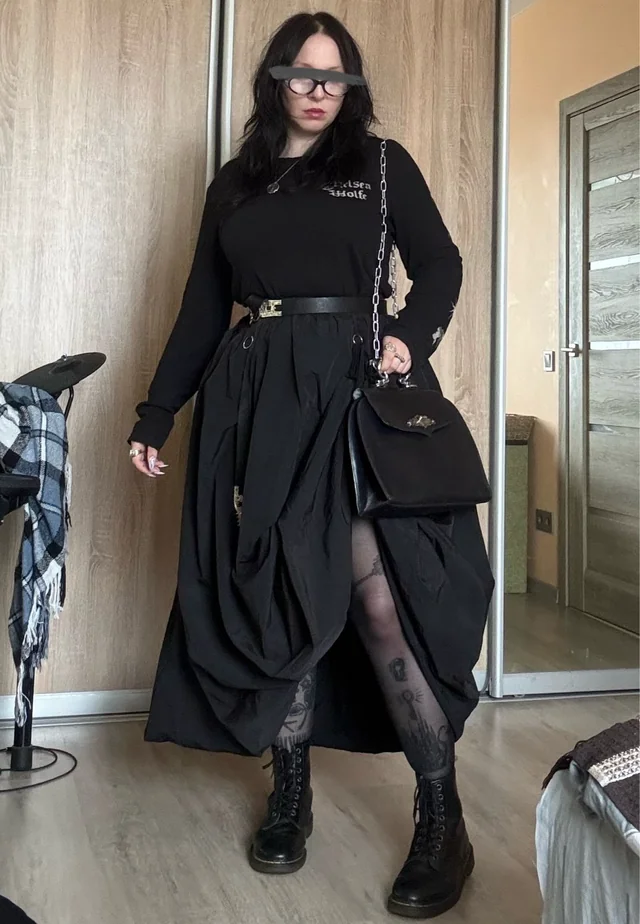
Goth
Summary. Goth is a dress system in which garments, cosmetics, hair manipulation, and hardware are integrated into a unified body-presentation regime organized around darkness, theatricality, and the aestheticization of mortality. The category originates in the UK post-punk music scene of the late 1970s and early 1980s, where bands, nightclubs, and audiences co-produced a visual language that fused Victorian mourning dress, punk bricolage, BDSM material vocabulary, and horror-cinema iconography into a coherent subcultural aesthetic. Goth is governed by a semiotic-inversion logic: materials, silhouettes, and body modifications that mainstream culture codes as morbid, transgressive, or theatrical are revalued as beautiful, meaningful, and communally binding.
In Material Terms
Goth's coherence depends on a specific textile palette — leather, velvet, lace, PVC, fishnet, and black-dyed cotton — deployed under the particular environmental conditions of nightclub use: sustained heat, humidity from body density, cigarette and fog-machine smoke (historically), alcohol exposure, and friction from close-quarters movement and dance. These conditions constitute a performance environment as demanding as any outdoor or athletic context, and goth garments are evaluated (within the subcultural community) by how they survive, age, and develop character under repeated nightclub exposure. A leather jacket that softens and molds to its wearer's body through years of goth-night attendance communicates subcultural commitment in ways that a new, stiff jacket cannot.
At Category Level
Goth occupies a contested boundary between subcultural authenticity and commercial extraction. High-authenticity implementations (DIY-customized garments, scene-veteran wardrobes, small-batch subcultural designers) are evaluated through embodied knowledge: correct material selection, competent construction or modification, and styling that demonstrates familiarity with goth's musical, visual, and literary references. Commercial implementations (Hot Topic's mass-market goth, Killstar's online goth retail, fast-fashion "Halloween goth") reproduce the visual grammar while stripping away the subcultural knowledge, musical foundation, and material specificity that distinguish scene participation from costume purchase. This stratification is central to goth discourse, because authenticity is judged not by darkness of palette alone but by the depth of subcultural engagement that the wardrobe evidences.
Methodologically
This entry treats goth as an integrated body-modification system: garments, cosmetics, hair, and hardware are analyzed as interdependent components of a unified presentation regime, evaluated by how they perform under subcultural use conditions and by how they encode community knowledge, musical literacy, and aesthetic commitment.
Word (Etymology)
"Goth" derives from "Gothic," a term with a complex migratory history across disciplines. In architecture, "Gothic" designates the pointed-arch, ribbed-vault, flying-buttress style of European medieval construction (12th–16th centuries), named retrospectively during the Renaissance as a pejorative associating the style with the "barbarous" Goths who had sacked Rome. In literature, "Gothic" designates the genre of supernatural horror and brooding atmosphere established by Horace Walpole's The Castle of Otranto (1764) and elaborated through Ann Radcliffe, Mary Shelley, Bram Stoker, and Edgar Allan Poe. In music, "Gothic" was applied to post-punk bands in the late 1970s: Martin Hannett described Joy Division's sound as "gothic" in 1979; Steve Abbott of UK Decay coined "punk gothique" in 1981; and by 1983, the NME had settled on "goth" to describe the scene coalescing around Bauhaus, Siouxsie and the Banshees, The Sisters of Mercy, and The Cure.
The fashion usage inherits all three genealogies simultaneously: architectural goth's verticality and structural ambition, literary goth's preoccupation with death, decay, and the supernatural, and musical goth's post-punk sonic palette of reverb-heavy guitars, deep male vocals, high female counterpoint, and drum-machine precision. This triple inheritance gives goth an unusually dense cultural-reference infrastructure that distinguishes it from purely fashion-derived aesthetics.
Within subcultural discourse, "goth" also operates as a gatekeeping term: its correct application requires demonstrating knowledge of the musical genealogy that produced the subculture. Fashion adoption that reproduces the visual grammar without musical literacy — wearing all black, silver jewelry, and dark makeup without knowing Bauhaus from Bela Lugosi — is coded within the scene as "cosplay" or "tourist," not goth. This evaluative criterion (musical knowledge as authentication) is unique among fashion-adjacent subcultures and structures the community's internal hierarchy.
Subculture
Goth crystallized as a subculture in specific venues at specific dates, and its community structure has been shaped by the physical and economic conditions of nightlife, independent music, and DIY cultural production.
Club culture as founding institution. The Batcave, opened in July 1982 by Olli Wisdom (vocalist of Specimen) and Jon Klein at the Gargoyle Club, 69 Dean Street, London's Soho, running every Wednesday night, is goth's acknowledged birthplace as a self-conscious subcultural scene. The venue featured live bands, 8mm horror-film screenings, mud-wrestling cabaret, and a dresscode-by-reputation that encouraged elaborate costume and presentation. The Batcave's significance was institutional: it provided a physical space where music, fashion, and social identity could co-produce each other in real time. You did not arrive at the Batcave pre-formed as a goth; you became goth through participation in its environment — learning dress codes by observation, absorbing musical knowledge through exposure, and developing styling competence through the iterative feedback of weekly attendance. Leeds' F Club, Berlin's SO36, and New York's Danceteria served parallel functions in other cities, each producing locally inflected variations on the goth-club template.
This club-based transmission model established goth's primary expertise economy: knowledge was earned through physical presence, scene longevity, and embodied participation rather than through purchase or media consumption. The hierarchy operated through visible evidence of commitment: the quality and elaboration of the outfit (indicating preparation time and skill), recognition of musical references (signaled through band t-shirts, patches, and conversation), and temporal accumulation of scene relationships (knowing people, having been present at significant events). This expertise economy persisted into the digital era but was progressively diluted as online platforms (Tumblr goth, Instagram goth, TikTok goth) enabled visual participation without club attendance or musical literacy.
Scene fragmentation and sub-style codification. By the late 1980s, goth had diversified into distinct sub-styles, each with its own material and musical signature:
- Traditional goth (trad goth): The original 1982–1986 template: post-punk DIY, backcombed hair, leather-fishnet-lace combination, Dr. Martens or winklepickers, heavy eyeliner, band t-shirts. Music: Bauhaus, Siouxsie, The Sisters of Mercy, Fields of the Nephilim.
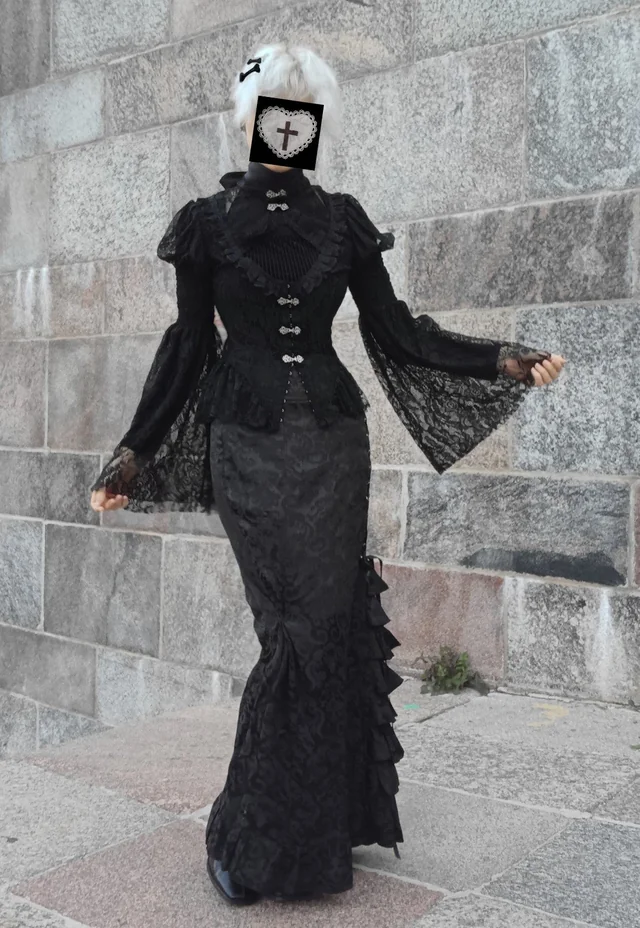
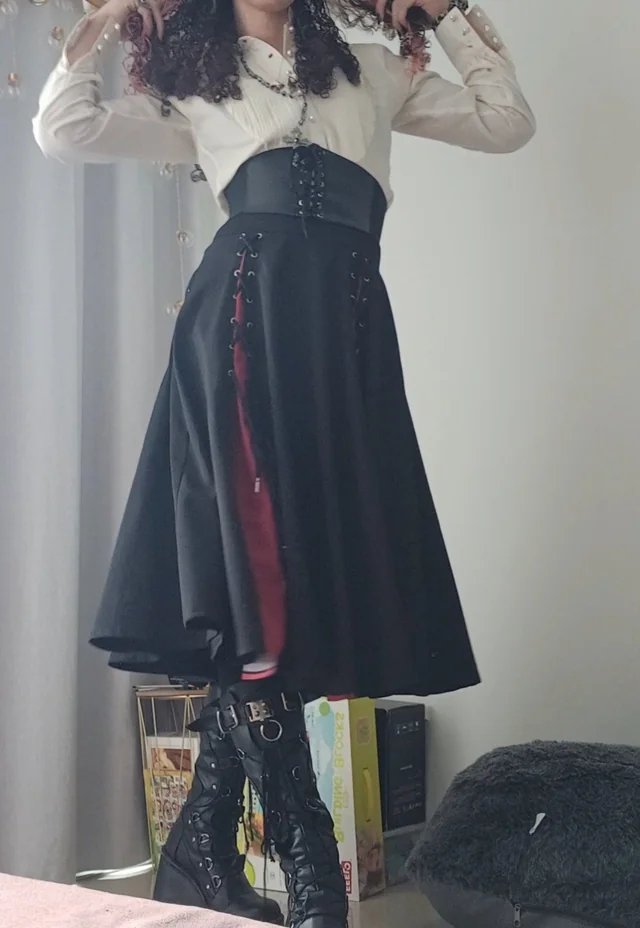
- Romantic goth / Victorian goth: Elaborated the Victorian mourning reference into corsetry, crinolines, top hats, velvet cloaks, ornate jewelry, and period-accurate (or period-referencing) garments. Music: Dead Can Dance, Sopor Aeternus, Clan of Xymox.
- Deathrock: The American West Coast parallel to UK goth, more explicitly punk-influenced: ripped fabrics, safety pins, mohawks dyed black, horror-punk aesthetics, DIY over refinement. Music: Christian Death, 45 Grave, Kommunity FK.
- Cybergoth: Late 1990s–2000s fusion of goth and rave/industrial culture: neon-colored synthetic dreadfall hair extensions, UV-reactive clothing, gas masks, goggles, massive platform boots (New Rock, Demonia Stack), PVC and vinyl dominant. Music: VNV Nation, Combichrist, Covenant.
- Mall goth / Hot Topic goth: 2000s mass-market goth: Tripp NYC wide-leg pants with chain attachments, band t-shirts (My Chemical Romance, Evanescence, Marilyn Manson), chunky wallet chains, studded belts. The commercial gateway that introduced millions to goth's visual language while severing it from its musical and subcultural foundations.
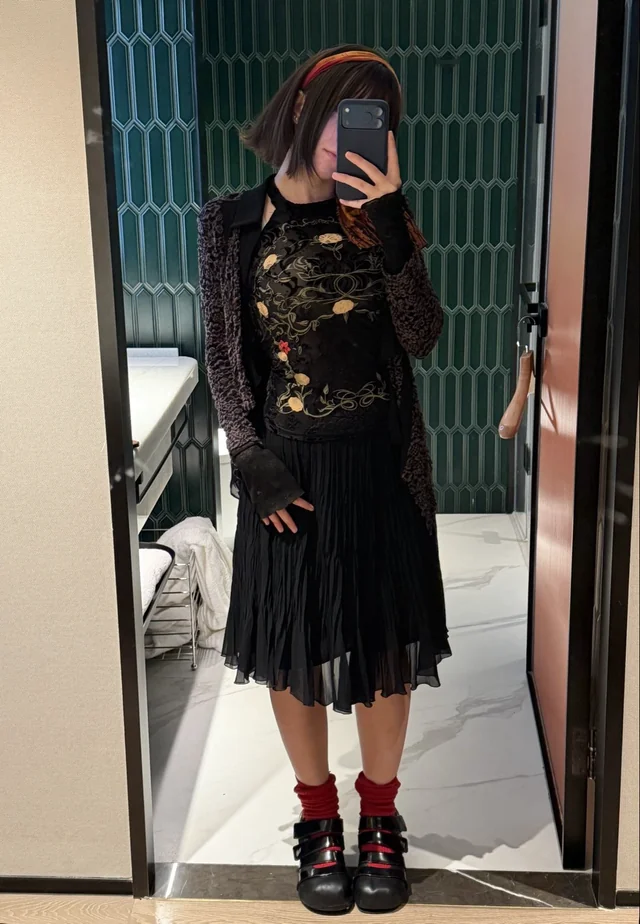
- Nu-goth / pastel goth: 2010s Tumblr-era reinterpretation: mixing goth motifs (occult symbols, witchcraft references, black palettes) with soft pastels, kawaii influences, and platform sneakers. Explicitly post-subcultural — defining goth through aesthetic preference rather than musical community.
Each sub-style carries its own authentication hierarchy. Within trad-goth communities, musical knowledge is the primary credential. Within romantic goth, historical accuracy and construction skill determine status. Within cybergoth, the elaboration and engineering of custom hair pieces and platform-boot modifications confer expertise. These fragmented hierarchies coexist in tension, with each sub-style periodically contesting the others' legitimacy.
Festival and event culture. Whitby Gothic Weekend (founded 1994, held biannually in Whitby, North Yorkshire — chosen for its connection to Bram Stoker's Dracula, partially set there), Wave-Gotik-Treffen (founded 1992, Leipzig, Germany, the world's largest goth festival, attracting 20,000+ attendees), and M'era Luna (Hildesheim, Germany) function as periodic reunification events where the subculture's fragmented communities reconvene, and where the expertise economy is most visibly on display. These festivals are the goth subculture's equivalent of trade shows: they demonstrate current styling standards, transmit knowledge across geographic scenes, and reinforce the community's shared identity through concentrated physical co-presence.
History
Goth's history begins in post-punk music and the specific economic and cultural conditions of late-1970s Britain. Each phase produced material innovations, subcultural infrastructure, and commercial dynamics that shaped the aesthetic's development.
Post-punk substrate and pre-goth darkness (1977–1981). The visual language that would become goth emerged from post-punk's darker edge: Joy Division's austere presentation (grey, black, minimal stage set, Peter Saville's typography-driven sleeve design), Siouxsie Sioux's Egyptian-punk makeup and bondage-influenced styling, Bauhaus's theatrical performance (Peter Murphy's skeletal physicality, the "Bela Lugosi's Dead" single as founding text, 1979). These acts operated within the broader post-punk economy of independent labels (4AD, Factory, Beggars Banquet), small-venue touring, and fanzine-distributed discourse. The visual aesthetic was not yet codified as "goth" but was assembling its components: black as default color, androgynous presentation, literary and horror-cinema reference, and DIY construction from charity-shop and surplus sources.
The economic context was critical: Britain's late-1970s recession made new clothing economically inaccessible for many young people, driving the charity-shop, surplus-store, and DIY-customization practices that became goth's founding material logic. Necessity produced the aesthetic's characteristic bricolage: Victorian mourning pieces from charity shops, military surplus boots, safety pins and hardware from ironmongers, hair dye and makeup applied with experimental techniques developed through peer learning rather than professional instruction.
Batcave era and subcultural crystallization (1982–1986). The Batcave's July 1982 opening formalized what had been a diffuse post-punk darkness into a self-conscious scene with named identity, dress expectations, and community infrastructure. Bands that defined the first wave — Bauhaus, Siouxsie and the Banshees, The Sisters of Mercy, The Cure (Robert Smith's lipstick-and-smeared-eyeliner presentation), Fields of the Nephilim (flour-dusted Western-gothic presentation), The Mission, Alien Sex Fiend — each contributed visual elements that the audience adopted, modified, and recombined.
Goth's material economy in this period was characterized by scarcity and ingenuity. Purpose-made goth clothing barely existed; participants assembled wardrobes from: charity-shop finds (Victorian blouses, mourning jewelry, faded velvet), army surplus (boots, greatcoats), punk retail (Seditionaries/World's End, Camden market stalls), fetish retailers (leather, PVC, fishnet from sex shops and early fetish boutiques), and extensive DIY modification (dyeing, distressing, adding hardware, hand-sewing lace and trim). This material scarcity was culturally productive: it ensured that every outfit required creative labor, making the wardrobe itself evidence of subcultural investment.
Commercial expansion and subcultural tension (1987–2000). As goth's visual impact registered in mainstream culture (aided by music-video exposure on MTV, cinematic representations, and Tim Burton's gothic-inflected filmography), commercial demand produced dedicated goth retail: Retroscope, Gallery Serpentine, and later Lip Service, Tripp NYC, and Cyberdog provided purpose-made goth garments. This commercial development simultaneously serviced and threatened the subculture: ready-to-wear goth eliminated the creative labor that DIY assembly required, making the aesthetic purchasable rather than constructed.
The 1990s industrial-goth crossover (Nine Inch Nails, Ministry, KMFDM) introduced harder, more militant aesthetics: riveted leather, combat-industrial silhouettes, and machine-derived hardware. Cybergoth emerged in the late 1990s as a fusion of goth, rave, and industrial cultures, introducing synthetic materials (PVC, vinyl, UV-reactive fabrics) and electronic-music references that traditionalists contested as departures from goth's post-punk foundations.
Mall-goth commodification and runway absorption (2000–2010). Hot Topic (founded 1989, Montclair, California; expanded to 600+ U.S. mall locations by the mid-2000s) sold band t-shirts, studded accessories, black nail polish, and pre-made "alternative" clothing to millions of American teenagers, creating a mass-market goth entry point that the existing scene regarded with ambivalence. Mall goth was coded within the subculture as inauthentic — "kids who think goth is buying a Marilyn Manson shirt at the mall" — but it also introduced an entire generation to goth's visual vocabulary, some of whom subsequently deepened their engagement with the subculture's musical and historical foundations.
Simultaneously, high fashion absorbed goth's visual language. Alexander McQueen's runway presentations (particularly "The Hunger," Spring/Summer 1996; "Dante," Autumn/Winter 1996; and the hologram of Kate Moss in "Widows of Culloden," Autumn/Winter 2006) translated goth's preoccupation with death, the macabre, and romantic darkness into couture spectacle. Rick Owens developed "glunge" (goth + grunge) as an aesthetic vocabulary: draped, monochrome, architecturally distorted silhouettes that borrowed goth's tonal palette while replacing its subcultural specificity with high-fashion abstraction. Ann Demeulemeester's lyrical noir and Yohji Yamamoto's black-palette draping contributed additional fashion-goth registers. The FIT exhibition Gothic: Dark Glamour (2008), curated by Valerie Steele, positioned goth as cultural heritage worthy of institutional study.
Platform revival and post-subcultural goth (2010–present). Tumblr's visual-curation model (2010–2018) generated "pastel goth" and "nu-goth" — post-subcultural aesthetics that mixed goth motifs with kawaii, witchcraft, and meme culture. TikTok's short-form video format (2020s) produced "goth transformation" content where users documented the process of constructing goth presentation, inadvertently restoring visibility to the preparation labor that is central to the aesthetic but invisible in still-image platforms. The Netflix series Wednesday (2022, Jenna Ortega as Wednesday Addams) triggered a mainstream goth-adjacent fashion cycle, with fast-fashion retailers producing black-palette collections tagged as "gothic" — the latest iteration of the recurring commercial-extraction pattern that has accompanied goth since the 1990s.
Throughout, dedicated scene infrastructure has survived: goth nights continue in cities worldwide, Whitby Gothic Weekend and Wave-Gotik-Treffen maintain annual attendance, independent goth labels (Cleopatra Records, Projekt Records) continue to release music, and online communities (Reddit's r/goth, maintained with strict music-centric moderation) preserve the subculture's evaluative framework against platform-era dilution.
Silhouette
Goth silhouette is governed by a theatrical-verticality logic that combines Victorian structural engineering, punk destruction, and BDSM material vocabulary into a body-presentation system designed to be read in the specific environmental conditions of nightclub lighting, stage proximity, and subcultural display.
Verticality and elongation. The goth silhouette consistently emphasizes vertical proportion: tall hair (backcombed, teased, or styled into towering structures that add 10–30cm to apparent height), long skirts or coats (floor-length or ankle-length, creating unbroken vertical lines), and platform or heeled footwear (adding 5–15cm to height). This verticality serves both practical and semiotic functions: in crowded nightclub environments, height increases visibility and visual impact; semiotically, elongation references both cathedral architecture (the Gothic pointed arch that draws the eye upward) and funerary aesthetics (the tall, narrow forms of gravestones and memorial columns). Platform boots — Demonia's Camel series (knee-high, 5-inch platform), New Rock's Reactor (buckled, heavy, 3-inch platform), and various custom and vintage platforms — are engineering solutions to the verticality problem: they add height without the balance instability of thin heels, permitting sustained standing and movement on nightclub dance floors.
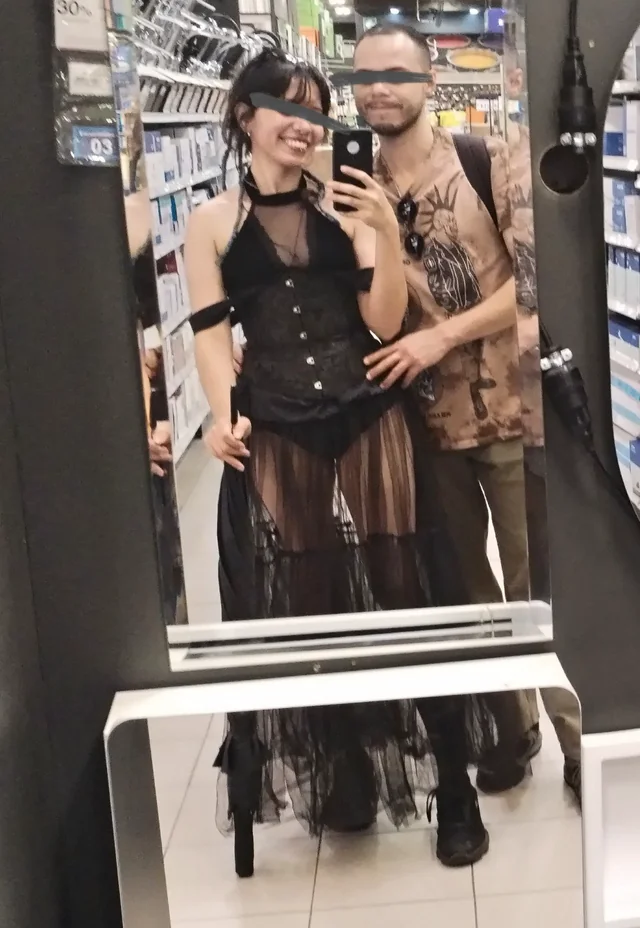
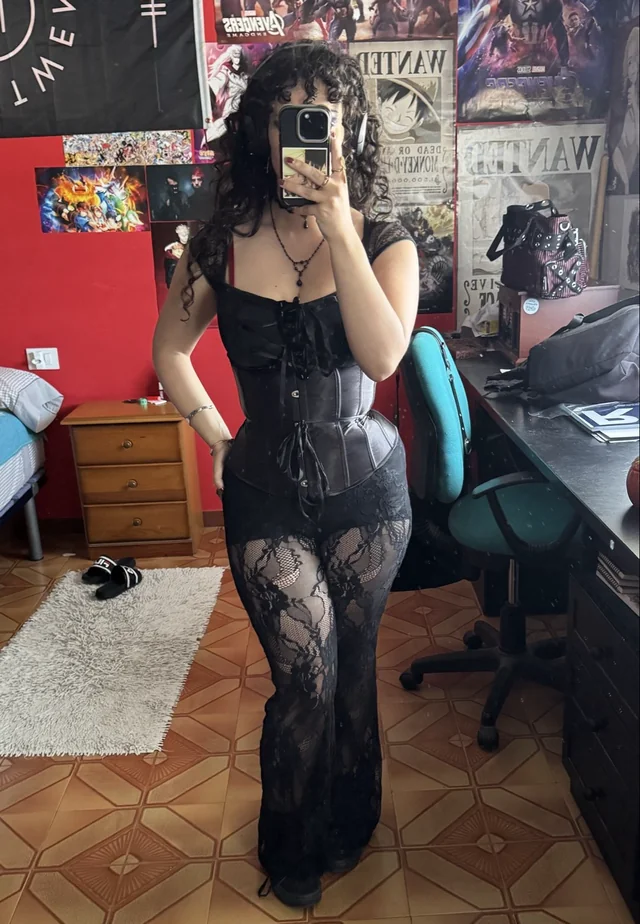
Corsetry and torso engineering. The corset is romantic goth's defining structural garment. Functional corsets (as opposed to decorative corset-styled tops) use steel boning (spiral steel for flexibility, flat steel for rigidity at the center front and center back), multi-panel construction (typically 6–12 panels to create compound curves), and heavy-duty closure systems (steel busk at the center front for ease of entry/exit, grommeted lacing at the center back for waist reduction). A properly fitted steel-boned corset reduces the natural waist by 2–6 inches, redistributing the body's soft tissue upward (bust) and downward (hips) to create the hourglass silhouette that romantic goth quotes from Victorian fashion. The corset's functional engineering is the goth silhouette's closest equivalent to techwear's membrane architecture: two visually similar garments (a steel-boned corset versus a decorative corset-styled top with plastic boning) diverge radically in structural behavior, comfort under sustained wear, and capacity to produce the intended silhouette modification.
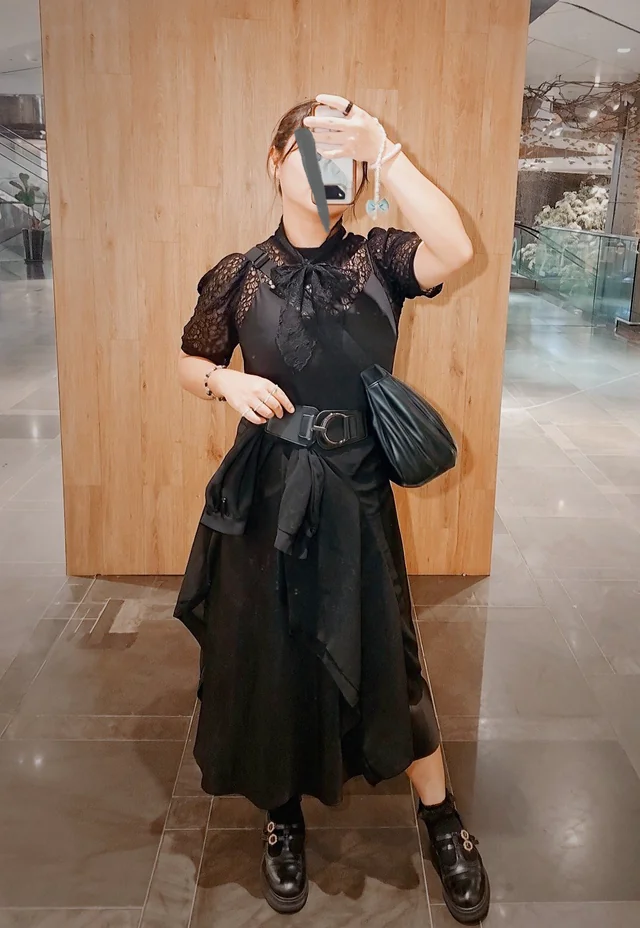
Layering and texture depth. Goth layering creates visual depth through material contrast rather than thermal management: a lace overlay on velvet, fishnet beneath leather, sheer fabric revealing and concealing the body simultaneously. This transparency-opacity play is structural to goth's body logic — the body is neither fully revealed nor fully concealed but exists in a state of partial disclosure that references both Victorian modesty and BDSM display. The layering produces visual complexity under the low lighting and colored-gel illumination of nightclub environments, where flat, single-layer garments lose visual interest while textured, multi-layer compositions gain it.
Sub-style silhouette variations. Trad goth favors punk-derived proportions (leather jacket, band tee, tight or ripped trousers, boots) modified through goth-specific accessories and styling. Romantic goth favors Victorian-derived proportions (corset, full skirt, cape or cloak, period-referencing accessories). Cybergoth favors architectural-industrial proportions (massive platform boots, structured PVC garments, oversized synthetic hair extensions that function as a wearable sculpture). Each sub-style's silhouette corresponds to its musical and cultural reference: trad goth quotes punk-to-post-punk, romantic goth quotes the literary Gothic, cybergoth quotes industrial and electronic-music aesthetics.
Materials
Material selection in goth operates under environmental conditions that distinguish it from most fashion categories: nightclub heat (ambient temperatures of 25–35°C from body density and restricted ventilation), humidity (from perspiration in enclosed spaces), smoke exposure (historically from cigarettes, currently from fog machines), alcohol contact, and sustained physical activity (dancing, standing for extended periods). Goth materials are evaluated, within the subcultural community, by how they perform, age, and develop character under these specific conditions.
Leather. Goth's primary prestige textile: motorcycle jackets (Schott Perfecto, Lewis Leathers, or vintage and second-hand equivalents), trousers, corset panels, harnesses, cuffs, and chokers use cow, sheep, or goat leather in various tannages. Full-grain vegetable-tanned leather develops the richest patina through nightclub use: body oils, sweat absorption, and mechanical flexion produce personalized softening and darkening that records the wearer's physical history in the material. Chrome-tanned leather (softer, more uniform, more water-resistant) is more commercially available but develops less character over time. Bonded and split leather (lower-quality, used in mass-market goth garments) degrade faster — peeling, cracking, and delaminating under the heat and moisture of sustained club wear — and are readable as quality indicators by experienced scene members.
Leather failure modes include: grain cracking (loss of surface flexibility through desiccation when conditioning is neglected — accelerated by the alternation between nightclub heat and outdoor cold), dye transfer (pigment migration from leather to skin or adjacent garments, particularly in new, heavily pigmented pieces), hardware corrosion (oxidation of rivets, snaps, and buckles from moisture exposure), and stitch degradation (thread weakening at stress points from repeated flexion). Proper leather maintenance — conditioning every 2–4 weeks during active use with appropriate products (Leather Honey, Chamberlain's Leather Milk, or traditional saddle soap followed by conditioner) — extends service life significantly, but the maintenance labor itself is part of goth's material-care practice.
Velvet. Goth's second signature textile, providing the tactile richness and light-absorption properties that the aesthetic requires. Silk velvet (the historical prestige standard, with a dense pile on a silk ground) produces the deepest light absorption and most fluid drape but is fragile: it crushes easily (pile flattens under sustained pressure, creating visible marks that are difficult to remove), water-spots from spills, and is difficult to clean. Cotton velvet offers better durability and easier maintenance at the cost of lighter weight and less fluid drape. Synthetic velvet (polyester-base, the most commercially available) resists crushing better than natural-fiber velvet and is machine-washable but lacks the tactile warmth and light-absorption depth of silk or cotton alternatives. Stretch velvet (with elastane content) provides body-contour fit for goth tops, dresses, and trousers but sacrifices the heavy drape that makes velvet visually effective in dim lighting.
Velvet's specific performance in nightclub environments is relevant: it retains body heat (making it warm in already hot venues), absorbs smoke odor (historically, velvet garments would retain cigarette smoke for days after club exposure), and shows wear at friction points (seat, elbow, wherever the body contacts hard surfaces — the velvet pile wears flat, creating shiny patches called "nap loss"). These aging characteristics are generally accepted within the subculture as evidence of use rather than deterioration, but they accelerate the garment's visual degradation relative to less absorptive textiles.
Lace. Provides the transparency-opacity dynamic central to goth's body logic. Machine-made lace (Raschel lace, widely available in synthetic fibers) serves most commercial and mass-market goth applications. Finer laces — Chantilly (fine, scalloped-edge floral patterns), guipure (heavy, motif-connected lace without mesh ground), and Nottingham lace (a distinctively English machine-lace tradition with historical production in the East Midlands) — appear in higher-tier goth garments and romantic-goth constructions. Lace failure modes include snagging (catching on hardware, jewelry, or rough surfaces, creating pulled or broken threads that propagate across the fabric), stretch-out (in knitted lace, progressive loss of elastic recovery), and fiber degradation (UV exposure and repeated laundering weaken both natural and synthetic lace fibers). The material's fragility is culturally productive: lace that shows wear, small tears, and repaired damage communicates temporal depth — the garment has survived, like its wearer, through years of use.
PVC and vinyl. Synthetic alternatives to leather that provide the high-gloss, body-contour surface associated with BDSM-derived goth styling. PVC (polyvinyl chloride fabric — a woven or knitted base coated with a PVC layer) provides a glossy, waterproof surface that is inexpensive and easy to clean but uncomfortable under sustained wear: PVC does not breathe, trapping body heat and perspiration against the skin, making it physically punishing in hot nightclub environments. Patent leather (genuine leather with a lacquered finish) provides a similar glossy appearance with better breathability and durability but at significantly higher cost. Pleather (polyurethane-coated fabric, marketed as "vegan leather") is lighter and more breathable than PVC but less glossy and less durable. PVC fails through surface cracking (the polymer coating becomes brittle with age and UV exposure), adhesion failure (the coating separates from the base fabric), and stiffening (loss of plasticizer over time, making the material increasingly rigid and uncomfortable).
Fishnet. A large-gauge net fabric (typically nylon or polyester) that provides the signature goth layering element: worn beneath other garments to create visible geometric patterns against skin. Fishnet's cultural function in goth is borrowed from punk and burlesque/fetish contexts: it references transgression, bodily display, and subcultural membership. Material quality varies from micro-fishnet (small, tight holes, more fabric coverage) to large-gauge industrial fishnet (wide holes, minimal coverage). Fishnet fails through runs (a broken connection point propagates into a visible ladder that extends across the fabric) — a failure mode that goth culture often embraces as deliberate aesthetic (pre-torn fishnet, safety-pinned repairs) rather than defect.
Black dye as material system. Black is not merely goth's color preference but its foundational material treatment. Achieving deep, consistent, non-fading black across multiple textile types (cotton, leather, velvet, synthetic) requires different dyeing processes for each substrate: reactive dyes for cellulosic fibers (cotton, viscose), acid dyes for protein fibers (wool, silk), disperse dyes for synthetics (polyester, nylon), and surface coatings for leather. Black fading — the progressive shift from true black toward grey, green-tinged black, or reddish black through UV exposure and laundering — is the most common material complaint in goth fashion. Premium black dyeing (Dharma's Jet Black, Rit DyeMore for synthetics, leather-specific black dyes) uses higher dye concentrations and fixation techniques that resist fading longer, but all black dyes fade eventually. Over-dyeing (re-dyeing faded garments) is a common goth maintenance practice that extends the visual life of garments that have faded beyond acceptable levels.
Color Palette
Black is not a fashion choice within goth but a philosophical and material commitment — the foundational condition from which all other color operates as departure. Goth's relationship to black is distinct from any other fashion category's: in techwear or streetwear, black is a practical neutral; in goth, black is a meaning-carrying position that references mourning, night, death, the unknown, and the rejection of daylight culture's chromatic optimism.
Within the black foundation, accent colors carry specific subcultural coding. Deep burgundy, wine, and oxblood reference Victorian mourning's second-stage colors (half-mourning) and also blood. Deep purple references both royalty and occult tradition. Deep emerald references poison, absinthe, and preternatural forces. Stark white (pale skin, white shirts, white lace) provides contrast that intensifies the surrounding black and references the pallor of the dead. Silver (jewelry, hardware, metallic fabric) is goth's prestige metal — chosen over gold because it references moonlight, death's cold temperature, and the anti-warmth that goth's thermal semiotics require.
Cybergoth introduced fluorescent and UV-reactive colors (neon green, pink, blue, orange) as a deliberate transgression of trad-goth's chromatic austerity, provoking internal debates about whether color-saturated goth was a legitimate extension of the aesthetic or a categorical violation. Pastel goth similarly challenged the palette by introducing soft pinks, lavenders, and baby blues — a Tumblr-era mutation that traditionalists rejected as "goth in name only."
Details
Details in goth are best understood as a body-modification interface system — elements that transform the body's appearance, communicate subcultural knowledge, and encode specific references to goth's musical, literary, and visual genealogy.
Cosmetic systems. Makeup in goth functions not as enhancement of natural features (the dominant paradigm in mainstream cosmetics) but as construction of an alternative face — a painted mask that announces its own artificiality. The goth cosmetic system has specific technical requirements:
- Foundation: Pale foundation, often 2–4 shades lighter than the wearer's natural skin tone, creating a pallor that references Victorian consumption aesthetics, vampire mythology, and death. This requires products with high pigment opacity and matte finish (Manic Panic Dreamtone, Illamasqua Skin Base, theatrical pancake makeup for extreme coverage). Application technique affects result: full-coverage matte application produces a "flat," mask-like effect; lighter application with powder setting produces a more wearable pallor.
- Eye makeup: The most technically demanding element. Heavy black eyeliner (liquid, pencil, or gel, often applied to both upper and lower waterlines and extended into dramatic wings, Cleopatra-inspired extensions, or smudged-out smoky effects) defines the eye socket and creates visual depth under dim nightclub lighting. Black or deep-colored eyeshadow (applied in layered washes to build density) extends the darkened zone across the lid, crease, and sometimes brow bone. Mascara or false lashes (often dramatic, spider-lash effect) complete the eye construction. The skill hierarchy is readable: a well-executed gothic eye — blended, symmetrical, dramatically extended but technically controlled — signals cosmetic competence that parallels garment-construction skill.
- Lip color: Black, deep red, deep purple, or berry lipstick completes the facial construction. Liquid-to-matte formulas (Kat Von D, Jeffree Star, Lime Crime) resist transfer under nightclub conditions better than traditional bullet lipstick.
The goth cosmetic system is gender-nonconforming by tradition: male-presenting, female-presenting, and non-binary goths all participate in this facial construction. This precedes contemporary gender-neutral beauty culture by decades — the Batcave operated under what fashion historians now code as "radical androgyny," with Pete Burns (Dead or Alive), Robert Smith (The Cure), and Dave Vanian (The Damned) wearing makeup as standard subcultural practice in the early 1980s.
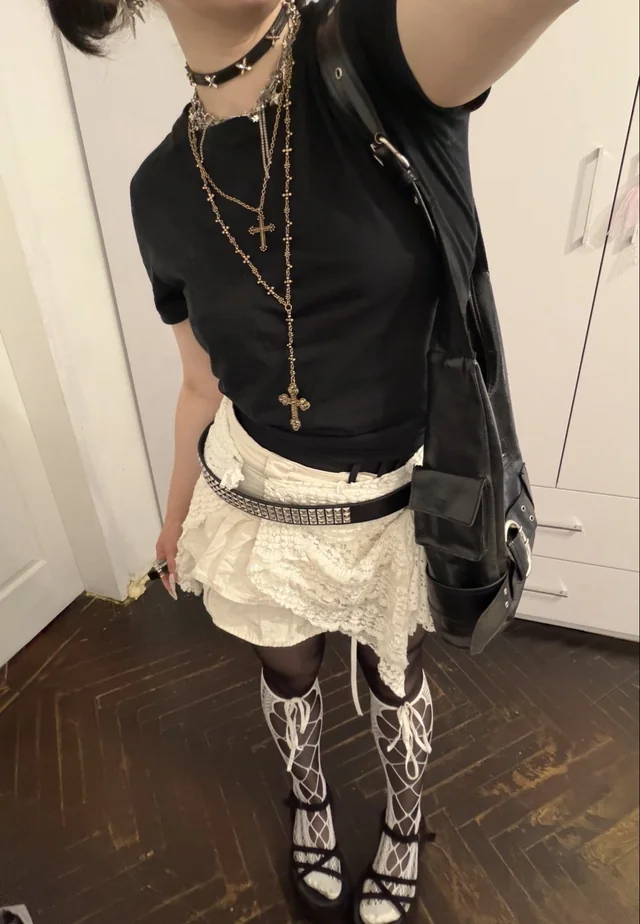
Hardware systems. Silver-toned jewelry (sterling silver, stainless steel, or silver-plated base metals) carries specific iconographic content: ankhs (referencing Egyptian death mythology and the 1983 film The Hunger), crosses (inverted or traditional, depending on subcultural position — inverted crosses reference anti-Christian punk provenance; traditional crosses reference mourning and Gothic religious iconography), pentagrams, occult symbols, serpents, bats, skulls, and coffin-shaped pendants. Chokers (leather, velvet ribbon, or chain, worn close to the throat) reference both Victorian mourning neckwear and BDSM collar symbolism. Body hardware — chains attached to clothing, multiple ear piercings, septum rings, lip rings, industrial piercings — extends the body-modification logic beyond garments and cosmetics into the flesh itself.
Band t-shirts and textual markers. The band t-shirt functions in goth as it does in punk and metal: as a declaration of musical allegiance that is simultaneously a knowledge claim. Wearing a Bauhaus "Bela Lugosi's Dead" shirt or a Sisters of Mercy "Floodland" shirt is not merely a fashion choice but an assertion of musical literacy that the community may test through conversation. Vintage or original-run band t-shirts carry temporal authenticity that reprints cannot replicate — the faded, softened cotton of a shirt purchased at a 1985 gig communicates subcultural tenure in material form.
Hardware on garments. Studs, rivets, safety pins, chains, D-rings, buckles, and spikes applied to leather jackets, boots, belts, and accessories derive from punk's DIY hardware tradition and BDSM's functional-restraint vocabulary. Each hardware type carries specific resonance: safety pins reference punk's founding bricolage (Sid Vicious, Johnny Rotten); pyramid studs reference punk-to-goth transition hardware; O-rings and D-rings reference bondage restraint systems. In DIY-constructed goth garments, hardware is attached using specific techniques (prong-back studs pushed through punched holes, screw-back spikes for removable attachment, riveted chains for permanent installation) that constitute a craft skill transmittable within the scene.
Accessories
Footwear. Dr. Martens 1460 (8-eyelet boot) and 1914 (14-eyelet, calf-height) in black provide trad goth's standard footwear — durable, subcultural-legacy-carrying, and available across budgets. Winklepickers (pointed-toe boots or shoes, referencing 1960s mod style adopted by post-punk) provide a sleeker alternative. Platform boots (Demonia Camel, Shaker, Stack series; New Rock Reactor, Tower, and Metallic series) provide the height-adding engineering that goth's verticality requires, with sole heights from 2 to 6+ inches. Underground (London brand producing creepers and pointed boots) bridges punk and goth footwear traditions. Boot quality is evaluated through sole construction (Goodyear welt for resoleable longevity, cemented for affordability), leather grade, and hardware durability — the same criteria as workwear, applied in a different subcultural context.
Parasols, canes, and dramatic accessories. Romantic goth incorporates Victorian-derived accessories — black parasols, walking canes (sometimes with concealed swords, at least in imagination), mourning fans, lace gloves — that extend the period-reference beyond garments into carried objects. These accessories are primarily display objects with limited practical function (the parasol does provide sun protection for pale skin) but serve as additional surfaces for subcultural communication.
Body Logic
Goth conceptualizes the body as a constructed artifact rather than a natural given — a surface to be deliberately remade through garment, cosmetic, hair, and hardware into an alternative presentation that rejects mainstream beauty standards in favor of subcultural aesthetic values. The goth body is pallid where mainstream culture demands warmth, dark where mainstream culture demands brightness, theatrical where mainstream culture demands naturalism, and androgynous where mainstream culture demands gender legibility.
This constructedness is not concealed but displayed. The goth face is visibly painted — the cosmetic labor is the point, not the simulation of an unpainted face. The goth hair is visibly manipulated — backcombed, dyed, extended, or shaved in ways that announce artificial intervention. The goth body wears its garments as architecture — corsets, platforms, layered textures create a silhouette that is manifestly constructed rather than naturally occurring. In Judith Butler's terms, goth makes gender and beauty performativity visible by refusing to naturalize its own construction: the effort is the aesthetic.
Gender presentation in goth precedes and exceeds contemporary gender-neutral fashion discourse. Male-presenting goths wearing eyeliner, lipstick, nail polish, skirts, corsets, and fishnet was standard practice in the 1982 Batcave — not as political statement but as subcultural convention. The goth community's early adoption of androgynous and gender-fluid presentation was grounded in the aesthetic's rejection of normative appearance rather than in explicit gender theory, but the effect was structurally identical: goth created spaces where masculine-coded and feminine-coded garments and cosmetics circulated freely across gender presentations.
The goth body also operates through deliberate mortality reference. Pallor, thinness, dark-circled eyes, and spectral styling reference the dead, the dying, and the supernatural. This is not nihilism but memento mori — an aesthetic acknowledgment of death's reality that mainstream beauty culture's health-and-vitality emphasis systematically denies. The goth body says "I will die" and makes that acknowledgment beautiful rather than terrifying.
Race in goth's body logic is a largely unexamined tension. The pale-foundation convention was developed in a predominantly white British subculture and encodes whiteness as the goth body's default skin condition. Black goths, Brown goths, and goths of color have always existed within the subculture but have often experienced the pale-skin convention as a limiting norm. Contemporary goth discourse has begun to address this — acknowledging that "goth pallor" can be achieved relative to any skin tone, that dark-skinned goths can achieve striking cosmetic effects through techniques specific to their complexion, and that the subculture's racial demographics reflect structural barriers rather than aesthetic necessity.
Garment Logic
Goth garment construction spans three distinct production modes with radically different engineering priorities, material sources, and cultural functions.
DIY and scene-made construction. The original and most subcultural-authenticating production mode. DIY goth garments are assembled from: charity-shop and thrift-store finds (Victorian and Edwardian garments, vintage mourning wear, discarded formal wear that can be dyed black or disassembled for materials), military surplus (boots, greatcoats, belts, hardware), fetish-retail purchases (leather, PVC, hardware components), and new materials modified through dyeing, distressing, hardware addition, and reconstruction. The skills required — hand-sewing, machine sewing, leather working, fabric dyeing, hardware attachment, pattern modification — constitute a craft tradition transmitted through scene mentorship, online tutorials, and experimentation.
DIY construction quality varies enormously, but its evaluative criteria differ from commercial garment assessment: in DIY goth, visible hand-stitching, imperfect symmetry, and evidence of modification are valued as markers of personal investment rather than critiqued as construction failures. The garment's value derives from its uniqueness and the labor it evidences rather than from manufacturing precision.
Commercial subcultural production. Brands serving the goth market — Killstar (founded 2010, UK-based, online-retail-driven), Punk Rave (Chinese manufacturer, widely distributed through Amazon and alternative-fashion retailers), Lip Service (Los Angeles, 1985–2016), and Tripp NYC (New York, known for chain-attached wide-leg pants) — produce purpose-made goth garments at mass-market scale. Construction quality in this tier is commercial-standard: overlocked seams, moderate-weight fabrics, synthetic-dominant fiber content, and fashion-grade hardware. The primary critique from within the subculture is that commercial goth produces "costume" rather than "culture" — garments that look correct in isolation but lack the material depth, personal history, and subcultural investment of DIY or accumulated wardrobes.
Runway and high-fashion goth. Alexander McQueen, Rick Owens, Ann Demeulemeester, Yohji Yamamoto, Comme des Garçons, Gareth Pugh, and Olivier Theyskens have all produced collections that translate goth's visual language into luxury-construction contexts. These garments use premium materials (Italian leather, silk velvet, Japanese cotton, cashmere), precision construction (couture seaming, hand-finishing), and design authorship (each designer's distinctive pattern language and silhouette). The relationship between runway goth and subcultural goth is analogous to luxury-streetwear's relationship to subcultural streetwear: the visual grammar is preserved while the production context, price architecture, and evaluative framework change entirely.
Aftercare and maintenance. Goth garments require specific maintenance determined by their material composition and use conditions. Leather requires conditioning after nightclub exposure (sweat and heat accelerate desiccation). Velvet requires careful storage (hanging or rolling, never folding, to prevent permanent crush marks) and spot-cleaning rather than machine washing for silk and cotton varieties. PVC requires surface cleaning with damp cloth and storage away from heat (PVC becomes brittle and cracks in sustained heat). Lace requires gentle hand-washing and air-drying (machine agitation destroys delicate thread structures). Black garments require cold-water washing, inside-out turning (to reduce surface abrasion and dye loss), and separation from lighter-colored items (black dye bleeds in early washes).
Black-dye maintenance is the category's most persistent care challenge: goth wardrobes, being overwhelmingly black, are in perpetual negotiation with fading. Over-dyeing (re-dyeing faded garments using fabric dye) is a common maintenance practice that extends visual service life. Color-preserving detergents (Woolite Dark, Perwoll Black) slow but do not prevent progressive dye loss. The inevitability of fading produces a visible aging gradient within any goth wardrobe: newer garments read as true black while older garments shade toward grey, green-black, or red-black, creating an inadvertent temporal record of the wardrobe's history.
Motifs / Themes
Dominant themes include death as memento mori (the aesthetic acknowledgment of mortality as a counter to mainstream culture's denial), Victorian mourning as historical reference (borrowing the visual language of an era that codified grief into dress), romantic melancholy as emotional register (beautiful sadness rather than nihilistic despair), occult symbolism as subcultural shorthand (pentagrams, ankhs, inverted crosses encoding references to horror literature, film, and alternative spirituality), and music as identity foundation (goth remains, in its dedicated scenes, a music subculture first and a fashion system second).
The "undead" motif — goth's refusal to die despite repeated mainstream pronouncements of its death — functions as a meta-narrative: the subculture performs its own immortality, surviving commercialization, ridicule, moral panics, and generational change through the persistence of its musical, social, and aesthetic infrastructure. Goth is the vampire of fashion subcultures: declared dead in every decade, reviving in every decade, feeding on each new generation's alienation.
Cultural Touchstones
Film: Nosferatu (1922, F.W. Murnau) established the visual vocabulary of cinematic Gothic. The Hunger (1983, Tony Scott; David Bowie and Catherine Deneuve as vampire lovers) provided the goth subculture's most direct cinematic mirror — ankh symbolism, Bauhaus performing "Bela Lugosi's Dead" in the opening scene, androgynous beauty, and death-as-erotic-experience. The Crow (1994, Alex Proyas; Brandon Lee in black leather and white face-paint) became goth's most commercially successful cinematic icon. Bram Stoker's Dracula (1992, Francis Ford Coppola; Eiko Ishioka's Oscar-winning costumes) restored Victorian-Gothic visual richness to the vampire genre. Tim Burton's oeuvre — Beetlejuice (1988), Edward Scissorhands (1990), Sweeney Todd (2007), Corpse Bride (2005) — constitutes mainstream culture's most sustained engagement with gothic-adjacent visual language.
Television: The Addams Family (1964–1966, and subsequent adaptations) and The Munsters (1964–1966) provided comedic-Gothic templates that normalized dark-aesthetic presentation. Wednesday (2022, Netflix; Jenna Ortega) triggered the latest goth-adjacent fashion cycle, introducing a new generation to the aesthetic through a character who embodies goth's alienation-as-identity logic.
Music: Bauhaus's "Bela Lugosi's Dead" (1979, the nine-and-a-half-minute single that is goth's foundational text). Siouxsie and the Banshees' Juju (1981). The Sisters of Mercy's Floodland (1987). The Cure's Disintegration (1989). These recordings constitute goth's musical canon — the shared reference set that the subculture uses to authenticate membership.
Exhibition: Gothic: Dark Glamour (FIT Museum, 2008, curated by Valerie Steele and Jennifer Park) positioned goth as a legitimate subject of fashion-history scholarship, analyzing its relationship to literary Gothic, haute couture, and subcultural production.
See Also
- Punk: Direct antecedent; goth softened punk's aggression into introspection while retaining DIY ethics and anti-establishment positioning
- Victorian mourning culture: Historical reference system for romantic goth's material and silhouette vocabulary
- Industrial / rivethead: Overlapping subculture; harder, more militant aesthetic with shared nightclub infrastructure
- Deathrock: American West Coast parallel to UK goth; more explicitly punk-influenced, rougher construction
- Emo: 2000s descendant; traded goth's Victorian romance and musical specificity for confessional vulnerability and pop-punk
- Steampunk: Victorian romanticism with technophilic rather than death-preoccupied emphasis
- Darkwear: Contemporary fashion-adjacent darkness that borrows goth's tonal palette without subcultural investment
- Nu-goth / Pastel goth: Post-subcultural aesthetic mutations that mix goth motifs with Tumblr-era kawaii and witchcraft references
Brands and Designers
Subcultural / Scene-Rooted:
- Specimen / Batcave-era DIY (1982): the original goth-fashion production — hand-made, venue-specific, community-produced
- Kambriel (est. 1990s, handmade goth-Victorian couture): one of the first dedicated goth fashion designers, hand-constructed garments in velvet, silk, and brocade
- Gallery Serpentine (Australian goth-Victorian label): corsetry and period-referencing formal goth garments
- Plastik Wrap: subcultural PVC and fetish-adjacent goth garments
- Ipso Facto (Fullerton, California): long-standing American goth retail and production
Commercial Goth Retail:
- Killstar (founded 2010, UK): dominant online goth-fashion retailer, occult-themed graphic tees, dresses, and accessories
- Punk Rave (Chinese manufacturer): mass-market goth garments distributed through Amazon and alternative-fashion platforms
- Dolls Kill (2012, San Francisco): alternative-fashion marketplace including goth, rave, and festival-wear sub-brands
- Cyberdog (Camden, London): cybergoth retail, UV-reactive clothing, platform boots, synthetic accessories
Footwear:
- Dr. Martens (1960, Wollaston, England): 1460 and 1914 boots as trad-goth foundational footwear, air-cushioned sole, punk-goth-skinhead subcultural legacy
- Demonia (division of Pleaser USA): platform boots (Camel, Shaker, Stack series) providing goth's height-engineering solutions
- New Rock (1978, La Palma, Canary Islands): Reactor and Tower series, heavy metal hardware, leather-and-rubber platform construction
- Underground (London): creepers and pointed boots bridging punk and goth footwear traditions
Runway / High-Fashion Goth:
- Alexander McQueen: the macabre, the spectacular, death-as-couture ("The Hunger" SS1996, "Dante" AW1996, skull-print scarves, "Widows of Culloden" AW2006)
- Rick Owens: "glunge" (goth + grunge), architecturally distorted monochrome silhouettes, brutalist draping
- Ann Demeulemeester: lyrical noir, poetic asymmetry, leather-and-lace combinations as foundational goth-fashion vocabulary
- Yohji Yamamoto: black-palette draping, deconstructed tailoring, Japanese-Gothic formal darkness
- Gareth Pugh: theatrical-architectural goth, inflatable silhouettes, extreme proportion
- Olivier Theyskens: romantic Gothic darkness, Nina Ricci and Theory tenure bringing goth to broader luxury market
- Rodarte (Kate and Laura Mulleavy): horror-cinema-referenced textiles, cobweb knits, blood-stained fabrications
Mass-Market Gateway:
- Hot Topic (1989, Montclair, California): the category's most consequential commercial gateway, introducing millions to goth visual language through mall-based retail
Citations
[1] Steele, Valerie, and Jennifer Park. Gothic: Dark Glamour. Yale University Press, 2008. [2] Goodlad, Lauren M.E., and Michael Bibby, editors. Goth: Undead Subculture. Duke University Press, 2007. [3] Harriman, Andi, and Marloes Bontje. Some Wear Leather, Some Wear Lace: The Worldwide Compendium of Postpunk and Goth in the 1980s. Intellect Books, 2014. [4] Brill, Dunja. Goth Culture: Gender, Sexuality and Style. Berg, 2008. [5] Hodkinson, Paul. Goth: Identity, Style and Subculture. Berg, 2002. [6] Mercer, Mick. Gothic Rock. Omnibus Press, 1991. [7] Thompson, Dave. The Dark Reign of Gothic Rock. Helter Skelter Publishing, 2002. [8] Museum of Youth Culture. "Goth." https://www.museumofyouthculture.com/goth/ [9] "Gothic: Bat Cave." FIT Museum. https://sites.fitnyc.edu/depts/museum/Gothic/batcave.html [10] The Conversation. "A Brief History of Goth Fashion — from All-Black to Pastels." 2023. [11] Entwistle, Joanne. The Fashioned Body: Fashion, Dress and Social Theory. 2nd ed., Polity, 2015. [12] Kawamura, Yuniya. Fashion-ology: An Introduction to Fashion Studies. 2nd ed., Bloomsbury Academic, 2018. [13] Breward, Christopher. Fashion. Oxford University Press, 2003. [14] Wilson, Elizabeth. Adorned in Dreams: Fashion and Modernity. Revised ed., Rutgers University Press, 2003. [15] Crane, Diana. Fashion and Its Social Agendas: Class, Gender, and Identity in Clothing. University of Chicago Press, 2000. [16] Lipovetsky, Gilles. The Empire of Fashion: Dressing Modern Democracy. Princeton University Press, 1994. [17] Hebdige, Dick. Subculture: The Meaning of Style. Routledge, 1979. [18] Butler, Judith. Gender Trouble: Feminism and the Subversion of Identity. Routledge, 1990. [19] Muggleton, David. Inside Subculture: The Postmodern Meaning of Style. Berg, 2000. [20] Muggleton, David, and Rupert Weinzierl, editors. The Post-Subcultures Reader. Berg, 2003. [21] Thornton, Sarah. Club Cultures: Music, Media and Subcultural Capital. Polity, 1995. [22] Barthes, Roland. The Fashion System. Translated by Matthew Ward and Richard Howard, University of California Press, 1983. [23] Simmel, Georg. "Fashion" (1904). In Simmel on Culture: Selected Writings, edited by David Frisby and Mike Featherstone, SAGE, 1997. [24] Bourdieu, Pierre. Distinction: A Social Critique of the Judgement of Taste. Translated by Richard Nice, Harvard University Press, 1984. [25] Hollander, Anne. Seeing Through Clothes. University of California Press, 1993. [26] Tortora, Phyllis G., and Sara B. Marcketti. Survey of Historic Costume. 6th ed., Fairchild Books, 2015. [27] Taylor, Lou. Mourning Dress: A Costume and Social History. Routledge, 1983. [28] Cunnington, Phillis, and Catherine Lucas. Costume for Births, Marriages and Deaths. Adam and Charles Black, 1972. [29] Spooner, Catherine. Contemporary Gothic. Reaktion Books, 2006. [30] Spooner, Catherine. Fashioning Gothic Bodies. Manchester University Press, 2004. [31] Garland-Thomson, Rosemarie. Staring: How We Look. Oxford University Press, 2009. [32] Sophie Lancaster Foundation. https://www.sophielancasterfoundation.com/ [33] Fletcher, Kate. Sustainable Fashion and Textiles: Design Journeys. 2nd ed., Earthscan, 2013. [34] Whitby Gothic Weekend. https://www.whitbygothweekend.co.uk/ [35] Wave-Gotik-Treffen. https://www.wave-gotik-treffen.de/