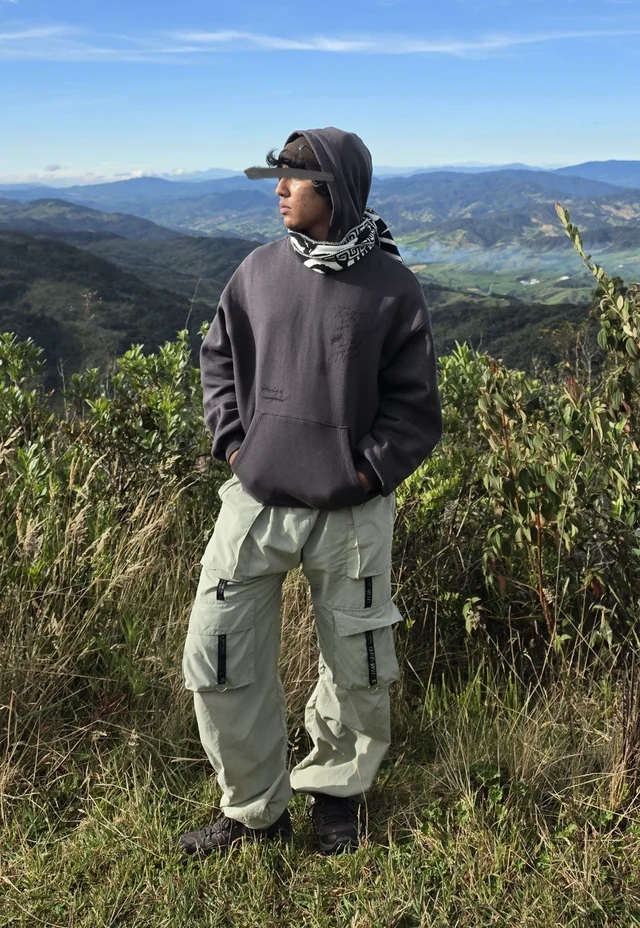
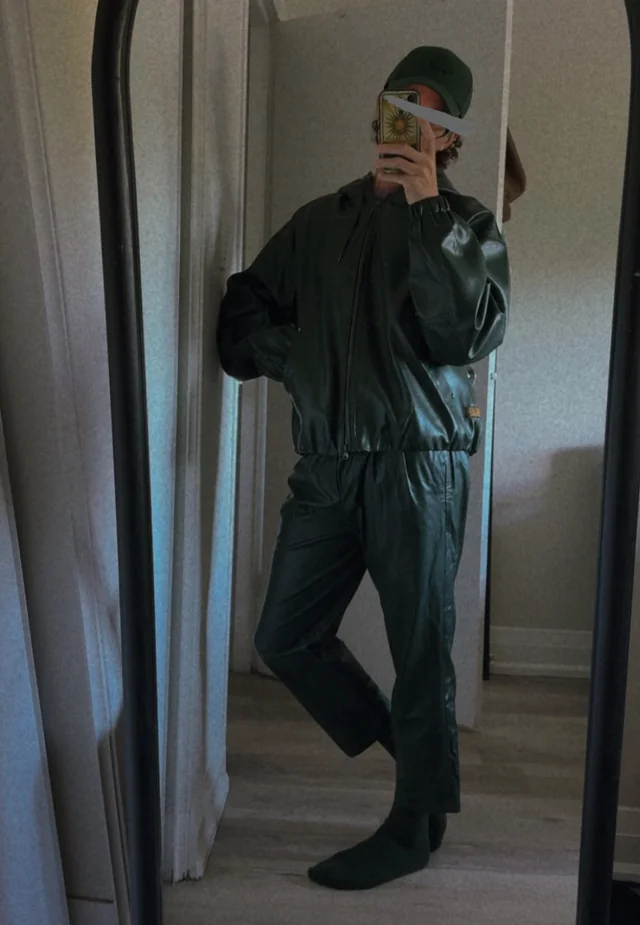
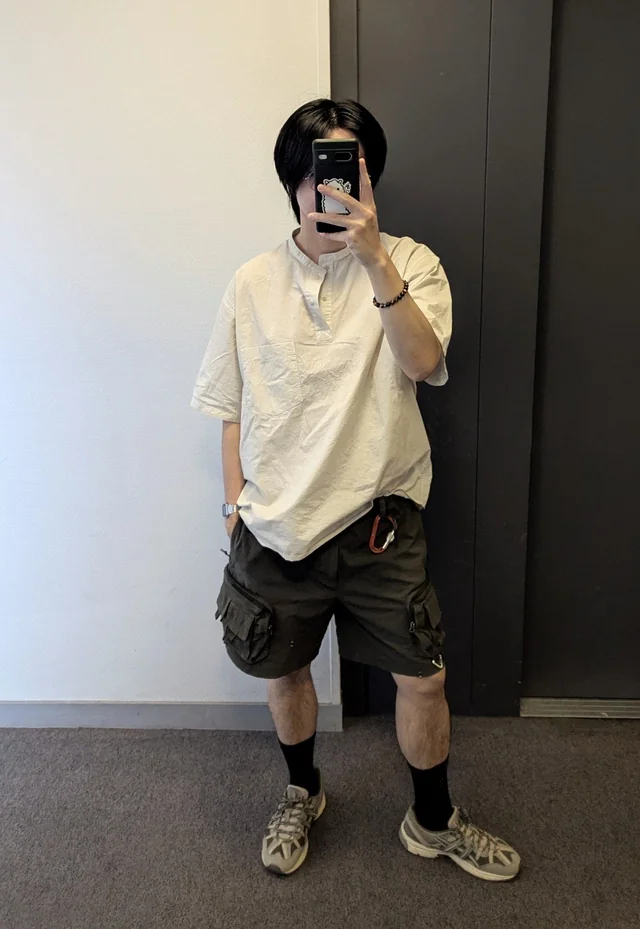
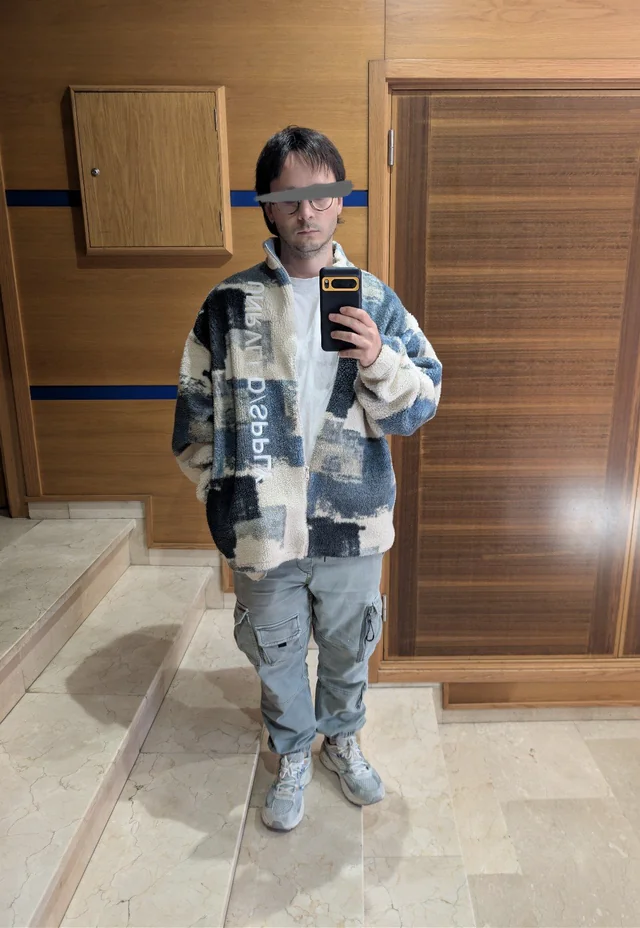
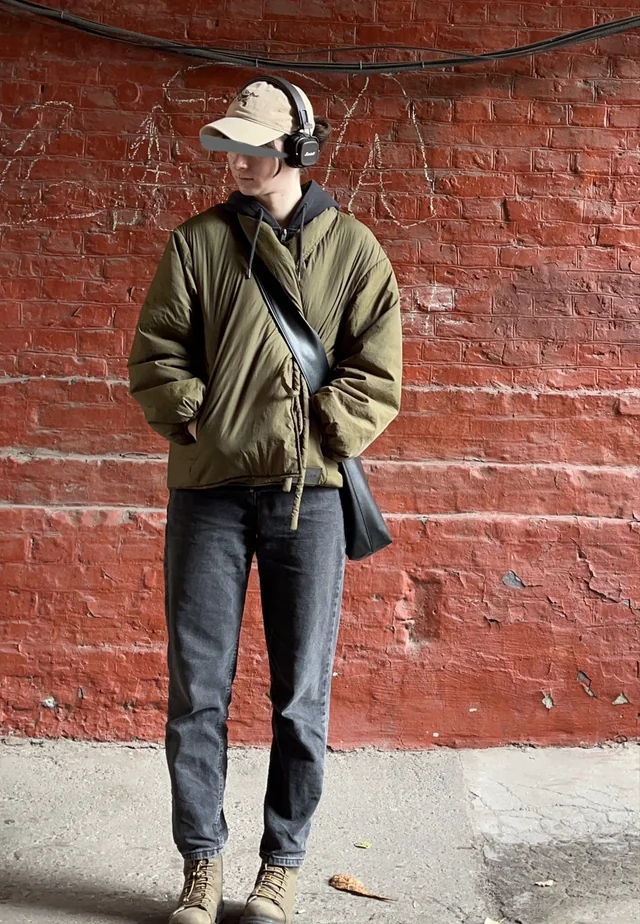
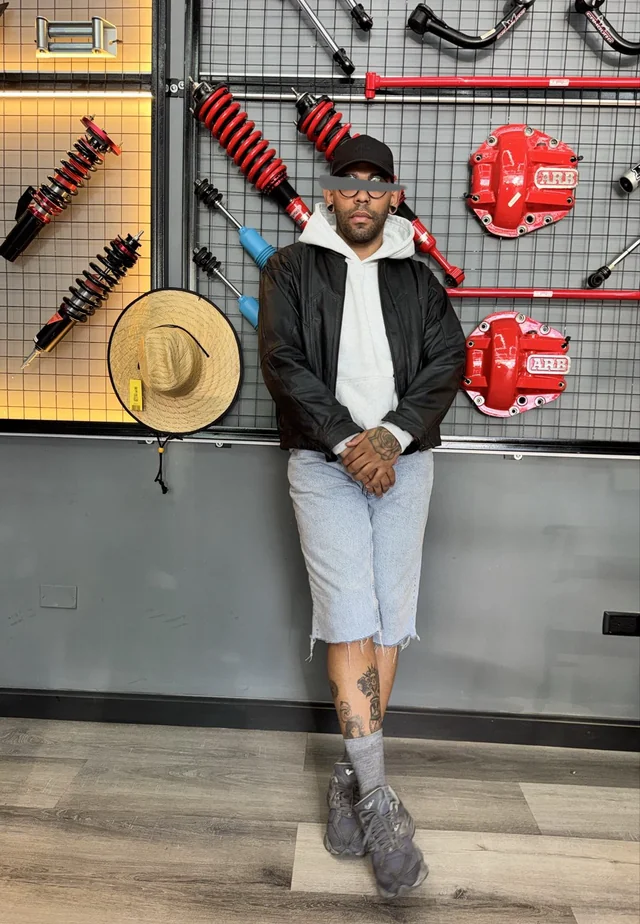
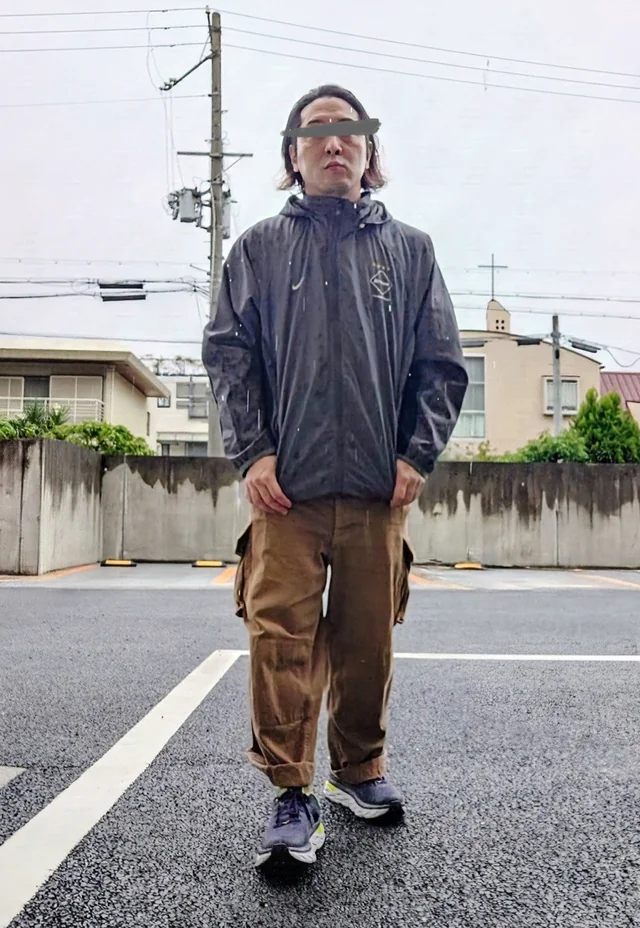
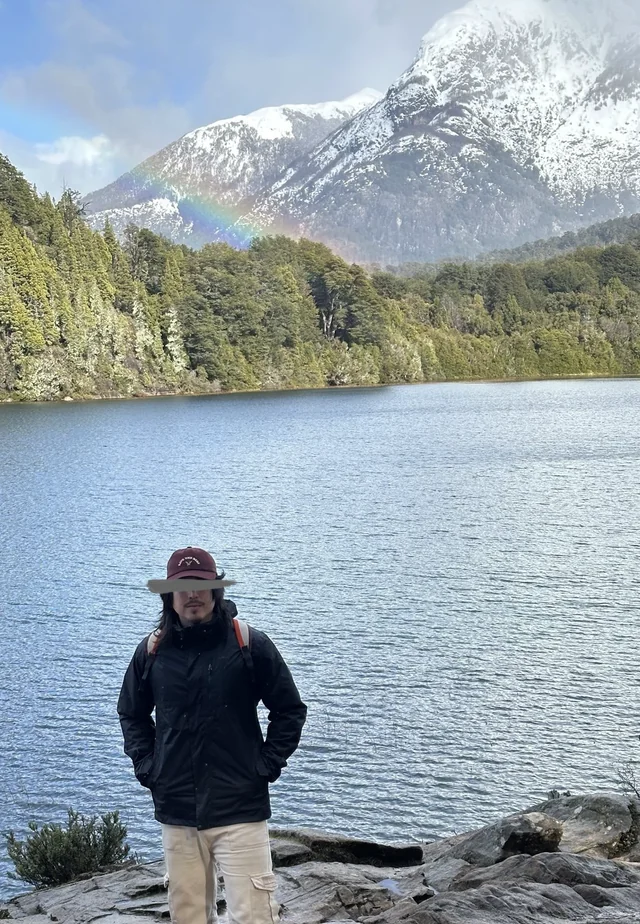
Gorpcore
Summary. Gorpcore is a dress system in which technical outdoor apparel — garments originally engineered for hiking, climbing, mountaineering, and trail running under conditions of sustained weather exposure, variable terrain, and load carriage — migrates into urban wardrobes and is worn as everyday clothing. The aesthetic is governed by a performance-transfer logic: waterproof-breathable membranes, insulation architectures, abrasion-resistant reinforcements, and articulated patterning developed for wilderness use are recontextualized as both practical urban infrastructure and visible cultural signifier. Unlike techwear, which stages an urban-cyberpunk imaginary, gorpcore retains the wilderness as its referent — garments carry the trace of trail, summit, and base camp even when deployed on city sidewalks.
In Material Terms
Gorpcore's coherence depends on layering-system engineering: base layers managing moisture transport, mid layers trapping insulative dead air, and outer shells deflecting precipitation and wind. Each layer is designed not as an isolated garment but as an interdependent component within a thermal-regulation stack. When this system functions correctly, it maintains a stable microclimate against the body across temperature swings of 20°C or more. When the system is reduced to visual quotation — shell aesthetics without membrane integrity, fleece silhouettes without thermal architecture — the category collapses into costume.
At Category Level
Gorpcore occupies a contested boundary between equipment culture and lifestyle fashion. High-specification implementations are evaluated through field-performance criteria: hydrostatic head ratings, moisture vapor transmission rates, fill-power measurements, and abrasion-resistance testing. Lower-tier iterations reproduce the visual grammar — boxy silhouettes, earth-tone palettes, logo placement, carabiner accessories — while stripping away the engineering substrate that originally justified those forms. This stratification is not merely commercial but epistemological: it separates participants who evaluate garments through specification literacy from those who evaluate through trend recognition.
Methodologically
This entry treats gorpcore as an infrastructural migration system: garments are analyzed by how they translate between wilderness performance environments and urban dress contexts, and by how that translation alters function, legibility, and value at each stage.
Word (Etymology)
The compound "gorpcore" was coined in 2017 by Jason Chen in New York magazine's The Cut, coupling "gorp" — a colloquial American English term for trail mix, conventionally glossed as an acronym for "Good Ol' Raisins and Peanuts," though more likely a backronym applied to an older dialectal word meaning to eat greedily — with the suffix "-core," which in internet aesthetic taxonomy denotes a codified stylistic regime (following the pattern established by "normcore," "cottagecore," etc.). Chen used the term with deliberate irony, describing "defiantly ugly" outdoor gear worn in Manhattan by people who "would sooner die than drink from a Nalgene." The term was rapidly adopted unironically by fashion media, retail platforms, and consumers, demonstrating the speed at which platform-era naming conventions convert satirical observation into market category.
Culturally, the label performs classificatory work beyond its lexical content. It distinguishes outdoor-derived urban dress from adjacent categories: "techwear" (which foregrounds cyberpunk urbanism over wilderness reference), "athleisure" (which derives from gym and sport rather than trail and summit), and "workwear" (which derives from industrial labor rather than outdoor recreation). In Japanese fashion discourse, the overlapping concept circulated earlier as "outdoor style" (アウトドアスタイル) in magazines such as Popeye and Lightning, without requiring a neologism, because the Japanese market had already normalized technical outdoor garments as lifestyle dress by the 2000s. The English coinage thus reflects a specifically Anglo-American moment of recognition: the realization that outdoor equipment had become fashion, and that this migration required a name.
Subculture
Gorpcore emerged at the intersection of several distinct communities whose overlap produced a new evaluative regime. Outdoor enthusiasts — climbers, thru-hikers, trail runners, backcountry skiers — constituted the original user base, evaluating garments through field performance under specific conditions: sustained rain, high-output aerobic activity, sub-zero bivouacs, multi-day pack carriage. Within this community, expertise was measured through direct experience: trip reports, gear lists optimized by weight and function, and comparative reviews grounded in use rather than brand loyalty. Forums such as Backpacking Light, r/ultralight, and regional mountaineering clubs transmitted this knowledge through a meritocracy of documented experience. Status accrued to those who could articulate why a 3-layer Gore-Tex Pro shell outperformed a 2.5-layer Gore-Tex Paclite in sustained downpour, or why 850-fill-power goose down compressed more efficiently than 650-fill for equivalent thermal output.
When this equipment migrated into urban fashion contexts — driven by celebrity adoption, Instagram mood-board curation (accounts like @gorpgirls, @advanced.rock, @114.index), and luxury collaborations — a second community formed around trend recognition, brand signaling, and styling rather than field knowledge. This produced a structural tension that outdoor purists captured with terms like "Patagucci" (mocking Patagonia's luxury pricing) and "all the gear, no idea" (British hillwalking slang for overdressed novices). The tension is not merely cultural resentment; it indexes a genuine epistemological split between communities that evaluate garments through measured performance and communities that evaluate through visual grammar and social positioning.
A third, mediating community emerged: fashion adopters who, through gear acquisition, developed genuine outdoor interests — purchasing the shell jacket first and hiking second. This reverse pipeline complicates any simple authentic/inauthentic binary. The Japanese outdoor-fashion ecosystem anticipated this dynamic by decades: brands like Snow Peak and Nanamica built business models around the premise that lifestyle interest and technical performance could develop in either direction.
Sociologically, gorpcore is structured by layered expertise economies. At the top, gear reviewers, outdoor guides, and cottage-industry designers (Zpacks, Gossamer Gear, Enlightened Equipment) command authority through manufacturing knowledge and field-testing data. Mid-tier authority belongs to content creators who translate specifications into lifestyle narratives. At the entry level, participants navigate brand recognition and silhouette imitation. These tiers are not sealed — mobility between them is possible through demonstrated knowledge — but the hierarchy shapes how authenticity claims are adjudicated in platform discourse.
History
The material prehistory of gorpcore begins not in fashion studios but in military procurement, industrial textiles research, and outdoor equipment development. Each historical phase produced technical innovations that subsequently became available for fashion adoption.
Military and industrial substrate (1940s–1960s). The U.S. Army's Quartermaster Corps developed the M-1943 field jacket system during World War II, establishing the layering principle — discrete base, insulating, and shell layers designed to be added or removed in response to thermal conditions — that remains the engineering foundation of outdoor dress. Cold-weather research at the Army's Natick Laboratories (established 1954) advanced understanding of moisture vapor transport, windchill dynamics, and insulation failure under compression. Nylon, developed by DuPont in 1935 and mass-produced for military applications, displaced cotton and wool in performance contexts due to superior strength-to-weight ratio and rapid drying. Gore-Tex, patented by W.L. Gore & Associates in 1969 and commercialized through the 1970s, introduced the first widely available waterproof-breathable membrane, enabling shell garments that blocked liquid water while permitting water vapor to escape — a thermodynamic breakthrough that redefined what outdoor garments could do.
American outdoor industry consolidation (1960s–1990s). The North Face (founded 1966), Patagonia (1973), and REI (cooperative model, 1938, expanded nationally through the 1970s) built retail and brand ecosystems that translated military-derived textile technologies into consumer outdoor equipment. These brands established the template that gorpcore later adopted: technical specifications marketed alongside lifestyle aspiration. Patagonia's 1972 adoption of clean-climbing ethics and later environmental activism (1% for the Planet, founded 2002) embedded environmental consciousness into the brand narrative, creating a moral dimension that fashion gorpcore would inherit and complicate.
Japanese outdoor-fashion anticipation (1990s–2000s). Japan produced the first mature outdoor-fashion hybrid ecosystem. The 1965 photo book Made in U.S.A. catalyzed a "heavy duty" movement in which American outdoor and workwear brands were adopted as fashion objects with curatorial precision. By the 1990s, brands like Montbell (founded 1975), Snow Peak (1958), and Goldwin (producing The North Face Japan line since 1978) operated simultaneously as technical equipment providers and lifestyle labels. Nanamica (founded 2003 by Eiichiro Homma, a former editor at Popeye magazine) explicitly designed for the outdoor-urban crossover, using Gore-Tex and Cordura in garments cut for city wear. White Mountaineering (founded 2006 by Yosuke Aizawa) positioned technical outdoor fabrication within high-fashion presentation. This Japanese ecosystem — decades ahead of the Western gorpcore moment — demonstrated that outdoor dress could function as legitimate fashion without requiring the apologetic framing that Western adoption initially demanded.
Hip-hop adoption and urban recontextualization (1990s–2000s). Simultaneously but independently, Black and Latino communities in New York adopted outdoor brands for urban wear, valuing durability, weather protection, logo visibility, and the implicit class signaling of expensive equipment. The Timberland 6-inch boot became a staple of East Coast hip-hop dress. North Face Nuptse puffers circulated as winter uniforms. Raekwon of Wu-Tang Clan wearing the Ralph Lauren "Snow Beach" pullover (1994) marked a visible convergence of outdoor iconography and hip-hop styling. Columbia Sportswear, initially ambivalent about hip-hop adoption, eventually recognized the market expansion it represented. This history is often undertold in gorpcore narratives, which tend to center white outdoor enthusiasts and Japanese curators while underrepresenting the Black urban communities who pioneered outdoor-brand-as-streetwear decades before The Cut coined a term for it.
Celebrity adoption and luxury convergence (2014–2020). Frank Ocean photographed in Arc'teryx and Patagonia (2015 onward), A$AP Rocky integrating technical shells into runway-adjacent styling (2016–2017), and Drake and Virgil Abloh wearing matching Arc'teryx LEAF parkas at New York Fashion Week (2020) repositioned outdoor gear within aspirational fashion. High-fashion collaborations formalized this: Jil Sander × Arc'teryx (2021), Gucci × The North Face (2020–2021), and Moncler's ongoing collaborations with designers from Pierpaolo Piccioli to Rick Owens. These partnerships performed a double legitimation: fashion houses gained technical credibility, and outdoor brands gained cultural-capital access. The price architecture shifted accordingly — Arc'teryx's Alpha SV, already expensive as specialist mountaineering equipment, became a $900 fashion object whose resale value could exceed retail.
Pandemic acceleration and mass adoption (2020–2023). COVID-19 lockdowns drove unprecedented outdoor recreation participation: U.S. National Park visits surged, trail-running shoe sales increased over 15% year-on-year, and outdoor apparel became the fastest-growing fashion segment. Working from home eliminated formal dress codes, normalizing technical fabrics for everyday wear. The gorpcore aesthetic peaked in mainstream visibility between 2021 and 2023, sustained by TikTok (#gorpcore accumulating billions of views), Instagram curation, and continued luxury-outdoor collaborations.
Analytically, gorpcore's history is a sequence of context translations — military to outdoor, outdoor to Japanese lifestyle, outdoor to hip-hop streetwear, outdoor to luxury fashion, outdoor to pandemic mass-market — in which the same material substrate (membrane shells, insulated layers, ripstop constructions) is preserved while its social function, audience, and price logic are repeatedly renegotiated.
Silhouette
Gorpcore silhouette is governed by thermal-regulation geometry and layering-system accommodation rather than by tailoring ideals or body-sculpting intent. The characteristic boxy, volume-forward profile is not an arbitrary aesthetic preference but an engineering consequence: effective layering requires air gaps between garments to function as insulative dead-air space, and each layer must be cut generously enough to avoid compressing the layer beneath it, which would destroy its thermal efficiency.
Outer shells are cut with articulated shoulder gussets, underarm panels, and elbow darts that permit overhead reaching (critical for climbing, relevant for urban movement in different ways — overhead handrails, shelf access, umbrella management). Drop-back hems extend coverage over the lumbar region when bending or carrying loads, compensating for the upward garment creep that occurs under backpack hip belts. Adjustable hems, cuffs, and hoods create closeable microclimates — tightening seals airflow gaps to reduce convective heat loss in wind, while loosening permits ventilation during high-output activity.
Trousers follow similar logic: articulated knees use gusseted or pre-curved patterning to maintain mobility during high-step movements without excess fabric pooling at the joint. Tapered or elasticated ankle closures prevent fabric from snagging on terrain obstacles — a trail-derived feature that in urban contexts produces the distinctive boot-revealing silhouette associated with the aesthetic. Waistbands are typically adjustable rather than fixed, accommodating the variable bulk of base and mid layers.
Puffer jackets, the aesthetic's most recognizable garment, derive their voluminous silhouette directly from insulation physics: down or synthetic fill must loft fully — expanding to trap maximum dead air — to achieve rated thermal output. Baffled construction (sewn-through or box-baffle) determines how fill distributes across the garment; cold spots occur at stitch-through seams where fill is compressed to zero loft. The visual signature of the puffer — its quilted, billowing form — is thus a direct expression of thermal engineering, not stylistic invention.
As a result, gorpcore silhouette communicates preparedness through accommodation: the body appears instrumented for thermal management, mobility, and environmental variability rather than sculpted for display. Even when worn in temperate urban settings where no layering system is needed, the proportions retain their engineering logic as a visual grammar of readiness.
Materials
Material selection is gorpcore's primary authentication mechanism. The category's credibility depends on textiles engineered to measurable performance standards, and the gap between genuine technical fabrics and their visual imitations defines the central quality hierarchy.
Waterproof-breathable membranes. Gore-Tex remains the dominant membrane system, available in multiple architectures: Gore-Tex Pro (3-layer, highest durability and breathability, rated for sustained alpine use), Gore-Tex Active (lighter weight, optimized for high-output aerobic activity), Gore-Tex Paclite (2.5-layer, packable, reduced durability). Competing systems include eVent (direct-venting PTFE membrane offering higher instantaneous breathability), Pertex Shield (PU-based, less durable but more affordable), and proprietary brand systems (Arc'teryx's discontinued Gore partnership led to their own membrane development; Patagonia's H2No uses PU-based membranes). Key performance metrics include hydrostatic head (measured in millimeters; Gore-Tex Pro exceeds 28,000mm, meaning the membrane resists a 28-meter column of water before leaking), moisture vapor transmission rate (MVTR, measured in grams per square meter per 24 hours; values above 15,000 g/m²/24h indicate high breathability), and air permeability. Fashion-tier gorpcore frequently uses unrated "waterproof" coatings — polyurethane or DWR-only treatments — that mimic membrane aesthetics without matching performance under sustained rain.
Insulation systems. Down insulation is rated by fill power, which measures the cubic inches of loft per ounce of down: 550-fill is entry-level, 700-fill is mid-range, 800-fill and above represents premium compressibility and thermal efficiency. Goose down generally outperforms duck down at equivalent fill ratings due to larger cluster size. The critical failure mode of down is moisture absorption: wet down collapses, losing virtually all insulative capacity. Hydrophobic down treatments (Nikwax, DownTek) mitigate this but do not eliminate it. Synthetic insulations — PrimaLoft (microfiber), Climashield (continuous filament), Coreloft (Arc'teryx proprietary) — retain warmth when wet but offer inferior warmth-to-weight ratio and compressibility compared to equivalent-grade down. Insulation choice thus encodes a performance trade-off that experienced users can read: down signals weight-conscious optimization for dry conditions; synthetic signals wet-climate pragmatism or budget constraint.
Shell and face fabrics. Ripstop nylon (visible grid reinforcement preventing tear propagation) is the dominant face fabric, available in deniers from ultralight 7D (fragile, packable) to heavy-duty 80D+ (abrasion-resistant, heavier). Cordura nylon provides reinforcement at high-wear zones (knees, seat, elbows, pack-contact areas), with standard ratings from 330D to 1000D. Pertex Quantum (ultralight, tightly woven nylon) is used in down garments where wind resistance and low weight are prioritized. Softshell fabrics combine stretch-woven nylon or polyester with DWR treatment to provide weather resistance and mobility without full waterproofing — a compromise fabric that succeeds in variable conditions but fails in sustained heavy rain.
Fleece and mid-layer textiles. Polartec dominates the technical fleece market. Classic Polartec 100, 200, and 300 weights correspond to increasing thermal output and decreasing breathability. Polartec Alpha (active insulation with high air permeability) represents a significant engineering advance, designed to regulate temperature during high-output activity without the dump-and-pump cycle of removing layers. Polartec Power Stretch provides a four-way-stretch base/mid layer with smooth exterior and brushed interior. Grid fleece (Polartec Power Grid, R1 Grid) uses a raised-grid interior to increase surface area for moisture wicking while reducing weight. The fashion market frequently substitutes unbranded polyester fleece that approximates the visual texture of Polartec without matching its pill resistance, thermal efficiency, or moisture management.
Base-layer fibers. Merino wool (fiber diameter 15–24 microns) provides temperature regulation, odor resistance through lanolin's antimicrobial properties, and comfort across a wider temperature range than synthetics. Failure modes include moth vulnerability in storage, pilling under abrasion (especially at pack-contact points), and slow drying relative to synthetic alternatives. Synthetic base layers (polyester, nylon blends) dry faster and resist abrasion better but accumulate odor within hours of high-output use.
DWR (Durable Water Repellent) coatings. Applied to face fabrics to cause water to bead and roll off rather than saturating the face fabric (which would block membrane breathability — a phenomenon called "wetting out"). Traditional DWR uses long-chain fluorocarbon (C8) chemistry, now being phased out due to PFAS environmental persistence. Short-chain (C6) and fluorine-free alternatives (silicone-based, wax-based) offer reduced environmental impact but degrade faster under abrasion and laundering, requiring more frequent reapplication. DWR degradation is the most common maintenance failure in gorpcore garments: a shell with depleted DWR will wet out and feel clammy even if its membrane remains intact, leading users to misdiagnose membrane failure when the issue is surface treatment.
Consequently, "gorpcore quality" is materially empirical. Two visually identical shell jackets may diverge radically in rain protection, breathability, durability, and environmental impact because of membrane architecture, face fabric denier, seam-sealing method, and DWR chemistry. Specification literacy — the ability to read and interpret these material systems — is the primary marker separating technical participants from aesthetic adopters.
Color Palette
The palette operates on a dual axis with both practical and semiotic functions. Earth tones — olive, khaki, tan, bark brown, slate grey, charcoal, deep navy, and black — dominate because they fulfill multiple operational requirements simultaneously: they reduce visual conspicuousness in natural environments (the original design intent), increase interchangeability across modular layering wardrobes (any earth-tone shell combines with any earth-tone mid layer without chromatic conflict), and mask wear patterns, dirt accumulation, and minor damage that would be visible on lighter or brighter fabrics.
High-visibility accents — safety orange, electric yellow, cobalt blue, alpine red — derive from trail-safety requirements where visual detectability aids search-and-rescue identification. In fashion contexts, these colors function as deliberate stylistic punctuation: a single bright shell over muted layers signals awareness of outdoor color conventions while deploying them as aesthetic rather than safety choice.
Vintage outdoor gear from the 1980s and 1990s introduces a third chromatic register: retro colorways (teal, purple, burgundy, coral) that are now sought after precisely because they date the garment, signaling archival knowledge and pre-fashion-adoption provenance. This temporal coding is important: a faded teal Patagonia Snap-T fleece from 1993 communicates different cultural information than a new-production retro-reissue in identical colors, because the original carries evidence of actual use-life.
Monochromatic systems (all-black technical layering, tonal grey stacks) overlap with techwear's palette logic but retain distinctively outdoor proportions and brand language. The palette's restraint serves the same function as in techwear: it redirects evaluation from ornamental color play toward material performance and construction quality.
Details
Details in gorpcore are best understood as environmental interfaces — engineered solutions to specific exposure, ventilation, and access problems that, through context migration, have become legible style markers.
Seam systems. Fully taped seams (heat-welded waterproof tape applied to every seam's interior) are the standard for waterproof shells; critically taped seams (tape applied only to shoulder and upper-body seams, where rain exposure is highest) represent a weight-saving compromise. The taping method itself encodes quality: wider tape (22mm+) with consistent adhesion indicates factory-level quality control; bubbling, lifting, or incomplete coverage indicates manufacturing shortcuts or age-related adhesive degradation. Seam-tape failure is one of the first visible signs of garment aging in membrane shells, typically appearing after 3–7 years depending on use intensity and storage conditions.
Ventilation systems. Pit zips (underarm ventilation zippers, typically 20–30cm in length) exploit the body's convective airflow: as warm, moist air rises from the torso, opening pit zips creates a chimney effect that vents heat and moisture without removing the shell layer. This is an interface design solution to a specific thermodynamic problem — maintaining rain protection while preventing internal condensation buildup during aerobic activity. Core vents (chest or back zippered openings), mesh-backed pockets that double as ventilation channels, and two-way front zippers (allowing bottom-up opening for seated ventilation or pack-belt access) extend this logic. In fashion gorpcore, pit zips and vents are frequently present but unused, functioning as visual indicators of technical intent rather than active thermal-management tools.
Closure and adjustment systems. Hoods feature three-axis adjustment: fore-aft (depth), lateral (width), and volume (overall circumference), each controlled by independent cordlocks. This permits the hood to be fitted closely around the face for maximum weather protection or loosened for peripheral vision and airflow — a critical interface in high-wind or driving-rain conditions. Hem drawcords seal the shell's lower opening against updraft wind penetration. Velcro or snap cuff closures create wrist seals that prevent water tracking up sleeves during overhead arm positions. Each adjustment point is a microclimate control: it modulates the boundary between the garment's internal environment and external conditions.
Pocket architecture. Pocket placement in technical outdoor garments is constrained by pack-strap and hip-belt positioning: chest pockets (Napoleon pockets) are accessible while wearing a loaded pack; hand pockets are positioned high on the torso (above hip-belt line) for the same reason. Internal mesh pockets manage small items without adding external bulk. Cargo pockets on trousers use bellowed construction to expand capacity without permanent protrusion. Zipper weather-flaps (storm flaps) shield pocket openings from direct rain, adding a layer of water management beyond the zipper's own water resistance. In urban contexts, this pocket logic translates into high-access convenience — the same chest pocket that served a trail map now serves a transit card — preserving functional coherence even as the use scenario shifts.
Reinforcement and attachment points. Cordura panels at knees, elbows, seat, and shoulder (pack-contact zone) address abrasion from rock, ice, ground contact, and equipment friction. Daisy chains (parallel rows of bar-tacked webbing loops) and gear loops provide clip-in points for carabiner-attached tools, hydration systems, or accessories. In fashion contexts, carabiners clipped to belt loops or bag attachment points have become iconic gorpcore accessories — aesthetic citations of functional attachment systems, sometimes carrying actual gear (water bottles, pouches) and sometimes carrying nothing but symbolic readiness.
The distinction between engineered interface and decorative quotation is central to gorpcore critique. In mature technical implementations, every detail addresses a specific exposure or access problem; in fashion iterations, details accumulate as surface density — pit zips that are never opened, storm flaps over non-waterproof zippers, daisy chains that carry only a keychain.
Accessories
Accessory systems in gorpcore extend the same layering and interface logic as garments, forming an integrated outdoor-mobility kit that migrates to urban contexts with varying degrees of functional retention.
Footwear is the aesthetic's most immediate identifier. Trail runners (Salomon Speedcross and XT-6, Hoka Speedgoat, La Sportiva Bushido) provide aggressive lug patterns, cushioned midsoles, and protective toe bumpers originally designed for technical terrain — features that in urban contexts provide grip on wet pavement, comfort during long walks, and a distinctive chunky silhouette. Hiking boots (Danner Mountain Light, Merrell MOAB, Scarpa Zodiac) offer ankle support and Vibram outsoles. The Salomon XT-6, originally a fell-running shoe, became gorpcore's defining footwear object through fashion adoption, demonstrating how a highly specific performance tool can become a general lifestyle signifier.
Technical backpacks (Osprey, Gregory, Arc'teryx Arro) feature load-transfer hip belts, sternum straps, hydration-bladder sleeves, and external compression systems designed to stabilize weight during dynamic movement. These features translate into urban utility — laptop compartments, water-bottle pockets, organized gear access — while visually communicating outdoor preparedness. Smaller-format bags (sling bags, hip packs, chest rigs) provide quick-access carry for essentials without the commitment of a full pack.
Headwear (technical beanies, sun-protective caps, buffs), eyewear (sport-wrapped frames with high-contrast or polarized lenses), and watches (Garmin, Suunto, Casio Pro Trek with altimeter, barometer, and GPS functions) complete the system. Each accessory carries dual legibility: functional specification for outdoor users, lifestyle signaling for fashion adopters.
Body Logic
Gorpcore conceptualizes the body as a thermal-regulation system moving through variable environmental conditions rather than as a display surface organized by gender, proportion, or ornamental presentation. The layering stack instrumentalizes the body: it wraps it in a managed microclimate where moisture transport, insulation, and weather protection operate as interdependent functions. Pattern articulation at joints, shell fit that accommodates dynamic movement, and closure systems that modulate airflow all treat the body as a kinetic platform requiring adaptive environmental interface rather than static shaping.
Gender coding is comparatively attenuated. Technical outdoor garments are historically designed with minimal gendered differentiation: the same membrane shell, the same fleece weight, the same insulated pant serves all bodies. Sizing may vary, but the design priorities — thermal management, mobility, weather resistance — are not gendered priorities. This relative neutrality attracts wearers seeking escape from the gendered evaluative regimes that govern most fashion categories. In gorpcore, a body reads as "prepared" or "equipped" before it reads as masculine or feminine.
However, gorpcore's body logic encodes class in ways that its functionality rhetoric obscures. Genuine technical outdoor gear is expensive: an Arc'teryx Alpha SV shell retails at $800+, Salomon XT-6 trail runners at $180, and a complete three-layer system (base, mid, shell) from premium brands easily exceeds $1,500. Wearing this gear in urban contexts signals disposable income for "investment dressing" and leisure time for outdoor recreation — hiking trips, ski weekends, trail-running routines. The prepared body implies a lifestyle of recreational access to wilderness, which is itself a class-structured resource. This produces the category's central paradox: democratic-appearing gear (unisex, practical, utility-forward) actually encoding privilege (expensive, leisure-dependent, access-structured).
Embodied use remains a real, if weakened, evaluative criterion. A layering system that overheats its wearer on a moderate urban walk, a shell that wets out in light rain, or trail runners that blister on a commute all fail the body-as-platform test — even if they succeed visually. But unlike techwear, where field performance is the decisive legitimacy test, gorpcore tolerates a wider gap between performance capacity and actual use. Many gorpcore garments are genuinely overengineered for their deployment context, which is part of their appeal: the surplus of capability is itself the aesthetic.
Garment Logic
Gorpcore construction begins with the layering principle and works outward to individual garment engineering. The system's architecture — base layer (moisture management), mid layer (insulation), outer layer (weather protection) — is not a styling framework but a thermal-regulation protocol originally developed through military cold-weather research and refined through decades of mountaineering field testing.
Base-layer construction. Merino wool or synthetic knit fabrics are engineered for next-to-skin moisture transport: fiber structure, knit density, and surface treatment are calibrated to wick perspiration away from skin and distribute it across a larger evaporative surface area. Flatlock seams eliminate raised interior ridges that cause chafing under sustained movement or pack-strap pressure. Ergonomic patterning (longer rear hem, articulated sleeve, offset shoulder seams) prevents bunching and riding under mid layers.
Mid-layer construction. Fleece (Polartec series), synthetic insulation (PrimaLoft, Climashield), and down (goose or duck, baffled or stitch-through construction) are optimized for warmth-to-weight ratio and packability. In fleece, pill resistance correlates with fiber quality and knit tightness: premium Polartec resists pilling significantly longer than unbranded polyester fleece. In down garments, box-baffle construction (rectangular chambers separated by internal mesh walls) maintains more even fill distribution than sewn-through baffles (where the stitch line compresses fill to zero loft, creating cold spots). In synthetic insulation, continuous-filament construction (Climashield APEX) resists migration and clumping better than short-staple fiber fills (lower-grade PrimaLoft variants), maintaining thermal output over more use-and-wash cycles.
Shell construction. Waterproof-breathable shells integrate membrane, face fabric, and lining into laminated systems rated by layer count: 2-layer (membrane bonded to face fabric, with a separate hanging liner), 2.5-layer (membrane bonded to face fabric with a protective printed pattern replacing the liner), and 3-layer (membrane bonded between face fabric and interior lining, creating a single integrated textile). 3-layer construction provides the greatest durability and most consistent hand feel but is heaviest and most expensive. The lamination adhesive itself represents a longevity-critical element: polyurethane-based adhesives are vulnerable to hydrolysis — chemical degradation through moisture exposure — and can delaminate even in unworn garments stored in humid environments over 5–10 years. This is the most common catastrophic failure mode in membrane garments and the reason experienced users prioritize active use and proper storage over long-term archiving.
Seam and hardware engineering. All seams in waterproof garments must be sealed (taped or welded) to prevent water penetration through needle holes. Zipper selection balances water resistance, durability, and weight: YKK AquaGuard (water-resistant, coil-type), YKK Vislon (molded-tooth, more durable but less water-resistant), and proprietary systems (Arc'teryx's WaterTight) each represent different engineering trade-offs. Zipper sliders are tested for cycling durability — the number of open-close repetitions before failure — with premium zippers rated for 10,000+ cycles. Snap closures, Velcro tabs, and magnetic buckles provide secondary closure options, each with distinct failure profiles: snaps can lose tension; Velcro accumulates lint and loses grip; magnetic closures resist contamination but provide less security under load.
Aftercare and failure modes. Gorpcore garments require active maintenance to sustain performance. Gore-Tex shells must be periodically washed (to remove body oils and dirt that impair membrane breathability) and have their DWR reactivated through tumble-drying heat or iron application; failure to do so results in face-fabric wetting out, interior condensation, and perceived membrane failure. Down garments must be washed with specialist non-detergent cleaners (Nikwax Down Wash, Granger's) and tumble-dried at low heat with dryer balls to restore cluster loft; standard detergents strip natural oils from down clusters, permanently reducing fill power. Fleece garments shed microplastic fibers during washing — a documented environmental externality that contradicts gorpcore's nature-affinity rhetoric — and pill progressively with abrasion, especially at pack-contact points and under arm movement.
The most significant long-term failure mode is membrane delamination: the adhesive bond between membrane and face fabric degrades through hydrolysis, heat, UV exposure, and chemical contamination (sunscreen, insect repellent, detergent residue). A delaminated shell may appear intact externally while providing zero waterproof protection. This failure is invisible until field exposure and irreversible once initiated. Experienced users therefore evaluate gorpcore garments not only by current performance but by storage history, adhesive technology, and predicted service life — a longitudinal assessment that separates technical participants from visual consumers.
Contemporary fashion gorpcore sometimes sacrifices this engineering integrity for aesthetic effect: using unrated "waterproof" coatings, including non-functional pit zips, or cutting garments in silhouettes that preclude actual layering. This generates a persistent authentic-versus-fashion divide. The distinction is not merely cultural snobbery; it is structurally grounded in whether the garment's construction matches its visual claims.
Motifs / Themes
Brand insignia function as the category's primary iconographic system. The North Face's half-dome, Patagonia's Fitz Roy mountain outline, Arc'teryx's archaeopteryx fossil, and Salomon's "S" mark operate simultaneously as quality certifications, tribal identifiers, and status signals. Unlike luxury fashion's ambivalent relationship with logo visibility, outdoor brands display prominently because the logo originated as a trust mark — a guarantee of tested performance — before it became a fashion signifier. The logo's dual function (certification and status) mirrors gorpcore's structural ambiguity between equipment culture and fashion culture.
Mountain and wilderness imagery pervade the aesthetic's referential system: summit silhouettes, topographic contour lines, elevation markers, trail-map abstractions. These motifs encode aspirational orientation toward outdoor experience even when the wearer has never set foot on a trail. They function as identity projections — "this is who I imagine myself to be" — rather than documentary records of lived experience.
Preparedness, modularity, and environmental responsiveness recur as organizing themes. At a symbolic level, gorpcore stages a fantasy of competent self-sufficiency: the wearer is equipped, capable, ready for weather change or spontaneous outdoor departure. This preparedness rhetoric links gorpcore to broader cultural anxieties about climate instability, urban fragility, and the desire for practical agency in increasingly abstract economic and environmental systems.
Sustainability rhetoric — Patagonia's "Don't Buy This Jacket" campaign (2011), Worn Wear repair programs, recycled-material branding — appears as a thematic overlay that creates productive contradictions. Buying new gear (even from "sustainable" brands) consumes petroleum-derived synthetics, produces manufacturing waste, and requires global shipping. True environmental practice — using existing equipment until it fails, repairing rather than replacing — contradicts the fashion cycle's demand for constant newness. This tension is not resolved but is itself a recurring motif of gorpcore discourse.
Cultural Touchstones
The cultural reference system operates across documentary, musical, editorial, and social-media contexts.
In documentary and film, the outdoor-equipment genre — Free Solo (2018), Meru (2015), Valley Uprising (2014), 14 Peaks (2021) — provided aspirational imagery of technical clothing performing under extreme conditions, establishing the visual vocabulary that fashion adoption would later cite. 127 Hours (2010), with James Franco as climber Aron Ralston, dramatized the life-or-death consequences of equipment choice. These narratives supplied gorpcore with an origin mythology: garments that were "tested on K2" or "used in Yosemite" carry narrative residue that urban wear can borrow but never fully possess.
In music, Frank Ocean's repeated appearance in Arc'teryx and Patagonia (2015–present) provided a celebrity template for outdoor-as-fashion. Drake's integration of Klättermusen and Arc'teryx into his visual identity (2020–2021) amplified this signal through hip-hop's massive cultural reach. Travis Scott's festival appearances in outdoor brands further normalized the crossover.
In fashion media, Jason Chen's 2017 Cut coinage launched the discourse. Bloomberg's "A 163-Year Illustrated History of America's Gorpcore Obsession" (2023) provided historical depth. Vogue Business coverage of PFAS chemicals in outdoor apparel (2025) introduced critical environmental interrogation into a category that had largely escaped sustainability scrutiny.
On social media, Instagram accounts (@gorpgirls, @advanced.rock, @114.index) curated the aesthetic's visual canon from 2019 onward, defining its styling conventions through persistent image selection. TikTok's #gorpcore hashtag, accumulating billions of views, democratized participation while accelerating trend-cycle compression. Japanese fashion magazines — Popeye, Lightning, GO OUT — documented the outdoor-fashion hybrid decades before Western platforms named it, providing a deep archival resource for historically literate participants.
Luxury collaborations — Gucci × The North Face (2020), Jil Sander × Arc'teryx (2021), Moncler × Hoka, Dior × Birkenstock — represent institutional touchstones where outdoor equipment and high fashion formally merged, producing objects that circulate simultaneously in both evaluative regimes.
See Also
- Techwear: Shares technical fabrication but stages cyberpunk-urban imaginary rather than wilderness reference
- Athleisure: Activewear as casualwear, derived from gym and sport rather than trail and summit
- Workwear: Adjacent durability values but derived from industrial labor rather than outdoor recreation
- Normcore: Predecessor aesthetic emphasizing unremarkable comfort, less specifically outdoor-oriented
- Granola: Overlapping outdoor and environmental values, more countercultural and less technical
- Military fashion: Shared material substrate (layering systems, nylon, ripstop) through common military-research origins
- Streetwear: Intersecting through hip-hop adoption of outdoor brands and logo-driven evaluation
Brands and Designers
Heritage Outdoor / High-Performance:
- Arc'teryx (founded 1989, Vancouver): precision-engineered shells, Alpha SV and Beta AR as category-defining garments, Gore-Tex Pro construction
- Patagonia (1973, Ventura, California): environmental-activist positioning, Nano Puff and Torrentshell as accessible technical standards, Worn Wear repair ecosystem
- The North Face (1966, San Francisco): broadest market reach, Nuptse puffer as gorpcore's most recognizable silhouette, Summit Series for technical credibility
- Salomon (1947, Annecy, France): trail-running footwear (XT-6, Speedcross), Contagrip outsole technology, Advanced Chassis midsole engineering
- Montbell (1975, Osaka): ultralight engineering philosophy, Japanese outdoor market leadership, superior down-garment construction
Japanese Outdoor-Fashion Hybrids:
- Nanamica (2003, Tokyo): Gore-Tex and Coolmax in urban silhouettes, founded by former Popeye editor Eiichiro Homma
- Snow Peak (1958, Tsubame, Niigata): lifestyle-outdoor integration, campfire-to-city design philosophy
- and wander (2011, Tokyo): luxury outdoor-inspired clothing, collaborative with technical suppliers
- White Mountaineering (2006, Tokyo): high-fashion outdoor presentation, Yosuke Aizawa's technical-formal fusion
- Goldwin (1951, Tokyo): The North Face Japan production partner, C-Knit membrane innovation, 0 concept line
Luxury-Outdoor Collaborations:
- Gucci × The North Face (2020–2021): luxury-outdoor crossover defining the category's high-fashion moment
- Jil Sander × Arc'teryx (2021): minimalist-technical fusion
- Moncler Genius (ongoing): rotating designer collaborations bridging down insulation and high fashion
- Dior × Birkenstock: luxury integration of outdoor-comfort footwear
Cottage Industry / Specialist:
- Zpacks (2005, Melbourne, Florida): ultralight Dyneema Composite Fabric shelters and packs, cottage-industry model
- Gossamer Gear (1998, Austin, Texas): minimalist ultralight packs, gram-counting expertise community
- Enlightened Equipment (2009, Winona, Minnesota): custom-spec quilts and insulation, direct-to-hiker model
- Hilleberg (1971, Frösön, Sweden): premium tent engineering, outer-pitch-first design philosophy
Accessible / Mass-Market Gateway:
- Columbia Sportswear (1938, Portland): Omni-Tech membrane system, broad price accessibility
- REI Co-op (1938, Seattle): cooperative retail model, house-brand gear at mid-tier pricing
- Uniqlo (outdoor-adjacent through Heattech and Blocktech lines): technical-lifestyle integration at fast-fashion pricing
- Hoka (2009, Annecy, France): maximalist cushioning trail runners adopted as fashion footwear
Citations
[1] Chen, Jason. "First Came Normcore. Now Get Ready for Gorpcore." The Cut, New York Magazine, May 25, 2017. [2] Trufelman, Avery. "A 163-Year Illustrated History of America's Gorpcore Obsession." Bloomberg Businessweek, June 1, 2023. [3] Francombe, Amy. "The Darker Side of Gorpcore." Vogue Business, November 27, 2025. [4] Sadachi, Takeshi Dylan. "Gorpcore: History of 'Outdoor Fashion' and the Japanese Brands To Know." Metropolis Magazine, September 19, 2025. [5] "A Story of Mountains and Moodboards – The Rise of Gorpcore." Sabukaru. [6] Diment, Maria. "What is 'Gorpcore' and how Vancouver did it first." Medium, October 12, 2022. [7] Entwistle, Joanne. The Fashioned Body: Fashion, Dress and Social Theory. 2nd ed., Polity, 2015. [8] Kawamura, Yuniya. Fashion-ology: An Introduction to Fashion Studies. 2nd ed., Bloomsbury Academic, 2018. [9] Breward, Christopher. Fashion. Oxford University Press, 2003. [10] Wilson, Elizabeth. Adorned in Dreams: Fashion and Modernity. Revised ed., Rutgers University Press, 2003. [11] Crane, Diana. Fashion and Its Social Agendas: Class, Gender, and Identity in Clothing. University of Chicago Press, 2000. [12] Lipovetsky, Gilles. The Empire of Fashion: Dressing Modern Democracy. Princeton University Press, 1994. [13] Hebdige, Dick. Subculture: The Meaning of Style. Routledge, 1979. [14] Veblen, Thorstein. The Theory of the Leisure Class. Macmillan, 1899. [15] Bourdieu, Pierre. Distinction: A Social Critique of the Judgement of Taste. Translated by Richard Nice, Harvard University Press, 1984. [16] Barthes, Roland. The Fashion System. Translated by Matthew Ward and Richard Howard, University of California Press, 1983. [17] Simmel, Georg. "Fashion" (1904). In Simmel on Culture: Selected Writings, edited by David Frisby and Mike Featherstone, SAGE, 1997. [18] Fletcher, Kate. Sustainable Fashion and Textiles: Design Journeys. 2nd ed., Earthscan, 2013. [19] Gwilt, Alison. A Practical Guide to Sustainable Fashion. Bloomsbury Academic, 2014. [20] Niinimaki, Kirsi, editor. Sustainable Fashion in a Circular Economy. Aalto ARTS Books, 2018. [21] Quinn, Bradley. Techno Fashion. Berg, 2002. [22] Braddock Clarke, Sarah E., and Marie O'Mahony. Techno Textiles 2: Revolutionary Fabrics for Fashion and Design. Thames and Hudson, 2005. [23] Holubar, Franz. The Development of Mountaineering Equipment. Austrian Alpine Club, 1965. [24] Renbourn, E.T., and W.H. Rees. Materials and Clothing in Health and Disease. H.K. Lewis, 1972. [25] Fourt, Lyman, and Norman R.S. Hollies. Clothing: Comfort and Function. Marcel Dekker, 1970. [26] Watkins, Susan M. Clothing: The Portable Environment. 2nd ed., Iowa State University Press, 1995. [27] Gonzalez, Richard R., et al. "Biophysics of Heat Transfer and Clothing Insulation." Comprehensive Physiology, 2011. [28] Laitala, Kirsi, et al. "Washing and Drying Instructions for Outdoor Garments." Journal of Cleaner Production, vol. 252, 2020. [29] Cousins, Imogen T., et al. "The High Persistence of PFAS Is Sufficient for Their Management as a Chemical Class." Environmental Science: Processes and Impacts, vol. 22, 2020, pp. 2307–2312. [30] Browne, Mark A., et al. "Accumulation of Microplastic on Shorelines Worldwide: Sources and Sinks." Environmental Science and Technology, vol. 45, no. 21, 2011, pp. 9175–9179. [31] Ivy, Daniel. "The Untold History of Black Outdoors Culture." Outside Magazine, 2021. [32] Made in U.S.A. Photo collection. Heibonsha, 1975. Reprinted by Popeye/Magazine House, 2019. [33] GORE-TEX Brand. "Technology." https://www.gore-tex.com/technology [34] Patagonia. "Worn Wear." https://wornwear.patagonia.com/ [35] Reddit. "r/ultralight." https://www.reddit.com/r/ultralight/