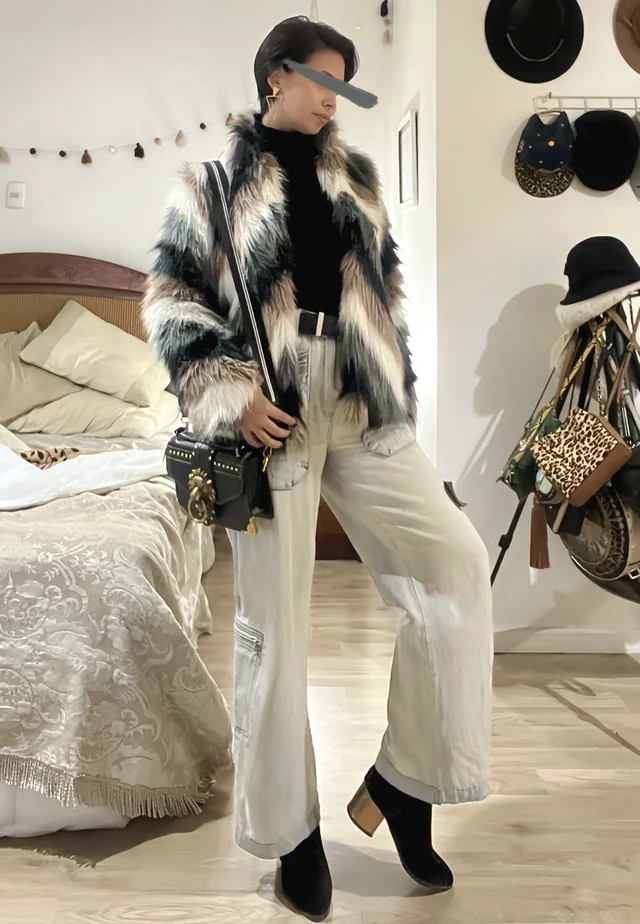
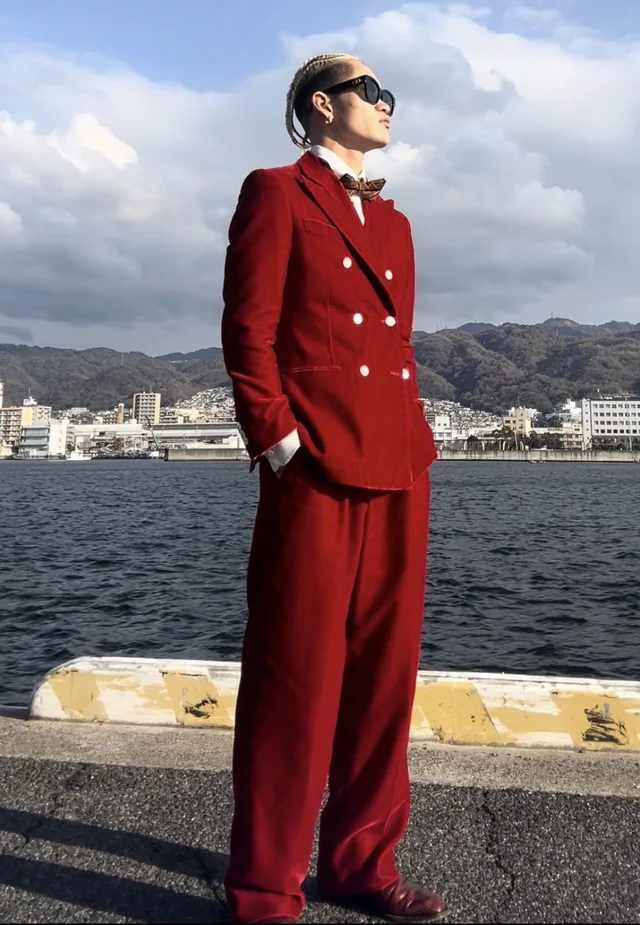
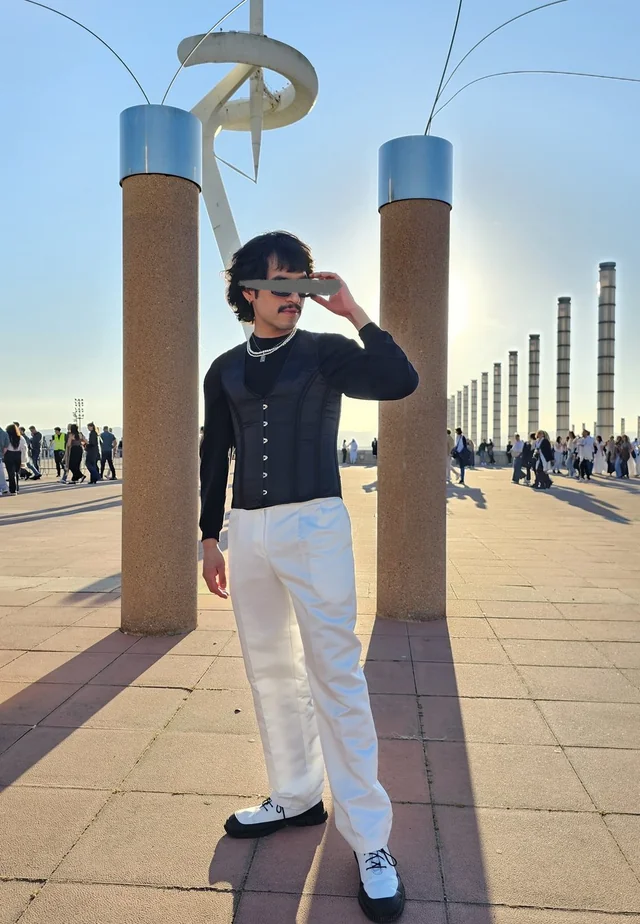
Glamrock
Summary. Glam rock is a spectacle-engineering system: a regime of material intensification in which every garment surface, every square centimeter of skin, and every accessory functions as a light-catching, gender-expanding, spatially amplifying interface between performer and audience. Emerging in Britain between 1971 and 1975, glam rejected the late-1960s rock ideology of authenticity — denim, workwear, naturalism — in favor of artifice understood as its own form of truth. The constructed persona (Bowie's Ziggy Stardust, Bolan's Cosmic Dancer, Roxy Music's Bryan Ferry) was a more honest declaration than the "authentic self" that blues-rock mythology demanded. The aesthetic runs on a single imperative: maximum optical event per unit surface area. Sequins, rhinestones, metallic lamé, glitter, platform soles, and cosmetic systems are not decorative additions — they are the primary engineering challenge. The garment exists to support embellishment, not the reverse.
In Material Terms
Glam's substrate is reflective, fragile, and hostile to the human body under performance conditions. Metallic lamé achieves 60–80% visible-spectrum reflectance but tears at low tensile loads and tarnishes through sweat-salt corrosion within 3–5 performances. Spandex blends provide the 300–600% stretch required for body-revealing fit but degrade under heat stress, perspiration, and chemical laundering. Sequin and rhinestone embellishment can add 5–15 kg to a single garment, demanding internal reinforcement architecture — boning, stay-tape, bias binding — to distribute load across the torso. Every material selection solves one engineering problem (light reflection, body contour, visual density) while creating others: weight, fragility, heat retention, and accelerated degradation under the exact conditions the garments are designed to inhabit.
At Category Level
Glam rock sits at the intersection of performance costume and subcultural dress, distinguished from both by its insistence that artifice constitutes authenticity. It separates from theater costume by its rock-music context and audience-participation dynamics; from punk by its embrace of spectacle over austerity; from goth by its chromatic maximalism over monochromatic severity; and from drag by its gender-identity politics — glam's androgyny challenged masculinity from within straight male rock culture, while drag's gender performance operates through different genealogies. The inversion of conventional construction hierarchy (fabric is primary, trim is secondary) defines glam's unique position: embellishment is not applied to a garment but constitutes the garment's reason for existing.
Methodologically
This entry treats glam rock as a performance-material system. Garments, cosmetics, footwear, and accessories are analyzed not as costume history but as engineered interfaces between the human body and the extreme conditions of live rock performance — 2,000–5,000W stage lighting, 35–45°C ambient temperature, continuous high-energy movement, audience distances of 5–50 meters, and sweat exposure over 60–120 minute sets. The focus is on how materials, construction techniques, and embellishment systems perform, degrade, and fail under these conditions, and how the expertise required to engineer them constitutes a knowledge economy that disappears when glam is reduced to "sequins and platforms."
Word (Etymology)
"Glam rock" contracts "glamorous rock," a term crystallized in the British music press during 1971–1972 to describe Marc Bolan (T. Rex) and David Bowie's theatricalized performances. The etymology traces through multiple genealogies: "glamour" derives from the Scots English alteration of "grammar" (as in occult knowledge, gramarye), retaining connotations of enchantment and spell-casting before its 20th-century narrowing to visual attractiveness; "rock" from "rock and roll," itself a euphemism for sexual intercourse in African American vernacular. The compound "glam rock" was initially pejorative — critics weaponized it to impute superficiality, frivolousness, and inauthenticity, everything the 1960s blues-rock orthodoxy (Cream, Led Zeppelin, the Rolling Stones' Beggars Banquet period) defined itself against [1][2].
The American variant "glitter rock" emphasized the literal material — glitter as applied surface — over the conceptual framework of glamour-as-performance. Related terminology: "gender-bender" (British tabloid coinage for androgynous presentation, applied to Bowie, Boy George, and later to Pete Burns and Marilyn); "camp" (Susan Sontag's 1964 theorization of exaggerated aestheticism directly applicable to glam's sensibility, though glam practitioners rarely used the term themselves); "art rock" (Roxy Music's preferred framing, positioning theatricality as intellectual project rather than pop entertainment) [1][3].
Subculture
Glam rock's subcultural structure differs fundamentally from peer-to-peer subcultures like punk or goth: it is a performer-to-audience transmission system in which a small number of originator-performers (Bowie, Bolan, Ferry, Alice Cooper, KISS) broadcast aesthetic codes through mass media — primarily BBC's Top of the Pops (1964–2006), the single most important vector for glam's visual dissemination — which audiences then interpret, adapt, and perform in concert attendance, record-store browsing, and street presentation [1][2][4].
The expertise economy operates across several tiers:
Originator tier (performers and their design collaborators). This tier possesses the deepest material knowledge: Kansai Yamamoto's construction expertise in translating kabuki costume engineering to rock-performance contexts; Natasha Korniloff's pattern-cutting for Bowie's Aladdin Sane tour; Zandra Rhodes' textile-print design adapted for stage visibility. The expertise here is genuinely specialized — understanding how a garment must be cut to accommodate a guitar stance, how embellishment must be secured to survive headbanging, how fabrics must breathe to prevent heat collapse during 90-minute sets under PAR can stage lighting [5][6].
Inner-circle tier (dedicated fans with material knowledge). These practitioners — concentrated in 1970s London around shops like Biba (Kensington High Street, 1964–1975), Mr. Freedom (King's Road), Alkasura (King's Road), and the sex shops of Soho — possessed sourcing knowledge: where to find metallic fabrics, theatrical-supply glitter, platform sole cobblers, and stage makeup suitable for male skin. Their expertise was practical and specific: how to apply loose glitter to skin that would be sweating (mixing with Vaseline or theatrical adhesive rather than hoping dry glitter would adhere); how to walk in 15 cm platforms without ankle injury; how to construct a feather boa that wouldn't shed catastrophically under movement [4][7].
Mass-audience tier. The widest tier experienced glam primarily through Top of the Pops broadcasts, album covers, and concert attendance. Their adoption was selective and adaptive: a boy applying his mother's eyeliner before a T. Rex concert; girls cutting up metallic fabrics from market stalls to approximate Bowie's costumes. The material knowledge at this tier was improvisational rather than systematic, producing the creative misreadings that Hebdige [8] identifies as subcultural innovation — getting the look "wrong" by necessity and thereby inventing new variations.
Contemporary transmission operates through: revival performance circuits (tribute acts, themed club nights), archival media (Mick Rock's photography, documentary films), fashion-industry citation (designers referencing glam in collections), and platform-mediated aesthetics (Instagram/TikTok glam-revival accounts, drag performance drawing on glam vocabulary). The contemporary glam practitioner's expertise centers on archival knowledge — identifying which Bowie era a particular fabric or silhouette references, distinguishing original 1970s platforms from contemporary reproductions — rather than the improvisational material knowledge of the original scene [2][9].
History
Pre-glam foundations (1960s). Glam's material preconditions were established through three convergent streams: (1) Art-school theatricality — British art schools (Hornsey, Ealing, Camberwell, St Martins) trained musicians who understood visual presentation as constitutive rather than supplementary: Bryan Ferry (Newcastle art school), Pete Townshend (Ealing), John Lennon (Liverpool), and later Bowie (Bromley Technical) absorbed the premise that aesthetic construction was intellectual practice, not mere decoration [10]. (2) Mod's male fashion consciousness — the mod movement (1960s London) established that British working-class men could invest serious attention in clothing without forfeiting masculine credibility, creating the cultural precondition for glam's more extreme interventions [8]. (3) Warhol's Factory and the Velvet Underground — Andy Warhol's management of the Velvet Underground (1965–1967) demonstrated that rock performance could incorporate visual-art concepts (multimedia light shows, costume as character, the performer as manufactured image), providing the conceptual framework that Bowie would operationalize more systematically [11].
Marc Bolan's breakthrough (March 1971). The conventional origin point: Marc Bolan appeared on BBC's Top of the Pops performing "Hot Love" wearing glittering satin, glitter applied to his cheekbones, a feather boa, and satin trousers — broadcasting theatrical androgyny into approximately 15 million British living rooms simultaneously. The significance was not the costume itself (theatrical performers had worn similar) but its medium-specific amplification: television's domestic intimacy made Bolan's presentation unavoidable for families watching together, producing a generational shock-encounter that concert attendance alone could not have achieved. Bolan — born Mark Feld in Hackney, East London, son of a lorry driver — represented glam's class dynamics from its origin: working-class boys adopting aristocratic/Hollywood visual codes as aspirational transformation [1][2][4].
Ziggy Stardust era (June 1972–July 1973). David Bowie's creation of Ziggy Stardust — a fictional bisexual alien rock star who serves as messianic figure before self-destructing — elevated glam from visual style to narrative-material system. The character required not just costumes but a complete material identity: Kansai Yamamoto designed seven costumes for the 1973 UK tour, applying Japanese kabuki construction techniques to Western rock contexts. The most iconic pieces — the "Woodland Creatures" bodysuit (asymmetrical leg construction, hand-painted mythological figures), the "Tokyo Pop" jumpsuit (geometric vinyl panels requiring industrial-sewing-machine capability), the red vinyl "Space Samurai" boots — represented genuine cross-cultural construction innovation. Yamamoto's pattern-cutting derived from kimono flat-construction principles (minimal waste, rectangular panel assembly) adapted to the three-dimensional body-revealing demands of Western performance wear. This was not costume design drawing on Japanese "inspiration" but structural engineering translation between distinct garment-construction traditions [5][6][12].
Bowie's Ziggy-era makeup — the red mullet (achieved with Schwarzkopf "Red Hot Red" dye, maintained by hairstylist Suzi Ronson), the lightning-bolt face paint (designed by makeup artist Pierre La Roche for the Aladdin Sane album cover, executed in red and blue greasepaint), the eyebrow shave — established cosmetic systems that required daily professional application. The material reality behind the iconic images was laborious: greasepaint formulations of the early 1970s were oil-based (typically a petrolatum/wax/pigment matrix), offering high opacity and color saturation but poor breathability, promoting sweat-induced slip during performance, and requiring complete removal with cold cream followed by reapplication for each appearance [6][13].
UK chart dominance (1971–1975). The commercial peak saw glam aesthetics adopted across the spectrum of British popular music: Slade (Noddy Holder's mirrored top hat, Dave Hill's "superyob" platform boots custom-built by cobbler Stan Miller to heights of 20+ cm), Sweet (silver lamé jumpsuits, glitter eye makeup), Mud (Les Gray's Elvis-via-glam styling), and Gary Glitter (rhinestone-encrusted jumpsuits weighing 5–10 kg due to embellishment density). The material escalation was competitive: each Top of the Pops appearance demanded more visible spectacle than the last, driving embellishment density upward in an arms race that eventually became self-parodic [1][4][14].
Simultaneously, artists not central to glam adopted its vocabulary selectively: Elton John's spectacle-glasses (designed by LA Eyeworks, incorporating feathers, batteries, lights, and motorized elements) constituted eyewear-as-engineering-project; Queen's Freddie Mercury deployed glam's bodily confidence (leotards, bare-chested performance) while maintaining harder rock credibility; Rod Stewart's leopard-print-and-spandex period borrowed glam's material vocabulary while retaining a blues-rock musical framework [2][14].
American variants. The US developed parallel but structurally distinct glam expressions: the New York Dolls (formed 1971) combined glam's androgyny with proto-punk aggression — their material aesthetic (lipstick, high heels, women's clothing purchased from thrift stores and trash bins) was deliberately degraded, rejecting British glam's polish for a specifically New York gutter-glamour that would directly influence the Ramones, Sex Pistols (via Malcolm McLaren's brief management), and Richard Hell [15]. Alice Cooper (born Vincent Damon Furnier) merged glam theatricality with Grand Guignol horror: boa constrictors, guillotines, fake blood — props requiring backstage engineering infrastructure (animal handlers, safety mechanisms, stage-blood chemistry — typically corn syrup, food coloring, and thickening agents that stained costumes irreversibly, requiring fresh garments per tour leg) [16]. KISS (formed 1973) industrialized glam's spectacle principle: the four face-paint personas (Starchild, Demon, Spaceman, Catman) eliminated individual identity entirely in favor of trademarked characters, while their pyrotechnic staging (Gene Simmons' fire-breathing using kerosene, Ace Frehley's smoking-guitar effect, platform boots with working lights) represented glam's material logic taken to its industrial endpoint [16][17].
Decline and mutation (1975–1985). Mainstream glam faded as punk emerged (1976), ostensibly rejecting glam's commercial excess — though punk inherited glam's expanded gender expression (Siouxsie Sioux's Bowie-indebted eye makeup), DIY aesthetics (already present in glam's audience tier), and the premise that performance could be more real than authenticity. Glam's DNA survived through direct lineage: hair metal/glam metal (Mötley Crüe, Poison, Def Leppard, 1983–1991) maintained visual excess while stripping away intellectual content; New Romantic (Duran Duran, Spandau Ballet, Adam Ant, 1980–1984) combined glam's theatricality with synthesizer pop and Blitz Kids' club culture; goth inherited dramatic cosmetics and androgyny while shifting the palette toward black; Japanese Visual Kei (X Japan, Malice Mizer, 1982–present) continued glam's core premise of music-as-visual-spectacle with construction sophistication that often exceeded British originals [8][18][19].
Contemporary revival (2010s–present). Artists including Lady Gaga (explicitly citing Bowie, deploying prosthetic and garment engineering — the meat dress as material-statement extreme), Harry Styles (glam-adjacent gender fluidity styled by Harry Lambert, Gucci partnership), Måneskin (Italian rock band performing Eurovision 2021 in Etro custom-embellished suits), Lil Nas X (consciously deploying glam's queer-spectacle logic through Versace and Richard Quinn commissions), and Janelle Monáe (tuxedo-as-gender-performance, android persona echoing Ziggy's alien distancing) sustain glam's material vocabulary. The critical difference: where 1970s glam operated through plausible deniability (Bowie's bisexuality announcement was shocking precisely because the aesthetic almost contained it within sci-fi fantasy), contemporary practitioners deploy glam's codes in an era of explicit queer visibility, altering the political charge from unconventional ambiguity to celebration-through-citation [2][9][20].
Silhouette
Glam rock silhouettes solve a specific engineering problem: how to maximize the performer's visual presence across audience distances of 5–50 meters under high-intensity stage lighting while enabling continuous high-energy movement. Every proportion choice serves this visibility logic:
Vertical amplification through platform engineering. The platform boot is glam's signature construction challenge. Original 1970s platforms ranged from 7.5 cm (3 inches, the conservative entry point) to 20+ cm (8 inches, Dave Hill's custom builds). Construction involves: (1) a sole unit — typically stacked layers of cork, wood, or compressed fiber bonded with contact adhesive and covered in leather, vinyl, or fabric; (2) an upper — leather, PU leather, or fabric stretched over a last (foot-shaped mold) and cemented or stitched to the sole; (3) a heel block — which in true platforms is continuous with the sole (the entire foot is elevated equally, unlike stilettos which elevate the heel disproportionately). The engineering challenge is weight distribution: a 15 cm platform sole in cork weighs approximately 400–600 g per boot (compared to ~200 g for a conventional boot sole), shifting the wearer's center of gravity and increasing ankle-injury risk. Stan Miller, Slade's cobbler, addressed this by incorporating steel shanks (supportive metal plates between insole and outsole) and sculpting the interior footbed to cradle the foot's arch, distributing weight across the entire plantar surface rather than concentrating it at heel and ball [4][7][14].
The biomechanics of platform performance are non-trivial: the elevated sole increases lever-arm forces on the ankle joint by 30–50% relative to flat footwear, meaning that lateral movements (stage crossing, dancing, jumping) carry substantially higher sprain risk. Performers developed adapted movement vocabularies — wider stance for stability, deliberate placement rather than quick directional changes, and the characteristic glam-rock strut (a controlled, hip-rolling gait that manages momentum transfer through elevated soles). Marc Bolan's fatal car accident (September 1977) occurred in platforms, though the crash was caused by his partner's driving rather than footwear; the association between platforms and physical danger was already culturally established [4][14].
Body-revealing fit through stretch construction. The spandex/Lycra jumpsuit — glam's other signature silhouette — presents a pattern-cutting challenge: stretch fabrics require negative ease (the pattern is cut smaller than body measurements, relying on fabric stretch to achieve skin-tight fit) typically at 10–20% reduction from body measurements depending on the fabric's stretch percentage. A four-way stretch spandex (stretching in both warp and weft directions) with 80% stretch capacity allows more aggressive negative ease than a two-way stretch satin with 20% stretch. The pattern must account for movement vectors: armholes cut deeper than standard to accommodate guitar playing, crotch gussets inserted for leg-spread movement (high kicks, stage splits), and shoulder seams positioned to allow overhead arm extension. The jumpsuit's continuous shoulder-to-ankle line — eliminating the visual interruption of a separate top and bottom — creates a streamlined body silhouette that reads as a single graphic element from audience distance [6][12][21].
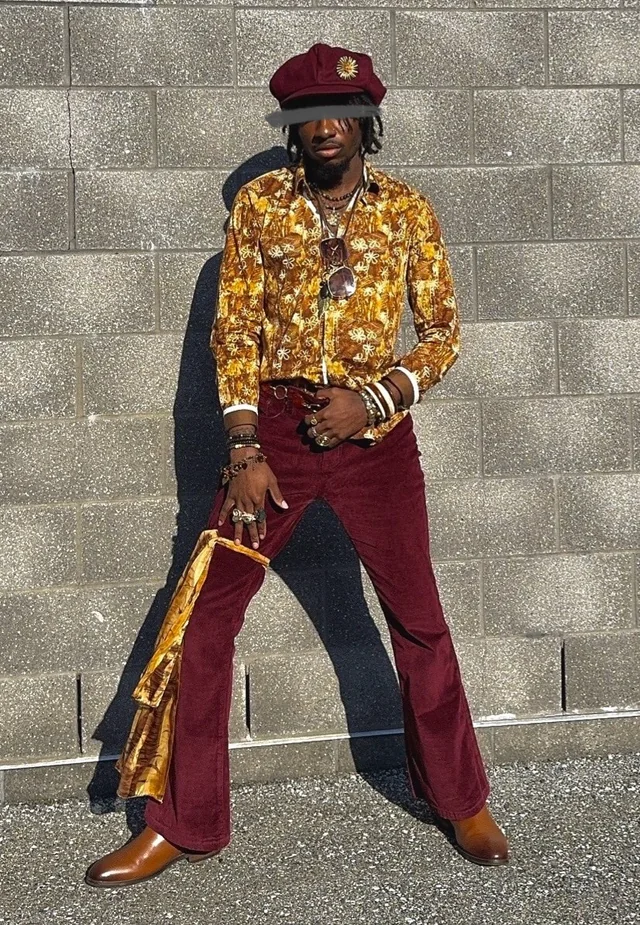
Volume addition through capes, boas, and flared trouser legs. Where the jumpsuit reduces the body to a streamlined graphic, volumetric additions — feather boas (600–1,200 mm in standard length, 100–150 mm diameter, weighing 50–150 g depending on feather density), flowing capes (cut on the bias for drape, or in stiff metallic fabric for sculptural effect), and extremely flared trousers (circumference at hem reaching 60–80 cm per leg, compared to 40–50 cm for standard wide-leg) — create movement amplification. The principle is identical to theatrical costume design: fabric volume translates small body movements into large visual events. A hip sway that would be invisible in straight-leg trousers produces a visible fabric wave in 80 cm flares; an arm gesture that registers only at close range generates a rippling cape effect visible from the back of a 3,000-seat venue [12][21].
Materials
Glam rock's material logic is governed by a single principle: maximum optical event under stage lighting conditions. Every material selection is a solution to the engineering problem of reflecting, refracting, or generating light at distances of 5–50 meters under PAR (Parabolic Aluminized Reflector) can spotlights and Fresnel floods operating at color temperatures of 3,200K (tungsten) with total stage-lighting power of 2,000–10,000W in 1970s concert venues:
Metallic lamé. Lamé fabrics incorporate metallic yarns — originally aluminum-coated polymer film slit into narrow strips and woven or knit with textile fibers — creating a continuously reflective surface. 1970s lamé used aluminum-coated polyester film (Lurex is the most common trade name, registered 1946), which achieves reflectance of 60–80% in the visible spectrum under direct illumination. The construction challenge: metallic film yarns have zero elasticity and low tensile strength (breaking at 2–5 N depending on width), meaning lamé fabrics cannot stretch and tear easily at stress points. Garments in lamé require: seam-reinforcement at all stress points (underarms, crotch, shoulder), reduced seam allowances to prevent stiffness at seam junctions, and lining to prevent the metallic surface from direct skin contact (metallic yarns irritate skin through abrasion, and sweat-salt corrodes aluminum coatings, producing tarnishing and black oxidation marks within 3–5 wears) [21][22].
Failure modes of lamé: Aluminum-coated polyester yarns tarnish through oxidation when exposed to perspiration (salt-accelerated corrosion), producing dull gray patches within 3–5 performances of heavy use. Washing accelerates degradation: machine washing causes metallic film to delaminate from the polymer substrate, producing a matte, flaking surface. Dry cleaning with perchloroethylene is the standard maintenance pathway, but repeated chemical exposure embrittles the metallic film. Functional lifespan of a lamé stage garment under tour conditions: 10–30 performances before visible tarnishing requires replacement or re-metallization of key panels [22].
Spandex/Lycra. Elastane fiber (DuPont's Lycra brand, introduced 1959) provides the 300–600% stretch required for glam's body-revealing fit. In 1970s formulations, elastane was typically blended at 15–25% with nylon (for sheen) or polyester (for durability), producing fabrics with 80–150% stretch and 95%+ recovery. Under stage conditions, spandex-blend fabrics face: (1) heat stress — elastane's glass transition temperature is approximately 180°C, safely above stage-lighting ambient temperatures, but prolonged exposure to direct spotlights (which can produce localized surface temperatures of 50–60°C on dark-colored fabrics) accelerates molecular chain relaxation, reducing elastic recovery over time; (2) sweat degradation — urea and salt in perspiration degrade elastane's polyurethane polymer chains, reducing stretch recovery by 10–20% over 20–50 wear cycles; (3) chlorine vulnerability — relevant for post-performance laundering, as chlorine bleach catastrophically degrades elastane, converting the fiber from elastic to brittle within a single wash [21][22][23].
Sequin and rhinestone fabrics. Sequins (flat metallic or plastic discs, 5–20 mm diameter, sewn or heat-applied to fabric substrate) and rhinestones (faceted glass or acrylic crystals, point-back or flat-back, 2–10 mm diameter, heat-set or prong-set) constitute glam's primary embellishment engineering challenge. A heavily sequined jumpsuit may incorporate 5,000–20,000 individual sequins, each requiring either: (1) chain-stitch application (sequins threaded on a cord and stitched in continuous lines — faster production but vulnerable to catastrophic unraveling if a single stitch breaks), or (2) individual tack-stitching (each sequin stitched separately — labor-intensive but failure of one sequin doesn't affect adjacent ones). Rhinestone application uses either: (1) heat-set adhesive (rhinestones with pre-applied hot-melt glue activated by heat-press — fast application, moderate adhesion, vulnerable to detachment through sweat exposure and flexion), or (2) prong-setting (metal claws crimped around the stone and pushed through fabric — strongest attachment, but adds weight and creates pressure points that can tear lightweight substrates) [21][22].
Weight implications of embellishment density: A Gary Glitter rhinestone-encrusted jumpsuit weighed an estimated 5–10 kg (compared to 0.5–1 kg for an unembellished garment of equivalent coverage), adding significant physical demand to 60–90 minute performances. Elton John's most elaborate stage outfits reportedly exceeded 15 kg including structural elements (feather plumes, battery-powered lighting). This weight distribution creates ergonomic stress: shoulder seams bear disproportionate load in jumpsuit construction, requiring internal reinforcement (canvas stay-tape or wide bias binding along shoulder seams) to prevent seam failure under the combined stress of movement and embellishment mass [14][22].
Glitter: Applied particle optics. Loose glitter — precision-cut metallic polyester film particles, typically 0.1–3 mm diameter hexagonal or square shapes — is glam's most ubiquitous and most problematic material. The optical principle is simple: each glitter particle acts as a tiny mirror, and the random orientations of thousands of particles on a curved surface (face, chest, fabric) create omnidirectional light reflection — the surface appears to sparkle from every viewing angle, unlike a flat mirror which reflects directionally. Application to skin requires an adhesive matrix: 1970s practitioners used Vaseline (petroleum jelly), theatrical spirit gum, or cosmetic-grade adhesives; contemporary formulations use polyvinyl-alcohol-based body glues. The failure mode is migration: glitter particles detach through sweat, movement, and contact transfer, producing the notorious "glitter contamination" that persists in environments for days or weeks (polyester glitter is non-biodegradable, dimensionally stable, and electrostatically clingy). Environmental concerns have produced biodegradable alternatives (cellulose-based glitter, typically regenerated cellulose coated with aluminum), though these degrade in optical intensity within 4–8 hours of skin application due to moisture absorption [22][24].
Feathers. Boas (ostrich, marabou, or turkey feathers knotted or sewn onto a central cord) and feather trim are structurally vulnerable: the barb-barbule interlocking structure that gives feathers their coherent surface is disrupted by: movement (performance-intensity arm gestures cause feather-on-feather friction, producing "bald spots" of lost barbules), moisture (sweat causes barbs to clump, destroying the fluffy volume that is the boa's primary visual purpose), and static electricity (generating in low-humidity environments, causing feathers to repel each other and the boa to appear sparse). A high-quality ostrich-feather boa (60–80 g, 1,500 mm length) has a performance life of approximately 5–15 uses before visible degradation; cheaper turkey-feather boas degrade within 2–5 uses. Steaming can partially restore barb alignment, but lost barbules are unrecoverable [22].
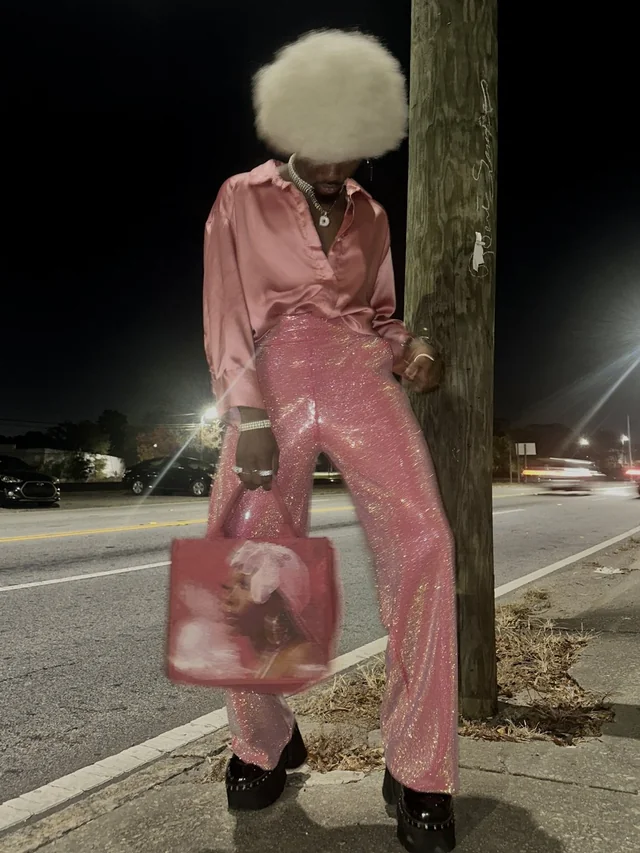
Satin. Woven satin (typically polyester or acetate in 1970s production, occasionally silk for premium pieces) achieves glam's characteristic liquid sheen through its weave structure: 4:1 or 7:1 satin weave floats long warp threads over multiple weft threads, creating a smooth surface with high specular reflectance. Under stage lighting, satin reflects light directionally (unlike glitter's omnidirectional scatter), producing dramatic highlight-and-shadow contrast that emphasizes body contour — the reason satin is preferred for tight-fitting shirts and trousers. Failure modes: satin is highly vulnerable to snag damage (any sharp contact pulls floating yarns, creating irreparable pulls), water-spotting (droplets cause permanent marks on acetate satin, less so on polyester), and seam slippage (the smooth yarns slide relative to each other under stress, causing seams to gape — a particular problem in tight-fitting garments under movement stress) [22].
Color Palette
Glam's chromatic logic is optical maximalism under artificial illumination: colors are selected not for how they appear in daylight (irrelevant, since glam exists primarily on stage and under studio lighting) but for how they interact with 3,200K tungsten spotlights and color gels:
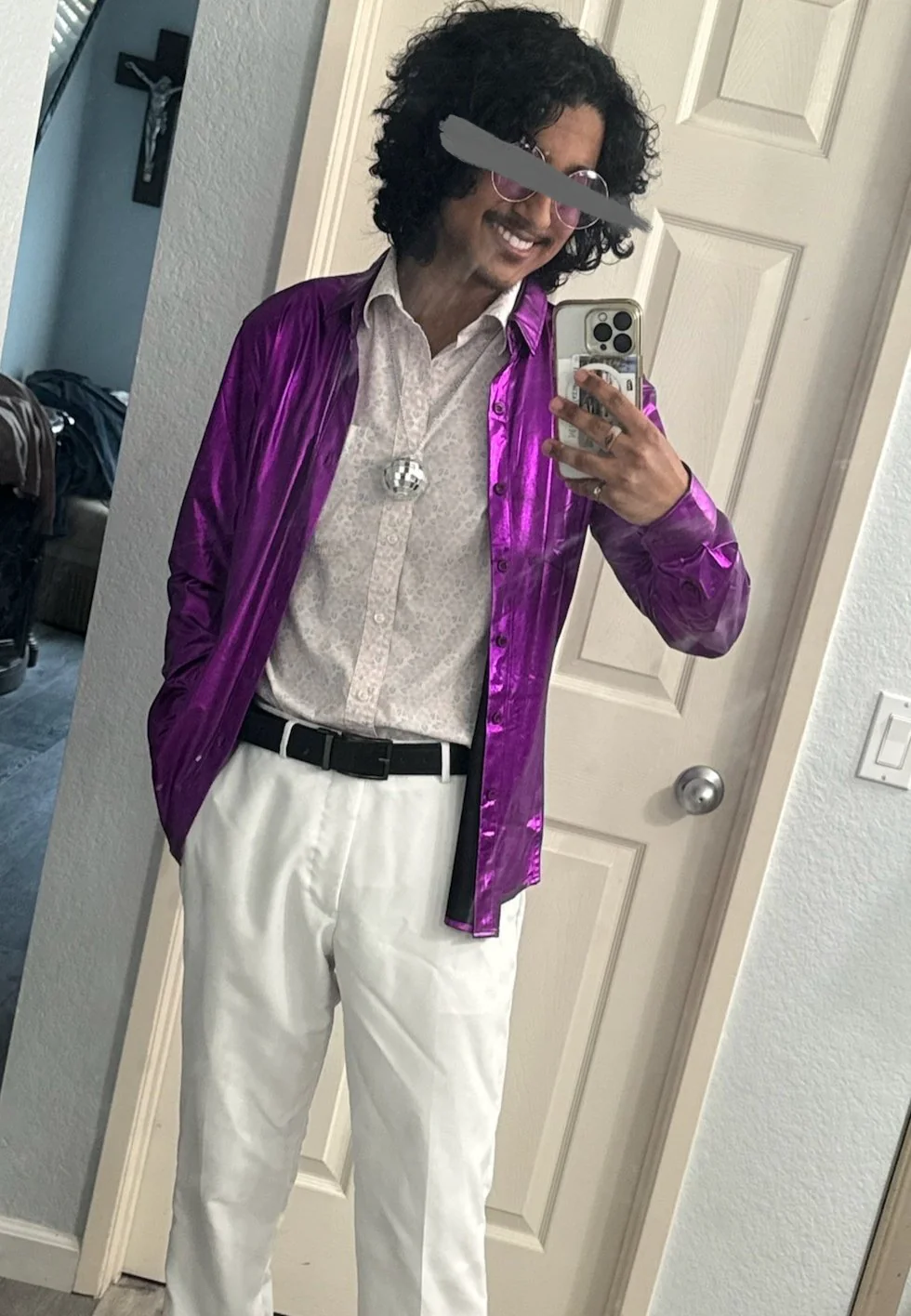
Metallics as base palette. Gold, silver, copper, and bronze — achieved through metallic lamé, sequins, or metallic-finish fabrics — function as neutral bases in glam's chromatic system because they reflect whatever colored light falls on them, appearing warm under amber gels, cool under blue, and neutral under white. This chromatric adaptability makes metallics the safest stage choice.
Saturated primaries and secondaries at maximum chroma. Red, royal blue, electric purple, hot pink, emerald green — chosen at maximum saturation because stage lighting washes out subtlety. A color that reads as nuanced under retail lighting becomes muddy under 5,000W of mixed stage illumination; only maximum-chroma colors retain their identity across lighting conditions.
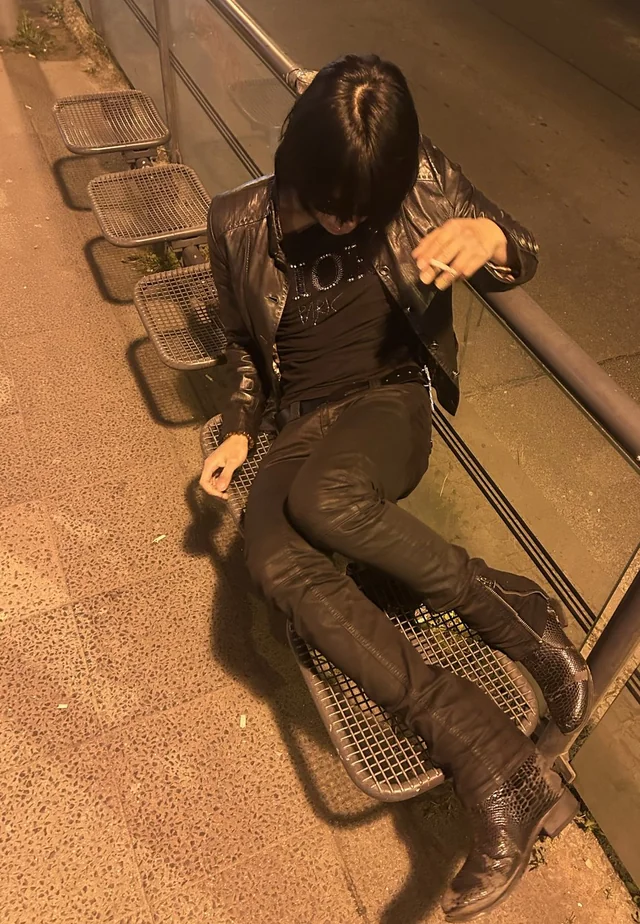
Black as structural frame. Glam's use of black (PVC, leather, velvet) provides contrast framing for reflective elements — a rhinestone-encrusted panel reads more dramatically against matte black than against another reflective surface. Black velvet (which absorbs 95%+ of incident light) paired with sequins (which reflect 60–80%) creates extreme contrast ratios that enhance perceived sparkle.
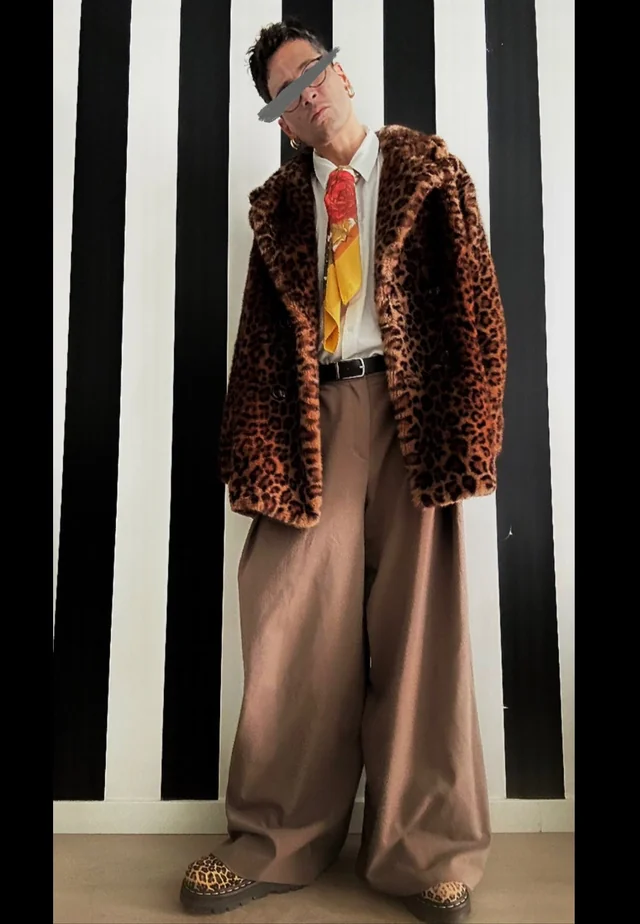
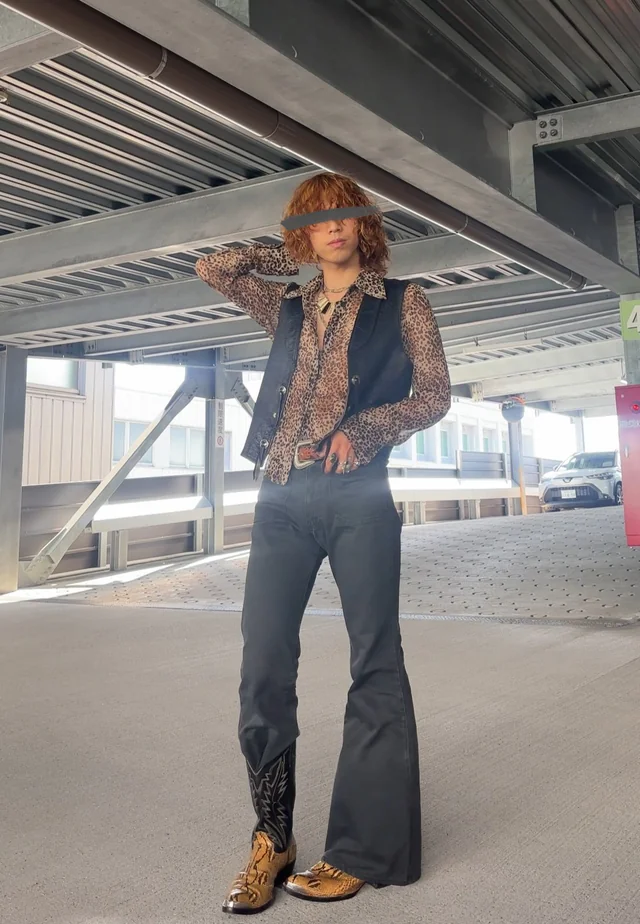
Animal prints as pattern-camouflage. Leopard (Marc Bolan's signature), zebra, tiger — these high-contrast patterns serve a specific stage function: they create visual interest at distances where solid colors appear flat. The irregular repeat pattern of leopard print activates figure-ground perception even at audience distances where individual spots are unresolvable, producing a "vibrating" visual texture [22].
Details
Details in glam rock function as optical interfaces — systems engineered to catch, scatter, and generate light — and must be analyzed as engineering solutions to the visibility problem rather than as decorative choices:
Cosmetic systems as material engineering. Glam's most technically demanding detail system is the male-presenting face under stage makeup: 1970s stage makeup formulations were oil-based greasepaint (a petrolatum/beeswax/pigment emulsion, typically Leichner or Max Factor brands), offering high opacity (essential for covering beard shadow, skin imperfections, and creating a uniform base for graphic elements) and intense color saturation but poor breathability, low sweat-resistance, and a tendency toward "slip" (pigment migration through perspiration) after 30–45 minutes under stage lighting [6][13][25].
Bowie's Ziggy-era makeup required: (1) base application — full-coverage greasepaint in a shade 2–3 tones lighter than natural skin, applied with sponge, creating the "otherworldly" pallor that read as alien from stage distance; (2) contouring — darker greasepaint applied to hollows of cheeks, jawline, and nose bridge to sculpt facial geometry for distant legibility; (3) eye design — the most technically demanding element, requiring graphic precision with brush-applied liquid or cream pigments (Bowie's characteristic color-field eyeshadow extending from brow to cheekbone in blocks of blue, red, or gold); (4) lip color — typically glossy and dark (plum, wine, or metallic), applied beyond the natural lip line to enlarge the mouth for stage legibility; (5) graphic elements — the Aladdin Sane lightning bolt (Pierre La Roche, 1973) required freehand application in red and blue greasepaint, with a teardrop detail, demanding steady-hand precision that constituted genuine artisanal skill [6][13].
The failure mode of 1970s stage makeup was thermal collapse: after 30–45 minutes under stage lighting at ambient temperatures of 35–45°C, greasepaint formulations began to soften and migrate, producing smudging, color bleed, and the "melting face" effect visible in late-set performance photographs. Contemporary equivalents use polymer-based long-wear formulations (silicone emulsions, film-forming polymers) with substantially better heat resistance, explaining why contemporary glam-revival performers can maintain crisp cosmetic detail through multi-hour festival sets [13][25].
Exposed hardware as graphic rhythm. Zippers (exposed metal, often brass or nickel-plated, chosen for reflective flash rather than concealment), studs (dome or pyramid, press-set or prong-set, typically brass or nickel-plated steel), and grommets (metal rings reinforcing lace-holes in corset-style closures) serve dual functions: they are functional closures AND they create rhythmic visual patterns — a line of studs down a jacket front establishes a vertical axis; lace-up closures create X-patterns that draw the eye along the garment's centerline. The engineering constraint: hardware adds weight, concentrates stress at attachment points, and creates potential skin-contact irritation points — studs that press against skin during performance movement can cause abrasion, requiring either internal lining or careful placement away from high-pressure body zones [21][22].
Embellishment attachment as invisible engineering. The labor of glam's detail work is precisely what disappears in photographic documentation: a jumpsuit that reads as "covered in rhinestones" in a photograph represents 20–80 hours of hand-application work (depending on stone density and attachment method). The skill hierarchy: (1) heat-press application (fastest, lowest skill, moderate adhesion — production assistants can learn in hours); (2) hand-sewing sequins (moderate speed, moderate skill, strong attachment — requires understanding of thread tension and stitch pattern to maintain flat lie across curved surfaces); (3) prong-setting rhinestones in metallic settings (slowest, highest skill, strongest attachment — requires jewelry-making precision, each stone must be oriented for maximum light-catch given its position on the body's curvature). Kansai Yamamoto's hand-painting of Bowie's costumes — applying acrylic pigments directly to garment surfaces with brush precision — represents the apex of glam's detail-labor hierarchy [5][6][22].
Accessories
Platform boots (analyzed in Silhouette section) constitute the primary accessory system. Supplementary accessories function as spatial amplifiers:
Feather boas extend the body's profile by 100–150 mm in all directions, creating a soft-focus edge that amplifies gesture. Construction: feathers (ostrich, marabou, or turkey) knotted or sewn at the quill onto a central cord (cotton or nylon), with density determining visual weight (12–20 feathers per linear centimeter for premium boas, 6–10 for budget). Performance use: draped over shoulders, wrapped around microphone stands, trailed behind during stage crosses — each configuration creates different movement profiles.
Oversized eyewear. Elton John's spectacle collection (designed collaboratively with LA Eyeworks and other custom opticians) constitutes eyewear-as-engineering: motorized elements (spinning stars, flashing LEDs powered by concealed battery packs), structural frames supporting feather, sequin, and dimensional attachments weighing 200–500 g (compared to 15–30 g for standard spectacles), and lens sizes exceeding 80 mm diameter (requiring non-standard optical-lens grinding for prescription correction). The biomechanical challenge: heavy eyewear creates pressure on the nose bridge and ear hooks, requiring custom-fitted silicone nose pads and temple adjustment to prevent migration during performance movement [14].
Jewelry and chains. Layered necklaces (mixed chain weights from fine curb-link to heavy cable-link), stacked rings, and oversized pendants create light-catching surfaces at the neck, chest, and hand zones — the body areas most frequently illuminated by follow-spot lighting during vocal performance. Sterling silver and gold-plated base metal were standard; the reflective requirement was more important than material value.
Scarves and fabric accessories. Silk or polyester scarves (tied at neck, wrist, or microphone stand) added movement-responsive fabric that amplified gesture at minimal weight. Marc Bolan's feather and silk scarves became signature accessories — their near-zero weight meant they could be worn continuously without performance-fatigue cost.
Body Logic
Glam's body logic operates a double inscription: the body is simultaneously hypermasculine (tight garments revealing male musculature, bare chests, codpieces emphasizing genitalia) and feminine (makeup, jewelry, flowing fabrics, platform-elevated gait). This is not contradiction but interference pattern — the simultaneous presence of masculine and feminine codes produces a third reading that is neither, a constructed alien-ness that Bowie literalized through the Ziggy Stardust persona [2][12][20].
Class transformation through material artifice. The bodies performing glam were overwhelmingly working-class British male bodies: Bolan from Hackney, Bowie from Brixton (via Bromley), Noddy Holder from Walsall, Gary Glitter from Banbury. The aesthetic's investment in platform elevation, metallic fabric, and cosmetic transformation performed literal upward mobility — making the body taller, shinier, more luminous than its social origins would predict. Auslander [12] reads this as "performing glamour as compensation for social deprivation," a reading that connects glam to camp's historical function as a survival strategy for marginalized subjects (though glam's performers were more class-marginal than sexually marginal, despite Bowie's bisexuality announcement).
Queer coding and plausible deniability. Glam operated in a specific historical window (1971–1975) between the partial decriminalization of male homosexuality in England (Sexual Offences Act 1967, legalizing private homosexual acts between men over 21) and the wider social acceptance that would emerge decades later. The sci-fi/alien framing — Ziggy as extraterrestrial, Bolan as Cosmic Dancer — provided plausible deniability: gender transgression could be consumed as fantasy rather than identity. This allowed mass-television audiences to enjoy androgynous spectacle while maintaining heteronormative interpretive frameworks. The queer content was simultaneously present (Bowie's 1972 Melody Maker bisexuality announcement) and containable (it's just a character, it's just rock and roll) — a productive ambiguity that Auslander [12] identifies as glam's distinctive political mechanism [2][12][20].
Spatial claim. Platform boots, capes, teased hair, and wide-stance postures produced bodies that occupied more physical space than their unadorned equivalents — a spatial amplification that coded as power regardless of the gender signals layered onto it. This is the other dimension of glam's body logic: it is fundamentally about taking up space, about refusing the physical modesty that British class norms demanded of working-class bodies [4][12].
Garment Logic
Construction principles. Glam garment construction follows an inverted priority hierarchy: (1) embellishment (the surface treatment is the primary design consideration); (2) silhouette (the garment must achieve the required profile); (3) fit (the garment must be tight enough or flowing enough to serve the silhouette); (4) durability (the garment must survive the performance conditions); (5) comfort (the least important consideration — performers tolerated significant discomfort in service of visual impact) [6][12][21].
This inversion means that construction techniques are subordinated to surface requirements: seam placement is determined by where embellishment panels fall rather than by conventional tailoring logic; dart and ease allocation serve the visual profile rather than ergonomic fit; and internal structure (interfacing, lining, boning) is determined by the weight and attachment requirements of surface embellishment rather than by garment-shape tradition.
Kansai Yamamoto's construction innovation. Yamamoto's Bowie costumes represent the most technically sophisticated glam construction: the "Woodland Creatures" bodysuit employed flat-pattern assembly derived from kimono construction (where garments are assembled from rectangular panels rather than shaped pattern pieces), adapted to Western body-revealing fit through strategic dart insertion and panel shaping. The "Tokyo Pop" jumpsuit used geometric vinyl panels — PVC sheeting cut in precise angular shapes and edge-joined through industrial-grade cement bonding (heat-welded PVC seams rather than stitched textile seams), a technique borrowed from inflatable-product manufacturing rather than garment construction. These cross-disciplinary construction methods represent genuine innovation, not mere costume decoration [5][6].
Aftercare under tour conditions. Glam garments operated within a disposability spectrum:
- Tour-durable pieces (leather boots, structured jackets): Cleaned with solvent wipes between performances; leather conditioned weekly to prevent cracking from sweat-salt exposure; hardware polished to maintain reflectivity. Functional lifespan: one full tour (30–100 dates) with ongoing maintenance.
- Performance-consumable pieces (heavily embellished jumpsuits, lamé garments): Dry-cleaned every 3–5 performances (more frequently caused lamé degradation); sequin and rhinestone losses repaired by wardrobe assistants between shows; garments retired and replaced when embellishment loss exceeded 10–15% of original coverage. Functional lifespan: 10–30 performances.
- Single-use elements (feather boas, glitter, certain makeup applications): Replaced per performance or per short tour leg. No aftercare attempted.
This disposability hierarchy meant that a single Bowie tour required production of multiple copies of each costume piece — the wardrobe was industrial infrastructure, not personal possession [6][12].
Failure modes. (1) Embellishment detachment — the primary failure mode: sequins and rhinestones separate from substrates through adhesive failure (heat, sweat, flexion), producing visible gaps that break the "total surface" effect. Rate: 1–3% loss per performance for heat-set application, 0.5–1% for prong-set. (2) Metallic fabric degradation — lamé tarnishing, metallic thread breakage, coating delamination (see Materials section). (3) Platform sole delamination — the adhesive bond between stacked sole layers fails through repeated impact (walking, stage movement), producing dangerous separation; this requires cobbler repair or boot retirement. (4) Spandex recovery loss — stretch garments that lose elastic recovery through sweat degradation and repeated extension develop "bagging" at knees, elbows, and crotch, destroying the skin-tight silhouette. (5) Seam failure under embellishment weight — heavily embellished garments concentrate stress at seams; without reinforcement, shoulder seams in 5+ kg jumpsuits can fail mid-performance [21][22].
Motifs / Themes
Science fiction as gender-bypass. Ziggy Stardust's alien origin narrative, Bolan's "cosmic" vocabulary, Roxy Music's retro-futurism — sci-fi framing allowed gender transgression to be consumed as fantasy rather than identity politics. The alien body is exempt from terrestrial gender rules, providing a conceptual framework through which working-class British masculinity could be decoratively transformed without requiring its audience to accept queerness directly [2][12][20].
Animal prints as atavistic signal. Marc Bolan's leopard-print obsession, Iggy Pop's animal physicality, the widespread use of zebra, tiger, and snake patterns — these operate as counter-signals to glam's technological futurism, asserting that beneath the glitter and platforms lies something primal, predatory, and sexually dangerous. The dialectic between futurism (metallic fabrics, platforms, alien makeup) and atavism (animal prints, bare chests, sexual aggression) structures glam's iconography [1][4].
Hollywood Old Glamour citation. References to 1930s–1950s Hollywood (Jean Harlow's platinum satin, Marlene Dietrich's androgynous tuxedo, Mae West's exaggerated femininity) positioned glam's performers as successors to a pre-rock tradition of constructed spectacle — acknowledging that artifice-as-art has a genealogy older than rock and roll, and that the 1960s' authenticity ideology was the historical anomaly, not glam's embrace of performance [3][12].
Celestial and occult symbols. Stars, lightning bolts, crescent moons, mystical eyes — these served as graphic design elements (Ziggy's lightning bolt is fundamentally a graphic-design solution to the problem of making a face memorable from 50 meters) and as signifiers of esoteric knowledge (connecting to Bowie's interest in Aleister Crowley and the Golden Dawn during the Station to Station period, 1975–1976) [2].
Cultural Touchstones
Film:
- The Rocky Horror Picture Show (1975) — Jim Sharpe; Tim Curry's Dr. Frank-N-Furter crystallizes glam's gender-boundary-crossing spectacle into a participatory audience-culture phenomenon with 50+ years of continuous screening
- Velvet Goldmine (1998) — Todd Haynes; fictional glam narrative explicitly theorizing the aesthetic as constructed persona and queer desire
- Phantom of the Paradise (1974) — Brian De Palma; rock-opera incorporating glam's visual excess as genre material
- Hedwig and the Angry Inch (2001) — John Cameron Mitchell; punk-glam hybrid exploring gender, identity, and transformation as material practice
- Ziggy Stardust and the Spiders from Mars (1973) — D.A. Pennebaker; documentary of the final Ziggy concert, primary archival record of glam's performance-material system in action
Music (canonical recordings):
- David Bowie: The Rise and Fall of Ziggy Stardust and the Spiders from Mars (1972) — the conceptual apex
- T. Rex: Electric Warrior (1971) — the sonic origin point
- Roxy Music: For Your Pleasure (1973) — the art-school intellectual variant
- Lou Reed: Transformer (1972) — produced by Bowie, New York's glam translation
- New York Dolls: New York Dolls (1973) — the proto-punk degraded-glam variant
- KISS: Alive! (1975) — the industrialized American spectacle variant
Television:
- BBC's Top of the Pops (1964–2006) — the primary mass-media vector for glam's visual dissemination; the show's format (bands performing to playback in a studio with live audience) created the conditions for glam's visual escalation
Photography:
- Mick Rock — self-titled "The Man Who Shot the Seventies," Rock's photography of Bowie, Bolan, Lou Reed, Queen, and Iggy Pop constitutes the primary visual archive of glam performance; his images established the iconographic vocabulary through which glam is retrospectively understood [26]
See Also
- Punk: Direct heir — rejected glam's commercial excess while inheriting expanded gender expression and DIY premise
- Goth: Inherited cosmetic systems and androgyny, shifted to minor-key affect and black palette
- Hair Metal / Glam Metal (1983–1991): Maintained visual excess (spandex, teased hair, makeup) while stripping intellectual and queer content
- New Romantic (1980–1984): Combined glam theatricality with synthesizer pop and Blitz Kids club culture
- Visual Kei: Japanese movement continuing glam's performer-as-constructed-character premise with often superior construction sophistication
- Drag: Shares glam's investment in cosmetic transformation and gender performance, though drag's relationship to female impersonation is structurally distinct from glam's androgynous "third gender"
Brands and Designers
Original-era designers and ateliers:
- Kansai Yamamoto — Japanese designer; created Bowie's Ziggy Stardust and Aladdin Sane costumes; applied kabuki-derived flat-construction and hand-painting to Western rock performance
- Natasha Korniloff — Costume designer for Bowie 1973–1976; designed the Diamond Dogs and Young Americans stage wardrobes
- Freddie Burretti — Bowie's personal designer 1971–1973; created many early Ziggy-era stage outfits from his own patterns
- Zandra Rhodes — British textile designer whose printed chiffons and punk-inflected couture intersected glam aesthetics
- Ossie Clark — British couturier whose flowing bias-cut dresses and snake-skin pieces appeared in glam wardrobes
- Mr. Freedom (Tommy Roberts) — King's Road boutique (1969–1970) producing pop-art-influenced pieces that anticipated glam's colorful excess
- Biba (Barbara Hulanicki) — Kensington boutique (1964–1975) providing affordable glam-adjacent clothing; the Biba rainbow palette and Art Deco interiors constituted glam's retail infrastructure
Original-era footwear:
- Stan Miller — Custom cobbler for Slade, constructing bespoke platforms to 20+ cm heights with steel-shank reinforcement
- Terry de Havilland — London-based cobbler; platform wedge specialist; dressed glam-era performers and continues production
Contemporary glam-influenced:
- Gucci under Alessandro Michele (2015–2022) — maximalist embellishment, gender-fluid presentation, direct glam citation
- Saint Laurent under Hedi Slimane (2012–2016) — rock-star silhouette, Chelsea boots, glitter, skinny-fit androgyny
- Richard Quinn — London-based designer; embellishment-intensive construction with theatrical presentation
- Harris Reed — British-American designer; gender-fluid spectacular construction explicitly citing glam lineage
Performance and specialty:
- Pleaser Shoes — Contemporary platform boot manufacturer; primary supplier to drag, burlesque, and glam-revival performance
- Terry de Havilland — Continuing platform-wedge production from original 1970s molds and updated designs
Citations
[1] Turner, Alwyn W. Glam Rock: Dandies in the Underworld. V&A Publishing, 2013. [2] Chapman, Ian. Experiencing David Bowie: A Listener's Companion. Rowman & Littlefield, 2015. See also: Waldrep, Shelton. The Aesthetics of Self-Invention: Oscar Wilde to David Bowie. University of Minnesota Press, 2004. [3] Sontag, Susan. "Notes on 'Camp'" (1964). Reprinted in Against Interpretation, Farrar, Straus and Giroux, 1966. Foundational theorization of the aesthetic sensibility underpinning glam. [4] Hoskyns, Barney. Glam! Bowie, Bolan and the Glitter Rock Revolution. Faber & Faber, 1998. [5] Yamamoto, Kansai. Kansai Yamamoto: My Travels with David Bowie. Rizzoli, 2017. See also: Bolton, Andrew, et al. David Bowie Is. V&A Publishing, 2013, exhibition catalogue documenting Yamamoto's construction techniques. [6] Broackes, Victoria, and Geoffrey Marsh, eds. David Bowie Is. V&A Publishing, 2013. Exhibition catalogue with detailed material analysis of Bowie's stage costumes. [7] Thomas, Nicholas. "Biba and the London Shop Revolution." Design Issues, vol. 21, no. 4, 2005, pp. 38–51. On the retail infrastructure enabling glam consumption. [8] Hebdige, Dick. Subculture: The Meaning of Style. Routledge, 1979. [9] Petridis, Alexis. "How David Bowie's legacy lives on in today's gender-fluid pop stars." The Guardian, 14 January 2016. [10] Frith, Simon, and Howard Horne. Art into Pop. Routledge, 1987. On the art-school-to-pop pipeline that produced glam's intellectual framework. [11] Bockris, Victor. Warhol: The Biography. Da Capo Press, 2003. On the Velvet Underground's visual-art-as-rock precedent. [12] Auslander, Philip. Performing Glam Rock: Gender and Theatricality in Popular Music. University of Michigan Press, 2006. The central academic study of glam as performance system. [13] Kehoe, Vincent J.-R. The Technique of the Professional Make-Up Artist. Focal Press, 1995. Standard reference for stage-makeup formulations, application techniques, and performance-condition challenges. [14] Cavanagh, David. "Slade: The Noisiest Band in the World." Mojo, 2006. On Slade's material escalation and Stan Miller's platform construction. [15] Morrissey. "New York Dolls." Autobiography, Penguin, 2013. See also: Antonia, Nina. Too Much Too Soon: The New York Dolls. Omnibus Press, 2006. [16] Lendt, C.K. Kiss and Sell: The Making of a Supergroup. Billboard Books, 1997. On KISS's industrialization of glam's spectacle principle. [17] Simmons, Gene. KISS and Make-Up. Three Rivers Press, 2002. First-person account of pyrotechnic and platform construction logistics. [18] Reynolds, Simon. Rip It Up and Start Again: Post-Punk 1978-1984. Faber & Faber, 2005. On glam's transformation into New Romantic and post-punk aesthetics. [19] McLeod, Ken. "Visual Kei: Hybridity and Gender in Japanese Popular Culture." Young, vol. 21, no. 4, 2013, pp. 309–325. [20] Dyer, Richard. "It's Being So Camp As Keeps Us Going." The Culture of Queers, Routledge, 2002. On camp as survival strategy and glam's relationship to queer cultural modes. [21] Ingham, Rosemary, and Liz Covey. The Costume Designer's Handbook. 2nd ed., Heinemann, 1992. Standard reference for theatrical garment construction and materials performance under stage conditions. [22] Kidd, Mary T. Stage Costume Step-by-Step. Betterway Books, 2002. On embellishment engineering, sequin and rhinestone application methods, and metallic-fabric behavior. [23] Kadolph, Sara J. Textiles. 11th ed., Pearson, 2011. Standard textile-science reference for elastane degradation, metallic-yarn properties, and fiber performance data. [24] Trisia Farrelly et al. "Microplastics in Cosmetics: Environmental Concerns and Policy Responses." In Freshwater Microplastics, Springer, 2018. On cosmetic glitter as microplastic pollution source. [25] Corson, Richard. Fashions in Makeup: From Ancient to Modern Times. Peter Owen Publishers, 2003. Historical reference for stage-makeup formulation chemistry and application techniques. [26] Rock, Mick. The Rise of David Bowie, 1972–1973. Taschen, 2015. Primary photographic archive of glam's visual culture. [27] Said, Edward W. Orientalism. Vintage Books, 1978. Foundational framework for analyzing glam's consumption of non-Western visual cultures. [28] McRobbie, Angela. "Fashion as a Culture Industry." Fashion Cultures Revisited, Routledge, 2013. On the gendered invisibility of construction labor behind male creative authorship. [29] Butler, Judith. Gender Trouble: Feminism and the Subversion of Identity. Routledge, 1990. Foundational theory of gender as performance, directly applicable to glam's reframing of masculinity. [30] Frith, Simon. Performing Rites: On the Value of Popular Music. Harvard University Press, 1996. On performance as constitutive of meaning in popular music. [31] Entwistle, Joanne. The Fashioned Body: Fashion, Dress and Social Theory. 2nd ed., Polity, 2015. [32] Breward, Christopher. Fashion. Oxford University Press, 2003. [33] Kawamura, Yuniya. Fashion-ology: An Introduction to Fashion Studies. 2nd ed., Bloomsbury Academic, 2018. [34] Barthes, Roland. The Fashion System. Translated by Matthew Ward and Richard Howard, University of California Press, 1983. [35] Simmel, Georg. "Fashion" (1904). In Simmel on Culture: Selected Writings, edited by David Frisby and Mike Featherstone, SAGE, 1997.