Fibonacci
Summary. Fibonacci fashion is a dress regime in which mathematical proportion — specifically the Fibonacci sequence (1, 1, 2, 3, 5, 8, 13, 21...) and its asymptotic limit, the golden ratio (phi, approximately 1:1.618) — governs garment construction at the level of pattern-cutting, panel distribution, pleat sequencing, and silhouette geometry. Unlike decorative applications of mathematical motifs (spiral prints, shell-shaped buttons), structural Fibonacci fashion embeds proportional logic into the garment's architecture: bodice-to-skirt length ratios approaching phi, sleeve-length relationships indexed to sequential terms, collar-to-shoulder spans calibrated to golden-section divisions, and pleat counts following sequence values. The aesthetic operates as a proportional regime — a system of dimensional relationships whose coherence depends on mathematical consistency rather than intuitive draping or trend-driven silhouette cycles.
In Material Terms
Fibonacci construction demands textiles capable of holding mathematically precise geometries without drift, distortion, or creep. Bias-cut fabrics — Madeleine Vionnet's foundational innovation — exploit the 45-degree angle between warp and weft to produce stretch and drape from non-stretch woven cloth, a technique whose success depends on the mathematical relationship between orthogonal grain directions and their diagonal resultant. Heat-set pleating systems, exemplified by Issey Miyake's Pleats Please line, use thermoplastic polyester's shape-memory properties to lock geometric folds into permanent configurations — each pleat a stored geometric transformation. Jacquard-woven textiles encode Fibonacci-derived repeat patterns through binary loom programming, translating mathematical sequences into thread-level structure. When fabrics lack dimensional stability — when viscose relaxes, when loosely woven cotton sags under gravity, when poorly stabilized pleats gradually unfold — the mathematical precision that constitutes the aesthetic's identity collapses, and the garment degenerates from applied geometry into approximate drape.
At Category Level
Fibonacci fashion occupies a contested position between decorative mathematics (where mathematical motifs appear as surface ornament — spiral prints, golden-ratio logos, phyllotaxis-inspired embroidery) and structural mathematics (where proportional relationships are embedded in pattern-cutting and construction). This distinction is analytically decisive. A dress printed with Fibonacci spirals but cut to arbitrary proportions is mathematically themed, not mathematically constructed. A garment whose panel widths follow sequential ratios, whose seam lines trace logarithmic spirals, and whose pleat accumulations replicate sequence growth is structurally mathematical regardless of surface decoration. The category's most rigorous practitioners — Vionnet, Miyake, Iris van Herpen, Zaha Hadid's fashion collaborations — work at the structural level. Mass-market iterations typically operate at the decorative level, borrowing mathematical iconography without embedding mathematical logic.
Methodologically
This entry treats Fibonacci fashion as an applied-geometry system: garments are analyzed by how mathematical relationships function in pattern-cutting, textile engineering, and three-dimensional form, and by how the gap between mathematical precision and material behavior produces both the aesthetic's distinctive elegance and its characteristic failure modes.
Word (Etymology)
The term derives from Leonardo of Pisa (c. 1170–c. 1250), known posthumously as "Fibonacci" — a contraction of "filius Bonacci" (son of Bonacci). His Liber Abaci (1202) introduced the sequence to European mathematical discourse through a rabbit-breeding problem, though the sequence itself appears earlier in Indian mathematics (Pingala's metrical analysis, c. 200 BCE; Hemachandra's prosodic enumeration, c. 1150 CE). The ratio between successive terms converges on phi (1.6180339...), which Luca Pacioli's De Divina Proportione (1509), illustrated by Leonardo da Vinci, canonized as a principle of visual harmony in Western art and architecture.
In fashion discourse, "Fibonacci" operates as a classificatory marker distinguishing mathematically structured garment design from intuitive or trend-driven approaches. The term performs intellectual legitimation: invoking it signals that a design's proportions are calculated rather than arbitrary, that its geometry derives from a formal system rather than from the designer's eye alone. This legitimation function explains why the term is frequently deployed in fashion marketing without corresponding structural precision — the word itself carries cultural capital independent of mathematical fidelity. The related term "golden ratio" circulates more widely in popular design discourse, often accompanied by pseudo-scientific claims about universal beauty that empirical aesthetics research (Fechner 1876, McManus 1980, Boselie 1992) has substantially complicated: preference for phi-proportioned rectangles is real but far from universal, culturally variable, and dependent on context, viewing conditions, and framing.
Subculture
Fibonacci fashion does not constitute a subculture in the sociological sense of a bounded community with shared rituals, gathering spaces, and internal status hierarchies. It functions instead as a cross-disciplinary expertise network connecting practitioners from fashion design, textile engineering, architecture, computational design, and mathematical art. The relevant communities include parametric-design studios (where architects and fashion designers share software platforms — Grasshopper, Rhino, Processing — and geometric vocabularies), academic textile-research laboratories (where jacquard programming, mathematical tiling, and symmetry-group analysis generate experimental fabrics), and avant-garde fashion houses whose design processes foreground geometric construction over trend interpolation.
Within this network, expertise is stratified along a structural-versus-decorative axis. Highest authority accrues to practitioners who can demonstrate mathematical rigor in construction — designers who can explain why a particular panel ratio produces visual harmony, who can derive a spiral seam trajectory from logarithmic equations, who can program a jacquard loom to produce Fibonacci-derived repeats. Mid-tier authority belongs to designers and curators who recognize and deploy proportional systems without necessarily deriving them mathematically. At the entry level, participants adopt the aesthetic's visual grammar — spiral motifs, golden-ratio references, sequential numbering — as stylistic vocabulary without mathematical substrate. This hierarchy is not sealed; mobility between tiers requires demonstrated technical knowledge.
Sociologically, the Fibonacci network is structured by a meritocracy of geometric literacy: the capacity to translate between mathematical formulation and material construction. This places it closer to architecture's evaluative regime than to fashion's typical taste-and-trend economy, which partly explains why the aesthetic's most prominent practitioners (Miyake, van Herpen, Hadid, Chalayan) consistently bridge fashion and architecture rather than operating within fashion's internal discourse alone.
History
The intellectual prehistory of Fibonacci fashion begins not in fashion studios but in mathematics, natural philosophy, and the science of visual perception. Each historical phase produced formal tools that subsequently became available for design application.
Mathematical foundations (200 BCE–1509 CE). The sequence now attributed to Fibonacci appears in Pingala's analysis of Sanskrit prosody (c. 200 BCE), where binary metrical patterns generate Fibonacci-like counts. Hemachandra's Chandonushasana (c. 1150 CE) formalizes the same recursive structure for Prakrit verse meters. Leonardo of Pisa's Liber Abaci (1202) introduces the sequence to European readers through the rabbit-population problem. Luca Pacioli's De Divina Proportione (1509), with polyhedra illustrations by Leonardo da Vinci, establishes phi as a principle of visual proportion in architecture, painting, and typography — the first systematic argument that mathematical ratios produce aesthetic harmony.
Natural philosophy and morphological science (1753–1917). Charles Bonnet's Recherches sur l'usage des feuilles dans les plantes (1754) initiates phyllotaxis research — the study of leaf, petal, and seed arrangements that follow Fibonacci-numbered spirals. Auguste Bravais and Louis Bravais (1837) formalize the mathematical analysis of spiral phyllotaxis. D'Arcy Wentworth Thompson's On Growth and Form (1917) reframes biological morphology as applied mathematics, demonstrating that organic shapes — spirals, branching patterns, tessellations — arise from physical forces acting on growing tissue rather than from purposive design. Thompson's work provides the intellectual foundation for treating mathematical proportion not as decoration applied to nature but as structure emerging from material process.
Experimental aesthetics and proportion perception (1876–1980s). Gustav Fechner's Vorschule der Aesthetik (1876) conducts the first systematic empirical study of rectangle-proportion preferences, finding measurable (though not absolute) preference for golden-ratio proportions. Subsequent research by Lalo (1908), McManus (1980), Boselie (1992), and Green (1995) refines and complicates these findings: phi-preference is real but context-dependent, subject to framing effects, and culturally variable. George Birkhoff's Aesthetic Measure (1933) proposes a mathematical formalization of beauty as the ratio of order to complexity — a framework that, while critiqued as reductive, influenced computational aesthetics and algorithmic design. Le Corbusier's Modulor system (1948, 1955) applies Fibonacci-derived proportional scaling to architectural design based on human body measurements, producing a practical proportion tool that influenced both building design and industrial product proportioning.
Applied geometry in fashion (1920s–present). Madeleine Vionnet's bias-cut innovations of the 1920s–1930s represent the first rigorous application of geometric analysis to garment construction: by cutting fabric at 45 degrees to the grain, Vionnet exploited the mathematical relationship between orthogonal warp-weft structure and diagonal stretch to produce garments that draped, clung, and moved in ways impossible with straight-grain cutting. Her pattern-cutting method — working with a small-scale dress form and mathematically scaling patterns upward — treated garment design as applied geometry. Cristobal Balenciaga's sculptural silhouettes of the 1950s–1960s employed precise proportional relationships between bodice, waist, and skirt volumes that, while not explicitly Fibonacci-derived, demonstrated the power of mathematical proportion in creating visual harmony.
Computational and parametric era (1980s–present). Issey Miyake's Pleats Please line (launched 1993) treats heat-set polyester pleating as geometric transformation: flat fabric is cut oversize, pleated through industrial heat-pressing, and emerges as a dimensionally stable geometric textile whose fold patterns encode mathematical regularity. Miyake's A-POC (A Piece of Cloth, 1998) pushes further, using computer-programmed knitting machines to generate entire garments from single tubes of thread — a manufacturing process whose logic is closer to algorithmic computation than to traditional cutting and sewing. Iris van Herpen's couture collections (2007–present) employ parametric modeling software (Rhino, Grasshopper) and 3D-printing technologies to generate garment forms derived from mathematical surfaces — Voronoi tessellations, reaction-diffusion patterns, minimal surfaces — that would be impossible to produce through manual construction. Zaha Hadid's fashion collaborations (with Lacoste, United Nude, Georg Jensen, and Charlotte Olympia) translated parametric architectural geometry — ruled surfaces, fluid dynamics simulations, topological deformations — into wearable objects. Thom Browne's systematic use of proportional ratios in suiting — sleeve lengths, trouser breaks, jacket-body relationships calibrated to precise fractions — demonstrates Fibonacci-adjacent logic in tailoring.
Analytically, Fibonacci fashion's history is a sequence of translations between disciplines: from pure mathematics to natural philosophy, from morphological science to experimental aesthetics, from architectural proportion to pattern-cutting geometry, from manual construction to parametric computation. Each translation preserves proportional logic while transforming the tools, materials, and institutional contexts through which that logic is realized.
Silhouette
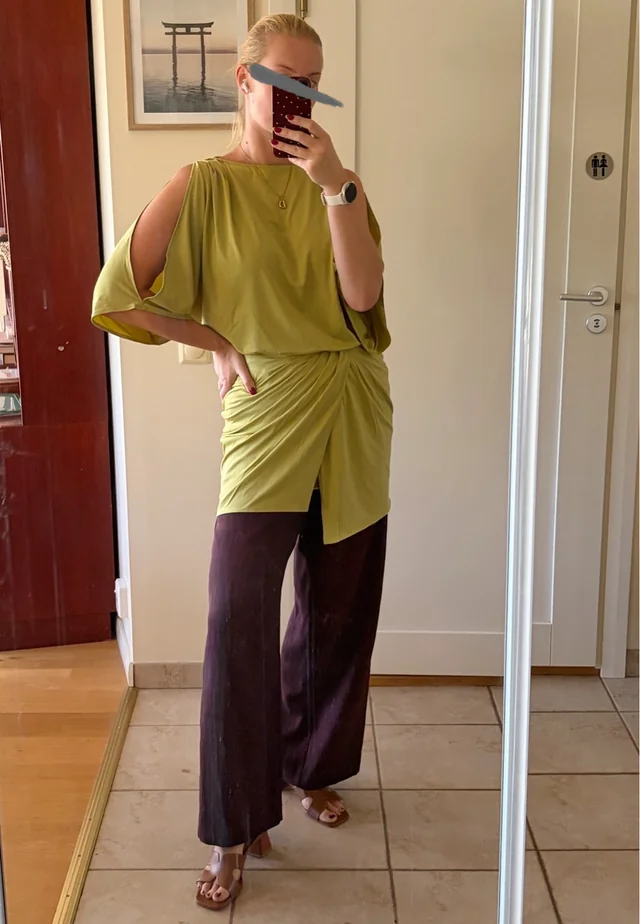
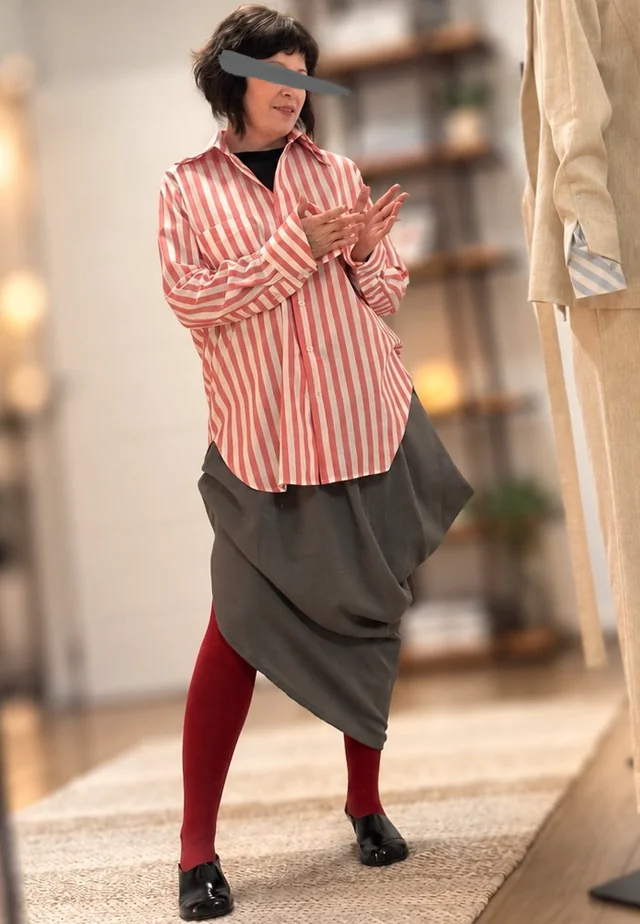
Fibonacci silhouette is governed by proportional geometry rather than by body-sculpting intent or trend-cycle variation. The characteristic relationship between garment zones — bodice to skirt, sleeve to torso, collar to shoulder — is calibrated to approximate phi (1:1.618) or to follow Fibonacci-sequential increments, producing proportions that register as "balanced" or "harmonious" through psychophysical mechanisms that experimental aesthetics has partially documented (Fechner 1876, Birkhoff 1933, Arnheim 1974).
The most elementary application is the bodice-to-skirt ratio: a dress whose bodice occupies approximately 38.2% of total length and whose skirt occupies approximately 61.8% produces a golden-section division at the waist or high-hip line. This proportion aligns with the natural waist position on many body types, which is why it codes as "classical" — it converges with anatomical landmarks rather than fighting them. More complex implementations layer multiple phi divisions: a coat whose collar-to-shoulder seam, shoulder-to-waist, and waist-to-hem each follow sequential ratios produces a cascading proportional system where no single division dominates but all relate through a shared mathematical grammar.
Spiral silhouettes — wrap dresses, draped cowl necks, asymmetric closures that travel around the body — exploit the logarithmic spiral (the spiral whose growth factor is phi) as a construction principle. When fabric wraps around a body along a logarithmic-spiral trajectory, the resulting drape widens at a mathematically consistent rate, producing visual coherence that distinguishes structured wrapping from arbitrary bunching. Vionnet's bias-cut gowns achieve this implicitly; van Herpen's 3D-printed spiral garments achieve it explicitly through digital modeling.
Cocoon and volumetric silhouettes built from concentric layers — Miyake's pleated forms, Comme des Garcons's padded accumulations, Noir Kei Ninomiya's sculptural shells — employ Fibonacci-sequential panel widths or layer counts. A garment with 3 inner panels, 5 middle panels, and 8 outer panels (following the sequence) produces visual expansion that feels organic rather than arbitrary because the growth rate between layers is mathematically consistent. The eye reads this consistency as "natural growth" even when the viewer cannot articulate the mathematical principle — a perceptual phenomenon that links garment proportion to phyllotaxis, shell growth, and other natural Fibonacci structures.
The silhouette's operational consequence is that minor deviations from mathematical precision become conspicuously visible. A garment whose design language promises geometric perfection establishes an evaluative frame in which asymmetry, uneven panel widths, or inconsistent pleat spacing register as errors rather than as character. This is the silhouette's central vulnerability: the mathematics sets a standard that construction must meet.
Materials
Material selection in Fibonacci fashion is governed by a single imperative: dimensional stability under mathematical demand. Fabrics must hold precise geometries — fold angles, panel proportions, spiral trajectories, sequential pleat spacings — without creep, relaxation, sag, or distortion over time. This requirement narrows the viable material palette considerably and establishes clear performance hierarchies.
Bias-cut substrates. Vionnet's foundational technique requires fabrics whose behavior at 45 degrees to the grain is predictable and controllable. Silk charmeuse (fiber diameter 10–13 microns, plain or satin weave) provides the classic bias-cut substrate: its low inter-fiber friction allows the warp and weft to shift relative to each other along the diagonal, producing stretch of 15–25% without elastic fiber content. Silk crepe (crepe-twisted yarns at high twist per inch) adds surface texture and slightly greater recovery. Acetate satin and rayon crepe offer lower-cost alternatives but with reduced recovery and greater susceptibility to permanent stretch under gravity — a critical failure mode in bias-cut garments, where unsupported fabric panels can elongate irreversibly over hours of wear, distorting the mathematical proportions the designer intended. Performance data: silk charmeuse retains approximately 90% of its original dimensions after 8 hours of bias-hang; viscose crepe retains approximately 75%, producing visible distortion in any garment calibrated to phi-proportions.
Heat-set pleating substrates. Miyake's Pleats Please system requires 100% polyester (polyethylene terephthalate, typically 75–150 denier) because the thermoplastic crystalline structure of PET fiber accepts permanent deformation when heated above its glass-transition temperature (approximately 70°C) and cooled under constraint. The fabric is cut approximately 2.5–3 times oversize, garment-assembled, sandwiched between paper templates, and fed through industrial heat-press rollers at 180–200°C. The resulting pleats are dimensionally stable through wearing and washing (machine-wash cold, hang-dry) because the molecular structure has been permanently reorganized. Natural fibers (cotton, silk, wool) cannot be heat-set in this manner because they lack the thermoplastic phase transition; "pleated" natural fabrics hold their folds through mechanical means (stitching, starch, steam-setting) that gradually relax through wear and laundering. The distinction between thermoplastic permanent pleating and mechanical temporary pleating is the material foundation of Miyake's contribution to Fibonacci fashion: he made geometric transformation a permanent textile property rather than a temporary surface treatment.
Jacquard-woven mathematical textiles. Jacquard looms — mechanized since Joseph Marie Jacquard's punch-card system (1804), now computer-controlled — encode pattern through binary thread selection: each warp thread is independently raised or lowered for every weft insertion, permitting arbitrary pattern complexity limited only by thread count. Fibonacci-derived weave patterns use sequence values to determine repeat lengths, color-change intervals, or structural float sequences, producing textiles whose surface patterns are literally woven from mathematical logic. Thread selection: mercerized cotton (for crisp pattern definition), filament silk (for luster and fine detail), or blended yarns combining structural stability with surface refinement. Warp density typically 60–120 ends per centimeter for fine-detail mathematical patterns.
3D-printed and parametric materials. Van Herpen's garments employ selective laser sintering (SLS) of polyamide powder, stereolithography (SLA) of photopolymer resins, and flexible TPU (thermoplastic polyurethane) printing to produce forms derived from mathematical surfaces. These materials offer geometric precision impossible in woven or knitted textiles — tolerances of 0.1mm in SLS, 0.05mm in SLA — but introduce distinct failure modes: layer delamination under flexion stress, UV-induced brittleness in photopolymers, and limited breathability that restricts wearability to runway and exhibition contexts. The material science of 3D-printed fashion textiles remains in its early development, with ongoing research into chain-mail-like interlocking structures, auxetic geometries (materials that expand laterally when stretched longitudinally), and multi-material printing that combines rigid structural elements with flexible connective zones.
Structural support fabrics. Mathematical garments often require internal infrastructure to maintain geometric precision: horsehair canvas, fusible interfacing, boning (steel, spiral, or synthetic), and stay tape applied along seam lines and panel edges prevent fabric movement that would distort calculated proportions. The maintenance burden is directly proportional to geometric ambition: the more precisely a garment's proportions are calibrated, the more structural support is required and the more vulnerable the garment becomes to support-system failure (interfacing bubbling, boning channel migration, stay tape delamination).
The material hierarchy in Fibonacci fashion thus runs from inherently stable substrates (heat-set polyester, 3D-printed polymers) through geometrically cooperative substrates (bias-cut silk, high-thread-count jacquard) to inherently unstable substrates (loosely woven natural fibers, unstructured knits) that require external support to maintain mathematical form. Material choice is not merely a texture or hand preference; it is a structural decision that determines whether the garment's mathematical logic survives contact with gravity, movement, and time.
Color Palette
Color in Fibonacci fashion serves mathematical legibility rather than decorative expression. The palette is organized to make proportional relationships, panel divisions, and geometric structures visible — or, conversely, to allow geometry to operate subliminally through tonal unity.
Monochromatic and tonal systems predominate: matte black, undyed ecru, chalk white, stone grey, and muted earth tones (sand, clay, bark) provide neutral fields against which geometric construction — pleat shadows, seam trajectories, panel junctions, spiral draping — becomes the primary visual content. When color is uniform, the eye reads form; when color varies, the eye reads pattern. Fibonacci fashion typically prioritizes form-reading.
Gradient and sequential color systems exploit mathematical logic directly: color values that shift in Fibonacci-sequential intervals across a garment's surface — deepening in steps of 1, 1, 2, 3, 5, 8 tonal units — produce color transitions that mirror the proportional logic of the construction. Miyake's pleated garments frequently use ombre effects where color transition rates correspond to pleat-fold accumulation, creating visual acceleration that reinforces the geometric rhythm.
Metallic accents — gold (whose association with the "golden ratio" is etymologically coincidental but culturally reinforced), brass, bronze, copper — appear as proportion markers: a golden thread along a phi-division seam, metallic hardware at golden-section points, or gilt detailing at spiral-center anchor points. These accents function as visual annotations, highlighting the mathematical structure for viewers literate in the proportional system.
High-contrast color blocking is reserved for pedagogic or demonstrative applications — garments designed to make mathematical divisions explicitly visible. A dress with a white bodice and black skirt, divided at the golden section, teaches proportion through color opposition. This approach is more common in academic, exhibition, and editorial contexts than in everyday wear, where the arithmetic becomes didactic.
Details
Details in Fibonacci fashion function as mathematical interfaces — points where proportional logic becomes visible, tactile, or structurally operative.
Panel systems and seam trajectories. Panel widths keyed to Fibonacci terms produce garments whose component pieces grow in mathematically consistent increments: a 5-panel bodice with panels measuring 1, 1, 2, 3, and 5 centimeters (or units proportional to these values) distributes visual weight according to the sequence's accumulative logic. Seam lines that follow logarithmic-spiral trajectories — curved seams whose radius increases by phi with each quarter-turn — produce the characteristic spiral construction associated with Vionnet's bias-cut work and van Herpen's parametric couture. These seams are technically demanding: a spiral seam requires the pattern-cutter to manage continuously changing seam allowances and grain angles, and sewing a curved seam to a straight edge without puckering or stretching demands exceptional machine control.
Pleat mathematics. Pleat counts following Fibonacci values (3, 5, 8, 13, 21 pleats per panel or per garment zone) produce visual rhythms whose spacing and accumulation mirror natural growth patterns. Miyake's pleating process — cutting flat, assembling, and heat-pressing — allows precise pleat counts because the folding template is engineered in advance. Accordion, knife, box, and sunburst pleat types each respond differently to Fibonacci sequencing: knife pleats in Fibonacci counts produce rhythmic linear textures; sunburst pleats in Fibonacci counts produce radial geometries that echo phyllotactic arrangements (the spiral patterns of sunflower seeds, pinecone scales, and artichoke bracts).
Closure and modular systems. Button counts and spacings follow sequential logic: 5 buttons spaced at intervals proportional to 1:1:2:3:5 produce a closure system whose density increases toward the garment's anchor point, visually accelerating toward the body's center. Modular attachment points — clips, ties, magnets, hook-and-loop — permit garment components to be added or removed in sequential configurations, producing layering systems whose visual accumulation mirrors Fibonacci growth. Craig Green's modular panel systems and Noir Kei Ninomiya's sculptural add-ons operate this logic, though neither designer explicitly invokes Fibonacci terminology.
Edge treatments and finishing. Binding widths, hem depths, and facing proportions scaled to Fibonacci values produce finishing details that participate in the garment's overall proportional system rather than existing as independent construction choices. A garment whose hem binding is 1 cm, whose facing is 2 cm, whose cuff is 3 cm, and whose collar stand is 5 cm embeds sequential logic in its edge treatments — a level of proportional consistency that most garments do not attempt and that most viewers will not consciously perceive, but that contributes to the overall impression of dimensional coherence.
Accessories
Accessories in Fibonacci fashion extend proportional logic beyond the garment into jewelry, footwear, bags, and body-worn objects.
Jewelry employs spiral geometry most directly: rings, bracelets, and necklaces whose forms trace logarithmic spirals, whose element sizes follow sequential growth, or whose settings are spaced at phi-proportioned intervals. Fibonacci jewelry's challenge is the tension between mathematical precision and organic comfort — a bracelet whose links grow in strict sequential increments may not accommodate wrist curvature without distortion, requiring compromise between mathematical purity and ergonomic function.
Footwear translates proportional logic into sole architecture, upper paneling, and heel-to-toe geometry. Segmented soles whose section lengths follow Fibonacci values produce stepping surfaces that mirror the foot's anatomical proportions (metatarsal, arch, and heel zones approximate phi-related ratios naturally). Upper constructions using spiral-wrapped strapping or sequentially widening panels extend the aesthetic from garment to ground contact.
Bags and carry objects use Fibonacci-derived panel proportions, spiral closure mechanisms, and compartment arrangements whose size relationships follow sequential logic. The internal organization of a bag — a system of pockets increasing in size from smallest (1-unit) to largest (8-unit or 13-unit) — applies mathematical sequencing to functional storage.
Scarves and wraps designed for spiral draping — fabrics cut or shaped so that their natural draping trajectory follows a logarithmic spiral around the neck and shoulders — represent perhaps the most materially successful Fibonacci accessory, because soft fabric naturally produces spiral forms when wrapped, and mathematical shaping can guide this natural tendency rather than fighting material behavior.
Body Logic
Fibonacci fashion treats the body as a proportional armature — a set of anatomical landmarks (clavicle, shoulder point, natural waist, high hip, knee, ankle) whose dimensional relationships approximate phi-ratios and whose geometry provides the origin points from which garment proportions radiate.
The observation that human body proportions approximate golden ratios — navel height to total height, fingertip-to-elbow versus elbow-to-shoulder, facial proportions — has been a persistent claim in art and architecture since Vitruvius, systematized by Le Corbusier's Modulor (1948), and empirically investigated with mixed results (some ratios approximate phi; others do not; individual variation is substantial). Fibonacci fashion exploits this approximation by anchoring garment proportions to the body's own dimensional logic, producing a resonance between corporeal ratio and textile ratio that registers as "natural fit" even when the garment's geometry is highly constructed.
The body in this system functions as a growth center: garments radiate outward from an anatomical origin point — collarbone, scapula, navel, hip — in expanding increments that follow sequential logic. Fit is adaptive rather than prescriptive: inner layers anchor at smaller dimensions; outer layers expand at larger dimensions, each increment related to the previous by a ratio approaching phi. This produces silhouettes that accommodate movement and body variation more flexibly than fixed-measurement tailoring, because the proportional system adjusts its scale relative to the body's actual dimensions rather than imposing abstract ideal measurements.
Gender differentiation is attenuated because the system evaluates bodies through dimensional relationships rather than through gendered silhouette conventions (waist suppression, shoulder emphasis, bust accommodation). A phi-proportioned garment adjusts to the wearer's actual proportions regardless of gendered body type, producing a structural basis for non-binary dressing that does not rely on androgynous styling choices but emerges from the mathematical logic itself. However, this neutrality is partial: pattern-cutting for mathematically precise proportions still requires accommodation of anatomical variation, and the claim that "mathematics transcends gender" can obscure the practical fitting labor that different body geometries demand.
Garment Logic
Fibonacci construction integrates mathematical proportion into every stage of garment production, from initial pattern drafting through assembly, finishing, and long-term maintenance. The system's coherence depends on consistency across all stages; a breakdown at any point — imprecise cutting, inaccurate sewing, inadequate structural support, improper care — compromises the mathematical relationships that constitute the garment's identity.
Pattern-cutting as applied geometry. The pattern-cutting stage is where Fibonacci logic is most consequentially embedded. Flat-pattern drafting uses phi-derived ratios to determine dart width, panel proportion, seam placement, and ease distribution. Draping on the dress form — Vionnet's preferred method — translates three-dimensional proportional relationships directly onto fabric, bypassing the abstraction of flat-pattern mathematics but requiring exceptional spatial intuition. Computer-aided pattern-making (Gerber, Lectra, CLO3D) allows precise phi-ratio input at the drafting stage, with parametric pattern systems that can scale proportions across size ranges while maintaining mathematical consistency — a technically demanding operation because phi-ratios in a size 36 do not simply scale linearly to a size 44 without distorting proportional relationships relative to the body's changing dimensions.
Assembly and construction. Sewing mathematically precise pattern pieces demands construction tolerances tighter than standard garment production: a 2mm error in seam allowance on a panel whose width is calibrated to a Fibonacci ratio can produce a cumulative distortion that propagates across the entire garment. Industrial sewing typically operates at tolerances of 3–5mm; Fibonacci-structured garments at the couture level demand 1–2mm tolerances, which is why the aesthetic's most rigorous implementations remain in couture or limited-production contexts. Spiral seams — curved construction lines following logarithmic-spiral trajectories — require the sewing operator to manage continuously varying seam geometry, easing the longer edge into the shorter edge at rates determined by the spiral's mathematical properties.
Aftercare protocols. Maintenance requirements are dictated by the intersection of mathematical precision and material vulnerability. Heat-set polyester pleated garments (Miyake system) are the most maintenance-friendly Fibonacci textiles: machine-washable in cold water, hang-dry, requiring no ironing because the thermoplastic memory restores pleat geometry automatically. Bias-cut silk garments demand dry cleaning or hand washing in tepid water with pH-neutral detergent, followed by flat drying on a towel to prevent gravity-induced elongation; hanging a bias-cut garment wet will permanently distort its proportions within hours. Structured garments with internal support systems (interfacing, boning, stay tape) require professional cleaning to prevent adhesive degradation and support-material distortion. 3D-printed components cannot be laundered conventionally and require spot cleaning with damp cloth only; immersion risks layer delamination and dimensional change. Jacquard-woven textiles with metallic threads require specialized cleaning to prevent oxidation and thread embrittlement.
Failure modes and longevity. Fibonacci fashion's characteristic failure mode is proportional collapse — the degradation of mathematical relationships through material aging, structural fatigue, or maintenance error. Specific failure patterns include: (1) bias-cut elongation, where gravity and movement stretch panels along the diagonal grain, distorting phi-calibrated proportions progressively over wear cycles; (2) pleat relaxation, where mechanically set pleats (as opposed to heat-set thermoplastic pleats) gradually lose fold definition, reducing Fibonacci-counted pleat structures to approximate gathers; (3) interfacing delamination, where fusible adhesives fail under heat, moisture, or age, causing supported panels to lose their calibrated dimensions and producing visible bubbling or rippling; (4) seam creep, where fabric migrates through seam lines under stress, altering panel widths and distorting sequential proportions; (5) asymmetry amplification, the aesthetic's most distinctive vulnerability — because the design language promises geometric perfection, even minor asymmetries (a spiral seam 2mm off trajectory, a pleat spacing 1mm inconsistent) become disproportionately visible, violating the mathematical contract the garment establishes with the viewer. Standard garments absorb small construction imperfections into their visual noise; mathematically precise garments amplify them.
Longevity correlates directly with material stability: heat-set polyester pleated garments maintain mathematical integrity for decades of regular wear; bias-cut silk garments show measurable proportional distortion within 20–50 wearings depending on fabric weight and construction support; 3D-printed garments are currently limited by polymer aging (UV degradation, flexion fatigue) to exhibition or occasional-wear lifespans. The most durable Fibonacci garments are those whose mathematical logic is embedded in dimensionally stable materials; the most fragile are those where mathematical precision is imposed on inherently unstable substrates through structural support systems that themselves degrade.
Motifs / Themes
The Fibonacci spiral — a logarithmic spiral whose growth factor is phi — operates as the aesthetic's primary visual motif, appearing in seam trajectories, draping patterns, print designs, and accessory forms. Its cultural resonance derives from its abundance in natural structures: nautilus shells, sunflower seed heads, pinecone bracts, hurricane formations, and galaxy arms all approximate logarithmic spirals, producing an associative chain (mathematics-nature-beauty-inevitability) that Fibonacci fashion exploits as both visual reference and legitimation narrative.
Phyllotaxis — the spiral arrangement of leaves, petals, and seeds around a plant stem, typically following Fibonacci-numbered spirals (3 and 5, 5 and 8, 8 and 13 counter-rotating spirals) — provides a second motif system: lattice-like textile structures, radial skirt constructions, and surface patterns derived from the dual-spiral geometry of seed heads. The textile translation uses jacquard weaving, laser cutting, or 3D printing to produce phyllotactic lattices whose aperture sizes follow sequential values.
Growth as design principle — the idea that a garment "grows" from an origin point through accumulating increments, each related to the previous by phi — constitutes the aesthetic's organizing narrative. This growth metaphor performs simultaneous scientific and mystical functions: it grounds design decisions in measurable mathematics while evoking a quasi-spiritual vision of universal order — "nature's secret code," "the divine proportion," "the language of the cosmos." The tension between empirical rigor and mystical elevation is constitutive of the aesthetic's cultural meaning and a persistent target of its critique.
The golden rectangle (a rectangle whose sides are in phi ratio, containing an infinite regression of squares and smaller golden rectangles) provides a compositional framework for print design, panel arrangement, and spatial organization within garments. Its recursive structure — each subdivision replicates the whole at smaller scale — embodies the self-similarity principle that connects Fibonacci aesthetics to fractal geometry.
Cultural Touchstones
Madeleine Vionnet's bias-cut gowns of the 1920s–1930s represent the foundational cultural touchstone: the first systematic application of geometric analysis to fabric behavior, producing garments that moved with the body in ways that contemporaries described as revolutionary. Her working method — drafting patterns on a small articulated mannequin, using geometric principles to scale proportions — established the paradigm of fashion-as-applied-geometry that Fibonacci fashion inherits.
Issey Miyake's Pleats Please (1993–present) and A-POC (1998) constitute the second major touchstone: the demonstration that industrial-scale production could embed geometric transformation into fabric permanently. The Pleats Please garment, which arrives flat and unfolds into three-dimensional geometric form when worn, performs the Fibonacci principle of growth-from-origin as a literal material property.
Iris van Herpen's couture collections (2007–present) represent the computational-era touchstone: parametric modeling, 3D printing, and algorithmic pattern generation producing garment forms derived from mathematical surfaces (minimal surfaces, Voronoi cells, reaction-diffusion patterns) that would be impossible through manual construction.
Zaha Hadid's architectural practice and fashion collaborations (Lacoste, United Nude, Georg Jensen) bridge the architectural and fashion applications of parametric geometry, translating ruled surfaces and fluid-dynamics simulations into wearable objects and demonstrating the disciplinary continuity between building design and garment design.
Le Corbusier's Modulor system (1948, 1955), while not a fashion object, provides the proportional framework that connects architectural golden-ratio applications to body-based design. The Modulor man — a figure whose body proportions follow phi-derived ratios, used to calibrate architectural dimensions — is the explicit ancestor of fashion's body-as-proportional-armature approach.
The "golden ratio" as popular-design meme — amplified by Dan Brown's The Da Vinci Code (2003), TED talks, and design-school curricula — provides the ambient cultural context in which Fibonacci fashion circulates. This popularization simultaneously expands the aesthetic's audience and dilutes its rigor, producing a context where "golden ratio" can mean anything from precise mathematical construction to vague associations with natural beauty.
See Also
- Bauhaus: Shared commitment to geometric construction and functional logic; adjacent in intellectual genealogy through modernist proportion theory
- Parametricism: Overlapping computational-geometry tools and design philosophy; shared use of Grasshopper, Rhino, and algorithmic form-generation
- Biomimicry: Shared reference to natural growth patterns; phyllotaxis, spiral geometry, and branching structures as common formal vocabulary
- Minimalism: Shared emphasis on proportion over ornament; diverges in that minimalism reduces toward simplicity while Fibonacci organizes toward mathematical complexity
- Wabi-sabi: Conceptual antithesis — wabi-sabi values irregularity and imperfection where Fibonacci values precision and mathematical order; productive tension between the two frameworks
- Modular clothing systems: Shared construction logic of interchangeable, systematically related components
- Op art fashion: Shared interest in visual-perceptual effects derived from geometric pattern; overlapping material in the use of mathematical tiling and symmetry groups
Brands and Designers
Foundational Practitioners (Structural Mathematics in Fashion):
- Madeleine Vionnet (1876–1975): bias-cut as applied geometry; pattern-cutting derived from three-dimensional proportional analysis; foundational figure for treating garment construction as mathematical practice
- Issey Miyake / Miyake Design Studio (founded 1970): Pleats Please heat-set geometric textiles; A-POC algorithmically knitted garments; 132 5. origami-derived folding system
- Iris van Herpen (founded 2007): parametric modeling and 3D-printed couture; mathematical surfaces (Voronoi, minimal surfaces, reaction-diffusion) as garment form
- Cristobal Balenciaga (1895–1972): sculptural proportional precision in couture; mathematically derived volume relationships in coat, suit, and gown construction
Architecture-Fashion Crossovers (Parametric Geometry):
- Zaha Hadid Architects / ZHA (fashion collaborations with Lacoste, United Nude, Georg Jensen, Charlotte Olympia): parametric geometry translated from building to garment scale
- Hussein Chalayan (founded 1994): technology-integrated garments exploring geometric transformation, mechanical movement, and spatial logic
- Thom Browne (founded 2001): systematic proportional ratios in tailoring; mathematically calibrated sleeve, trouser, and jacket relationships
Geometric Construction (Sequence and Accumulation):
- Comme des Garcons / Rei Kawakubo (founded 1969): structural recursion; garments whose components accumulate in systematic relationships
- Noir Kei Ninomiya (founded 2012, under Comme des Garcons): sculptural accumulation using modular elements — tulle rosettes, harness components, cage structures — in counted, systematic arrangements
- Craig Green (founded 2012): modular panel systems; garments built from repeated and scaled flat components that layer in sequential configurations
- Junya Watanabe (founded 1992): geometric pattern-cutting; mathematically derived flat-pattern constructions that produce complex three-dimensional forms
Mathematical Textile Design:
- Anni Albers (1899–1994): Bauhaus-trained weaver; mathematical structure in textile construction; foundational text On Weaving (1965) analyzing fabric as engineered surface
- Junichi Arai (1932–2017): experimental Japanese textile designer; computer-programmed jacquard weaving producing mathematically structured fabrics
- Nuno Corporation (founded 1984 by Reiko Sudo): computationally designed Japanese textiles integrating mathematical pattern logic with industrial weaving technology
Contemporary Proportional Design:
- Rick Owens (founded 1994): elongated proportional systems; consistent phi-adjacent body-to-garment ratios across collections
- Yohji Yamamoto (founded 1972): asymmetric construction governed by internal proportional rules; mathematical coherence within apparent irregularity
- Marine Serre (founded 2017): crescent-moon motif deployed in mathematically sequenced repeat patterns; regenerated-textile constructions with geometric discipline
Citations
[1] Fibonacci (Leonardo of Pisa). Liber Abaci. 1202; revised 1228. [2] Pacioli, Luca. De Divina Proportione. Illustrated by Leonardo da Vinci. Venice, 1509. [3] Fechner, Gustav. Vorschule der Aesthetik. Breitkopf and Hartel, 1876. [4] Thompson, D'Arcy Wentworth. On Growth and Form. Cambridge University Press, 1917; revised 1942. [5] Birkhoff, George David. Aesthetic Measure. Harvard University Press, 1933. [6] Le Corbusier. The Modulor: A Harmonious Measure to the Human Scale, Universally Applicable to Architecture and Mechanics. Faber and Faber, 1954. Modulor 2, 1958. [7] Livio, Mario. The Golden Ratio: The Story of Phi, the World's Most Astonishing Number. Broadway Books, 2002. [8] Markowsky, George. "Misconceptions about the Golden Ratio." College Mathematics Journal, vol. 23, no. 1, 1992, pp. 2–19. [9] McManus, I.C. "The Aesthetics of Simple Figures." British Journal of Psychology, vol. 71, no. 4, 1980, pp. 505–524. [10] Boselie, Frans. "The Golden Section Has No Special Aesthetic Attractivity." Empirical Studies of the Arts, vol. 10, no. 1, 1992, pp. 1–18. [11] Green, Christopher D. "All That Glitters: A Review of Psychological Research on the Aesthetics of the Golden Section." Perception, vol. 24, no. 8, 1995, pp. 937–968. [12] Arnheim, Rudolf. Art and Visual Perception: A Psychology of the Creative Eye. University of California Press, 1954; revised 1974. [13] Kirby, Betty. Madeleine Vionnet. Chronicle Books, 2012. [14] Kamitsis, Lydia. Vionnet. Assouline, 1996. [15] English, Bonnie. Japanese Fashion Designers: The Work and Influence of Issey Miyake, Yohji Yamamoto, and Rei Kawakubo. Berg, 2011. [16] Miyake, Issey, Dai Fujiwara, and Tim Blanks. Issey Miyake. Taschen, 2016. [17] Quinn, Bradley. The Fashion of Architecture. Berg, 2003. [18] Shima, Hisako. "A-POC Making: The Geometry of Flat-to-Form." Textile: The Journal of Cloth and Culture, vol. 2, no. 3, 2004, pp. 224–237. [19] Hadid, Zaha, and Patrik Schumacher. "Parametricism as Style: Parametricist Manifesto." Presented at the 11th Venice Architecture Biennale, 2008. [20] van Herpen, Iris, et al. Iris van Herpen: Transforming Fashion. Groninger Museum / High Museum of Art, 2015. [21] Albers, Anni. On Weaving. Wesleyan University Press, 1965; revised Princeton University Press, 2017. [22] Braddock Clarke, Sarah E., and Marie O'Mahony. Techno Textiles 2: Revolutionary Fabrics for Fashion and Design. Thames and Hudson, 2005. [23] Hann, Michael. The Grammar of Pattern. CRC Press, 2012. [24] Washburn, Dorothy K., and Donald W. Crowe. Symmetries of Culture: Theory and Practice of Plane Pattern Analysis. University of Washington Press, 1988. [25] Entwistle, Joanne. The Fashioned Body: Fashion, Dress and Social Theory. 2nd ed., Polity, 2015. [26] Kawamura, Yuniya. Fashion-ology: An Introduction to Fashion Studies. 2nd ed., Bloomsbury Academic, 2018. [27] Breward, Christopher. Fashion. Oxford University Press, 2003. [28] Wilson, Elizabeth. Adorned in Dreams: Fashion and Modernity. Revised ed., Rutgers University Press, 2003. [29] Crane, Diana. Fashion and Its Social Agendas: Class, Gender, and Identity in Clothing. University of Chicago Press, 2000. [30] Barthes, Roland. The Fashion System. Translated by Matthew Ward and Richard Howard, University of California Press, 1983. [31] Hollander, Anne. Seeing Through Clothes. University of California Press, 1993. [32] Simmel, Georg. "Fashion" (1904). In Simmel on Culture: Selected Writings, edited by David Frisby and Mike Featherstone, SAGE, 1997. [33] Coccia, C., et al. "The Fibonacci Sequence in Fashion Design and Pattern Making." AUTEX Research Journal, 2017. [34] Kurniawati, R., et al. "The Application of Golden Ratio and Fibonacci Tilings in Sustainable Fashion Design." IOP Conference Series: Materials Science and Engineering, vol. 1288, 2023. [35] Bourdieu, Pierre. Distinction: A Social Critique of the Judgement of Taste. Translated by Richard Nice, Harvard University Press, 1984.