Lekondo's
Ontology of Fashion Aesthetics

36 aesthetics

Clothing is expression without explanation. It influences how you’re seen and how you see yourself. Patterns of taste, mood, discipline, excess, and restraint repeat across time and culture. This is our guide to making that language visible.

Back to Ontology
Cottagecore 1
Cottagecore 2
Cottagecore 3

Cottagecore

Summary. Cottagecore is a pastoral-citation dress system in which garments composed of natural cellulosic fibers — cotton lawn, cotton muslin, linen, cotton voile, broderie anglaise cotton, and wool knit — are constructed through handcraft-referencing techniques (gathering, smocking, pintucking, tiered-skirt assembly, puffed-sleeve drafting, yoke-based pattern engineering) and printed or dyed with floral-botanical imagery to produce a dressed body that performs an idealized rural domesticity: baking, gardening, foraging, mending, resting — the body nested in care rather than armored for display. The system is governed by a pastoral-fantasy logic: garments cite the visual grammar of 18th- and 19th-century rural femininity (the prairie dress, the milkmaid bodice, the apron, the bonnet, the chemise) not as historical costume but as emotional refuge — a wearable rehearsal of simplicity staged against the acceleration, precarity, and digital saturation of 21st-century life. Unlike adjacent natural-fiber aesthetics that foreground layering-system accumulation (mori kei) or material degradation as aesthetic content (wabi-sabi), cottagecore foregrounds single-garment pastoral citation — the prairie dress alone carries the full semiotic weight of the aesthetic, its gathered tiers, puffed sleeves, and floral print encoding an entire imaginary landscape of meadows, cottage gardens, and domestic peace. The aesthetic's explosive growth during 2020-2021 COVID-19 lockdowns revealed its function as a mass-scale coping mechanism: when physical refuge from institutional life became impossible, cottagecore provided imaginary refuge through dress.

In Material Terms

Cottagecore's coherence depends on the performance characteristics and failure behaviors of lightweight cellulosic natural fibers deployed in garments whose construction logic — extensive gathering, multi-tier assembly, puffed and leg-of-mutton sleeves — subjects those fibers to mechanical stresses that their delicacy often cannot sustain under actual rural conditions. Cotton lawn (a fine, plain-weave fabric of 60-100 g/m², combed long-staple cotton yarns, thread count 60-80 per cm, semi-crisp hand with subtle luster from the calendering finish) provides the foundational dress fabric but saturates rapidly under perspiration and loses its calendered finish permanently after three to five machine washes, transitioning from a smooth, slightly lustrous surface to a soft, matte texture that alters the garment's visual register. Cotton muslin (plain-weave, 80-120 g/m², lower thread count than lawn at 30-50 per cm, producing a softer, more open-weave fabric with visible texture) provides the peasant-blouse and gathered-skirt base but wrinkles aggressively under any sustained contact — sitting, leaning, carrying — producing a crumpled appearance within hours of wear that reads as "authentically lived-in" within cottagecore's evaluative framework but as "unkempt" outside it. Linen (flax fiber, 100-200 g/m², crystalline cellulose structure producing approximately 70% crystallinity) provides superior moisture wicking and cooling but its low resilience causes pronounced wrinkling that no amount of pressing can prevent during active wear, and its angular crease behavior can disrupt the soft, flowing drape that cottagecore's pastoral imagery requires. Wool — in hand-knit cardigans, shawls, and fair-isle vests at 150-300 g/m² depending on gauge and yarn weight — provides thermal regulation through keratin fiber's hygroscopic properties (absorbing up to 30% of its weight in moisture vapor before feeling damp) but pills at every friction zone within 20-40 wears when layered over cotton or linen, whose stiffer cellulosic fibers act as abrasive agents against wool's softer protein structure. The fundamental material tension of cottagecore is that the fibers it selects for pastoral-romantic association — delicate lawns, fine muslins, open-weave linens — are precisely the fibers least suited to the physical activities (gardening, baking, foraging, animal care) that the aesthetic's visual narrative imagines the wearer performing.

At Category Level

Cottagecore occupies a position between internet-born micro-aesthetic and mass-market lifestyle category. It shares with mori kei a pastoral visual vocabulary — floral prints, natural fibers, earth tones, lace, handcraft references — but reverses mori kei's defining mechanism: where mori kei constructs pastoral identity through layering-system accumulation (four to seven garments whose interaction generates the aesthetic), cottagecore constructs it through single-garment citation (the prairie dress, the smocked blouse, the pinafore, each independently carrying the full pastoral code). It shares with the tradwife aesthetic a visual grammar of domestic femininity — aprons, baking, homemaking, garden tending — but diverges fundamentally in political valence: where tradwife ideology naturalizes patriarchal gender roles as biologically ordained, cottagecore (particularly in its queer iterations) reframes domesticity as chosen practice, elective care, and alternative world-building rather than as assigned destiny. It shares with boho a preference for flowing natural-fiber garments, floral prints, and handcraft details, but cottagecore's historical citation is specifically rural-pastoral (the cottage, the meadow, the garden gate) rather than boho's globally eclectic (the bazaar, the caravan, the festival). This categorical positioning means that cottagecore's authenticity is judged not by material precision or construction complexity — the way mori kei's is — but by emotional coherence: does the garment produce the feeling of pastoral refuge? This emotional-rather-than-material evaluative criterion is what allows fast-fashion polyester-blend "prairie dresses" to satisfy cottagecore's requirements in ways that fast-fashion "mori" dresses cannot satisfy mori kei's, making cottagecore unusually permeable to commercial appropriation.

Methodologically

This entry treats cottagecore as a pastoral-citation dress system: garments are analyzed through their fiber science and performance limitations, handcraft construction techniques (gathering ratios, smocking calculations, pintuck engineering, broderie anglaise eyelet construction, puffed-sleeve drafting geometry), floral-print textile processes (discharge printing, screen printing, digital printing — dye fastness, wash behavior), silhouette-generation mechanics (yoke construction, tiered-skirt gathering math, apron-and-pinafore layering), failure modes under actual versus imagined use conditions, and the platform-mediated cultural dynamics — Tumblr codification, TikTok explosion, queer reclamation, pandemic-era pastoral fantasy — through which the aesthetic was generated, circulated, commercialized, and critiqued.

Word (Etymology)

An internet compound: "cottage" + the productive suffix "-core." The morphological logic follows the pattern established by "hardcore" (1970s punk, denoting intensity and commitment), subsequently generalized through internet aesthetic discourse into a productive suffix designating a coherent micro-aesthetic organized around a central image, concept, or lifestyle fantasy — the same morphological engine that generates "normcore," "gorpcore," "goblincore," "dark academia" (the last using a different suffix pattern but similar taxonomic logic). The suffix "-core" in this usage has undergone semantic drift from its hardcore-punk origins: it no longer denotes intensity or extremity but rather thematic coherence — a "-core" aesthetic is one organized around a central referent that governs material, visual, and behavioral choices.

"Cottage" carries layered connotations critical to the aesthetic's pastoral logic. The word enters English from Anglo-Norman cotage (a small dwelling), itself from Old English cot (a shelter, a cottage), and its semantic history tracks a class-inflected idealization of rural poverty. In medieval usage, the cottage designated the dwelling of the lowest agricultural class — the cottar or cotter, a laborer who held a cottage without attached land. By the 18th century, the cottage had undergone aesthetic rehabilitation through the Picturesque movement: architects like John Nash designed the cottage ornee — ornamental cottages for the wealthy that aestheticized rural dwelling without its material conditions — and the cottage entered literary and visual culture as a figure for pastoral simplicity. This genealogy matters because cottagecore inherits and extends the cottage ornee logic: it aestheticizes rural domesticity as a lifestyle aspiration while structurally depending on the urban-economic conditions (disposable income, internet access, leisure time for craft) that make pastoral fantasy both desirable and purchasable. The "cottage" in cottagecore is not a dwelling but a feeling — and the feeling was always already a class production.

The term "cottagecore" stabilized on Tumblr between 2017 and 2018, though its exact origin point is impossible to determine because Tumblr's tag-based content organization and reblog-chain circulation obscure authorial origins. Google Trends data shows minimal search volume for "cottagecore" before mid-2018, a steady accumulation through 2019, and an explosive vertical spike beginning March 2020 — precisely coinciding with COVID-19 lockdowns across North America and Europe. By July 2020, "cottagecore" had entered mainstream fashion-media vocabulary (Vox, The New York Times, Vogue), and by December 2020, it had been reinforced by Taylor Swift's Folklore and Evermore album aesthetics, Selena Gomez's HBO cooking show, and a global retail response from fast-fashion (Shein, H&M, Zara) through premium (Doen, Reformation, Christy Dawn) to luxury (Erdem, Simone Rocha).

Subculture

Cottagecore emerged as an internet-native pastoral-fantasy community structured by platform aesthetics, pandemic-era longing, and a distinctively queer reclamation of domesticity. Its subcultural formation demonstrates how platform affordances shape aesthetic codification, how crisis conditions accelerate escapist-community growth, and how queer communities can repurpose heteronormative visual vocabularies for alternative world-building.

Tumblr incubation and visual codification (2017-2019). Cottagecore crystallized on Tumblr's image-reblog ecosystem, where the platform's affordances — infinite-scroll visual feeds, tag-based content organization, reblog chains that circulate images without authorial context, and a user culture oriented toward aesthetic curation rather than personal branding — created ideal conditions for micro-aesthetic formation. The earliest cottagecore Tumblr content aggregated images from diverse sources: pre-Raphaelite paintings, editorial photographs from rural-lifestyle magazines, screenshots from period films (Pride and Prejudice, Little Women, Anne of Green Gables), cottagecore-adjacent Instagram accounts, vintage clothing photographs, and original user photography of gardens, baked goods, wildflower arrangements, and handmade textiles. This aggregation produced a visual grammar through accretion rather than declaration: no founding manifesto defined cottagecore, no single user established its parameters. Instead, the tag accumulated content until a recognizable pattern emerged — floral dresses, linen aprons, bread loaves, meadow settings, candlelit interiors, handwritten letters, herb gardens — and the pattern became self-reinforcing as users contributed images that matched the established grammar.

Queer cottagecore and alternative domesticity. The aesthetic's most theoretically significant subcultural dimension is its adoption and transformation by queer communities, particularly lesbian and sapphic communities on Tumblr and later TikTok, who deployed cottagecore's pastoral-domestic imagery to imagine forms of domestic life outside heteronormative structures. "Two women living in a cottage, baking bread, tending a garden, growing old together" became a widely circulated queer cottagecore narrative — a pastoral-domestic fantasy in which the cottage functions as a space of queer self-determination, removed from the institutional and familial structures that police queer domesticity. This deployment is analytically significant because it inverts the aesthetic's apparent conservatism: the same visual grammar (cottage, garden, apron, baked goods, domestic interior) that in tradwife contexts naturalizes patriarchal gender roles becomes, in queer cottagecore, a vehicle for imagining non-patriarchal domestic alternatives. The inversion demonstrates that cottagecore's visual signifiers are politically polysemous — they carry no fixed ideological content but are activated differently depending on the community that deploys them. Noémie Sérieux (@cottagecoreblackfolks on Instagram) extended this reclamation analysis to race, arguing that Black participation in cottagecore constitutes a deliberate reclamation of pastoral leisure, land relation, and domestic softness from which Black communities were historically excluded through enslavement, sharecropping, and exclusionary rural-property regimes.

Pandemic explosion and mass adoption (2020-2021). COVID-19 lockdowns beginning March 2020 produced the conditions for cottagecore's transformation from niche Tumblr aesthetic to mass cultural phenomenon. Confined to domestic space, separated from urban social infrastructure, and facing existential uncertainty, millions of people independently discovered that the pastoral-domestic fantasy cottagecore offered — baking bread, tending plants, wearing soft clothes, imagining a simpler life — addressed their immediate emotional needs. The aesthetic provided a script for productive domesticity at a moment when domestic confinement was involuntary and potentially indefinite. TikTok's short-form video format accelerated the aesthetic's circulation: cottagecore content — "get dressed with me" videos featuring prairie dresses, sourdough-baking tutorials, flower-arrangement time-lapses, "day in my life" pastoral narratives — generated billions of combined views across 2020-2021. Pinterest reported a 500%+ increase in "cottagecore" searches in 2020. The speed and scale of adoption produced rapid commercial response: by autumn 2020, fast-fashion retailers had launched "cottage" and "prairie" collections, and by 2021, the aesthetic had permeated mainstream retail from Target to Anthropologie.

Post-pandemic persistence and diffusion (2022-present). As pandemic conditions receded, cottagecore's viral intensity diminished but its material and cultural infrastructure persisted. The aesthetic diffused from a coherent subcultural identity into a broader pastoral-lifestyle sensibility informing mainstream fashion, home décor, food culture, and craft practice. Specific garment types that cottagecore mainstreamed — the puff-sleeve blouse, the tiered midi skirt, the smocked bodice dress — became permanent wardrobe options rather than trend-specific citations. The community structure shifted from platform-specific congregations (cottagecore Tumblr, cottagecore TikTok) to dispersed practice: people who bake sourdough, tend kitchen gardens, sew their own clothes, and wear floral dresses no longer necessarily identify as "cottagecore" but are practicing within the aesthetic's material legacy.

History

The material and cultural history of cottagecore begins in the Arcadian literary tradition, passes through 18th-century aristocratic pastoral play, 19th-century prairie settlement, 20th-century back-to-the-land counterculture, and arrives at 21st-century internet-platform aesthetics through a genealogy in which each historical moment transforms the pastoral fantasy's class conditions while preserving its emotional structure.

Ancient pastoralism through Enlightenment pastoral (3rd century BCE-1790s). Theocritus's Idylls (3rd century BCE, Syracuse) invent the Western pastoral as a literary mode: idealized shepherds in idealized landscapes performing idealized leisure. Virgil's Eclogues (42-39 BCE) extend the pastoral into Roman imperial culture, establishing the template — rural simplicity as moral counterpoint to urban corruption — that persists through two millennia of pastoral production. The 18th century translates literary pastoral into material culture through the fete champetre (the outdoor rural entertainment staged by aristocratic households) and, most consequentially, through Marie Antoinette's Hameau de la Reine (1783-1786) — a fully operational "rustic" village constructed within the grounds of Versailles, where the queen performed milking, egg-gathering, and pastoral domesticity in garments that aestheticized rural labor without experiencing its conditions. The chemise à la reine — Marie Antoinette's controversial adoption of soft white muslin in place of rigid court dress, depicted in Élisabeth Vigée Le Brun's 1783 portrait — constitutes the first major cottagecore garment: lightweight cellulosic fabric, pastoral-feminine associations, a silhouette that prioritizes softness over structure, and a class logic in which aristocratic bodies adopt lower-class textile forms as costume. Cottagecore's contemporary practitioners, wearing muslin prairie dresses purchased online and photographed in rented rural properties for social-media content, are performing the same structural operation — aestheticizing rural domesticity from positions of urban economic privilege — that Marie Antoinette performed at the Hameau.

19th-century prairie dress and settler domesticity (1840s-1900s). The prairie dress that cottagecore most directly cites — long, gathered, high-necked, long-sleeved, constructed from printed cotton calico — emerged as practical settler women's clothing in the American westward expansion. Its construction logic was functional: calico was inexpensive, durable, and widely available through general-store distribution; long sleeves and high necklines provided sun and insect protection; gathered skirts accommodated physical labor (bending, kneeling, lifting) without fitted-garment constraints; and the overall volume provided modesty within the religious frameworks that governed many settler communities. Laura Ingalls Wilder's Little House series (published 1932-1943, depicting 1870s-1890s frontier life) established the prairie dress's literary-nostalgic mythology, transforming a garment of economic necessity into a symbol of wholesome self-reliance. This mythology simplifies the material conditions of its production: prairie settlement occurred alongside the displacement of Indigenous peoples; and the domestic labor that the prairie dress accommodated was performed under conditions of extreme material hardship, geographic isolation, and limited medical care. Cottagecore's citation of the prairie dress carries this historical context whether or not its wearers intend it.

1960s-1970s back-to-the-land and countercultural pastoral. The hippie and back-to-the-land movements of the 1960s-1970s revived pastoral dress as political gesture: natural fibers, handmade garments, vegetable-dyed fabrics, and the rejection of synthetic-industrial textiles constituted a material critique of consumer capitalism, the Vietnam War economy, and petrochemical modernity. Gunne Sax dresses (Jessica McClintock, founded 1969, San Francisco) — high-necked, lace-trimmed, gathered-skirt, floral-print cotton dresses in prairie-revival silhouettes — became the era's most commercially successful pastoral garment, producing a template that cottagecore would later cite directly. The counterculture's pastoral gesture was sincerely political — it sought material alternatives to industrial capitalism — but it reproduced the class conditions of all pastoral: the "voluntary simplicity" of educated, economically mobile young people choosing to homestead is categorically different from the involuntary material hardship of actual rural poverty.

Internet aesthetic formation (2010s-2020). The visual-platform ecosystem of the 2010s — Tumblr (image-reblog curation), Pinterest (mood-board aggregation), Instagram (lifestyle-performance photography) — created the conditions for cottagecore's emergence as a codified aesthetic category. The genealogy includes: the "indie sleaze to twee pipeline" of early-2010s Tumblr, where the twee aesthetic (cardigans, tea sets, vintage prints, Peter Pan collars) anticipated cottagecore's visual grammar; the slow-living and hygge movements of 2015-2018, which primed audiences for domesticity-as-lifestyle content; and the broader "-core" suffix proliferation that gave internet communities a taxonomic framework for generating micro-aesthetics. Taylor Swift's Folklore (July 2020) and Evermore (December 2020) — albums whose visual identities, shot by Beth Garrabrant in rural Pennsylvania and Oregon settings, deployed cottagecore's exact visual grammar (cardigans, autumn forests, stone cottages, neutral palettes) — provided the aesthetic with its most consequential mainstream celebrity endorsement, introducing cottagecore's visual vocabulary to audiences who had never encountered Tumblr or TikTok.

Silhouette

Cottagecore silhouette is generated through pattern-engineering techniques that produce volume, softness, and historical pastoral citation: gathered tiers, puffed sleeves, yoke-to-skirt fullness distribution, empire and natural-waist placement, and ankle-to-midi length conventions that together construct a dressed body that reads as rural-historical-feminine.

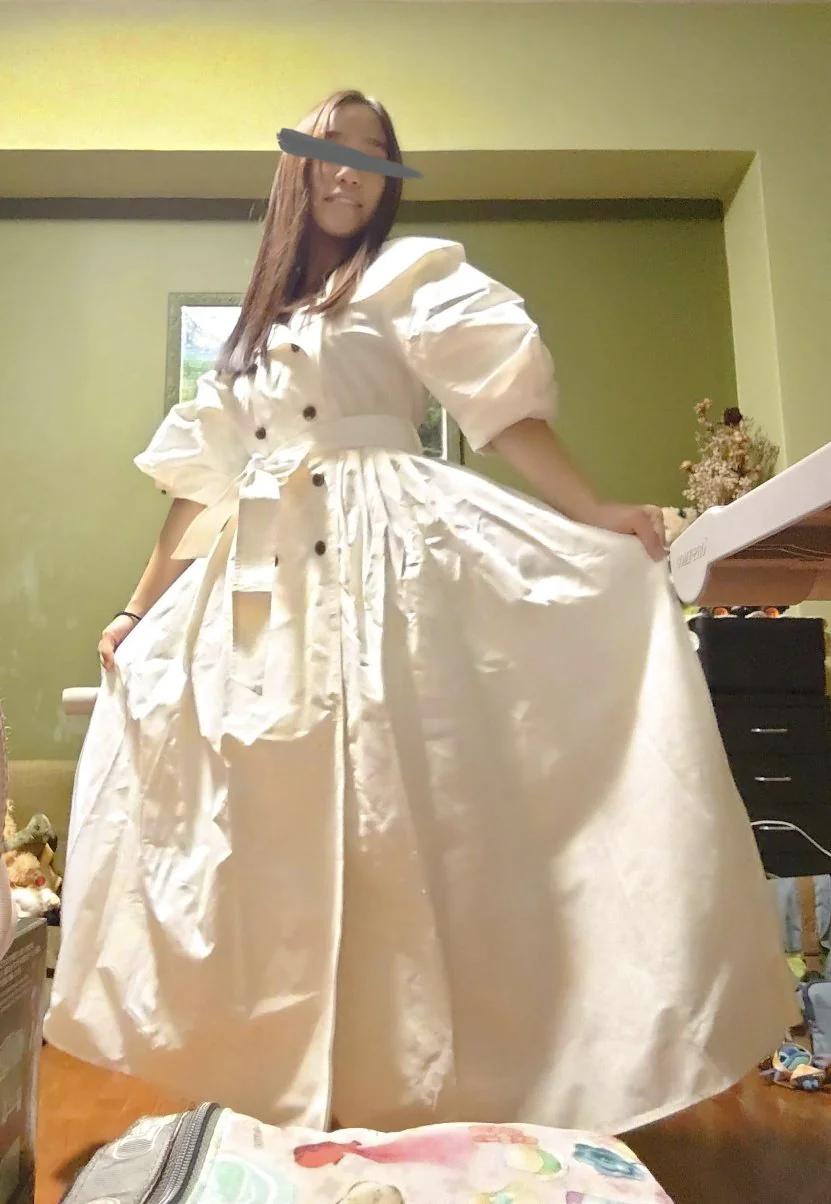
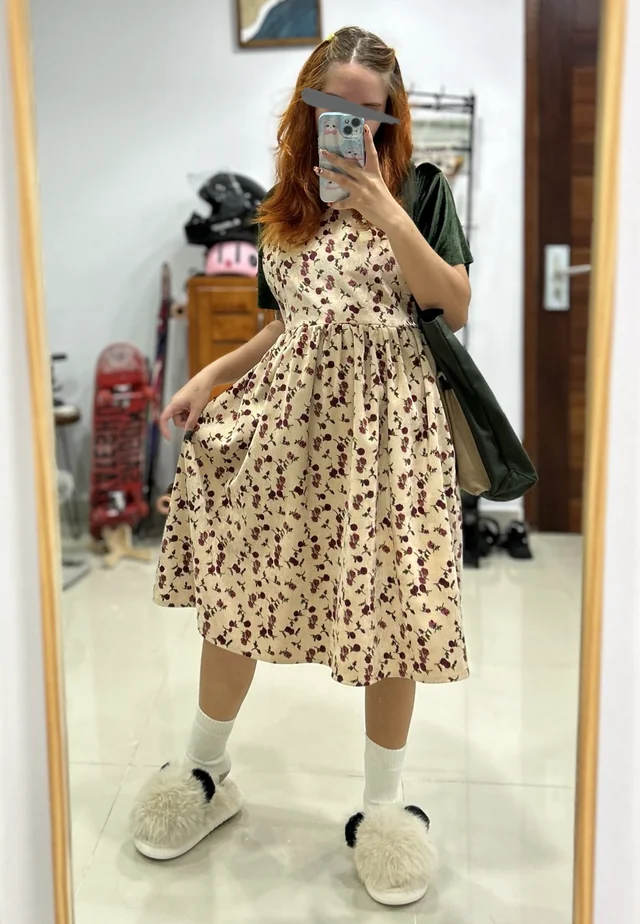
Gathered-tier skirt construction. The tiered skirt is cottagecore's most mathematically intensive silhouette element. A standard three-tier cottagecore skirt distributes fullness through progressive gathering ratios: the upper tier (yoke-to-hip) uses a gathering ratio of 1.5:1 to 2:1 (one and a half to two times the waist measurement in fabric, gathered to fit the waistband); the middle tier uses 2:1 to 2.5:1; the lower tier uses 2.5:1 to 3:1. This progressive increase in gathering ratio produces the characteristic silhouette — a gradual flare from fitted waist to maximum volume at the hem — and the corresponding progressive increase in fabric consumption. A three-tier cottagecore maxi skirt with a 70cm waist measurement and gathering ratios of 2:1 / 2.5:1 / 3:1 requires approximately 105cm of fabric width at the upper tier, 175cm at the middle tier (105cm x 2.5:1, adjusted for seam allowances and tier-attachment losses), and approximately 437cm at the lower tier (175cm x 2.5:1) — meaning the hem contains more than six times the fabric width of the waist. This fabric-consumption profile explains why quality cottagecore skirts in cotton lawn or linen are materially expensive (3-5 meters of fabric per skirt) and why fast-fashion approximations reduce gathering ratios to 1.5:1 across all tiers, producing a visually flatter, less voluminous skirt that saves approximately 40% on fabric costs but sacrifices the billowing pastoral fullness that defines the silhouette.

Puffed-sleeve drafting. The puffed sleeve — cottagecore's most recognizable single element — is constructed by adding width and height to a standard set-in sleeve block, then gathering the excess fabric at both the sleeve cap (where it attaches to the bodice armhole) and the cuff or elbow (where it terminates). A standard cottagecore puff sleeve adds 50-100% additional width to the base sleeve-block pattern and 20-40% additional cap height, creating the volume that is then controlled through gathering at the armhole seam and a band or elastic at the lower edge. The gathering ratio at the sleeve cap — typically 1.5:1 to 2:1 — determines the degree of puff: higher ratios produce the dramatic "Juliet" or leg-of-mutton sleeves seen in Batsheva and Selkie, while lower ratios produce the gentle puffs of Doen and Christy Dawn. The puffed sleeve's construction creates a specific failure mode: the gathered sleeve cap concentrates fabric weight at the shoulder seam, and in lightweight cotton lawn or voile, this concentration can cause the shoulder seam to pull forward under gravity over a day of wear, distorting the neckline and creating diagonal stress creases across the upper bodice. Quality construction addresses this through interfacing at the shoulder seam and balanced gathering distribution; fast-fashion construction, which omits interfacing to reduce cost, produces the characteristic forward-pulling shoulder distortion within the first wearing.

Yoke construction and bodice engineering. The yoke — a flat, fitted panel across the upper chest and shoulders from which the body of the dress or blouse hangs — is cottagecore's primary fullness-distribution mechanism. The yoke's function is to provide a structurally stable anchor (the flat, body-conforming panel) from which gathered, smocked, or pleated fabric can hang without distortion. Yoke depth varies from 10-15cm (shallow, for gathered-bodice blouses) to 20-30cm (deep, for full-yoke prairie dresses where the yoke extends from shoulder to below the bustline). Gathering is distributed evenly across the yoke's lower edge, with gathering ratios of 2:1 to 3:1 producing the characteristic body fullness. The yoke's critical construction challenge is achieving even gathering distribution: uneven gathering produces bunching at some points and flatness at others, destroying the visual uniformity of the gathered fall. Machine gathering (using differential feed or gathering-foot techniques) produces mechanically even distribution; hand gathering (running two parallel rows of basting stitches and pulling the bobbin threads to compress the fabric) produces slightly irregular distribution that reads as handmade. The distinction between machine and hand gathering is visible at close inspection (machine gathering produces uniform stitch intervals; hand gathering produces variable ones) and constitutes a quality-and-provenance marker within cottagecore's evaluative hierarchy.

Empire and natural-waist placement. Cottagecore employs two primary waist placements: the empire waist (positioned just below the bustline, at approximately the underbust measurement, producing a high-waisted silhouette with maximum skirt length and a column-like fall of fabric from underbust to hem) and the natural waist (positioned at the body's narrowest torso point, producing a more defined waist-to-hip ratio and a skirt that flares from the true waist). Empire waists produce the most pastoral-Regency citation — evoking Jane Austen, Bridgerton, and early 19th-century neoclassical dress — while natural waists produce more Prairie-Victorian citation. Both placements avoid the low or dropped waist positions that characterize flapper, Y2K, and other anti-pastoral silhouettes.

Materials

Material selection in cottagecore is organized by pastoral-romantic association rather than by functional performance: fibers are chosen because they connote nature, handcraft, and pre-industrial production, not because they perform optimally under the physical conditions the aesthetic imagines.

Cotton lawn. The aspirational cottagecore fabric. Cotton lawn is a fine, lightweight plain-weave cotton (60-100 g/m²) woven from combed, long-staple yarns at high thread counts (60-80 per cm in both warp and weft), then finished through calendering — a process in which the woven fabric is passed between heated metal rollers under pressure, flattening the surface fibers and producing the characteristic smooth, slightly lustrous hand that distinguishes lawn from muslin. Liberty of London's Tana Lawn — named for Lake Tana in Ethiopia, the historical source of the Sea Island-type cotton used in its production — is the gold standard: 135cm wide, approximately 70 g/m², printed with the house's archival floral designs using screen-printing and, increasingly, digital-printing technology. Cotton lawn's performance is suited to light, non-active wear: its fine yarns and high thread count produce excellent drape and a fluid fall that supports cottagecore's flowing silhouettes, but its low weight provides minimal UV protection (UPF 5-10, compared to the UPF 50+ that actual outdoor agricultural work requires), and its calendered finish degrades with washing — after three to five machine cycles at 30-40°C, the calendering is substantially lost, and the fabric transitions from smooth and lustrous to soft and matte. This finish degradation is irreversible and constitutes cotton lawn's primary aesthetic failure mode in cottagecore: the dress that appeared luminous and crisp at purchase develops a "washed-out" quality that, while not structurally damaging, alters the garment's visual register.

Cotton muslin. The workhorse cottagecore fabric. Muslin is a plain-weave cotton (80-150 g/m²) woven from carded or semi-combed yarns at moderate thread counts (30-50 per cm), producing a softer, more textured fabric than lawn with greater body weight and opacity. Its open weave structure provides high breathability — critical for the gathered, voluminous cottagecore silhouettes that trap body heat if made in less permeable fabrics — but also produces rapid moisture absorption and slow drying. A muslin prairie dress that encounters rain or heavy perspiration will absorb water throughout its gathered tiers, gaining substantial weight that causes the fabric to cling and the hemline to droop, collapsing the billowing silhouette into a sodden, body-revealing drape that contradicts the aesthetic's modesty conventions. Muslin wrinkles aggressively due to cotton's low resilience (cellulose fibers deform under mechanical stress and do not spring back to their original configuration), and the extensive gathering in cottagecore's construction concentrates wrinkle formation at gather points, producing permanent crease lines that resist pressing. The fabric's historical significance is precise: muslin was the material of the chemise à la reine, the Regency-era "muslin disease" scandal (in which women wearing dampened fine muslin for translucency effect developed pneumonia), and the 18th-century Indian textile trade that brought Dhaka muslin — at counts of 1,000+ threads per inch, so fine it was called "woven air" — to European markets before British trade policy significantly impacted the Bengali muslin industry to protect Lancashire cotton manufacturing.

Linen. The aspirational-pastoral fabric. Linen's flax-fiber crystalline cellulose structure (approximately 70% crystallinity versus cotton's 60%) produces a crisper hand, more angular drape, and superior moisture management compared to cotton — linen absorbs and releases moisture faster, creating a cooling micro-evaporation cycle that makes it theoretically ideal for the outdoor pastoral activities cottagecore imagines. In practice, linen's low resilience produces aggressive wrinkling that disrupts cottagecore's soft-pastoral visual logic within hours of active wear. A linen prairie dress pressed smooth in the morning will develop deep, angular creases across every gather point, seam intersection, and bend zone by afternoon — an aging signature that reads as "authentic naturalism" within cottagecore's evaluative framework but that many wearers find unacceptable. Linen's weight range in cottagecore applications (100-200 g/m²) is heavier than cotton lawn or muslin, which means gathered-tier skirts in linen accumulate more weight per tier, producing a downward-pulling drape that can overwhelm the puffed-sleeve lightness the silhouette requires above the waist. The most successful cottagecore linen garments use lighter-weight linens (100-140 g/m²) that approximate cotton's drape behavior while retaining linen's textural appeal.

Wool in cottagecore. Wool appears in cottagecore primarily as hand-knit cardigans, shawls, fingerless gloves, and fair-isle or cable-knit accessories — garments whose visible stitch structure and handcraft associations reinforce the aesthetic's anti-industrial orientation. Hand-knit cottagecore cardigans typically use worsted-weight yarn (approximately 200m per 100g, requiring needles in the 4.0-5.0mm range) in wool or wool-blend compositions, producing a knit at 18-22 stitches per 10cm with visible stitch definition and moderate warmth. The hand-knit garment's construction invests 30-60 hours of labor in a single cardigan — a material-intensity marker that distinguishes handcraft cottagecore from commercial cottagecore as fundamentally as hand-crochet lace distinguishes mori kei from fast-fashion approximation. Wool's failure mode in cottagecore is pilling: the fiber-to-fiber abrasion between wool and the cotton or linen garments beneath produces surface pills at every contact zone — underarm, inner elbow, waist overlap, button placket — within 20-40 wears, requiring ongoing maintenance (cashmere comb, fabric shaver) that the aesthetic's "effortless pastoral" narrative does not acknowledge.

Floral-print textile science. Florals are cottagecore's signature surface pattern, and the printing technology determines the print's visual quality, color fastness, wash behavior, and environmental impact. Screen printing (rotary or flatbed, using dye paste forced through a mesh screen with the pattern cut as a stencil) produces the most color-saturated, wash-stable results: each color requires a separate screen, so ditsy florals with 6-8 colors require 6-8 screen passes, making the process expensive but producing prints that retain color through 50+ wash cycles when using reactive dyes on cellulosic fibers. Digital printing (inkjet deposition of dye directly onto fabric from a digital file) enables photographic-quality, unlimited-color florals at lower setup costs but produces prints with inferior wash fastness — color loss of 10-20% is typical within the first ten wash cycles, and fine detail can blur as dye molecules migrate during washing. Discharge printing (applying a chemical that removes the base dye from already-dyed fabric, creating a pattern through color removal rather than addition) produces the distinctive "faded vintage" floral characteristic of high-end cottagecore — a soft, muted floral on a pre-dyed ground that cannot be replicated through additive printing processes. Liberty's screen-printed Tana Lawn, Doen's digitally printed cotton, and Christy Dawn's deadstock-fabric sourcing (using pre-existing printed fabrics from canceled production runs) represent three distinct approaches to the floral-print challenge, each with different color-fastness, wash-behavior, and environmental-impact profiles.

Color Palette

The palette operates through pastoral-historical citation: colors are selected for their association with rural landscape, botanical imagery, and pre-industrial textile production rather than for trend-cycle relevance.

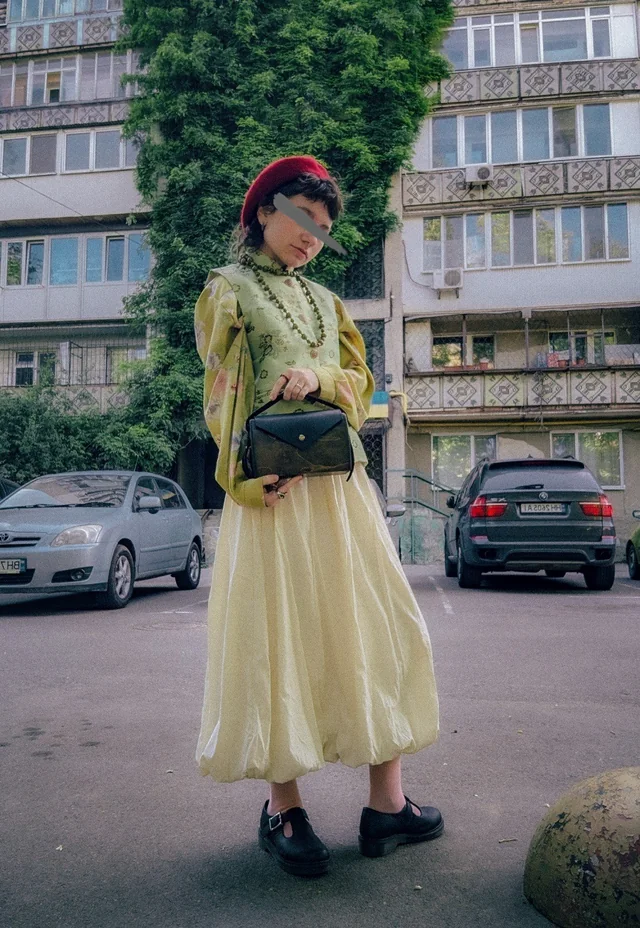
Meadow pastels. Milk white, butter yellow, lavender, powder blue, blush pink, sage green, and dusty rose constitute the palette's lightest register — colors that cite wildflower meadows, cottage-garden borders, and the washed-out quality of sun-exposed natural-dye colors. These pastels share an optical property: they are warm-leaning, low-saturation, and slightly muted, as if the color has been gently bleached by sunlight. This muting distinguishes cottagecore pastels from Barbiecore or Y2K pastels (which are fully saturated and synthetic-bright) and from Scandinavian pastels (which are cool-leaning and grey-undertoned).

Earth and harvest tones. Mushroom beige, wheat gold, cinnamon, terracotta, dried-herb green, and stone constitute the palette's middle register — colors that cite autumn harvest, dried flowers, bread crust, and the warm-neutral spectrum of undyed natural fibers. These earth tones provide chromatic grounding for the lighter pastels and connect the palette to the agricultural-harvest narrative that runs through cottagecore's seasonal imagery.

Deep botanical accents. Forest green, deep burgundy, midnight blue, and blackberry provide the palette's darkest values — used sparingly in print details, accessories, and autumn-winter iterations. These deeper tones cite the dark-pastoral register: autumn dusk, winter hearths, dried-berry preserves, and the deeper tones of the English cottage-garden border.

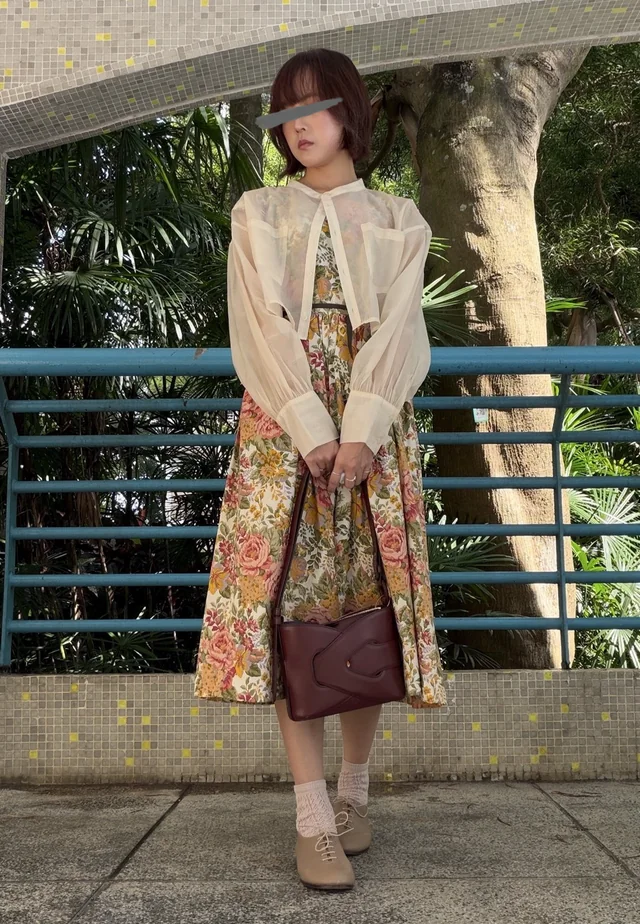
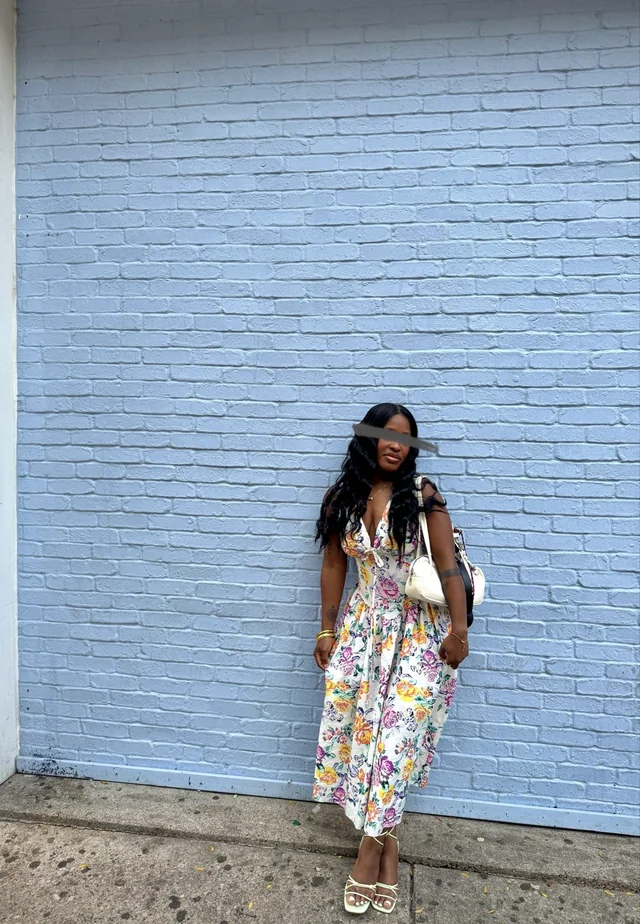
Pattern conventions. Ditsy florals (small-scale, all-over botanical prints with repeat sizes of 2-5cm) dominate; gingham (a balanced check produced by dyeing warp and weft yarns in alternating colored and white sequences) provides the domestic-utilitarian pattern; toile de Jouy (scenic prints depicting pastoral and mythological scenes, originating from the Oberkampf manufactory at Jouy-en-Josas, 1760) provides the historical-literary pattern; strawberry prints (a cottagecore-specific motif recycled from 18th-century textile design and popularized by Lirika Matoshi's widely imitated Strawberry Dress) provide the contemporary-viral pattern. Large-scale graphic prints, geometric abstracts, and animal prints are essentially absent — their visual assertiveness contradicts the palette's pastoral quietness.

Details

Details in cottagecore are best analyzed as handcraft-citation interfaces — construction elements whose visual character derives from manual textile techniques that the garment either genuinely employs or visually references.

Smocking. Smocking gathers fabric into regular folds secured with decorative stitching, creating elastic, expandable sections that accommodate body movement without zippers, buttons, or elastic. The gathering ratio ranges from 2.5:1 to 3:1 — a 30cm smocked bodice panel requires 75-90cm of fabric — making smocking one of the most fabric-intensive construction techniques in the cottagecore vocabulary. Traditional hand smocking (honeycomb, cable, wave, diamond, and basket stitch patterns worked over evenly gathered pleats) requires 4-8 hours of skilled needlework per bodice panel and produces the slight irregularity and dimensional texture that distinguishes handcraft from machine production. Machine-smocked garments (produced by specialty shirring machines or multi-needle elastic-shirring techniques) reproduce the gathered-and-stitched appearance at commercial speed but produce a more uniform, less textured surface. The functional distinction matters: hand smocking produces controlled elasticity that recovers its shape after stretching, while machine elastic shirring loses elastic recovery after 30-50 wash cycles as the elastic thread degrades, causing the smocked area to sag and lose its gathered structure — a failure mode that marks the garment as fast-fashion construction.

Broderie anglaise (eyelet embroidery). The technique involves punching or cutting holes in cotton fabric and finishing each hole with dense satin-stitch embroidery that simultaneously decorates and reinforces the opening. Authentic broderie anglaise is produced on schiffli embroidery machines (developed in St. Gallen, Switzerland, in the 1860s, named from the Swiss-German Schiffli, "little boat," describing the shape of the machine's shuttle) that punch and embroider simultaneously, encasing each eyelet's edge in thread with no raw fabric visible. Cheaper machine imitations use laser cutting to create holes and partial-coverage embroidery that leaves edges semi-raw, producing eyelets that fray, distort, and enlarge with repeated washing — a failure mode that can be diagnosed at purchase by running a fingernail around the eyelet's interior edge: fully encased eyelets feel smooth; partially finished eyelets catch on the fingernail. In cottagecore, broderie anglaise appears at blouse collars, dress hems, pinafore bibs, and apron edges, functioning as a shorthand for "handcrafted femininity" — the labor-intensive embroidery signifying the domestic care that the aesthetic centers.

Pintucks. Narrow stitched folds (2-3mm wide) running parallel across fabric surfaces, creating textural ridges that catch light differently from the flat fabric between them. A bodice panel with twenty 3mm pintucks loses 120mm of width to the folds, requiring pattern adjustment — the garment consumes significantly more fabric than a plain equivalent, making pintucking a material-intensity marker. In cottagecore, pintucks appear on bodice fronts, yoke panels, and cuff details, producing the "fine-craft" visual texture that signals construction investment. The technique's failure mode is pressing-related: pintuck folds are permanently set during construction using heat and steam, but aggressive machine washing and tumble drying can distort the folds, causing them to flatten unevenly or twist, producing a rumpled rather than crisp pintuck surface.

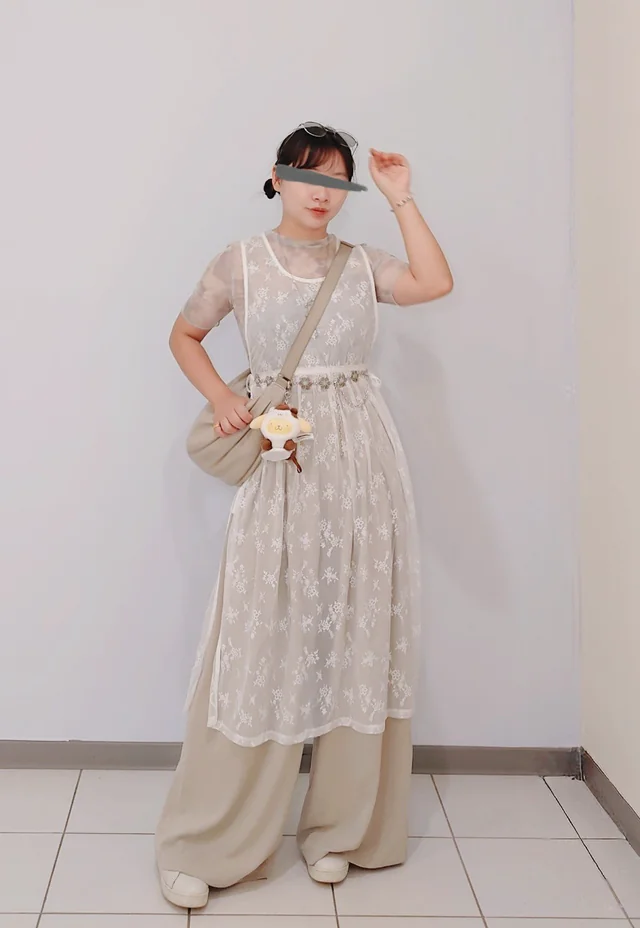
Lace and lace-insertion construction. Cotton lace — crochet lace, Cluny bobbin lace, chemical lace (embroidered on a dissolvable substrate), and machine-made Leavers lace — appears as trim, insertion, collar material, and full-garment panels. Lace insertion (setting a strip of lace into a seam between two fabric panels, creating a decorative band of transparency within an otherwise opaque garment) is cottagecore's most distinctive lace application: the technique creates visual breaks in the fabric surface through which skin or undergarments are partially visible, producing the controlled-transparency effect that cottagecore uses to introduce subtle sensuality within its otherwise modest silhouette. Lace quality varies enormously: cotton Leavers lace (produced on Leavers looms in Calais and Nottingham, using thousands of individual thread carriers to create true lace structures with twisted-and-crossed thread intersections) represents the quality ceiling; polyester chemical lace (produced by embroidering polyester thread onto water-soluble PVA fabric, then dissolving the substrate) represents the commercial floor. The distinction is detectable through burn testing (cotton chars to ash; polyester melts to a hard bead), through hand-feel (cotton lace drapes softly and absorbs moisture; polyester lace is stiffer and non-absorbent), and through aging behavior (cotton lace softens and yellows gradually; polyester lace retains its initial properties but eventually becomes brittle and cracks).

Gathering, ruffles, and ribbon-tie closures. Gathering ratios in cottagecore range from 1.5:1 (gentle softness) to 3:1 (full, billowing volume), with the ratio determining both the garment's visual character and its fabric consumption. Ruffles — strips gathered along one edge and attached to hems, cuffs, and necklines — add additional fabric consumption (a 5cm-wide ruffle at 2:1 gathering around a 200cm skirt hem requires 400cm of fabric, or 4 meters of additional material). Ribbon-tie closures (fabric or grosgrain ribbons tied at center front, waist, or sleeve) replace zippers and buttons as the preferred closure mechanism, reinforcing the aesthetic's anti-industrial orientation and providing adjustable fit without hardware — though ties loosen under activity and require retying throughout the day, a maintenance demand that the aesthetic's pastoral-ease narrative does not acknowledge.

Accessories

Accessories in cottagecore extend the pastoral-domestic citation from garments to carried and worn objects, creating a coherent material vocabulary organized around the cottage, the garden, and the meadow.

Footwear defaults to leather or canvas constructions that cite rural and domestic activity: leather Mary Janes (single-strap, low heel, round toe — the most canonical cottagecore shoe); leather lace-up ankle boots (citing Victorian and Edwardian country boots); wooden or leather clogs (citing Scandinavian and Dutch rural labor footwear); canvas sneakers (Converse, Superga) in white or earth tones (the concession to contemporary practicality). Wellington boots in muted colors provide the rain-garden utility that the aesthetic's pastoral imagery requires but that delicate leather footwear cannot survive.

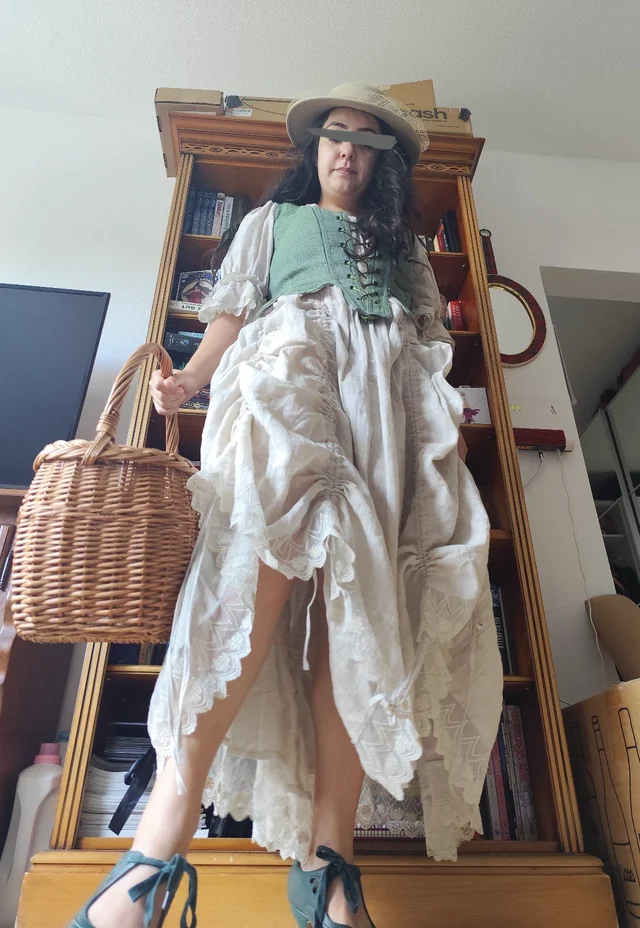
Bags are soft, unstructured, and pastoral-functional: woven baskets (wicker, rattan, seagrass) for market shopping and flower gathering; cotton or linen tote bags with floral prints or botanical embroidery; leather satchels in vegetable-tanned brown. The basket is the semiotic keystone: it cites foraging, flower-picking, and market-shopping activities that position the wearer within the pastoral labor narrative.

Headwear includes hair ribbons, floral crowns, straw hats (wide-brimmed, unstructured), cotton or linen head scarves, and crocheted hair accessories. Hair is typically worn long, loose, and unstructured — braids, loose buns, and flower-entwined styles rather than sleek, heat-styled configurations.

Jewelry is minimal and natural-material: pressed-flower pendants in resin, seed-pearl studs, thin gold or brass chains, cameo brooches, and handmade ceramic or glass beads. Precious stones, large-scale statement pieces, and brand-identifiable hardware are essentially absent.

Body Logic

Cottagecore constructs the body as a domestic-pastoral figure: gendered feminine in its dominant expression, oriented toward softness, care, interiority, and productive domesticity rather than toward display, sexual availability, or physical performance. The gathered, voluminous silhouette envelops the body in fabric that obscures anatomical contour — the waist is suggested rather than defined, the bust is covered rather than emphasized, the legs are concealed beneath skirt volume — producing a modesty logic that nevertheless permits selective sensuality through off-shoulder necklines, puffed-sleeve skin exposure at the upper arm, and lace-insertion transparency at the bodice.

The body imagined by cottagecore is a body in domestic action: kneading bread, arranging flowers, weeding a garden bed, hanging laundry, reading by a window, pouring tea. Garments are ostensibly designed to accommodate these activities — gathered skirts allow bending, puffed sleeves allow reaching, aprons protect dress fabric during kitchen work. In practice, the garments impede rather than facilitate physical labor: cotton lawn tears on brambles, muslin absorbs water and soil during gardening, gathered hems collect mud, puffed sleeves catch on branches, and lace trim snags on rough surfaces. The aesthetic thus produces a garment-activity contradiction: the clothes cite physical pastoral labor while being materially unsuited to it, revealing that cottagecore's pastoral body is imagined rather than functional — a body performing the idea of domestic work rather than the reality.

Gender presentation in cottagecore is primarily feminine but actively contested. The aesthetic's dominant visual grammar (long dresses, florals, lace, soft colors) cites conventional femininity, but its queer adoption recodes this grammar: two women in matching floral dresses, tending a shared garden, perform a domesticity that departs from heteronormative expectations while using its visual vocabulary. Masculine-presenting cottagecore participation exists but is marginal and often coded through adjacent aesthetics (dark academia, goblincore) rather than through cottagecore's primary garment vocabulary. The aesthetic's body-diversity accommodation operates through its volume-forward silhouette: gathered and smocked construction distributes fabric across the body without requiring precise body-garment fit, making the same garment wearable across a broader size range than fitted construction allows — though fast-fashion cottagecore frequently undercuts this accommodation by grading patterns for slim bodies and adding only width (not length, armhole depth, or yoke proportioning) at larger sizes.

Garment Logic

Construction in cottagecore operates through handcraft citation: garments are built using techniques that reference pre-industrial domestic needlework, and the quality hierarchy separates garments that genuinely employ these techniques from those that visually imitate them through industrial shortcuts.

Prairie-dress pattern engineering. The canonical cottagecore prairie dress integrates yoke, gathered bodice, puffed sleeves, and tiered skirt into a single garment whose pattern requires eight to twelve pieces (front and back yoke, front and back bodice panels, two sleeve pieces, three to four tier panels, waistband or belt, and collar if included). The construction sequence follows a specific dependency chain: yoke construction first (assembling the flat, fitted shoulder-and-upper-chest panel), then bodice attachment (gathering the bodice panels to the yoke's lower edge), then sleeve insertion (setting gathered puff sleeves into the bodice armhole), then tier assembly (gathering and attaching progressive tiers from waist to hem), then closures and finishing. Each step's quality depends on the preceding step's precision: an imprecisely constructed yoke produces uneven gathering at the bodice attachment, which produces asymmetric sleeve placement, which produces a skewed neckline. This cascading-dependency logic explains why quality prairie dresses require skilled construction — each decision propagates through the garment's entire system.

Apron and pinafore construction. The apron — a protective over-garment tied at the waist and, in full-bib versions, at the neck — is cottagecore's most directly functional garment and its most symbolically loaded. Apron construction is among the simplest in the cottagecore vocabulary: a rectangular body panel, gathered or pleated into a waistband, with ties cut from the same fabric or from contrasting ribbon. The pinafore — a sleeveless over-dress with front bib and shoulder straps, typically worn over a blouse or dress — is structurally similar but integrates a bib panel that covers the upper chest, creating a layered silhouette that adds visual complexity. Both garments function as pastoral-labor signifiers: they cite kitchen work, garden work, and domestic craft while providing genuine protection of the dress beneath — one of the few instances where cottagecore's visual citation and material function align.

Aftercare and maintenance. Cottagecore garments in cotton lawn, muslin, and linen require care calibrated to preserve the fibers' visual properties while managing the construction techniques' structural vulnerabilities. Gathered and smocked garments should be washed at 30°C on gentle cycle to prevent gathering-thread breakage and gather-point distortion; tumble drying should be avoided because the mechanical agitation flattens pintucks, distorts gathers, and accelerates the loss of cotton lawn's calendered finish. Broderie anglaise and lace elements require flat-bag protection during machine washing to prevent snagging. Linen garments should be dried on a line and pressed while slightly damp to manage wrinkling. Hand-knit wool components require hand washing in cold water with wool-specific detergent, flat drying, and moth-protection storage. The cumulative aftercare burden — in which a single cottagecore outfit may combine garments requiring three different care protocols — is substantial and rarely acknowledged in the aesthetic's presentation of pastoral simplicity.

Failure modes. Cottagecore garments fail along trajectories specific to their construction logic. Gathering-thread breakage (the basting or elastic threads that maintain gathers can snap under strain, causing localized gather collapse and visible looseness at the failure point) is the most common structural failure, occurring at stress points — waist, armhole, cuff — where body movement pulls against the gathered fabric. Smocking elastic degradation (the elastic threads in machine-smocked bodices lose recovery after 30-50 wash cycles, causing the smocked area to sag irreversibly) terminates fast-fashion smocked garments within one to two seasons of regular wear. Floral-print fading (reactive-dye prints lose color gradually through wash and UV exposure, with reds fading faster than blues due to the differential stability of azo versus anthraquinone dye chromophores) alters the garment's visual register over time. Lace-trim fraying (the exposed edges of lace trim catch on adjacent surfaces, pulling threads and creating holes) is accelerated in cottagecore by the garment's voluminous silhouette, which increases the surface area available for snagging. Seam failure at gather points (concentrated fabric at gathered seams creates stress concentrations that exceed the seam's tensile capacity under strain) is common in lightweight cotton garments where the seam thread's breaking strength is insufficient for the number of fabric layers compressed into the seam. These failure modes collectively establish that cottagecore garments have shorter functional lifespans than their "timeless" pastoral marketing suggests — a tension between the aesthetic's anti-fast-fashion self-image and the material reality of its garments' durability.

Motifs / Themes

Pastoral escapism as governing metaphor: the aesthetic positions the wearer within an idealized rural landscape — the cottage garden, the meadow, the kitchen hearth, the reading nook — that provides imaginary refuge from urban modernity, digital saturation, economic precarity, and institutional alienation. The pastoral escape is genuine in its emotional operation (participants report real comfort, real community, real identity) but structurally conditioned by the urban-digital conditions it refuses: cottagecore requires internet access, platform participation, disposable income, and leisure time — resources that are disproportionately available to the middle-class urban populations from which the aesthetic's primary community is drawn.

Domesticity as chosen practice: cottagecore reframes domestic labor — baking, gardening, preserving, mending, crafting — from assigned obligation to elective pleasure, converting activities historically associated with women's unpaid labor into aesthetic practice and lifestyle content. This reframing is emotionally genuine but analytically complex: by aestheticizing domestic labor, cottagecore risks obscuring the conditions under which domestic labor remains involuntary, uncompensated, and unequally distributed along gender, class, and racial lines.

Nature as setting rather than system: cottagecore's "nature" is a curated garden, a meadow in bloom, a basket of wildflowers — nature as backdrop and resource rather than as ecological system with its own dynamics, vulnerabilities, and claims. The aesthetic does not engage with agriculture as industrial practice, with land as contested property, or with ecology as relational science; it engages with nature as ambiance. This is not a failure of the aesthetic but a structural feature: pastoral has always been a literary mode, not an agricultural one.

Handcraft as identity: knitting, embroidery, sewing, baking, and gardening function both as material practices and as identity markers, positioning the practitioner within a lineage of domestic skill that the aesthetic valorizes against industrial mass production. The craft-identity claim is most credible when the practitioner actually possesses the skills (the hand-knitter, the home sewist, the sourdough baker) and least credible when it is performed through consumption (purchasing a machine-made "handcraft-style" dress from a fast-fashion retailer).

Cultural Touchstones

Taylor Swift's Folklore (July 2020) and Evermore (December 2020) constitute the aesthetic's most commercially consequential cultural vehicle. The albums' visual identity — Swift photographed by Beth Garrabrant in cardigans, braids, and autumnal rural settings; the "cardigan" single released with a music video set in a woodland piano fantasy; the "willow" video depicting a pastoral-domestic narrative — deployed cottagecore's exact visual grammar at a scale no subcultural-origin aesthetic had previously achieved. The accompanying "cardigan" merchandise — a cable-knit, oversized cardigan with star motifs, released as limited-edition merchandise and subsequently sold out within hours — became cottagecore's most widely circulated single garment, producing a template that retailers from Target to Etsy reproduced in the millions.

Pride and Prejudice (2005 film, dir. Joe Wright; and 1995 BBC miniseries) provides the Regency-pastoral visual reference: empire-waist muslin dresses, English country landscapes, domestic interiors organized around fireplaces and writing desks. Little Women (2019, dir. Greta Gerwig) extends the reference into 19th-century American domesticity. The Secret Garden (Frances Hodgson Burnett, 1911) and its film adaptations provide the garden-as-refuge narrative. Anne of Green Gables (L.M. Montgomery, 1908) — particularly the 1985 CBC television adaptation — provides the romantic, imaginative girl-in-rural-domesticity figure that anticipates cottagecore's character type.

Bridgerton (Netflix, 2020-present) introduced Regency-era pastoral settings and empire-waist silhouettes to a mass streaming audience, reinforcing the Regency-cottagecore overlap. Studio Ghibli films — particularly Howl's Moving Castle (2004, pastoral-domestic fantasy with explicitly cottagecore-adjacent imagery) and Kiki's Delivery Service (1989, the independent young woman in domestic-craft settings) — circulate as cottagecore visual reference on Tumblr and Pinterest. The Great British Bake Off (Channel 4/Netflix, 2010-present) — with its tent-in-a-garden setting, pastel palette, and domesticity-as-competition format — provided the aesthetic's baking-pastoral touchstone.

See Also

  • Mori kei: Japanese pastoral predecessor; shares natural-fiber and floral vocabulary but constructs identity through multi-layer accumulation rather than cottagecore's single-garment citation; mori kei predates cottagecore by a decade and operates through a codified rule system absent in cottagecore
  • Tradwife: Overlapping domestic-femininity visual grammar; divergent political valence — tradwife naturalizes patriarchal gender roles where cottagecore (in its queer iterations) reimagines domesticity outside patriarchal structures
  • Boho: Shared flowing-natural-fiber silhouettes and handcraft references; boho cites global-eclectic sources (bazaar, caravan, festival) where cottagecore cites specifically rural-pastoral sources (cottage, meadow, garden)
  • Hygge: Shared coziness and domestic-comfort orientation; hygge centers interior atmospheric design where cottagecore centers dressed-body pastoral performance
  • Dark academia: Overlapping bookish-pastoral sensibility; dark academia cites institutional and literary settings where cottagecore cites domestic and agricultural ones
  • Goblincore: Overlapping nature-and-craft aesthetic; goblincore foregrounds mess, decay, fungi, and non-pretty natural elements where cottagecore foregrounds beauty, order, flowers, and curated naturalness
  • Fairycore: Overlapping romanticization of nature and femininity; fairycore adds fantasy and supernatural elements (wings, glitter, ethereal fabrics) where cottagecore remains terrestrial and domestic
  • Regencycore: Overlapping empire-waist silhouettes and period-pastoral reference; Regencycore cites specifically Regency-era (1811-1820) sources, driven by Bridgerton, where cottagecore draws from a broader temporal range
  • Prairie revival (1970s): Direct historical predecessor through Gunne Sax and back-to-the-land counterculture; cottagecore recycles the prairie-dress silhouette through internet-platform aesthetics rather than counterculture politics

Brands and Designers

Premium Contemporary:

  • Doen (founded 2015, Los Angeles; Margaret and Katherine Kleveland): the commercially dominant cottagecore-adjacent brand; digitally printed cotton and silk prairie dresses, puffed-sleeve blouses, tiered skirts in pastoral floral prints; price range $150-$400; vertical-integration aspirations with increasing attention to sustainable sourcing
  • Christy Dawn (founded 2013, Los Angeles; Christy Dawn Petersen): deadstock-fabric prairie dresses and blouses, regenerative-agriculture cotton program ("Farm-to-Closet" initiative sourcing from regenerative farms in India), limited-run production; the cottagecore brand most committed to resolving the aesthetic's environmental contradictions
  • Hill House Home (founded 2016, New York; Nell Diamond): the Nap Dress — a smocked-bodice, puffed-sleeve, tiered-skirt dress designed for home wear that became cottagecore's crossover hit — in cotton, linen, and cotton-blend fabrics with seasonal floral prints; the brand that most successfully commercialized cottagecore's domestic-comfort proposition
  • Batsheva (founded 2016, New York; Batsheva Hay): prairie-dress silhouettes in bold, often ironic prints that engage with the aesthetic's religious and historical references — Mennonite and Amish dress codes, Little House on the Prairie — with deliberate visual tension between modesty and spectacle
  • The Vampire's Wife (founded 2014, London; Susie Cave): romantic, floor-length dresses with gathered sleeves, high necklines, and metallic or floral fabrics; positioned at the luxury-gothic-pastoral intersection
  • Selkie (founded 2019, Los Angeles; Kimberley Gordon): exaggerated puff sleeves and voluminous tulle-over-cotton constructions in pastel and floral prints; cottagecore's maximalist-fantasy extreme

Artisanal and Independent:

  • Lirika Matoshi (founded 2019, New York): the Strawberry Dress — a pink tulle midi dress with strawberry-motif embroidery that went viral on TikTok in 2020 — became one of cottagecore's most widely circulated single garments, despite being more fairycore than cottagecore in construction; handmade, direct-to-consumer
  • Bernadette (founded 2018, Antwerp; Bernadette de Geyter): romantic floral-print dresses in cotton and silk with cottagecore-adjacent silhouettes at luxury price points
  • Meadows (London): floral-print cotton and linen dresses and blouses with romantic, garden-party silhouettes
  • Etsy handcraft sellers: the independent cottagecore ecosystem — hand-sewn prairie dresses, hand-knit cardigans, hand-embroidered aprons, handmade lace — representing the aesthetic's most materially authentic production, where handcraft claims are verifiable through construction evidence

Heritage and Vintage Sources:

  • Laura Ashley (founded 1953, Wales; revived under licensing): the historical proto-cottagecore brand — floral-print cotton dresses, curtains, and home textiles in pastoral prints produced from the 1960s through 1990s; vintage Laura Ashley garments carry particular cachet within cottagecore as "original" pastoral fashion
  • Gunne Sax / Jessica McClintock (founded 1969, San Francisco): the 1970s prairie-revival brand whose high-necked, lace-trimmed, floral-print cotton dresses provided the template that contemporary cottagecore directly cites; vintage Gunne Sax is the most sought-after historical cottagecore garment category
  • Edwardian and Victorian white-cotton garments: antique and vintage white-cotton blouses, petticoats, nightgowns, and chemises from 1880-1910 circulate within cottagecore as "original" pastoral garments, valued for their handcraft construction (hand-embroidery, hand-smocking, hand-finished seams) and natural-fiber purity
  • Liberty of London (founded 1875): Tana Lawn floral-print cotton as the premium cottagecore fabric; Liberty prints circulate as cut fabric for home sewists and as finished garments through Liberty's own retail

Accessible and Fast-Fashion:

  • Reformation (founded 2009, Los Angeles): cottagecore-adjacent floral-print dresses in sustainable-production frameworks; positioned between premium and accessible tiers
  • & Other Stories (H&M Group): floral-print cotton and linen dresses and blouses at high-street pricing with better-than-fast-fashion material quality
  • H&M Conscious collections: periodic prairie-dress and floral-print drops using organic cotton and recycled polyester, representing the fast-fashion tier's sustainability gesture
  • Shein, ASOS, Amazon: mass-market cottagecore at $15-$40 price points using polyester-cotton blends, synthetic lace, and machine-smocked construction with limited garment lifespan — the commercial floor of the cottagecore market

Citations

[1] Slone, Isabel. "Escape Into Cottagecore, the Quarantine Trend That Channels the Simple Life." The New York Times, 10 Mar. 2020. [2] Jennings, Rebecca. "Cottagecore Was Just the Beginning." Vox, 15 Dec. 2020. [3] Frey, Angelica. "Cottagecore Debuted 2,300 Years Ago." JSTOR Daily, 2020. [4] Spellings, Sarah. "What Is Cottagecore? And How Do I Get the Look?" The Cut, New York Magazine, 2020. [5] Casid, Jill H. "Queer(y)ing Georgic: Utility, Pleasure, and Marie Antoinette's Ornamented Farm." Eighteenth-Century Studies, vol. 30, no. 3, 1997, pp. 304-318. [6] Williams, Raymond. The Country and the City. Oxford University Press, 1973. [7] Empson, William. Some Versions of Pastoral. New Directions, 1935. [8] Marx, Leo. The Machine in the Garden: Technology and the Pastoral Ideal in America. Oxford University Press, 1964. [9] Wilder, Laura Ingalls. Little House on the Prairie (series). Harper & Brothers, 1932-1943. [10] Tuck, Eve, and K. Wayne Yang. "Decolonization Is Not a Metaphor." Decolonization: Indigeneity, Education & Society, vol. 1, no. 1, 2012, pp. 1-40. [11] Rifkin, Mark. Settler Common Sense: Queerness and Everyday Colonialism in the American Renaissance. University of Minnesota Press, 2014. [12] Entwistle, Joanne. The Fashioned Body: Fashion, Dress and Social Theory. 2nd ed., Polity, 2015. [13] Kadolph, Sara J., and Sara B. Marcketti. Textiles. 12th ed., Pearson, 2016. [14] Hatch, Kathryn L. Textile Science. West Publishing, 1993. [15] Morton, W. E., and J. W. S. Hearle. Physical Properties of Textile Fibres. 4th ed., Woodhead Publishing, 2008. [16] Tortora, Phyllis G., and Robert S. Merkel. Fairchild's Dictionary of Textiles. 7th ed., Fairchild Books, 1996. [17] Humphries, Mary. Fabric Reference. 4th ed., Pearson Prentice Hall, 2009. [18] Riello, Giorgio. Cotton: The Fabric That Made the Modern World. Cambridge University Press, 2013. [19] Beckert, Sven. Empire of Cotton: A Global History. Vintage, 2015. [20] Reader, John. "The Untold History of the Potato." Propelled: How Cycles of Invention Shape America. HarperCollins, 2009. [21] Kawamura, Yuniya. Fashion-ology: An Introduction to Fashion Studies. 2nd ed., Bloomsbury Academic, 2018. [22] Wilson, Elizabeth. Adorned in Dreams: Fashion and Modernity. Revised ed., Rutgers University Press, 2003. [23] Crane, Diana. Fashion and Its Social Agendas: Class, Gender, and Identity in Clothing. University of Chicago Press, 2000. [24] Hebdige, Dick. Subculture: The Meaning of Style. Routledge, 1979. [25] Barthes, Roland. The Fashion System. Translated by Matthew Ward and Richard Howard, University of California Press, 1983. [26] Hollander, Anne. Seeing Through Clothes. University of California Press, 1993. [27] Bourdieu, Pierre. Distinction: A Social Critique of the Judgement of Taste. Translated by Richard Nice, Harvard University Press, 1984. [28] Lipovetsky, Gilles. The Empire of Fashion: Dressing Modern Democracy. Princeton University Press, 1994. [29] Fletcher, Kate. Sustainable Fashion and Textiles: Design Journeys. 2nd ed., Earthscan, 2013. [30] Fletcher, Kate. Craft of Use: Post-Growth Fashion. Routledge, 2016. [31] Veblen, Thorstein. The Theory of the Leisure Class. Macmillan, 1899. [32] Simmel, Georg. "Fashion" (1904). In Simmel on Culture: Selected Writings, edited by David Frisby and Mike Featherstone, SAGE, 1997. [33] Kimmerer, Robin Wall. Braiding Sweetgrass: Indigenous Wisdom, Scientific Knowledge and the Teachings of Plants. Milkweed Editions, 2013. [34] McRobbie, Angela. "Bridging the Gap: Feminism, Fashion, and Consumption." Feminist Review, no. 55, 1997, pp. 73-89. [35] Stallybrass, Peter. "Worn Worlds: Clothes, Mourning, and the Life of Things." The Yale Review, vol. 81, no. 2, 1993, pp. 35-50.