Boho
Summary. Boho is a dress system in which artisanal textile techniques — block-printing, hand-woven ikat, batik resist-dyeing, crochet, macramé, and embroidery drawn from multiple global traditions — are assembled into layered, unstructured silhouettes that code artistic nonconformity and craft reverence as wearable identity. The aesthetic originates in the material conditions of nineteenth-century Parisian bohemia, where genuinely impoverished artists, writers, and musicians wore secondhand, mismatched, and deteriorating garments not as stylistic choice but as economic fact; subsequent translations — through Pre-Raphaelite romanticism, 1960s–70s hippie counterculture, and the mid-2000s "boho-chic" media cycle — progressively converted that poverty-born visual grammar into an aspirational lifestyle commodity. Boho is governed by a craft-provenance logic: garments are evaluated not through construction precision or material engineering but through the density and legibility of artisanal reference they carry — hand-stitching, natural-dye irregularity, visible embroidery, woven pattern complexity — and through the layered, fluid body-presentation that those textile methods produce.
In Material Terms
Boho's coherence depends on the performance behavior of natural cellulosic fibers — cotton, linen, hemp — under conditions of loose construction, minimal interfacing, and sustained everyday wear; on the chemistry of traditional dyeing systems including indigo resist-printing, wax-based batik, and mordant-fixed vegetable dyes that produce the muted, warm-spectrum palette the aesthetic requires; and on the aging trajectories of vegetable-tanned leather and suede, which soften, darken, and mold to the wearer's body through sustained contact. When these material systems function authentically — hand-blocked cotton whose irregularities record the printer's gesture, ikat cloth whose color bleeding indexes the warp-resist alignment process, crochet whose stitch tension varies with the maker's hand — the aesthetic achieves its claim to artisanal individuality. When the same visual effects are simulated through digital printing on polyester, machine-made "crochet-look" knits, and chrome-tanned suedette, the category collapses into costume: the signifiers of handcraft circulate without the material substrate that originally produced them.
At Category Level
Boho occupies a uniquely contested position because its defining tension — between countercultural refusal and commercial absorption — has been restaged in every decade since the 1960s without resolution. High-authenticity implementations draw on genuine artisanal supply chains (Indian block-print cooperatives, Oaxacan embroidery workshops, Central Asian suzani ateliers) and are evaluated through textile-provenance literacy: the ability to distinguish ajrakh from screen-printed imitation, Kutchi mirror-work from machine-appliquéd sequins, or hand-knotted macramé from injection-molded resin. Low-tier implementations reproduce the visual grammar — florals, fringe, "ethnic" prints, peasant-blouse silhouettes — through fast-fashion manufacturing that eliminates the artisanal labor and cultural specificity the aesthetic claims to honor. This stratification is not merely commercial but epistemological: it separates participants who evaluate garments through craft knowledge from those who evaluate through trend recognition, and it maps directly onto the cross-cultural borrowing dynamics that constitute boho's most significant ongoing conversation.
Methodologically
This entry treats boho as a craft-migration system: garments are analyzed by how artisanal textile techniques originating in specific cultural traditions are translated, combined, and recontextualized within Western fashion markets, and by how that translation alters the techniques' material integrity, cultural meaning, and economic value at each stage.
Word (Etymology)
"Boho" is a late-twentieth-century abbreviation of "bohemian," a term whose fashion usage derives from a geographic and ethnic misidentification. In early-nineteenth-century French, bohémien designated Roma (Romani) people, whom the French believed to originate in Bohemia (the western Czech lands). The term migrated from ethnic label to lifestyle descriptor through Henri Murger's serialized stories Scènes de la vie de bohème (published in Le Corsaire magazine, 1845–1849; collected as a book in 1851), which romanticized the impoverished artists, poets, and musicians of Paris's Latin Quarter as living "la vie de bohème" — a life of creative passion, material deprivation, and disdain for bourgeois convention. Murger's bohemians did not dress distinctively by choice; they dressed shabbily by necessity, wearing secondhand garments, patched coats, and inherited pieces because they could not afford new ones. The crucial cultural operation was the reframing of poverty-dress as artistic-identity dress — a conversion that every subsequent boho iteration has repeated.
Puccini's opera La Bohème (1896), based on Murger, further disseminated the bohemian mythology across European culture. By the early twentieth century, "bohemian" had stabilized as an English-language term for the artistic, unconventional, and socially marginal — a semantic domain that encompassed both genuine creative poverty and its romanticization by those with other options. The abbreviation "boho" entered British fashion journalism in the early 2000s, initially through Vogue UK and tabloid coverage of Sienna Miller and Kate Moss, who wore combinations of vintage, designer, and market-stall garments coded as "bohemian" but at price points far removed from Murger's attic poverty. The compound "boho-chic" — attributed to various fashion editors between 2002 and 2005 — performed the final semantic conversion: it explicitly paired bohemian's poverty connotation with "chic," a term denoting fashionable elegance, producing an oxymoron that the market resolved by treating bohemian as a visual style rather than an economic condition.
The etymological trajectory from Roma ethnic designation through Parisian artist poverty through mid-2000s celebrity fashion reveals the term's central operation: successive cultural borrowing. At each stage, "bohemian" draws on the cultural residue of outsider status — first Roma marginality, then artist poverty, then countercultural dissent — and repackages it as lifestyle aspiration for audiences who do not share the original condition. This etymological pattern prefigures and structures the cross-cultural adoption dynamics that define contemporary boho fashion.
Subculture
Boho has no single originating subculture. It exists instead as a layered accumulation of subcultural references, each contributing visual elements that subsequent iterations recombined, detached from their source communities, and circulated through different institutional channels.
Parisian bohemia (1840s–1900s). The original "bohemians" — Murger's circle, later the Impressionist milieu, the Montmartre cabaret world — dressed in secondhand and inherited garments whose eclecticism derived from economic constraint rather than aesthetic program. The "look" was genuinely unplanned: an artist wore a velvet jacket because it was available at the rag market, not because velvet coded as artistic. This original community's expertise economy was organized around artistic production (painting, writing, music) rather than dress; clothing was a byproduct of poverty, not a signaling system. The retroactive identification of this poverty-dress as a "style" is itself the foundational act of boho's cross-cultural borrowing.
Hippie counterculture (1965–1975). The 1960s counterculture performed the first deliberate adoption of bohemian-coded dress as political-aesthetic statement. Anti-Vietnam War activists, commune dwellers, back-to-the-land advocates, and psychedelic-culture participants assembled wardrobes from surplus military garments, thrift-store finds, and — critically — textiles imported from or inspired by non-Western traditions: Indian cotton kurtas and mirror-embroidered vests, Afghan sheepskin coats with heavy embroidery, Guatemalan huipils, Moroccan djellabas, and Native American fringed suede. Woodstock (August 1969) and the broader festival circuit crystallized this polyglot textile assemblage into a recognizable visual template. The expertise economy shifted from artistic production to lifestyle performance: status accrued to those who could demonstrate genuine countercultural commitment through travel experience (having actually been to India, Morocco, or Guatemala), artisanal-acquisition knowledge (knowing where to buy handwoven textiles), and ideological coherence (connecting dress to anti-materialist, anti-war, or spiritual-seeking positions).
Festival economy (2000s–present). Coachella Valley Music and Arts Festival (founded 1999, Indio, California), Glastonbury (Somerset, UK), Burning Man (Black Rock City, Nevada), and Tomorrowland (Boom, Belgium) produced a contemporary festival-dressing economy in which boho's visual grammar — flowing garments, artisanal accessories, layered jewelry, natural fibers — functions as event costume rather than daily wear. This festival community evaluates dress through photogenicity (how effectively the outfit performs on Instagram and TikTok), brand recognition (Spell, Free People, Zimmermann as festival-boho prestige markers), and body display (the festival silhouette favors cropped tops, high-cut shorts, and skin exposure more than any previous boho iteration). The expertise economy is organized around content creation rather than craft knowledge: status accrues to those who produce compelling festival-outfit imagery, not to those who can identify textile provenance.
Wellness and spiritual-seeking communities (2010s–present). Yoga practitioners, meditation-retreat attendees, Ayahuasca-ceremony participants, and broader "conscious living" communities overlap significantly with boho's consumer base. The visual language — loose linen, mala beads, Sanskrit tattoos, crystal jewelry, "ethnic" prints — codes spiritual seeking as lifestyle practice. This community introduces a quasi-religious dimension to boho evaluation: garments are judged not only by craft quality but by their perceived spiritual authenticity, producing a secondary expertise economy organized around esoteric knowledge claims.
Sociologically, boho is structured by a progressive detachment of visual grammar from originating community: each successive adoption preserves the look while altering the evaluative criteria, social function, and economic context. The trajectory — from poverty-born eclecticism through political counterculture through festival costume through spiritual-lifestyle branding — traces a consistent pattern in which countercultural signifiers are absorbed into consumer markets that neutralize their oppositional content.
History
Boho's history is a sequence of context translations in which the same visual grammar — layered, unstructured, artisanally referenced, globally sourced — is repeatedly assembled, commodified, critiqued, and reassembled under different institutional conditions.
Romantic and Pre-Raphaelite antecedents (1848–1900). The Pre-Raphaelite Brotherhood (founded 1848 by Dante Gabriel Rossetti, William Holman Hunt, and John Everett Millais) and the associated Aesthetic Movement (1860s–1880s) produced the first deliberate adoption of anti-fashion dress as artistic statement. Women in the Pre-Raphaelite circle — Jane Morris, Elizabeth Siddal, Evelyn De Morgan — wore uncorseted, flowing medieval-inspired gowns in rich fabrics (velvet, silk, tapestry-weight cotton) that rejected the structured crinoline silhouette of mainstream Victorian fashion. William Morris's textile designs (founded Morris, Marshall, Faulkner & Co., 1861; later Morris & Co.) promoted handcraft, natural dyes, and medieval construction methods as alternatives to industrial textile production. The Rational Dress Society (founded 1881) advocated garments that did not restrict movement, connecting dress reform to women's liberation and artistic freedom. This Pre-Raphaelite aesthetic established the template that boho would inherit: flowing silhouettes, visible craft, natural materials, and the framing of anti-fashion dress as morally and artistically superior to fashionable dress.
Beatnik to hippie transition (1950s–1970s). The Beat Generation (Kerouac, Ginsberg, Burroughs, active 1950s–early 1960s) revived bohemian mythology in an American context: black turtlenecks, berets, and jazz-club culture constituted a minimalist bohemianism focused on literary production. The hippie counterculture expanded this into a maximalist, globally-referencing textile vocabulary. Key material innovations included: the adoption of Indian hand-blocked and hand-woven textiles (facilitated by the "hippie trail" overland route through Turkey, Iran, Afghanistan, Pakistan, and India, active roughly 1965–1979); the incorporation of Native American-inspired fringed suede and beadwork; the development of tie-dye as a participatory craft practice; and the embrace of crochet and macramé as domestic-production techniques. Thea Porter (opened her London shop in 1966, imported Middle Eastern and Central Asian textiles, and redesigned them as Western garments) and Zandra Rhodes (launched 1969, brought textile-print-led design to mainstream fashion) translated hippie-bohemian textiles into designer-fashion contexts. Yves Saint Laurent's "Rive Gauche" collections (1966 onward) absorbed bohemian and non-Western references into haute couture, legitimizing the aesthetic at fashion's highest institutional level.
Post-hippie diffusion and dormancy (1975–1998). The economic crises of the late 1970s and the subsequent rise of power dressing, punk, and New Wave aesthetics pushed boho to the cultural margins. Elements persisted in niche markets: Biba (London, active 1964–1975, relaunched later) had combined Art Nouveau, Pre-Raphaelite, and hippie references; Laura Ashley (founded 1953, expanded through 1970s–80s) maintained a romanticized, pastoral-craft positioning that overlapped with boho's gentler registers. The Grateful Dead's touring community sustained a hippie-inflected boho subculture into the 1990s, and early festival culture (Glastonbury, established 1970, growing through the 1990s) maintained outdoor-boho dressing as a seasonal practice. But boho as a mainstream fashion force was largely dormant between the late 1970s and the early 2000s.
Boho-chic explosion (2002–2008). The mid-2000s produced boho's most commercially intense moment. Sienna Miller — photographed at Glastonbury in a combination of vintage, designer, and high-street pieces (waistcoats over floaty dresses, cowboy boots, layered jewelry, wide-brim hats) — became the defining image of "boho-chic." Kate Moss's parallel styling (mixing Topshop with vintage fur and festival dressing) amplified the template. Celebrity weeklies (Grazia, Heat, Look) provided weekly documentation of the look, creating a feedback loop between celebrity adoption and mass-market reproduction. High-fashion endorsement followed: Chloé under Phoebe Philo (creative director 2001–2006) produced flowing silk blouses, peasant-style dresses, and oversized accessories that translated boho into luxury retail. Roberto Cavalli, Etro, and Matthew Williamson built collections around bohemian-referenced prints and embellishments. Mass-market translation was immediate: Free People (founded 1984 as a single store in Philadelphia, expanded nationally through the 2000s as Urban Outfitters' boho-focused subsidiary), Anthropologie (founded 1992, intensified boho positioning in the 2000s), and Topshop (London, at its commercial peak 2005–2010) produced boho garments at accessible price points, creating the market infrastructure that sustained the trend.
Post-chic diffusion and platform era (2010–present). The "boho-chic" label faded after 2008, but the underlying aesthetic persisted through institutional migration. Spell & The Gypsy Collective (founded 2009, Byron Bay, Australia; rebranded to "Spell" in 2020 following cultural-sensitivity criticism of the original name), Zimmermann (founded 1991, Sydney, expanded internationally through the 2010s), and Dôen (founded 2015, Los Angeles) provided Instagram-era boho with luxury-tier anchors. Instagram's curation logic (2012 onward) favored boho's photogenic layering and natural-light styling, sustaining the aesthetic as a content-creation category. Pinterest mood-boarding and TikTok "outfit of the day" content further embedded boho in platform-mediated fashion cycles. COVID-19 lockdowns (2020) generated a temporary convergence between boho's loose, comfort-oriented silhouettes and pandemic dressing's rejection of structured clothing. By 2023, boho had stabilized as a perennial mid-market category — no longer a trend but a standing consumer segment with dedicated retail infrastructure, seasonal refreshment cycles, and a global supply chain connecting artisanal textile producers in India, Indonesia, Mexico, and Central Asia to Western consumer markets.
Analytically, boho's history is a recurring translation cycle: countercultural textile assemblage is commercially codified, critiqued for inauthenticity, declared dead as a trend, and then reassembled under new institutional conditions (different media platform, different celebrity catalyst, different retail infrastructure) while preserving the same visual grammar of layered, artisanal, globally-sourced, unstructured dress. The visual surface is remarkably stable; the social function, institutional embedding, and economic architecture change with each iteration.
Silhouette
Boho silhouette is governed by anti-tailoring logic: the systematic refusal of darting, boning, pressing, and fitted construction in favor of drape, volume, and body-independent garment behavior. This is not absence of design but a specific design commitment — the silhouette is engineered to move independently of the body, creating the flowing, wind-responsive visual effect that distinguishes boho from adjacent loose-fitting categories.
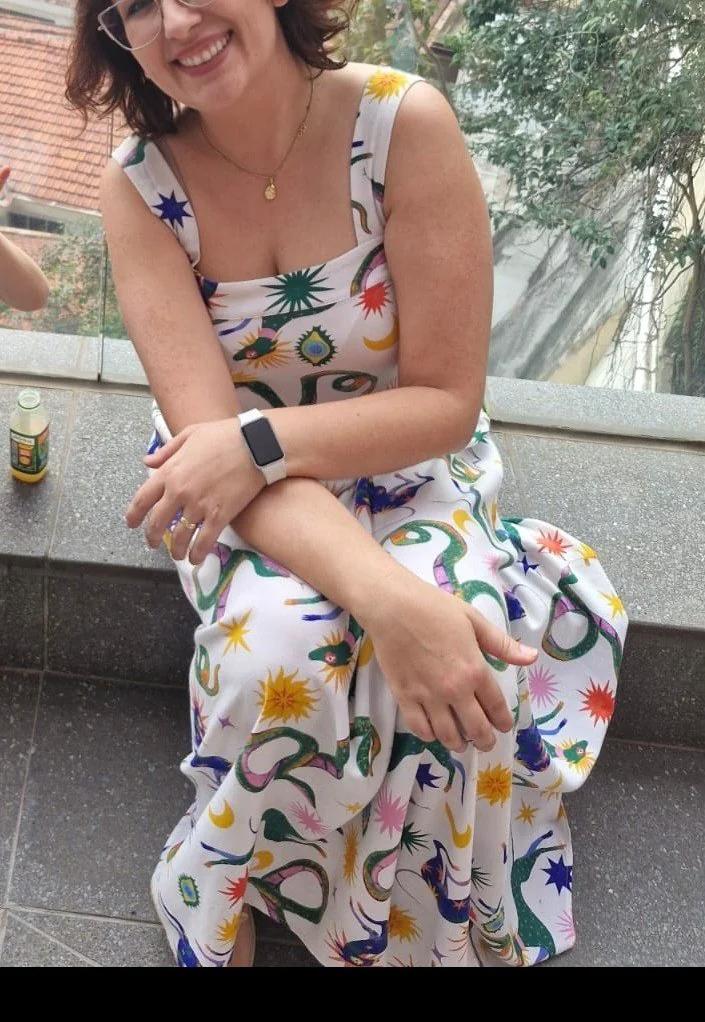
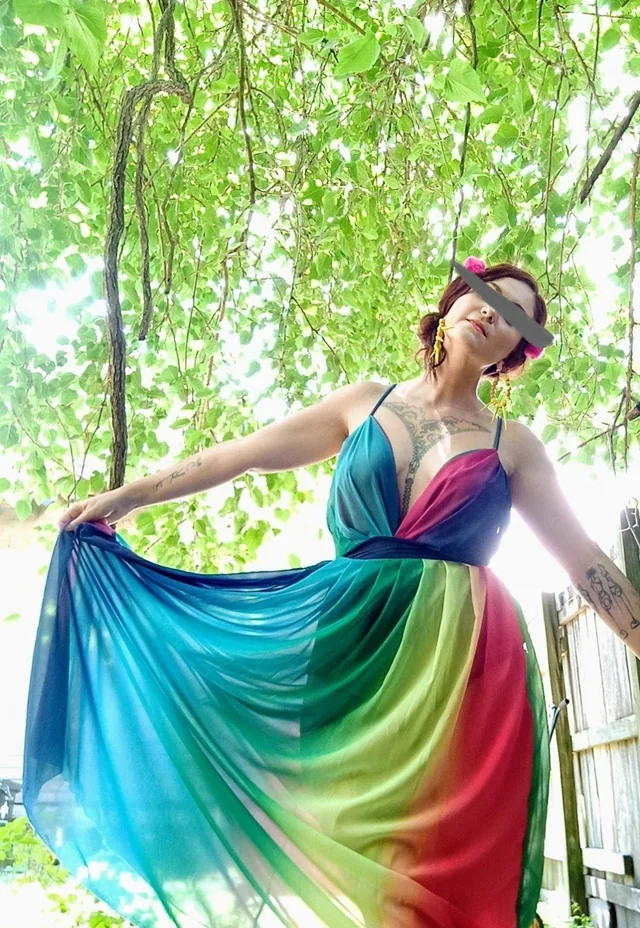
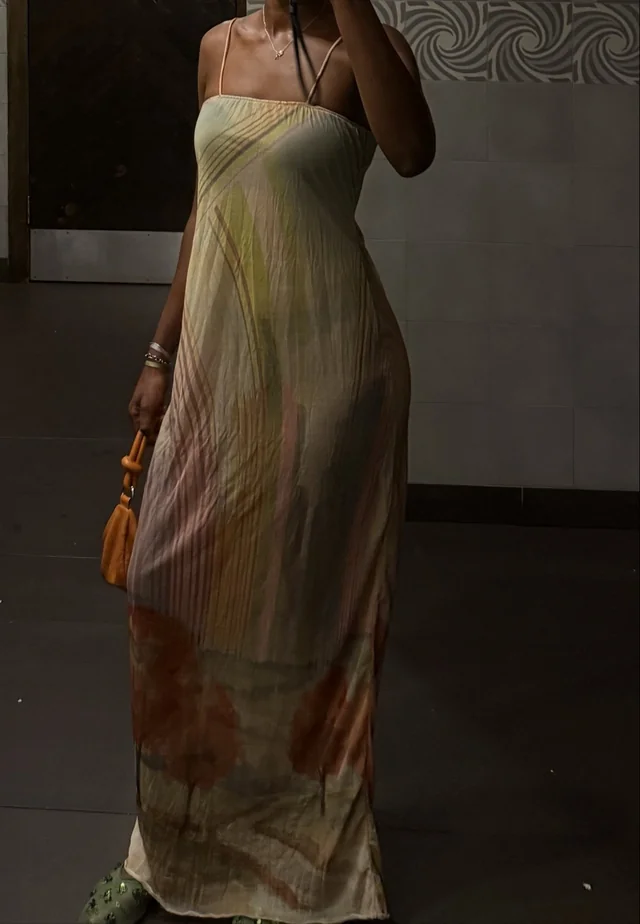
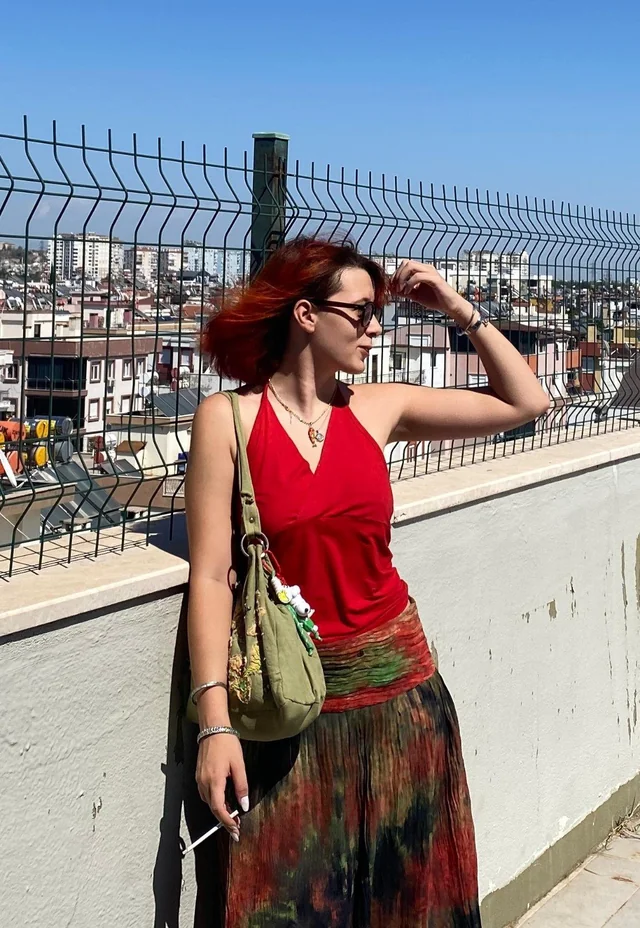
Maxi-length dominance. The maxi skirt (ankle- or floor-length) and maxi dress constitute boho's signature garment length. The proportion serves both visual and functional purposes: extended hemlines increase the visible surface area of printed or woven fabrics, making textile pattern the primary visual content of the dressed body rather than body shape; floor-length garments also produce the ground-sweeping movement behavior — fabric pooling at the hem, swaying during walking, catching wind — that constitutes boho's kinetic signature. Maxi skirts are typically cut as full circles, half circles, or tiered A-lines, each generating different movement patterns: circle skirts produce dramatic swing, tiered skirts produce layered bounce, and A-lines produce controlled sway.
Peasant and gathered construction. The peasant blouse — gathered at the neckline and cuffs using elastic, drawstring, or smocking — is boho's defining torso garment. The construction creates volume through fabric distribution rather than darting: excess fabric is gathered into bands that define neckline and cuff circumference, allowing the body of the garment to billow. Smocking (decorative shirring using parallel rows of gathered stitches) serves simultaneously as construction technique and ornamental detail. Off-shoulder variations (elastic necklines positioned below the shoulder line) add skin exposure without compromising the garment's overall looseness. These construction methods derive from historical European rural garments and were adopted by the 1960s counterculture specifically because they rejected the structured, body-conscious tailoring associated with bourgeois convention.
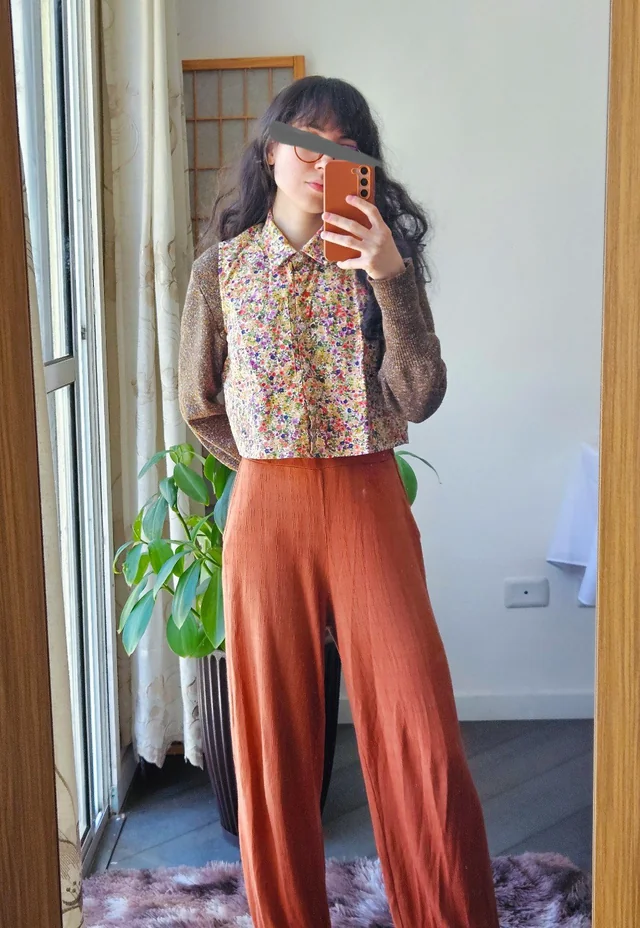
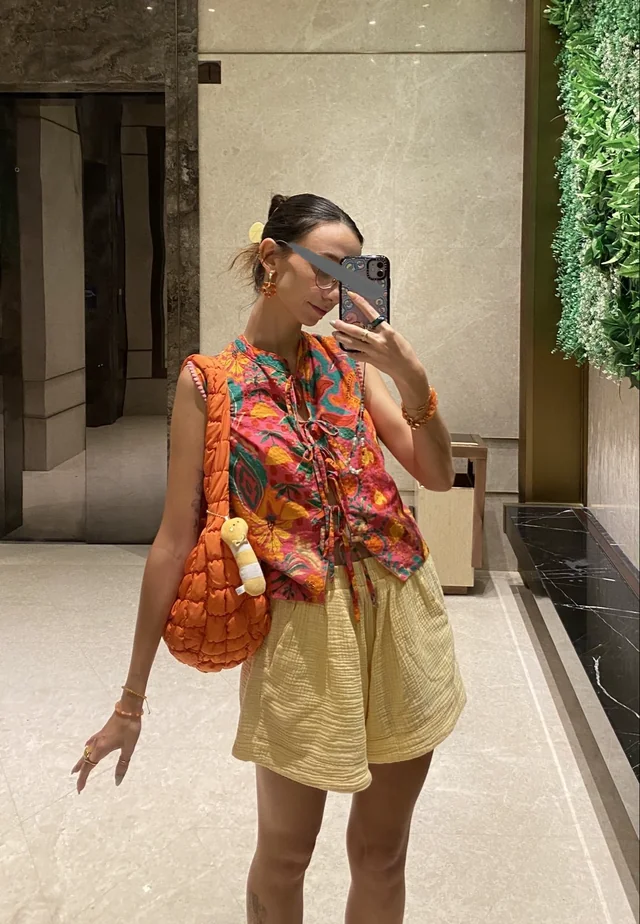
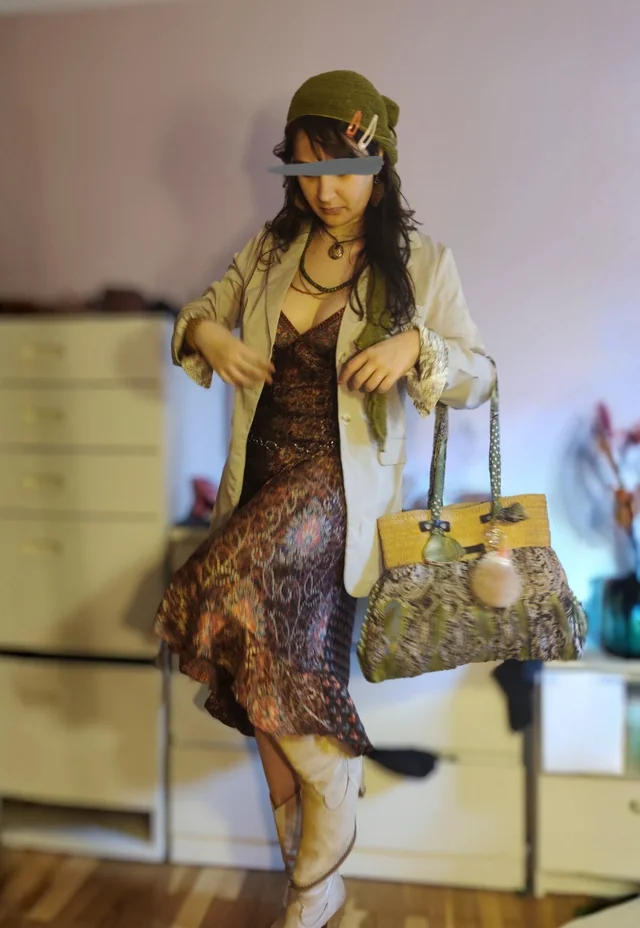
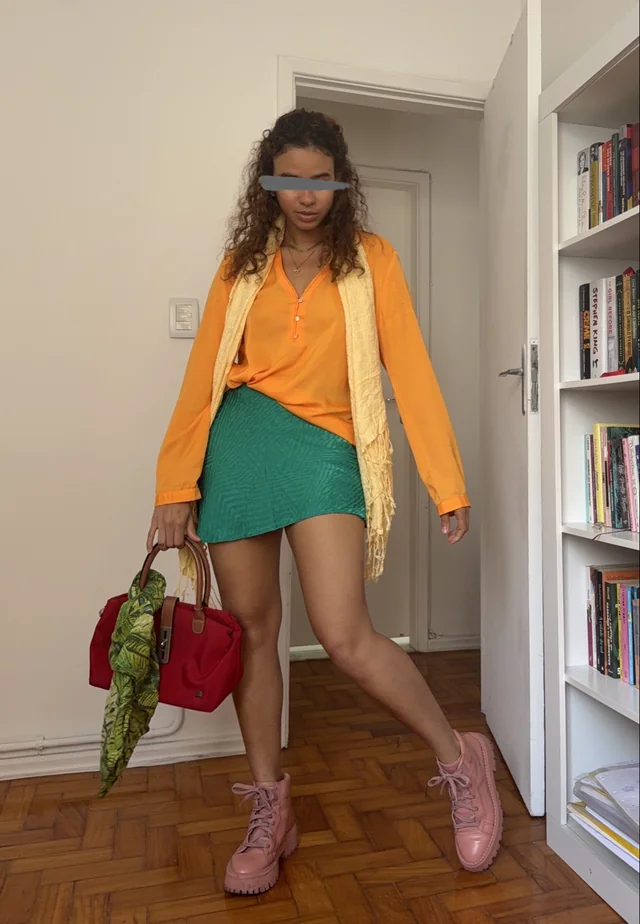
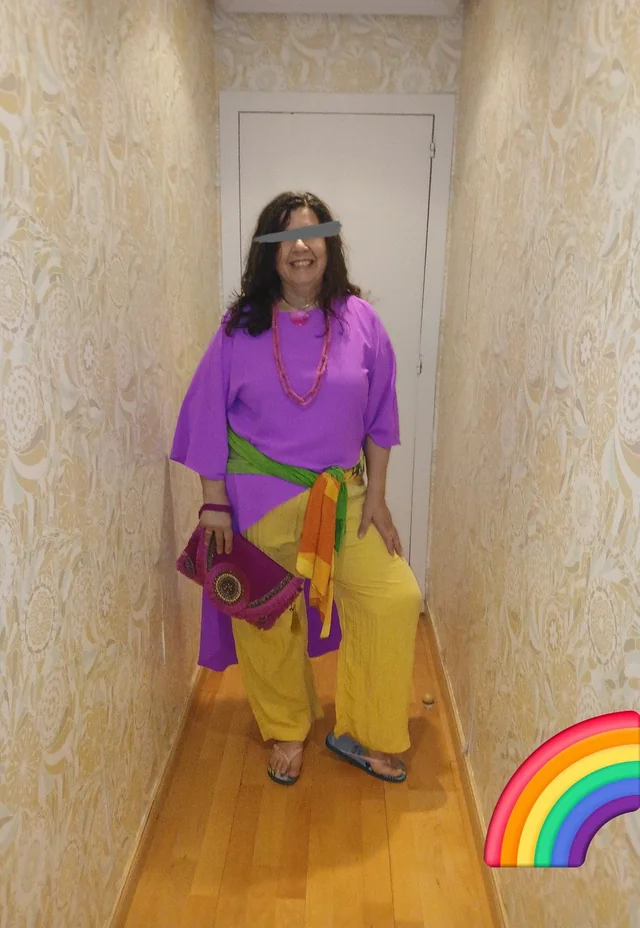
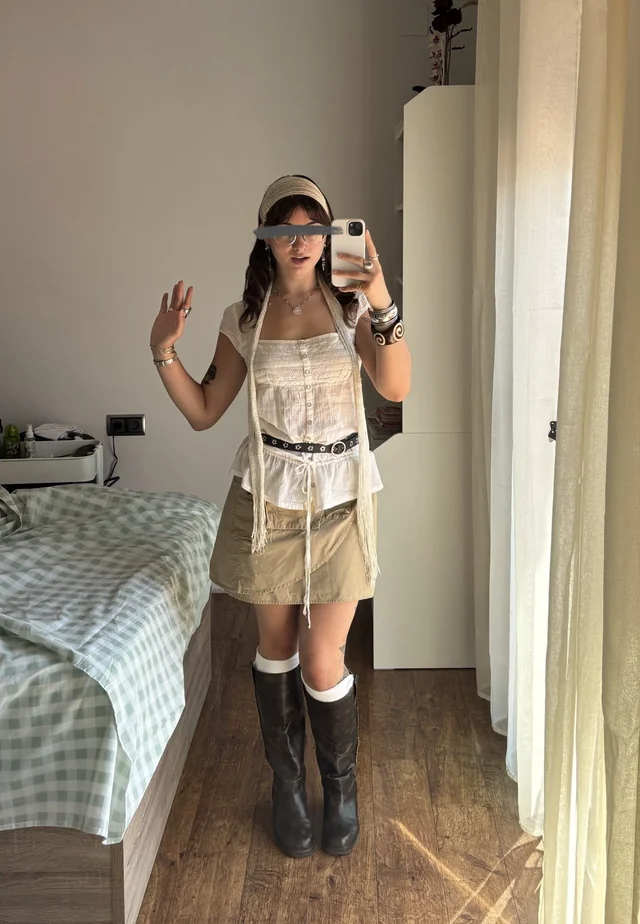
Layering as silhouette architecture. Boho's characteristic "built-up" appearance results from deliberate layering: a camisole or tank beneath a sheer or semi-sheer blouse, beneath a vest or jacket, with layered necklaces, stacked bracelets, and a belt or waist wrap defining the midsection. This layering does not function thermally (as in gorpcore's insulation stacking) but compositionally — each layer adds visual texture, pattern complexity, and depth of field to the dressed body. The layering convention explains boho's resistance to minimalism: the aesthetic requires accumulation, and a single garment — no matter how artisanally produced — reads as incomplete.
Asymmetry and handkerchief hemlines. Asymmetric hems, handkerchief points (hemlines cut on the bias so that the fabric falls into pointed, uneven drapes), and high-low constructions (shorter front, longer back) introduce irregularity that references handmade garment-making where pattern precision was secondary to material availability. These irregular hemlines also increase the garment's kinetic complexity — each pointed hem moves independently in wind or walking, producing visual activity that symmetrical hemlines do not.
The boho silhouette's refusal of body-conscious fit produces a specific body-reading regime: the dressed body is evaluated not by how it shapes or reveals the physical form but by how effectively it serves as an armature for textile display. The body becomes a mobile gallery for artisanal textiles, with the silhouette functioning as display architecture rather than body sculpture.
Materials
Material selection in boho operates through a craft-provenance logic in which the textile's production method — who made it, how, using what traditional technique — constitutes its primary value proposition. The gap between authentically artisanal textiles and their industrial simulations defines boho's central quality hierarchy.
Cotton and cotton-based printing. Cotton is boho's dominant fiber, valued for breathability, drape in lightweight weaves, and compatibility with traditional printing and dyeing techniques. Block-printed cotton — produced by hand-carving teak or sheesham wood blocks and pressing them into fabric through pigment or resist paste — is the artisanal technique most closely associated with boho. Indian block-printing traditions are regionally specific: ajrakh (Kutch, Gujarat, and Sindh, Pakistan) uses a multi-step mordant and resist process involving up to sixteen printings and washings to build layered geometric patterns in indigo and alizarin red; bagru (Rajasthan) uses dabu mud-resist printing to create white-on-indigo or indigo-on-white patterns; sanganeri printing (Jaipur, Rajasthan) produces fine floral designs in bright colors through direct-print mordant dyeing. Each tradition produces visually distinct results with specific irregularity signatures — slight registration misalignments between block impressions, color density variations from pigment distribution, and edge softness from paste bleeding — that distinguish handwork from the uniform precision of rotary screen-printing. Industrial boho garments frequently simulate these irregularities through digital printing, producing "block-print-look" patterns that lack the material depth, color complexity, and haptic quality of genuine handwork.
Ikat and warp-resist weaving. Ikat (from the Malay-Indonesian word mengikat, "to tie") is a resist-dyeing technique in which warp threads, weft threads, or both are tie-dyed before weaving, producing characteristic feathered-edge patterns whose blurriness results from the slight shifting of dyed threads during the loom tensioning process. Central Asian ikat (Uzbekistan, particularly Bukhara and Fergana Valley) produces bold, large-scale polychromatic patterns on silk-warp/cotton-weft fabrics. Indonesian ikat (Flores, Sumba, Bali) produces earth-toned geometric and figurative patterns on cotton. Guatemalan jaspe (the local ikat tradition) produces distinctive striped and geometric patterns used in huipils and corte skirts. The feathered-edge effect — the soft, bleeding boundary between dyed and undyed areas — is ikat's visual signature and its authentication mechanism: industrial imitations that print ikat-like patterns produce hard-edged facsimiles that are immediately distinguishable to knowledgeable observers.
Batik resist-dyeing. Batik applies molten wax (traditionally a mixture of beeswax for flexibility and paraffin for crackle effect) to cloth as a dye resist, creating patterns defined by the boundary between waxed and unwaxed areas. Javanese batik (Indonesia) is the tradition most referenced in boho fashion, classified into two production methods: batik tulis (hand-drawn using a canting, a small copper tool with a spouted reservoir for molten wax) and batik cap (stamped using a copper block). The chemistry is specific: the wax resist blocks dye penetration into covered areas; successive wax-apply-and-dye cycles build polychromatic patterns through a subtractive process. The characteristic "crackle" effect — fine lines of dye bleeding through hairline cracks in the wax resist — is batik's accidental signature, produced when wax coating fractures during handling. Industrial batik substitutes screen-printed crackle simulation for actual wax-resist process, eliminating the three-dimensionality of genuine wax resist (which creates a slight textural ridge where wax was applied) and the irregular, organic quality of real wax cracking.
Embroidery systems. Boho draws on embroidery traditions from multiple regions, often combining them within single garments or outfits: Mexican embroidery (floral chain-stitch and satin-stitch work on cotton huipils and blouses, particularly from Oaxaca, Chiapas, and Puebla); Indian mirror-work (shisha embroidery from Gujarat and Rajasthan, in which small mirrors are secured to fabric with radiating buttonhole stitches); Uzbek suzani (large-format silk or cotton embroidered panels using chain stitch and couching, featuring bold floral and botanical motifs); and Eastern European traditions (Hungarian matyo embroidery, Romanian ie blouse embroidery, Ukrainian vyshyvanka cross-stitch). Each tradition has a specific stitch vocabulary, thread-weight convention, color palette, and compositional logic that knowledgeable participants can identify and distinguish. Mass-market boho frequently substitutes machine embroidery — recognizable through perfectly uniform stitch density, locked-off thread ends, and symmetrical pattern registration — for the hand-stitched originals, flattening regional specificity into generic "ethnic embroidery."
Crochet and macramé. Crochet (interlocking loops of yarn using a hooked needle) and macramé (knotted cord without tools) produce the open-work, textural surfaces characteristic of boho accessories and overlay garments. Crochet's structural properties differ from knitting: crochet fabric is thicker, less elastic, and more dimensionally stable, making it suitable for structured pieces (bags, vests, halter tops) that maintain their shape without internal support. Macramé's knotting vocabulary — square knots, spiral knots, half-hitches, crown knots — produces textured, semi-rigid surfaces used in wall hangings, bags, belts, and jewelry. Both techniques produce garments whose construction is fully visible — every stitch or knot is legible on the surface — making the labor of production an explicit part of the aesthetic content. Hand-crocheted garments exhibit tension variation (tighter and looser stitches reflecting the maker's hand fatigue, attention, and skill variation) that machine-crocheted or industrial-knit alternatives cannot replicate.
Leather and suede. Vegetable-tanned leather and suede constitute boho's prestige hard materials, used in boots, bags, belts, vests, and sandals. Vegetable tanning — using plant-based tannins from oak bark, mimosa, chestnut, or quebracho to convert raw hide into stable leather over weeks or months — produces leather with a distinctive warm brown color, firm initial hand, and pronounced aging trajectory: vegetable-tanned leather darkens through UV exposure, softens through mechanical flexion, and develops surface patina through oil absorption, creating a personalized aging record. Suede (the napped underside of leather, produced by buffing split hides) offers a softer, more textured surface that ages through nap wear (flattening at friction points), staining (suede's open fiber structure absorbs liquids readily), and color variation. Chrome-tanned leather — processed with chromium salts in hours rather than weeks, producing softer, more uniform, and more water-resistant but less character-developing leather — is the mass-market alternative that most commercial boho uses.
Failure modes across the system. The primary material failure in boho is provenance collapse: the substitution of industrially produced textiles for artisanal originals while maintaining the aesthetic's artisanal-reference claims. Digital-print "block print," machine-embroidered "ethnic" detail, polyester "crochet," and chrome-tanned "suede" reproduce visual grammar without material integrity, creating garments that cannot age into the softened, personalized state that authentic boho materials achieve. Secondary failures include natural-fiber degradation under inappropriate care (cotton shrinkage from hot washing, linen brittleness from machine drying, leather stiffening from moisture exposure without conditioning), dye instability in vegetable-dyed textiles (especially indigo and madder, which fade under UV and friction), and structural failure in loosely constructed crochet and macramé (yarn breakage, knot slippage, dimensional distortion).
Color Palette
The palette derives from traditional dyeing chemistry and natural-fiber ground tones rather than from seasonal trend logic. Boho's chromatic range maps directly onto the pigments and dyes available through pre-synthetic textile chemistry, producing a warm, earthy, muted spectrum.
Earth and mineral tones. Terracotta (iron-oxide pigment), ochre (hydrated iron hydroxide), rust (iron oxide in red phase), burnt sienna, and raw umber constitute the palette's foundation. These colors reference both mineral-dye origins and the physical landscape (desert, soil, clay, dried grass) that boho's nature-affinity rhetoric invokes.
Plant-derived dyes and their fading behavior. Indigo (deep blue through pale sky, depending on dipping count and age), madder (deep red through coral, fading toward salmon), turmeric (golden yellow, the least lightfast common dye — fading rapidly under UV), pomegranate (gold-amber), and walnut (warm brown through cool grey) produce the palette's chromatic complexity. These dyes' fading trajectories are aesthetically relevant: garments that have aged through sun and wear develop softer, more complex color than new-dyed pieces, creating the "lived-in" quality that boho prizes.
Jewel tones as accent. Deep purple (historically from murex or lichen-derived orchil dyes), teal (indigo overdyed with yellow), burgundy (madder at high concentration), and deep emerald provide chromatic intensity against the muted earth-tone ground. These jewel tones appear in embroidery thread, woven-in pattern, and accent garments rather than as dominant palette colors.
Undyed and natural ground tones. Unbleached cotton (ecru through cream), raw linen (pale gold through warm grey), natural hemp (silver-grey), and undyed wool (cream through brown, depending on breed) contribute the neutral ground against which printed and dyed patterns register. The presence of these natural ground tones is a boho authentication signal: mainstream fashion typically bleaches, brightens, or optically whitens base textiles, while boho preserves natural fiber color as evidence of minimal processing.
Palette coordination in boho follows complementary-warmth logic rather than matching or contrast logic: multiple earth tones and muted warm hues are combined within a single outfit, creating tonal cohesion through shared warmth rather than through color matching. This coordination produces the "curated but uncontrived" effect the aesthetic requires — the outfit reads as gathered over time rather than purchased as a set.
Details
Details in boho function simultaneously as ornamental elements and as craft-provenance markers — each detail is evaluated for both its visual contribution and the production method it evidences.
Fringe. Leather fringe (strips cut from hide edge, left to swing freely), woven fringe (warp or weft ends left unfinished and hanging beyond the cloth body), and knotted fringe (macramé-derived decorative edge finishing) constitute boho's signature kinetic detail. Fringe adds movement to garments and accessories — each strand sways independently during walking, creating visual activity at hemlines, sleeve edges, and bag flaps. The detail's historical references are multiple: Native American buckskin fringe (where cut strips served a practical function as water drainage channels and repair material), Spanish flamenco shawl fringe (decorative, indicating wealth through thread quantity), and 1920s flapper fringe (movement-driven nightclub display). In boho, these references collapse into a general "free-spirited movement" signifier.
Tassels and pom-poms. Tassels (bound thread bundles suspended from a cord head) and pom-poms (spherical thread constructions) appear at hemlines, drawstring ends, bag closures, and jewelry terminations. Both details derive from global textile traditions: Moroccan tassel-work (used on djellaba hoods and ceremonial textiles), Indian ghungroo-style hanging ornaments, and Andean textile pom-pom edging. Their function in boho is accumulative — multiple tassels and pom-poms create visual density and sound (soft clicking or rustling during movement).
Visible construction and hand-finishing. Exposed seam allowances, hand-rolled hems, blanket-stitch edging, and visible hand-stitching in contrasting thread serve as craft-provenance signals. These details communicate "this garment was made by hand" even when the garment's actual construction is largely machine-made — the hand-finishing is often applied as a final step to an otherwise industrial garment, performing artisanal authenticity at the visible surface.
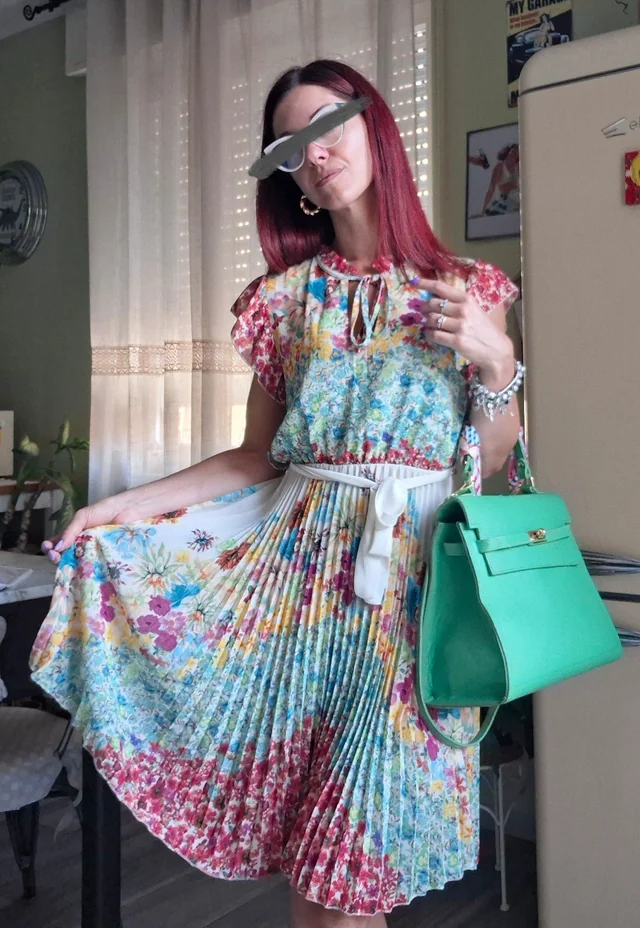
Mixed print composition. The combination of multiple prints within a single outfit — floral with paisley, ikat with block-print, stripe with geometric — constitutes a boho-specific compositional detail. Successful print mixing requires intuitive color-palette coordination (shared tonal warmth, complementary scale variation) and cultural confidence (the willingness to combine patterns that conventional fashion rules would prohibit). Print mixing functions as a skill marker within the boho community, distinguishing participants who can compose harmonious multi-pattern outfits from those who reproduce safer, single-print ensembles.
Beading, sequins, and mirror-work. Hand-applied beads (glass, wood, bone, seed), flat sequins (paillettes), and shisha mirror-work provide light-catching surface detail. The distinction between hand-applied and machine-applied embellishment is critical: hand-beading produces slightly irregular placement, variable bead orientation, and visible knotting on the garment's reverse; machine-beading produces uniform spacing, identical orientation, and locked-off thread chains. This distinction is readable as a quality and provenance indicator by knowledgeable participants.
Accessories
Accessories in boho extend the layered, artisanal, globally-referenced logic from garments into an integrated personal-ornament system.
Jewelry layering. Multiple necklaces of varying lengths (choker, collarbone-length, chest-length, waist-length) worn simultaneously create a cascading ornamental field across the torso. Materials include silver (boho's prestige metal, chosen over gold for its association with Native American, Berber, and Central Asian jewelry traditions), turquoise (the iconic boho gemstone, culturally associated with Navajo and Tibetan traditions), coral, amber, bone, wood, seed beads, and hammered or cast metal. Stacked bracelets and bangles (10–30 per wrist in maximalist presentations) extend the layering logic to the forearms, producing both visual density and auditory effect (metallic clinking during movement). Ring stacking (multiple rings across most fingers, including thumb and midi-rings) completes the hand adornment system.
Bags. Fringed leather crossbody bags, woven or macramé market bags, embroidered clutches, and beaded evening bags extend the textile-craft vocabulary to carried objects. Vegetable-tanned leather bags develop patina that parallels the leather aging described in the Materials section. Woven bags — particularly Moroccan kilim bags and Indonesian woven rattan baskets — carry specific cultural-provenance signals.
Headwear. Wide-brim felt hats (typically wool felt, unstructured crown, 3–4 inch brim), headbands worn across the forehead (a hippie-derived convention), flower crowns (festival-specific), turbans and head wraps (referencing multiple African and South Asian traditions), and scarves tied as headbands complete the head-adornment system.
Footwear. Ankle boots (often suede, with western-influenced stacked heel, cutout details, or fringe), gladiator sandals (flat, laced to mid-calf, referencing ancient Mediterranean footwear), and flat leather sandals (the hippie-inherited barefoot-adjacent option) constitute boho's primary footwear vocabulary. Cowboy-boot derivatives — pointed toe, stacked heel, embroidered or tooled shaft — bridge boho and western aesthetics, a crossover amplified by festival culture.
Body Logic
Boho conceptualizes the body as a mobile armature for textile display and ornamental accumulation rather than as a surface to be sculpted, revealed, or concealed through fitted construction. The dressed body reads as "adorned" before it reads as "shaped" — the silhouette is determined by the garments' drape behavior rather than by the body's physical contours.
Gender presentation leans feminine through ornament, softness, and flowing form rather than through hourglass emphasis or body-conscious fit. The boho body is never rigidly structured — no corsetry, no boning, no sharp tailoring — producing a softened, fluid presentation that codes femininity through decoration and movement rather than through body-shape revelation. This coding accommodates body diversity more readily than fitted fashion categories: loose, voluminous garments obscure rather than delineate, making the aesthetic accessible across a wider range of body types.
Hair is worn long, loose, and "undone" — natural waves, textured braids, partially pinned arrangements that suggest romantic dishevelment. Makeup tends toward either the minimal-sun-kissed register (bronzed skin, natural lip, barely-there coverage) or the heavily kohled-eye register (dark eyeliner, smudged shadow, referencing 1960s counterculture and Middle Eastern cosmetic traditions). Both registers refuse the "polished" mainstream beauty standard, aligning cosmetic presentation with the garments' artisanal, unstructured logic.
The boho body's class encoding operates through a paradox familiar from adjacent aesthetics: the "effortlessly bohemian" look requires significant economic investment (artisanal garments, quality jewelry, festival attendance, travel to photogenic destinations) and specific body-maintenance labor (sun-kissed skin requiring vacation time, toned-but-not-muscular physique, maintained-but-natural hair). The fantasy of carefree nonconformity is produced through expenditure and discipline that the aesthetic's rhetoric denies. This is the bohemian-to-bourgeois conversion at the body level: the "free spirit" requires considerable economic freedom.
Garment Logic
Boho garment construction privileges softness, drape, and visible craft over precision engineering or structural innovation. The construction system is deliberately low-intervention: minimal internal structure (no interfacing, no boning, no shoulder pads), simple closures (drawstrings, elastic, ties rather than zippers or buttons), and patterning that favors straight seams and gathered volume over complex curved shaping.
Peasant-blouse construction. The archetypal boho garment uses a modified rectangular construction: a body panel is gathered into a neckline band through elastic or drawstring, with sleeves cut as modified rectangles and gathered at the cuff. This construction requires minimal fitting — the gathering accommodates a wide range of body sizes within a single garment — and creates the billowing volume that boho silhouette demands. Quality differentiation occurs at the gathering method (elastic produces uniform gathering; hand-smocking produces decorative textured gathering; drawstring produces adjustable gathering), the neckline finish (self-fabric facing versus bias binding versus raw edge), and the sleeve-seam construction (French seam for refined finish; overlocked for durability; raw-edge for intentional rusticity).
Maxi-skirt and dress construction. Tiered skirts are constructed by joining progressively wider fabric strips from waist to hem, each tier gathered into the tier above. The number of tiers (typically 3–5), the degree of gathering (the ratio of gathered-to-flat fabric width, typically 1.5:1 to 3:1), and the tier width proportions determine the skirt's volume, movement behavior, and visual weight. Bias-cut maxi dresses (fabric cut at 45 degrees to the grain, producing maximum drape and body-skimming behavior without fitted construction) represent a more technically demanding boho construction that creates flowing silhouettes through material behavior rather than through gathering.
Aftercare protocols. Natural-fiber boho garments require care calibrated to their specific material composition. Cotton with vegetable dyes should be washed in cold water with pH-neutral detergent and dried in shade to minimize dye loss. Embroidered garments should be turned inside out and washed on gentle cycles to protect raised thread surfaces from abrasion. Leather and suede require conditioning every 4–8 weeks (leather) or brushing with a suede-specific brass-bristle brush (suede) and protection from water, which causes irreversible staining on suede's open-fiber surface. Crochet garments should be hand-washed and dried flat to prevent dimensional distortion from hanging weight. Beaded and embellished garments should avoid machine washing entirely — the mechanical agitation dislodges beads, breaks thread, and damages mirror-work attachments.
Failure modes. The primary construction failure in boho is structural inadequacy disguised as "relaxed" construction: garments whose seams are too weak for the fabric weight they carry, elastic that loses recovery within months, gathering that pulls out under wearing stress, and embroidery threads that snag and pull because they were not properly secured. Boho's deliberately unstructured aesthetic creates an ambiguity zone where construction deficiency is difficult to distinguish from intentional looseness — a zone that mass-market producers exploit by reducing construction quality while claiming aesthetic authenticity. Secondary failures include: dye migration between layers in multi-print garments stored in humid conditions, leather and suede water damage from festival-rain exposure without protective treatment, and crochet fiber degradation from UV exposure (cotton crochet yellows and weakens under sustained sun, a significant vulnerability for an aesthetic associated with outdoor and festival contexts).
Motifs / Themes
The "free spirit" mythology is boho's governing narrative: the wearer is coded as creative, independent, nature-connected, and unconstrained by conventional social expectations. This mythology operates through specific material and visual motifs.
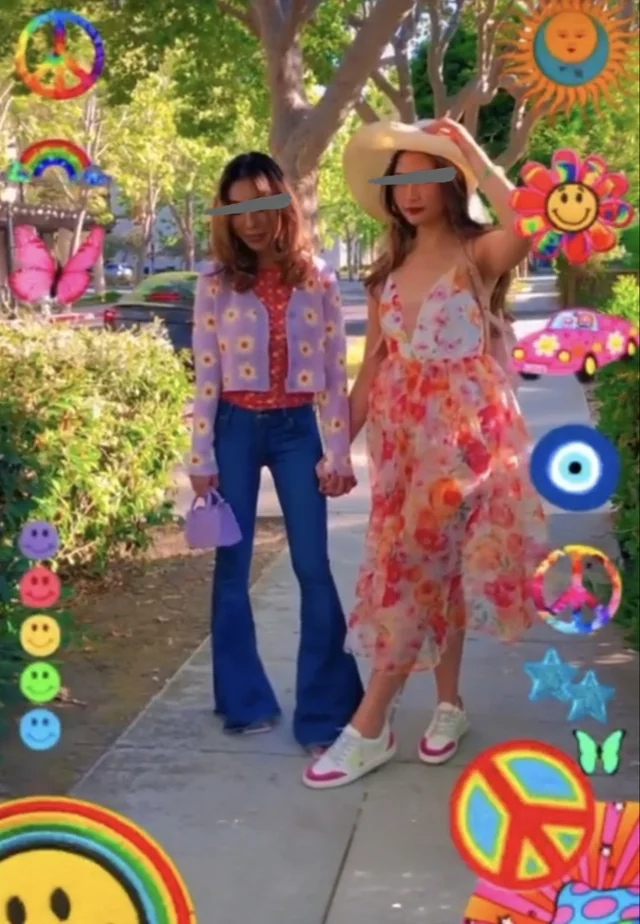
Floral abundance. Floral prints — oversized painterly florals, ditsy calico florals, dark moody florals, tropical botanicals — appear more densely in boho than in any other contemporary aesthetic category. The floral motif references both nature-connection and historical textile tradition (chintz, the Indian painted-cotton export fabric that transformed European textile markets in the seventeenth century, is boho's deepest material ancestor).
Paisley. The teardrop-shaped motif (derived from the boteh, a Zoroastrian symbol used in Persian and Kashmiri textile design) entered Western fashion through East India Company textile imports and was mass-produced at Paisley, Scotland, giving the motif its English name. In boho, paisley functions as a general "Eastern" signifier, carrying the residue of its Indo-Persian origins while operating as a pattern rather than a culturally specific symbol.
Global-craft synthesis. The combination of techniques and motifs from multiple, unrelated cultural traditions — Mexican embroidery with Indian mirror-work, African wax-print with Indonesian batik, Navajo turquoise with Tibetan coral — constitutes boho's compositional method and its most significant ongoing conversation. The synthesis claims a universal craft humanism ("all handcraft is beautiful, all traditions are valid sources") while the specific cultural, religious, and economic contexts that produced the incorporated elements remain part of an evolving dialogue about cross-cultural exchange in fashion.
Nature as lifestyle. Unlike wabi-sabi's nature-as-process or gorpcore's nature-as-environment, boho's nature reference is primarily aspirational: the aesthetic codes the wearer as someone who spends time outdoors, values natural materials, and rejects industrial artificiality, whether or not this coding corresponds to lived practice.
Cultural Touchstones
Photography and media images. Talitha Getty photographed by Patrick Lichfield on a Marrakech rooftop, January 1969 — wearing a white caftan with gold embroidery, layered jewelry, kohl-rimmed eyes — constitutes boho's single most reproduced reference image. The photograph encodes the aesthetic's entire mythology: exotic location, luxurious craft, orientalist glamour, aristocratic bohemianism. Sienna Miller photographed at Glastonbury, 2004–2005, in combinations of vintage waistcoats, floaty dresses, Hunter boots, and stacked jewelry, provided the template for twenty-first-century boho-chic. Stevie Nicks in Fleetwood Mac's Rumours-era stage wardrobe (1976–1977) — platform boots, layered shawls, flowing skirts, top hat — established the rock-bohemian archetype.
Film. Almost Famous (Cameron Crowe, 2000): Kate Hudson's Penny Lane character wearing vintage fur coats, floppy hats, and layered jewelry provided a Gen-X/Millennial boho template. Zabriskie Point (Michelangelo Antonioni, 1970): counterculture desert imagery that supplied boho with its American-landscape visual register. Easy Rider (Dennis Hopper, 1969): fringed leather, Native American-referenced jewelry, and open-road mythology.
Music. Janis Joplin's 1960s stage wardrobe — tie-dyed and embroidered garments, feather boas, layered beads, round sunglasses — constituted the original rock-bohemian body. Joni Mitchell's 1970s presentation — flowing hair, ethnic-print garments, handcrafted jewelry — added the folk-intellectual dimension. Florence Welch (Florence + the Machine, 2009 onward) — flowing Gucci gowns, Pre-Raphaelite hair, romantic maximalism — provided a contemporary high-fashion boho reference.
Fashion industry. Chloé under Phoebe Philo (2001–2006) defined luxury boho for the mid-2000s. Free People's institutional identity (the Urban Outfitters Group subsidiary that has maintained boho as its core positioning since the early 2000s) provided the commercial infrastructure for mass-market boho. Etro's long-standing commitment to paisley-based prints and artisanal references positioned the Italian house as boho's permanent luxury representative.
See Also
- Hippie: Direct countercultural antecedent; boho is hippie's commercial descendant
- Cottagecore: Shares romanticization of craft, nature, and pre-industrial aesthetics, but cottagecore is pastoral-domestic where boho is nomadic-global
- Mori-kei: Japanese forest-girl aesthetic with overlapping layering logic and natural-fiber commitment
- Festival fashion: Boho as event-specific dressing mode, intensified for outdoor-music contexts
- Romanticism: Shared Pre-Raphaelite ancestry, flowing silhouettes, and nature-connection rhetoric
- Indie sleaze: 2000s–2010s revival of layered, vintage-informed dress with higher body exposure and party-culture emphasis
- Wabi-sabi: Shared natural-fiber aging values, though wabi-sabi theorizes material degradation where boho aestheticizes surface craft
Brands and Designers
Heritage and High-Fashion Boho:
- Chloé (Paris, founded 1952; boho-defining era under Phoebe Philo, 2001–2006): flowing silk, peasant blouses, oversized accessories; established luxury-boho template
- Etro (Milan, founded 1968): paisley-centered prints, artisanal-reference collections, long-standing boho luxury positioning
- Roberto Cavalli (Florence, founded 1970): bold prints, embellished bohemian-glamour collections, festival-luxe
- Isabel Marant (Paris, founded 1994): French-bohemian balance of effortless drape, embroidered details, and western-influenced boots
- Matthew Williamson (London, active 2001–2016): color-saturated boho-luxe prints, embellished occasionwear
Contemporary Premium Boho:
- Zimmermann (Sydney, founded 1991): resort-boho with intricate embroidery, lace insertion, and tiered silhouettes; Instagram-era boho's prestige marker
- Spell (Byron Bay, founded 2009; originally Spell & The Gypsy Collective, rebranded 2020): vintage-inspired prints, flowing silhouettes, festival-boho positioning
- Dôen (Los Angeles, founded 2015): prairie-boho with quilted details, floral prints, and sustainable-sourcing emphasis
- Ulla Johnson (New York, founded 2000): artisanal embroidery, hand-dyed textiles, Latin American and South Asian craft references
- Johanna Ortiz (Cali, Colombia, founded 2010): Latin American botanical prints, ruffled maximalism, tropical-boho luxury
Mass-Market Boho:
- Free People (Philadelphia, founded 1984; Urban Outfitters Group): boho's largest commercial platform, defining mass-market boho pricing and styling
- Anthropologie (Wayne, PA, founded 1992; URBN Group): boho-adjacent home and clothing retail, artisanal-reference positioning
- Zara (Arteixo, Spain; boho collections seasonal): fast-fashion boho at maximum accessibility
- H&M Conscious Collection (periodic boho-referenced lines): sustainability-marketed fast-fashion boho
Artisanal and Ethical Boho:
- Christy Dawn (Los Angeles, founded 2013): deadstock fabrics, farm-to-closet cotton initiative, boho silhouettes with sustainability-infrastructure commitment
- Mes Demoiselles (Paris, founded 2006): French-boho with Indian and Moroccan textile sourcing, artisanal embroidery
- Star Mela (London/India): Indian block-printed and embroidered accessories and garments, artisan-cooperative supply chain
- Johnny Was (Los Angeles, founded 1987): embroidery-focused boho, silk and rayon garments with dense hand-stitched detail
- Cleobella (Bali-based, founded 2006): Indonesian artisan-produced leather goods and textiles
Adjacent Designers:
- Anna Sui (New York, founded 1981): boho-rock hybrid, vintage-referenced prints, hippie-glam maximalism
- Alberta Ferretti (Milan, founded 1974): romantic, flowing silhouettes with boho-adjacent embellishment
- Ermanno Scervino (Florence, founded 2000): lace, embroidery, and artisanal-craft positioning within Italian luxury
Citations
[1] Murger, Henri. Scènes de la vie de bohème. Michel Lévy Frères, 1851. [2] Wilson, Elizabeth. Bohemians: The Glamorous Outcasts. Rutgers University Press, 2000. [3] Grana, César. Bohemian versus Bourgeois: French Society and the French Man of Letters in the Nineteenth Century. Basic Books, 1964. [4] Siegel, Jerrold. Bohemian Paris: Culture, Politics, and the Boundaries of Bourgeois Life, 1830–1930. Viking, 1986. [5] Breward, Christopher. Fashion. Oxford University Press, 2003. [6] Wilson, Elizabeth. Adorned in Dreams: Fashion and Modernity. Revised ed., Rutgers University Press, 2003. [7] Entwistle, Joanne. The Fashioned Body: Fashion, Dress and Social Theory. 2nd ed., Polity, 2015. [8] Kawamura, Yuniya. Fashion-ology: An Introduction to Fashion Studies. 2nd ed., Bloomsbury Academic, 2018. [9] Hebdige, Dick. Subculture: The Meaning of Style. Routledge, 1979. [10] Crane, Diana. Fashion and Its Social Agendas: Class, Gender, and Identity in Clothing. University of Chicago Press, 2000. [11] Lipovetsky, Gilles. The Empire of Fashion: Dressing Modern Democracy. Princeton University Press, 1994. [12] Barthes, Roland. The Fashion System. Translated by Matthew Ward and Richard Howard, University of California Press, 1983. [13] Bourdieu, Pierre. Distinction: A Social Critique of the Judgement of Taste. Translated by Richard Nice, Harvard University Press, 1984. [14] Simmel, Georg. "Fashion" (1904). In Simmel on Culture: Selected Writings, edited by David Frisby and Mike Featherstone, SAGE, 1997. [15] Hollander, Anne. Seeing Through Clothes. University of California Press, 1993. [16] Root, Regina A., editor. The Latin American Fashion Reader. Berg, 2005. [17] Gillow, John, and Bryan Sentance. World Textiles: A Visual Guide to Traditional Techniques. Thames and Hudson, 1999. [18] Balfour-Paul, Jenny. Indigo: Egyptian Mummies to Blue Jeans. British Museum Press, 2011. [19] Bühler, Alfred, Eberhard Fischer, and Marie-Louise Nabholz. Indian Tie-Dyed Fabrics. Calico Museum of Textiles, 1980. [20] Fraser-Lu, Sylvia. Indonesian Batik: Processes, Patterns and Places. Oxford University Press, 1986. [21] Crill, Rosemary. Chintz: Indian Textiles for the West. V&A Publishing, 2008. [22] Schoeser, Mary. World Textiles: A Concise History. Thames and Hudson, 2003. [23] Elson, Vickie C. Dowries from Kutch: A Women's Folk Art Tradition in India. UCLA Fowler Museum, 1979. [24] Harvey, Janet. Traditional Textiles of Central Asia. Thames and Hudson, 1996. [25] Zorn, Elayne. Weaving a Future: Tourism, Cloth, and Culture on an Andean Island. University of Iowa Press, 2004. [26] Fletcher, Kate. Sustainable Fashion and Textiles: Design Journeys. 2nd ed., Earthscan, 2013. [27] Rivoli, Pietra. The Travels of a T-Shirt in the Global Economy. 2nd ed., Wiley, 2014. [28] Thomas, Dana. Fashionopolis: The Price of Fast Fashion and the Future of Clothes. Penguin, 2019. [29] Young, James O. Cultural Appropriation and the Arts. Blackwell, 2008. [30] Scafidi, Susan. Who Owns Culture? Appropriation and Authenticity in American Law. Rutgers University Press, 2005. [31] Maynard, Margaret. Dress and Globalisation. Manchester University Press, 2004. [32] Niessen, Sandra, Ann Marie Leshkowich, and Carla Jones, editors. Re-Orienting Fashion: The Globalization of Asian Dress. Berg, 2003. [33] Tortora, Phyllis G., and Sara B. Marcketti. Survey of Historic Costume. 6th ed., Fairchild Books, 2015. [34] Steele, Valerie, editor. Encyclopedia of Clothing and Fashion. Thomson Gale, 2005. [35] Veblen, Thorstein. The Theory of the Leisure Class. Macmillan, 1899.