Baroque
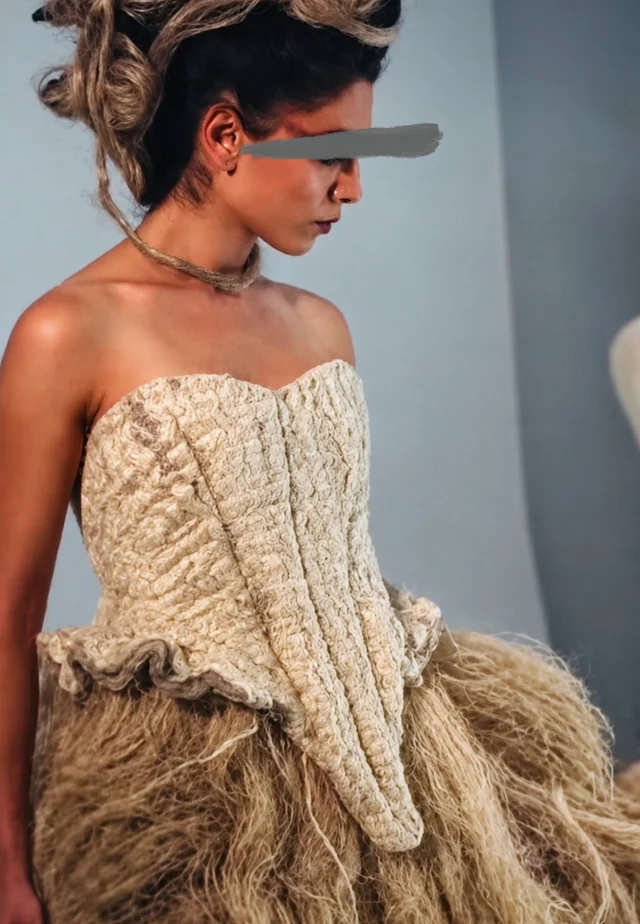
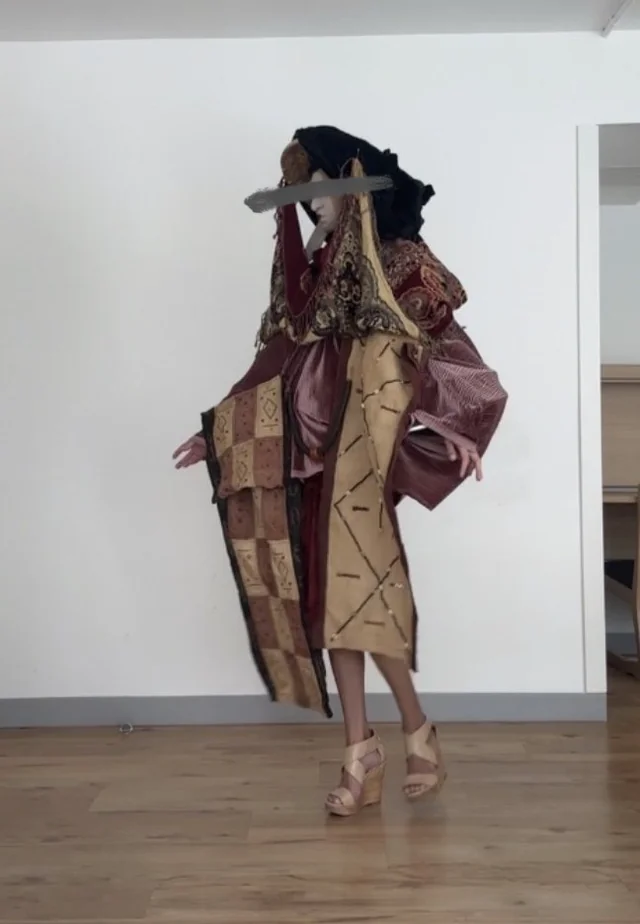
Summary. Baroque fashion is an ornament-engineering regime in which garment construction is organized around the principle of material excess — surfaces saturated with embroidery, metallic thread, beading, brocade weave structures, and applied embellishment to a density that transforms the garment from a worn object into an architectural display system. The aesthetic operates through a structural logic of accumulation: every available surface becomes a substrate for decorative labor, every silhouette is amplified beyond anatomical proportion through internal engineering (boning, crinolines, padding, counterweighting), and every material is selected for its capacity to catch, refract, and radiate light under the conditions of spectacle — candlelight in the seventeenth century, stage lighting and camera flash in the twenty-first. Unlike minimalism, which achieves its effects through subtraction, or utilitarian dress, which justifies form through function, baroque fashion treats ornament itself as the primary structural and communicative system: decoration is not applied to a garment but constitutes the garment's reason for existing. The regime's coherence depends on the mutual reinforcement of embellishment density, silhouette exaggeration, material weight, and the concealed engineering infrastructure — corsetry, boning channels, weighted hems, suspension scaffolding — required to sustain these elements on a moving human body.
In Material Terms
Baroque fashion's substrate is woven opulence: silk brocades produced on Jacquard looms where supplementary weft threads in metallic or polychrome silk create raised figural patterns against a satin or twill ground weave; cut and voided velvets (ciselé) where pile height variation produces sculptural texture; silk damasks where warp-face and weft-face satin interchange creates tone-on-tone patterning visible only through light angle; and dense embroidery systems — goldwork (couched metal threads, bullion wire, purl, check thread, and plate), tambour beading (chain-stitch bead attachment using a hooked needle from the garment's reverse), and hand-applied crystal and sequin work where Swarovski elements are individually prong-set or hand-sewn through drilled holes. Performance properties are governed by weight, fragility, and light interaction: a fully embellished baroque bodice can weigh two to four kilograms, requiring internal boning architecture to distribute load across the torso rather than suspending it from shoulder seams alone. These materials fail through thread breakage under flex stress, bead detachment at friction points, metallic thread tarnishing through atmospheric sulfur exposure, and pile crushing in velvet that — unlike synthetic pile — does not recover without professional steaming.
At Category Level
Baroque occupies the maximalist pole of a spectrum whose opposite terminus is occupied by minimalism and whose middle ground includes romanticism, bohemian eclecticism, and various historical-revival modes. It is distinguished from adjacent maximalist categories — camp, which foregrounds ironic excess and performative failure; kitsch, which traffics in taste transgression; and general "maximalism," which is a volume descriptor without specific material protocols — by its insistence on material authenticity and craft density. Baroque demands that excess be structurally achieved through actual embellishment labor, not merely signified through print simulation or surface-level reference. A screen-printed "baroque pattern" on jersey knit is not baroque fashion; it is a citation of baroque that substitutes image for material reality. This distinction — between achieved ornament and simulated ornament — is the category's primary evaluative criterion and its most contested boundary.
Methodologically
This entry treats baroque fashion as an embellishment-engineering system: garments are analyzed by how ornament is materially produced, structurally supported, and socially deployed, and by how the translation between couture-level craft and commercial-level simulation alters the category's meaning, authenticity claims, and political economy at each stage of diffusion.
Word (Etymology)
"Baroque" entered European critical vocabulary in the mid-eighteenth century as a pejorative term for art and architecture perceived as excessively ornate, irregular, and theatrically overwrought — a departure from the balanced proportion and restrained harmony of classical and Renaissance ideals. The word's etymology is contested across two principal derivations. The first traces it to the Portuguese barroco, a jeweler's term for an irregularly shaped pearl — a natural object whose deviation from geometric perfection made it commercially less valuable but aesthetically distinctive, encoding the tension between formal irregularity and decorative potential that would define the baroque sensibility. The second derivation locates it in the medieval Latin baroco, a mnemonic term from scholastic logic designating a particularly convoluted form of syllogism, carrying associations of tortuous complexity and needless elaboration. Both etymologies converge on the same semantic field: excess that exceeds rational justification, form that proliferates beyond functional necessity, decoration that overwhelms the structure it adorns.
The term was first systematically applied to fashion in the mid-twentieth century by costume historians seeking periodizing vocabulary for the dress of the European seventeenth and early eighteenth centuries — the era of Versailles court culture, Flemish textile production, and the consolidation of state-sponsored luxury manufacturing under figures like Jean-Baptiste Colbert, Louis XIV's finance minister, who understood silk weaving and gold-thread production as instruments of economic policy. In contemporary fashion discourse, "baroque" has migrated from strict period designation to a transhistorical stylistic category: it names any fashion system that privileges ornamental density, theatrical silhouette, and material opulence over minimalist restraint, regardless of its chronological position. Versace's 1990s Medusa-print maximalism, Dolce & Gabbana's Sicilian ecclesiastical references, and Alessandro Michele's layered Renaissance-kitsch hybridity at Gucci (2015–2022) are all filed under "baroque" despite sharing no direct material continuity with seventeenth-century court dress. The term thus functions as a floating signifier — historically rooted but perpetually available for reattachment to any fashion moment that exceeds the threshold of decorative density recognized as "enough" by prevailing taste norms. This semantic flexibility is both the term's analytical utility and its critical weakness: it illuminates a persistent maximalist impulse across fashion history while risking the collapse of materially distinct production systems into a single mood-board category.
Subculture
Baroque fashion does not anchor in a single bounded subculture but operates across multiple overlapping communities of practice, each deploying the same ornamental vocabulary for distinct social purposes and evaluating authenticity through different criteria.
The haute couture and luxury ready-to-wear community constitutes the aesthetic's institutional core. Here, baroque functions as a demonstration of atelier capability — the technical mastery required to produce hand-embroidered bodices, gold-thread brocade gowns, and crystal-encrusted eveningwear that can cost $50,000 to $500,000 per garment. Houses like Dolce & Gabbana's Alta Moda program, Elie Saab's couture atelier, and Zuhair Murad's beading workshops (employing teams of fifty or more embroiderers per garment, with single pieces requiring 800 to 3,000 hours of hand labor) produce baroque garments as demonstrations of craft at its material limit. Within this community, expertise is evaluated through production knowledge: understanding the difference between Lesage-style Lunéville tambour beading and Indian zardozi goldwork, recognizing whether crystals are hand-set or heat-bonded, distinguishing between real gold bullion thread (made by wrapping thin gold wire around a silk or cotton core) and Lurex metallic yarn (polyester film vacuum-coated with aluminum). The hierarchy runs from client (who selects and funds), to creative director (who designs), to première main/head embroiderer (who interprets design into stitch), to the atelier workers whose manual labor physically produces the ornament. Status accrues upward through this chain, while the labor that constitutes the aesthetic's material substance flows downward and remains largely invisible in public discourse.
The red-carpet and celebrity-styling community deploys baroque as spectacle currency. Here, garments are evaluated not by production knowledge but by visual impact under specific conditions: how an embellished gown photographs under paparazzi flash, how beading catches stage lighting, how a structured silhouette reads at red-carpet distance (typically three to ten meters from camera position). Stylists — Law Roach (who built Zendaya's baroque-inflected red-carpet identity), Kollin Carter (Cardi B's Met Gala collaborator), and Wayman + Micah (who style for event spectacle) — function as intermediaries between couture production and media consumption, selecting garments that maximize photographic legibility. Within this community, the garment's construction is less important than its image performance: a well-photographed baroque gown generates more cultural capital than a technically superior garment that reads as flat on camera.
The ballroom and voguing community — rooted in Black and Latino LGBTQ+ culture in New York from the 1960s onward, and globally disseminated through Paris Is Burning (1990), FX's Pose (2018–2021), and contemporary ballroom events — has long deployed baroque vocabulary as a vehicle for aspirational self-fashioning and competitive performance. In ballroom, baroque ornamentation signals not aristocratic inheritance but creative self-invention: elaborately beaded and embellished garments are often self-constructed or collaboratively produced within houses (the kinship structures of ballroom culture), using materials sourced from garment districts and craft supply chains rather than couture ateliers. Categories like "Runway" and "Best Dressed" evaluate the convincingness of luxury simulation — how effectively a self-made baroque garment performs the codes of wealth, elegance, and couture craft. This community's relationship to baroque is simultaneously sincere (the ornament is genuinely desired and painstakingly produced) and critical (the performance exposes the arbitrariness of class-based taste hierarchies by demonstrating that excluded communities can master and exceed the aesthetic codes of institutions that exclude them).
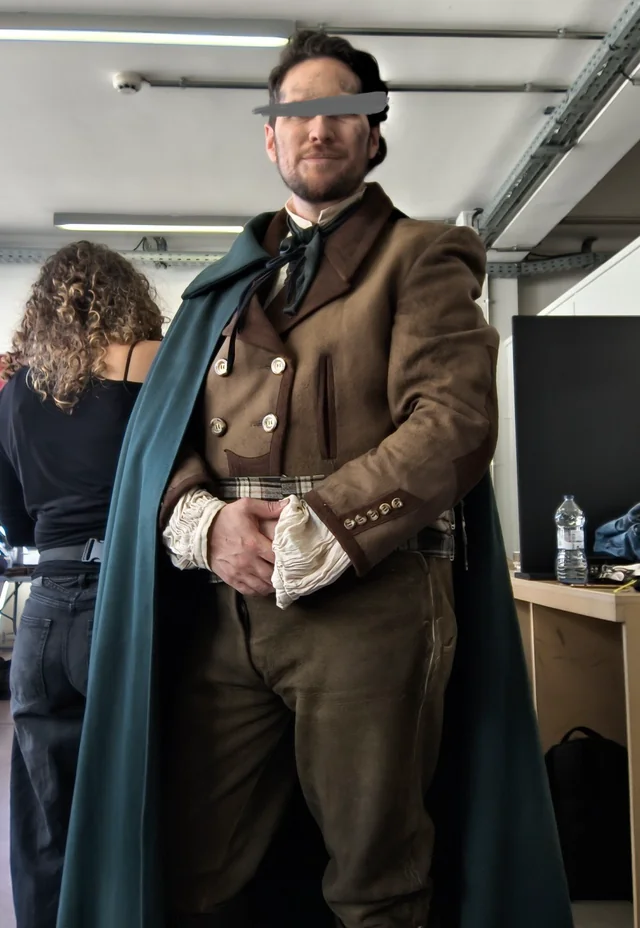
Historical reenactment and cosplay communities engage baroque fashion through a material-accuracy epistemology distinct from both couture and ballroom. Historical costumers evaluate garments against documentary evidence: extant garments in museum collections, period portraiture, textile inventories, sumptuary legislation, and tailor's pattern books. Expertise is demonstrated through source citation (referencing specific garments at the V&A, the Metropolitan Museum's Costume Institute, or the Palais Galliera), construction-method fidelity (hand-sewn channels for whalebone stays rather than machine-stitched channels for plastic boning), and material authenticity (silk taffeta rather than polyester satin, linen rather than cotton for underlayers). This community's gatekeeping is archival: authority derives from documented knowledge of what was actually worn, constructed, and maintained in the historical periods baroque fashion references.
Online aesthetic communities — operating through TikTok (#baroque, #royalcore, #regencycore, #darkacademia), Pinterest mood boards, and Instagram styling accounts — constitute the aesthetic's broadest and most diffuse participation layer. Here, baroque is consumed as image rather than material: visual mood, color palette, and ornamental density are evaluated through screen-mediated photography, and participation requires only the assembly of referentially appropriate imagery. This community's relationship to material specificity is attenuated — a polyester dress with printed brocade pattern can circulate as "baroque" if it photographs well — which generates tension with communities whose evaluative criteria depend on material authenticity.
History
The material history of baroque fashion is inseparable from the political economy of European state formation, colonial extraction, and luxury-goods manufacture. Each historical phase produced specific textile technologies, silhouette architectures, and social functions that subsequent fashion would cite, simulate, and transform.
Court spectacle and state-sponsored luxury (1643–1715). The foundational moment of baroque fashion as a coherent system occurs under Louis XIV of France, whose minister Jean-Baptiste Colbert understood luxury textile production as an instrument of mercantilist economic policy. The establishment of the Gobelins manufactory (1662), the royal silk-weaving monopolies at Lyon, and the systematic development of French lace production at Alençon and Argentan were not merely cultural patronage but industrial strategy — they aimed to capture the luxury textile trade from Italian (particularly Venetian and Florentine) producers and redirect European aristocratic spending toward French manufacturers. Court dress at Versailles became the vehicle for this economic project: the grand habit (formal court dress consisting of a heavily boned bodice, full skirt with train, and elaborate embroidered or brocaded surface) required fabrics produced exclusively by French workshops, consumed enormous quantities of silk and metallic thread (a single court gown could use fifteen to twenty-five meters of fabric), and was subject to sumptuary regulation that restricted the most luxurious materials to the highest-ranking courtiers. The habit à la française (men's three-piece suit of coat, waistcoat, and breeches) was similarly embellished with silk embroidery, metallic braid, and button covers that functioned as miniature embroidery exercises. Fashion at Versailles was not personal expression but political technology: dress communicated rank, favor, allegiance, and economic participation in the state's luxury-production apparatus.
Textile industrialization and romantic revival (1780s–1900s). The Jacquard loom, demonstrated by Joseph Marie Jacquard in Lyon in 1804, mechanized the production of figured textiles by encoding weft-selection patterns on punched cards — a binary programming system that is legitimately cited as a precursor to modern computing. Before the Jacquard mechanism, brocade and damask weaving required a drawboy to manually select and raise individual warp threads for each pattern row, limiting production speed and making elaborate figured fabrics prohibitively expensive. The Jacquard loom dramatically reduced the labor required for pattern weaving while increasing pattern complexity, enabling wider distribution of baroque textile vocabulary — though at the cost of the hand-drawn irregularities that distinguished earlier luxury production. The Romantic period (1820s–1850s) revived baroque ornamental density through historicist pastiche: puffed sleeves, heavily embellished bodices, full skirts supported by crinolines, and Renaissance-revival jewelry. Charles Frederick Worth, operating from his Paris maison from 1858, established the institutional framework of couture as we know it — designer as auteur, seasonal collection as cultural event, elaborate construction as luxury marker — and drew heavily on baroque vocabulary for his most theatrical commissions. The Belle Époque (1880s–1914) produced some of the most technically accomplished embellished garments in fashion history, with houses like Paquin, Doucet, and Worth producing beaded and embroidered evening gowns whose construction hours rivaled seventeenth-century court dress.
Twentieth-century baroque cycles (1947–1999). Christian Dior's "New Look" (spring 1947) reinstated baroque silhouette principles — cinched waist, padded hip, full skirt consuming fifteen to twenty-five meters of fabric — after the material deprivation and utilitarian silhouettes of wartime fashion. Though Dior's aesthetic was more rococo than baroque (favoring lightness and curve over weight and density), it re-established the principle that fashion could legitimately demand structural excess and material abundance. Cristóbal Balenciaga's architectural approach to couture (1950s–1960s) — sculptural volume achieved through internal engineering rather than applied ornament — provided a modernist reinterpretation of baroque spatial logic. The 1980s produced the most explicitly baroque fashion moment since Versailles: Christian Lacroix's debut collection for his own house (1987), featuring the "pouf" dress (a short bubble-hemmed ball gown densely embellished with bows, embroidery, and jewels), was received as a deliberate rejection of minimalist austerity. Gianni Versace, operating from the late 1970s through his death in 1997, constructed what remains the most commercially successful baroque fashion system in modern history. Versace's achievement was not merely aesthetic but semiotic: he developed a coherent visual language — the Medusa head as brand cipher (referencing Greek mythology's figure whose gaze transforms the viewer), baroque scroll prints derived from seventeenth-century Italian palace interiors and executed through high-fidelity silk screen-printing, the safety pin as structural hardware elevated to iconic accessory (Elizabeth Hurley's Versace safety-pin dress, 1994), and an overall material proposition in which silk, leather, and metal chain mesh operated as surfaces for the display of sexualized power. John Galliano's tenure at Christian Dior (1996–2011) pushed baroque theatricality to its couture maximum: collections like "Cleopatra" (2004) and "Les Incroyables" (1999) deployed historical-fantasy narratives with full-scale set design, dramatic makeup, and garments that functioned as mobile scenography. Alexander McQueen's work — particularly "The Widows of Culloden" (2006) and "Plato's Atlantis" (2010) — merged baroque ornamental density with Gothic darkness and technological experimentation, producing a strain of baroque that was psychologically intense rather than merely decorative.
Digital-era baroque and platform aesthetics (2010–present). The post-2008 recession produced a counter-intuitive baroque resurgence: as economic austerity became the dominant political narrative, fashion responded with exaggerated opulence as both escapist fantasy and implicit critique. Dolce & Gabbana's series of Sicilian baroque collections (2012–2016) drew on southern Italian church interiors — gold mosaic, altar embroidery, devotional imagery — translated into embellished dresses and jackets that became Instagram's most-shared runway images. Alessandro Michele's Gucci (2015–2022) produced the era's most influential baroque-adjacent system: a maximalist accumulation aesthetic that layered Renaissance painting references, ecclesiastical embroidery, kitsch animal motifs, and vintage-inspired textiles into a deliberately overwhelming visual density. Balmain under Olivier Rousteing (2011–present) developed a specifically digital-era baroque: garments designed for Instagram legibility, with heavy beading, structured shoulders, and gold-chain embellishment calibrated for the flat photographic medium of social media feeds. The Bridgerton effect (Netflix, 2020–present) — Regency-era court dress filtered through contemporary diversity casting and candy-colored art direction — introduced baroque visual codes to a mass audience, spawning TikTok aesthetics (#regencycore, #royalcore) that translated baroque ornamental density into accessible costume-party dress and vintage-market styling. Schiaparelli under Daniel Roseberry (2019–present) merged surrealist sculptural intervention with baroque embellishment density, producing garments — gilded body-cast corsets, trompe l'oeil jewelry molded in gold-painted resin — that operated simultaneously as baroque spectacle and conceptual art commentary on baroque spectacle.
Silhouette
Baroque silhouette is governed by a principle of volumetric amplification: the dressed body is enlarged, extended, and architecturally restructured beyond anatomical proportion through internal engineering systems that fabric alone cannot achieve. This is the critical distinction between baroque silhouette and the silhouettes of softer maximalist aesthetics (bohemian, romantic): baroque volume is rigid, structural, and engineered, not draped or gathered.
The foundational silhouette architecture depends on undergarment infrastructure. The corset (or "stays" in historical terminology) compresses and repositions the torso into an idealized conical or hourglass profile, providing a rigid foundation from which outer garments hang. Historical corsetry used whalebone (baleen) or cane for channel stiffening; modern corsetry uses spiral steel boning (which flexes with torso movement while resisting lateral collapse) or flat steel boning (which provides rigid posture support but limits movement). The boning is encased in stitched channels of coutil (a tightly woven cotton herringbone fabric engineered for dimensional stability under compression), and the corset's tension is controlled through grommeted lacing — brass or steel eyelets set into reinforced fabric panels through which cord or ribbon is threaded. The engineering challenge is distributing compressive force across the torso without creating pressure points that damage tissue or restrict breathing beyond tolerable limits: a well-constructed corset achieves two to four inches of waist reduction while maintaining diaphragmatic breathing capacity, while a poorly constructed one creates rib-cage pain, superficial skin abrasion, and circulatory compression within minutes.
Below the waist, volume-generation structures transform the lower silhouette from anatomical to architectural. The farthingale (sixteenth–seventeenth century), consisting of graduated hoops of cane, wire, or whalebone sewn into a linen or cotton underskirt, created the rigid conical or drum-shaped profile of Spanish and English court dress. The pannier (eighteenth century) — a wide, flat hip-extension structure made of cane hoops or whalebone ribs connected by linen tapes — produced the extreme lateral width (sometimes exceeding four feet from hip to hip) of French court dress, requiring wearers to navigate doorways sideways and sit on specially designed wide chairs. The crinoline (mid-nineteenth century), first as layers of starched petticoats and then as the cage crinoline (a framework of graduated spring-steel hoops connected by cotton tapes, patented by various manufacturers in the 1850s), produced the dome-shaped skirt silhouette that re-enacted baroque volumetric excess through industrial-era engineering. The bustle (1870s–1890s) redirected volume to the posterior, creating a cantilevered profile. Each of these structures solves the same engineering problem — how to create a garment silhouette that exceeds what fabric weight and drape alone can sustain — through progressively refined internal frameworks.
Upper-body silhouette amplification operates through shoulder and sleeve engineering. Puffed sleeves (from the modest gathered cap to the extreme virago sleeve of the 1620s–1640s, which divided the upper arm into multiple paned and ribboned sections) increase the visual width of the shoulder line, creating a proportional relationship with the amplified lower body. Structured shoulders in contemporary baroque — Balmain's sharp-shouldered jackets, Schiaparelli's sculpted shoulder treatments — use tailoring pads, internal canvas interfacing, or molded foam inserts to extend the shoulder line beyond the natural acromion point, producing the inverted-triangle torso that contemporary baroque shares with 1980s power dressing. High collars (standing bands, ruffs, Medici collars) extend the vertical axis above the natural shoulder line, framing the face as if within an architectural niche.
The proportional logic follows a hierarchy of attention: waist compression creates a visual anchor point; above-waist and below-waist volumes expand symmetrically or asymmetrically from that anchor; and embellishment density increases at focal zones (bodice front, sleeve caps, hemline, neckline) while potentially decreasing at concealed zones (inner arms, back below the shoulder blades, underskirt panels hidden beneath overskirts). This proportional strategy maximizes visual impact from the frontal and three-quarter viewing angles that dominate both historical court presentation and contemporary red-carpet photography.
Materials
Material selection in baroque fashion operates under a governing principle: every fabric must possess sufficient surface complexity, light-interactive capacity, or structural density to sustain the ornamental intensity the aesthetic demands. Materials that are flat, matte, lightweight, or visually inert are categorically excluded unless they serve as concealed structural substrates beneath visible embellishment.
Brocade and Jacquard-woven figured silks. Brocade is the baroque textile par excellence — a figured fabric in which supplementary weft threads (often metallic, often in multiple colors) are introduced selectively across the width of the cloth to create raised, often multicolored patterns against a ground weave of satin, twill, or plain structure. The Jacquard loom's punched-card mechanism (and its modern computerized successors) controls which warp threads are raised for each passage of the supplementary weft shuttle, enabling pattern complexity limited only by the number of warp threads in the loom setup — a 4,000-end Jacquard can produce patterns of extraordinary figural detail. Thread count directly affects pattern definition: higher-density warps produce finer pattern resolution but require more elaborate (and expensive) loom setup and slower weaving speed. The ground weave's structure determines the fabric's drape and body: satin grounds produce a smooth, lustrous base against which brocade patterns appear to float; twill grounds provide more structure and diagonal texture. Silk brocade — the historical standard — offers a natural luster, drape, and color saturation that synthetic brocade (polyester, acetate, viscose blends) cannot fully replicate: silk's triangular fiber cross-section produces prismatic light refraction, while polyester's round cross-section produces a flatter, more uniform reflectance that reads as "shiny" rather than "luminous." However, silk brocade is vastly more expensive (€80–€400 per meter for quality production from Lyonnaise or Italian mills, versus €5–€30 per meter for synthetic alternatives from Chinese or Indian mills), more vulnerable to UV fading, more susceptible to water spotting, and more demanding in care. Brocade fails through weft-float snagging (the raised pattern threads, being longer floating sections of yarn, are vulnerable to catching on rough surfaces and pulling out), selvage unraveling at cut edges, and color bleeding if exposed to moisture when improperly finished.
Silk velvet and pile-weave constructions. Velvet is produced through a pile-weave mechanism in which an additional set of warp threads is looped over thin metal rods inserted during weaving; when the rods are withdrawn (or, in cut-pile velvet, when a blade attached to the rod cuts the loops as it is pulled out), the resulting upright fiber tufts create the dense, light-absorbing surface that defines velvet's visual character. Pile height, pile density (tufts per square centimeter), and fiber content determine the fabric's hand, weight, drape, and light behavior. Silk velvet — with its fine, naturally lustrous fiber producing a pile that appears to shift in tone as the viewing angle changes — represents the material's highest expression. Voided velvet (ciselé) creates pattern by selectively cutting pile in some areas while leaving it uncut (looped) or absent (ground weave exposed) in others, producing a sculptural surface that combines pile texture with flat ground within a single fabric. Devoré (burnout) velvet achieves a similar effect through chemical means: a cellulose-dissolving paste (typically sodium bisulfate or aluminum chloride) is screen-printed onto a silk-viscose blend velvet, destroying the viscose pile fibers while leaving the silk ground intact, creating a sheer-and-opaque pattern. The chemistry requires precise temperature and timing control — over-application dissolves ground threads and creates holes; under-application leaves residual pile that pills and sheds. Velvet's primary failure mode is pile crushing: sustained pressure (from sitting, folding, or hanging on narrow hangers) permanently flattens pile fibers, especially in silk and viscose velvets that lack the elastic recovery of synthetic alternatives. Proper storage requires garments to be hung on wide, padded hangers or rolled rather than folded, with pile surfaces never in contact with other surfaces. Professional restoration of crushed velvet involves careful steaming with the pile held in suspension — a process that is partially but not fully effective, particularly on silk pile.
Metallic thread and goldwork embroidery. The pinnacle of baroque surface treatment is goldwork embroidery, a family of techniques using metal threads — real gold or silver wire, gilt wire (base metal coated with gold), and various metal-wrapped threads — applied to a fabric ground. The primary techniques include couching (laying metal threads on the surface and securing them with fine silk stitches at regular intervals, because metal threads are too rigid and fragile to be passed through fabric), bullion work (using coiled wire — purl — cut into short lengths and applied like beads, creating a faceted, light-catching texture), plate work (using flat metal strips), and padding (stitching layers of felt, card, or string beneath the goldwork to create three-dimensional relief). The weight of real gold thread is substantial — a densely worked goldwork panel can add 200 to 500 grams per square decimeter — creating the engineering challenges described in the silhouette section. Real gold thread production involves drawing gold into fine wire and then flattening or coiling it around a silk or linen core; this is expensive, labor-intensive, and increasingly rare, replaced in most contemporary production by Lurex (a polyester film vacuum-metallized with aluminum, then slit into strips), Japanese gold thread (a paper substrate laminated with gold or gilt film, cut into strips and wound around a silk core — lighter and more flexible than wire-drawn gold but less durable), and metallic machine-embroidery threads that simulate goldwork effects at a fraction of the weight and cost. The material hierarchy — real gold bullion at the apex, hand-couched Japanese gold in the middle, machine-embroidered Lurex at the base — maps directly onto the aesthetic's authenticity spectrum. Gold thread tarnishes through sulfur exposure (atmospheric pollution, body chemistry, proximity to rubber and certain adhesives); silver thread tarnishes more rapidly. Lurex does not tarnish but degrades through abrasion, delamination (the metallic coating separating from the polyester substrate), and UV exposure that dulls its reflectance.
Beading and crystal embellishment. Baroque surface density is frequently achieved through applied elements: glass beads (seed beads, bugle beads, cut beads), crystals (Swarovski — now "Swarovski Crystals" following the 2021 restructuring — graded by size, cut, and coating: clear crystal, AB/Aurora Borealis iridescent coating, metallic coatings), sequins (flat or cupped, stamped from metallic film), paillettes (larger diameter than sequins, typically single-hole attachment allowing movement and light play), and pearls (natural, cultured, or imitation). Attachment methods determine durability: hand-sewn beads (each individually secured with thread passed through the bead and back through the fabric) are the most secure but most labor-intensive; tambour beading (a continuous chain stitch worked from the reverse of the fabric using a hooked tambour needle, with each bead caught in a loop of the chain) allows faster production but produces a less secure attachment if a single thread breaks, since the chain can unravel; heat-bonded rhinestones (using heat-activated adhesive pre-applied to the crystal's flat back) are fastest but fail first, as adhesive degrades through washing, dry cleaning, flexion stress, and heat cycling. The weight of dense beading creates the same structural challenges as goldwork: a fully beaded gown can weigh eight to fifteen kilograms (some couture pieces have exceeded twenty kilograms), requiring the internal boning and suspension systems described elsewhere in this entry to prevent the garment from distorting, sagging, or becoming unwearable.
Structural substrates and support textiles. Beneath the visible embellished surface, baroque garments depend on an invisible infrastructure of support textiles. Coutil (tightly woven cotton twill with herringbone pattern) provides the dimensional stability for corsetry. Cotton canvas and hair canvas (horsehair and cotton blend interfacing) stiffen bodice and jacket structures. Horsehair braid (crinoline tape) stiffens hem edges to maintain skirt shape without internal frameworks. Buckram (stiffened cotton or linen) creates rigid forms for structured collars and headpieces. Silk organza (a sheer, crisp plain-weave silk) serves as an interlining that adds body without weight and as a mounting ground for embroidery work that would distort lighter fabrics. These materials are never seen in the finished garment but are structurally essential: without proper interlining and support, embellished fabrics sag, distort, and lose the silhouette that gives baroque fashion its architectural character.
Color Palette
The baroque palette is organized around a single operational principle: chromatic intensity sufficient to sustain visual impact under the conditions of spectacle. Colors must read at distance, maintain richness under artificial lighting (historically candlelight and gaslight; now stage lighting, camera flash, and screen reproduction), and provide sufficient contrast with embellishment materials (metallic thread, crystals, pearls) to allow the ornamental surface to be legible rather than lost in chromatic noise.
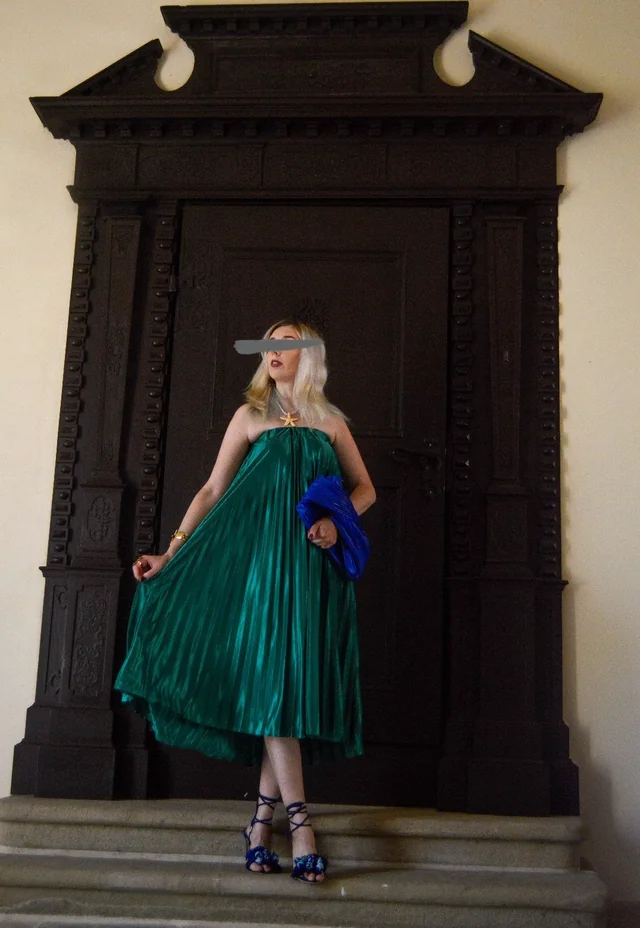
Jewel tones constitute the palette's core: emerald green, sapphire blue, ruby red, amethyst purple, and topaz gold — colors named, not coincidentally, after precious stones, embedding the vocabulary of mineral wealth into the chromatic system itself. These saturated, medium-to-dark values function as grounds against which gold and silver embellishment achieves maximum contrast: gold thread on emerald satin, silver beading on sapphire velvet, crystal embellishment on ruby silk. The color-embellishment relationship is not arbitrary but optically engineered: complementary and near-complementary pairings (gold against blue, silver against burgundy) produce the greatest visual vibrancy, while analogous pairings (gold on red, gold on orange) create a more unified but less dynamic effect.
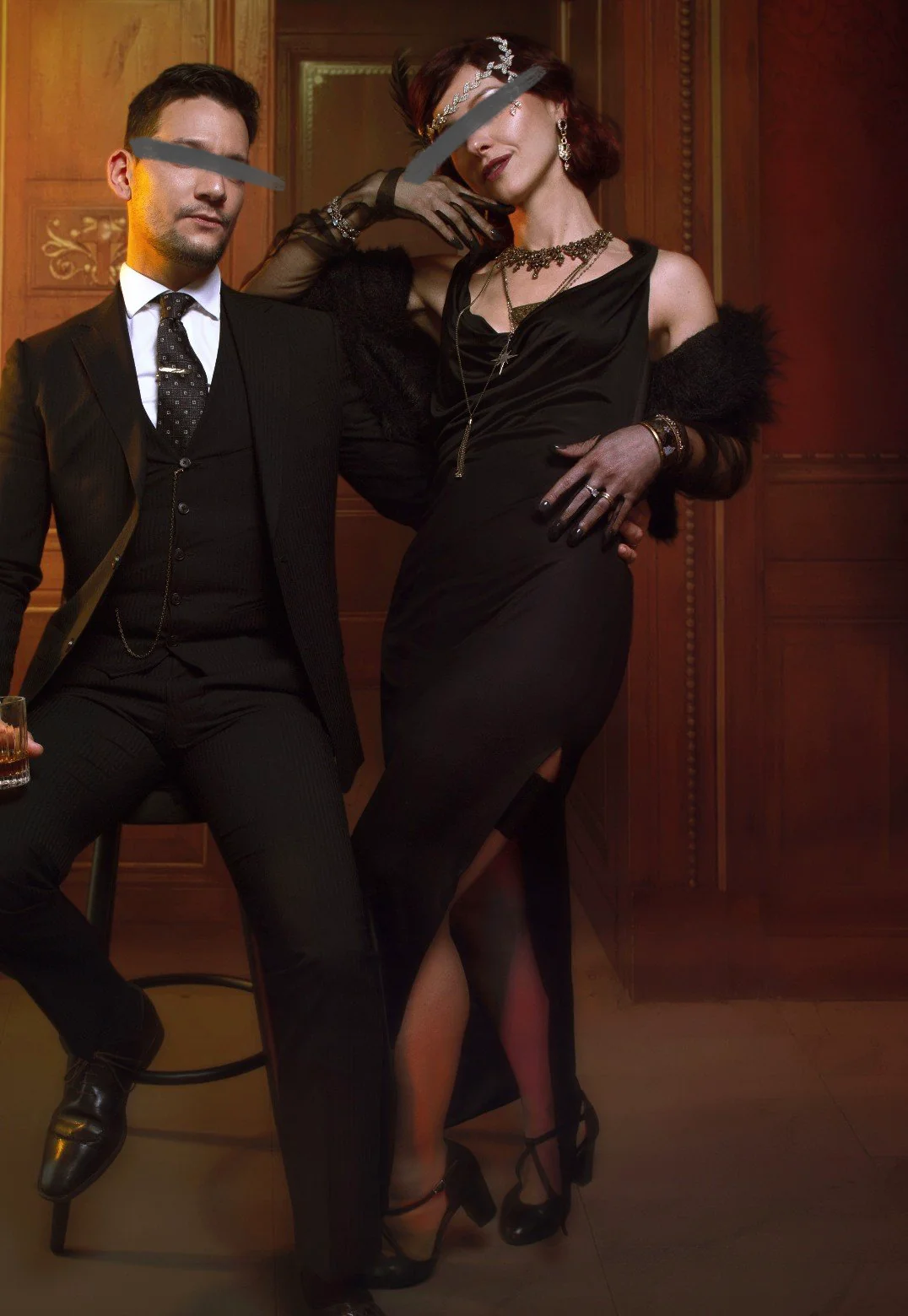
Black functions not as absence but as the ultimate embellishment ground — a chromatic void against which gold, silver, crystal, and color achieve maximum relief. Black velvet with gold embroidery, black silk with crystal beading, black brocade with metallic supplementary weft: these combinations constitute some of baroque fashion's most iconic material expressions because black's total light absorption makes adjacent embellishment appear to glow by contrast. Versace's deployment of black silk with gold baroque-scroll screen printing became the house's most recognizable material signature, exploiting this optical principle at industrial scale.
White and ivory, though less common, serve as ceremonial registers — bridal, debutante, and formal state-occasion palettes where the absence of color directs attention entirely to surface texture, silhouette, and embellishment quality. White-on-white baroque — ivory brocade, white embroidery on white satin, pearl-on-cream silk — demands the highest material quality because there is no color to compensate for imprecise craftsmanship or inferior textile character.
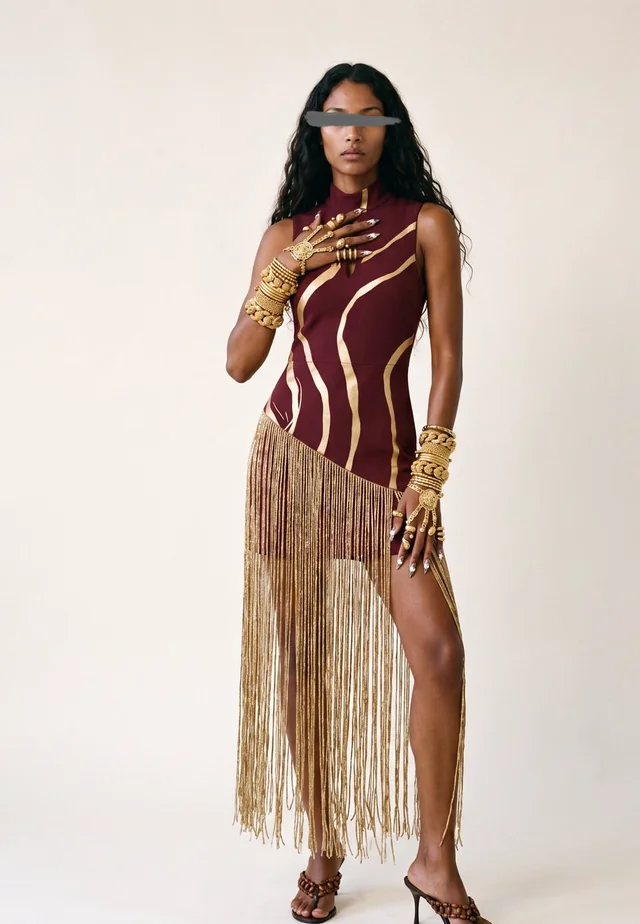
Metallic tones — gold, silver, bronze, copper, rose gold — function simultaneously as embellishment and as color in their own right. A fully gold brocade gown is not "embellished" in the conventional sense; rather, the fabric itself is the embellishment, and the color is the material. This collapse of ornament into substrate is distinctively baroque: in no other fashion aesthetic does metallic function so comprehensively as both surface treatment and primary chromatic identity.
Details
Details in baroque fashion must be analyzed through a dual framework: as engineering solutions to the structural challenges posed by heavy, rigid, embellished garments on moving bodies, and as communicative elements within a semiotic system where every closure, fastening, and edge treatment carries social meaning proportional to its visible elaboration.
Closure systems. Baroque garments historically fastened through lacing (corset backs, bodice fronts), hooks and eyes (rows of small interlocking metal closures distributing tension across a seam), and pins (straight pins securing draped or layered elements in place — an impermanent attachment system that allowed garments to be reconfigured between wearings). Contemporary baroque garments typically use concealed zippers (usually centered at the back, sometimes side-placed to avoid disrupting a heavily embellished front panel) combined with interior hooks or snaps at stress points. The engineering challenge is that heavily embellished fabrics resist the gathering and feed required by standard zipper installation: beaded or metallic-thread surfaces can jam zipper teeth, and the weight of the garment places lateral stress on the zipper tape that exceeds the load rating of standard dress zippers. Couture solutions include installing the zipper on a separate tape reinforced with cotton seam binding, clearing a channel of beading along the zipper line during embellishment (requiring coordination between embroidery team and construction team), and using hook-and-eye or hook-and-bar closures at the waist point where stress is highest while using the zipper only above and below this zone.
Edge treatments. Baroque garments resolve raw edges through techniques that are themselves ornamental: hand-rolled hems on silk (where the raw edge is rolled between thumb and finger and secured with slip stitches at one-to-two-millimeter intervals — invisible from the outside, requiring extraordinary manual consistency), couched cord or braid edging (metallic or silk cord hand-sewn along edges, simultaneously finishing the raw edge and adding decorative border), sequin or bead-edged borders (where the outermost row of embellishment also secures the fabric edge), and overlocked or serged edges concealed beneath applied trim. In couture, the edge treatment is often the most labor-intensive finishing element: the final row of hand-stitching that controls how the garment's boundary meets the body or the air.
Buttons and hardware as ornament. In baroque systems, buttons rarely serve purely functional closure purposes — instead, they are miniature decorative objects: metallic (cast or stamped in brass, gold-plated, or silver), jeweled (with set stones), fabric-covered (in matching or contrasting brocade, sometimes embroidered), or sculptural (three-dimensional forms — Versace's Medusa-head buttons, Dolce & Gabbana's filigree buttons, Schiaparelli's surrealist insect and anatomical buttons). Hardware — buckles, clasps, chains, brooches used as functional closures — occupies the same category: each piece of hardware is evaluated by its ornamental contribution as much as its mechanical function. Versace's safety-pin dress (1994) exemplifies this logic: large gold safety pins functioned as visible structural elements holding the dress together, collapsing the distinction between fastening and ornament by making the closure system the garment's primary decorative feature.
Lace and applied textiles. Lace in baroque fashion serves as a material threshold between the garment and the body — a transitional zone that simultaneously conceals and reveals, adding a layer of ornamental complexity between skin and structured fabric. Historical baroque lace (Venetian needlelace, Flemish bobbin lace) was among the most expensive textiles in existence: a single Venetian gros point lace collar could cost more than the garment it adorned. Contemporary baroque uses both machine-produced lace (Leavers or raschel lace from Calais or Nottingham, at €15–€150 per meter) and hand-embroidered tulle (where the tulle acts as a sheer ground for tambour-beaded or needle-embroidered patterns, at €200–€2,000+ per meter for couture quality). Applied textiles — ribbons, braids, appliquéd fabric motifs, passementerie (decorative trimming of twisted cord, braid, and fringe) — add material layers that increase surface complexity without requiring the entire fabric to be figured or embellished.
Accessories
Accessories in baroque fashion extend the garment system's ornamental logic to the extremities and periphery of the dressed body, completing the transformation from dressed person to total spectacle.
Footwear operates under the same embellishment-density principle as garments. Historical baroque shoes featured silk or brocade uppers, jeweled buckles, embroidered vamps, and elevated heels (the red-soled heel, famously, was a privilege restricted to the French court of Louis XIV — the original "red-bottom shoe" as a marker of aristocratic access). Contemporary baroque footwear includes embellished pumps and sandals (Dolce & Gabbana's crystal-encrusted satin heels, Versace's Medusa-hardware platforms, Jimmy Choo and Manolo Blahnik's jeweled evening shoes), as well as embroidered or brocade boots that extend the garment's surface treatment below the hemline. The functional challenge is that heavily embellished footwear sacrifices durability: crystal adhesive fails under the flexion stresses of walking, brocade uppers abrade and soil rapidly, and metallic hardware scratches and tarnishes through contact with floors and pavement.
Jewelry in baroque systems is volumetric and architecturally scaled rather than delicate or minimalist. Statement earrings (chandelier drops, shoulder-dusters, clip-on clusters), layered necklaces (multiple chains of varying length creating a cascade effect), ornate brooches (used both decoratively and structurally, to pin drapery or secure closures), and cocktail rings (oversized, often cabochon-set) function as embellishment extensions — they continue the garment's surface density onto the body's exposed areas (ears, neck, décolletage, hands). Historical baroque jewelry used gold, enamel, gemstones, and seed pearls; contemporary interpretations range from fine jewelry (Buccellati's Renaissance-revival goldwork, Dolce & Gabbana's filigree and enamel collections) to costume jewelry that simulates the same visual density at accessible price points. The hierarchy — precious versus simulated — maps directly onto the aesthetic's broader authenticity spectrum.
Bags and clutches serve as portable embellishment surfaces: heavily beaded evening bags, brocade clutches, metal-frame minaudières (rigid, jewel-box-shaped evening bags in cast and plated metal), and ornate chain-strap shoulder bags. Dolce & Gabbana's box bags (structured wooden boxes covered in hand-painted and embellished fabric) exemplify baroque accessory logic at its most literal: the bag is a miniature decorated container whose surface treatment is more important than its carrying capacity.
Headpieces, tiaras, and hair ornaments complete the vertical axis: jeweled combs, coronet-style tiaras, decorative pins, and — at the spectacular end — full headdresses that evoke ecclesiastical miters or royal crowns. These accessories are particularly important in red-carpet and bridal baroque, where the head functions as the visual apex of the entire dressed composition.
Body Logic
Baroque fashion constructs the body as a display armature — a structural scaffold for the presentation of ornamental surface, not a natural form to be revealed, celebrated, or comfortably accommodated. This is perhaps the most fundamental difference between baroque and contemporary dress norms that privilege "body-positive" acknowledgment of anatomical diversity: baroque does not accommodate the body as it is but reconstructs it into an idealized architectural form through compression, extension, and augmentation.
The corset compresses the waist and repositions the bust, creating an artificial torso geometry that would not exist without the garment's intervention. The crinoline, pannier, or bustle extends the hip and posterior beyond anatomical proportion, transforming the lower body from a biological form into a geometric volume. Padding augments shoulders, sleeves, and hips where the natural body lacks the mass the silhouette requires. The result is that the baroque-dressed body bears little resemblance to the undressed body: the silhouette is the garment's achievement, not the body's. This architectural body-concept is historically continuous from seventeenth-century court dress through nineteenth-century crinolines to Thierry Mugler's armored 1990s couture and Schiaparelli's contemporary molded-corset silhouettes.
Gender coding in baroque fashion is typically amplified rather than attenuated. Feminine baroque exaggerates secondary sexual characteristics — bust prominence through corseted uplift, waist narrowness through compression, hip width through structural extension — producing a hyperbolic femininity that exceeds anything the unaugmented body could display. Masculine baroque exaggerates shoulder breadth, chest prominence, and leg length through padding, structured tailoring, and elevated heels. In both cases, the body is not freed from gendered norms but subjected to their most extreme expression. However, the ballroom community's deployment of baroque vocabulary complicates this binary: in ballroom, the elaborate construction of femininity through corsetry, padding, and embellishment is performed by bodies of all anatomical configurations, revealing gender presentation as a fabrication — in the literal sense, something produced through the labor of construction — rather than a natural expression. Contemporary drag culture's use of baroque vocabulary operates on the same principle: the visible labor of constructing baroque femininity or masculinity exposes the constructedness of all gender presentation.
The baroque body is also, critically, an immobilized body. Heavily embellished garments restrict movement: corsets limit torso flexion and rotation; wide skirts require spatial accommodation; trailing hems demand measured gait; the sheer weight of beaded and metallic-thread garments induces fatigue within hours. This immobility is not a design failure but a social function: historically, the inability to perform physical labor while wearing court dress visibly demonstrated aristocratic exemption from labor. The leisure body — a body that can afford to be architecturally encased, movement-restricted, and ornamentally burdened — is the baroque body's ultimate social meaning. In contemporary contexts, red-carpet baroque reproduces this logic: the garment renders the wearer spectacular but constrained, able to pose and process but not to move freely, sit comfortably, or manage independently — hence the stylist-and-handler infrastructure that accompanies every major red-carpet baroque appearance.
Garment Logic
Baroque garment construction operates as a layered engineering system in which the visible ornamental surface depends on multiple concealed structural substrates working in concert. Understanding this system requires analyzing the relationship between support layers (closest to the body), structural layers (intermediate), embellished layers (visible), and the attachment, closure, and finishing systems that integrate them.
Support and structural layer construction. The innermost layer manages the body-garment interface: a fitted lining of silk charmeuse, habotai, or cotton batiste protects both the body from rough internal construction (boning channels, seam allowances, embroidery knots) and the garment from body oils, perspiration, and mechanical abrasion. Boning channels — narrow fabric tubes encasing steel or plastic bones — are stitched to this lining or to a separate structural interlining, distributing the corset-like compression and support that the silhouette requires. In couture construction, boning placement is customized to the individual body: bones are positioned to follow the torso's contours, with shorter bones at the natural waist curve and longer bones at the center front and center back to prevent buckling. The boning material itself encodes a quality hierarchy: spiral steel boning (a continuous helix of flat steel wire) provides the best combination of support and flex; flat steel boning (rigid steel strips) provides maximum support with minimal flex; German plastic boning (Rigilene — polyester boning tape) provides lightweight support adequate for lighter garments but insufficient for heavily embellished pieces; and cheap plastic cable-tie boning (sometimes found in fast-fashion "baroque" pieces) provides effectively no support and bends permanently out of shape within hours of wear.
Embellished surface construction. The visible layer is where the baroque garment's material labor is concentrated. Embroidery work is typically produced on an embroidery frame (a wooden or metal frame that holds the fabric taut), working from a design transferred to the fabric through tracing, pouncing (pushing charcoal powder through a perforated paper pattern), or digital printing of guidelines. The production sequence is critical: structural seaming is completed first, establishing the garment's three-dimensional form, and then embellishment is applied to the assembled garment (so that pattern repeats align across seams) — or, in some couture methods, embroidery is worked on flat fabric panels that are subsequently seamed, which is faster but creates alignment challenges at panel junctions. Bead and crystal attachment methods (hand-sewn, tambour, heat-bonded) are selected based on the garment's intended use: garments for repeated wear and movement (stage costumes, performance wear) require the more secure hand-sewn or tambour attachment; garments for limited-occasion wear (red carpet, editorial photography) may use faster heat-bonded methods, accepting the trade-off of reduced durability. The economic calculus is stark: hand-sewn beading at €60–€120 per hour of labor, with a densely beaded bodice requiring 200–500 hours, produces embellishment costs alone of €12,000–€60,000 — before fabric, construction, fitting, or design costs are included.
Seam engineering in embellished garments. Seaming heavily embellished fabrics presents specific technical challenges. Beads and crystals at seam allowances must be removed or crushed before stitching — the standard practice is to clear a channel of embellishment along the seam line during production, then fill the cleared channel after seaming by hand-stitching additional beads to conceal the seam. Metallic brocade frays aggressively when cut, requiring immediate edge treatment (overlocking, binding, or fray-stop liquid application) before any seaming can proceed. Heavy fabrics require industrial-weight sewing machines with reinforced feed mechanisms — standard domestic machines cannot penetrate multiple layers of brocade or beaded fabric. Seam finishes in couture are hand-finished (silk-bound seam allowances, hand-felled linings) for comfort against the body; in commercial production, overlocked seams suffice but create the scratchy interior finish that distinguishes industrial from artisanal construction.
Aftercare. Baroque garments demand the most intensive aftercare regime of any fashion category. Dry cleaning is the standard, but even dry-cleaning solvents can damage specific embellishment materials: perchloroethylene (the most common dry-cleaning solvent) can dissolve certain adhesives used in heat-bonded crystals, dull the finish on metallic sequins, and weaken some beading threads. Professional conservators increasingly recommend localized spot-cleaning rather than full-immersion dry cleaning for heavily embellished garments. Velvet requires specialized pressing (never with direct iron contact — only steam, with the pile facing a velvet board or needle board that supports the pile structure). Brocade should be pressed on the wrong side with a press cloth to prevent flattening the supplementary weft pattern. Storage requires hanging on wide, padded hangers (narrow wire hangers create shoulder-point distortion in heavy garments within days), with acid-free tissue paper between folds, in cool, dry, dark conditions to prevent metallic thread tarnishing, silk UV degradation, and moth damage. Garments too heavy for hanging (some beaded gowns) must be stored flat in acid-free boxes with tissue support at stress points — a storage method that requires considerable dedicated space. Any visible damage — loose beads, snagged brocade threads, torn lace — should be repaired immediately, as damage propagates rapidly in these material systems: a single broken tambour-beading chain can cause cascading bead loss across an entire panel.
Failure modes and longevity. Baroque garments degrade through multiple pathways operating simultaneously. Mechanical failure: bead and crystal detachment through thread breakage or adhesive degradation, particularly at flex points (elbows, waist, shoulder joints) where repeated movement stresses attachment points. Material degradation: metallic thread tarnishing, silk fiber weakening through UV exposure and atmospheric acidity, velvet pile crushing under storage pressure. Structural failure: boning fatigue (steel boning can develop permanent bends after repeated wear; plastic boning loses shape recovery much faster), seam stress under garment weight (a fifteen-kilogram beaded gown exerts constant gravitational force on shoulder seams, waist seams, and closure points), and adhesive breakdown in laminated or heat-bonded elements. Chemical failure: dye transfer between touching fabric layers during storage, adhesive residue migration (heat-bonded crystal adhesive softening in warm storage and creating stains on adjacent fabric), and insect damage (silk and wool substrates are vulnerable to clothes moths — Tineola bisselliella — whose larvae consume protein fibers). The practical consequence is that heavily embellished baroque garments have finite performance lives measured in wearings rather than years: a couture beaded gown may sustain twenty to fifty wearings before requiring significant restoration, and the restoration cost may approach or exceed the original production cost. This impermanence is not a deficiency but a structural feature: baroque fashion's material fragility ensures continued demand for production, repair, and replacement — a built-in economic logic that sustains the ateliers, embroiderers, and material suppliers that constitute the aesthetic's production ecosystem.
Motifs / Themes
Baroque fashion's motif system draws from a specific iconographic reservoir: European court culture, ecclesiastical display, classical mythology, and the natural world rendered through stylized ornamental convention rather than naturalistic representation.
Scrollwork and acanthus-leaf patterns — derived from Greco-Roman architectural ornament and transmitted through Renaissance and Baroque decorative arts — constitute the most pervasive surface motif. Versace's baroque-scroll prints, which became the house's visual identity, are direct citations of the decorative programs of Italian Baroque palace interiors (the type found in Rome's Palazzo Barberini or Lecce's Basilica di Santa Croce): symmetrical volute patterns based on the acanthus leaf's curling form, organized into bilateral compositions and executed in gold on black, gold on navy, or polychrome configurations. These patterns encode a specific historical-aesthetic claim: continuity with European aristocratic decorative tradition, accessed through the Italian design lineage that Versace's Calabrian origins and Milanese career positioned him to claim.
Religious and ecclesiastical imagery — crosses, halos, Madonna iconography, altar-frontal patterns, mosaic compositions derived from Byzantine and Roman church interiors — appears with particular frequency in Italian baroque fashion. Dolce & Gabbana's Sicilian baroque collections drew extensively on the material culture of southern Italian Catholicism: embroidered saints, jeweled crosses, ex-voto imagery (devotional objects offered in thanksgiving), and fabric treatments inspired by liturgical vestments. This appropriation creates a semiotic double bind: the sacred imagery generates aesthetic power precisely because it carries residual spiritual charge — it is more than merely decorative — but its deployment on fashion garments detaches it from devotional context and subjects it to commercial and sexual display logics that may contradict the imagery's original function.
Heraldic and regal motifs — crowns, fleurs-de-lis, lions rampant, double-headed eagles, coats of arms — invoke aristocratic lineage and state authority. These symbols function as shorthand for legitimacy by inheritance, even when deployed by fashion houses with no actual aristocratic connection. The heraldic motif system is baroque fashion's most transparent claim to class authority: it borrows the visual vocabulary of inherited privilege and redeploys it as purchasable luxury.
Floral and vegetal motifs in baroque contexts are distinguished from their deployment in other aesthetics by their stylization and material execution: baroque flowers are not impressionistic or naturalistic (as in romantic or bohemian fashion) but formally composed, symmetrically arranged, and materially realized in embroidery, brocade, or beading rather than printed or painted. A baroque rose is a goldwork rose — thread, wire, and padded satin stitch rendering the flower as a sculptural textile object rather than a pictorial image.
Cultural Touchstones
The cultural reference system supporting baroque fashion operates across cinema, music performance, television, and institutional fashion events, each medium translating the aesthetic's material density into its own representational logic.
In cinema, Sofia Coppola's Marie Antoinette (2006) — with costumes by Milena Canonero using pastel reinterpretations of eighteenth-century court dress, Ladurée macarons as set decoration, and a New Wave soundtrack — produced a defining visual template for baroque-as-pop: historically referenced but deliberately anachronistic, materially elaborate but tonally playful. Baz Luhrmann's The Great Gatsby (2013), with costumes by Catherine Martin and jewelry by Tiffany & Co., translated 1920s Art Deco excess through a baroque sensibility of ornamental saturation. The Favourite (Yorgos Lanthimos, 2018), with Sandy Powell's austere monochrome costumes, offered a counter-baroque: the period setting (Queen Anne's court) invoked baroque expectation while the deliberately restrained palette interrogated it. Stanley Kubrick's Barry Lyndon (1975), shot entirely in natural and candlelight, remains the most materially authentic cinematic representation of eighteenth-century dress, providing a visual archive that costume designers and fashion designers continue to reference.
In music performance, Beyoncé's Renaissance World Tour (2023) deployed custom baroque-inflected stage costumes — metallic corsetry by Balmain, crystallized body armor by Area and Loewe, gilded chain-mail by Schiaparelli — as a vehicle for a specifically Black maximalist reclamation of opulence. Rihanna's Met Gala 2018 appearance in a Maison Margiela Artisanal papal-inspired ensemble — jeweled mitre, embroidered cope, pearl-encrusted train — produced what may be the single most-photographed baroque fashion moment of the digital era, demonstrating how red-carpet spectacle can achieve cultural penetration that runway presentations cannot. Lil' Kim's late-1990s and early-2000s styling — baroque-print Versace, heavily embellished custom pieces, fur-and-crystal excess — established a hip-hop baroque idiom that anticipated by two decades the mainstream fashion industry's embrace of maximal embellishment.
Television's Bridgerton (Netflix, 2020–present) — with costumes by Ellen Mirojnick (Season 1) drawing on Regency-era dress but heightening color saturation, embellishment density, and silhouette drama — triggered a measurable market response: searches for "regency dress," "corset top," and "baroque fashion" spiked immediately following each season premiere. The Crown (Netflix, 2016–2023) provided a documentary-adjacent representation of royal ceremonial dress whose baroque qualities — coronation robes, state-dinner gowns, jeweled tiaras — reinforced associations between ornamental density and institutional authority. Pose (FX, 2018–2021) centered ballroom culture's engagement with baroque vocabulary, representing the community's creative labor in constructing elaborate garments as both artistic practice and survival strategy.
The Met Gala — the Metropolitan Museum of Art's annual Costume Institute benefit — functions as baroque fashion's most prominent institutional platform. Themed galas like "Heavenly Bodies: Fashion and the Catholic Imagination" (2018), "Camp: Notes on Fashion" (2019), and "In America: An Anthology of Fashion" (2022) have repeatedly created contexts in which baroque ornamental density, religious iconography, and theatrical excess are not only permitted but competitively incentivized — each attendee attempting to produce the most photographed, most shared, most culturally penetrating appearance of the evening.
See Also
- Rococo: Baroque's lighter, more playful historical successor, favoring pastel palettes, asymmetrical ornament, and organic curves over baroque's symmetrical weight and saturated color
- Maximalism: Broader category encompassing baroque alongside other high-density aesthetics; baroque is maximalism's most historically specific and materially rigorous variant
- Camp: Related through shared commitment to excess, but camp foregrounds ironic self-awareness and performative failure where baroque insists on ornamental sincerity and material achievement
- Royalcore / Regencycore: Internet-era historical-fantasy aesthetics that borrow baroque visual vocabulary for digital-native self-presentation, typically with attenuated material specificity
- Gothic fashion: Shares baroque's engagement with dark color, religious iconography, and architectural silhouette, but privileges shadow, austerity, and melancholy over baroque's luminous excess
- Renaissance revival: Overlapping historical reference period; distinguished from baroque by relatively greater emphasis on balanced proportion and classical harmony over ornamental proliferation
- Kitsch: Baroque's degraded double — ornamental excess that fails to achieve (or deliberately refuses) the material sincerity that baroque demands, producing excess as taste transgression rather than craft achievement
Brands and Designers
Heritage Maximalists:
- Versace (founded 1978, Milan): the modern baroque fashion system's defining house — Medusa-head insignia, baroque-scroll silk screen-printing, safety-pin hardware, gold chain-mesh dresses, Gianni Versace's fusion of classical Mediterranean ornament with sexualized spectacle, Donatella's continuation and amplification of the house codes
- Dolce & Gabbana (1985, Milan): Sicilian baroque — ecclesiastical embroidery, mosaic-tile prints, devotional imagery, Alta Moda couture program producing maximum-embellishment garments for ultra-high-net-worth clients
- Christian Dior (1946, Paris): periodic baroque cycles from the New Look through John Galliano's theatrical tenure (1996–2011) to Maria Grazia Chiuri's embellished couture presentations
- Alexander McQueen (1992, London): dark baroque — gothic ornamental density, skull motifs rendered in crystals and metallic thread, Elizabethan-ruff silhouettes, Sarah Burton's continuation of ornamental craft excellence
Contemporary Baroque:
- Balmain (under Olivier Rousteing, 2011–present): digital-era baroque — heavy beading, structured shoulders, gold-chain embellishment, Instagram-optimized ornamental density
- Gucci (under Alessandro Michele, 2015–2022): maximalist accumulation baroque — Renaissance embroidery, ecclesiastical motifs, jeweled accessories, deliberate taste-boundary excess
- Schiaparelli (under Daniel Roseberry, 2019–present): surrealist baroque — gilded body-cast corsets, trompe l'oeil jewelry, anatomical motifs in gold-painted resin, merging baroque ornamental logic with conceptual art intervention
- Valentino (under Pierpaolo Piccioli, 2016–2024): couture baroque refined through monochrome discipline and architectural volume — Piccioli's singular ability to sustain ornamental density while maintaining silhouette clarity
- Roberto Cavalli (1970, Florence): baroque-adjacent maximalism — animal prints, ornate embellishment, Mediterranean excess, gold hardware
Embellishment Specialists and Couture Ateliers:
- Elie Saab (1982, Beirut): evening-wear baroque — maximum embellishment through beading, embroidery, and crystal application on tulle and silk, Middle Eastern luxury market as primary client base
- Zuhair Murad (1997, Beirut): baroque embellishment at its technical maximum — gowns requiring thousands of hours of hand-beading, red-carpet presence through ornamental spectacle
- Marchesa (2004, New York): red-carpet baroque — romantic embellishment, floral beading, tulle and lace layering
- Lesage (embroidery atelier, 1924, Paris, acquired by Chanel in 2002): the institutional center of couture embroidery — Lunéville tambour technique, goldwork, bead and crystal application, supplier to major couture houses
- Reem Acra (1997, New York): bridal and evening baroque — beaded and embroidered gowns drawing on Middle Eastern ornamental traditions
Historical-Revival and Artisanal:
- Simone Rocha (2010, London): Irish-inflected baroque — tulle layering, pearl embellishment, structured volume, craft-forward construction
- Erdem (2005, London): botanical baroque — floral embroidery, jacquard weaving, romantic maximalism grounded in textile research and historical reference
- Iris van Herpen (2007, Amsterdam): techno-baroque — 3D-printed ornamental structures, laser-cut textiles, and digital fabrication methods reinterpreting baroque's ornamental density through twenty-first-century production technology
- Thom Browne (2001, New York): conceptual baroque — theatrical presentation, embroidered suiting, ornamental density deployed within menswear and tailoring frameworks that traditionally resist decoration
Accessible / Fast-Fashion Simulation:
- Zara (Inditex): seasonal baroque-reference collections translating runway embellishment into printed-polyester and machine-embroidered approximations
- H&M (including Conscious Collection and designer collaborations): periodic baroque-inspired ranges, notably the Balmain × H&M collaboration (2015) that mass-produced beaded and embellished silhouettes
- ASOS and Boohoo: e-commerce-native baroque simulation — heavily embellished party wear using heat-bonded rhinestones and printed brocade at sub-$50 price points
- Shein: ultra-fast-fashion baroque — digital-print "brocade," plastic-crystal embellishment, polyester "velvet," representing the aesthetic's maximum diffusion and minimum material integrity
Citations
[1] Loos, Adolf. "Ornament and Crime" (1910). Reprinted in Ornament and Crime: Selected Essays, translated by Michael Mitchell, Ariadne Press, 1998. [2] Wölfflin, Heinrich. Renaissance and Baroque. Translated by Kathrin Simon, Cornell University Press, 1966. Originally published 1888. [3] Martin, John Rupert. Baroque. Harper & Row, 1977. [4] Maravall, José Antonio. Culture of the Baroque: Analysis of a Historical Structure. Translated by Terry Cochran, University of Minnesota Press, 1986. [5] Steele, Valerie. Fashion and Eroticism: Ideals of Feminine Beauty from the Victorian Era to the Jazz Age. Oxford University Press, 1985. [6] Hollander, Anne. Seeing Through Clothes. University of California Press, 1993. [7] Ribeiro, Aileen. Dress in Eighteenth-Century Europe, 1715–1789. Revised ed., Yale University Press, 2002. [8] Ribeiro, Aileen. The Art of Dress: Fashion in England and France, 1750–1820. Yale University Press, 1995. [9] Cumming, Valerie, C.W. Cunnington, and P.E. Cunnington. The Dictionary of Fashion History. Revised ed., Bloomsbury Academic, 2017. [10] Waugh, Norah. Corsets and Crinolines. Routledge, 1954. Reprint, 2004. [11] Waugh, Norah. The Cut of Women's Clothes, 1600–1930. Faber and Faber, 1968. [12] Arnold, Janet. Patterns of Fashion 1: Englishwomen's Dresses and Their Construction, c. 1660–1860. Macmillan, 1977. [13] DeJean, Joan. The Essence of Style: How the French Invented High Fashion, Fine Food, Chic Cafés, Style, Sophistication, and Glamour. Free Press, 2005. [14] Roche, Daniel. The Culture of Clothing: Dress and Fashion in the Ancien Régime. Translated by Jean Birrell, Cambridge University Press, 1996. [15] Miller, Lesley Ellis. "Innovation and Industrial Espionage in Eighteenth-Century France: An Investigation of the Selling of Silks and Espionage at Lyon." Technology and Culture, vol. 36, no. 3, 1995, pp. 513–535. [16] Scott, Katie. The Rococo Interior: Decoration and Social Spaces in Early Eighteenth-Century Paris. Yale University Press, 1995. [17] Buss, Chiara. Silk Gold Crimson: Secrets and Technology at the Visconti and Sforza Courts. Silvana Editoriale, 2009. [18] Monnas, Lisa. Merchants, Princes and Painters: Silk Fabrics in Italian and Northern Paintings, 1300–1550. Yale University Press, 2008. [19] Harlow, Mary, and Marie-Louise Nosch, editors. Greek and Roman Textiles and Dress: An Interdisciplinary Anthology. Oxbow Books, 2014. [20] Levey, Santina M. An Elizabethan Inheritance: The Hardwick Hall Textiles. National Trust, 1998. [21] Johnstone, Pauline. High Fashion in the Church: The Place of Church Vestments in the History of Art from the Ninth to the Nineteenth Century. Maney Publishing, 2002. [22] Synge, Lanto. Art of Embroidery: History of Style and Technique. Antique Collectors' Club, 2001. [23] Eaton, Jan. The Encyclopedia of Sewing Techniques. Quarto, 2003. [24] White, Palmer. The Master Touch of Lesage: Embroidery for French Fashion. Chêne, 1987. [25] Martin, Richard, and Harold Koda. Infra-Apparel. Metropolitan Museum of Art, 1993. [26] Bolton, Andrew. Heavenly Bodies: Fashion and the Catholic Imagination. Metropolitan Museum of Art, 2018. [27] Sontag, Susan. "Notes on 'Camp'" (1964). In Against Interpretation and Other Essays, Farrar, Straus and Giroux, 1966. [28] Veblen, Thorstein. The Theory of the Leisure Class. Macmillan, 1899. [29] Bourdieu, Pierre. Distinction: A Social Critique of the Judgement of Taste. Translated by Richard Nice, Harvard University Press, 1984. [30] Simmel, Georg. "Fashion" (1904). In Simmel on Culture: Selected Writings, edited by David Frisby and Mike Featherstone, SAGE, 1997. [31] Benjamin, Walter. The Arcades Project. Translated by Howard Eiland and Kevin McLaughlin, Harvard University Press, 1999. [32] Barthes, Roland. The Fashion System. Translated by Matthew Ward and Richard Howard, University of California Press, 1983. [33] Entwistle, Joanne. The Fashioned Body: Fashion, Dress and Modern Social Theory. 2nd ed., Polity, 2015. [34] Kawamura, Yuniya. Fashion-ology: An Introduction to Fashion Studies. 2nd ed., Bloomsbury Academic, 2018. [35] Wilson, Elizabeth. Adorned in Dreams: Fashion and Modernity. Revised ed., Rutgers University Press, 2003. [36] Crane, Diana. Fashion and Its Social Agendas: Class, Gender, and Identity in Clothing. University of Chicago Press, 2000. [37] Lawrence, Tim. "'Listen, and You Will Hear All the Houses That Walked There Before': A History of Drag Balls, Houses, and the Culture of Voguing." In Voguing and the House Ballroom Scene of New York, 1989–92, Soul Jazz Records, 2011.