Amekaji
Summary. Amekaji is a dress regime in which mid-twentieth-century American casual clothing — denim work pants, military flight jackets, chambray shirts, moc-toe work boots, oxford button-downs — is systematically studied, reverse-engineered, and reproduced by Japanese manufacturers and enthusiasts with a fidelity that frequently exceeds the construction quality of the American originals being referenced. The aesthetic is governed by a reproduction-fidelity logic: garments are evaluated not by contemporary fashion criteria (novelty, silhouette trend, seasonal rotation) but by their material accuracy relative to historical American specimens — loom type, yarn construction, dyeing method, hardware provenance, thread weight, stitch formation, and aging behavior are each measured against archived originals, and deviation from the reference model is treated as deficiency rather than creative license. Unlike workwear revival, which translates labor-garment construction into contemporary civilian dress, amekaji preserves the historical garment as an archaeological artifact to be replicated with obsessive precision — a project of material-cultural conservation conducted through cloth rather than museum display.
In Material Terms
Amekaji's coherence depends on the textile science of cellulosic fibers processed through mid-century production methods that American industry has largely abandoned. Selvedge denim woven on narrow shuttle looms at 14 to 21 ounces per square yard, rope-dyed with indigo through six to sixteen immersion cycles to achieve varying penetration depths, constitutes the system's foundational textile. Heavyweight cotton chambray (a plain-weave fabric with dyed warp and white weft, typically 4 to 6 ounces), oxford cloth (a basket-weave cotton with a pronounced grain texture at 5 to 7 ounces), and cotton flannel (a twill or plain weave with a napped surface, 5 to 8 ounces) provide shirting substrates that are chosen for their density, hand feel, and capacity to soften through wear without losing structural integrity. Vegetable-tanned leather — processed through tannin cross-linking derived from bark, wood, or plant extracts over weeks or months rather than the hours required by chromium tanning — provides boot uppers, belts, and accessories that develop patina through oxidation, handling oils, and ultraviolet exposure. When these materials are substituted with lighter-weight contemporary equivalents, synthetic blends, or chrome-tanned leathers that resist visible aging, the system collapses into costume — the visual grammar of Americana without the material behavior that authenticates it.
At Category Level
Amekaji occupies a specific position within a constellation of adjacent aesthetics. It is narrower than "ametora" (American traditional), which encompasses the full spectrum of Japanese adoption of American dress including Ivy League prep, trad, and sportswear. It is distinct from workwear revival, which evaluates garments through occupational-performance criteria (stress resistance, reinforcement engineering, failure-mode analysis) rather than historical-reproduction accuracy. It overlaps with but is not reducible to raw denim culture, which focuses specifically on denim aging as empirical project rather than on the broader wardrobe system of mid-century American casual dress. And it differs from vintage collecting, which acquires original specimens, whereas amekaji produces new garments engineered to behave like originals — the difference between conservation and reconstruction. This positional specificity matters because amekaji's evaluative criteria — reproduction accuracy, material provenance, aging fidelity — are not interchangeable with the criteria governing adjacent categories, and collapsing the distinction flattens the expertise economies that sustain the aesthetic.
Methodologically
This entry treats amekaji as a reproduction-fidelity system: garments are analyzed by how accurately they replicate the material construction, aging behavior, and production methods of mid-century American casual clothing, and by how this replication project generates its own expertise economies, cultural politics, and political-economic contradictions.
Word (Etymology)
"Amekaji" (アメカジ) is a contracted compound of "American casual" (アメリカン・カジュアル, amerikan kajuaru), entering Japanese fashion vocabulary during the 1970s as magazines systematized knowledge about American dress into discrete, nameable categories. The contraction follows a productive Japanese word-formation pattern in which English loanword compounds are clipped to four morae for ease of reference: pasokon (personal computer), sumaho (smartphone), amekaji (American casual). The term gained wide circulation through Popeye (founded 1976 by Magazine House), which dedicated extensive editorial coverage to American casual culture — documenting specific garments, brands, retailers, and styling conventions with an encyclopedic precision that had no equivalent in American fashion media. Men's Club (founded 1954), which had earlier systematized Ivy League dress for Japanese readers, provided the editorial model; Popeye extended this methodology from preppy to casual Americana.
The taxonomic work the term performs is precise. "Amekaji" designates the blue-collar, utilitarian, and military-surplus stratum of American dress: denim, leather, chambray, chore coats, flight jackets, work boots. It is distinguished from "ametora" (アメトラ, a contraction of "American traditional"), which W. David Marx popularized in Ametora: How Japan Saved American Style (2015) as the umbrella term for Japan's broader adoption of American dress, encompassing both Ivy League formality and workwear utility. Where ametora might reference Brooks Brothers, J. Press, and the sack suit, amekaji references Levi's, Lee, Red Wing, and the MA-1 flight jacket. The distinction is not merely stylistic but sociological: ametora indexes Japan's adoption of American upper-middle-class institutional dress (university, country club, corporate office), while amekaji indexes adoption of American working-class and military material culture — garments whose authority derives from labor and service rather than from social position.
In contemporary English-language fashion discourse, the term circulates alongside "Japanese Americana," a phrase that captures the geographic and cultural inversion at the category's heart — American clothing as Japanese cultural project — but lacks the specificity that "amekaji" provides within its native taxonomic system.
Subculture
Amekaji coheres as a subculture not through shared social identity (age, class, geography) but through shared material literacy — the ability to identify, evaluate, and interpret construction details that are invisible to non-participants. This literacy constitutes an expertise economy with multiple tiers, internal gatekeeping mechanisms, and distinctive knowledge-transmission channels.
Reproduction specialists and archival collectors. At the apex of the expertise hierarchy are the manufacturers, designers, and vintage collectors who study original mid-century American garments with curatorial rigor. Hitoshi Tsujimoto, founder of The Real McCoy's, has described his process as beginning with the acquisition and disassembly of vintage specimens — taking apart an original 1940s A-2 flight jacket seam by seam, documenting thread type, stitch count, leather weight, hardware specification, and pattern geometry, then sourcing or commissioning equivalent materials to produce a replica that could be mistaken for the original under expert examination. This archaeological approach — treating garments as artifacts to be conserved through reproduction rather than reinterpreted through design — defines the highest tier of amekaji expertise. Vintage collectors who supply these reference specimens — hunting through American estate sales, military surplus depots, and secondhand markets for unworn or well-preserved originals from specific decades — constitute a parallel expertise community whose authority derives from provenance knowledge: the ability to authenticate a garment's age, origin, and manufacturing context through material evidence (selvedge characteristics, hardware marks, label typography, fabric composition).
Retail curators and editorial institutions. Japanese select shops — Beams (founded 1976, Shinjuku), United Arrows (1989), Journal Standard (1997), and their numerous sub-labels and competitors — function as curatorial intermediaries, selecting and presenting amekaji garments within styled contexts that establish how the aesthetic should be assembled and worn. These shops do not merely sell products; they produce aesthetic knowledge through display, combination, and editorial framing. The editorial infrastructure is equally critical: Lightning magazine (founded 1994 by ei Publishing, dedicated to American vintage culture), Clutch magazine (focused on heritage Americana), Free & Easy (1997-2016), and 2nd have maintained decades of detailed coverage — photographing garments, interviewing manufacturers, analyzing construction methods, documenting fade patterns, and reviewing vintage specimens — that constitutes the amekaji community's textual archive. This editorial ecosystem has no American equivalent; no U.S. publication has ever sustained the level of material-culture analysis that these Japanese magazines routinely produce about American clothing.
Online enthusiast communities and fade culture. The global diffusion of amekaji knowledge accelerated through online forums and social media. SuperFuture (now defunct), Superfuture's SUFU denim forum, r/rawdenim, and Heddels provided English-language platforms where Japanese reproduction expertise was transmitted to Western audiences who then applied it to their own consumption and evaluation practices. "Fade diaries" — photographic documentation of raw denim aging over months and years, posted with detailed notes on wear frequency, washing schedule, and activity type — emerged as a distinctive community practice that transforms garment use into an empirical project with visible, measurable results. The fade diary is amekaji's contribution to fashion epistemology: it reframes consumption as longitudinal experiment, converting passive ownership into active material engagement.
Gatekeeping and authentication. The expertise economy generates predictable gatekeeping dynamics. Construction-detail literacy — the ability to identify chain-stitch hemming by the roping pattern it produces, to distinguish shuttle-loom selvedge from faux selvedge applied to projectile-loom fabric, to read hardware stamps (Talon, Scovill, Crown) as temporal markers, to evaluate indigo depth by examining the white core exposed at fade points — functions as both useful knowledge and exclusionary cultural capital. Newcomers are assessed, sometimes harshly, on their material fluency; the community rewards demonstrated knowledge (detailed reviews, informed questions, well-documented fade progression) and sanctions perceived ignorance (misidentified construction methods, brand confusion, trend-motivated purchasing without construction understanding). This gatekeeping is not arbitrary: it defends the evaluative framework (reproduction fidelity, material quality, aging behavior) that distinguishes amekaji from adjacent fashion categories where visual imitation suffices. But it can calcify into status protection, where expertise becomes less about material knowledge and more about community position.
Sociologically, amekaji is structured by expertise economies that evaluate garments through reproduction accuracy, material provenance, and aging documentation. These evaluative criteria produce a distinctive community in which authority accrues not through wealth or social position but through demonstrated construction literacy — though wealth remains a prerequisite for access, given the price points of reproduction garments.
History
The material history of amekaji is a sequence of cross-cultural translations in which American garments, production methods, and material-culture values were transmitted to Japan, studied with greater precision than their country of origin applied to them, and reproduced at quality levels that American manufacturers had abandoned.
Occupation, surplus, and first contact (1945-1960). The American military occupation of Japan (1945-1952) introduced American casual clothing as both physical surplus and cultural symbol. GIs stationed throughout Japan brought denim jeans, leather jackets, flight jackets, oxford shirts, and military surplus into a society where these garments represented modernity, individual freedom, and the material abundance of the occupying power. Japanese markets along military-base perimeters sold surplus MA-1 flight jackets, N-1 deck jackets, A-2 leather bombers, Levi's 501 jeans, and assorted military-issue clothing to Japanese youth who read in these garments a liberation from wartime austerity and postwar conformity. Hollywood amplified the appeal: James Dean in Rebel Without a Cause (1955), wearing a red windbreaker, white t-shirt, and jeans, and Marlon Brando in The Wild One (1953), in a Perfecto motorcycle jacket and engineer boots, projected images of American youth rebellion that Japanese teenagers consumed with intense identification despite — or because of — the vast cultural distance. Steve McQueen's films throughout the 1960s and 1970s provided a more restrained template: casual American masculinity expressed through chambray shirts, khaki chinos, Harrington jackets, and desert boots — garments whose authority derived from quiet material competence rather than theatrical defiance.
The Ivy boom and editorial systematization (1959-1975). Kensuke Ishizu, founder of VAN Jacket (established 1951), catalyzed the first organized Japanese engagement with American dress by importing, then manufacturing, Ivy League clothing for Japanese consumers. The landmark photo book Take Ivy (1965), produced by a team of four — Teruyoshi Hayashida (photographer), Shosuke Ishizu, Toshiyuki Kurosu, and Hajime Hasegawa — who traveled to Princeton, Harvard, Yale, and other campuses to document how American students actually wore Ivy League clothing, became a primary source text studied with the intensity of a religious manuscript. The book's significance was methodological as much as aesthetic: it established the practice of direct observation and systematic documentation that would later define amekaji's approach to American workwear and military surplus. Men's Club magazine extended this methodology through decades of editorial coverage that dissected American garments with technical precision — publishing measurement charts, construction specifications, fabric analyses, brand genealogies, and historical timelines that transformed casual clothing into an organized knowledge system. The 1964 Tokyo Olympics brought the "Miyuki-zoku" — teenagers parading in shrunken Ivy League clothing along Ginza's Miyuki-dori — into public view and police confrontation, demonstrating that American-style dress in Japan carried subcultural charge beyond fashion preference.
Heavy Duty and the workwear turn (1975-1985). The 1975 publication Made in U.S.A. (Heibonsha) marked a decisive shift from Ivy League formality to American workwear and outdoor clothing as objects of fascinated study. The book cataloged American casual products — denim, leather goods, outdoor equipment, military surplus, hardware-store staples — with the curatorial exhaustiveness that Take Ivy had applied to campus fashion. This inaugurated the "heavy duty" (ヘビーデューティー) sensibility: the idea that American utilitarian objects possessed an aesthetic authority grounded in functional honesty, material durability, and historical continuity. Japanese consumers began seeking out American workwear brands — Levi's, Lee, Wrangler, Filson, Red Wing, Woolrich — not as disposable fashion but as material culture to be studied, collected, maintained, and understood in historical context. Popeye magazine (1976) served as the primary editorial vehicle for this sensibility, its pages dense with information about American brands, garment histories, construction methods, and import sources.
The Osaka Five and denim archaeology (1979-1999). The most consequential development in amekaji history occurred when Japanese entrepreneurs began not merely importing but reproducing American denim. As American textile manufacturers abandoned shuttle looms for faster, wider projectile looms — prioritizing production efficiency over fabric character — Japanese entrepreneurs recognized that the older production methods were producing textiles with qualities that modern methods could not replicate: the irregular surface texture, the tighter weave, the characteristic selvedge edge, and the slow, dramatic fade behavior that resulted from shuttle-loom-woven, rope-dyed indigo denim. Studio D'Artisan (founded 1979, Osaka), generally recognized as the first Japanese selvedge denim producer, began weaving denim on vintage shuttle looms in the Okayama-Hiroshima textile region, initiating a movement that would transform global denim production. Throughout the 1980s and 1990s, four more Osaka-based brands — Evisu (1991, Hidehiko Yamane), Denime (1988), Fullcount (1992, Mikiharu Tsujita), and Warehouse & Co. (1995, Shigeru Uchida) — joined Studio D'Artisan to form the constellation retrospectively known as the "Osaka Five." These brands shared a methodology: acquiring decommissioned shuttle looms (including Toyoda power looms that were themselves Japanese-manufactured and had been exported to American mills decades earlier), sourcing long-staple cotton varieties and period-correct dyestuffs, studying original vintage Levi's, Lee, and Wrangler garments from specific decades (the 1947 Levi's 501XX, the 1955 501XX, the 1966 501 "Big E"), and reverse-engineering every construction detail — yarn twist direction, warp-weft tension ratios, indigo dip counts, rivet metallurgy, button stamping, pocket-bag fabric, thread weight, and stitch formation — to produce jeans that replicated the originals' material behavior rather than merely their appearance.
Simultaneously, other Japanese manufacturers extended this archaeological methodology beyond denim. The Real McCoy's (1988, Hitoshi Tsujimoto, Kobe) specialized in military-garment reproduction — A-2 flight jackets, N-1 deck jackets, M-65 field jackets — studying original government-issue specimens to replicate leather type, lining material, hardware specification, and construction sequence. Buzz Rickson's (1993, Toyo Enterprise) focused on flight jackets with similar military-archaeological precision. Sugar Cane (Toyo Enterprise) produced workwear reproductions using period-specific fabrics and hardware. The Flat Head (founded 1996 by Takeshi Ooe, Nagoya) developed heavyweight selvedge denim (up to 20 ounces) with proprietary weave characteristics designed to produce intense, high-contrast fading. Samurai Jeans (1997, Osaka) pushed fabric weight further, producing 25-ounce selvedge denim that approached the density of canvas.
Reverse export and the American rediscovery (2000-2015). By the early 2000s, a paradox had fully materialized: the most technically precise "American" workwear and denim were being produced in Japan. American consumers, catalyzed by online forums (SuperFuture, Styleforum) and editorial platforms (A Continuous Lean, Put This On, Heddels), rediscovered their own material heritage through Japanese preservation. The raw denim movement — wearing unsanforized, unwashed selvedge denim for extended periods to develop personalized fade patterns — spread from Japanese enthusiast culture into American, European, and global communities. American brands founded during this period — 3sixteen (2008, Andrew Chen and Johan Lam, New York), Raleigh Denim (2007, Victor and Sarah Lytvinenko, North Carolina), Imogene + Willie (2009, Matt and Carrie Eddmenson, Nashville), Left Field NYC (2003, Christian McCann, New York) — were explicitly influenced by Japanese reproduction methods and frequently used Japanese selvedge denim woven in Okayama mills. The closure of Cone Mills' White Oak plant in Greensboro, North Carolina in December 2017 — the last selvedge denim mill in the United States — completed the symbolic transfer: American selvedge denim production ended just as Japanese selvedge production reached its highest quality and global influence.
Contemporary diffusion and digital circulation (2015-present). Social media, particularly Instagram and YouTube, has expanded amekaji's audience beyond its core Japanese and specialist Western communities. Fade-documentation accounts, vintage-sourcing videos, and factory-tour content have made reproduction-level construction knowledge accessible to global audiences. Simultaneously, the category has stratified: high-end reproduction brands (The Real McCoy's, Buzz Rickson's, The Flat Head) continue to operate at museum-quality fidelity, while a broader market of "heritage-inspired" brands produces simplified versions that borrow amekaji's visual vocabulary without matching its construction standards. This stratification mirrors patterns observed in gorpcore and techwear, where aesthetic diffusion systematically decouples visual grammar from material substance.
Silhouette
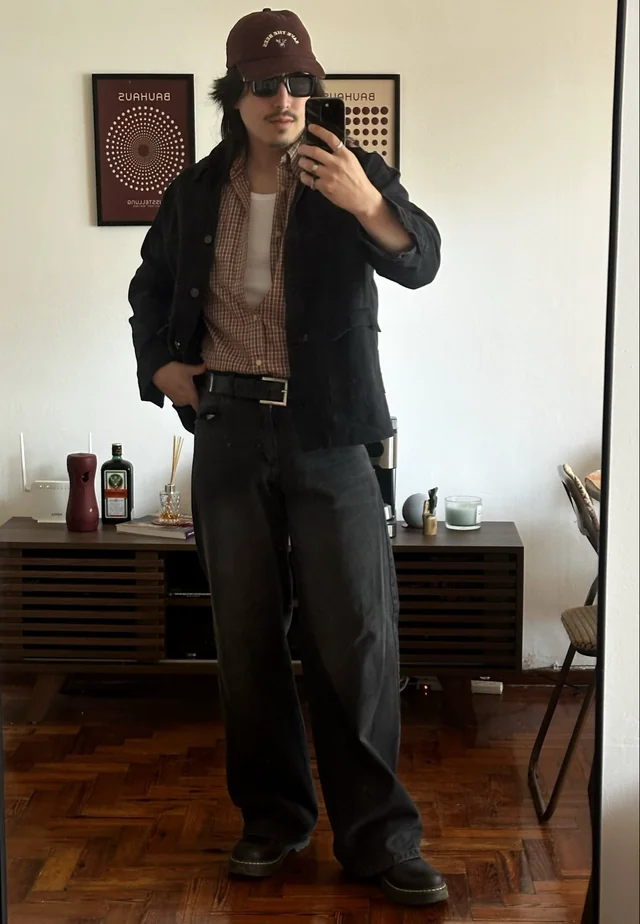
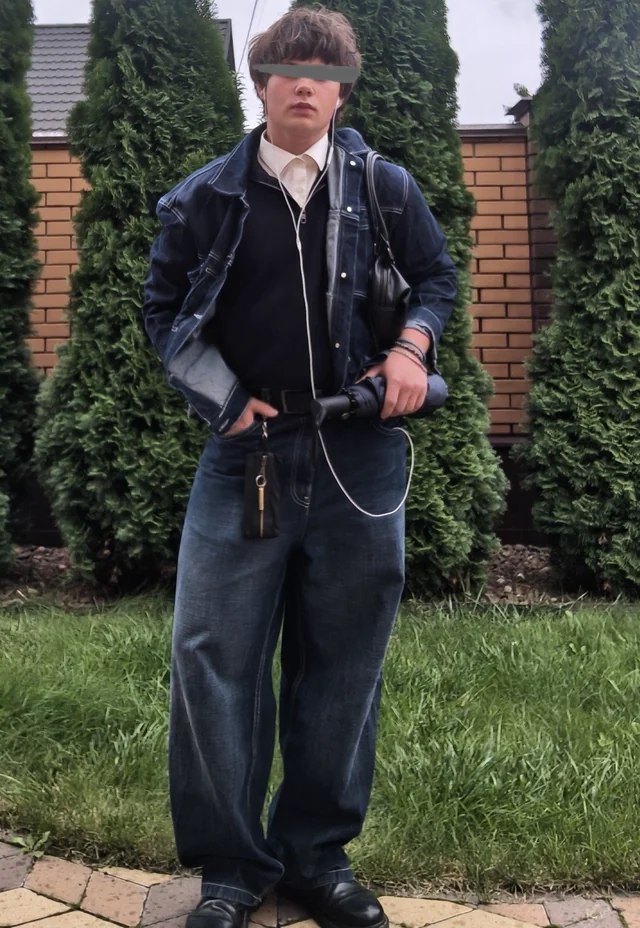
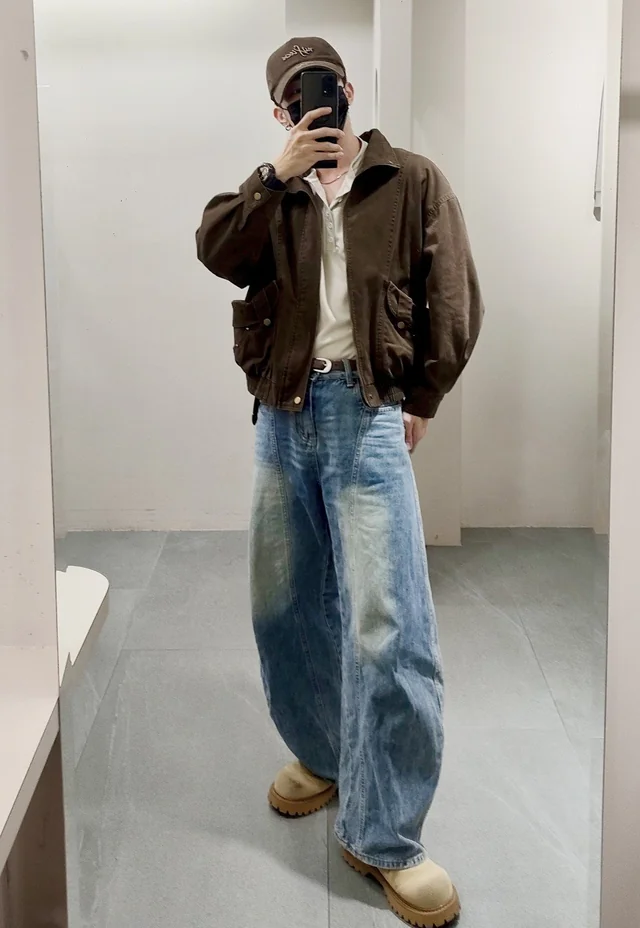
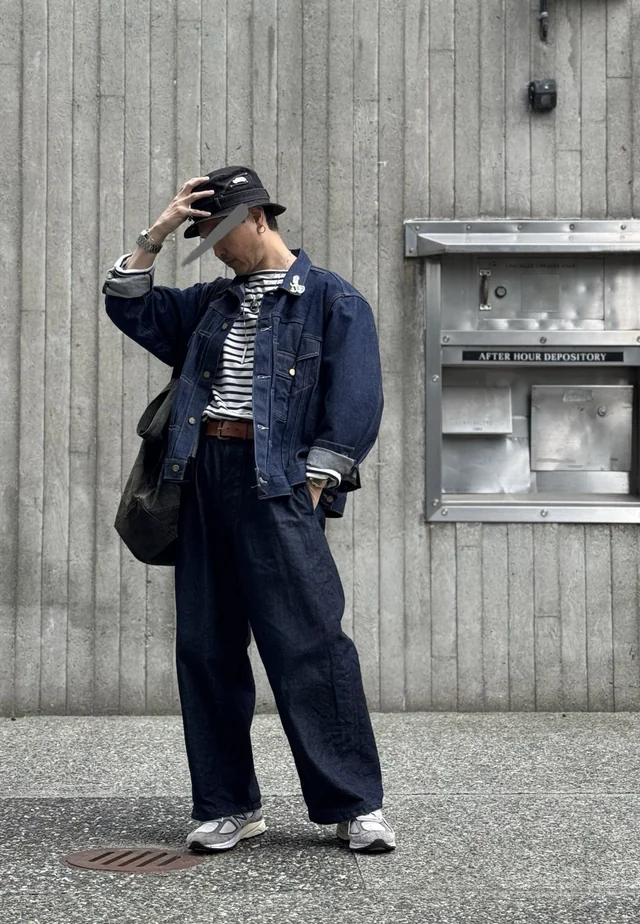
Amekaji silhouette is governed by mid-century American pattern geometry — the proportions, cuts, and fit conventions of American casual clothing from approximately 1940 to 1970 — rather than by contemporary fashion proportions or body-sculpting intent. The characteristic forms are engineering consequences of how garments were patterned during this period, when American workwear and military clothing were designed for movement, durability, and layering rather than for the close-fitting, body-conscious silhouettes that dominated later decades.
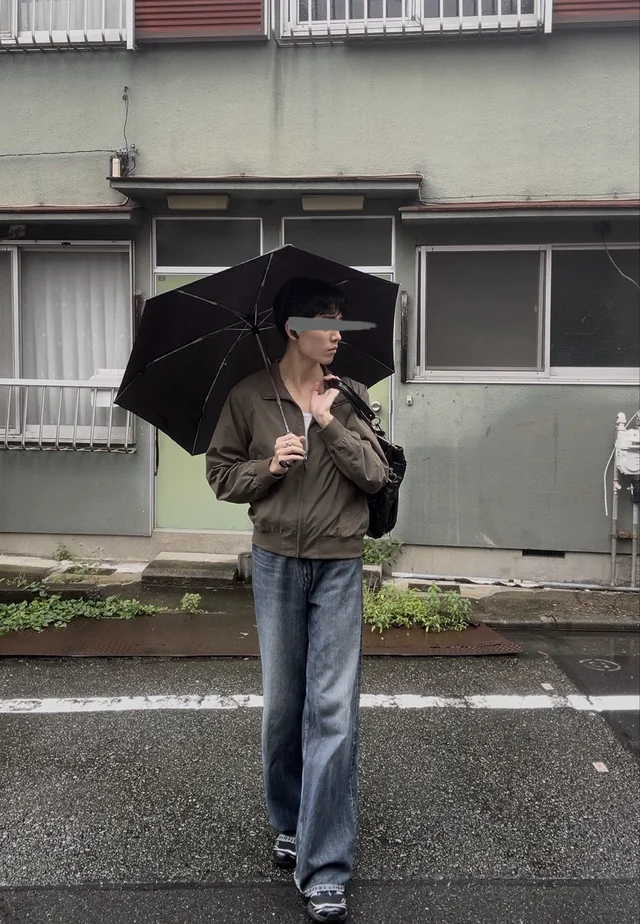
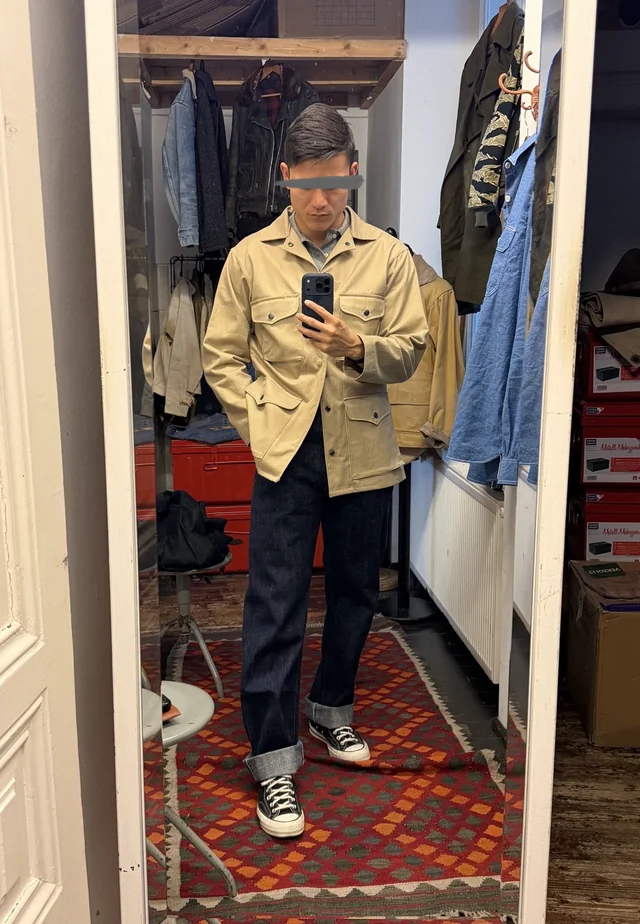
Denim trousers. The defining silhouette reference is the high-rise, straight-leg jean modeled on 1940s-1960s Levi's 501 patterns. The rise (distance from crotch seam to waistband top) sits at or near the natural waist — approximately 11 to 12 inches on a size 32, compared to 9 to 10 inches on contemporary mid-rise jeans — producing a trouser that stays in position during bending, squatting, and physical activity without the waistband gapping and sliding that lower rises produce. The straight leg follows a consistent width from knee to hem (typically 8 to 8.5 inches at the hem opening on a size 32), providing clearance for work boots while creating the distinctive stacking (horizontal compression folds above the boot) that amekaji treats as an aging marker rather than a fit deficiency. Reproduction brands typically offer both unsanforized cuts (requiring the wearer to size up 1 to 2 inches in waist and 2 to 3 inches in inseam to account for shrinkage) and one-wash versions (pre-shrunk through a single hot soak to stabilize dimensions while retaining raw-denim aging potential). The silhouette's authority derives from its historical reference: these proportions are not fashion choices but archaeological recoveries of how American work pants were actually cut before the slim-fit revolution of the 1960s-1970s.
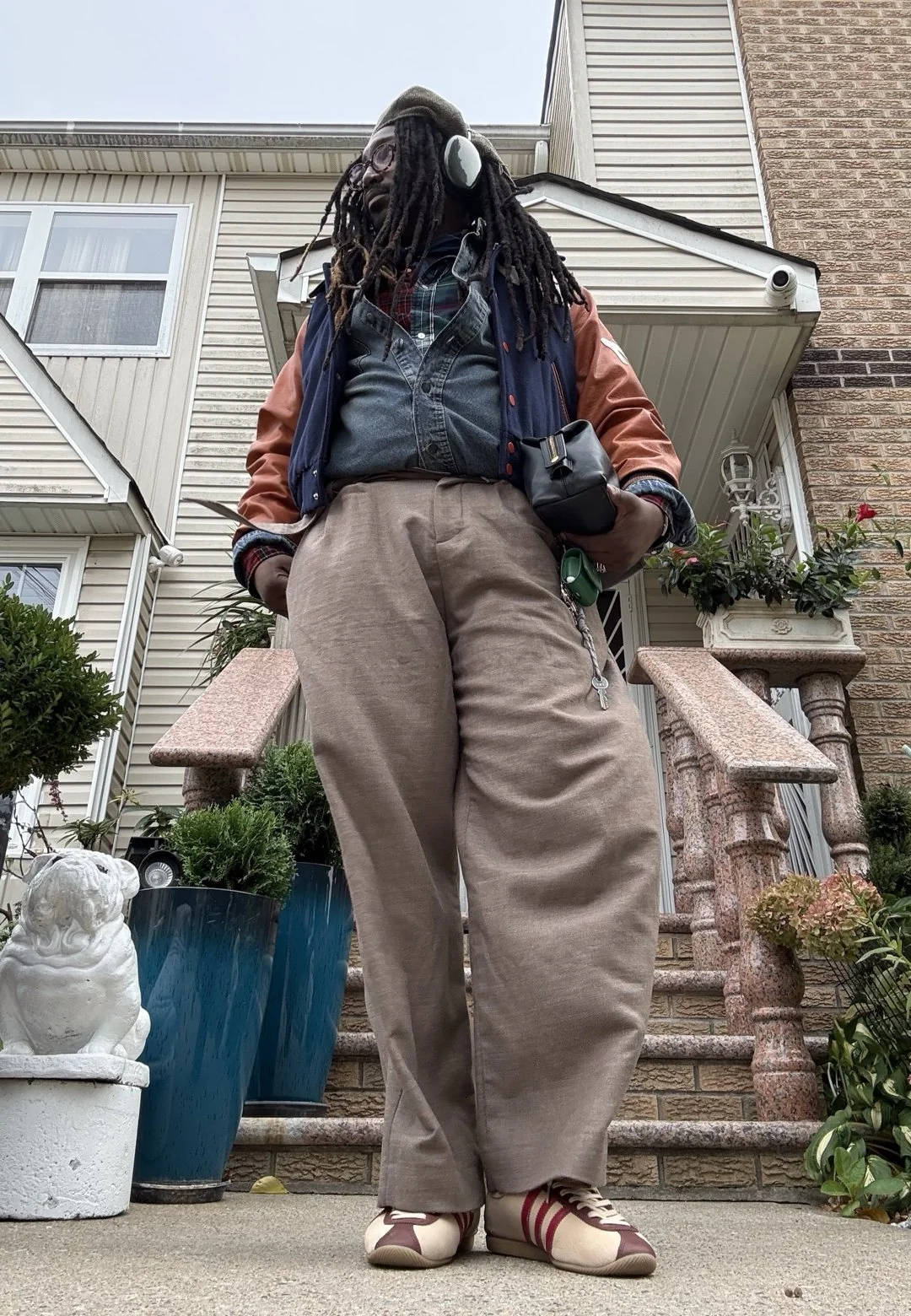
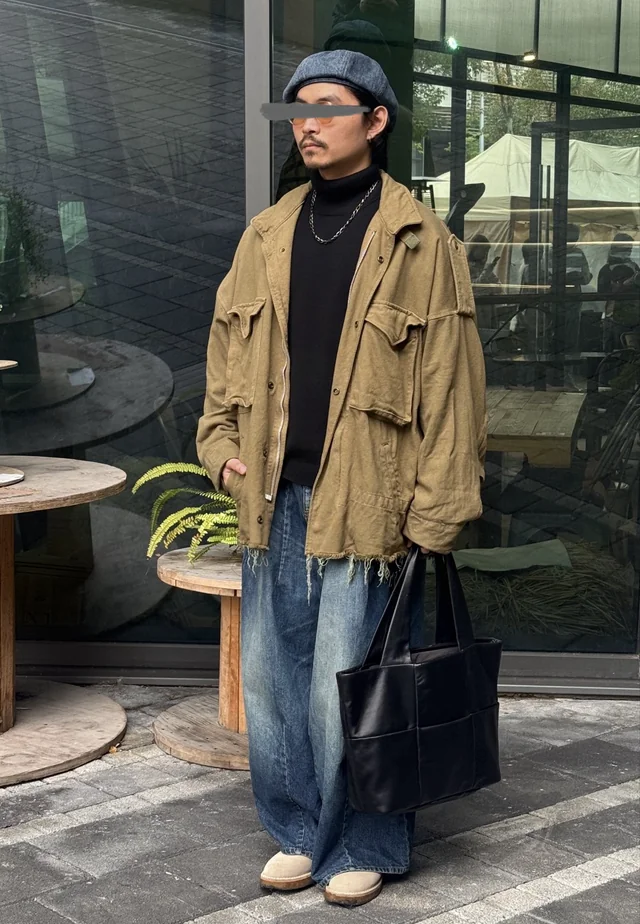
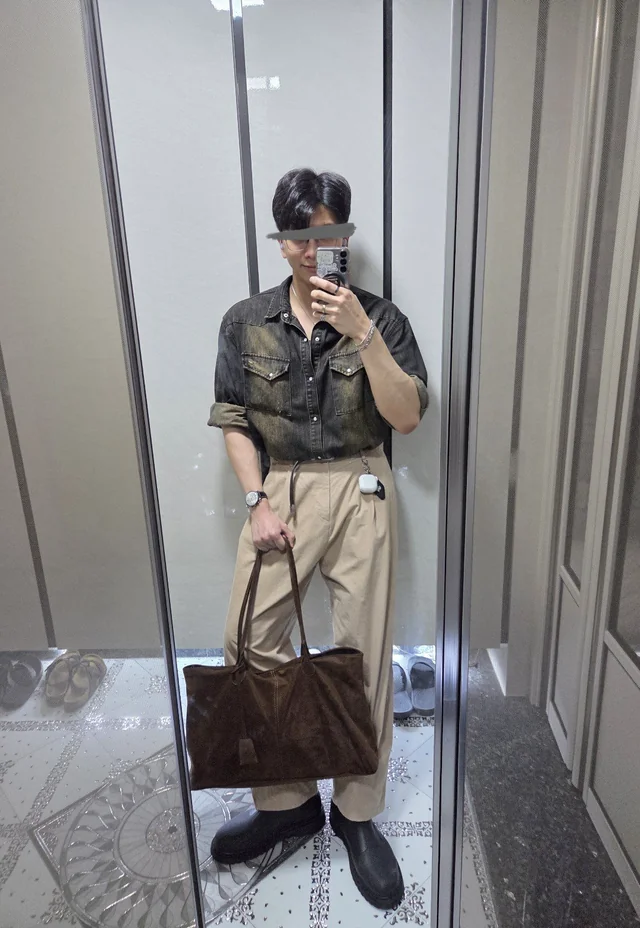
Work shirts and outerwear. Chambray and flannel shirts follow relaxed, boxy patterns with dropped shoulder seams that sit at or slightly past the natural shoulder point, providing clearance for arm movement without binding. The body is cut with minimal waist suppression and a longer hem that stays tucked during bending. Chore coats, coverall jackets, and denim truckers (Type I, II, and III Levi's jacket silhouettes) hit at the natural waist rather than extending to the hip, following mid-century conventions that predated the elongated jacket silhouettes of later decades. Military outerwear — MA-1 bomber jackets, N-1 deck jackets, A-2 flight jackets, M-65 field jackets — maintains the original boxy, functional proportions specified in military contracts: roomy through the chest and shoulders for layering, short enough to avoid interference with equipment or vehicle operation, and cut to accommodate the movements (overhead reaching, crouching, climbing) that military service demanded.
Layering logic. The silhouette accommodates the layering approach central to amekaji styling: a base layer (t-shirt or thermal undershirt), a middle layer (chambray, flannel, or oxford shirt), and an outer layer (denim jacket, chore coat, or military jacket), each cut generously enough to avoid compressing or restricting the layer beneath. This three-layer structure produces the slightly volume-forward profile that distinguishes amekaji from contemporary fitted aesthetics — the body appears comfortably dressed rather than precisely tailored, with enough ease to suggest readiness for physical activity without the architectural excess of oversized fashion.
Materials
Material selection is amekaji's primary authentication mechanism and the domain where the aesthetic's reproduction-fidelity logic is most empirically verifiable. The category's credibility depends on textiles produced through specific historical methods, and the gap between genuine period-method production and visual imitation defines the central quality hierarchy.
Selvedge denim: weave structure and loom technology. Selvedge denim is woven on shuttle looms — machines that pass a shuttle carrying a continuous weft thread back and forth across the warp, producing a finished (self-finished, hence "selvedge") edge along each side of the fabric that prevents unraveling. This finished edge, typically marked with a colored thread (most commonly red, but also green, gold, white, or other colors depending on the mill and era), is visible when jeans are cuffed and functions as the single most recognizable visual marker of amekaji denim. Shuttle looms produce narrow fabric, typically 30 to 34 inches wide, compared to the 60-plus-inch widths that modern projectile and rapier looms produce. This narrow width constrains pattern layout (requiring more fabric per garment), limits production speed, and introduces irregularities in weft tension that produce a characteristic slubby texture — uneven yarn thickness visible as subtle ridges and variations across the fabric surface. These "imperfections" are precisely what amekaji values: they create visual depth, tactile interest, and unpredictable fade behavior that machine-regular projectile-loom denim cannot replicate.
Three primary twill structures govern selvedge denim construction. Right-hand twill (the dominant structure, used by Levi's since the 1850s) produces a diagonal ridge running from lower left to upper right on the fabric face, yielding a relatively smooth surface that fades through clear, high-contrast patterns. Left-hand twill (historically associated with Lee jeans) runs the opposite direction and produces a slightly softer hand feel and more diffuse fading due to the counter-twist relationship between twill direction and yarn twist. Broken twill (developed by Wrangler in the 1960s to reduce leg twist — the tendency of denim pant legs to rotate on the body as the fabric relaxes after washing) alternates twill direction every few rows, producing a flat fabric that resists torque but fades less dramatically than consistent-direction twills. Japanese reproduction brands select twill structure based on the specific historical garment being referenced: a 1947 Levi's 501XX reproduction uses right-hand twill; a Lee 101Z reproduction uses left-hand twill.
Indigo dyeing: chemistry and fade science. The indigo dyeing process determines how denim ages, and amekaji treats this chemistry as a primary quality variable. Rope dyeing — the method used for premium selvedge denim — bundles several hundred warp yarns into a rope, then passes the rope through a sequence of indigo baths (dip boxes), each followed by an oxidation step in which the yarn is exposed to air, allowing the indigo to bond to the cotton fiber's surface through oxidation. The number of dips (typically 6 to 16 in premium production) determines the color depth: fewer dips produce lighter, faster-fading denim; more dips produce deeper, slower-fading denim with more indigo layers to wear through before the white cotton core is exposed. The critical chemical fact is that indigo does not penetrate the cotton fiber's core — it bonds to the surface in concentric rings, like the layers of an onion. When abrasion physically removes outer indigo layers, the lighter layers beneath (and ultimately the white cotton core) are progressively revealed, producing the characteristic fade topography that amekaji documents and celebrates.
This surface-bonding behavior produces the specific fade patterns that constitute denim's visual aging language. Whiskers (diagonal creases radiating from the crotch across the upper thigh) form where the fabric is compressed and folded during sitting, creating friction ridges that lose indigo faster than surrounding flat areas. Honeycombs (diamond-shaped crease patterns behind the knee) form from the fabric's repeated folding during walking and bending, producing a geometric wear pattern unique to each wearer's gait and knee geometry. Train tracks (parallel vertical fade lines along the outseam, where the folded selvedge edge creates a raised ridge) result from the doubled-back selvedge fabric rubbing against itself and against external surfaces. Vertical falling (irregularly spaced vertical fade lines across the thigh and shin) develops as the warp yarns progressively lose surface indigo while the weft remains protected in the fabric's interior. Stacking (horizontal compression folds above the boot, where excess fabric length pools) produces ringed fade bands that record the specific boot height and pant break the wearer habitually maintains.
Sheet dyeing (or slasher dyeing), the alternative industrial method, passes individual yarns flat through a single long dye bath rather than bundling them into ropes. This method is faster and produces more uniform color but yields shallower, less complex indigo penetration and consequently flatter, less dramatic fading. Amekaji discourse treats the rope-dye/sheet-dye distinction as a fundamental quality marker: rope-dyed denim is materially capable of the rich, three-dimensional fading that the aesthetic values; sheet-dyed denim is not.
Unsanforized versus sanforized shrinkage behavior. Sanforization (patented by Sanford Lockwood Cluett in 1930) mechanically pre-shrinks denim by compressing the fabric between a rubber belt and a heated drum, reducing residual shrinkage to less than 1 percent. Sanforized denim fits predictably out of the package and maintains its dimensions through washing. Unsanforized denim (sometimes labeled "shrink-to-fit," following Levi's terminology) retains 5 to 10 percent shrinkage potential in both warp (length) and weft (width) directions, requiring the wearer to size up significantly and accept that the garment will contract to its final dimensions through the first soak and subsequent wear cycles. Amekaji enthusiasts often prefer unsanforized denim because the shrinkage process produces a personalized fit — the fabric contracts around the wearer's specific body geometry, creating a garment that is literally molded to its owner through the interaction of heat, water, and physical use. This participatory engagement with material behavior — the wearer as active collaborator in the garment's formation — is central to amekaji's material philosophy.
Chambray, flannel, and oxford cloth. Chambray is a plain-weave cotton fabric with a dyed warp (typically indigo or blue) and a white weft, producing a soft, heathered appearance that distinguishes it from the twill-weave structure of denim. In amekaji contexts, chambray is evaluated by weight (heavier is generally preferred, 4 to 6 ounces per square yard for shirting), yarn quality (ring-spun cotton produces a smoother, more lustrous yarn than open-end spinning), and color depth. Flannel, in amekaji, refers to heavyweight cotton flannel (not the lightweight poly-blend flannels of contemporary mass-market production) with a dense nap raised through a brushing process that creates a soft, insulating surface. Weight typically runs 5 to 8 ounces; the nap should be substantial enough to blur the underlying weave structure. Oxford cloth — a basket weave in which two warp yarns are interlaced with one or two weft yarns — produces a textured, slightly rough surface that distinguishes it from smoother poplin or broadcloth. The amekaji oxford button-down references the American university shirt (Brooks Brothers' invention, adopted by Ivy League students and subsequently codified by Japanese fashion media) but in a heavier weight and with a more pronounced weave texture than contemporary dress-shirt oxfords.
Leather: tanning science and patina development. Vegetable-tanned leather, the standard for amekaji boots and accessories, undergoes a tanning process in which animal hides are soaked in solutions containing plant-derived tannins (from bark, wood, leaves, or fruit) for weeks to months, allowing the tannin molecules to cross-link with the collagen fibers of the hide and render it resistant to decomposition. This slow process produces leather that is initially stiff and pale but develops a rich patina through oxidation (darkening through exposure to air and sunlight), oil absorption (darkening and softening through contact with skin oils and applied conditioners), and mechanical wear (burnishing at contact points, creasing at flex points). The patina is not cosmetic — it is a chemical and structural transformation of the leather's surface that records the owner's handling and use patterns in the material itself. Horween Leather Company's Chromexcel — a proprietary combination-tanned leather (chrome-tanned for structural stability, then retanned with vegetable agents and hot-stuffed with a mixture of natural oils, waxes, and greases) — has become a prestige leather in the amekaji ecosystem, prized for its pull-up character (oils migrate away from pressure points, creating lighter and darker zones that shift with handling) and rapid patina development.
Shell cordovan — horsehide taken from the fibrous flat muscle (the "shell") beneath the horse's rump — is the most valued leather in amekaji boot culture. Unlike conventional leather, which is composed of interwoven collagen fibers that crease and crack under repeated flexion, shell cordovan consists of densely packed, non-interwoven fibers that bend without creasing, producing a distinctive rolling rather than cracking pattern at flex points. This rolling behavior — visible as smooth, undulating waves rather than sharp crease lines — is the visual marker that shell cordovan enthusiasts identify and prize. The leather is rare (each horse produces only a small section of shell), expensive (shell cordovan boots from Alden, Horween's primary shell customer, retail at $700 to $900), and requires specific maintenance (brushing and occasional conditioning with neutral cream or shell-specific product, avoiding standard shoe polish that can clog the fiber structure).
Failure modes and aging analysis. Denim fails through crotch blowout (inner-thigh abrasion wearing through the fabric, typically after 12 to 24 months of daily wear), warp-thread breakage along high-stress fade lines, and pocket-corner tearing at stress concentration points. Leather fails through grain cracking (loss of surface flexibility through desiccation when conditioning is neglected), sole separation (adhesive or welt-thread degradation), and mold formation (in humid storage without adequate air circulation). Chambray and flannel fail through collar and cuff fraying (abrasion at fold-and-contact points) and button loss (thread degradation at button attachment). These failure modes are not peripheral to amekaji analysis — they are central to how the community evaluates material quality, predicts garment lifespan, and determines whether a garment has been properly maintained. A garment that fails gracefully — accepting repair, developing character through its degradation — embodies amekaji's material logic. A garment that fails abruptly — seam rupture, hardware disintegration, fabric tearing without warning — exposes construction shortcuts.
Color Palette
The palette is constrained by historical reference rather than seasonal trend logic. Indigo, in all its fade stages — from the near-black of freshly dyed, unworn raw denim to the pale, sky-blue of years-worn vintage — constitutes the primary color. Brown, in the range from dark chocolate through tobacco to camel, appears in leather goods, duck canvas, and corduroy. Olive drab and khaki (colors derived from U.S. military specification, the former for combat dress, the latter for service uniforms and tropical wear) provide the military-surplus register. Ecru and natural white (undyed, unbleached cotton) appear in t-shirts, sweatshirts, and canvas accessories. Navy, in both deep and faded states, provides an alternative to indigo in cotton knits and wool outerwear. Black appears in leather boots and occasionally in black selvedge denim, though purists often regard indigo as the "correct" denim color.
This palette's chromatic complexity is generated not through dye selection but through material aging. A single pair of indigo jeans contains dozens of blue tones after six months of wear, ranging from near-white at whisker and honeycomb peaks to deep indigo in protected zones — a chromatic richness that results from the differential removal of indigo layers rather than from deliberate dyeing technique. Brown leather darkens through oxidation and oil absorption, producing a tonal range within a single belt or boot that develops over years of use. Olive drab military cotton fades toward sage green under sun exposure. This temporal color development — color earned through wear rather than selected at purchase — is fundamental to amekaji's visual logic.
Details
Details in amekaji are best understood as historical construction markers — specific manufacturing techniques and hardware choices that identify the era, manufacturer, and production method of the garment being reproduced. Each detail encodes temporal and geographic information that literate participants can decode, making the amekaji garment function as a material-historical document.
Chain-stitch hemming and the Union Special 43200G. Chain-stitch hemming, in which a single thread forms a looped chain on the fabric's underside, was the standard industrial hemming method for denim jeans through the mid-twentieth century, performed on Union Special 43200G machines (and their variants). When denim hems are washed and dried, chain stitch produces a distinctive "roping" effect — the hem twists slightly as the chain-stitch loops contract unevenly, creating an irregular, three-dimensional edge that accumulates indigo in the creases and develops a characteristic blue-white-blue pattern visible on cuffed jeans. This roping effect is one of the most immediately recognizable visual markers of heritage denim construction. Modern lockstitch hems lie flat and produce even, undifferentiated fading. Japanese reproduction brands either maintain vintage Union Special machines (which are no longer manufactured and must be sourced through industrial equipment dealers) or use their Japanese equivalents (such as the Juki MH series modified for chain-stitch hemming) to achieve authentic roping behavior. Chain-stitch hemming services — offered by specialist denim retailers and alteration shops — charge $30 to $60 per hem, reflecting the scarcity of the equipment and the specialized knowledge required to operate it.
Hardware: zippers, rivets, and buttons. Amekaji hardware is evaluated by provenance: reproduction accuracy requires hardware that matches the specifications of the era being referenced. Talon zippers (manufactured by Talon, Inc., originally Universal Fastener Company, from 1893 through bankruptcy in 1997) are the correct hardware for jeans and jackets from the 1930s through the 1970s; their distinctive slider shape and pull-tab design are identifiable by sight. Crown zippers (manufactured by Crown Fastener Corporation) appeared on military garments from the 1930s through the 1960s. Waldes zippers (Waldes Kohinoor, Inc.) served primarily the military and industrial markets. Modern YKK zippers, while mechanically reliable, are period-incorrect for reproduction garments referencing pre-1970s originals, and their use in a "reproduction" garment signals a construction compromise visible to informed observers. Copper rivets — the original Davis-Strauss reinforcement (U.S. Patent 139,121, 1873) — appear exposed on pre-1937 Levi's reproductions and hidden (with the rivet covered by a cap of denim or replaced by a bar tack) on post-1937 reproductions. Button specifications vary by era and manufacturer: donut buttons (two-hole metal buttons with a raised center) are correct for certain periods; laurel-wreath buttons (stamped with a laurel design) for others; and tack buttons (a two-piece riveted button) for denim jean waistbands.
Selvedge cuffing as display practice. Cuffing jeans to expose the selvedge edge is amekaji's most visible sartorial gesture — a deliberate display of the fabric's finished edge that simultaneously proves shuttle-loom provenance and creates a visual accent at the hem. The cuff width (typically 1 to 1.5 inches) and number of folds (single or double) constitute minor styling variables within the community, but the act of cuffing itself performs a communicative function: it transforms an interior construction detail into an exterior quality indicator, visible from several feet away, that identifies the wearer as a participant in selvedge culture.
Cinch-back waistbands and buckle-back construction. Pre-belt-loop jeans (before the 1920s-1930s, depending on the manufacturer) used rear-waist cinch straps — fabric tabs with a buckle that allowed waist adjustment without a belt. Japanese reproduction brands include this detail on reproductions referencing pre-1930s originals, and its presence signals a high level of historical fidelity. The cinch-back has no contemporary functional advantage over belt loops; it exists solely as archaeological recovery — a detail preserved because the original had it, not because the reproduction needs it.
Accessories
Accessory systems extend the same reproduction-fidelity and material-aging logic as garments, forming an integrated mid-century American material-culture kit.
Work boots. Red Wing Heritage models (Iron Ranger No. 8111, Moc Toe No. 875, Beckman, Blacksmith) provide the amekaji footwear foundation: Goodyear-welted construction that permits multiple resolings, full-grain leather that develops pronounced patina, and sole types (Vibram mini-lug, crepe wedge, cork nitrile) that reference specific trade applications. Wesco (founded 1918, Scappoose, Oregon) produces engineer and logger boots from heavyweight leather with stitchdown construction. White's Boots (1853, Spokane, Washington) manufactures smoke jumper and hiker boots with Goodyear-welt or stitchdown construction from top-grade leather. Alden (1884, Middleborough, Massachusetts) provides shell cordovan boots and shoes with Goodyear-welt construction and traditional New England lasts. Japanese boot makers — Clinch (by Brass, Tokyo), Rolling Dub Trio, Wesco collaborations through Beams — extend the reproduction-fidelity approach to footwear, sourcing Horween leather, period-correct hardware, and traditional construction methods.
Leather goods. Belts (heavy harness or bridle leather, 1.5 inches wide, solid brass hardware), wallets (long wallets in vegetable-tanned leather, designed for rear-pocket carry), key fobs, and watch straps constitute the leather-accessory layer. These goods are evaluated through the same patina-development criteria applied to boot leather: they should darken, burnish, and develop character through handling and wear over years, recording their owner's use patterns in the leather's surface.
Vintage watches and eyewear. Mechanical watches — particularly mid-century American military-issue models (Hamilton, Elgin, Bulova), vintage Omega, and Japanese-produced Seiko models from the 1960s-1970s — complete the temporal reference system. Eyewear follows similar vintage logic: acetate frames in classic shapes (American Optical, Shuron, vintage Ray-Ban Wayfarer and Clubmaster) rather than contemporary titanium or minimalist designs.
Bandanas, caps, and incidentals. Cotton bandanas (paisley print, selvedge-edged, natural-dye options), mechanic's caps, military-style watch caps, and canvas tote bags constitute the utilitarian-accessory layer that completes the amekaji wardrobe system.
Body Logic
Amekaji conceptualizes the body as a substrate for material aging rather than as a display surface for fashion composition. The dressed body's function is to provide the friction, heat, moisture, and movement patterns that transform raw materials into aged artifacts — the wearer is not the audience for the garment but the instrument of its development. This is a distinctive body logic: the body matters not for how it looks in the garment but for what it does to the garment over time.
Gender coding in amekaji is overwhelmingly masculine, rooted in the mid-century American working-class and military contexts that the aesthetic references. The silhouettes, proportions, and garment categories are historically male — work jeans, flight jackets, engineer boots, chore coats — and the reproduction-fidelity project preserves this gendering rather than challenging it. Women participate in amekaji culture but typically through the same garments rather than through gender-differentiated versions, making the aesthetic a resource for cross-gender dressing more by default than by design. The community's evaluative criteria — construction knowledge, fade documentation, material literacy — are not gendered, but the garment archive being reproduced and the cultural references being cited are heavily male-coded.
The paradox at the center of amekaji body logic is cultural-geographic rather than gendered: "authentic" American working-class and military identity is performed most convincingly by Japanese wearers who have never experienced American labor or military service. This paradox is not a critique — it is a structural observation about how the aesthetic operates. The amekaji body in Japan reads as culturally literate and materially disciplined; the same body in America might read as vintage enthusiast or workwear revivalist. The garments are identical; the social legibility shifts entirely with geographic context.
Embodied use remains amekaji's ultimate evaluative criterion. A pair of raw denim jeans that develops fades from twelve months of daily wear communicates different information than a pair that has been pre-distressed or faded through artificial abrasion — even when the visual result is similar. The community can usually detect the difference: lived fades have irregular patterns that correspond to natural body mechanics; manufactured fades have regular, repeated patterns that correspond to machine motions. This distinction — between aging earned through embodiment and aging simulated through production — is the body-logic equivalent of the material distinction between shuttle-loom and projectile-loom denim.
Garment Logic
Amekaji construction begins with archaeological research rather than with trend silhouette or seasonal design briefs. The design process is reverse-engineering: a vintage specimen is acquired, studied, documented, disassembled, analyzed for materials and methods, and then reconstructed using sourced or commissioned period-equivalent materials. This process is closer to historical conservation than to fashion design, and it produces garments whose quality criteria are fidelity and accuracy rather than novelty and innovation.
Loom sourcing and fabric production. Japanese selvedge denim mills — Kuroki Mills (Okayama), Kaihara (Hiroshima), Nihon Menpu (Okayama), Collect Mills (Okayama), and smaller operations like Shinya in Ibara — operate reconditioned shuttle looms to produce fabrics specified by the brands they supply. A brand like The Flat Head may specify yarn type (long-staple Zimbabwe cotton or American Supima), spinning method (ring-spun for slub character versus compact-spun for smoothness), yarn count and twist direction, warp density (number of yarns per inch), indigo dipping count, and finishing treatment. The resulting fabric is not a commodity product but a custom textile engineered to produce specific aging behavior under wear — a material whose performance characteristics are designed, not merely selected.
Construction sequence and period accuracy. Reproduction garments are constructed following period-appropriate methods. A 1947 Levi's 501XX reproduction by Warehouse & Co. might use: unsanforized 14-ounce selvedge denim woven on Toyoda GL-3 shuttle looms; hidden rivets (copper rivet beneath a fabric cap) at pocket stress points; a single-needle chain-stitch waistband attachment; a leather patch (vegetable-tanned, to develop patina and shrinkage over time, rather than the paper or synthetic patches that Levi's adopted in later decades); a red-line selvedge in the outseam; a watch pocket with bar-tack reinforcement; and a Union Special chain-stitch hem. Each specification references the construction logic of the 1947 original — not because these methods are superior to modern alternatives in absolute terms, but because fidelity to the original is the governing design principle.
Aftercare and maintenance. Raw selvedge denim in the amekaji system requires specific care protocols to preserve fade-development potential. The standard community recommendation is 6 to 12 months of daily wear before the first wash, allowing body movement, friction, and compression to establish crease patterns that will become permanent fade markers. Initial soaking of unsanforized denim (in lukewarm water for 30 to 60 minutes, agitating periodically) removes starch sizing and initiates shrinkage. Subsequent washes should be infrequent (every 3 to 6 months for fade-focused wearers), cold or lukewarm, inside-out, with minimal detergent (or specialized denim wash that preserves indigo). Hang drying preserves dimensional stability; machine drying accelerates shrinkage and can distort fade patterns. Freezing jeans to control odor — a widely circulated folk remedy — has been empirically debunked (bacteria survive freezing temperatures and resume metabolic activity upon thawing) but persists as community folklore. Leather boots require conditioning (with leather cream, oil, or specific products like Lexol, Bick 4, or Venetian Shoe Cream) every 2 to 4 weeks during heavy wear to maintain grain flexibility and prevent cracking. Cedar shoe trees, inserted after each wear, absorb moisture and maintain shape.
Failure timeline. A mid-weight raw denim jean (14 ounces) under daily wear will typically develop visible whisker and honeycomb fading by 3 to 4 months, fabric softening and full-body fade development by 6 to 9 months, inner-thigh thinning and potential crotch blowout by 12 to 24 months, and eventual warp-thread breakage along high-stress fade lines by 24 to 36 months. Each failure stage is repairable: darning, sashiko-style reinforcement, and patch application extend garment life while adding visible repair history that the amekaji community values as evidence of commitment. Leather boots, with proper conditioning and periodic resoling (Goodyear-welted construction permits 3 to 5 resolings), can provide 10 to 20 years of service — a lifespan that justifies the $300 to $900 investment at the point of purchase and converts the boot from consumer product into long-term material companion.
Motifs / Themes
Amekaji does not deploy motifs in a decorative sense. Its thematic structure operates through preservation, fidelity, aging, and material knowledge as organizing principles rather than through surface ornament.
Preservation as reverence constitutes the dominant theme: Japanese manufacturers and enthusiasts safeguard American material culture that America itself has abandoned — maintaining the shuttle looms, dyeing methods, construction techniques, and hardware specifications that American industry discarded in pursuit of production efficiency. This preservation is not nostalgic sentiment but active material practice: it requires ongoing investment in obsolete equipment, specialized knowledge, and labor-intensive production methods that modern manufacturing has rendered economically irrational.
Aging as authentication provides the second organizing theme. In amekaji, a garment's value increases with wear rather than decreasing — the opposite of the depreciation logic that governs most fashion consumption. A well-worn, carefully maintained pair of raw denim jeans is worth more (culturally, if not always financially) than an unworn pair, because the wear patterns constitute evidence of commitment, knowledge, and embodied engagement with the material. This temporal value-creation distinguishes amekaji from fashion systems where newness equals value.
The kodawari motif — the Japanese concept of uncompromising dedication to a specific craft or pursuit, sometimes translated as "obsessive perfectionism" but more accurately understood as methodical devotion to getting every detail right — provides the aesthetic's philosophical foundation. Kodawari is not neurotic perfectionism; it is the disciplined attention to quality that emerges when a practitioner cares enough about a subject to refuse compromise. In amekaji, kodawari justifies the reproduction project's apparent excess: why reverse-engineer a zipper? why commission custom-spun cotton? why maintain a machine that has been out of production for decades? Because the details matter, and compromising any of them compromises the whole.
Cultural Touchstones
Editorial foundations. Popeye (Magazine House, 1976-present) established the editorial methodology that amekaji discourse still follows: systematic documentation of American casual culture through photography, specification charts, brand genealogies, and styling guides. Lightning (ei Publishing, 1994-present) focused specifically on American vintage culture with issues dedicated to single garment types (denim jackets, flight jackets, work boots), individual brands, or specific eras. Clutch provided a lifestyle-magazine framework for heritage Americana. Free & Easy (1997-2016) covered American traditional and casual dress with a sophistication that no American publication matched. Take Ivy (1965) and Made in U.S.A. (1975) remain foundational reference texts whose influence extends far beyond their original publication context.
Film and media. James Dean (Rebel Without a Cause, 1955), Marlon Brando (The Wild One, 1953), and Steve McQueen (across The Great Escape, Bullitt, Le Mans, and other films of the 1960s-1970s) constitute the cinematic trinity of amekaji masculinity. Each actor-role projected a version of American casual identity through specific garments: Dean's red windbreaker and jeans encoded youthful rebellion; Brando's Perfecto and engineer boots encoded dangerous physicality; McQueen's chambray shirts, khakis, and Harrington jackets encoded competent nonchalance. These images were consumed in Japan with an intensity and analytical precision that exceeded their reception in their country of origin, becoming primary source documents for an aesthetic project that would take decades to fully elaborate.
Scholarship. W. David Marx's Ametora: How Japan Saved American Style (2015) remains the definitive English-language analysis of Japan's adoption and transformation of American fashion, providing the historical, sociological, and cultural framework within which amekaji is most productively understood. Kiyoshi Moriguchi and others writing in Japanese have contributed extensive material-culture scholarship on specific garment types, brands, and production methods, though much of this work remains untranslated.
Online and contemporary. Heddels (founded 2011) has become the primary English-language editorial platform for denim and heritage-clothing analysis, providing brand profiles, comparative reviews, fade contests, and construction analyses that transmit amekaji expertise to global audiences. The r/rawdenim subreddit sustains an active community for fade documentation, fit advice, and brand evaluation.
See Also
- Workwear: Adjacent category sharing materials and construction methods but governed by occupational-performance rather than reproduction-fidelity logic
- Ametora / Ivy / Trad: The broader umbrella of Japanese adoption of American dress, encompassing both preppy and casual registers
- Raw denim culture: Specialized material-enthusiasm community organized around denim aging as empirical project, overlapping with but not identical to amekaji
- Vintage collecting: Acquisition of original historical specimens, where amekaji produces new garments engineered to replicate originals
- Military surplus fashion: Overlapping garment categories (flight jackets, field jackets, deck jackets) with shared construction logic
- Wabi-sabi: Shared valuation of aging, imperfection, and visible wear as aesthetic virtue, though wabi-sabi's philosophical framework differs from amekaji's archival approach
- Heritage revival: Contemporary American and European movement influenced by Japanese reproduction methods
- Gorpcore: Parallel migration narrative (outdoor to urban) with analogous authenticity debates
Brands and Designers
Reproduction Specialists:
- The Real McCoy's (1988, Hitoshi Tsujimoto, Kobe): military and workwear reproductions to museum-grade fidelity, period-correct leather, hardware, and construction methods
- Buzz Rickson's (1993, Toyo Enterprise, Tokyo): military flight jacket reproductions with archaeological precision, period-correct materials and manufacturing sequences
- Warehouse & Co. (1995, Shigeru Uchida, Osaka): vintage Levi's and workwear reproductions with period-specific selvedge denim, hardware, and construction
- Sugar Cane (Toyo Enterprise): workwear reproductions using period-appropriate fabrics including cane-sugar-fiber blends and vintage-specification hardware
- Mister Freedom (2003, Christophe Loiron, Los Angeles): Americana reproduction and original designs informed by vintage manufacturing methods
Denim Houses:
- Studio D'Artisan (1979, Osaka): among the first Japanese selvedge denim producers, pioneering shuttle-loom denim weaving in the Okayama-Hiroshima region
- Evisu (1991, Hidehiko Yamane, Osaka): hand-painted seagull logo, early Osaka Five member, helped establish Japanese selvedge as global category
- Fullcount (1992, Mikiharu Tsujita, Osaka): ring-spun, unsanforized selvedge denim from Zimbabwe cotton, slow-fade philosophy
- Denime (1988, Osaka): early Japanese selvedge producer, part of the original Osaka Five, vintage Levi's reproduction focus
- The Flat Head (1996, Takeshi Ooe, Nagoya): heavyweight selvedge denim (up to 20 oz), proprietary weave designs optimized for high-contrast fading
- Samurai Jeans (1997, Osaka): ultra-heavyweight selvedge denim (up to 25 oz), extreme-weight specialists
- Iron Heart (2003, Haraki Mihara, Goshu): heavyweight selvedge denim (21 oz flagship), known for fade intensity and durability engineering
- Pure Blue Japan (2001, Okayama): slubby, textured selvedge denim with pronounced irregular character
- Kapital (1984, Toshikiyo Hirata, Okayama): workwear and denim foundation with avant-garde interpretation, boro-inspired repair and indigo patchwork
- OrSlow (2005, Ichiro Nakatsu, Tokyo): relaxed-fit workwear reproductions inspired by vintage American civilian and military garments
Retail Curators:
- Beams (1976, Yo Shitara, Shinjuku): pioneering select shop that curated and popularized American casual clothing for Japanese audiences, multiple sub-labels (Beams Plus for heritage Americana)
- United Arrows (1989, Osamu Shigematsu, Tokyo): multi-brand select shop with heritage and contemporary American lines
- Journal Standard (1997, Baycrews, Tokyo): lifestyle retailer with strong Americana curation and original-brand heritage lines
- Ships (1977, Ueno, Tokyo): select shop with Ivy and American casual foundations
Heritage Americana (American brands influenced by Japanese methods):
- 3sixteen (2008, Andrew Chen and Johan Lam, New York): selvedge denim and garment-dyed basics using Japanese fabrics
- Raleigh Denim (2007, Victor and Sarah Lytvinenko, North Carolina): American-made selvedge denim, small-batch production
- Left Field NYC (2003, Christian McCann, New York): selvedge denim and vintage-inspired sportswear using Japanese and American fabrics
- Imogene + Willie (2009, Matt and Carrie Eddmenson, Nashville): heritage denim and workwear with Southern Americana inflection
- RRL (1993, Ralph Lauren): American heritage reproductions at luxury positioning, vintage-sourced design references
Boot Makers:
- Red Wing Heritage (1905, Red Wing, Minnesota): Goodyear-welted work boots (Iron Ranger, Moc Toe, Blacksmith), full-grain leather, resoleable construction
- Wesco (1918, Scappoose, Oregon): engineer and logger boots, heavyweight leather, stitchdown construction
- White's Boots (1853, Spokane, Washington): smoke jumper and hiker boots, traditional American construction
- Alden (1884, Middleborough, Massachusetts): shell cordovan and calfskin boots/shoes, Goodyear-welt construction, traditional New England lasts
- Viberg (1931, Victoria, British Columbia): service boots using Horween leathers, stitchdown and Goodyear-welt construction
Citations
[1] Marx, W. David. Ametora: How Japan Saved American Style. Basic Books, 2015. [2] Hayashida, Teruyoshi, et al. Take Ivy. PowerHouse Books, 2010. [Originally published 1965.] [3] Made in U.S.A. Heibonsha, 1975. Reprinted by Popeye/Magazine House, 2019. [4] Sullivan, James. Jeans: A Cultural History of an American Icon. Gotham Books, 2006. [5] Miller, Daniel, and Sophie Woodward. Blue Jeans: The Art of the Ordinary. University of California Press, 2012. [6] Downey, Lynn. Levi Strauss: The Man Who Gave Blue Jeans to the World. University of Massachusetts Press, 2016. [7] Torimaru, Tomoo. Denim: An American Story. Schiffer Publishing, 2016. [8] Keet, Philomena. The Tokyo Look Book. Kodansha International, 2007. [9] Kawamura, Yuniya. Fashion-ology: An Introduction to Fashion Studies. 2nd ed., Bloomsbury Academic, 2018. [10] Entwistle, Joanne. The Fashioned Body: Fashion, Dress and Social Theory. 2nd ed., Polity, 2015. [11] Breward, Christopher. Fashion. Oxford University Press, 2003. [12] Wilson, Elizabeth. Adorned in Dreams: Fashion and Modernity. Revised ed., Rutgers University Press, 2003. [13] Crane, Diana. Fashion and Its Social Agendas: Class, Gender, and Identity in Clothing. University of Chicago Press, 2000. [14] Lipovetsky, Gilles. The Empire of Fashion: Dressing Modern Democracy. Princeton University Press, 1994. [15] Bourdieu, Pierre. Distinction: A Social Critique of the Judgement of Taste. Translated by Richard Nice, Harvard University Press, 1984. [16] Hebdige, Dick. Subculture: The Meaning of Style. Routledge, 1979. [17] Barthes, Roland. The Fashion System. Translated by Matthew Ward and Richard Howard, University of California Press, 1983. [18] Simmel, Georg. "Fashion" (1904). In Simmel on Culture: Selected Writings, edited by David Frisby and Mike Featherstone, SAGE, 1997. [19] Hatch, Kathryn L. Textile Science. West Publishing, 1993. [20] Kadolph, Sara J., and Sara B. Marcketti. Textiles. 12th ed., Pearson, 2016. [21] Tortora, Phyllis G., and Sara B. Marcketti. Survey of Historic Costume. 6th ed., Fairchild Books, 2015. [22] Comstock, Sandra Curtis. "The Making of an American Icon: The Transformation of Blue Jeans during the Great Depression." In Global Denim, edited by Daniel Miller and Sophie Woodward, Berg, 2011. [23] Fletcher, Kate. Sustainable Fashion and Textiles: Design Journeys. 2nd ed., Earthscan, 2013. [24] Rivoli, Pietra. The Travels of a T-Shirt in the Global Economy. 2nd ed., Wiley, 2014. [25] U.S. Patent No. 139,121. "Improvement in Fastening Pocket-Openings." Jacob W. Davis and Levi Strauss, May 20, 1873. [26] Cluett, Sanford L. U.S. Patent No. 1,861,422. "Process for Treating Fabrics." 1932. [Sanforization patent.] [27] Levi Strauss & Co. "The Invention of the Blue Jean." https://www.levistrauss.com/levis-history/ [28] Horween Leather Company. "Our Leathers." https://www.horween.com/ [29] Heddels. "Denim Encyclopaedia." https://www.heddels.com/dictionary/ [30] Red Wing Heritage. "Our Legacy." https://www.redwingheritage.com/our-legacy/ [31] Lightning magazine archives (ei Publishing, 1994-present). Japanese publication dedicated to American vintage culture. [32] Clutch magazine archives. Japanese publication focused on heritage Americana lifestyle. [33] Free & Easy magazine archives (1997-2016). Japanese menswear publication covering American traditional and casual dress. [34] Japan Today. "'Ametora': How American Style Changed Japanese Fashion Forever." https://japantoday.com/category/features/lifestyle/'ametora'-how-american-style-changed-japanese-fashion-forever [35] Grailed. "What Is Japanese Americana?" October 10, 2024. https://www.grailed.com/drycleanonly/what-is-japanese-americana [36] Fussell, Paul. Class: A Guide Through the American Status System. Summit Books, 1983. [37] Veblen, Thorstein. The Theory of the Leisure Class. Macmillan, 1899.