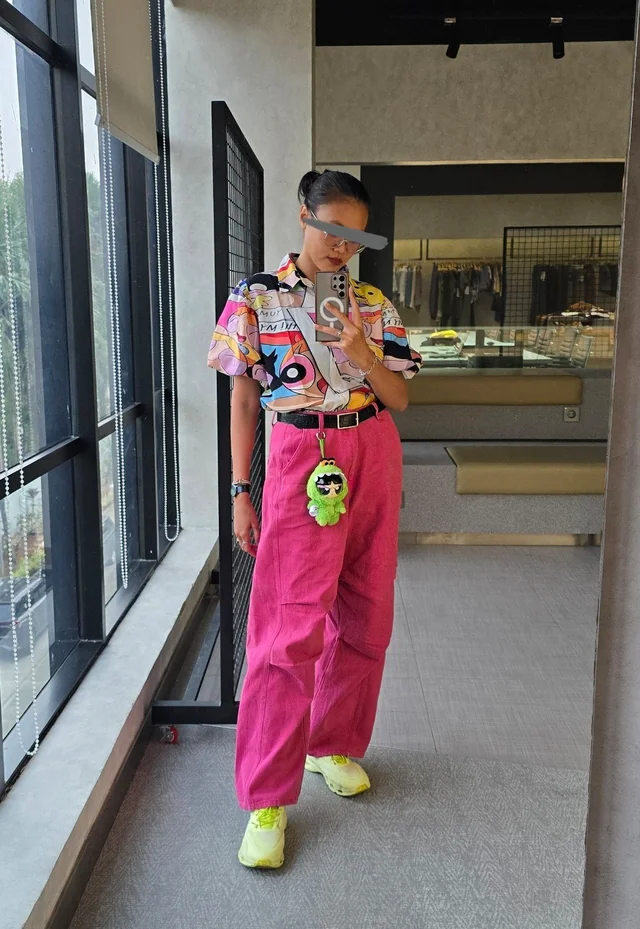
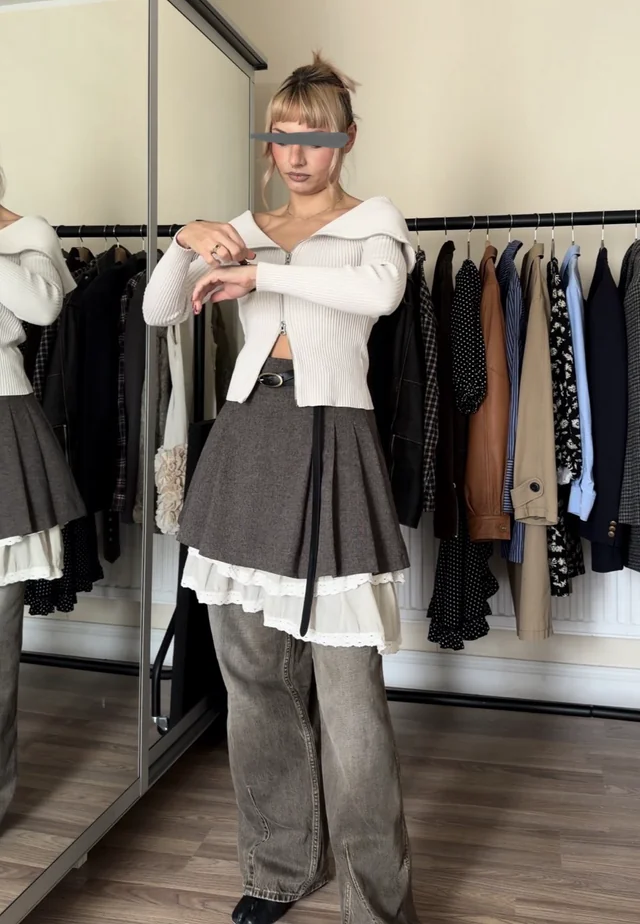
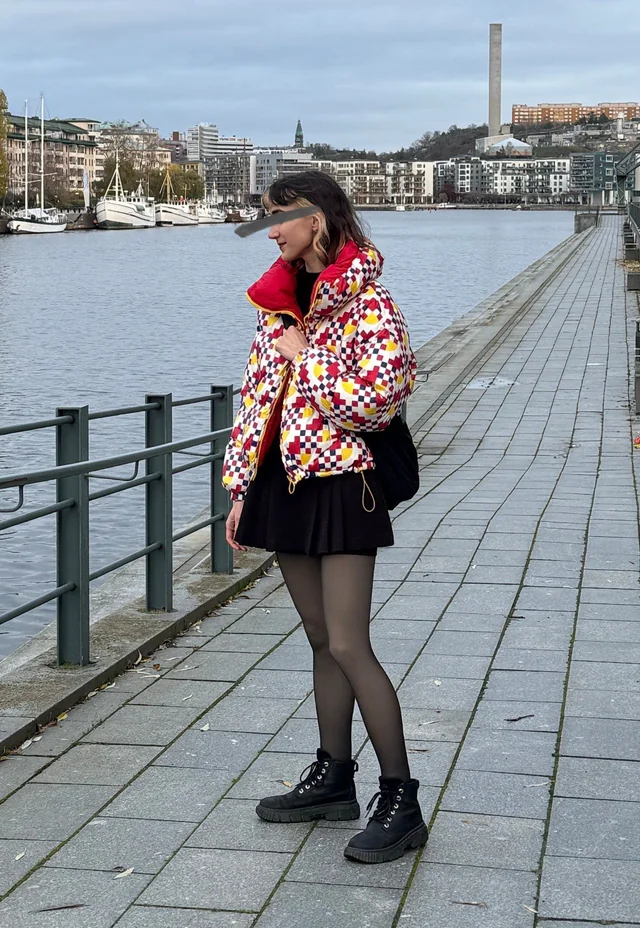
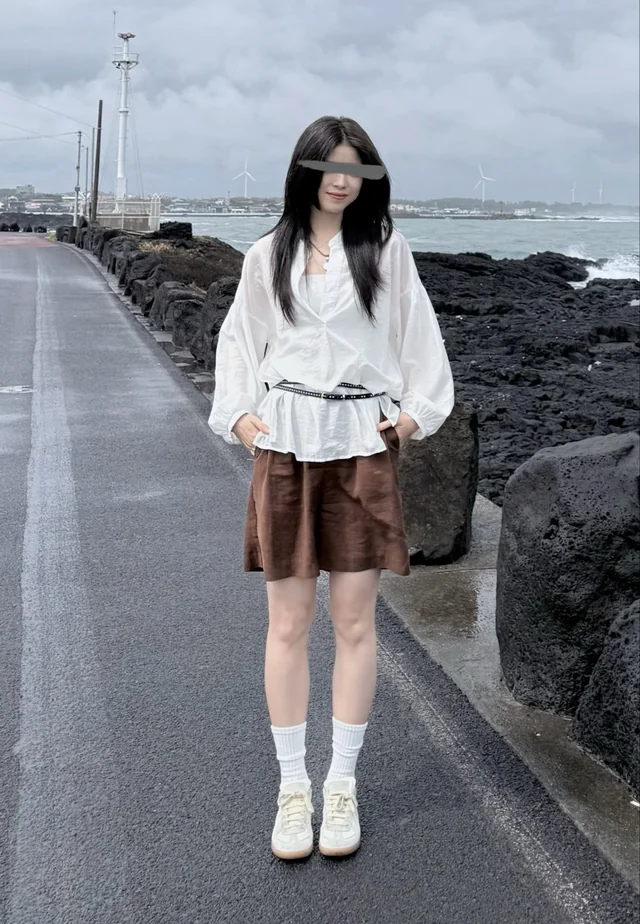
Acubi
Summary. Acubi is a platform-mediated casual layering system in which Korean knit and denim basics — rib-knit cardigans, interlock-jersey tees, cotton-blend vests, straight-leg and wide-leg denim in controlled washes — are assembled into multi-piece outfits governed by a contrast-stacking logic: fitted garments are paired against relaxed garments, sheer layers against opaque layers, and cropped hemlines against elongated hemlines within a muted neutral palette, producing an appearance of spontaneous assembly that in practice requires precise knowledge of proportion engineering, fabric-weight sequencing, and platform-legible styling conventions. The aesthetic is governed by a curated-effortlessness regime: each outfit must read as unconstructed and casually thrown together while demonstrating command of the layering grammar — cardigan-over-tee drape ratios, vest-over-shirt collar emergence, denim-wash calibration against knitwear tone — that makes the look reproducible and recognizable across Seoul street-snap, Musinsa product grid, and TikTok styling tutorial simultaneously. Unlike adjacent minimalist systems that reduce the wardrobe to single-layer austerity (normcore, quiet luxury) or maximalist systems that accumulate decorative complexity (Y2K, coquette), acubi operates through modular recombination — a relatively small inventory of interchangeable basics whose styling value emerges from combination logic rather than from individual garment distinction.
In Material Terms
Acubi's coherence depends on the knit-construction science of casual layering basics and the denim engineering of Korean-market trouser silhouettes. Rib-knit cardigans — typically 1x1 or 2x2 rib in cotton-polyester or cotton-nylon blends at 180-280 g/m², knit on circular or flat-bed machines at 12-14 gauge — constitute the system's primary layering instrument, requiring sufficient recovery (the ability to return to original dimensions after stretch, measured as percentage of elongation retained after release) to maintain clean closure lines when worn open and adequate drape to fall without rigidity when unbuttoned over a fitted base layer. Interlock jersey (a double-knit construction in which two rib-knit fabrics are interlocked face-to-face, producing a smooth, stable textile at 160-220 g/m²) provides the fitted tee and long-sleeve base layers whose body-mapping opacity and weight determine how effectively the layering stack reads as intentional contrast rather than accidental bulk. Cotton-blend composition is the critical variable: 100% cotton jersey pills rapidly at layering-friction zones (underarm, waist overlap, cardigan-tee contact surfaces) and loses dimensional stability after 15-20 wash cycles, while cotton-polyester blends (typically 60/40 or 70/30) retain shape and resist pilling but sacrifice the matte hand and moisture absorption that make cotton appropriate for skin-contact layering. Cotton-nylon blends (80/20 or 90/10) offer a middle path — nylon's abrasion resistance and recovery properties extend garment life while preserving cotton's breathability and surface texture — and are increasingly favored by Korean mid-tier brands for layering basics. When these material systems function correctly, each layer maintains its own silhouette integrity within the stack: the cardigan drapes without collapsing, the tee lies smooth without riding, the vest holds its armhole line without bunching. When materials are substituted with low-gauge acrylic knits, tissue-weight single-jersey tees, or rigid non-stretch denim, the layering logic fails — garments bunch, shift, and lose the proportion relationships that produce acubi's characteristic controlled nonchalance.
At Category Level
Acubi occupies a specific position within a constellation of adjacent Korean and global casual aesthetics. It is narrower than "Korean minimalism" (han-guk mi-ni-meol-li-jeum, a broad stylistic descriptor encompassing everything from Seoul corporate dress to clean-line designerwear), which does not specify the layering-system mechanics or knit-construction vocabulary that define acubi's operational grammar. It is distinct from K-pop idol styling, which shares acubi's Korean origin and some garment categories but operates through costume-design logic — garments selected for stage impact, brand partnership, and choreographic accommodation — rather than through the modular-casual logic of everyday layering. It overlaps with but is not reducible to Y2K revival, which foregrounds early-2000s silhouettes (low-rise, baby tee, platform shoe) as nostalgic citation, whereas acubi selectively incorporates Y2K proportions into a broader system governed by Korean proportion sensibility and neutral-palette restraint. And it differs from normcore, which cultivates unremarkability as its primary aesthetic value, whereas acubi cultivates the appearance of unremarkability while depending on visible styling competence — the difference between genuine indifference and performed indifference. This positional specificity matters because acubi's evaluative criteria — layering coherence, proportion contrast, knit-and-denim calibration, platform legibility — are not interchangeable with the criteria governing adjacent categories, and collapsing the distinction obscures the specific material literacy and platform infrastructure that sustain the aesthetic.
Methodologically
This entry treats acubi as a platform-era modular-layering system: garments are analyzed by their knit-construction properties, denim-engineering specifications, layering-interaction mechanics, and the Korean retail-platform ecosystems (Musinsa, W Concept, 29CM, Dongdaemun supply chains) through which the aesthetic was codified, disseminated, algorithmically amplified, and commercially reproduced across Korean and transnational markets.
Word (Etymology)
"Acubi" derives from Acubi Club (아쿠비클럽), a Seoul-based fashion label launched in 2020 whose name carries no direct Korean-language meaning — it is a fabricated brand coinage, phonetically playful and intentionally opaque, following a pattern common in Korean indie fashion branding where evocative sound is prioritized over semantic content (comparable to brand names like Mardi Mercredi, Marithe Francois Girbaud Korea, or Ader Error, where the name's foreignness or abstraction signals cosmopolitan positioning rather than communicating specific meaning). The brand produced casual knitwear and basics in muted palettes — cropped cardigans, ribbed tees, relaxed trousers — that crystallized a styling approach already latent in Korean youth fashion: neutral-toned layering with proportion contrast and Y2K-adjacent silhouettes.
The term's migration from brand name to aesthetic category occurred through platform-mediated semantic expansion. As TikTok users, Instagram stylists, and Pinterest curators began tagging outfits that resembled Acubi Club's styling logic — but were assembled from other brands entirely — with #AcubiStyle, #AcubiFashion, and #AcubiAesthetic, the brand name underwent genericization: "acubi" ceased to denote the specific label and began denoting the broader styling grammar the label exemplified. This trajectory — brand name becoming aesthetic category through platform tagging — parallels earlier fashion-language developments (Burberry becoming shorthand for a check pattern, Barbour becoming metonymic for waxed-cotton country dress) but occurs at platform speed: what previously required decades of cultural diffusion was accomplished in approximately eighteen months of hashtag accumulation (mid-2022 to late 2023).
In Korean fashion discourse, acubi circulates alongside related but distinct terms: mu-de-ru-keu (무드룩, "mood look," emphasizing tonal atmosphere over specific garment categories), dae-il-li-ruk (데일리룩, "daily look," the broader category of everyday outfit documentation), and mi-ni-meol (미니멀, "minimal," the general descriptor for restrained styling). Acubi's specificity within this taxonomy is its combination of layering-system mechanics with a specific proportion grammar (fitted-against-relaxed, cropped-against-long) and palette constraint (neutral-dominant with occasional muted accent) — a precision that the broader Korean casual-styling vocabulary does not capture.
Subculture
Acubi coheres as a distributed styling competence rather than a bounded subcultural community. Unlike aesthetics organized around physical gathering sites (Harajuku's street-fashion tribes, Dongdaemun's wholesale markets, Hongdae's indie music scene), acubi exists primarily as a platform-mediated practice: participants learn the styling grammar through short-form video tutorials, mood-board aggregation, and influencer-led outfit decomposition, and demonstrate competence through platform-native content production — outfit-of-the-day posts, styling reels, "get ready with me" videos, and "dress to impress" (DTI) challenge responses. The community's cohesion is algorithmic rather than geographic: participants are connected not by physical co-presence but by recommendation-engine clustering, hashtag convergence, and cross-platform visual pattern matching.
Platform-mediated knowledge transmission. TikTok constitutes the primary transmission channel, with hashtags including #AcubiStyle, #AcubiFashion, #AcubiOutfit, and #AcubiDTI accumulating billions of cumulative views by 2023-2024. The platform's short-form video format shapes how acubi knowledge is encoded: styling tutorials decompose outfits into sequential layering steps (base tee, then cardigan, then vest, then trouser-shoe relationship), making the combination logic explicitly visible in ways that static photography cannot achieve. Instagram provides the mood-board and grid-curation layer, where outfit flat-lays and mirror selfies establish the aesthetic's canonical proportions and palette. Pinterest functions as the archival-reference layer, where boards titled "acubi inspo," "Korean casual layering," and "muted minimalist outfits" aggregate reference imagery across sources. Each platform emphasizes different aspects of the aesthetic: TikTok transmits process (how to layer), Instagram transmits composition (what the finished outfit looks like), Pinterest transmits atmosphere (what mood the aesthetic produces).
K-pop idol mediation. Korean pop groups — NewJeans, LE SSERAFIM, aespa, IVE, STAYC — have been photographed in acubi-coded casual wear during airport departures, variety-show appearances, and social-media posts, producing celebrity endorsement that operates through casual-wear association rather than through formal brand partnership. The "airport look" (gong-hang-pae-syeon, 공항패션) is a distinctively Korean celebrity-fashion genre in which idols' transit outfits are documented by fan photographers and disseminated across platforms, generating styling templates that fans reverse-engineer and reproduce. When NewJeans members are photographed in cropped cardigans over fitted tees with wide-leg denim and chunky sneakers — the core acubi silhouette — the outfit circulates as both celebrity documentation and styling instruction, compressing the distance between idol presentation and consumer adoption to hours rather than seasons.
Styling competence as social currency. Acubi participation requires a specific knowledge set: understanding which cardigan weight drapes correctly over which tee weight, which denim wash complements which knitwear tone, which shoe silhouette balances which trouser proportion, and which layering sequence produces the correct collar-and-hem emergence. This knowledge is transmitted through tutorial content but evaluated through outfit documentation — the quality of a participant's acubi fluency is assessed not through verbal articulation but through visual output. The result is an expertise economy in which styling literacy functions as cultural capital, with top-tier participants (influencers with consistent, well-executed acubi output) commanding platform authority that translates into brand partnerships, affiliate revenue, and community gatekeeping power.
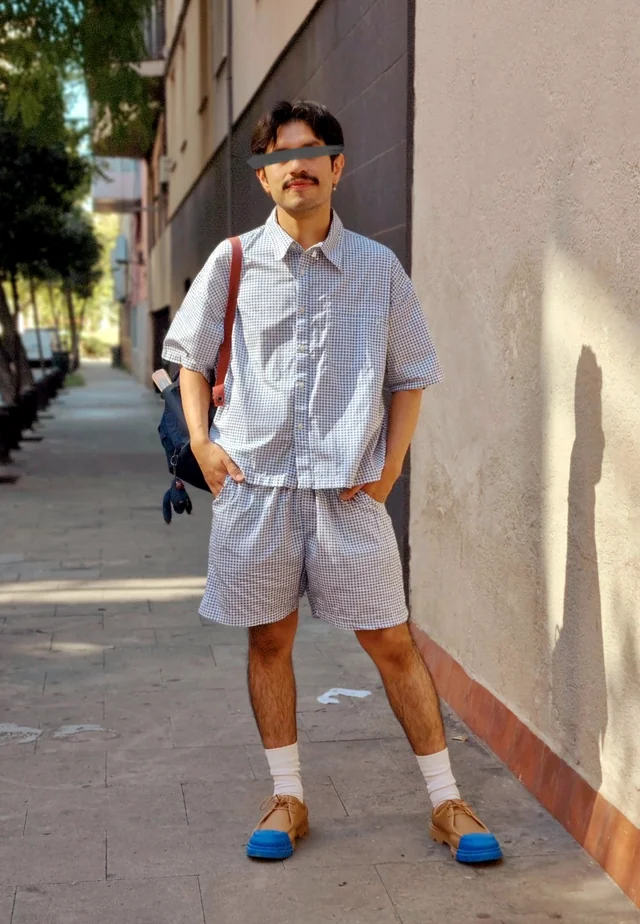
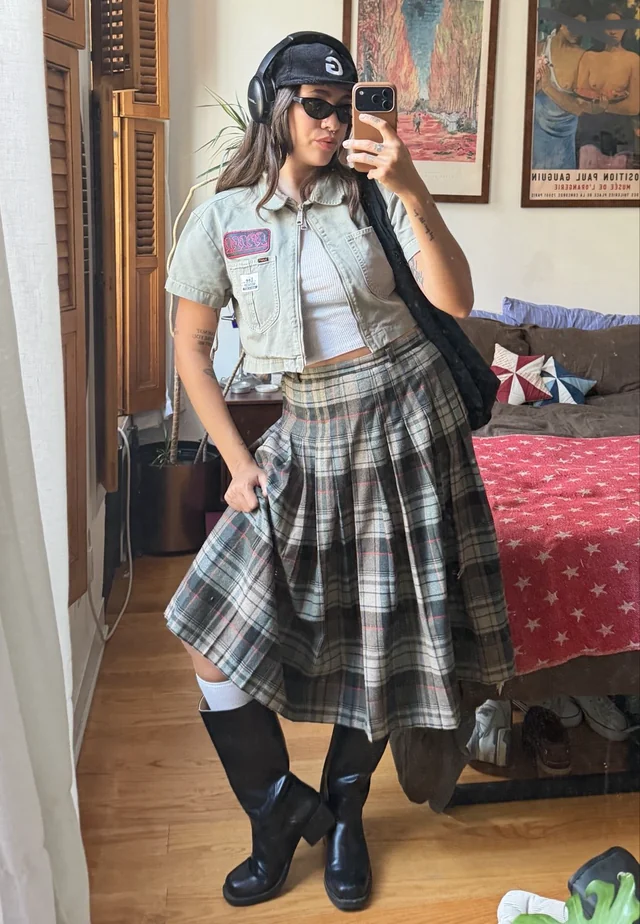
Global translation and local adaptation. Acubi's transnational circulation produces region-specific adaptations. American Gen Z participants integrate acubi's layering logic with streetwear elements (sneaker culture, graphic tees, oversized hoodies), producing a hybrid that retains proportion contrast but shifts the material palette toward heavier cotton and athletic-adjacent fabrics. European participants blend acubi with continental minimalism (cleaner lines, less layering, more emphasis on single-garment quality), producing a pared-back interpretation that privileges palette and proportion over stacking complexity. Southeast Asian participants adapt the aesthetic for tropical climates, replacing knitwear with lightweight cotton and mesh layers and substituting denim with linen or cotton trousers. In each adaptation, the core acubi grammar — contrast stacking, neutral palette, curated effortlessness — persists while the specific garment vocabulary shifts to accommodate local climate, retail availability, and adjacent style traditions.
History
The material and cultural history of acubi is compressed and recursive — brand origin, street adoption, platform amplification, and global diffusion occur within overlapping two-to-three-year cycles rather than the decades-long timelines characteristic of pre-internet aesthetic formations. This compression reflects the structural conditions of platform-era fashion: algorithmic distribution, K-pop amplification, and fast-fashion supply chains accelerate every stage of the aesthetic lifecycle.
Korean casual-fashion substrate (2010s). Acubi's stylistic vocabulary did not emerge from nothing in 2020; it crystallized tendencies already present in Korean youth fashion throughout the 2010s. Seoul's Hongdae (hong-dae, 홍대) neighborhood — the commercial zone surrounding Hongik University, historically associated with indie music, art, and youth culture — had developed a distinct casual-layering sensibility through the decade: muted neutrals, proportion play between oversized and fitted elements, and a studied nonchalance that distinguished Korean street fashion from both Tokyo's subcultural maximalism and Western minimalism's austerity. Dongdaemun (dong-dae-mun, 동대문) market — the massive wholesale and retail textile complex operating through the night, supplying both domestic retailers and global fast-fashion pipelines with rapid-turnaround production — provided the manufacturing infrastructure that made Korean trend cycles exceptionally fast: a silhouette visible on Seoul streets could be in production at Dongdaemun within days and available on Korean retail platforms within weeks.
Acubi Club launch and brand crystallization (2020-2021). Acubi Club launched in 2020 in Seoul, positioning itself in the space between fast fashion and independent design — what Korean retail discourse calls jung-jeo-ga (중저가, "mid-low price"), offering casual basics with deliberate styling sensibility at price points accessible to university students and early-career consumers. The brand's product range — cropped rib-knit cardigans, fitted interlock tees, relaxed cotton trousers, knit vests — was not individually novel; each garment type already existed across Korean retail. What the brand consolidated was the specific combination logic: how these elements should be layered, in what proportions, within what palette constraints, to produce a specific visual result. The brand's lookbook imagery and social-media content functioned as styling manuals, demonstrating the layering sequences and proportion relationships that would become the aesthetic's grammar.
Platform explosion and hashtag genericization (2022-2023). The #AcubiStyle hashtag gained traction on TikTok in early 2022 and surged through mid-2023, driven by the convergent forces of K-pop airport-look documentation, Korean styling-tutorial content crossing language barriers through visual demonstration, and the platform's recommendation algorithm clustering related content into self-reinforcing exposure loops. The critical inflection occurred when users began applying "acubi" to outfits assembled entirely from non-Acubi-Club sources — Zara, H&M, Uniqlo, thrift stores, other Korean brands — demonstrating that the term had detached from the brand and attached to the styling grammar. Pinterest boards, Instagram reels, and YouTube "how to dress acubi" tutorials consolidated the aesthetic's visual canon: cardigan-over-tee, vest-over-shirt, wide-leg or straight-leg denim, chunky sneakers or loafers, silver jewelry, rectangular sunglasses, neutral palette with occasional muted accent.
K-drama styling influence (2020s). Korean television dramas contributed to acubi's codification through costume design that translated the aesthetic's casual-layering logic into narrative-character styling. Contemporary youth-focused K-dramas (series targeting 18-30 demographics) consistently dress protagonists in acubi-adjacent casual wear — the university student in a cardigan-over-tee combination, the young professional in a knit vest over oxford shirt, the love interest in wide-leg denim and chunky sneakers. K-drama costume design operates through a "aspirational-relatable" logic: characters must appear stylish enough to generate viewer desire but casual enough to suggest everyday wearability. This logic aligns precisely with acubi's curated-effortlessness grammar, making K-drama a powerful normalization channel — viewers absorb the styling conventions through narrative identification rather than through explicit fashion instruction.
Fast-fashion absorption and microtrend compression (2023-present). Ultra-fast-fashion platforms (Shein, Temu) and fast-fashion retailers (Zara, H&M, Uniqlo) rapidly absorbed acubi's visual vocabulary into their production pipelines, offering "acubi-style" cardigans, tees, and wide-leg denim at price points 30-70% below Korean mid-tier brands. This absorption simultaneously democratized access (the styling grammar became achievable at minimal cost) and compressed the aesthetic's lifecycle: the trend-cycle speed of ultra-fast fashion threatens to exhaust acubi's visual novelty before the aesthetic's layering-system depth — the knit-construction knowledge, proportion engineering, and denim-wash literacy that distinguish skilled acubi from surface imitation — can be transmitted to the broader participant base.
Silhouette
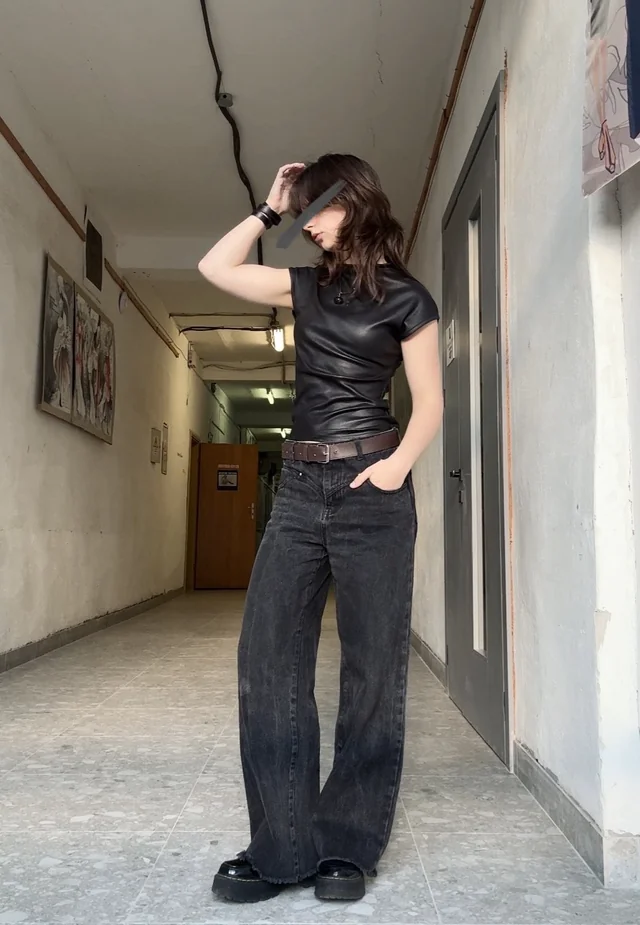
Acubi silhouette is governed by a contrast-stacking logic in which fitted and relaxed elements are deliberately paired to produce proportion tension — the visual energy that distinguishes intentional layering from mere clothing accumulation. Unlike monolithic silhouette systems that maintain consistent volume throughout (oversized streetwear, slim-fit tailoring), acubi generates visual interest through the junction points where different volumes meet: where a fitted tee meets a relaxed cardigan at the shoulder, where a cropped hemline meets a high-rise waistband at the midriff, where a slim torso profile meets a wide-leg trouser at the hip.
Upper-body layering proportions. The base layer (fitted tee or long-sleeve in interlock jersey) establishes a close-to-body torso profile that serves as the dimensional reference against which all subsequent layers produce contrast. The mid layer (rib-knit cardigan, knit vest, lightweight overshirt) introduces controlled volume expansion at the shoulder, chest, or collar — "controlled" because acubi's mid layers are sized to drape rather than engulf, falling 2-5 cm past the base layer's hemline at most. The critical proportion relationship is between the base layer's body-mapping fit and the mid layer's relaxed drape: too much size differential produces an oversized-streetwear reading; too little produces a conventional-layering reading without stylistic charge. The acubi sweet spot is a mid layer approximately one size larger than the base, providing visible drape without volume dominance.
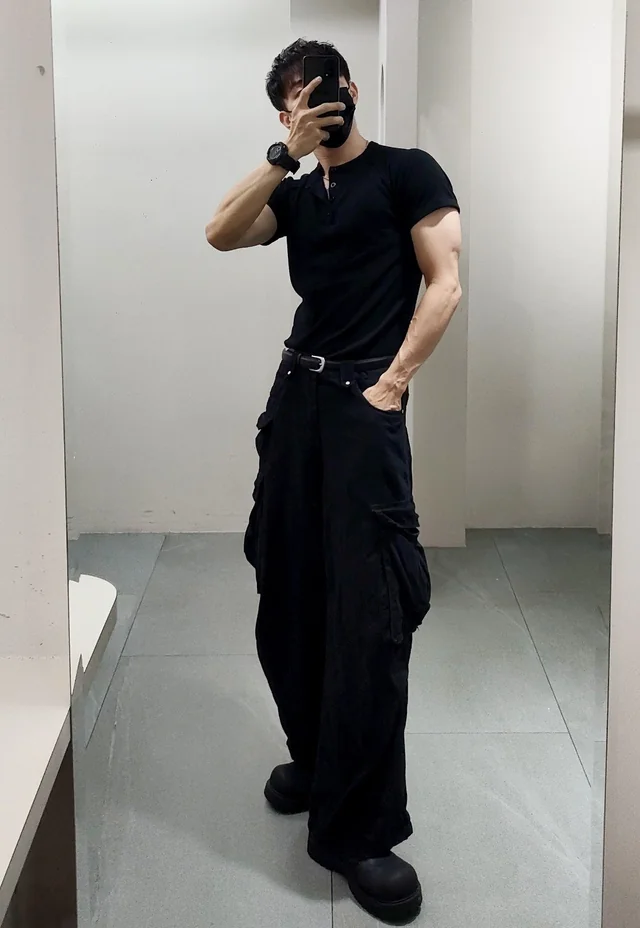
Trouser silhouettes. Wide-leg and straight-leg denim constitute the dominant lower-body silhouette, typically in mid-rise to high-rise construction with an inseam that produces either a clean break at the shoe (no fabric pooling) or controlled stacking (slight compression folds above the sneaker or loafer). The wide-leg trouser's function is both visual and proportional: it counterbalances the fitted upper body, creating a silhouette that narrows through the torso and expands below the hip — an inverted-triangle proportion that reads as relaxed and grounded. Straight-leg denim (leg opening 18-21 cm on a size 28) provides a more restrained version of the same proportional logic. Slim or skinny jeans are categorically excluded — their body-mapping fit at the lower body would produce a monolithically fitted silhouette that eliminates the contrast-stacking dynamic.
Cropping and hemline interplay. Cropped cardigans and vests (hemlines falling at or above the natural waist) expose the base layer's lower section — a deliberate visibility window that displays the tee's fabric quality and fit while creating a horizontal division across the torso. This cropped-over-long layering produces the hemline interplay that is acubi's most recognizable compositional feature: multiple horizontal lines at different heights (cardigan hem, tee hem, trouser waistband) creating a stratified torso profile that communicates layering depth and styling intentionality.
Materials
Material selection in acubi is organized around three textile systems — knitwear for layering, denim for trousers, and cotton wovens for supplementary pieces — each evaluated through the specific performance criteria that layering-system styling demands.
Rib-knit construction: gauge, weight, and recovery. Rib knit (alternating knit-and-purl wales producing a fabric with inherent crosswise stretch and recovery) is acubi's signature textile, appearing in cardigans, vests, tees, and long-sleeve base layers. The critical construction variables are gauge (the number of needles per inch on the knitting machine, with 12-gauge producing a fine, smooth fabric and 7-gauge producing a chunkier, more textured fabric), weight (180-280 g/m² for layering cardigans, 150-200 g/m² for tees and base layers), and recovery (the percentage of original dimension to which the fabric returns after stretching, with values above 90% indicating good shape retention and values below 80% indicating garments that will distort and bag with wear). Acubi's characteristic rib-knit cardigans occupy a 10-14 gauge range — fine enough to drape cleanly when worn open, textured enough to register as knitwear rather than as woven fabric. At this gauge, fiber composition determines performance: cotton-polyester blends (60/40 or 70/30) provide the recovery and pill resistance that pure cotton at the same gauge cannot achieve, while cotton-nylon blends (80/20 or 90/10) offer superior abrasion resistance at layering-friction zones — the underarm, the front closure edge, the hem where the cardigan contacts the trouser waistband.
Interlock jersey: stability and opacity. Interlock jersey — a double-knit construction producing a smooth, stable fabric that does not curl at the edges (unlike single jersey, which curls toward the face on cut edges) — provides the base-layer tees and fitted long-sleeves that anchor acubi's layering stack. Interlock's double-faced structure (smooth on both sides, with no visible loop structure) creates a fabric of superior opacity and dimensional stability compared to single jersey: it resists the stretching, sagging, and transparency-through-thinning that compromise cheaper tee-shirt fabrics within a few months of layered wear. Weight ranges from 160 g/m² (lightweight, summer-appropriate) to 220 g/m² (substantial, cooler-season), with the 180-200 g/m² range providing optimal layering performance — heavy enough to maintain a clean silhouette under a cardigan without visible wrinkling, light enough to avoid bulk accumulation at layer junctions.
Denim: wash engineering and silhouette. Acubi denim operates in a narrower wash and construction range than raw-denim culture or workwear: the characteristic washes are mid-blue (a uniform indigo tone suggesting moderate wear without dramatic fade contrast), light blue (a pale, sun-bleached tone associated with Y2K reference), and ecru or cream (undyed or lightly tinted denim used as a neutral-palette alternative to blue). Distressing is minimal or absent — no rips, no heavy whiskering, no aggressive sanding — because acubi's visual logic depends on clean, controlled surfaces rather than on visible garment aging. Construction is typically 11-13 oz cotton or cotton-elastane (98/2 or 99/1) in right-hand twill, with 2-4% elastane providing the comfort stretch that wide-leg and straight-leg silhouettes require to maintain clean drape without stiffness at the knee and hip. Korean denim production — both Dongdaemun-sourced domestic manufacturing and contract production in China and Vietnam — generally prioritizes silhouette precision and wash consistency over the raw-denim aging properties that amekaji values, reflecting the aesthetic's different relationship to material temporality: acubi garments are styled for immediate platform documentation rather than for longitudinal wear-pattern development.
Cotton wovens and mesh. Cotton poplin and cotton-polyester broadcloth provide the overshirt and oxford-shirt layers that supplement knitwear in cooler-season acubi styling. Mesh (typically polyester or nylon, 40-80 g/m², open-knit construction) appears as a transparency layer — a mesh long-sleeve under an opaque tee, or a mesh turtleneck beneath a solid cardigan — providing visual depth and textural contrast without significant thermal addition. The mesh layer performs a function analogous to cotton voile in mori kei: it creates a zone of partial visibility through which the adjacent layer is diffusely perceived, adding compositional complexity to the layering stack.
Color Palette
The palette is constrained by platform-legibility requirements rather than by material properties or historical reference. Acubi's characteristic neutrals — black, white, cream, grey, beige, charcoal, taupe — are selected because they maximize inter-garment compatibility (any neutral top combines with any neutral bottom without chromatic conflict), photograph consistently across lighting conditions (critical for platform documentation), and produce the "effortlessly coordinated" reading that acubi's curated-effortlessness grammar demands.
Muted accents — dusty pink, sage green, lavender, slate blue, terracotta — appear sparingly, typically limited to a single garment per outfit (a sage cardigan over a white tee and cream trousers, a dusty-pink vest over a grey long-sleeve and black denim). The accent's function is compositional punctuation: it breaks tonal monotony without disrupting the palette's overall restraint. Saturated colors — red, cobalt, orange, neon — are categorically excluded; their chromatic intensity would dominate the outfit's visual field, eliminating the neutral-ground against which acubi's proportion and layering relationships are meant to be read.
Denim washes function as palette elements: mid-blue denim provides a cool-toned counterpoint to warm-toned knitwear (beige, cream, taupe); ecru denim extends the neutral palette into the lower body; black denim anchors the outfit in a darker tonal register. The denim-knitwear color relationship — how the trouser wash complements or contrasts with the upper-body tonal composition — is a primary styling variable that acubi tutorials frequently address, demonstrating that the palette's apparent simplicity conceals deliberate chromatic calibration.
Details
Details in acubi function as proportion markers and layering interfaces rather than as decorative elements or historical-construction citations. Each detail modulates the visibility, fit, or interaction behavior of the layering stack.
Collar emergence and neckline engineering. The relationship between the base layer's neckline and the mid layer's collar determines the outfit's upper-body compositional structure. A crew-neck tee under an open cardigan exposes a horizontal neckline that frames the face and establishes the torso's topmost horizontal line. A mock-neck or turtleneck base layer under a V-neck vest creates a texture-and-shape contrast at the collar — the smooth, high neck emerging from the angular V opening — that reads as deliberate styling rather than accidental combination. Korean acubi styling frequently engineers this collar relationship as the outfit's primary detail, using the neckline junction as a focal point that substitutes for the jewelry, embellishment, or hardware that other aesthetics deploy.
Button and closure systems. Cardigan closures (buttons, snaps, or open-front) modulate the layering stack's openness and the base layer's visibility. Worn open, the cardigan's fronts create vertical frame lines along the tee beneath; worn partially buttoned (a single button at the chest or waist), the cardigan introduces controlled gathering that alters the drape at the closure point. Small, flat buttons (10-15mm, often in matte plastic, shell, or corozo nut) are preferred over large or decorative buttons — the button should not compete for visual attention with the proportion relationships and collar interactions that carry the outfit's compositional weight.
Thumb holes and extended cuffs. Thumb-hole detailing on long-sleeve base layers and some cardigans extends the sleeve past the wrist, creating a hand-covering cuff that elongates the arm profile and adds a gesture of vulnerability or softness to the silhouette. The detail is functionally minimal but compositionally significant: it extends the garment's visual line past its natural termination point, connecting the sleeve to the hand in a continuous surface that eliminates the skin-break between cuff and wrist.
Asymmetric cuts and raw edges. Asymmetric hemlines, unfinished edges, and deliberately uneven cuts appear on tees, cardigans, and vests, providing the "subversive" detail that distinguishes acubi from plain minimalism. These details introduce controlled imperfection — a visual disruption that signals intentional styling rather than conventional dressing. The asymmetry is typically subtle (2-5 cm of hemline variation, a slightly offset seam, a raw-cut neckline) rather than dramatic, maintaining the aesthetic's overall restraint while preventing it from reading as generic.
Accessories
Accessories in acubi operate as silhouette-completion elements and platform-legibility markers, maintaining the aesthetic's restraint while providing compositional finishing.
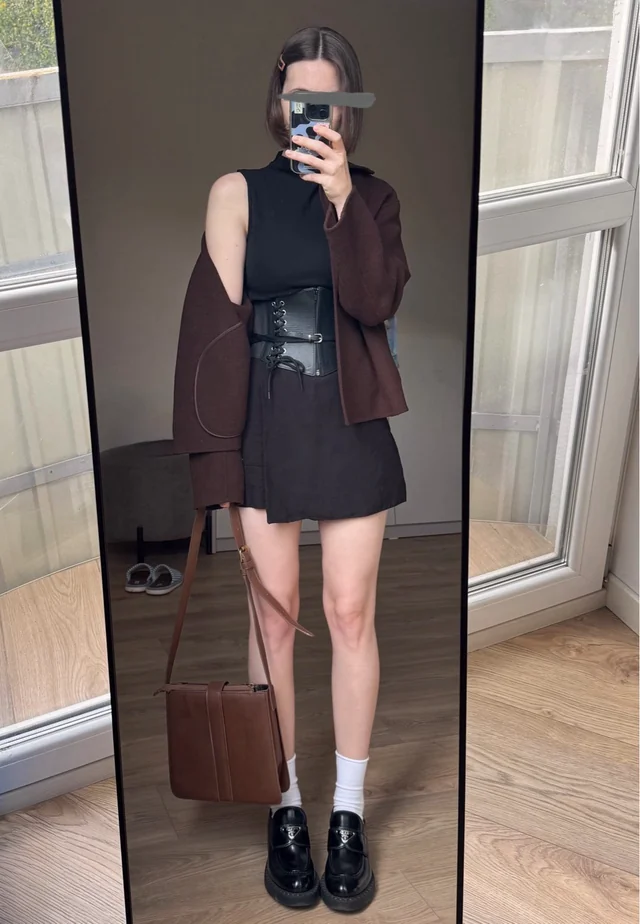
Footwear anchors the lower-body silhouette: chunky sneakers (New Balance 530 and 550, Nike Air Force 1, Adidas Samba, platform Converse) provide the substantial sole profile that balances wide-leg denim's volume; loafers and Mary Janes (low-heeled, round-toed, in black or brown leather) provide a more refined alternative that shifts the aesthetic toward clean-casual; platform boots add height while maintaining the outfit's grounded, comfortable register. The shoe's proportional weight is critical — a thin-soled shoe under wide-leg denim produces a top-heavy, unstable silhouette; a chunky-soled shoe provides visual ballast that grounds the wider trouser.
Jewelry is minimal, predominantly silver-toned: thin chains (1-2mm width), small hoop earrings (15-25mm diameter), stacked thin rings, and delicate pendant necklaces. The silver-over-gold preference aligns with the palette's cool-neutral orientation (silver complements grey, black, and white; gold introduces warmth that can conflict with the palette's cooler registers). Jewelry's function is textural punctuation — a metallic accent against soft knitwear and matte denim — rather than statement or status signaling.
Bags are compact and body-adjacent: mini crossbody bags, small shoulder bags, and tote bags in neutral leather or canvas. Rectangular sunglasses (narrow lenses, angular frames) and hair accessories (claw clips, minimal hair ties, thin headbands) complete the accessory vocabulary without disrupting the outfit's proportion relationships.
Body Logic
Acubi constructs the body as a layering platform whose proportions are modulated through garment combination rather than revealed through body-mapping fit. The aesthetic's contrast-stacking logic — fitted above, relaxed below; cropped outer, longer inner — produces a dressed body whose visual proportions are garment-determined rather than anatomy-determined, which is both acubi's democratic promise and its practical complication.
The fitted-base-plus-relaxed-outer formula accommodates diverse body types more readily than body-conscious aesthetics because the relaxed outer layers soften anatomical specificity while the fitted base layer provides just enough body-reference to prevent the outfit from reading as shapeless. Baggy trousers balance proportions across different hip and thigh measurements; layered tops add dimension that neither displays nor conceals the torso's shape. Platform shoes create height extension without requiring heeled construction. The system's adaptability explains its broad adoption: the same styling principles apply across different bodies, producing outfits that read as "acubi" through combination logic rather than through body conformity.
Gender coding in acubi is operationally neutral by default. Oversized cardigans, fitted tees, wide-leg denim, and chunky sneakers carry no inherent gender assignment — the same garment categories and styling principles apply regardless of the wearer's gender presentation. Korean fashion's increasing fluidity in gender presentation, visible in idol styling (male K-pop idols wearing cropped cardigans, female idols wearing oversized blazers), normalizes cross-gender adoption of the aesthetic's vocabulary. Acubi participants signal participation in this fluidity without explicit political declaration — the garments simply do not enforce a gendered reading.
However, acubi's body logic is not without normative pressure. The fitted-tee-plus-low-or-mid-rise-trouser combination foregrounds the waist and hip relationship in ways that can reinforce narrow body ideals even when marketed as "effortless" and "inclusive." The aesthetic's platform-mediated visual standard — curated through influencer content that disproportionately features slim, young bodies — generates an aspirational body norm that contradicts the styling system's theoretical inclusivity. The gap between acubi's democratic-sounding grammar (anyone can layer) and its platform-mediated visual canon (particular bodies dominate the reference imagery) is a structural tension that characterizes many platform-era aesthetics.
Garment Logic
Acubi construction favors modular compatibility over individual garment distinction. Each garment is designed — or selected — for recombinability: the same cardigan works over multiple tees, the same tee works under multiple outer layers, the same denim works with multiple upper-body combinations. This modular logic explains both the aesthetic's mass adoption (a small wardrobe produces many outfits) and its susceptibility to fast-fashion standardization (the module's simplicity makes it easy to replicate at low cost).
Knitwear construction. Acubi cardigans are typically full-fashioned (knit to shape on the machine, with pieces assembled by linking rather than by cutting from a larger knit panel) or cut-and-sew (panels cut from yardage of knit fabric and assembled like woven garments). Full-fashioned construction produces garments with clean edges and minimal waste but requires more machine setup; cut-and-sew construction is faster and cheaper but produces raw-cut edges that require binding or hemming and generates fabric waste from cutting. Mid-tier Korean brands (Musinsa-platform brands in the 25,000-60,000 KRW range, approximately $20-$45) typically use cut-and-sew construction with overlocked seam finishing; higher-tier brands (Ader Error, Andersson Bell, and comparable labels in the 80,000-150,000 KRW range) use full-fashioned or linked construction with self-finished edges. The construction method is visible in the garment's interior: linked seams lie flat with minimal bulk; overlocked seams produce a raised ridge of thread that can create irritation at skin-contact points and bulk at layer junctions.
Denim construction. Acubi-market denim is produced primarily in Korean domestic mills, Chinese contract mills (Guangdong and Jiangsu provinces), and occasionally in Japanese mills (for premium Korean labels referencing Japanese denim prestige). Silhouette precision is prioritized: pattern-grading for Korean body proportions (which tend toward shorter inseams and narrower hips than Western standard-sizing charts assume) produces trousers that hang correctly on the target market without extensive alteration. Waistband construction uses a standard curtain waistband with 2-4 cm of internal elastic or drawstring adjustment at the rear, providing the sizing flexibility that facilitates e-commerce purchase without in-store fitting — a construction feature driven by the platform-retail model through which most acubi denim is sold.
Aftercare and maintenance. Knitwear maintenance is acubi's primary care challenge. Rib-knit cardigans in cotton-blend compositions should be washed inside-out on a gentle cycle at 30 degrees C or hand washed to prevent pilling at friction zones and dimensional distortion from agitation. Tumble drying accelerates fiber breakage and shrinkage; flat drying preserves shape and knit structure. Pilling, the most visible degradation, occurs first at the underarm, the front closure overlap, and the waist area where the cardigan contacts the trouser waistband — all zones where inter-garment friction concentrates during layered wear. A fabric shaver or de-pilling comb extends the garment's visual life but cannot reverse the underlying fiber damage. Denim requires standard cold-wash care; the controlled, uniform washes of acubi denim do not involve the wear-pattern preservation protocols that raw denim demands.
Failure modes. Knitwear fails through pilling (surface fiber entanglement at friction zones, first visible within 15-30 wears on pure-cotton rib knits), dimensional distortion (stretching at the neckline, cuff, and hem where gravitational and tensile forces concentrate), and seam failure (particularly at the underarm junction where arm movement generates repeated stress). Interlock-jersey base layers fail through opacity loss (progressive thinning at friction points, making the tee increasingly transparent over layered use) and neckline distortion (stretched neck openings that no longer maintain the correct collar-emergence relationship with the outer layer). Denim fails through color loss at the seat, knee, and inner thigh (friction zones where the controlled wash progressively fades), pocket-corner tearing, and crotch-seam stress failure. The characteristic acubi failure pattern is systemic rather than single-garment: as individual modules degrade at different rates, the layering stack's proportion and color relationships shift, requiring selective replacement of the most degraded elements to maintain overall ensemble coherence — a rotating-module maintenance strategy rather than the wear-it-till-it-dies approach of raw denim or workwear cultures.
Motifs / Themes
Curated effortlessness as governing fiction: acubi's central aesthetic operation is the production of an appearance that reads as spontaneous, unconstructed, and casually achieved while depending on precise knowledge of proportion, layering, and color calibration. This fiction is not hypocritical — it is a styling convention understood by both producer and audience, comparable to the "natural makeup" look that requires more skill than dramatic cosmetics, or the "messy bun" hairstyle that demands more technique than a polished updo. The fiction's function is to signal social competence without visible effort — the wearer appears stylish because styling is effortless to them, not because they labored over outfit assembly. This is Korea-specific in its cultural resonance: nat-cheu-reol (내추럴, "natural") as a beauty and fashion concept carries particular weight in Korean aesthetics, where the appearance of unstudied grace has deep cultural value.
Modular democracy as accessibility narrative: acubi's relatively simple garment vocabulary (cardigan, tee, vest, denim, sneaker) and accessible price range (achievable through Uniqlo, H&M, thrift stores, and Korean mid-tier platforms) support a narrative of democratic fashion participation — anyone can dress acubi without significant capital investment or specialized sourcing. This narrative is partially true (the styling grammar is genuinely accessible) and partially misleading (executing it well requires styling literacy that is itself a form of cultural capital, unevenly distributed across platform exposure and prior fashion knowledge).
Korean global soft power as cultural context: acubi's international diffusion is inseparable from the broader Korean Wave (Hallyu) export of K-pop, K-drama, K-beauty, and Korean lifestyle aesthetics. The aesthetic benefits from a pre-existing global appetite for Korean cultural production, which creates receptive audiences for Korean fashion conventions that might not otherwise achieve transnational circulation. Acubi proves that fashion trends now emerge from Seoul as readily as from Paris, Milan, or New York — but this emergence is structurally supported by the entertainment and platform infrastructure that makes Korean culture globally visible.
Cultural Touchstones
K-pop and idol styling. NewJeans' casual-wear documentation (airport looks, variety-show outfits, Instagram posts) constitutes the most cited acubi reference, with member Hanni and Danielle's layered-cardigan-and-wide-leg-denim outfits circulating as canonical styling templates. LE SSERAFIM's Kazuha and Sakura have been photographed in acubi-coded ensembles blending Korean casual layering with Japanese minimalist sensibility. Male K-pop groups (SEVENTEEN, ENHYPEN, TXT) demonstrate acubi's gender-neutral application through similar layering conventions in their off-stage documentation.
K-drama wardrobe. Contemporary youth K-dramas (Twenty-Five Twenty-One, Our Beloved Summer, Extraordinary Attorney Woo, Lovely Runner) dress protagonists in acubi-adjacent casual wear that normalizes the aesthetic through narrative identification. Costume designers for these productions — working with Korean brands and fast-fashion sources — codify acubi's styling grammar into character wardrobes that millions of viewers absorb without explicit fashion awareness.
Platform infrastructure. Musinsa (무신사, founded 2001, Korea's largest online fashion platform with 10+ million monthly active users) functions as acubi's primary commercial ecosystem — the platform where acubi-coded brands are discovered, purchased, and reviewed. W Concept and 29CM provide curated alternatives with higher editorial positioning. These platforms' recommendation algorithms, editorial features, and user-generated content create feedback loops that reinforce acubi's visual conventions while continuously testing variations.
Social media. TikTok #AcubiStyle and related hashtags, Instagram @acubi_club and styling accounts, Pinterest "acubi" and "Korean casual" boards, and YouTube "how to dress acubi" tutorial channels constitute the distributed media infrastructure through which the aesthetic is learned, practiced, and evaluated.
See Also
- Y2K fashion: Shares early-2000s silhouette references (low-rise, baby tee, wide-leg) but diverges in palette intensity and maximalist orientation versus acubi's neutral restraint
- Korean minimalism: Broader aesthetic tradition from which acubi draws; lacks acubi's specific layering-system mechanics and contrast-stacking grammar
- Normcore: Shares unremarkable-basics vocabulary but cultivates genuine indifference where acubi cultivates performed indifference through visible styling competence
- Quiet luxury: Shares neutral palette and restraint but operates through single-garment quality signaling (material, brand, construction) rather than through multi-piece layering logic
- Cottagecore: Contrasting platform-era aesthetic formation; cottagecore's pastoral-handcraft orientation versus acubi's urban-casual-layering orientation demonstrates how platform aesthetics can crystallize around entirely different material logics
- Coquette: Adjacent Gen Z aesthetic sharing some Y2K reference but diverging in decorative maximalism (bows, lace, pink) versus acubi's textural minimalism
- Mori kei: Shares layering-as-compositional-strategy but differs fundamentally in fiber (natural cellulosics versus synthetic-blend knits), palette (earth tones versus cool neutrals), and silhouette (volume-forward drape versus contrast-stacking)
- Amekaji: Contrasting Japanese casual aesthetic; amekaji's reproduction-fidelity logic and aging-as-authentication versus acubi's modular-recombination and platform-immediacy represent opposite temporal orientations in casual-dress systems
Brands and Designers
Korean Origin and Mid-Tier:
- Acubi Club (아쿠비클럽, 2020, Seoul): eponymous brand whose product range and styling content crystallized the aesthetic; cropped cardigans, rib-knit basics, relaxed trousers in neutral palettes
- Mardi Mercredi (마르디 메크르디, 2018, Seoul): casual knitwear and graphic basics; the embroidered-logo sweatshirt became a K-fashion export staple
- Kirsh (키르시, Seoul): playful-minimalist basics with cherry motif; positioned between streetwear and acubi casual
- Rolarola (로라로라, Seoul): oversized silhouettes and muted tones; accessible Korean youth fashion
- Romantic Crown (로맨틱 크라운, Seoul): neutral-focused Korean streetwear adaptable to acubi styling
Korean Designer / Elevated:
- Ader Error (아더에러, 2014, Seoul): deconstructed basics and conceptual Korean streetwear; higher-tier construction with experimental proportion
- Andersson Bell (앤더슨벨, 2014, Seoul): Scandinavian-Korean fusion with elevated basics; clean-line layering at premium positioning
- Low Classic (로우 클래식, 2012, Seoul): Korean minimalism with architectural proportion; tailored interpretation of neutral-palette casual
- EENK (잉크, Seoul): contemporary Korean womenswear with structured-casual silhouettes; designer-tier acubi-adjacent layering
- Stylenanda (스타일난다, 2004, Seoul): pioneering Korean online fashion brand; K-beauty and casual fashion integration
Korean Retail Platforms (distribution infrastructure):
- Musinsa (무신사, 2001, Seoul): Korea's dominant fashion e-commerce platform; primary commercial ecosystem for acubi-coded brands; editorial features and user content shape trend formation
- W Concept (더블유컨셉, Seoul): curated Korean fashion platform with higher editorial positioning; designer-tier Korean casual
- 29CM (이구공구씨엠, Seoul): lifestyle-curated platform blending fashion, home, and culture; editorial-driven Korean aesthetics
International Accessible:
- Uniqlo (1984, Hiroshima/global): LifeWear basics providing acubi's most accessible layering foundation; interlock tees, rib-knit cardigans, and wide-leg denim at entry-level pricing
- COS (2007, London, H&M Group): architectural minimalism and clean-line knitwear adaptable to acubi's neutral-palette layering
- Aritzia (1984, Vancouver): quality minimalist pieces; TNA and Wilfred lines provide acubi-compatible knitwear and trousers
- & Other Stories (2013, Stockholm, H&M Group): elevated basics in natural and blended fibers; accessible European interpretation of casual layering
- Zara (1975, Arteixo, Spain): fast-fashion trend response providing rapid acubi-adjacency at mass-market pricing; quality variable but silhouette accuracy high
Fast Fashion / Entry-Level:
- H&M (1947, Vasteras, Sweden): accessible basics for entry-level acubi assembly; knitwear and denim at lowest price points
- Shein (2008, Guangzhou/Singapore): ultra-fast-fashion replication of acubi silhouettes and styling; lowest cost, lowest material quality, fastest trend absorption
- YesStyle (2006, Hong Kong): Korean fashion aggregator providing global access to Korean mid-tier brands; primary international gateway for Korean acubi-market product
Citations
[1] Kim, Soo. "Acubi Style: The Korean Fashion Trend Taking Over TikTok." South China Morning Post, 2023. [2] Lee, Min-ji. "From Seoul to the World: How Acubi Became a Global Fashion Phenomenon." Korea Herald, 2023. [3] Acubi Club. Official site. https://acubi.club/ [4] Cheema, S. "Acubi Fashion: Everything You Need to Know." YesStyle, October 23, 2024. https://www.yesstyle.com/blog/2024-10-23/acubi-fashion-everything-you-need-to-know/ [5] Marx, W. David. Ametora: How Japan Saved American Style. Basic Books, 2015. [6] Kawamura, Yuniya. Fashion-ology: An Introduction to Fashion Studies. 2nd ed., Bloomsbury Academic, 2018. [7] Kawamura, Yuniya. Fashioning Japanese Subcultures. Berg, 2012. [8] Entwistle, Joanne. The Fashioned Body: Fashion, Dress and Modern Social Theory. 2nd ed., Polity, 2015. [9] Breward, Christopher. Fashion. Oxford University Press, 2003. [10] Wilson, Elizabeth. Adorned in Dreams: Fashion and Modernity. Revised ed., Rutgers University Press, 2003. [11] Crane, Diana. Fashion and Its Social Agendas: Class, Gender, and Identity in Clothing. University of Chicago Press, 2000. [12] Lipovetsky, Gilles. The Empire of Fashion: Dressing Modern Democracy. Princeton University Press, 1994. [13] Bourdieu, Pierre. Distinction: A Social Critique of the Judgement of Taste. Translated by Richard Nice, Harvard University Press, 1984. [14] Barthes, Roland. The Fashion System. Translated by Matthew Ward and Richard Howard, University of California Press, 1983. [15] Simmel, Georg. "Fashion" (1904). In Simmel on Culture: Selected Writings, edited by David Frisby and Mike Featherstone, SAGE, 1997. [16] Hebdige, Dick. Subculture: The Meaning of Style. Routledge, 1979. [17] Hollander, Anne. Seeing Through Clothes. University of California Press, 1993. [18] Jenkins, Henry. Convergence Culture: Where Old and New Media Collide. New York University Press, 2006. [19] Kadolph, Sara J., and Sara B. Marcketti. Textiles. 12th ed., Pearson, 2016. [20] Hatch, Kathryn L. Textile Science. West Publishing, 1993. [21] Spencer, David J. Knitting Technology: A Comprehensive Handbook and Practical Guide. 3rd ed., Woodhead Publishing, 2001. [22] Tortora, Phyllis G., and Sara B. Marcketti. Survey of Historic Costume. 6th ed., Fairchild Books, 2015. [23] Fletcher, Kate. Sustainable Fashion and Textiles: Design Journeys. 2nd ed., Earthscan, 2013. [24] Rivoli, Pietra. The Travels of a T-Shirt in the Global Economy. 2nd ed., Wiley, 2014. [25] Niinimaki, Kirsi, editor. Sustainable Fashion in a Circular Economy. Aalto ARTS Books, 2018. [26] Gwilt, Alison. A Practical Guide to Sustainable Fashion. Bloomsbury Academic, 2014. [27] Jung, Sojin, and Daeho Jin. "Hallyu 4.0: Korean Wave and the Platform Economy." Korean Journal of Journalism and Communication Studies, vol. 66, no. 2, 2022. [28] Kim, Youna. The Korean Wave: Korean Media Go Global. Routledge, 2013. [29] Ha, Jisoo, and Soo-Hee Park. "Fashion Industry in Korea: Current State and Future Directions." Journal of the Korean Society of Clothing and Textiles, vol. 44, no. 6, 2020. [30] Musinsa. "About Musinsa." https://www.musinsa.com/ [31] Braddock Clarke, Sarah E., and Marie O'Mahony. Techno Textiles 2: Revolutionary Fabrics for Fashion and Design. Thames and Hudson, 2005. [32] Veblen, Thorstein. The Theory of the Leisure Class. Macmillan, 1899. [33] Fussell, Paul. Class: A Guide Through the American Status System. Summit Books, 1983. [34] Korea Fashion Industry Association. "Korean Fashion Market Report." KFIA, 2023. [35] Doneger Group / WGSN. "K-Fashion and Platform Retail Dynamics." Trend forecasting report, 2023.